World Map
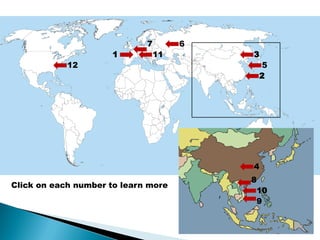
7       6
                      1       11         3
            12                            5
                                          2


                                         4
                                         8
Click on each number to learn more
                                          10
                                          9
   While both Japan and China were allied with the
    Entente powers during the course of the First
    World War, the Western victory contrasted in its
    effects in each of the Asian countries. As the
    Japanese used the war as an excuse to gain
    control of German concessionary areas in China,
    control of these parts by the Japanese
    government was solidified in the Treaty of
    Versailles. This angered many of the Chinese
    nationalist politicians and sparked a series of
    protests against the betrayal by Entente powers
    {political}.


                                         Back
   After Sun Yat-sen’s death, the position at the head of
    the Nationalist Party was passed over to Chiang Kai-
    shek, a former attendee of the Whampoa Military
    Academy. Allied with dominating warlords
    throughout the region, Chiang formed an army that
    helped the Nationalists gain control of territory
    throughout China, such as the Yangtze River valley
    and Shanghai. This occupation of Shanghai also
    corresponded with the ruthless tactics imposed on
    the working class, murdering thousands of
    communist supporters on the streets and setting the
    stage for the civil war that was to take place between
    the two political parties {political/social}.


                                             Back
   Japan’s struggle to compete with the world’s
    superpowers led to the decision to invade
    neighboring Manchuria. As the invading power began
    pushing towards the Chinese mainland, putting
    pressure on the Nationalist Party of China, the
    Nationalist preoccupation with suppressing the
    communist party had to be put on hold in order to
    focus on the more immediate threat. After a forced
    signing of a treaty between the two parties, the
    Communists opened the door to a new opportunity in
    gaining an advantage over the Nationalists. This led
    to the ultimate Communist victory in 1949 followed
    by the establishment of the People’s Republic of
    China {political}.

                                            Back
   After the early establishment of a communist
    headquarters in Hunan, Chiang launched a series
    of attacks towards the area in order to rid the
    opposing party of their rising influence in China.
    In order to escape the dangerous raids, Mao and
    his 90,000 followers made the Long March to the
    Chinese city of Shaanxi, losing over half of the
    initial travelers during the journey across
    thousands of miles of difficult terrain. The party
    was able to reestablish its capital which later
    gave the communists advantage during the
    Japanese invasion in terms of location, putting
    their guerrilla forces in the direct path of
    oncoming attacks {political}.

                                          Back
   As the Communist Party slowly began gaining
    control of the country, the government
    leaders prioritized the need to reestablish
    China’s influence in East Asia. This led to
    Chinese intervention in the Korean conflict,
    competing against the United States’ support
    in the south and resulting in permanent
    partition of the neighboring Korean nation
    {political}.


                                     Back
   By the 1950s, the alliance between China and
    Soviet Russia began to dwindle as a rise in
    border disputes and China’s refusal to remain
    inferior to the northern superpower created
    heavy tensions between the former
    collaborators. Stalin’s death in 1953 and the
    rise of Khrushchev to power worked to
    further extend the failure of the relationship.
    Mao Zedong was left to believe that he
    himself was now “the chief theoretician and
    leader of the communist world” {cultural}.


                                        Back
   After initial French support of the rising Nguyen
    dynasty, the reign of leaders such as Minh Mang
    led to French distrust of the developing super-
    Confucian society which contradicted the
    European desire to push Catholicism into the
    country. Using military defeats at home and
    increased quarrels between Nguyen rulers as
    motive, France launched an objective to gain
    control of Vietnam and neighboring Laos and
    Cambodia. The colonizers used their newly-
    conquered areas as sources of financial revenue
    which in turn worsened the already-difficult
    economic status of the Vietnamese people
    {political/economic}.

                                          Back
   With the establishment of the Viet Minh forces
    during World War II, the nationalist resistance
    managed to gain influence in the war for
    independence. Led by General Vo Nguyen Giap,
    the Viet Minh used guerrilla tactics to offset the
    French colonizers and gain support throughout
    the rural north. After gaining control of the
    northern city of Hanoi in 1945, the communist
    leader Ho Chi Minh declared the independent
    nation of Vietnam but still lacked the control of
    southern regions desired by dominating
    nationalist forces {political}.


                                            Back
   To match the Viet Minh’s successes in the
    north, as well as looking for ways to regain
    strength as a result of Nazi domination, the
    French reinforced their title as an imperialist
    power by reoccupying Saigon with British
    support. This was followed by France’s desire
    to reassert control over the entire nation by
    launching a war against the resisting forces in
    the north, breaking a previous truce with the
    Viet Minh {political}.

                                        Back
   The critical battle at Dien Bien Phu arose as the
    main conflict which allowed full decolonization
    and withdrawal of French forces from Vietnam to
    take place. The battle pitted the French against
    the highly effective guerrilla tactics used by the
    Viet Minh. After surrounding the enemy at their
    base in Dien Bien Phu, the Vietnamese forces
    used complex tunnel systems to transport
    weapons and supplies, pushing the enemy
    towards the center which eventually forced the
    French to surrender {political/human-
    environmental}.


                                           Back
   After suffering heavy losses at Dien Bien Phu, the
    French were forced to comply with the decisions
    made during the Geneva Conference held in
    Switzerland. The treaty declared Vietnam
    independent from foreign powers and started the
    withdrawal of French forces from the nation. In
    settling political disputes, the agreement promised
    national elections to take place in two years time
    under which the communist-dominated north and the
    politically-fragmented south would reunite under one
    ruler. After the elections failed to take place, Ho Chi
    Minh’s army named the Viet Cong launched an attack
    on its southern counterparts in an attempt to unite
    the nation under a single communist regime
    {political}.

                                              Back
   As the Cold War sparked U.S. competition against
    the Russian superpower and promoted anti-
    communist propaganda to rise among the
    American population, the U.S. government sent
    in its first troops to South Vietnam in the 1950s
    to protect the nation from further communist
    influence. Throughout decades of bombings and
    herbicide usage which destroyed the local
    environment, the U.S. style of fighting failed to
    gain victory over the guerrilla-based Viet Cong,
    leading to withdrawal of American forces after a
    series of treaty organizations established
    communist rule throughout {political/human-
    environmental}.

                                         Back

Chapter 35 – war and revolution

  • 1.
  • 2.
    7 6 1 11 3 12 5 2 4 8 Click on each number to learn more 10 9
  • 3.
    While both Japan and China were allied with the Entente powers during the course of the First World War, the Western victory contrasted in its effects in each of the Asian countries. As the Japanese used the war as an excuse to gain control of German concessionary areas in China, control of these parts by the Japanese government was solidified in the Treaty of Versailles. This angered many of the Chinese nationalist politicians and sparked a series of protests against the betrayal by Entente powers {political}. Back
  • 4.
    After Sun Yat-sen’s death, the position at the head of the Nationalist Party was passed over to Chiang Kai- shek, a former attendee of the Whampoa Military Academy. Allied with dominating warlords throughout the region, Chiang formed an army that helped the Nationalists gain control of territory throughout China, such as the Yangtze River valley and Shanghai. This occupation of Shanghai also corresponded with the ruthless tactics imposed on the working class, murdering thousands of communist supporters on the streets and setting the stage for the civil war that was to take place between the two political parties {political/social}. Back
  • 5.
    Japan’s struggle to compete with the world’s superpowers led to the decision to invade neighboring Manchuria. As the invading power began pushing towards the Chinese mainland, putting pressure on the Nationalist Party of China, the Nationalist preoccupation with suppressing the communist party had to be put on hold in order to focus on the more immediate threat. After a forced signing of a treaty between the two parties, the Communists opened the door to a new opportunity in gaining an advantage over the Nationalists. This led to the ultimate Communist victory in 1949 followed by the establishment of the People’s Republic of China {political}. Back
  • 6.
    After the early establishment of a communist headquarters in Hunan, Chiang launched a series of attacks towards the area in order to rid the opposing party of their rising influence in China. In order to escape the dangerous raids, Mao and his 90,000 followers made the Long March to the Chinese city of Shaanxi, losing over half of the initial travelers during the journey across thousands of miles of difficult terrain. The party was able to reestablish its capital which later gave the communists advantage during the Japanese invasion in terms of location, putting their guerrilla forces in the direct path of oncoming attacks {political}. Back
  • 7.
    As the Communist Party slowly began gaining control of the country, the government leaders prioritized the need to reestablish China’s influence in East Asia. This led to Chinese intervention in the Korean conflict, competing against the United States’ support in the south and resulting in permanent partition of the neighboring Korean nation {political}. Back
  • 8.
    By the 1950s, the alliance between China and Soviet Russia began to dwindle as a rise in border disputes and China’s refusal to remain inferior to the northern superpower created heavy tensions between the former collaborators. Stalin’s death in 1953 and the rise of Khrushchev to power worked to further extend the failure of the relationship. Mao Zedong was left to believe that he himself was now “the chief theoretician and leader of the communist world” {cultural}. Back
  • 9.
    After initial French support of the rising Nguyen dynasty, the reign of leaders such as Minh Mang led to French distrust of the developing super- Confucian society which contradicted the European desire to push Catholicism into the country. Using military defeats at home and increased quarrels between Nguyen rulers as motive, France launched an objective to gain control of Vietnam and neighboring Laos and Cambodia. The colonizers used their newly- conquered areas as sources of financial revenue which in turn worsened the already-difficult economic status of the Vietnamese people {political/economic}. Back
  • 10.
    With the establishment of the Viet Minh forces during World War II, the nationalist resistance managed to gain influence in the war for independence. Led by General Vo Nguyen Giap, the Viet Minh used guerrilla tactics to offset the French colonizers and gain support throughout the rural north. After gaining control of the northern city of Hanoi in 1945, the communist leader Ho Chi Minh declared the independent nation of Vietnam but still lacked the control of southern regions desired by dominating nationalist forces {political}. Back
  • 11.
    To match the Viet Minh’s successes in the north, as well as looking for ways to regain strength as a result of Nazi domination, the French reinforced their title as an imperialist power by reoccupying Saigon with British support. This was followed by France’s desire to reassert control over the entire nation by launching a war against the resisting forces in the north, breaking a previous truce with the Viet Minh {political}. Back
  • 12.
    The critical battle at Dien Bien Phu arose as the main conflict which allowed full decolonization and withdrawal of French forces from Vietnam to take place. The battle pitted the French against the highly effective guerrilla tactics used by the Viet Minh. After surrounding the enemy at their base in Dien Bien Phu, the Vietnamese forces used complex tunnel systems to transport weapons and supplies, pushing the enemy towards the center which eventually forced the French to surrender {political/human- environmental}. Back
  • 13.
    After suffering heavy losses at Dien Bien Phu, the French were forced to comply with the decisions made during the Geneva Conference held in Switzerland. The treaty declared Vietnam independent from foreign powers and started the withdrawal of French forces from the nation. In settling political disputes, the agreement promised national elections to take place in two years time under which the communist-dominated north and the politically-fragmented south would reunite under one ruler. After the elections failed to take place, Ho Chi Minh’s army named the Viet Cong launched an attack on its southern counterparts in an attempt to unite the nation under a single communist regime {political}. Back
  • 14.
    As the Cold War sparked U.S. competition against the Russian superpower and promoted anti- communist propaganda to rise among the American population, the U.S. government sent in its first troops to South Vietnam in the 1950s to protect the nation from further communist influence. Throughout decades of bombings and herbicide usage which destroyed the local environment, the U.S. style of fighting failed to gain victory over the guerrilla-based Viet Cong, leading to withdrawal of American forces after a series of treaty organizations established communist rule throughout {political/human- environmental}. Back