SCARCITY, OPPORTUNITY COST, PPC,
DEMAND AND SUPPLY
“The great virtue of a free market is that it enables people who
hate each other, or who are from vastly different religious or ethnic
backgrounds, to cooperate economically. Government
intervention can’t do that. Politics exacerbates and magnifies
differences.”
Milton Friedman, New Perspectives Quarterly, 2006: 18.
SCARCITY AND CHOICE
• Scarcity and choice are the two essential
ingredients of an economic topic.
• Goods are scarce because desire for them far
outstrips their availability from nature.
• Scarcity forces us to choose among available
alternatives.
SCARCITY AND CHOICE
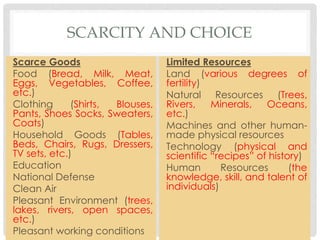
Scarce Goods
Food (Bread, Milk, Meat,
Eggs, Vegetables, Coffee,
etc.)
Clothing (Shirts, Blouses,
Pants, Shoes Socks, Sweaters,
Coats)
Household Goods (Tables,
Beds, Chairs, Rugs, Dressers,
TV sets, etc.)
Education
National Defense
Clean Air
Pleasant Environment (trees,
lakes, rivers, open spaces,
etc.)
Pleasant working conditions
Limited Resources
Land (various degrees of
fertility)
Natural Resources (Trees,
Rivers, Minerals, Oceans,
etc.)
Machines and other human-
made physical resources
Technology (physical and
scientific “recipes” of history)
Human Resources (the
knowledge, skill, and talent of
individuals)
UN D E R S T A N D I N G P E R S O N A L F I N A N C E
CHOICES
NECESSITIES
• Bare essentials required universally
for subsistence or survival, or for
maintaining a certain minimum
standard-of-living.
LUXURIES
• Products and services that are
non-essential, and are therefore in
greater demand when incomes
are high. In some countries, a tax
is imposed on purchases of luxury
goods (luxury tax).
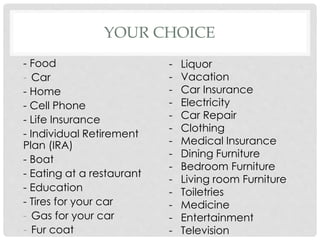
YOUR CHOICE
- Food
- Car
- Home
- Cell Phone
- Life Insurance
- Individual Retirement
Plan (IRA)
- Boat
- Eating at a restaurant
- Education
- Tires for your car
- Gas for your car
- Fur coat
- Liquor
- Vacation
- Car Insurance
- Electricity
- Car Repair
- Clothing
- Medical Insurance
- Dining Furniture
- Bedroom Furniture
- Living room Furniture
- Toiletries
- Medicine
- Entertainment
- Television
THE NATURE OF MONEY
• Three types of money
• Commodity is the exchange of items in need, bartering,
trading, e.g., precious stones, salt, livestock, etc.
• Representative money is based on some item of value, for
example, gold or silver.
• Fiat money is money that is deemed legal tender by the
government, and it is not based on or convertible into a
precious metal.
• The fractional-reserve system
Slide 10
HOW MONEY IS CREATED
• Printing currency and creating money are two
different things.
• Money is actually created by the interaction of the
demand for it, banks’ use of it, and the Federal
Reserve’s supply and control of it.
Slide 11
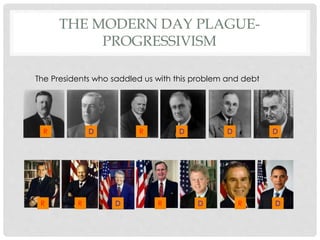
THE MODERN DAY PLAGUE-
PROGRESSIVISM
The Presidents who saddled us with this problem and debt
RRRR D D D
RR DDDD
Financial Policy
 Socialism and pork-barrel spending change the face of America.
 $787,000,000,000 + $350,000,000,000 left over from Bush administration
spending bill passed that increased debt when coupled with the Bush bail-
out to $1,487,000,000,000. More money spent than the first 200 years of
America including wars. These bills were left open-ended to be re-funded
when necessary.
- $787 billion bill had 15 hours of review. Lobbyists got it before Congress.
- OMB figures said with the interest and principal together the American
public will repay $3,750,000,000,000 over next 30 years.
- Forced banks to take the money and refuses to allow them to pay the
money back. Federal government wants to control the banks. Changed
their preferred stock status to common stock so the fed. gov’t would have
control over the banks. The banks used the money to buy other banks.
- As of 13 Apr 09, the national debt is $10.626 trillion dollars, $175,000 for
every taxpayer. 0n 14 Aug 09 it was $11.6 trillion.
- As of 13 Jul 09 for the first time in history, the deficit is $1 trillion dollars and
23% of our GDP is foreign debt. Russian President Medvedev proposes a
new world supranational currency to replace the dollar.
THE FACE OF AMERICA CHANGES
“Russian President Dmitry Medvedev illustrated his call for a
supranational currency to replace the dollar by pulling from his
pocket a sample coin of a ‘united future world currency,”
reports Bloomberg news service. Agence France Presse
reports: “Even if Russia’s call for a global currency failed to
gain much traction at a G8 summit, President Dmitry
Medvedev took home a coin meant to symbolize that the
dream may one day come true.” 10 Jul 09
CURRENT EVENT NECESSITIES
• Required every chapter before the test date
• Cut and paste the article from the source with the
following:
• Publication name and date
• Title and author of article
• The article (minimum 18 size font)
• Discussion question developed from the article
• Saved to a thumb drive/flash drive for presentation on my
computer
• One student of the group presents the article and will be done
on a rotating basis
• These are the publications I would like to see used
because they do not require a subscription:
• Investor’s Business Daily- http://news.investors.com/
• Bloomberg Businessweek- http://www.businessweek.com/

Presentation1 financial choices

  • 1.
    SCARCITY, OPPORTUNITY COST,PPC, DEMAND AND SUPPLY “The great virtue of a free market is that it enables people who hate each other, or who are from vastly different religious or ethnic backgrounds, to cooperate economically. Government intervention can’t do that. Politics exacerbates and magnifies differences.” Milton Friedman, New Perspectives Quarterly, 2006: 18.
  • 4.
    SCARCITY AND CHOICE •Scarcity and choice are the two essential ingredients of an economic topic. • Goods are scarce because desire for them far outstrips their availability from nature. • Scarcity forces us to choose among available alternatives.
  • 5.
    SCARCITY AND CHOICE ScarceGoods Food (Bread, Milk, Meat, Eggs, Vegetables, Coffee, etc.) Clothing (Shirts, Blouses, Pants, Shoes Socks, Sweaters, Coats) Household Goods (Tables, Beds, Chairs, Rugs, Dressers, TV sets, etc.) Education National Defense Clean Air Pleasant Environment (trees, lakes, rivers, open spaces, etc.) Pleasant working conditions Limited Resources Land (various degrees of fertility) Natural Resources (Trees, Rivers, Minerals, Oceans, etc.) Machines and other human- made physical resources Technology (physical and scientific “recipes” of history) Human Resources (the knowledge, skill, and talent of individuals)
  • 6.
    UN D ER S T A N D I N G P E R S O N A L F I N A N C E CHOICES
  • 7.
    NECESSITIES • Bare essentialsrequired universally for subsistence or survival, or for maintaining a certain minimum standard-of-living.
  • 8.
    LUXURIES • Products andservices that are non-essential, and are therefore in greater demand when incomes are high. In some countries, a tax is imposed on purchases of luxury goods (luxury tax).
  • 9.
    YOUR CHOICE - Food -Car - Home - Cell Phone - Life Insurance - Individual Retirement Plan (IRA) - Boat - Eating at a restaurant - Education - Tires for your car - Gas for your car - Fur coat - Liquor - Vacation - Car Insurance - Electricity - Car Repair - Clothing - Medical Insurance - Dining Furniture - Bedroom Furniture - Living room Furniture - Toiletries - Medicine - Entertainment - Television
  • 10.
    THE NATURE OFMONEY • Three types of money • Commodity is the exchange of items in need, bartering, trading, e.g., precious stones, salt, livestock, etc. • Representative money is based on some item of value, for example, gold or silver. • Fiat money is money that is deemed legal tender by the government, and it is not based on or convertible into a precious metal. • The fractional-reserve system Slide 10
  • 11.
    HOW MONEY ISCREATED • Printing currency and creating money are two different things. • Money is actually created by the interaction of the demand for it, banks’ use of it, and the Federal Reserve’s supply and control of it. Slide 11
  • 12.
    THE MODERN DAYPLAGUE- PROGRESSIVISM The Presidents who saddled us with this problem and debt RRRR D D D RR DDDD
  • 13.
    Financial Policy  Socialismand pork-barrel spending change the face of America.  $787,000,000,000 + $350,000,000,000 left over from Bush administration spending bill passed that increased debt when coupled with the Bush bail- out to $1,487,000,000,000. More money spent than the first 200 years of America including wars. These bills were left open-ended to be re-funded when necessary. - $787 billion bill had 15 hours of review. Lobbyists got it before Congress. - OMB figures said with the interest and principal together the American public will repay $3,750,000,000,000 over next 30 years. - Forced banks to take the money and refuses to allow them to pay the money back. Federal government wants to control the banks. Changed their preferred stock status to common stock so the fed. gov’t would have control over the banks. The banks used the money to buy other banks. - As of 13 Apr 09, the national debt is $10.626 trillion dollars, $175,000 for every taxpayer. 0n 14 Aug 09 it was $11.6 trillion. - As of 13 Jul 09 for the first time in history, the deficit is $1 trillion dollars and 23% of our GDP is foreign debt. Russian President Medvedev proposes a new world supranational currency to replace the dollar. THE FACE OF AMERICA CHANGES “Russian President Dmitry Medvedev illustrated his call for a supranational currency to replace the dollar by pulling from his pocket a sample coin of a ‘united future world currency,” reports Bloomberg news service. Agence France Presse reports: “Even if Russia’s call for a global currency failed to gain much traction at a G8 summit, President Dmitry Medvedev took home a coin meant to symbolize that the dream may one day come true.” 10 Jul 09
  • 14.
    CURRENT EVENT NECESSITIES •Required every chapter before the test date • Cut and paste the article from the source with the following: • Publication name and date • Title and author of article • The article (minimum 18 size font) • Discussion question developed from the article • Saved to a thumb drive/flash drive for presentation on my computer • One student of the group presents the article and will be done on a rotating basis • These are the publications I would like to see used because they do not require a subscription: • Investor’s Business Daily- http://news.investors.com/ • Bloomberg Businessweek- http://www.businessweek.com/