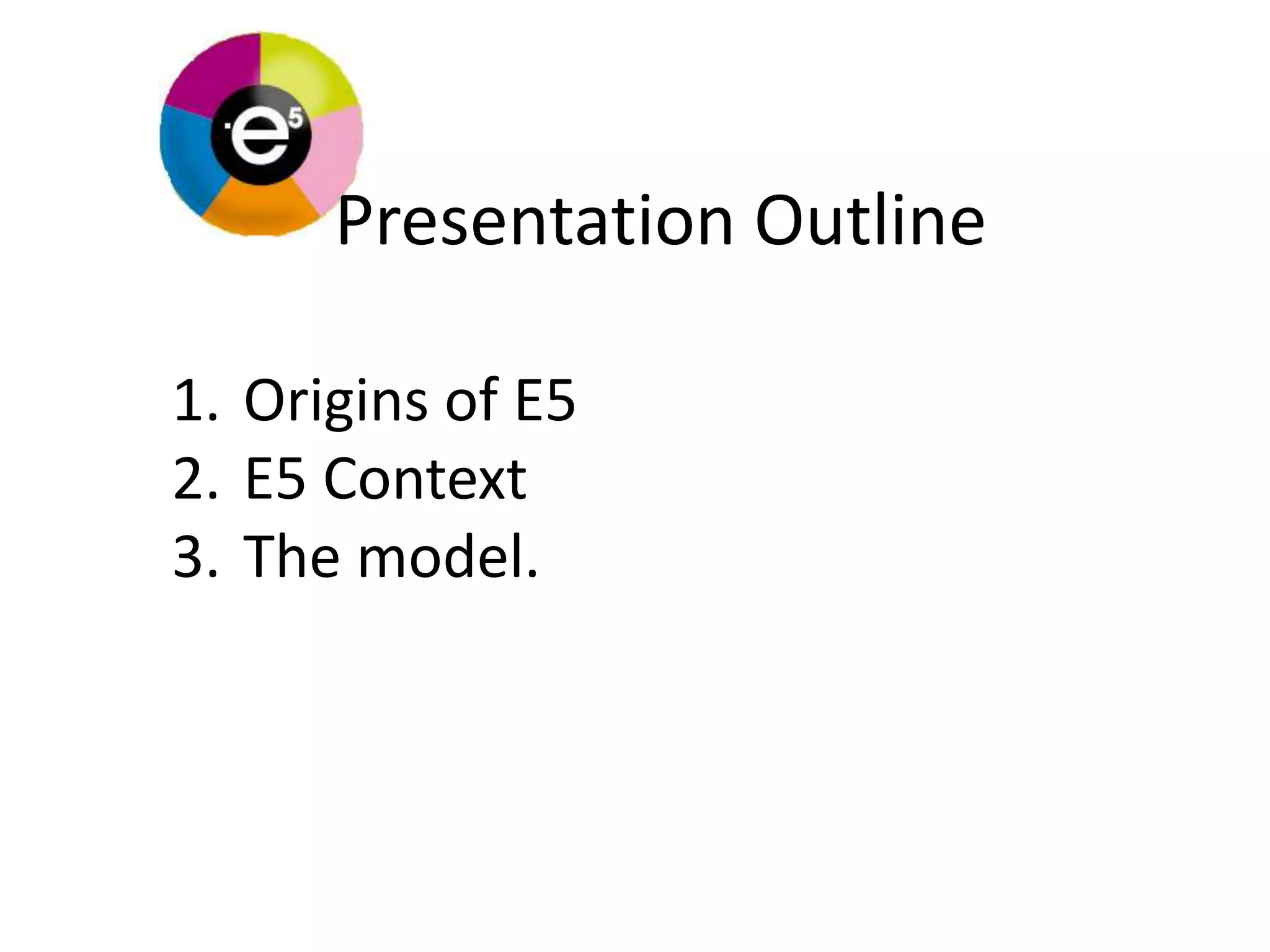
E5 Instructional modelExplore2Engage13EvaluateExplain5‘I am your student, help me learn.’ Elaborate4
Presentation OutlineOrigins of E5E5 ContextThe model.
Origins of e5An instructional model is the broadest level of instructional practice and provides a philosophical view of instruction. Johann Herbart (1776-1841) a German philosopher, psychologist and founder of pedagogy as an academic discipline, developed an instructional model with four steps:Preparation - The teacher brings prior experience to students' awareness.
Presentation- The teacher introduces new experiences and makes connections to prior experiences
Generalisation – The teacher explains ideas and develops concepts for the students
Application – The teacher provides experiences where the students demonstrate their understanding by applying concepts in new contexts.In the 1930's John Dewey (1859 – 1952) an American philosopher, psychologist and educational reformer developed an instructional model that included:Sensing a perplexing situation
Clarifying the problem
Formulating an hypothesis
Testing the hypothesis
Revising tests
Acting on solutionsIn 1962 J. Myron Atkin and Robert Karplus, science educators published a paper on a 'guided discovery' approach that was used in the Science Curriculum Improvement Study (SCIS). This cycle used terms such as exploration, invention and discovery which were later modified to exploration, term introduction and concept application. The Biological Sciences Curriculum Study (BSCS) 5E Instructional Model was developed in America in the 1980'sand consists of the following phases:Engagement
Exploration
Explanation
Elaboration
Evaluation An executive summary of this model can be found at: http://mickelson.nsta.org/ (PDF)Based on the preceding work of the 5E model, in April 2009the Department of Education and Early Childhood Development in Victoria, released the e5Instructional Model. This model is intended to support teachers in Victorian state schools when developing purposeful teaching. More information about The Blueprint for Government Schools in Victoria and the Effective Schools Model and is available at: http://www.education.vic.gov.auThe e5Instructional Model provides a common language for educators to assist with defining quality instruction. The phases of the e5 model are:Engage
Explore
Explain

Presentation1 e5

  • 1.
    E5 Instructional modelExplore2Engage13EvaluateExplain5‘Iam your student, help me learn.’ Elaborate4
  • 2.
    Presentation OutlineOrigins ofE5E5 ContextThe model.
  • 3.
    Origins of e5Aninstructional model is the broadest level of instructional practice and provides a philosophical view of instruction. Johann Herbart (1776-1841) a German philosopher, psychologist and founder of pedagogy as an academic discipline, developed an instructional model with four steps:Preparation - The teacher brings prior experience to students' awareness.
  • 4.
    Presentation- The teacherintroduces new experiences and makes connections to prior experiences
  • 5.
    Generalisation – Theteacher explains ideas and develops concepts for the students
  • 6.
    Application – Theteacher provides experiences where the students demonstrate their understanding by applying concepts in new contexts.In the 1930's John Dewey (1859 – 1952) an American philosopher, psychologist and educational reformer developed an instructional model that included:Sensing a perplexing situation
  • 7.
  • 8.
  • 9.
  • 10.
  • 11.
    Acting on solutionsIn1962 J. Myron Atkin and Robert Karplus, science educators published a paper on a 'guided discovery' approach that was used in the Science Curriculum Improvement Study (SCIS). This cycle used terms such as exploration, invention and discovery which were later modified to exploration, term introduction and concept application. The Biological Sciences Curriculum Study (BSCS) 5E Instructional Model was developed in America in the 1980'sand consists of the following phases:Engagement
  • 12.
  • 13.
  • 14.
  • 15.
    Evaluation An executivesummary of this model can be found at: http://mickelson.nsta.org/ (PDF)Based on the preceding work of the 5E model, in April 2009the Department of Education and Early Childhood Development in Victoria, released the e5Instructional Model. This model is intended to support teachers in Victorian state schools when developing purposeful teaching. More information about The Blueprint for Government Schools in Victoria and the Effective Schools Model and is available at: http://www.education.vic.gov.auThe e5Instructional Model provides a common language for educators to assist with defining quality instruction. The phases of the e5 model are:Engage
  • 16.
  • 17.
  • 18.
  • 19.
    EvaluateE5 ContextSupport teacherswhen developing purposeful teaching.Need for lesson/unit planning skills.Meet the goals of the School Strategic Plan.Engagement with DEECD initiatives.
  • 20.
    E5 Instructional model“Aframework to inform conversations and guide the observation, critique and reflection of classroom practice.” (D. Fraser)
  • 21.
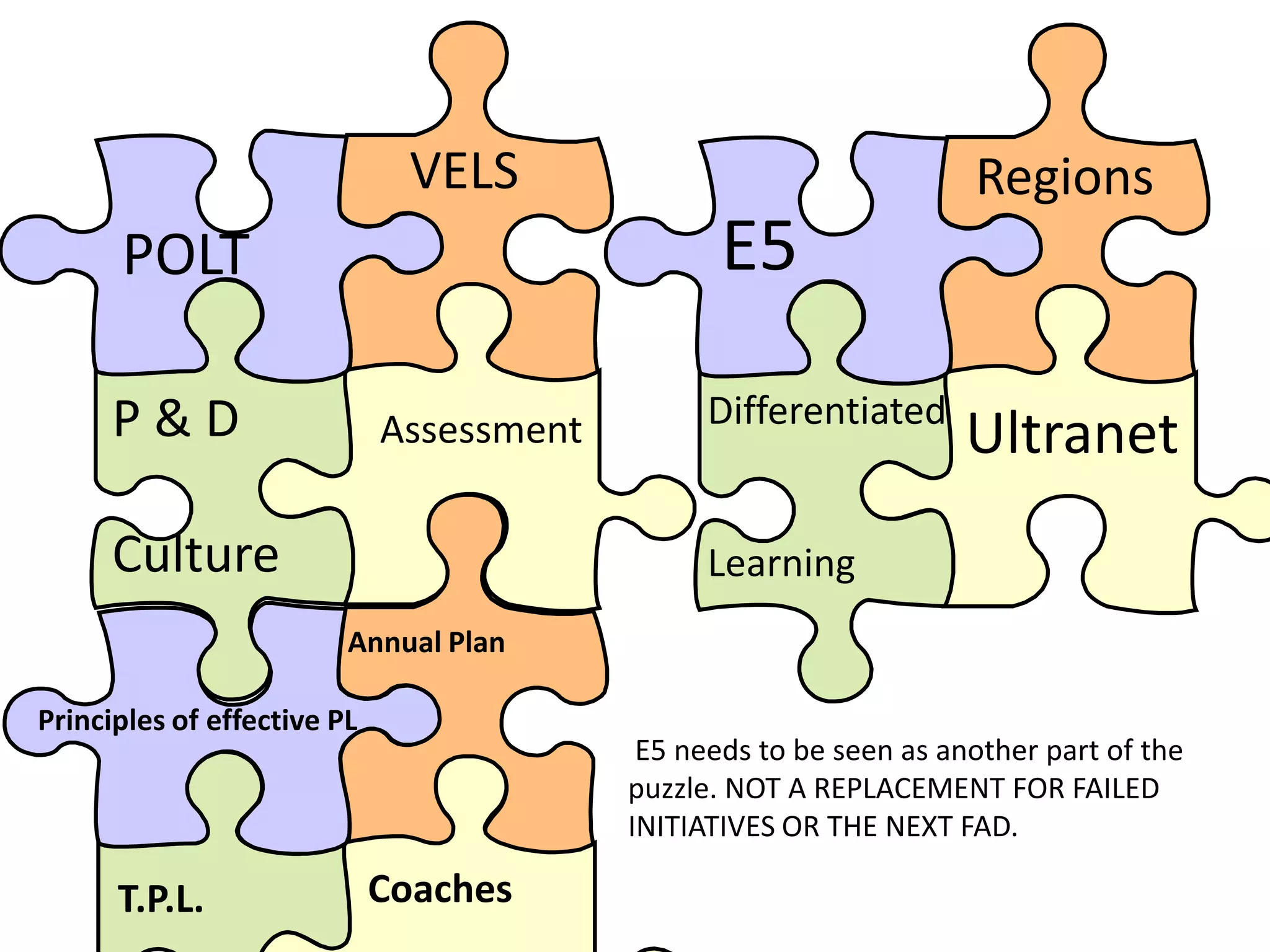
    Instructional modelE5 shouldnot be seen as something new. It is simply a structure for describing and articulating what good teachers already do.VELSRegionsE5POLTP & D CultureDifferentiatedLearningUltranetAssessmentAnnual PlanPrinciples of effective PL E5 needs to be seen as another part of the puzzle. NOT A REPLACEMENT FOR FAILED INITIATIVES OR THE NEXT FAD.CoachesT.P.L.
  • 22.
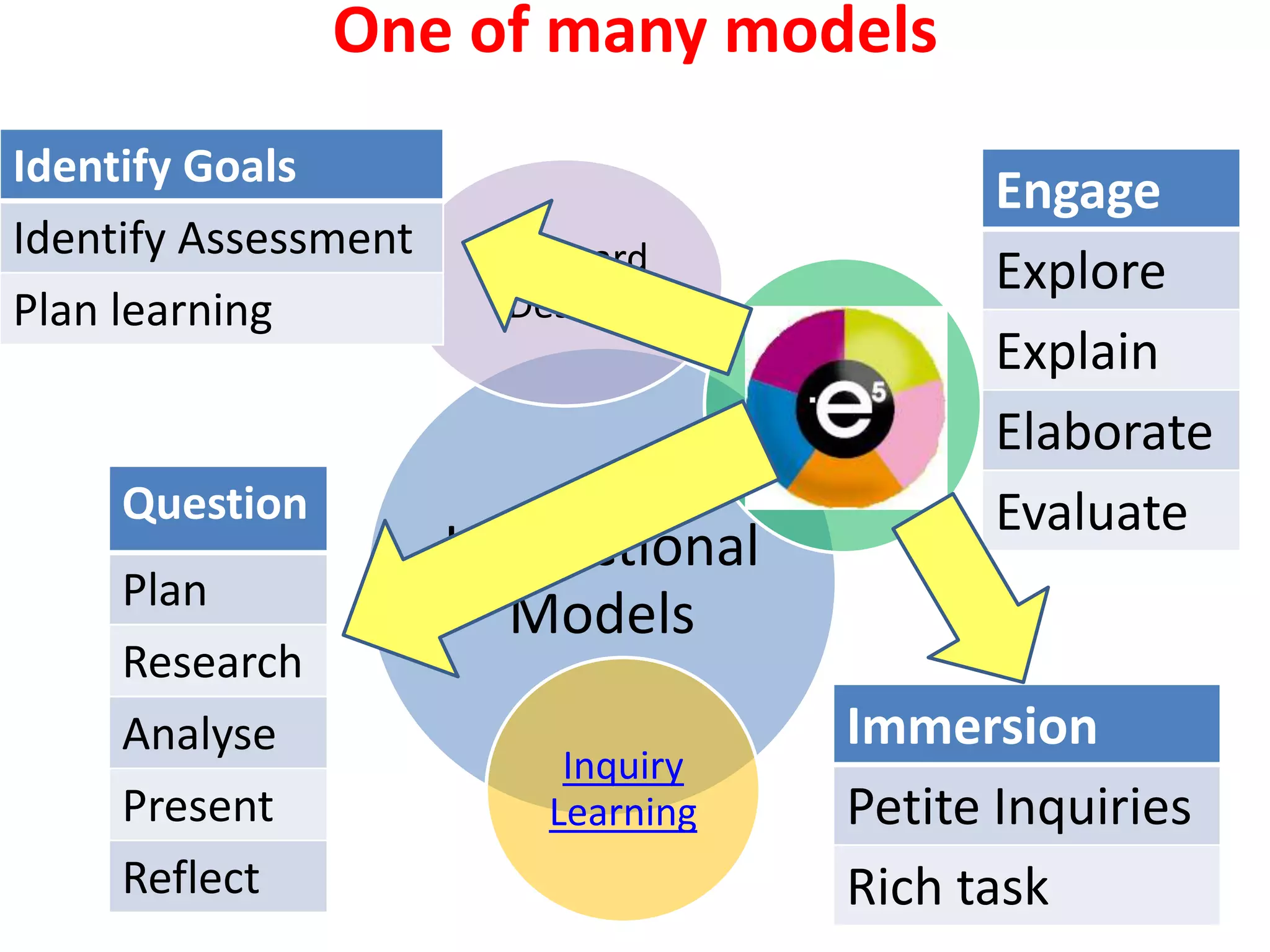
    E5 Instructional modelE5is one of a suite of complementary models including Backwards Design, Inquiry learning, Rich tasks, Problem Based learning.Interpretation and use of the E5 model should be able to be flexible and adaptable and adoptable.
  • 23.
  • 24.
    E5 Instructional modelModelswhat teachers do in classroomsCould be used as a framework for:A unit of workA series of lessonsAny one lesson
  • 25.
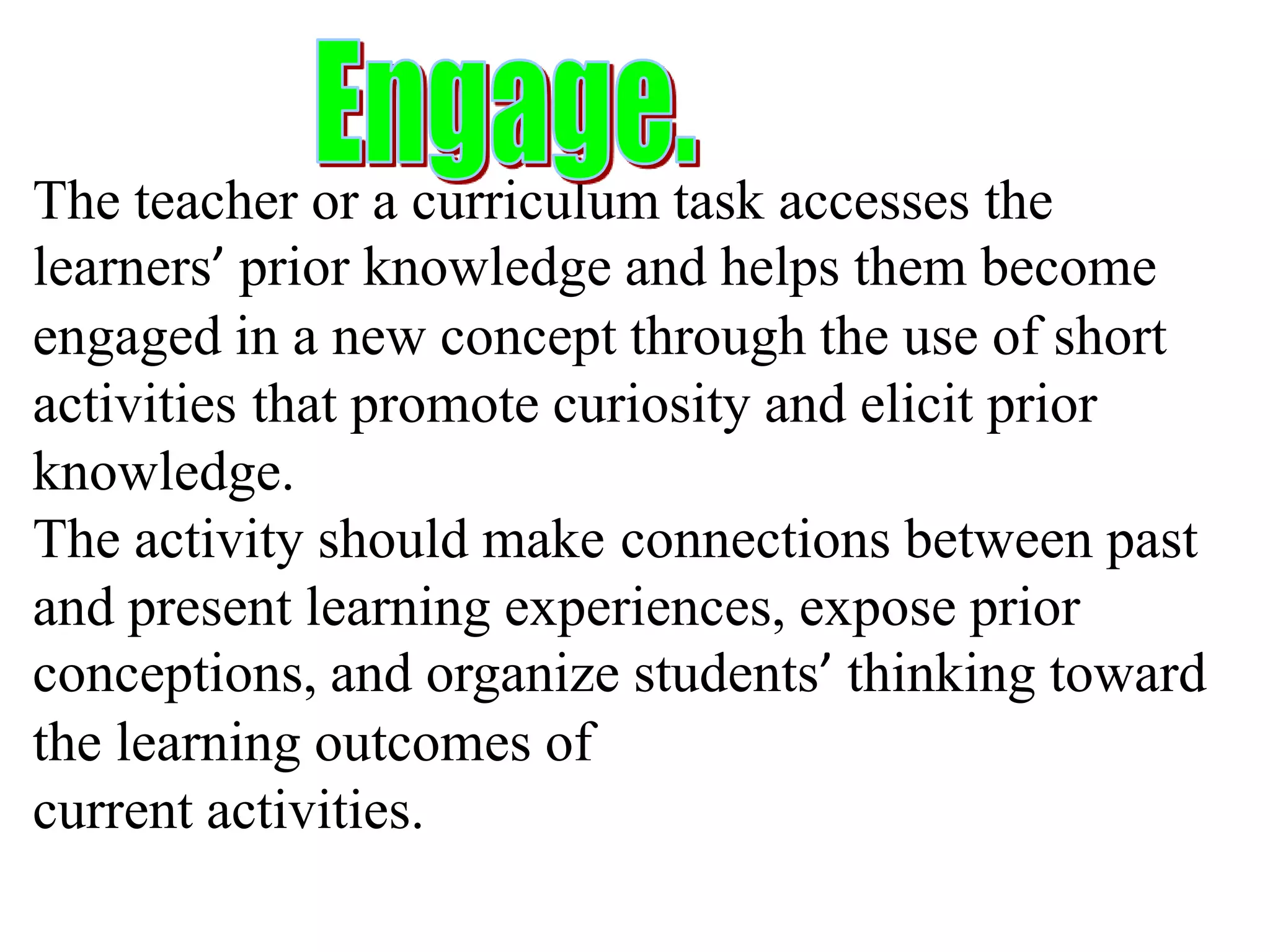
    Engage.The teacher ora curriculum task accesses the learners’ prior knowledge and helps them becomeengaged in a new concept through the use of short activitiesthat promote curiosity and elicit prior knowledge. The activity should makeconnections between past and present learning experiences, expose priorconceptions, and organize students’ thinking toward the learning outcomes ofcurrent activities.
  • 26.
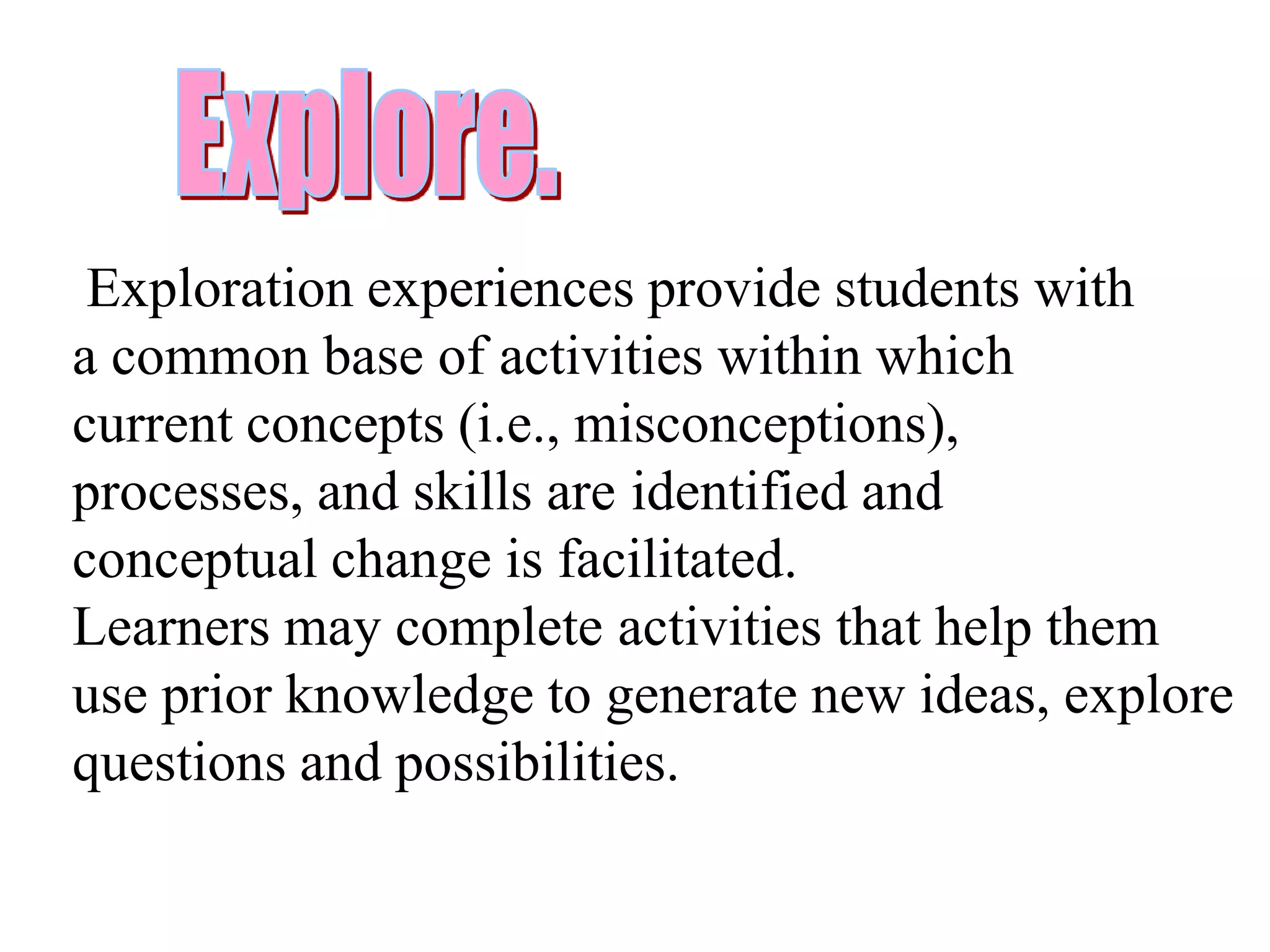
    Explore. Exploration experiencesprovide students with a common base of activities within which current concepts (i.e., misconceptions), processes, and skills areidentified and conceptual change is facilitated. Learners may completeactivities that help them use prior knowledge to generate new ideas, explorequestions and possibilities.
  • 27.
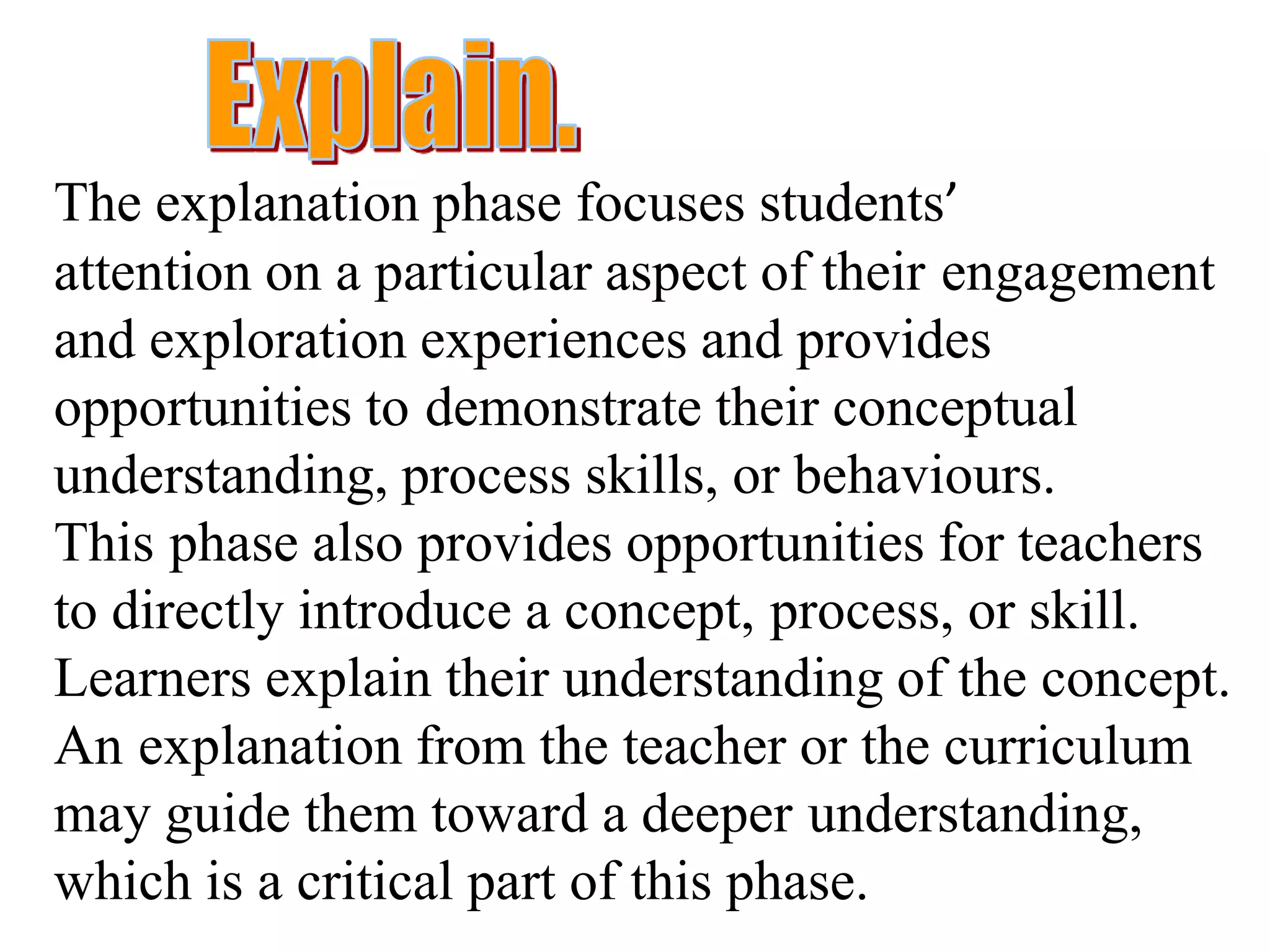
    The explanation phasefocuses students’attention on a particular aspect of theirengagement and exploration experiences and provides opportunities todemonstrate their conceptual understanding, process skills, or behaviours. Thisphase also provides opportunities for teachers to directly introduce a concept,process, or skill. Learners explain their understanding of the concept. Anexplanation from the teacher or the curriculum may guide them toward a deeperunderstanding, which is a critical part of this phase.Explain.
  • 28.
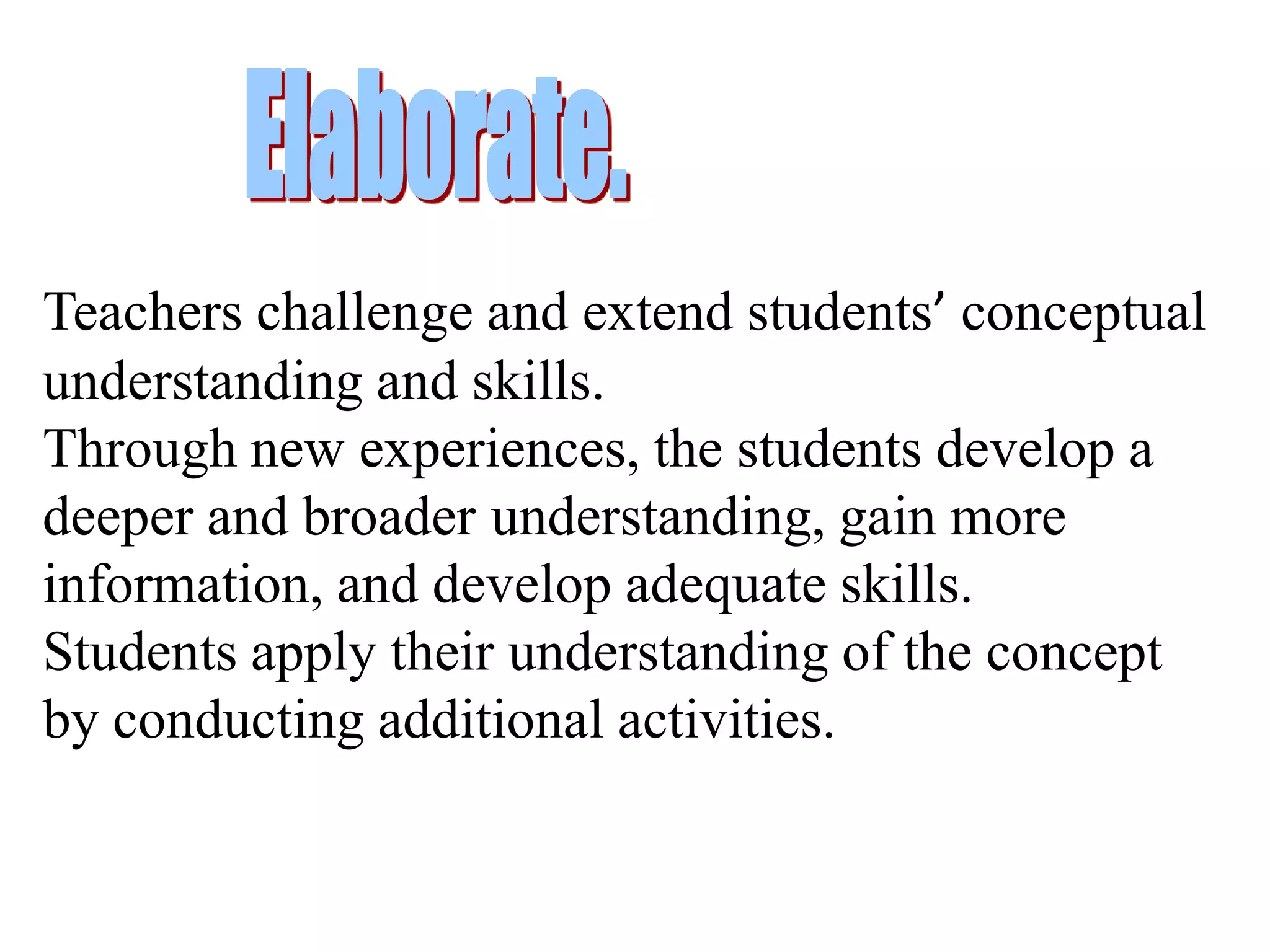
    Elaborate.Teachers challenge andextend students’ conceptual understanding and skills.Through new experiences, the students develop adeeper and broaderunderstanding, gain moreinformation, and develop adequate skills. Students apply theirunderstanding of the concept by conductingadditional activities.
  • 29.
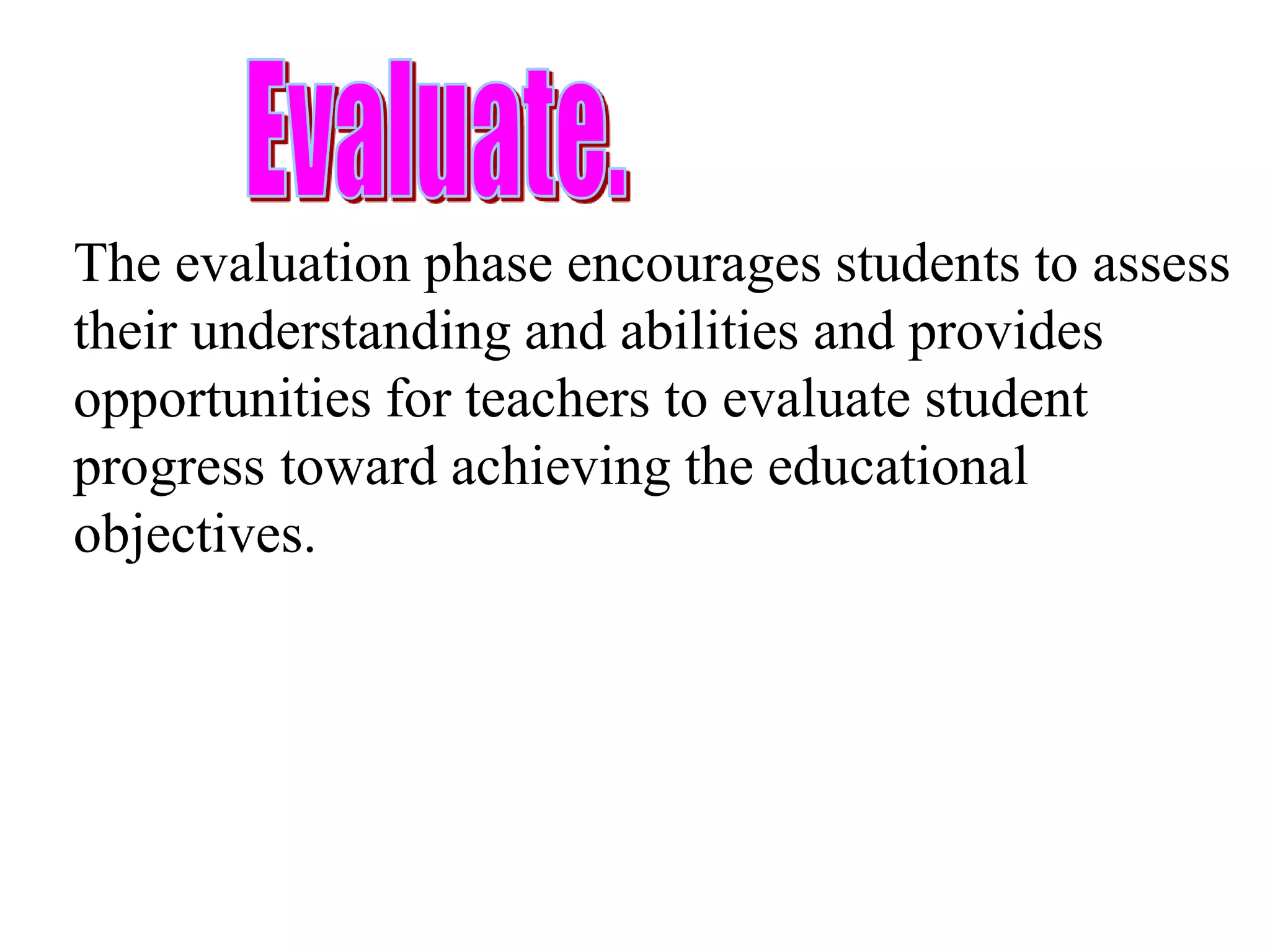
    Evaluate.The evaluation phaseencourages students to assess their understanding and abilities and provides opportunitiesfor teachers to evaluate studentprogresstoward achieving the educational objectives.
  • 30.
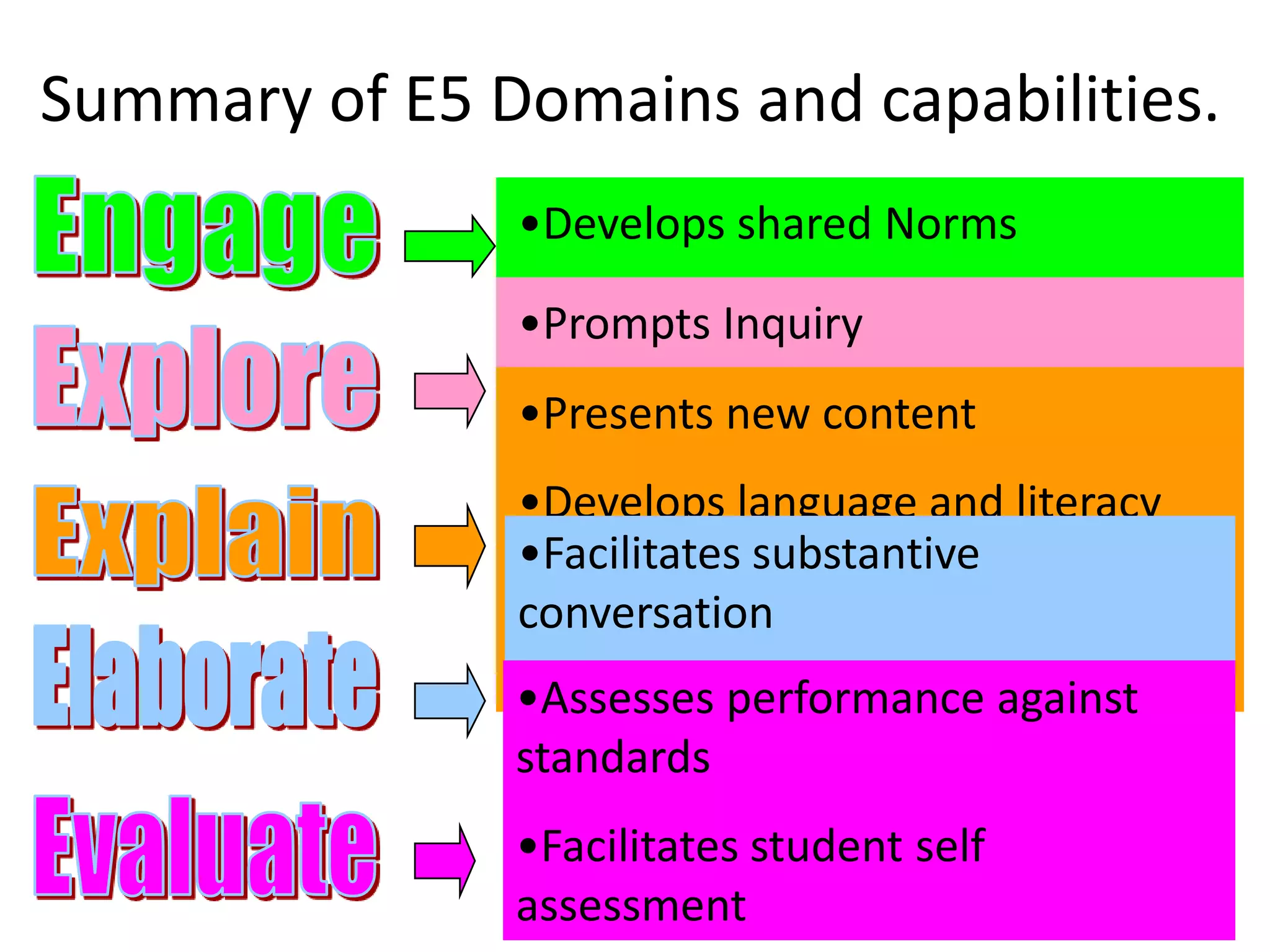
    Summary of E5Domains and capabilities.EngageDevelops shared Norms
  • 31.
  • 32.
  • 33.
  • 34.
  • 35.
  • 36.
  • 37.
  • 38.
  • 39.
  • 40.
  • 41.
    Facilitates student selfassessmentEvaluate
  • 42.
    E5 – An Instructional Model The E5 Instructional Model is a framework for purposeful teaching and describes the interactions that take place within a classroom between the teacher, the student and the content using five descriptors‐ EngageExploreExplainElaborateEvaluate

Editor's Notes

  • #10 For example see chart comparing E5 to an inquiry model and relating this to VELS themes