Guide Questions:
DEPAR TMENT OF EDUCATION
What is Inquiry
Based-Learning?
WHAT IS INQUIRY-BASED
LEARNING
DEPAR TMENT OF EDUCATION
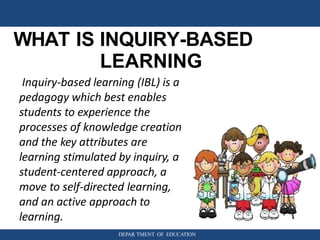
Inquiry-based learning (IBL) is a
pedagogy which best enables
students to experience the
processes of knowledge creation
and the key attributes are
learning stimulated by inquiry, a
student-centered approach, a
move to self-directed learning,
and an active approach to
learning.
WHAT IS INQUIRY-BASED
LEARNING
DEPAR TMENT OF EDUCATION
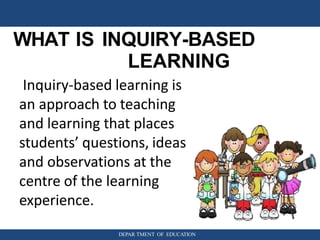
Inquiry-based learning is
an approach to teaching
and learning that places
students’ questions, ideas
and observations at the
centre of the learning
experience.
WHAT IS INQUIRY-BASED
LEARNING
DEPAR TMENT OF EDUCATION
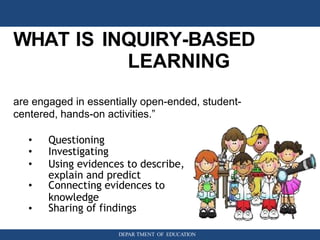
are engaged in essentially open-ended, student-
centered, hands-on activities.”
• Questioning
• Investigating
• Using evidences to describe,
explain and predict
• Connecting evidences to
knowledge
Sharing of findings
•
INQUIRY-BASED
LEARNING
DEPAR TMENT OF EDUCATION
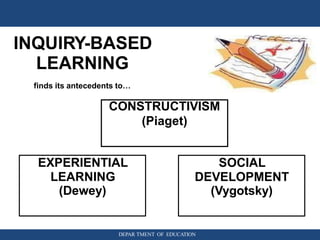
finds its antecedents to…
SOCIAL
DEVELOPMENT
(Vygotsky)
EXPERIENTIAL
LEARNING
(Dewey)
CONSTRUCTIVISM
(Piaget)
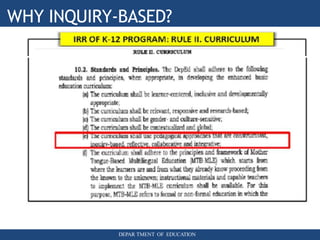
WHY INQUIRY-BASED?
DEPAR TMENT OF EDUCATION
WHY INQUIRY-BASED?
DEPAR TMENT OF EDUCATION
“If we are only teaching what we
know, our children can only do as
bad as we are doing, and this is the
challenge we are facing – we have
to go beyond it.”
(Pauli, 2009, TEDx)
For 3 Minutes by group:
DEPAR TMENT OF EDUCATION
1. What is the
importance of Inquiry –
Based Learning in
teaching competencies?
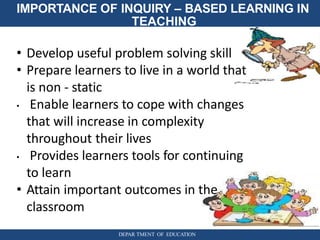
IMPORTANCE OF INQUIRY – BASED LEARNING IN
TEACHING
• Develop useful problem solving skill
• Prepare learners to live in a world that
is non - static
• Enable learners to cope with changes
that will increase in complexity
throughout their lives
• Provides learners tools for continuing
to learn
• Attain important outcomes in the
classroom
DEPAR TMENT OF EDUCATION
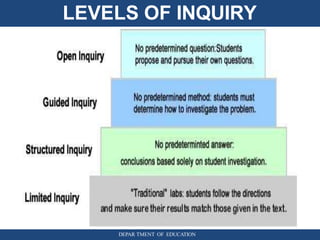
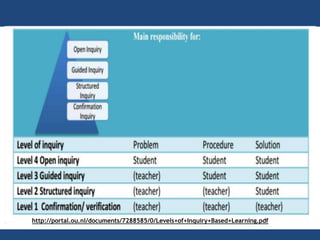
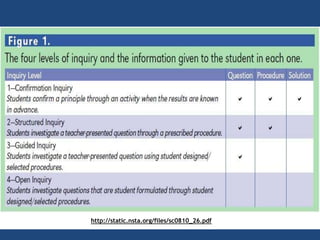
LEVELS OF INQUIRY
DEPAR TMENT OF EDUCATION
http://portal.ou.nl/documents/7288585/0/Levels+of+Inquiry+Based+Learning.pdf
http://static.nsta.org/files/sc0810_26.pdf
LEVELS OF INQUIRY
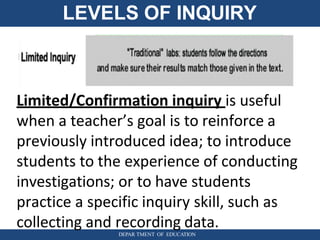
Limited/Confirmation inquiry is useful
when a teacher’s goal is to reinforce a
previously introduced idea; to introduce
students to the experience of conducting
investigations; or to have students
practice a specific inquiry skill, such as
collecting and recording data.
DEPAR TMENT OF EDUCATION
LEVELS OF INQUIRY
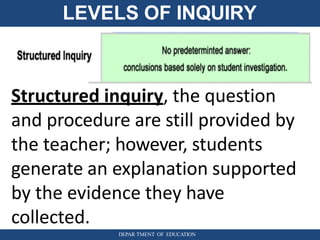
Structured inquiry, the question
and procedure are still provided by
the teacher; however, students
generate an explanation supported
by the evidence they have
collected.
DEPAR TMENT OF EDUCATION
LEVELS OF INQUIRY
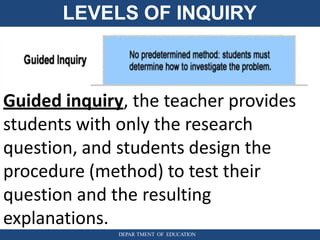
Guided inquiry, the teacher provides
students with only the research
question, and students design the
procedure (method) to test their
question and the resulting
explanations.
DEPAR TMENT OF EDUCATION
LEVELS OF INQUIRY
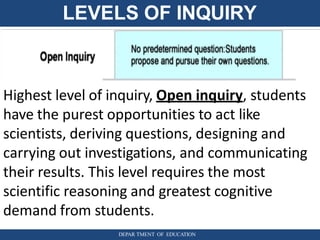
Highest level of inquiry, Open inquiry, students
have the purest opportunities to act like
scientists, deriving questions, designing and
carrying out investigations, and communicating
their results. This level requires the most
scientific reasoning and greatest cognitive
demand from students.
DEPAR TMENT OF EDUCATION
LEVELS OF INQUIRY
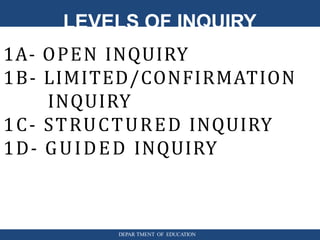
1A- OPEN INQUIRY
1B- LIMITED/CONFIRMATION
INQUIRY
1C- STRUCTURED INQUIRY
1D- GUIDED INQUIRY
DEPAR TMENT OF EDUCATION
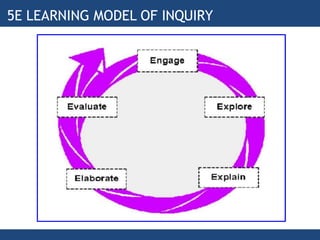
5E LEARNING MODEL OF INQUIRY
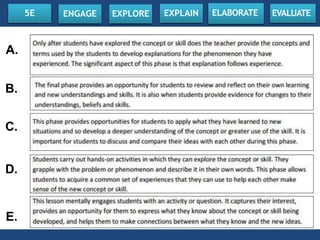
A.
B.
C.
D.
E.
EVALUATE
ELABORATE
EXPLAIN
EXPLORE
ENGAGE
5E
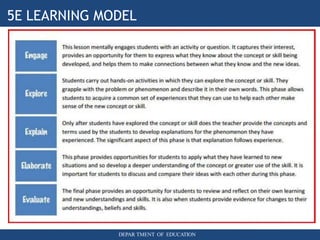
5E LEARNING MODEL
DEPAR TMENT OF EDUCATION
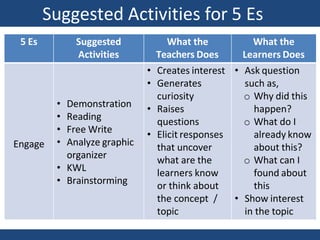
Suggested Activities for 5 Es
5 Es Suggested
Activities
What the
Teachers Does
What the
Learners Does
Engage
• Demonstration
• Reading
• Free Write
• Analyze graphic
organizer
• KWL
• Brainstorming
• Creates interest
• Generates
curiosity
• Raises
questions
• Elicit responses
that uncover
what are the
learners know
or think about
the concept /
topic
• Ask question
such as,
o Why did this
happen?
o What do I
already know
about this?
o What can I
found about
this
• Show interest
in the topic
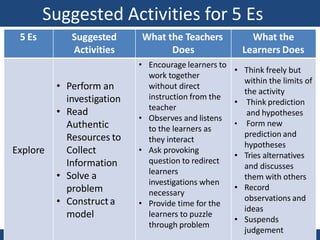
Suggested Activities for 5 Es
5 Es Suggested
Activities
What the Teachers
Does
What the
Learners Does
Explore
• Perform an
investigation
• Read
Authentic
Resources to
Collect
Information
• Solve a
problem
• Constructa
model
• Encourage learners to
work together
without direct
instruction from the
teacher
• Observes and listens
to the learners as
they interact
• Ask provoking
question to redirect
learners
investigations when
necessary
• Provide time for the
learners to puzzle
through problem
• Think freely but
within the limits of
the activity
• Think prediction
and hypotheses
• Form new
prediction and
hypotheses
• Tries alternatives
and discusses
them with others
• Record
observations and
ideas
• Suspends
judgement
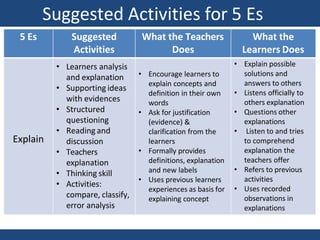
Suggested Activities for 5 Es
5 Es Suggested
Activities
What the Teachers
Does
What the
Learners Does
Explain
• Learners analysis
and explanation
• Supporting ideas
with evidences
• Structured
questioning
• Reading and
discussion
• Teachers
explanation
• Thinking skill
• Activities:
compare, classify,
error analysis
• Encourage learners to
explain concepts and
definition in their own
words
• Ask for justification
(evidence) &
clarification from the
learners
• Formally provides
definitions, explanation
and new labels
• Uses previous learners
experiences as basis for
explaining concept
• Explain possible
solutions and
answers to others
• Listens officially to
others explanation
• Questions other
explanations
• Listen to and tries
to comprehend
explanation the
teachers offer
• Refers to previous
activities
• Uses recorded
observations in
explanations
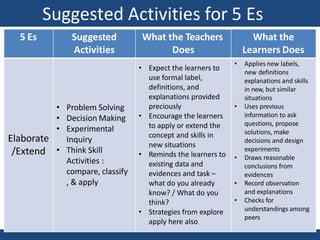
Suggested Activities for 5 Es
5 Es Suggested
Activities
What the Teachers
Does
What the
Learners Does
Elaborate
/Extend
• Problem Solving
• Decision Making
• Experimental
Inquiry
• Think Skill
Activities :
compare, classify
, & apply
• Expect the learners to
use formal label,
definitions, and
explanations provided
preciously
• Encourage the learners
to apply or extend the
concept and skills in
new situations
• Reminds the learners to
existing data and
evidences and task –
what do you already
know? / What do you
think?
• Strategies from explore
apply here also
• Applies new labels,
new definitions
explanations and skills
in new, but similar
situations
• Uses previous
information to ask
questions, propose
solutions, make
decisions and design
experiments
• Draws reasonable
conclusions from
evidences
• Record observation
and explanations
• Checks for
understandings among
peers
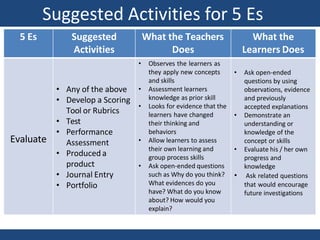
Suggested Activities for 5 Es
5 Es Suggested
Activities
What the Teachers
Does
What the
Learners Does
Evaluate
• Any of the above
• Develop a Scoring
Tool or Rubrics
• Test
• Performance
Assessment
• Produced a
product
• Journal Entry
• Portfolio
• Observes the learners as
they apply new concepts
and skills
• Assessment learners
knowledge as prior skill
• Looks for evidence that the
learners have changed
their thinking and
behaviors
• Allow learners to assess
their own learning and
group process skills
• Ask open-ended questions
such as Why do you think?
What evidences do you
have? What do you know
about? How would you
explain?
• Ask open-ended
questions by using
observations, evidence
and previously
accepted explanations
• Demonstrate an
understanding or
knowledge of the
concept or skills
• Evaluate his / her own
progress and
knowledge
• Ask related questions
that would encourage
future investigations
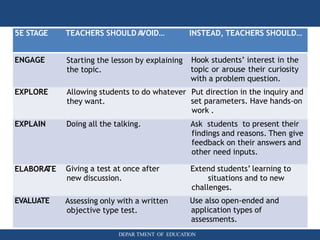
5E STAGE
DEPAR TMENT OF EDUCATION
TEACHERS SHOULDA
VOID… INSTEAD, TEACHERS SHOULD…
ENGAGE Starting the lesson by explaining
the topic.
Hook students’ interest in the
topic or arouse their curiosity
with a problem question.
EXPLORE Allowing students to do whatever Put direction in the inquiry and
they want. set parameters. Have hands-on
work .
EXPLAIN Doing all the talking. Ask students to present their
findings and reasons. Then give
feedback on their answers and
other need inputs.
ELABORA
TE Giving a test at once after
new discussion.
Extend students’ learning to
situations and to new
challenges.
EVALUATE Assessing only with a written
objective type test.
Use also open-ended and
application types of
assessments.
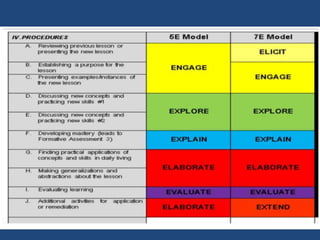
5E Learning Model vs 7E Learning Model
DEPAR TMENT OF EDUCATION
Sometimes a current model must be amended
to maintain its value after new information,
insights, and knowledge have been gathered.
Such is now the case with the highly successful
5E learning cycle and instructional model.
National Research Council. 2006. National science
education standards. Washington, D.C.: National
Academy Press.
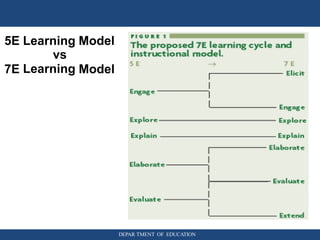
5E Learning Model
vs
7E Learning Model
DEPAR TMENT OF EDUCATION

inquirybased-learning-200926032449.pptx

  • 1.
    Guide Questions: DEPAR TMENTOF EDUCATION What is Inquiry Based-Learning?
  • 2.
    WHAT IS INQUIRY-BASED LEARNING DEPARTMENT OF EDUCATION Inquiry-based learning (IBL) is a pedagogy which best enables students to experience the processes of knowledge creation and the key attributes are learning stimulated by inquiry, a student-centered approach, a move to self-directed learning, and an active approach to learning.
  • 3.
    WHAT IS INQUIRY-BASED LEARNING DEPARTMENT OF EDUCATION Inquiry-based learning is an approach to teaching and learning that places students’ questions, ideas and observations at the centre of the learning experience.
  • 4.
    WHAT IS INQUIRY-BASED LEARNING DEPARTMENT OF EDUCATION are engaged in essentially open-ended, student- centered, hands-on activities.” • Questioning • Investigating • Using evidences to describe, explain and predict • Connecting evidences to knowledge Sharing of findings •
  • 5.
    INQUIRY-BASED LEARNING DEPAR TMENT OFEDUCATION finds its antecedents to… SOCIAL DEVELOPMENT (Vygotsky) EXPERIENTIAL LEARNING (Dewey) CONSTRUCTIVISM (Piaget)
  • 6.
  • 7.
    WHY INQUIRY-BASED? DEPAR TMENTOF EDUCATION “If we are only teaching what we know, our children can only do as bad as we are doing, and this is the challenge we are facing – we have to go beyond it.” (Pauli, 2009, TEDx)
  • 8.
    For 3 Minutesby group: DEPAR TMENT OF EDUCATION 1. What is the importance of Inquiry – Based Learning in teaching competencies?
  • 9.
    IMPORTANCE OF INQUIRY– BASED LEARNING IN TEACHING • Develop useful problem solving skill • Prepare learners to live in a world that is non - static • Enable learners to cope with changes that will increase in complexity throughout their lives • Provides learners tools for continuing to learn • Attain important outcomes in the classroom DEPAR TMENT OF EDUCATION
  • 10.
    LEVELS OF INQUIRY DEPARTMENT OF EDUCATION
  • 11.
  • 12.
  • 13.
    LEVELS OF INQUIRY Limited/Confirmationinquiry is useful when a teacher’s goal is to reinforce a previously introduced idea; to introduce students to the experience of conducting investigations; or to have students practice a specific inquiry skill, such as collecting and recording data. DEPAR TMENT OF EDUCATION
  • 14.
    LEVELS OF INQUIRY Structuredinquiry, the question and procedure are still provided by the teacher; however, students generate an explanation supported by the evidence they have collected. DEPAR TMENT OF EDUCATION
  • 15.
    LEVELS OF INQUIRY Guidedinquiry, the teacher provides students with only the research question, and students design the procedure (method) to test their question and the resulting explanations. DEPAR TMENT OF EDUCATION
  • 16.
    LEVELS OF INQUIRY Highestlevel of inquiry, Open inquiry, students have the purest opportunities to act like scientists, deriving questions, designing and carrying out investigations, and communicating their results. This level requires the most scientific reasoning and greatest cognitive demand from students. DEPAR TMENT OF EDUCATION
  • 17.
    LEVELS OF INQUIRY 1A-OPEN INQUIRY 1B- LIMITED/CONFIRMATION INQUIRY 1C- STRUCTURED INQUIRY 1D- GUIDED INQUIRY DEPAR TMENT OF EDUCATION
  • 18.
  • 19.
  • 20.
    5E LEARNING MODEL DEPARTMENT OF EDUCATION
  • 21.
    Suggested Activities for5 Es 5 Es Suggested Activities What the Teachers Does What the Learners Does Engage • Demonstration • Reading • Free Write • Analyze graphic organizer • KWL • Brainstorming • Creates interest • Generates curiosity • Raises questions • Elicit responses that uncover what are the learners know or think about the concept / topic • Ask question such as, o Why did this happen? o What do I already know about this? o What can I found about this • Show interest in the topic
  • 22.
    Suggested Activities for5 Es 5 Es Suggested Activities What the Teachers Does What the Learners Does Explore • Perform an investigation • Read Authentic Resources to Collect Information • Solve a problem • Constructa model • Encourage learners to work together without direct instruction from the teacher • Observes and listens to the learners as they interact • Ask provoking question to redirect learners investigations when necessary • Provide time for the learners to puzzle through problem • Think freely but within the limits of the activity • Think prediction and hypotheses • Form new prediction and hypotheses • Tries alternatives and discusses them with others • Record observations and ideas • Suspends judgement
  • 23.
    Suggested Activities for5 Es 5 Es Suggested Activities What the Teachers Does What the Learners Does Explain • Learners analysis and explanation • Supporting ideas with evidences • Structured questioning • Reading and discussion • Teachers explanation • Thinking skill • Activities: compare, classify, error analysis • Encourage learners to explain concepts and definition in their own words • Ask for justification (evidence) & clarification from the learners • Formally provides definitions, explanation and new labels • Uses previous learners experiences as basis for explaining concept • Explain possible solutions and answers to others • Listens officially to others explanation • Questions other explanations • Listen to and tries to comprehend explanation the teachers offer • Refers to previous activities • Uses recorded observations in explanations
  • 24.
    Suggested Activities for5 Es 5 Es Suggested Activities What the Teachers Does What the Learners Does Elaborate /Extend • Problem Solving • Decision Making • Experimental Inquiry • Think Skill Activities : compare, classify , & apply • Expect the learners to use formal label, definitions, and explanations provided preciously • Encourage the learners to apply or extend the concept and skills in new situations • Reminds the learners to existing data and evidences and task – what do you already know? / What do you think? • Strategies from explore apply here also • Applies new labels, new definitions explanations and skills in new, but similar situations • Uses previous information to ask questions, propose solutions, make decisions and design experiments • Draws reasonable conclusions from evidences • Record observation and explanations • Checks for understandings among peers
  • 25.
    Suggested Activities for5 Es 5 Es Suggested Activities What the Teachers Does What the Learners Does Evaluate • Any of the above • Develop a Scoring Tool or Rubrics • Test • Performance Assessment • Produced a product • Journal Entry • Portfolio • Observes the learners as they apply new concepts and skills • Assessment learners knowledge as prior skill • Looks for evidence that the learners have changed their thinking and behaviors • Allow learners to assess their own learning and group process skills • Ask open-ended questions such as Why do you think? What evidences do you have? What do you know about? How would you explain? • Ask open-ended questions by using observations, evidence and previously accepted explanations • Demonstrate an understanding or knowledge of the concept or skills • Evaluate his / her own progress and knowledge • Ask related questions that would encourage future investigations
  • 26.
    5E STAGE DEPAR TMENTOF EDUCATION TEACHERS SHOULDA VOID… INSTEAD, TEACHERS SHOULD… ENGAGE Starting the lesson by explaining the topic. Hook students’ interest in the topic or arouse their curiosity with a problem question. EXPLORE Allowing students to do whatever Put direction in the inquiry and they want. set parameters. Have hands-on work . EXPLAIN Doing all the talking. Ask students to present their findings and reasons. Then give feedback on their answers and other need inputs. ELABORA TE Giving a test at once after new discussion. Extend students’ learning to situations and to new challenges. EVALUATE Assessing only with a written objective type test. Use also open-ended and application types of assessments.
  • 27.
    5E Learning Modelvs 7E Learning Model DEPAR TMENT OF EDUCATION Sometimes a current model must be amended to maintain its value after new information, insights, and knowledge have been gathered. Such is now the case with the highly successful 5E learning cycle and instructional model. National Research Council. 2006. National science education standards. Washington, D.C.: National Academy Press.
  • 28.
    5E Learning Model vs 7ELearning Model DEPAR TMENT OF EDUCATION
  • 30.
    DEPAR TMENT OFEDUCATION