Security Challenges in IoT
December 1, 2017
1 / 25
Outline
Introduction
Technologies used in IoT
RFID Technology
EPC Technology
Security Challenges in IoT
Solutions
Cryptographic Algorithms
Conclusion
References
2 / 25
Introduction
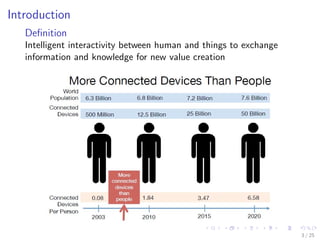
Definition
Intelligent interactivity between human and things to exchange
information and knowledge for new value creation
3 / 25
Introduction (Cont’d)
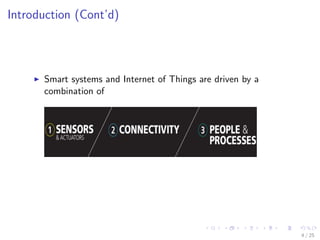
Smart systems and Internet of Things are driven by a
combination of
4 / 25
Introduction (Cont’d)
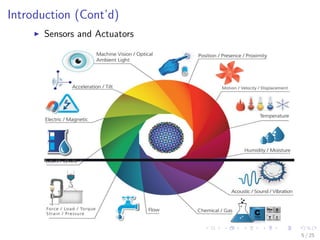
Sensors and Actuators
5 / 25
Introduction (Cont’d)
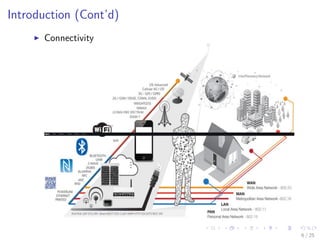
Connectivity
6 / 25
Introduction (Cont’d)
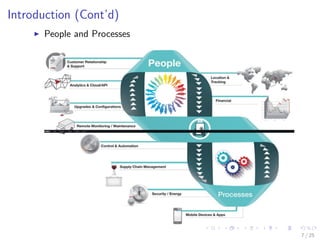
People and Processes
7 / 25
Introduction (Cont’d)
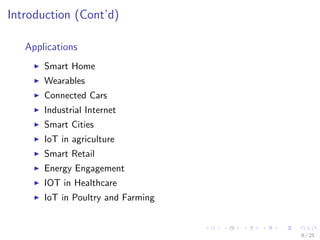
Applications
Smart Home
Wearables
Connected Cars
Industrial Internet
Smart Cities
IoT in agriculture
Smart Retail
Energy Engagement
IOT in Healthcare
IoT in Poultry and Farming
8 / 25
Outline
Introduction
Technologies used in IoT
RFID Technology
EPC Technology
Security Challenges in IoT
Solutions
Cryptographic Algorithms
Conclusion
References
9 / 25
Technologies used in IoT
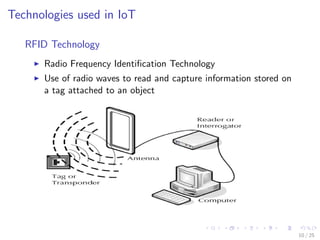
RFID Technology
Radio Frequency Identification Technology
Use of radio waves to read and capture information stored on
a tag attached to an object
10 / 25
Technologies used in IoT (Cont’d)
Classifications for RFID tags
Class 0/class 1
basic radio frequency (RF) passive capability
tags are factory programmed
Class 2
Additional functionality - encryption and read-write RF
memory
tags are user-programmable
Class 3
Batteries are found on board that will power logic in the
computer circuit
longer range and broadband communications
11 / 25
Technologies used in IoT (Cont’d)
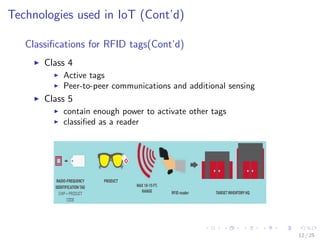
Classifications for RFID tags(Cont’d)
Class 4
Active tags
Peer-to-peer communications and additional sensing
Class 5
contain enough power to activate other tags
classified as a reader
12 / 25
Outline
Introduction
Technologies used in IoT
RFID Technology
EPC Technology
Security Challenges in IoT
Solutions
Cryptographic Algorithms
Conclusion
References
13 / 25
Technologies used in IoT (Cont’d)
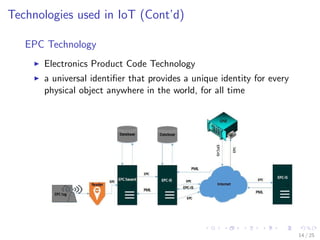
EPC Technology
Electronics Product Code Technology
a universal identifier that provides a unique identity for every
physical object anywhere in the world, for all time
14 / 25
Technologies used in IoT (Cont’d)
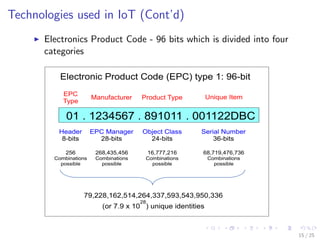
Electronics Product Code - 96 bits which is divided into four
categories
15 / 25
Security Challenges in IoT
Key challenge areas are
Access control
Confidentiality
Integrity
Availability
Privacy
Standardization
Data deluge
16 / 25
Solutions
Timely updation of software
IoT devices are huge in number and it quite difficult to update
these devices one by one
High security codes
Data loss can happen if the attacker cracks the code
Devices must be connected to a central power station
But if central power station reaches its empty level
17 / 25
Outline
Introduction
Technologies used in IoT
RFID Technology
EPC Technology
Security Challenges in IoT
Solutions
Cryptographic Algorithms
Conclusion
References
18 / 25
Solutions(Cont’d)
Cryptographic Algorithms
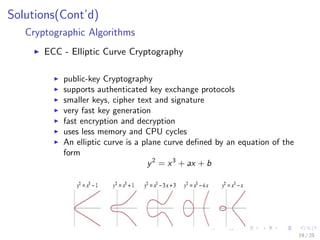
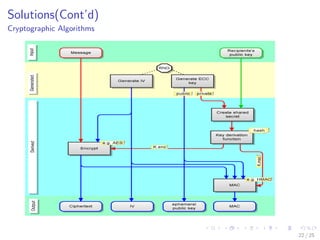
ECC - Elliptic Curve Cryptography
public-key Cryptography
supports authenticated key exchange protocols
smaller keys, cipher text and signature
very fast key generation
fast encryption and decryption
uses less memory and CPU cycles
An elliptic curve is a plane curve defined by an equation of the
form
y2
= x3
+ ax + b
19 / 25
Solutions(Cont’d)
Cryptographic Algorithms
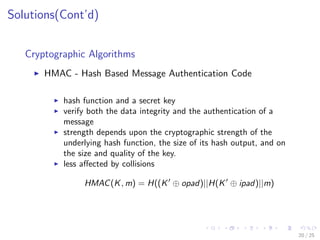
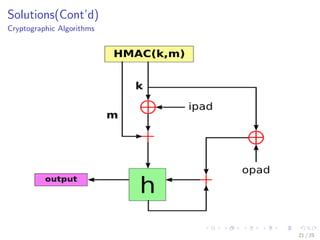
HMAC - Hash Based Message Authentication Code
hash function and a secret key
verify both the data integrity and the authentication of a
message
strength depends upon the cryptographic strength of the
underlying hash function, the size of its hash output, and on
the size and quality of the key.
less affected by collisions
HMAC(K, m) = H((K ⊕ opad)||H(K ⊕ ipad)||m)
20 / 25
Solutions(Cont’d)
Cryptographic Algorithms
21 / 25
Solutions(Cont’d)
Cryptographic Algorithms
22 / 25
Conclusion
Billions of devices are connected to the Internet
Companies behind these devices are not designing them with
security in mind
Leaving IoT devices unsecured, is like leaving the back door to
your house unlocked
Various solutions to security challenges were discussed
Cryptographic encrytpion techniques like ECC and HMAC can
be used to provide better protection
23 / 25
References
1. Aditya Parashar, Sachin Rishishwar Security Challanges In IoT
3rd International Conference on Advances in Electrical,
Electronics, Information, Communication and Bio-Informatics
(AEEICB17)
2. Ankush B. Pawar, Dr.Shashikant Ghumbre A survey on IoT
applications, security challenges, and counter measures 2016
International Conference on Computing, Analytics and
Security Trends (CAST)
3. Mohsen Hallaj Asghar RFID and EPC as key technology on
Internet of Things (IoT) IJCST Vol. 6, Iss ue 1, Jan - March
2015
4. Xiaolin Jia, Quanyuan Feng, Taihua Fan, Quanshui Lei1 RFID
Technology and Its Applications in Internet of Things (IOT)
978-1-4577-1415-3/12/2012 IEEE
24 / 25
25 / 25

Security challenges in IoT

  • 1.
    Security Challenges inIoT December 1, 2017 1 / 25
  • 2.
    Outline Introduction Technologies used inIoT RFID Technology EPC Technology Security Challenges in IoT Solutions Cryptographic Algorithms Conclusion References 2 / 25
  • 3.
    Introduction Definition Intelligent interactivity betweenhuman and things to exchange information and knowledge for new value creation 3 / 25
  • 4.
    Introduction (Cont’d) Smart systemsand Internet of Things are driven by a combination of 4 / 25
  • 5.
  • 6.
  • 7.
  • 8.
    Introduction (Cont’d) Applications Smart Home Wearables ConnectedCars Industrial Internet Smart Cities IoT in agriculture Smart Retail Energy Engagement IOT in Healthcare IoT in Poultry and Farming 8 / 25
  • 9.
    Outline Introduction Technologies used inIoT RFID Technology EPC Technology Security Challenges in IoT Solutions Cryptographic Algorithms Conclusion References 9 / 25
  • 10.
    Technologies used inIoT RFID Technology Radio Frequency Identification Technology Use of radio waves to read and capture information stored on a tag attached to an object 10 / 25
  • 11.
    Technologies used inIoT (Cont’d) Classifications for RFID tags Class 0/class 1 basic radio frequency (RF) passive capability tags are factory programmed Class 2 Additional functionality - encryption and read-write RF memory tags are user-programmable Class 3 Batteries are found on board that will power logic in the computer circuit longer range and broadband communications 11 / 25
  • 12.
    Technologies used inIoT (Cont’d) Classifications for RFID tags(Cont’d) Class 4 Active tags Peer-to-peer communications and additional sensing Class 5 contain enough power to activate other tags classified as a reader 12 / 25
  • 13.
    Outline Introduction Technologies used inIoT RFID Technology EPC Technology Security Challenges in IoT Solutions Cryptographic Algorithms Conclusion References 13 / 25
  • 14.
    Technologies used inIoT (Cont’d) EPC Technology Electronics Product Code Technology a universal identifier that provides a unique identity for every physical object anywhere in the world, for all time 14 / 25
  • 15.
    Technologies used inIoT (Cont’d) Electronics Product Code - 96 bits which is divided into four categories 15 / 25
  • 16.
    Security Challenges inIoT Key challenge areas are Access control Confidentiality Integrity Availability Privacy Standardization Data deluge 16 / 25
  • 17.
    Solutions Timely updation ofsoftware IoT devices are huge in number and it quite difficult to update these devices one by one High security codes Data loss can happen if the attacker cracks the code Devices must be connected to a central power station But if central power station reaches its empty level 17 / 25
  • 18.
    Outline Introduction Technologies used inIoT RFID Technology EPC Technology Security Challenges in IoT Solutions Cryptographic Algorithms Conclusion References 18 / 25
  • 19.
    Solutions(Cont’d) Cryptographic Algorithms ECC -Elliptic Curve Cryptography public-key Cryptography supports authenticated key exchange protocols smaller keys, cipher text and signature very fast key generation fast encryption and decryption uses less memory and CPU cycles An elliptic curve is a plane curve defined by an equation of the form y2 = x3 + ax + b 19 / 25
  • 20.
    Solutions(Cont’d) Cryptographic Algorithms HMAC -Hash Based Message Authentication Code hash function and a secret key verify both the data integrity and the authentication of a message strength depends upon the cryptographic strength of the underlying hash function, the size of its hash output, and on the size and quality of the key. less affected by collisions HMAC(K, m) = H((K ⊕ opad)||H(K ⊕ ipad)||m) 20 / 25
  • 21.
  • 22.
  • 23.
    Conclusion Billions of devicesare connected to the Internet Companies behind these devices are not designing them with security in mind Leaving IoT devices unsecured, is like leaving the back door to your house unlocked Various solutions to security challenges were discussed Cryptographic encrytpion techniques like ECC and HMAC can be used to provide better protection 23 / 25
  • 24.
    References 1. Aditya Parashar,Sachin Rishishwar Security Challanges In IoT 3rd International Conference on Advances in Electrical, Electronics, Information, Communication and Bio-Informatics (AEEICB17) 2. Ankush B. Pawar, Dr.Shashikant Ghumbre A survey on IoT applications, security challenges, and counter measures 2016 International Conference on Computing, Analytics and Security Trends (CAST) 3. Mohsen Hallaj Asghar RFID and EPC as key technology on Internet of Things (IoT) IJCST Vol. 6, Iss ue 1, Jan - March 2015 4. Xiaolin Jia, Quanyuan Feng, Taihua Fan, Quanshui Lei1 RFID Technology and Its Applications in Internet of Things (IOT) 978-1-4577-1415-3/12/2012 IEEE 24 / 25
  • 25.