1
Master: Mrs Hossein Nejhad
Researcher: Azar Larijani
 Spring 2018
2
Table Of Content
Abstract
Definition of shock wave
Definition of shock tube
Shock wave in chemical Kinetics . rate of dissociation of molecular bromine
Result
References
3
Abstract
In this presentation we tried to give a definition of shocked wave and shocked tube. and show
the diaphragm and clip that related to the subject. for the achievement best result in this
subject give some examples of Molecular Bromine.
About this subject we try to give useful information and have a good presentation for your with
guidance of our master mrs Hossein nejhad.
4
Definition Of Shock Wave
When the speed of a moving object in the medium becomes equal to the velocity of sound in
the medium the wave fronts can not escape from the source and pile up.this results in a large
and amplitude sound barrier. when the speed of the moving object or source exceeds the speed
of sound in the medium then the wave fronts lag behind the source forming a cone-shaped
region with the source at a vertex.the edge of the cone forms a supersonic wave front with and
unusually large amplitude called a “shock wave”.
5
Application Of Shock Waves
1. Match reflection of a shock wave is used to remove micron size dust particles from the
surface of silicon wafers.
2. Shock waves are used in medical therapy in orthopedics and for breaking kidney stones.
3. Shock waves are used in pencil industries to impregnate preservatives into wood slates.
6
Shock Wave /Boundary Layer Interaction In Shock Tube
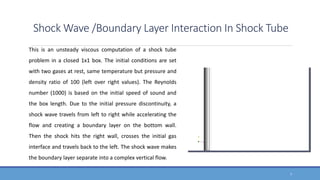
This is an unsteady viscous computation of a shock tube
problem in a closed 1x1 box. The initial conditions are set
with two gases at rest, same temperature but pressure and
density ratio of 100 (left over right values). The Reynolds
number (1000) is based on the initial speed of sound and
the box length. Due to the initial pressure discontinuity, a
shock wave travels from left to right while accelerating the
flow and creating a boundary layer on the bottom wall.
Then the shock hits the right wall, crosses the initial gas
interface and travels back to the left. The shock wave makes
the boundary layer separate into a complex vertical flow.
7
Definition Of Shock Tube
The shock tube is an instrument used to replicate and direct blast waves at a sensor or a model in order to
simulate actual explosions and their effects, usually on a smaller scale. Shock tubes (and related impulse
facilities such as shock tunnels, expansion tubes, and expansion tunnels) can also be used to study
aerodynamic flow under a wide range of temperatures and pressures that are difficult to obtain in other
types of testing facilities. Shock tubes are also used to investigate compressible flow phenomena and gas
phase combustion reactions .
8
The Clip Of Shock Tube
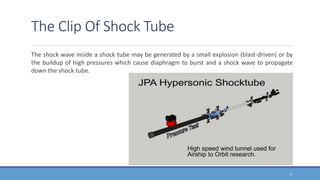
The shock wave inside a shock tube may be generated by a small explosion (blast-driven) or by
the buildup of high pressures which cause diaphragm to burst and a shock wave to propagate
down the shock tube.
9
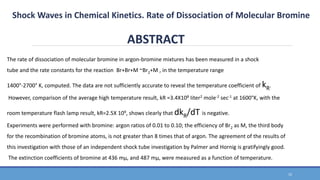
Shock Waves in Chemical Kinetics. Rate of Dissociation of Molecular Bromine
ABSTRACT
10
The rate of dissociation of molecular bromine in argon-bromine mixtures has been measured in a shock
tube and the rate constants for the reaction Br+Br+M ~Br2+M , in the temperature range
1400°-2700° K, computed. The data are not sufficiently accurate to reveal the temperature coefficient of kR.
However, comparison of the average high temperature result, kR =3.4X10⁸ Iiter2 mole-2 sec-1 at 1600°K, with the
room temperature flash lamp result, kR=2.5X 10⁹, shows clearly that dkR/dT is negative.
Experiments were performed with bromine: argon ratios of 0.01 to 0.10; the efficiency of Br2 as M, the third body
for the recombination of bromine atoms, is not greater than 8 times that of argon. The agreement of the results of
this investigation with those of an independent shock tube investigation by Palmer and Hornig is gratifyingly good.
The extinction coefficients of bromine at 436 mμ, and 487 mμ, were measured as a function of temperature.
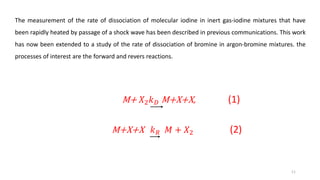
The measurement of the rate of dissociation of molecular iodine in inert gas-iodine mixtures that have
been rapidly heated by passage of a shock wave has been described in previous communications. This work
has now been extended to a study of the rate of dissociation of bromine in argon-bromine mixtures. the
processes of interest are the forward and revers reactions.
M+ 𝑋2 𝑘 𝐷 M+X+X, (1)
M+X+X 𝑘 𝑅 𝑀 + 𝑋2 (2)
11
Result:
Extinction coefficients of Broime
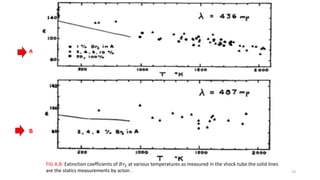
Some of the experimental results are displayed in Fig.A.B The scatter is about that
usually encountered in our shock wave experiments.
The data are compared to literature values of the extinction coefficients of bromine
vapor as a function of temperature.
12
13
A
B
FIG A,B: Extinction coefficients of 𝐵𝑟2 at various temperatures as measured in the shock tube.the solid lines
are the statics measurements by acton .
14
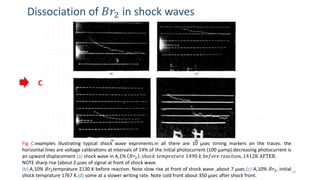
Dissociation of 𝐵𝑟2 in shock waves
Fig C:examples illustrating typical shock wave expriments.in all there are 10 µsec timing markers on the traces. the
horizontal lines are voltage calibrations at intervals of 14% of the initial photocurrent (100 µamp).decreasing photocurrent is
an upward displacement.(a) shock wave in A,1% 𝐵𝑟2 . 𝑠ℎ𝑜𝑐𝑘 𝑡𝑒𝑚𝑝𝑟𝑒𝑡𝑢𝑟𝑒 1490 𝑘 𝑏𝑒𝑓𝑜𝑟𝑒 𝑟𝑒𝑎𝑐𝑡𝑖𝑜𝑛, 1412K AFTER.
NOTE sharp rise (about 2 µsec of signal at front of shock wave.
(b):A,10% 𝐵𝑟2temprature 2130 K before reaction. Note slow rise at front of shock wave ,about 7 µsec.(c) A,10% 𝐵𝑟2, initial
shock temprature 1767 K.(d) some at a slower writing rate. Note cold front about 350 µsec after shock front.
C
Kinetics
15
D
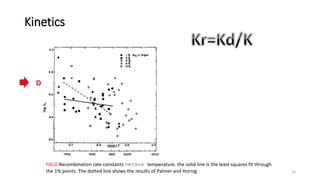
FIG D:Recombination rate constants versus temperature. the solid line is the least squares fit through
the 1% points. The dotted line shows the results of Palmer and Hornig
16
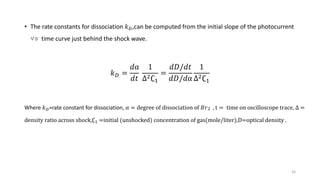
• The rate constants for dissociation 𝑘 𝐷,can be computed from the initial slope of the photocurrent
vs time curve just behind the shock wave.
𝑘 𝐷 =
𝑑α
𝑑𝑡
1
∆2∁1
=
𝑑𝐷/𝑑𝑡
𝑑𝐷/𝑑α
1
∆2∁1
Where 𝑘 𝐷=rate constant for dissociation, α = degree of dissociation of 𝐵𝑟2 , t = time on oscilloscope trace, ∆ =
density ratio across shock,∁1 =initial (unshocked) concentration of gas(mole/liter),D=optical density .
Results
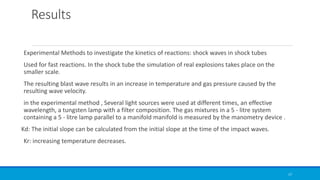
Experimental Methods to investigate the kinetics of reactions: shock waves in shock tubes
Used for fast reactions. In the shock tube the simulation of real explosions takes place on the
smaller scale.
The resulting blast wave results in an increase in temperature and gas pressure caused by the
resulting wave velocity.
in the experimental method , Several light sources were used at different times, an effective
wavelength, a tungsten lamp with a filter composition. The gas mixtures in a 5 - litre system
containing a 5 - litre lamp parallel to a manifold manifold is measured by the manometry device .
Kd: The initial slope can be calculated from the initial slope at the time of the impact waves.
Kr: increasing temperature decreases.
17
References
1.shock waves in chemical kinetics .rate of dissociation of molecular bromine.
Doyle Britton and Norman Davidson.
the journal of chemical physics 25,810(1956);doi:10.1063/1.1743128.
2.Wikipedia.org article,adapted under license.
https://creativecommons.org/license/by-sa/3.0/
3.Indian institute of technology madras.
Dr .Rinku Mukherjee .
Department of applied mechanics IIT madras.
18
19
Thanks your attention

Shock waves in shock tubes.

  • 1.
  • 2.
    Master: Mrs HosseinNejhad Researcher: Azar Larijani  Spring 2018 2
  • 3.
    Table Of Content Abstract Definitionof shock wave Definition of shock tube Shock wave in chemical Kinetics . rate of dissociation of molecular bromine Result References 3
  • 4.
    Abstract In this presentationwe tried to give a definition of shocked wave and shocked tube. and show the diaphragm and clip that related to the subject. for the achievement best result in this subject give some examples of Molecular Bromine. About this subject we try to give useful information and have a good presentation for your with guidance of our master mrs Hossein nejhad. 4
  • 5.
    Definition Of ShockWave When the speed of a moving object in the medium becomes equal to the velocity of sound in the medium the wave fronts can not escape from the source and pile up.this results in a large and amplitude sound barrier. when the speed of the moving object or source exceeds the speed of sound in the medium then the wave fronts lag behind the source forming a cone-shaped region with the source at a vertex.the edge of the cone forms a supersonic wave front with and unusually large amplitude called a “shock wave”. 5
  • 6.
    Application Of ShockWaves 1. Match reflection of a shock wave is used to remove micron size dust particles from the surface of silicon wafers. 2. Shock waves are used in medical therapy in orthopedics and for breaking kidney stones. 3. Shock waves are used in pencil industries to impregnate preservatives into wood slates. 6
  • 7.
    Shock Wave /BoundaryLayer Interaction In Shock Tube This is an unsteady viscous computation of a shock tube problem in a closed 1x1 box. The initial conditions are set with two gases at rest, same temperature but pressure and density ratio of 100 (left over right values). The Reynolds number (1000) is based on the initial speed of sound and the box length. Due to the initial pressure discontinuity, a shock wave travels from left to right while accelerating the flow and creating a boundary layer on the bottom wall. Then the shock hits the right wall, crosses the initial gas interface and travels back to the left. The shock wave makes the boundary layer separate into a complex vertical flow. 7
  • 8.
    Definition Of ShockTube The shock tube is an instrument used to replicate and direct blast waves at a sensor or a model in order to simulate actual explosions and their effects, usually on a smaller scale. Shock tubes (and related impulse facilities such as shock tunnels, expansion tubes, and expansion tunnels) can also be used to study aerodynamic flow under a wide range of temperatures and pressures that are difficult to obtain in other types of testing facilities. Shock tubes are also used to investigate compressible flow phenomena and gas phase combustion reactions . 8
  • 9.
    The Clip OfShock Tube The shock wave inside a shock tube may be generated by a small explosion (blast-driven) or by the buildup of high pressures which cause diaphragm to burst and a shock wave to propagate down the shock tube. 9
  • 10.
    Shock Waves inChemical Kinetics. Rate of Dissociation of Molecular Bromine ABSTRACT 10 The rate of dissociation of molecular bromine in argon-bromine mixtures has been measured in a shock tube and the rate constants for the reaction Br+Br+M ~Br2+M , in the temperature range 1400°-2700° K, computed. The data are not sufficiently accurate to reveal the temperature coefficient of kR. However, comparison of the average high temperature result, kR =3.4X10⁸ Iiter2 mole-2 sec-1 at 1600°K, with the room temperature flash lamp result, kR=2.5X 10⁹, shows clearly that dkR/dT is negative. Experiments were performed with bromine: argon ratios of 0.01 to 0.10; the efficiency of Br2 as M, the third body for the recombination of bromine atoms, is not greater than 8 times that of argon. The agreement of the results of this investigation with those of an independent shock tube investigation by Palmer and Hornig is gratifyingly good. The extinction coefficients of bromine at 436 mμ, and 487 mμ, were measured as a function of temperature.
  • 11.
    The measurement ofthe rate of dissociation of molecular iodine in inert gas-iodine mixtures that have been rapidly heated by passage of a shock wave has been described in previous communications. This work has now been extended to a study of the rate of dissociation of bromine in argon-bromine mixtures. the processes of interest are the forward and revers reactions. M+ 𝑋2 𝑘 𝐷 M+X+X, (1) M+X+X 𝑘 𝑅 𝑀 + 𝑋2 (2) 11
  • 12.
    Result: Extinction coefficients ofBroime Some of the experimental results are displayed in Fig.A.B The scatter is about that usually encountered in our shock wave experiments. The data are compared to literature values of the extinction coefficients of bromine vapor as a function of temperature. 12
  • 13.
    13 A B FIG A,B: Extinctioncoefficients of 𝐵𝑟2 at various temperatures as measured in the shock tube.the solid lines are the statics measurements by acton .
  • 14.
    14 Dissociation of 𝐵𝑟2in shock waves Fig C:examples illustrating typical shock wave expriments.in all there are 10 µsec timing markers on the traces. the horizontal lines are voltage calibrations at intervals of 14% of the initial photocurrent (100 µamp).decreasing photocurrent is an upward displacement.(a) shock wave in A,1% 𝐵𝑟2 . 𝑠ℎ𝑜𝑐𝑘 𝑡𝑒𝑚𝑝𝑟𝑒𝑡𝑢𝑟𝑒 1490 𝑘 𝑏𝑒𝑓𝑜𝑟𝑒 𝑟𝑒𝑎𝑐𝑡𝑖𝑜𝑛, 1412K AFTER. NOTE sharp rise (about 2 µsec of signal at front of shock wave. (b):A,10% 𝐵𝑟2temprature 2130 K before reaction. Note slow rise at front of shock wave ,about 7 µsec.(c) A,10% 𝐵𝑟2, initial shock temprature 1767 K.(d) some at a slower writing rate. Note cold front about 350 µsec after shock front. C
  • 15.
    Kinetics 15 D FIG D:Recombination rateconstants versus temperature. the solid line is the least squares fit through the 1% points. The dotted line shows the results of Palmer and Hornig
  • 16.
    16 • The rateconstants for dissociation 𝑘 𝐷,can be computed from the initial slope of the photocurrent vs time curve just behind the shock wave. 𝑘 𝐷 = 𝑑α 𝑑𝑡 1 ∆2∁1 = 𝑑𝐷/𝑑𝑡 𝑑𝐷/𝑑α 1 ∆2∁1 Where 𝑘 𝐷=rate constant for dissociation, α = degree of dissociation of 𝐵𝑟2 , t = time on oscilloscope trace, ∆ = density ratio across shock,∁1 =initial (unshocked) concentration of gas(mole/liter),D=optical density .
  • 17.
    Results Experimental Methods toinvestigate the kinetics of reactions: shock waves in shock tubes Used for fast reactions. In the shock tube the simulation of real explosions takes place on the smaller scale. The resulting blast wave results in an increase in temperature and gas pressure caused by the resulting wave velocity. in the experimental method , Several light sources were used at different times, an effective wavelength, a tungsten lamp with a filter composition. The gas mixtures in a 5 - litre system containing a 5 - litre lamp parallel to a manifold manifold is measured by the manometry device . Kd: The initial slope can be calculated from the initial slope at the time of the impact waves. Kr: increasing temperature decreases. 17
  • 18.
    References 1.shock waves inchemical kinetics .rate of dissociation of molecular bromine. Doyle Britton and Norman Davidson. the journal of chemical physics 25,810(1956);doi:10.1063/1.1743128. 2.Wikipedia.org article,adapted under license. https://creativecommons.org/license/by-sa/3.0/ 3.Indian institute of technology madras. Dr .Rinku Mukherjee . Department of applied mechanics IIT madras. 18
  • 19.