Internship Report on Quality Control of Drugs
Presented By Menail Sajid
Contents
• Introduction to Drug Testing Laboratory
• Building and equipment
• Establishment & objectives
• Performance
• Pictorial presentation
• My findings about this Internship activity
• Conclusion
• References
Introduction to DTL
• Section 15 of the Drugs Act, 1976 requires that:-
• “Each Provincial Government shall, as soon as may be, set up a Provincial
Drugs Testing Laboratory for such purposes as may be prescribed”
• Drugs Testing Laboratory, is established and functioning under Section 15 of the
Drugs Act, 1976 at Chitterpari Mirpur AJK.
Building and equipment
• DTL is housed in a two story building, specially designed for the purpose.
• It has approximately 10,700 Sq. Ft. covered area.
• Cost of civil work was 11.055 Million
Establishment and objectives
• Construction Work Completed in 2008
• Shifted on Normal Budget in 2010
• Inaugurated on 13th May 2011
Objectives
• Safeguard Public Health by monitoring Quality of medicines available in the
Market and Supplies made to the Government.
• Assist AJK Quality Control Board to take legal actions against the firms or
individuals involved in the manufacture or sale of Sub-standard and Spurious
medicines.
• Implementation of Section 15 of the Drugs Act, 1976.
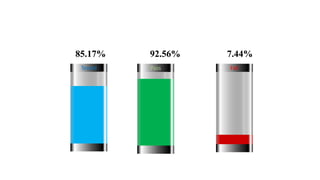
85.17% 92.56% 7.44%
Tested Pass Fail
Physical Inspection of tablets/Syrups/Injections
• Proper sealing and labelling (brand name, API, type of formulation (syrup or
suspension), volume in ml, and flavor (Orange, banana)
• Description (Type of container (Plastic or glass bottle), Color of container (Clear
or amber)
• Volume (Weighing balance)
• pH (pH meter)
• For powdered drug (color of powder, type of container, type of powder, color of
solution after reconstitution), volume of soln. after reconstitution
Physical tests
• Weight variation test
• Hardness test
• Friability test
• Disintegration test
• Dissolution test
• Sonicator
Weight variation test
• Main purpose for performing this test is to check that claimed strength is
actually present in the formulation or not.
• I was given with a blister and asked to take five readings for it.
• I took tablets out of blister one by one, place them on apparatus after
tearing the balance and note down the readings for five tablets.
• I tare apparatus every time after weighing a tablet.
0.192g, 0.193g, 0.195g, 0.201g, 0.195g, 0.1952
X= Average value× Maximum value÷ 100
= 0.1952× 0.201÷ 100= 3.923× 10-04
Y= Average value× Minimum value÷ 100
= 0.1952× 0.192÷ 100= 3.747×10-04
X1= X+Y
= 3.923×10-04+ 3.747×10-04
= 7.6705×10-04
X2= X-Y
= 3.923×10-04-3.747×10-04
=0.176×10-04
Percentage= X1÷X2×100
= 7.6705×10-04÷0.176×10-04×100
= 04%
Friability test
• This test is done to check the loss of solid dosage form while
traveling from producer to end user.
• I was given with 10 tablets. I weight them collectively by using
weighing balance. This is W1.
• I turn ON the apparatus and set rotations at 25 revolutions per
minutes for 04 minutes.
• I place tablets inside the test apparatus and start the apparatus
by pressing start button.
• After 04 minutes, when machine complete its 100 revolutions,
I press stop button and took tablets out of the machine.
• I weigh them and note down the reading as W2.
• I then use formula and find out the %age of loss.
Hardness test
• This is used to check the strength/hardness of tablets.
• I was given with an unknown white oblong tablet.
• I turn on the apparatus, wait until machine shows “Ready to Use”
I place tablet inside the apparatus.
• I press start button and wait until breakage of the tablet.
• I note down the value shown on the machine and repeat this for
different tablets from same blister.
Disintegration test
• This test is done to check the time taken by any tablet or capsule to dissolve
in solvent and become available for the body.
• I turn on the disintegration test apparatus.
• Put solvent inside the apparatus. Temperature can range from 36-39˚C for this test.
• I took basket of disintegration test apparatus out of the apparatus and place
formulation (tablet/capsule) inside it.
• I press “START” button and note down the DT.
• I keeps on observing until no residue left in basket.
Sonicator
• It is a dissolving apparatus which is used to dissolve drugs by providing
high shaking.
• It is used to dissolve those drugs that could not be dissolved mechanically.
• It is filled with dis.H2O.
• I put flask containing drug and its relevant solvent into it.
• I turn ON the apparatus.
Chemical tests
• Titration
• To find out percentage of iron in drug
• Elemental calcium ion titration
• Titration inside fume hood
• Spectrophotometry
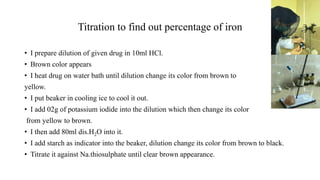
Titration to find out percentage of iron
• I prepare dilution of given drug in 10ml HCl.
• Brown color appears
• I heat drug on water bath until dilution change its color from brown to
yellow.
• I put beaker in cooling ice to cool it out.
• I add 02g of potassium iodide into the dilution which then change its color
from yellow to brown.
• I then add 80ml dis.H2O into it.
• I add starch as indicator into the beaker, dilution change its color from brown to black.
• Titrate it against Na.thiosulphate until clear brown appearance.
• Percentage= Volume× Force÷ Stated amount× 100
• As readings were always confidential, so let’s suppose the readings are;
01ml of 0.1N sodium thiosulfate= 5.58 mg of iron
Percentage= 17× 5.58÷100×100
= 94.6%
• According to USP 90-110% while according to BP 95-105% active should be
present in the given formulation. So, drug approve for this test.
Elemental calcium ion titration
• I put 30ml EDTA as titration solvent in burette.
• I prepare 02M HCl, weigh 60mg drug and dissolve it in 02M HCl.
• I add dis.H2O into and make total volume 20ml.
• I add 12ml ammonium chloride and 50mg mordent black
(indicator).
• Solution show caramel brown.
• I start titrating it till solution change its color from caramel brown to
clear brown
Calculations
Percentage= Volume× Force÷ Stated amount× 100
01ml of EDTA= 4.008mg
Volume= 12 liter
Force= 4.008N
Stated amount= 60
Percentage= 12× 4.008÷60× 100
= 80%
So, drug fails in this test.
Titration inside fume hood
• I took a flask and prepare dilution of drug by dissolving 50mg drug in 5oml
of acetic acid. A colorless solution forms.
• I add 01-02 drops of crystal violet dye into it. Solution change its color
from transparent to blue.
• I titrate solution with per-chloric acid till solution change its color from
blue to yellow
Spectrophotometry
• I turn “ON” the apparatus and set lambda at 240nm.
• Solvent used is 0.1N HCl.
• I weigh 10 tablets (given) on weighing balance i.e. 0.313g.
• I ground tablets and again weight the powder i.e. 0.311g.
• I make dilution of given drug in HCl (0.1N) by dissolving 0.311g of
drug in HCl.
• Similarly I prepare 50ml dilution for standard in another 50ml flask.
• I calibrate apparatus and set lambda by pressing “GOTO” button.
• I took cuvettes out, rinse with solvent and put it back to the spectrophotometer
• I set it at auto zero and took cuvette out of the apparatus.
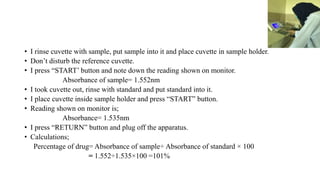
• I rinse cuvette with sample, put sample into it and place cuvette in sample holder.
• Don’t disturb the reference cuvette.
• I press “START’ button and note down the reading shown on monitor.
Absorbance of sample= 1.552nm
• I took cuvette out, rinse with standard and put standard into it.
• I place cuvette inside sample holder and press “START” button.
• Reading shown on monitor is;
Absorbance= 1.535nm
• I press “RETURN” button and plug off the apparatus.
• Calculations;
Percentage of drug= Absorbance of sample÷ Absorbance of standard × 100
= 1.552÷1.535×100 =101%
Microbial test
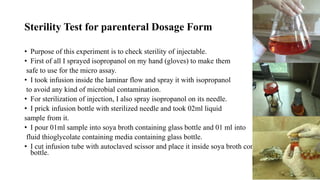
Sterility Test for parenteral Dosage Form
• Purpose of this experiment is to check sterility of injectable.
• First of all I sprayed isopropanol on my hand (gloves) to make them
safe to use for the micro assay.
• I took infusion inside the laminar flow and spray it with isopropanol
to avoid any kind of microbial contamination.
• For sterilization of injection, I also spray isopropanol on its needle.
• I prick infusion bottle with sterilized needle and took 02ml liquid
sample from it.
• I pour 01ml sample into soya broth containing glass bottle and 01 ml into
fluid thioglycolate containing media containing glass bottle.
• I cut infusion tube with autoclaved scissor and place it inside soya broth containing media
bottle.
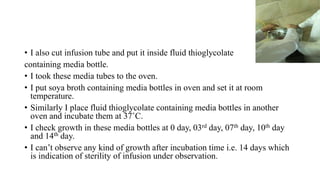
• I also cut infusion tube and put it inside fluid thioglycolate
containing media bottle.
• I took these media tubes to the oven.
• I put soya broth containing media bottles in oven and set it at room
temperature.
• Similarly I place fluid thioglycolate containing media bottles in another
oven and incubate them at 37˚C.
• I check growth in these media bottles at 0 day, 03rd day, 07th day, 10th day
and 14th day.
• I can’t observe any kind of growth after incubation time i.e. 14 days which
is indication of sterility of infusion under observation.
My findings about this Internship activity
• I spent a very valuable time at DTL with a lot of findings about the laboratory.
Some of my extremely interested findings are; first and foremost the level of
neatness of the laboratory was delightfully incomparable. Second, the expertise of
laboratory technicians were matchless. I am really impressed by the behavior of
the staff with me (internee), the way they are always available for my help and
guidance was extremely scenic and unable to be equaled. I am very much
impressed by the Director Drug Controller, Dr. Zafar Iqbal, who instead of his
challenging routine arrange a meeting for all internees along with their respective
supervisor to his office and discuss our progress with them. Last but not the least,
my final intensively interesting finding, the brunch served at the lab, highly
pleasant to taste and unforgettable.
Conclusion
• I would like to conclude this research report by the statement that this internship
enables me to be professional in the sense of dealing with other internee and staff
at laboratory, to effectively communicate with other fellows and to safely deal
with instruments and chemicals inside laboratory. Pharmaceutical laboratories are
an excellent opportunities for the students of biotechnology to work with. My
experience with Drug Testing Laboratory is excellent and I will suggest
biotechnologists to go and work with these kind of laboratories. My duration at
laboratory helps me to learn how to deal with drugs, how to test them, how to deal
with standards, how to deal with other learners etc. This training session would be
very advantageous for my upcoming future in several ways. In short it was an
excellent experience for me, I want to go back and learn more.
References
• 1. J. S. Swarbrick, Encyclopedia of Pharmaceutical Technology, Third Edition - 6
Volume Set,
• Taylor & Francis, 2006.
• 2. ENCYCLOPEDIA OF LIFE SCIENCES & 2010, John Wiley & Sons, Ltd.
www.els.net
• 3. IPQC for Parenterals or Sterile Dosage Forms | Mr. Sagar Kishor Savale

Presentation on quality control tests

  • 1.
    Internship Report onQuality Control of Drugs Presented By Menail Sajid
  • 2.
    Contents • Introduction toDrug Testing Laboratory • Building and equipment • Establishment & objectives • Performance • Pictorial presentation • My findings about this Internship activity • Conclusion • References
  • 3.
    Introduction to DTL •Section 15 of the Drugs Act, 1976 requires that:- • “Each Provincial Government shall, as soon as may be, set up a Provincial Drugs Testing Laboratory for such purposes as may be prescribed” • Drugs Testing Laboratory, is established and functioning under Section 15 of the Drugs Act, 1976 at Chitterpari Mirpur AJK.
  • 4.
    Building and equipment •DTL is housed in a two story building, specially designed for the purpose. • It has approximately 10,700 Sq. Ft. covered area. • Cost of civil work was 11.055 Million
  • 5.
    Establishment and objectives •Construction Work Completed in 2008 • Shifted on Normal Budget in 2010 • Inaugurated on 13th May 2011 Objectives • Safeguard Public Health by monitoring Quality of medicines available in the Market and Supplies made to the Government. • Assist AJK Quality Control Board to take legal actions against the firms or individuals involved in the manufacture or sale of Sub-standard and Spurious medicines. • Implementation of Section 15 of the Drugs Act, 1976.
  • 6.
  • 7.
    Physical Inspection oftablets/Syrups/Injections • Proper sealing and labelling (brand name, API, type of formulation (syrup or suspension), volume in ml, and flavor (Orange, banana) • Description (Type of container (Plastic or glass bottle), Color of container (Clear or amber) • Volume (Weighing balance) • pH (pH meter) • For powdered drug (color of powder, type of container, type of powder, color of solution after reconstitution), volume of soln. after reconstitution
  • 8.
    Physical tests • Weightvariation test • Hardness test • Friability test • Disintegration test • Dissolution test • Sonicator
  • 9.
    Weight variation test •Main purpose for performing this test is to check that claimed strength is actually present in the formulation or not. • I was given with a blister and asked to take five readings for it. • I took tablets out of blister one by one, place them on apparatus after tearing the balance and note down the readings for five tablets. • I tare apparatus every time after weighing a tablet.
  • 10.
    0.192g, 0.193g, 0.195g,0.201g, 0.195g, 0.1952 X= Average value× Maximum value÷ 100 = 0.1952× 0.201÷ 100= 3.923× 10-04 Y= Average value× Minimum value÷ 100 = 0.1952× 0.192÷ 100= 3.747×10-04 X1= X+Y = 3.923×10-04+ 3.747×10-04 = 7.6705×10-04 X2= X-Y = 3.923×10-04-3.747×10-04 =0.176×10-04 Percentage= X1÷X2×100 = 7.6705×10-04÷0.176×10-04×100 = 04%
  • 11.
    Friability test • Thistest is done to check the loss of solid dosage form while traveling from producer to end user. • I was given with 10 tablets. I weight them collectively by using weighing balance. This is W1. • I turn ON the apparatus and set rotations at 25 revolutions per minutes for 04 minutes. • I place tablets inside the test apparatus and start the apparatus by pressing start button. • After 04 minutes, when machine complete its 100 revolutions, I press stop button and took tablets out of the machine. • I weigh them and note down the reading as W2. • I then use formula and find out the %age of loss.
  • 12.
    Hardness test • Thisis used to check the strength/hardness of tablets. • I was given with an unknown white oblong tablet. • I turn on the apparatus, wait until machine shows “Ready to Use” I place tablet inside the apparatus. • I press start button and wait until breakage of the tablet. • I note down the value shown on the machine and repeat this for different tablets from same blister.
  • 13.
    Disintegration test • Thistest is done to check the time taken by any tablet or capsule to dissolve in solvent and become available for the body. • I turn on the disintegration test apparatus. • Put solvent inside the apparatus. Temperature can range from 36-39˚C for this test. • I took basket of disintegration test apparatus out of the apparatus and place formulation (tablet/capsule) inside it. • I press “START” button and note down the DT. • I keeps on observing until no residue left in basket.
  • 14.
    Sonicator • It isa dissolving apparatus which is used to dissolve drugs by providing high shaking. • It is used to dissolve those drugs that could not be dissolved mechanically. • It is filled with dis.H2O. • I put flask containing drug and its relevant solvent into it. • I turn ON the apparatus.
  • 15.
    Chemical tests • Titration •To find out percentage of iron in drug • Elemental calcium ion titration • Titration inside fume hood • Spectrophotometry
  • 16.
    Titration to findout percentage of iron • I prepare dilution of given drug in 10ml HCl. • Brown color appears • I heat drug on water bath until dilution change its color from brown to yellow. • I put beaker in cooling ice to cool it out. • I add 02g of potassium iodide into the dilution which then change its color from yellow to brown. • I then add 80ml dis.H2O into it. • I add starch as indicator into the beaker, dilution change its color from brown to black. • Titrate it against Na.thiosulphate until clear brown appearance.
  • 17.
    • Percentage= Volume×Force÷ Stated amount× 100 • As readings were always confidential, so let’s suppose the readings are; 01ml of 0.1N sodium thiosulfate= 5.58 mg of iron Percentage= 17× 5.58÷100×100 = 94.6% • According to USP 90-110% while according to BP 95-105% active should be present in the given formulation. So, drug approve for this test.
  • 18.
    Elemental calcium iontitration • I put 30ml EDTA as titration solvent in burette. • I prepare 02M HCl, weigh 60mg drug and dissolve it in 02M HCl. • I add dis.H2O into and make total volume 20ml. • I add 12ml ammonium chloride and 50mg mordent black (indicator). • Solution show caramel brown. • I start titrating it till solution change its color from caramel brown to clear brown
  • 19.
    Calculations Percentage= Volume× Force÷Stated amount× 100 01ml of EDTA= 4.008mg Volume= 12 liter Force= 4.008N Stated amount= 60 Percentage= 12× 4.008÷60× 100 = 80% So, drug fails in this test.
  • 20.
    Titration inside fumehood • I took a flask and prepare dilution of drug by dissolving 50mg drug in 5oml of acetic acid. A colorless solution forms. • I add 01-02 drops of crystal violet dye into it. Solution change its color from transparent to blue. • I titrate solution with per-chloric acid till solution change its color from blue to yellow
  • 21.
    Spectrophotometry • I turn“ON” the apparatus and set lambda at 240nm. • Solvent used is 0.1N HCl. • I weigh 10 tablets (given) on weighing balance i.e. 0.313g. • I ground tablets and again weight the powder i.e. 0.311g. • I make dilution of given drug in HCl (0.1N) by dissolving 0.311g of drug in HCl. • Similarly I prepare 50ml dilution for standard in another 50ml flask. • I calibrate apparatus and set lambda by pressing “GOTO” button. • I took cuvettes out, rinse with solvent and put it back to the spectrophotometer • I set it at auto zero and took cuvette out of the apparatus.
  • 22.
    • I rinsecuvette with sample, put sample into it and place cuvette in sample holder. • Don’t disturb the reference cuvette. • I press “START’ button and note down the reading shown on monitor. Absorbance of sample= 1.552nm • I took cuvette out, rinse with standard and put standard into it. • I place cuvette inside sample holder and press “START” button. • Reading shown on monitor is; Absorbance= 1.535nm • I press “RETURN” button and plug off the apparatus. • Calculations; Percentage of drug= Absorbance of sample÷ Absorbance of standard × 100 = 1.552÷1.535×100 =101%
  • 23.
  • 24.
    Sterility Test forparenteral Dosage Form • Purpose of this experiment is to check sterility of injectable. • First of all I sprayed isopropanol on my hand (gloves) to make them safe to use for the micro assay. • I took infusion inside the laminar flow and spray it with isopropanol to avoid any kind of microbial contamination. • For sterilization of injection, I also spray isopropanol on its needle. • I prick infusion bottle with sterilized needle and took 02ml liquid sample from it. • I pour 01ml sample into soya broth containing glass bottle and 01 ml into fluid thioglycolate containing media containing glass bottle. • I cut infusion tube with autoclaved scissor and place it inside soya broth containing media bottle.
  • 25.
    • I alsocut infusion tube and put it inside fluid thioglycolate containing media bottle. • I took these media tubes to the oven. • I put soya broth containing media bottles in oven and set it at room temperature. • Similarly I place fluid thioglycolate containing media bottles in another oven and incubate them at 37˚C. • I check growth in these media bottles at 0 day, 03rd day, 07th day, 10th day and 14th day. • I can’t observe any kind of growth after incubation time i.e. 14 days which is indication of sterility of infusion under observation.
  • 26.
    My findings aboutthis Internship activity • I spent a very valuable time at DTL with a lot of findings about the laboratory. Some of my extremely interested findings are; first and foremost the level of neatness of the laboratory was delightfully incomparable. Second, the expertise of laboratory technicians were matchless. I am really impressed by the behavior of the staff with me (internee), the way they are always available for my help and guidance was extremely scenic and unable to be equaled. I am very much impressed by the Director Drug Controller, Dr. Zafar Iqbal, who instead of his challenging routine arrange a meeting for all internees along with their respective supervisor to his office and discuss our progress with them. Last but not the least, my final intensively interesting finding, the brunch served at the lab, highly pleasant to taste and unforgettable.
  • 27.
    Conclusion • I wouldlike to conclude this research report by the statement that this internship enables me to be professional in the sense of dealing with other internee and staff at laboratory, to effectively communicate with other fellows and to safely deal with instruments and chemicals inside laboratory. Pharmaceutical laboratories are an excellent opportunities for the students of biotechnology to work with. My experience with Drug Testing Laboratory is excellent and I will suggest biotechnologists to go and work with these kind of laboratories. My duration at laboratory helps me to learn how to deal with drugs, how to test them, how to deal with standards, how to deal with other learners etc. This training session would be very advantageous for my upcoming future in several ways. In short it was an excellent experience for me, I want to go back and learn more.
  • 28.
    References • 1. J.S. Swarbrick, Encyclopedia of Pharmaceutical Technology, Third Edition - 6 Volume Set, • Taylor & Francis, 2006. • 2. ENCYCLOPEDIA OF LIFE SCIENCES & 2010, John Wiley & Sons, Ltd. www.els.net • 3. IPQC for Parenterals or Sterile Dosage Forms | Mr. Sagar Kishor Savale