ASEPTIC PROCESS
TECHNOLOGY
by
DURGALAKSHMI
M.PHARM QUALITY ASSURANCE
CONTENTS
 Aseptic processing
 Manufacturing in aseptic process
 In process quality control test for;
ointments
Suspension
Emulsion
Powders
solution
ASEPTIC PROCESSING
Sterile products which cannot receive a post filling lethal treatment
because the product ,container cannot withstand terminal sterilization
treatments.
Aseptic processing of the drug product , container, and closure are
subjected to sterilisation processes separately and then brought together in
clean room environment to create the finished product.
ASEPTIC PROCESSING
Manufacturing of the product and the
requirements
TABLETS
CONTAINERS
CLOSURES
sterilization
sterilization
sterilization
Sterile drug
product
Sterile container
Sterile closure
Aseptic
processing
Sterile drug
product
INPR0CESS QUALITY CONTROL
IPQC means controlling the procedure involved in manufacturing of the
dosage forms starting from raw material purchase to dispatch of the
quality product in ideal packaging.
It monitors all the features of the product that may affect its quality and
prevent errors during processing.
It is the activity performed between QA and QC.
INPROCESS QUALITY CONTROL TEST
Ointment
Suspension
Emulsion
Dry powder
Solution(large volume and small volume)
INPROCESS QUALITY
CONTROL TEST
OINTMENTS
PHYSICAL APPEARANCE
The main characteristics need to be checked are :
 Cracking of creams (separation of oil and water)
 Development of granular and lumpy appearance
 Marked change in viscosity
 Crystal growth
 Microbial contamination
PARTICLE SIZE DETERMINATION
 Dilute a suitable quantity of preparation with equal volume of glycerol or
liquid paraffin, as specified .
 Mount on a glass slide and examine under light microscope.
 Count the number of particles with diameter above or below than that
specified in monograph.
 Compare the percentage with official limits.
SOLUBILITY TEST
The preparation should be soluble in 9 parts of water and 1.7 parts of hot
water
 The preparation should be miscible with alcohol, ether and chloroform
WEIGHT VARIATION
 Applies to those products in which labeled net weight is not more than 150g
 Select 10 filled containers, remove the label, clean and weigh individually
 Remove the contents by cutting the containers and wash with suitable solvent
WEIGHT VARIATION
 Dry and again weigh each empty container together with its
corresponding part, take difference as weight of contents.
 The average net weight of contents of 10 containers should not be less
than the labeled amount
 The net weight of contents of any single container should not be less than
90% of the labeled amount (for ≤ 60g)
WEIGHT VARIATION
 And not less than 95% of the labeled amount (60-150g)
 If this requirement is not met repeat this procedures taking additional 20
containers
 The average net weight of contents of 30 containers should not be less
than labeled amount
WEIGHT VARIATION
 Contents of not more than 1 of the 30 units should be less than 90% of the
stated amount (for ≤ 60g)
 And not less than 95% of the labeled amount (60-150g)
VISCOSITY DETERMINATION
The viscometer calibrated to measure the apparent viscosity of the
disperse system at a given temperature .
Consistency type: plastic flow, spreadable
Approximate viscosity:300000-1000000.
ACTIVE INGREDIENTS
 Assay of active ingredients should be performed according to monograph
 Percentage contents should be within the official limits
MICROBIAL CONTAMINATION
Microorganisms can grow, if no preservative is added, or even if added, its
efficiency is reduced due to interaction with other ingredients.
 Microorganisms may get into the preparation during handling and storage
 Therefore, aseptic technique of handling is needed.
Antimicrobial assay should be performed according to official monograph,
usually,
– Direct inoculation method
– Membrane filtration method
METAL PARTICLE IN OPTHALMIC
OINTMENTS
 Extrude completely the contents of 10 containers separately into flat bottom
Petri dishes
Cover, heat at 85oC for 2 h and cool slowly to solidify
 Remove the cover and invert on the stage of microscope adjusted to 30 times
magnification and equipped with eye-piece micrometer disk calibrated for this
magnification.
 Additional illuminator may also used
 Examine the entire bottom of Petri dish for metal particles.
METAL PARTICLE IN OPTHALMIC
OINTMENTS
 Count the metal particles of 50µm or larger
 The requirement is met if total number of such particles in all 10 tubes
does not exceed 50
 Not more than 1 tube contains more than 8 such particles
 If not, repeat with 20 more tubes
 The requirement is met if total number of such particles in 30 tubes is not
more than 150
 And not more than 3 containers allowed to contain more than 8 particles.
INPROCESS QUALITY CONTROL
TEST
SUSPENSION
APPEARANCE
It must appear uniform and elegant .
Particles of suspension should be well distributed.
No hard cake formation of particles
COLOUR,ODOUR,TASTE
Variation in colour often indicates poor distribution and/or differences in particle
size.
Variation in taste, especially of active constituents can often be attributed to
changes in particle size, crystal habit and subsequent particle dissolution.
 Change in colour, odour and taste can also indicates chemical instability.
DENSITY
Density of the suspension is an important parameter. Decrease in density
indicates the presence of entrapped air with in the structure of the
suspension.
Hydrometers are used to measure the density
PH VALUE
pH of the phases of suspension also contribute to stability and characteristics of
formulations.
 So pH of the different vehicles, phases of suspension before mixing and after
mixing are monitored and recorded time to time to ensure optimum pH
environment being maintained.
 Different types of methods are used in the measurement of pH ,
a)Dip a piece of pH paper into the sample
b) PH meter
CLARITY TEST
Clarity testing is carried out to check the particulate matter in the sample.
POURABILITY
This test is carried out on the phases of suspension after mixing to ensure
that the final preparation is pourable and will not cause any problem
during filling and handling of patient.
VISCOSITY DETERMINATION
The viscosity can be measured by;
a)cup and bob viscometer
b)cone and plate viscometer
PARTICLE SIZE
As the particle size is reduced they tend to exhibit Brownian movement.
So it is necessary to choose the optimum particle size for maximum
stability
DRUG CONTENT UNIFORMITY
For proper dosing of the dosage form it is necessary that the active
ingredient is uniformly distributed throughout the dosage form.so samples
are withdrawn from the dispersed phase after micronization and after
mixing with dispersion medium, ASSAYED to find out degree of
homogeneity.
If any discrepancy is found out it is suitably correct mixing step to ensure
a reliable dosage formulation by monitoring the mixing step to ensure a
reliable dosage formulation.
INPROCESS QUALITY CONTROL
TEST
EMULSION
PARTICLE SIZE DISTRIBUTION
Globules of uniform size impart maximum stability.
In such emulsions globules pack loosely and globule to globule contact is
less.
Globule distribution is effected by viscosity, phase volume ratio, density
of phases etc.
An optimum degree of size distribution range should be chosen to
achieve maximum physical stability
INPROCESS QUALITY CONTROL
TEST
POWDERS
PARTICLE SIZE AND SHAPE
DETERMINATION
The size and shape depends upon processing requirements during granulation.
Size affects the average weight of tablet, disintegration time, weight
variation, friability, flowability and drying rate.
The methods for determining size and shape are:
Sieving
Sedimentation rate
Microscopy (SEM)
By light Scattering
SURFACE AREA
It is not commonly used for granules but generally used for drug
substances.
 If required particle size is measured and from this surface area is
measured
 Mostly used method are gas adsorption method and air permeability
method.
DENSITY
Density may influence compressibility, tablet porosity and dissolution.
Dense granules have less friability but cause a problem in releasing the
problem.
FLOW PROPERTIES
It is an ability of the granule to flow from hopper to die cavity for tablet
uniformity
If flow property of granules are not uniform we are not getting
tablet of uniform size
 Flow property of material results from many forces:
1. Frictional force
2. Surface tension force
3. Mechanical force caused by interlocking of irregular shape particles
FLOW PROPERTIES
4.Electrostatic forces.
5.Cohesive/ Vander Waals forces.
FLOW PROPERTIES
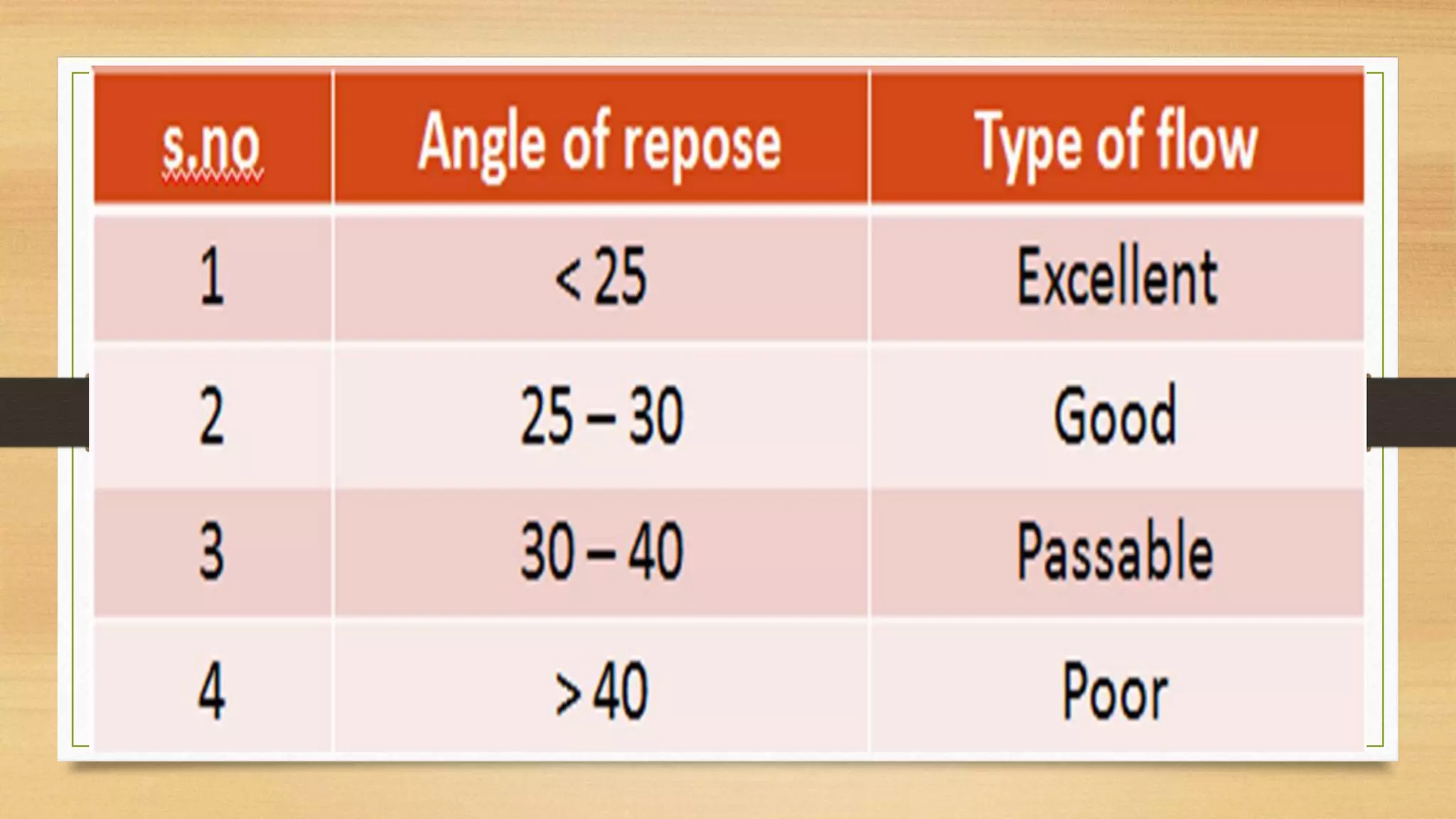
Flow properties of granules are determined by measuring 3 parameters:
 Angle of repose
 Percentage compressibility index
 Hausner’s ratio
MOISTURE CONTENT
The amount of moisture present in the granule is called moisture content.
Generally granules contain 2% moisture. It is required for the binding of
the powder or granules during compression in die cavity.
Percentage of moisture is calculated by using moisture balance or IR
balance.
IR balance consist of simple balance which is placed to the casing in
which the IR bulb is attached which Produce heat inside the chamber.
MOISTURE CONTENT
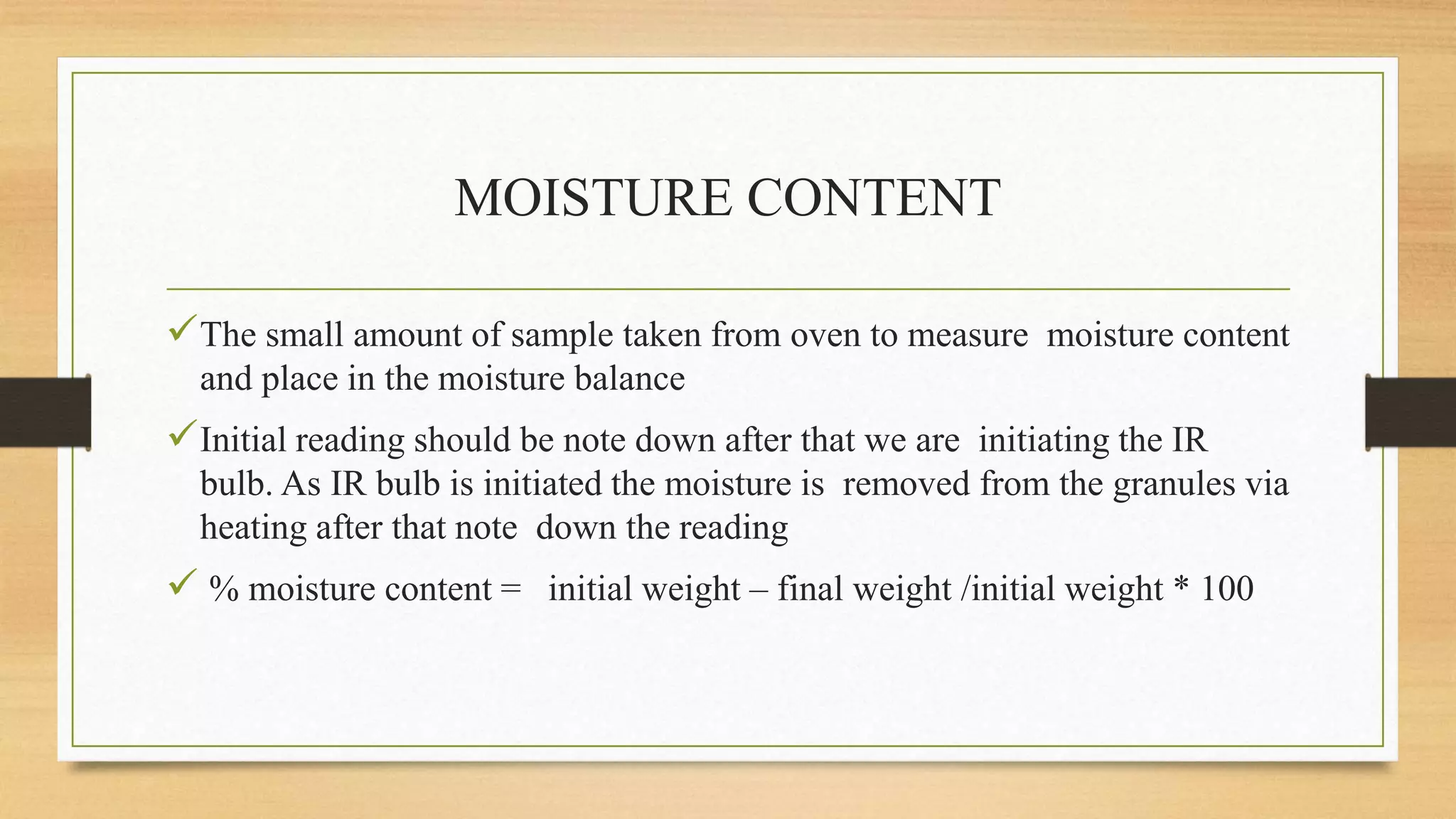
The small amount of sample taken from oven to measure moisture content
and place in the moisture balance
Initial reading should be note down after that we are initiating the IR
bulb. As IR bulb is initiated the moisture is removed from the granules via
heating after that note down the reading
 % moisture content = initial weight – final weight /initial weight * 100
QUALITY CONTROL TEST
PARENTERALS
TEST FOR PYROGENS
RABBIT TEST
The test involves measurement of rise in body temperature of the rabbits
following
The intravenous injection of a sterile solution of the substance to be
tested. The body temperature of the rabbits increases if pyrogens are
present in the injected test solution.
TEST FOR PYROGENS
LAL TEST
The gel clot end point is the most commonly used endotoxin test
It is simple and requires minimal laboratory equipment
Equal volumes of test solution and LAL reagent ( usually 0.1 ml of each)
are mixed in glass test tubes .
After incubation at 37 degrees c for one hour tubes are observed for clot
formation after inverting them.
TEST FOR PYROGENS
LAL TEST
Formation of solid gel clot that withstands inversion of the tube constitutes
a positive test.
 Each lot of gel clot reagent licensed by the FDA must be labeled with
sensitivity( lambda) to reference standard endotoxin(RSE).
ASSAY
Assay is performed according to method given In the monograph of that
parental preparation in the pharmacopeia
 Assay is done to check the quantity of medicament present in the
parenteral preparation.
 So we can know the exact amount of medicament present such that it can
perform its action.
We should follow the official monograph IP/BP/USP for performing the
assay.
STERILITY TEST
Sterility can be defined as the free from the presence of viable
microorganisms.
 It is done for detecting the presence of viable forms of bacteria, fungi and
yeast in parenteral products.
 The test for Sterility must be carried out under strict aseptic conditions
in order to avoid accidental contamination of the product during test.
 All glassware's required for the test must be sterile.
STERILITY TEST
Culture media used for sterility testing:
 Fluid thioglycolate medium
 Soybean casein digest medium
Sterility test methods:
 Direct inoculation method
 Membrane filtration method.
MEMBRANE FILTRATION
Selection of filters for membrane filtration :
 pore size of 0.45µ effectiveness established in the retention of
micro- organisms appropriate composition the size of filter discs is about
50 mm in diameter
PROCEDURE
Sterilization of filtration system and membrane filtration of examined
solution under aseptic conditions.
 Filtration of the sample through a membrane filter having the nominal
size of 0.45µ and a diameter of 47mm.
 After filtration the membrane is removed aseptically from the metallic
holder and divided into two halves.
 The first half is transferred into 100 ml of culture media meant for fungi
and incubated at 20˚ to 25 ˚c for not less than seven days.
PROCEDURE
The other half is transferred into 100ml of fluid thioglycolate medium and
incubated at 30 to 35 ˚c for not less than 7 days.
DIRECT INOCULATION
Required quantities of liquid is removed from the test containers with a
sterile pipette / sterile syringe.
 Aseptically transfer the specified volume of the material from each
container to vessel of culture medium
 Incubate the inoculated media for not less than 14 days , unless otherwise
specified in the monograph at 300c - 350c in the case of fluid
thioglycolate medium and 200c - 250 c for soybean casein digest
medium.
DIRECT INOCULATION
When materials examined renders the medium turbid so presence /
absence of microbial growth cannot be determined readily by visual
examination transfer suitable portions of medium to fresh vessels of the
same medium between 3 rd. and 7 th day after test is started.
Continue incubation of the transfer vessel for not less than 7 additional
days after transfer and total of NLT 14 days.
CLARITY TEST
 In visual inspection, each injectable is inspected visually against white
and black backgrounds. The white background aids in detection of dark
colored particles.
 The light or reflective particles will appear against the black back
ground. Some visual-enhancing aids can increase the efficiency.
 A magnifying lens at 2.5 × magnification set at the eye level facilitates
the inspection. Microscopic examination enhances detection of particulate
matter in injectable. Visual inspection gives the qualitative estimation of
the particulate matter.
LEAK TEST
Visual inspection is the easiest leak test method to perform. But this
method is least sensitive
The method is used for the evaluation of large volume parenteral. To
increase the sensitivity of the method, the visual inspection of the sample
container may be coupled with the application of vacuum to make leakage
more readily observable.
 This method is simple and inexpensive. However, the method is
insensitive, operator dependent, and qualitative
BUBBLE TEST
 The test package is submerged in liquids. A differential pressure is
applied on the container. The container is observed for bubbles.
 Sometimes, surfactant added liquid is used for immersion of test
package. Any leakage is evident after the application of differential
pressure as the generation of foaming in immersion liquid. The method is
simple and inexpensive.
 The location of the leaks can be observed in this method. However, it is
relatively insensitive.
DYE TEST
 The test container is immersed in a dye bath. Vacuum and pressure is
applied for some time.
 The container is removed from the dye bath and washed. The container
is then inspected for the presence of dye visually.
 The dye used may be of blue, green, yellowish-green color.
 The dye test can be optimized by use of a surfactant and or a low
viscosity fluid in the dye solution to increase the capillary migration
through the pores.
PH
 Checking the bulk solution, before filling for drug content ,pH,
color, clarity and completeness of solution
 The pH of a formulation must be considered from following
standpoint:
 the effect on the body when the solution is administered
 the effect on stability of the product
 the effect on container-closure system
REFERENCES
• In process quality control review: by hem Ander
• C.V.S. Subramanyam textbook of pharmaceutics
• Pharmaceutical dosage form and delivery system by Ansel .c
• Liebermann and Lachman
inprocess quality control test

inprocess quality control test

  • 1.
  • 2.
    CONTENTS  Aseptic processing Manufacturing in aseptic process  In process quality control test for; ointments Suspension Emulsion Powders solution
  • 3.
    ASEPTIC PROCESSING Sterile productswhich cannot receive a post filling lethal treatment because the product ,container cannot withstand terminal sterilization treatments. Aseptic processing of the drug product , container, and closure are subjected to sterilisation processes separately and then brought together in clean room environment to create the finished product.
  • 4.
    ASEPTIC PROCESSING Manufacturing ofthe product and the requirements
  • 6.
  • 10.
    INPR0CESS QUALITY CONTROL IPQCmeans controlling the procedure involved in manufacturing of the dosage forms starting from raw material purchase to dispatch of the quality product in ideal packaging. It monitors all the features of the product that may affect its quality and prevent errors during processing. It is the activity performed between QA and QC.
  • 11.
    INPROCESS QUALITY CONTROLTEST Ointment Suspension Emulsion Dry powder Solution(large volume and small volume)
  • 12.
  • 13.
    PHYSICAL APPEARANCE The maincharacteristics need to be checked are :  Cracking of creams (separation of oil and water)  Development of granular and lumpy appearance  Marked change in viscosity  Crystal growth  Microbial contamination
  • 14.
    PARTICLE SIZE DETERMINATION Dilute a suitable quantity of preparation with equal volume of glycerol or liquid paraffin, as specified .  Mount on a glass slide and examine under light microscope.  Count the number of particles with diameter above or below than that specified in monograph.  Compare the percentage with official limits.
  • 15.
    SOLUBILITY TEST The preparationshould be soluble in 9 parts of water and 1.7 parts of hot water  The preparation should be miscible with alcohol, ether and chloroform
  • 16.
    WEIGHT VARIATION  Appliesto those products in which labeled net weight is not more than 150g  Select 10 filled containers, remove the label, clean and weigh individually  Remove the contents by cutting the containers and wash with suitable solvent
  • 17.
    WEIGHT VARIATION  Dryand again weigh each empty container together with its corresponding part, take difference as weight of contents.  The average net weight of contents of 10 containers should not be less than the labeled amount  The net weight of contents of any single container should not be less than 90% of the labeled amount (for ≤ 60g)
  • 18.
    WEIGHT VARIATION  Andnot less than 95% of the labeled amount (60-150g)  If this requirement is not met repeat this procedures taking additional 20 containers  The average net weight of contents of 30 containers should not be less than labeled amount
  • 19.
    WEIGHT VARIATION  Contentsof not more than 1 of the 30 units should be less than 90% of the stated amount (for ≤ 60g)  And not less than 95% of the labeled amount (60-150g)
  • 20.
    VISCOSITY DETERMINATION The viscometercalibrated to measure the apparent viscosity of the disperse system at a given temperature . Consistency type: plastic flow, spreadable Approximate viscosity:300000-1000000.
  • 21.
    ACTIVE INGREDIENTS  Assayof active ingredients should be performed according to monograph  Percentage contents should be within the official limits
  • 22.
    MICROBIAL CONTAMINATION Microorganisms cangrow, if no preservative is added, or even if added, its efficiency is reduced due to interaction with other ingredients.  Microorganisms may get into the preparation during handling and storage  Therefore, aseptic technique of handling is needed. Antimicrobial assay should be performed according to official monograph, usually, – Direct inoculation method – Membrane filtration method
  • 23.
    METAL PARTICLE INOPTHALMIC OINTMENTS  Extrude completely the contents of 10 containers separately into flat bottom Petri dishes Cover, heat at 85oC for 2 h and cool slowly to solidify  Remove the cover and invert on the stage of microscope adjusted to 30 times magnification and equipped with eye-piece micrometer disk calibrated for this magnification.  Additional illuminator may also used  Examine the entire bottom of Petri dish for metal particles.
  • 24.
    METAL PARTICLE INOPTHALMIC OINTMENTS  Count the metal particles of 50µm or larger  The requirement is met if total number of such particles in all 10 tubes does not exceed 50  Not more than 1 tube contains more than 8 such particles  If not, repeat with 20 more tubes  The requirement is met if total number of such particles in 30 tubes is not more than 150  And not more than 3 containers allowed to contain more than 8 particles.
  • 25.
  • 26.
    APPEARANCE It must appearuniform and elegant . Particles of suspension should be well distributed. No hard cake formation of particles
  • 27.
    COLOUR,ODOUR,TASTE Variation in colouroften indicates poor distribution and/or differences in particle size. Variation in taste, especially of active constituents can often be attributed to changes in particle size, crystal habit and subsequent particle dissolution.  Change in colour, odour and taste can also indicates chemical instability.
  • 28.
    DENSITY Density of thesuspension is an important parameter. Decrease in density indicates the presence of entrapped air with in the structure of the suspension. Hydrometers are used to measure the density
  • 29.
    PH VALUE pH ofthe phases of suspension also contribute to stability and characteristics of formulations.  So pH of the different vehicles, phases of suspension before mixing and after mixing are monitored and recorded time to time to ensure optimum pH environment being maintained.  Different types of methods are used in the measurement of pH , a)Dip a piece of pH paper into the sample b) PH meter
  • 30.
    CLARITY TEST Clarity testingis carried out to check the particulate matter in the sample.
  • 31.
    POURABILITY This test iscarried out on the phases of suspension after mixing to ensure that the final preparation is pourable and will not cause any problem during filling and handling of patient.
  • 32.
    VISCOSITY DETERMINATION The viscositycan be measured by; a)cup and bob viscometer b)cone and plate viscometer
  • 33.
    PARTICLE SIZE As theparticle size is reduced they tend to exhibit Brownian movement. So it is necessary to choose the optimum particle size for maximum stability
  • 34.
    DRUG CONTENT UNIFORMITY Forproper dosing of the dosage form it is necessary that the active ingredient is uniformly distributed throughout the dosage form.so samples are withdrawn from the dispersed phase after micronization and after mixing with dispersion medium, ASSAYED to find out degree of homogeneity. If any discrepancy is found out it is suitably correct mixing step to ensure a reliable dosage formulation by monitoring the mixing step to ensure a reliable dosage formulation.
  • 35.
  • 36.
    PARTICLE SIZE DISTRIBUTION Globulesof uniform size impart maximum stability. In such emulsions globules pack loosely and globule to globule contact is less. Globule distribution is effected by viscosity, phase volume ratio, density of phases etc. An optimum degree of size distribution range should be chosen to achieve maximum physical stability
  • 47.
  • 48.
    PARTICLE SIZE ANDSHAPE DETERMINATION The size and shape depends upon processing requirements during granulation. Size affects the average weight of tablet, disintegration time, weight variation, friability, flowability and drying rate. The methods for determining size and shape are: Sieving Sedimentation rate Microscopy (SEM) By light Scattering
  • 49.
    SURFACE AREA It isnot commonly used for granules but generally used for drug substances.  If required particle size is measured and from this surface area is measured  Mostly used method are gas adsorption method and air permeability method.
  • 50.
    DENSITY Density may influencecompressibility, tablet porosity and dissolution. Dense granules have less friability but cause a problem in releasing the problem.
  • 51.
    FLOW PROPERTIES It isan ability of the granule to flow from hopper to die cavity for tablet uniformity If flow property of granules are not uniform we are not getting tablet of uniform size  Flow property of material results from many forces: 1. Frictional force 2. Surface tension force 3. Mechanical force caused by interlocking of irregular shape particles
  • 52.
  • 53.
    FLOW PROPERTIES Flow propertiesof granules are determined by measuring 3 parameters:  Angle of repose  Percentage compressibility index  Hausner’s ratio
  • 56.
    MOISTURE CONTENT The amountof moisture present in the granule is called moisture content. Generally granules contain 2% moisture. It is required for the binding of the powder or granules during compression in die cavity. Percentage of moisture is calculated by using moisture balance or IR balance. IR balance consist of simple balance which is placed to the casing in which the IR bulb is attached which Produce heat inside the chamber.
  • 57.
    MOISTURE CONTENT The smallamount of sample taken from oven to measure moisture content and place in the moisture balance Initial reading should be note down after that we are initiating the IR bulb. As IR bulb is initiated the moisture is removed from the granules via heating after that note down the reading  % moisture content = initial weight – final weight /initial weight * 100
  • 58.
  • 59.
    TEST FOR PYROGENS RABBITTEST The test involves measurement of rise in body temperature of the rabbits following The intravenous injection of a sterile solution of the substance to be tested. The body temperature of the rabbits increases if pyrogens are present in the injected test solution.
  • 60.
    TEST FOR PYROGENS LALTEST The gel clot end point is the most commonly used endotoxin test It is simple and requires minimal laboratory equipment Equal volumes of test solution and LAL reagent ( usually 0.1 ml of each) are mixed in glass test tubes . After incubation at 37 degrees c for one hour tubes are observed for clot formation after inverting them.
  • 61.
    TEST FOR PYROGENS LALTEST Formation of solid gel clot that withstands inversion of the tube constitutes a positive test.  Each lot of gel clot reagent licensed by the FDA must be labeled with sensitivity( lambda) to reference standard endotoxin(RSE).
  • 62.
    ASSAY Assay is performedaccording to method given In the monograph of that parental preparation in the pharmacopeia  Assay is done to check the quantity of medicament present in the parenteral preparation.  So we can know the exact amount of medicament present such that it can perform its action. We should follow the official monograph IP/BP/USP for performing the assay.
  • 63.
    STERILITY TEST Sterility canbe defined as the free from the presence of viable microorganisms.  It is done for detecting the presence of viable forms of bacteria, fungi and yeast in parenteral products.  The test for Sterility must be carried out under strict aseptic conditions in order to avoid accidental contamination of the product during test.  All glassware's required for the test must be sterile.
  • 64.
    STERILITY TEST Culture mediaused for sterility testing:  Fluid thioglycolate medium  Soybean casein digest medium Sterility test methods:  Direct inoculation method  Membrane filtration method.
  • 65.
    MEMBRANE FILTRATION Selection offilters for membrane filtration :  pore size of 0.45µ effectiveness established in the retention of micro- organisms appropriate composition the size of filter discs is about 50 mm in diameter
  • 66.
    PROCEDURE Sterilization of filtrationsystem and membrane filtration of examined solution under aseptic conditions.  Filtration of the sample through a membrane filter having the nominal size of 0.45µ and a diameter of 47mm.  After filtration the membrane is removed aseptically from the metallic holder and divided into two halves.  The first half is transferred into 100 ml of culture media meant for fungi and incubated at 20˚ to 25 ˚c for not less than seven days.
  • 67.
    PROCEDURE The other halfis transferred into 100ml of fluid thioglycolate medium and incubated at 30 to 35 ˚c for not less than 7 days.
  • 68.
    DIRECT INOCULATION Required quantitiesof liquid is removed from the test containers with a sterile pipette / sterile syringe.  Aseptically transfer the specified volume of the material from each container to vessel of culture medium  Incubate the inoculated media for not less than 14 days , unless otherwise specified in the monograph at 300c - 350c in the case of fluid thioglycolate medium and 200c - 250 c for soybean casein digest medium.
  • 69.
    DIRECT INOCULATION When materialsexamined renders the medium turbid so presence / absence of microbial growth cannot be determined readily by visual examination transfer suitable portions of medium to fresh vessels of the same medium between 3 rd. and 7 th day after test is started. Continue incubation of the transfer vessel for not less than 7 additional days after transfer and total of NLT 14 days.
  • 70.
    CLARITY TEST  Invisual inspection, each injectable is inspected visually against white and black backgrounds. The white background aids in detection of dark colored particles.  The light or reflective particles will appear against the black back ground. Some visual-enhancing aids can increase the efficiency.  A magnifying lens at 2.5 × magnification set at the eye level facilitates the inspection. Microscopic examination enhances detection of particulate matter in injectable. Visual inspection gives the qualitative estimation of the particulate matter.
  • 71.
    LEAK TEST Visual inspectionis the easiest leak test method to perform. But this method is least sensitive The method is used for the evaluation of large volume parenteral. To increase the sensitivity of the method, the visual inspection of the sample container may be coupled with the application of vacuum to make leakage more readily observable.  This method is simple and inexpensive. However, the method is insensitive, operator dependent, and qualitative
  • 72.
    BUBBLE TEST  Thetest package is submerged in liquids. A differential pressure is applied on the container. The container is observed for bubbles.  Sometimes, surfactant added liquid is used for immersion of test package. Any leakage is evident after the application of differential pressure as the generation of foaming in immersion liquid. The method is simple and inexpensive.  The location of the leaks can be observed in this method. However, it is relatively insensitive.
  • 73.
    DYE TEST  Thetest container is immersed in a dye bath. Vacuum and pressure is applied for some time.  The container is removed from the dye bath and washed. The container is then inspected for the presence of dye visually.  The dye used may be of blue, green, yellowish-green color.  The dye test can be optimized by use of a surfactant and or a low viscosity fluid in the dye solution to increase the capillary migration through the pores.
  • 74.
    PH  Checking thebulk solution, before filling for drug content ,pH, color, clarity and completeness of solution  The pH of a formulation must be considered from following standpoint:  the effect on the body when the solution is administered  the effect on stability of the product  the effect on container-closure system
  • 75.
    REFERENCES • In processquality control review: by hem Ander • C.V.S. Subramanyam textbook of pharmaceutics • Pharmaceutical dosage form and delivery system by Ansel .c • Liebermann and Lachman