WELLCOME
1
A thesis Presentation on
‘Indoor and outdoor radio wave propagation using MATLAB’
Presented by,
Aktheruzzaman--Regi-101101129
&
Anup Kumar Roy--Regi-101101107
Supervised by,
Mohammad Mahmudul Alam Mia
Lecturer
Sylhet International University
Baghbari, Sylhet
Date: 07-06-2014, Time- 9:30AM 2
Overview
 Introduction
 Aims and Motivation
 Propagation Mechanism
 Simulation Flowchart
 Propagation Mechanism (Using MATLAB)
 Power
 Simulation Environment
 Shadow Effects
 Free Space Propagation
 Signal Strength
 Indoor Ray Propagation
 References
 Acknowledgement
3
Introduction
The thesis is the presentation of a two-dimensional simulation model which
simulates the radio wave propagation in indoor and outdoor environment,
through the combination of different propagation mechanisms. The simulation
program is created using MATLAB. The propagation mechanisms considered in
order to derive their contribution to the received power strength are the Line-of-
Sight (LOS) and reflection. The produced shadow region diagrams indicate the
importance of reflection as propagation mechanism in indoor and outdoor
wireless communication. The received field strength is computed by considering
the contribution of each propagation mechanism. Finally, the free space radio
wave propagation has been considered, in order to validate the simulation model.
4
Aims and Motivation
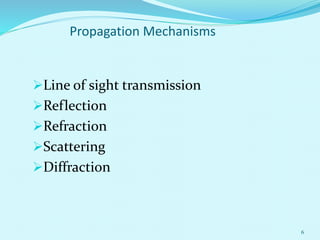
 To create a 2D simulation environment which simulates the radio wave
propagation in indoor and outdoor environment.
 Through the combination of different propagation mechanisms (line-of-sight,
reflection, refraction, scattering and diffraction).
 To determine the required number of ray.
 Cover the maximum shadow region using multiple reflection.
 Received power calculation.
 Signal strength calculation.
 To validate the simulation model.
5
Propagation Mechanisms
Line of sight transmission
Reflection
Refraction
Scattering
Diffraction
6
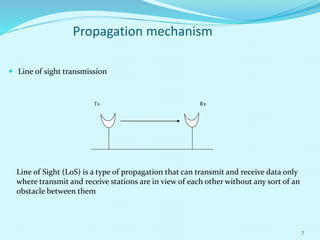
 Line of sight transmission
7
Propagation mechanism
Tx Rx
Line of Sight (LoS) is a type of propagation that can transmit and receive data only
where transmit and receive stations are in view of each other without any sort of an
obstacle between them
8
Propagation mechanism
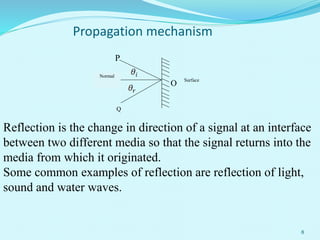
P
Normal
Q
Surface
O
Reflection is the change in direction of a signal at an interface
between two different media so that the signal returns into the
media from which it originated.
Some common examples of reflection are reflection of light,
sound and water waves.
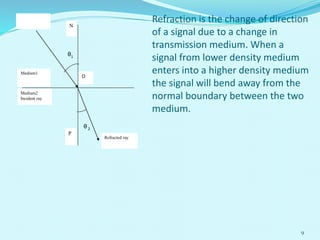
Refraction is the change of direction
of a signal due to a change in
transmission medium. When a
signal from lower density medium
enters into a higher density medium
the signal will bend away from the
normal boundary between the two
medium.
9
θ 2
Medium1
Medium2
Incident ray
N
Refracted ray
P
O
θ1
 Scattering
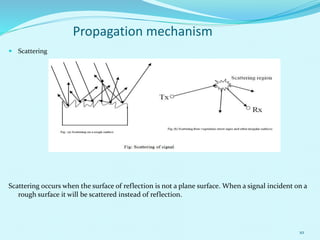
Scattering occurs when the surface of reflection is not a plane surface. When a signal incident on a
rough surface it will be scattered instead of reflection.
10
Propagation mechanism
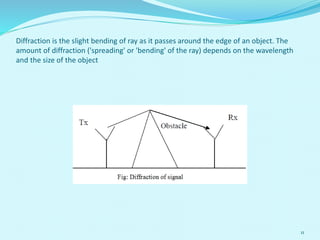
Diffraction is the slight bending of ray as it passes around the edge of an object. The
amount of diffraction ('spreading' or 'bending' of the ray) depends on the wavelength
and the size of the object
11
12
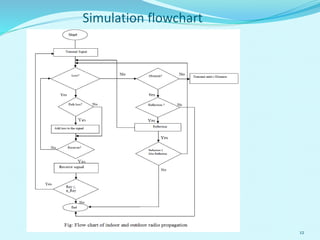
Simulation flowchart
Transmission
Obstacles
Intersection
Reflection
13
Propagation mechanism (Using MATLAB)
 Transmission
MATLAB code for Transmission
tx_x=16;
tx_y=20;
n_ray=input('Total number of rays:');
r=45;
for n=1:n_ray;
theta=(n-1)*360/n_ray*pi/180;
a(n)=r*cos(theta)+tx_x;
b(n)=r*sin(theta)+tx_y;
plot([tx_x a(n)],[tx_y b(n)],'k');
end
 Obstacle
MATLAB code for obstacles
obstacle=[36 36];
obstacle=[12 40];
plot(obstacle_x,obstacle_y,'k','LineWidth',3);
14
Propagation mechanism (Using MATLAB)
 Intersection
MATLAB code for Transmission
[xi,yi]=polyxpoly([20 a(n)],[20 b(n)],[36 36],[12 40]);
 Reflection
MATLAB code for Transmission
for m=1:i;
theta=180*pi/180-reflect_angle;
c= r*cos(theta)+intersect_x(m);
d= r*sin(theta)+intersect_y(m);
plot([intersect_x(m) c(m)],[intersect_y(m) d(m)],'r');
end
15
Propagation mechanism (Using MATLAB)
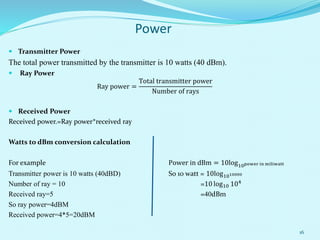
 Transmitter Power
The total power transmitted by the transmitter is 10 watts (40 dBm).
 Ray Power
Ray power =
Total transmitter power
Number of rays
 Received Power
Received power.=Ray power*received ray
Watts to dBm conversion calculation
For example Power in dBm = 10log10power in miliwatt
Transmitter power is 10 watts (40dBD) So 10 watt = 10log1010000
Number of ray = 10 =10 log10 104
Received ray=5 =40dBm
So ray power=4dBM
Received power=4*5=20dBM
16
Power
17
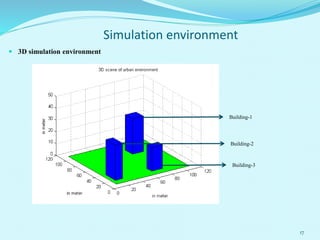
Building-1
Building-3
Building-2
Simulation environment
 3D simulation environment
18
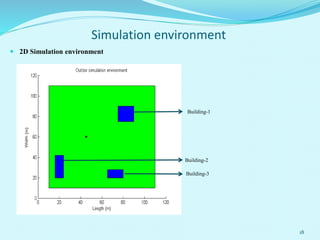
Building-1
Building-3
Building-2
 2D Simulation environment
Simulation environment
19
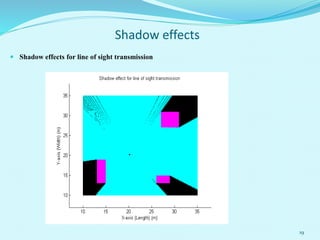
Shadow effects
 Shadow effects for line of sight transmission
20
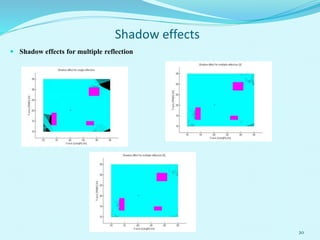
Shadow effects
 Shadow effects for multiple reflection
21
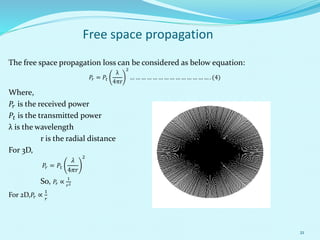
Free space propagation
The free space propagation loss can be considered as below equation:
𝑃𝑟 = 𝑃𝑡
λ
4πr
2
… … … … … … … … … … … … … … . (4)
Where,
𝑃𝑟 is the received power
𝑃𝑡 is the transmitted power
λ is the wavelength
r is the radial distance
For 3D,
𝑃𝑟 = 𝑃𝑡
𝜆
4𝜋𝑟
2
So, 𝑃𝑟 ∝
1
𝑟2
For 2D, 𝑃𝑟 ∝
1
𝑟
22
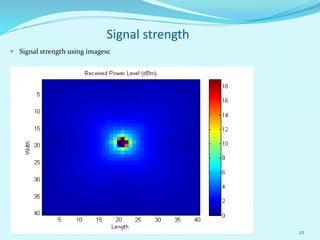
Signal strength
 Signal strength using imagesc
23
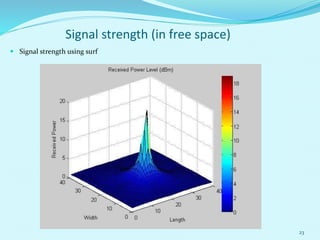
Signal strength (in free space)
 Signal strength using surf
24
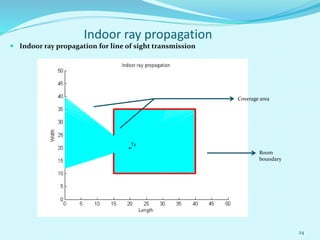
Room
boundary
Coverage area
Indoor ray propagation
 Indoor ray propagation for line of sight transmission
25
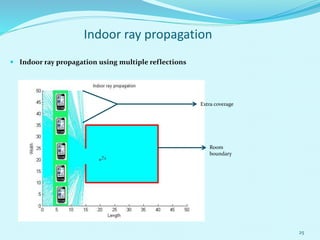
Room
boundary
Extra coverage
Indoor ray propagation
 Indoor ray propagation using multiple reflections
26
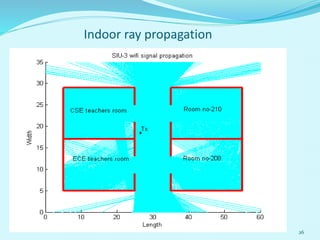
Indoor ray propagation
References
27
Conclusion
The simulation model is found to be useful one for the investigation of
indoor and outdoor radio wave propagation. This model shows the
simulation of indoor and outdoor radio wave propagation but it has been
found to give a fair representation of real environment. More significantly
the model can be used to investigate and understand the mechanism of
using multiple reflections for communication between transmitter and
receiver. The model can be useful in the planning and development
process of mobile communication. It can also be used in sound wave and
light wave propagation.
28
THANK YOU
Stay connected with technology
Science make life live
29

Presentation

  • 1.
  • 2.
    A thesis Presentationon ‘Indoor and outdoor radio wave propagation using MATLAB’ Presented by, Aktheruzzaman--Regi-101101129 & Anup Kumar Roy--Regi-101101107 Supervised by, Mohammad Mahmudul Alam Mia Lecturer Sylhet International University Baghbari, Sylhet Date: 07-06-2014, Time- 9:30AM 2
  • 3.
    Overview  Introduction  Aimsand Motivation  Propagation Mechanism  Simulation Flowchart  Propagation Mechanism (Using MATLAB)  Power  Simulation Environment  Shadow Effects  Free Space Propagation  Signal Strength  Indoor Ray Propagation  References  Acknowledgement 3
  • 4.
    Introduction The thesis isthe presentation of a two-dimensional simulation model which simulates the radio wave propagation in indoor and outdoor environment, through the combination of different propagation mechanisms. The simulation program is created using MATLAB. The propagation mechanisms considered in order to derive their contribution to the received power strength are the Line-of- Sight (LOS) and reflection. The produced shadow region diagrams indicate the importance of reflection as propagation mechanism in indoor and outdoor wireless communication. The received field strength is computed by considering the contribution of each propagation mechanism. Finally, the free space radio wave propagation has been considered, in order to validate the simulation model. 4
  • 5.
    Aims and Motivation To create a 2D simulation environment which simulates the radio wave propagation in indoor and outdoor environment.  Through the combination of different propagation mechanisms (line-of-sight, reflection, refraction, scattering and diffraction).  To determine the required number of ray.  Cover the maximum shadow region using multiple reflection.  Received power calculation.  Signal strength calculation.  To validate the simulation model. 5
  • 6.
    Propagation Mechanisms Line ofsight transmission Reflection Refraction Scattering Diffraction 6
  • 7.
     Line ofsight transmission 7 Propagation mechanism Tx Rx Line of Sight (LoS) is a type of propagation that can transmit and receive data only where transmit and receive stations are in view of each other without any sort of an obstacle between them
  • 8.
    8 Propagation mechanism P Normal Q Surface O Reflection isthe change in direction of a signal at an interface between two different media so that the signal returns into the media from which it originated. Some common examples of reflection are reflection of light, sound and water waves.
  • 9.
    Refraction is thechange of direction of a signal due to a change in transmission medium. When a signal from lower density medium enters into a higher density medium the signal will bend away from the normal boundary between the two medium. 9 θ 2 Medium1 Medium2 Incident ray N Refracted ray P O θ1
  • 10.
     Scattering Scattering occurswhen the surface of reflection is not a plane surface. When a signal incident on a rough surface it will be scattered instead of reflection. 10 Propagation mechanism
  • 11.
    Diffraction is theslight bending of ray as it passes around the edge of an object. The amount of diffraction ('spreading' or 'bending' of the ray) depends on the wavelength and the size of the object 11
  • 12.
  • 13.
  • 14.
     Transmission MATLAB codefor Transmission tx_x=16; tx_y=20; n_ray=input('Total number of rays:'); r=45; for n=1:n_ray; theta=(n-1)*360/n_ray*pi/180; a(n)=r*cos(theta)+tx_x; b(n)=r*sin(theta)+tx_y; plot([tx_x a(n)],[tx_y b(n)],'k'); end  Obstacle MATLAB code for obstacles obstacle=[36 36]; obstacle=[12 40]; plot(obstacle_x,obstacle_y,'k','LineWidth',3); 14 Propagation mechanism (Using MATLAB)
  • 15.
     Intersection MATLAB codefor Transmission [xi,yi]=polyxpoly([20 a(n)],[20 b(n)],[36 36],[12 40]);  Reflection MATLAB code for Transmission for m=1:i; theta=180*pi/180-reflect_angle; c= r*cos(theta)+intersect_x(m); d= r*sin(theta)+intersect_y(m); plot([intersect_x(m) c(m)],[intersect_y(m) d(m)],'r'); end 15 Propagation mechanism (Using MATLAB)
  • 16.
     Transmitter Power Thetotal power transmitted by the transmitter is 10 watts (40 dBm).  Ray Power Ray power = Total transmitter power Number of rays  Received Power Received power.=Ray power*received ray Watts to dBm conversion calculation For example Power in dBm = 10log10power in miliwatt Transmitter power is 10 watts (40dBD) So 10 watt = 10log1010000 Number of ray = 10 =10 log10 104 Received ray=5 =40dBm So ray power=4dBM Received power=4*5=20dBM 16 Power
  • 17.
  • 18.
  • 19.
    19 Shadow effects  Shadoweffects for line of sight transmission
  • 20.
    20 Shadow effects  Shadoweffects for multiple reflection
  • 21.
    21 Free space propagation Thefree space propagation loss can be considered as below equation: 𝑃𝑟 = 𝑃𝑡 λ 4πr 2 … … … … … … … … … … … … … … . (4) Where, 𝑃𝑟 is the received power 𝑃𝑡 is the transmitted power λ is the wavelength r is the radial distance For 3D, 𝑃𝑟 = 𝑃𝑡 𝜆 4𝜋𝑟 2 So, 𝑃𝑟 ∝ 1 𝑟2 For 2D, 𝑃𝑟 ∝ 1 𝑟
  • 22.
    22 Signal strength  Signalstrength using imagesc
  • 23.
    23 Signal strength (infree space)  Signal strength using surf
  • 24.
    24 Room boundary Coverage area Indoor raypropagation  Indoor ray propagation for line of sight transmission
  • 25.
    25 Room boundary Extra coverage Indoor raypropagation  Indoor ray propagation using multiple reflections
  • 26.
  • 27.
  • 28.
    Conclusion The simulation modelis found to be useful one for the investigation of indoor and outdoor radio wave propagation. This model shows the simulation of indoor and outdoor radio wave propagation but it has been found to give a fair representation of real environment. More significantly the model can be used to investigate and understand the mechanism of using multiple reflections for communication between transmitter and receiver. The model can be useful in the planning and development process of mobile communication. It can also be used in sound wave and light wave propagation. 28
  • 29.
    THANK YOU Stay connectedwith technology Science make life live 29