By : Hani Ramadhani
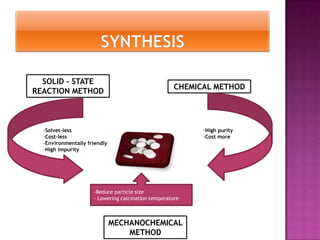
SOLID – STATE
                                                     CHEMICAL METHOD
REACTION METHOD


  -Solvet-less                                             -High purity
  -Cost-less                                               -Cost more
  -Environmentally friendly
  -High impurity


                     -Reduce particle size
                     - Lowering calcination temperature


                              MECHANOCHEMICAL
                                  METHOD
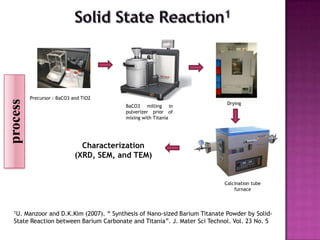
Precursor : BaCO3 and TiO2
process


                                                                            Drying
                                         BaCO3 milling in
                                         pulverizer prior of
                                         mixing with Titania


                               Characterization
                             (XRD, SEM, and TEM)


                                                                           Calcination tube
                                                                               furnace


  1U. Manzoor and D.K.Kim (2007). “ Synthesis of Nano-sized Barium Titanate Powder by Solid-
  State Reaction between Barium Carbonate and Titania”. J. Mater Sci Technol. Vol. 23 No. 5
Characterization


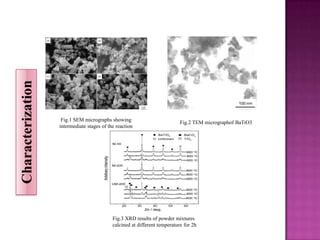
                    Fig.1 SEM micrographs showing                           Fig.2 TEM micrographof BaTiO3
                   intermediate stages of the reaction


                                            Fig.3 XRD results of powder mixtures
                                            calcined at different temperature for 2h
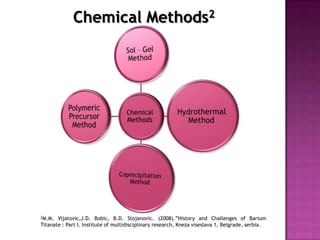
Chemical Methods2


2M.M.  Vijatovic,J.D. Bobic, B.D. Stojanovic. (2008).”History and Challenges of Barium
Titanate : Part I. Institute of multidisciplinary research, Kneza viseslava 1, Belgrade, serbia.
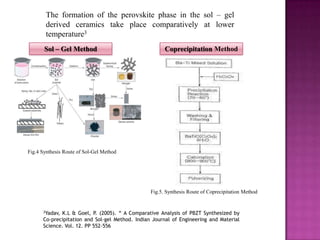
The formation of the perovskite phase in the sol – gel
        derived ceramics take place comparatively at lower
        temperature3
       Sol – Gel Method                                Coprecipitation Method


Fig.4 Synthesis Route of Sol-Gel Method


                                                 Fig.5. Synthesis Route of Coprecipitation Method


      3Yadav,K.L & Goel, P. (2005). “ A Comparative Analysis of PBZT Synthesized by
      Co-precipitation and Sol-gel Method. Indian Journal of Engineering and Material
      Science. Vol. 12. PP 552-556
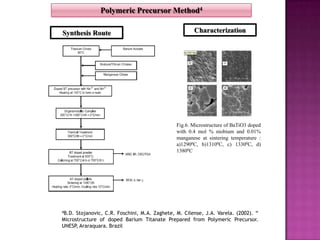
Polymeric Precursor Method4

Synthesis Route                                       Characterization


                                               Fig.6. Microstructure of BaTiO3 doped
                                               with 0.4 mol % niobium and 0.01%
                                               manganese at sintering temperature :
                                               a)12900C, b)13100C, c) 13300C, d)
                                               13800C


4B.D. Stojanovic, C.R. Foschini, M.A. Zaghete, M. Cilense, J.A. Varela. (2002). “
Microstructure of doped Barium Titanate Prepared from Polymeric Precursor.
UNESP, Araraquara. Brazil
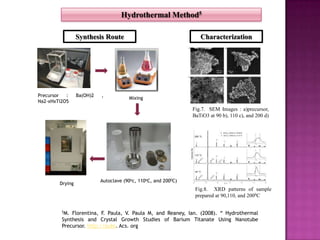
Hydrothermal Method5

                 Synthesis Route                                   Characterization


Precursor  :     Ba(OH)2   ,
                                       Mixing
Na2-xHxTi2O5
                                                                Fig.7. SEM Images : a)precursor,
                                                                BaTiO3 at 90 b), 110 c), and 200 d)


                           Autoclave (90oc, 110oC, and 2000C)
        Drying
                                                                 Fig.8. XRD patterns of sample
                                                                 prepared at 90,110, and 2000C


         5M. Florentina, F. Paula, V. Paula M, and Reaney, Ian. (2008). “ Hydrothermal
         Synthesis and Crystal Growth Studies of Barium Titanate Using Nanotube
         Precursor. http://pubs. Acs. org
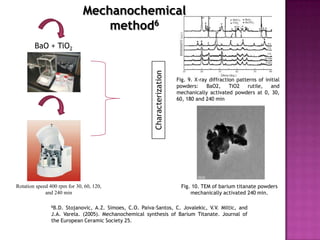
Mechanochemical
                                  method6
        BaO + TiO2


                                                         Characterization
                                                                            Fig. 9. X-ray diffraction patterns of initial
                                                                            powders:     BaO2,     TiO2   rutile,    and
                                                                            mechanically activated powders at 0, 30,
                                                                            60, 180 and 240 min


Rotation speed 400 rpm for 30, 60, 120,                                       Fig. 10. TEM of barium titanate powders
             and 240 min                                                          mechanically activated 240 min.

                6B.D. Stojanovic, A.Z. Simoes, C.O. Paiva-Santos, C. Jovalekic, V.V. Miltic, and
                J.A. Varela. (2005). Mechanochemical synthesis of Barium Titanate. Journal of
                the European Ceramic Society 25.
Which method?


Depends on ;
 ∙   Cost
 ∙   Application use
 ∙   Starting materials used, and
 ∙   Synthesis route

Barium titanate synthesis

  • 1.
    By : HaniRamadhani
  • 2.
    SOLID – STATE CHEMICAL METHOD REACTION METHOD -Solvet-less -High purity -Cost-less -Cost more -Environmentally friendly -High impurity -Reduce particle size - Lowering calcination temperature MECHANOCHEMICAL METHOD
  • 3.
    Precursor : BaCO3and TiO2 process Drying BaCO3 milling in pulverizer prior of mixing with Titania Characterization (XRD, SEM, and TEM) Calcination tube furnace 1U. Manzoor and D.K.Kim (2007). “ Synthesis of Nano-sized Barium Titanate Powder by Solid- State Reaction between Barium Carbonate and Titania”. J. Mater Sci Technol. Vol. 23 No. 5
  • 4.
    Characterization Fig.1 SEM micrographs showing Fig.2 TEM micrographof BaTiO3 intermediate stages of the reaction Fig.3 XRD results of powder mixtures calcined at different temperature for 2h
  • 5.
    Chemical Methods2 2M.M. Vijatovic,J.D. Bobic, B.D. Stojanovic. (2008).”History and Challenges of Barium Titanate : Part I. Institute of multidisciplinary research, Kneza viseslava 1, Belgrade, serbia.
  • 6.
    The formation ofthe perovskite phase in the sol – gel derived ceramics take place comparatively at lower temperature3 Sol – Gel Method Coprecipitation Method Fig.4 Synthesis Route of Sol-Gel Method Fig.5. Synthesis Route of Coprecipitation Method 3Yadav,K.L & Goel, P. (2005). “ A Comparative Analysis of PBZT Synthesized by Co-precipitation and Sol-gel Method. Indian Journal of Engineering and Material Science. Vol. 12. PP 552-556
  • 7.
    Polymeric Precursor Method4 SynthesisRoute Characterization Fig.6. Microstructure of BaTiO3 doped with 0.4 mol % niobium and 0.01% manganese at sintering temperature : a)12900C, b)13100C, c) 13300C, d) 13800C 4B.D. Stojanovic, C.R. Foschini, M.A. Zaghete, M. Cilense, J.A. Varela. (2002). “ Microstructure of doped Barium Titanate Prepared from Polymeric Precursor. UNESP, Araraquara. Brazil
  • 8.
    Hydrothermal Method5 Synthesis Route Characterization Precursor : Ba(OH)2 , Mixing Na2-xHxTi2O5 Fig.7. SEM Images : a)precursor, BaTiO3 at 90 b), 110 c), and 200 d) Autoclave (90oc, 110oC, and 2000C) Drying Fig.8. XRD patterns of sample prepared at 90,110, and 2000C 5M. Florentina, F. Paula, V. Paula M, and Reaney, Ian. (2008). “ Hydrothermal Synthesis and Crystal Growth Studies of Barium Titanate Using Nanotube Precursor. http://pubs. Acs. org
  • 9.
    Mechanochemical method6 BaO + TiO2 Characterization Fig. 9. X-ray diffraction patterns of initial powders: BaO2, TiO2 rutile, and mechanically activated powders at 0, 30, 60, 180 and 240 min Rotation speed 400 rpm for 30, 60, 120, Fig. 10. TEM of barium titanate powders and 240 min mechanically activated 240 min. 6B.D. Stojanovic, A.Z. Simoes, C.O. Paiva-Santos, C. Jovalekic, V.V. Miltic, and J.A. Varela. (2005). Mechanochemical synthesis of Barium Titanate. Journal of the European Ceramic Society 25.
  • 10.
    Which method? Depends on; ∙ Cost ∙ Application use ∙ Starting materials used, and ∙ Synthesis route