Mechanical engineering is the discipline that
applies the principles of engineering, physics,
and materials science for the design,
analysis, manufacturing, and maintenance
of mechanical systems. It is the branch of
engineering that involves the design,
production, and operation of machinery.
Material Science is the study of relationship
between structure and properties of
engineering materials.The reason for structure
in materials is manufacturing process like
machining, casting.
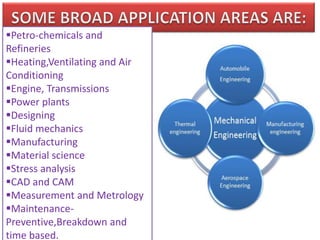
Petro-chemicals and
Refineries
Heating,Ventilating and Air
Conditioning
Engine, Transmissions
Power plants
Designing
Fluid mechanics
Manufacturing
Material science
Stress analysis
CAD and CAM
Measurement and Metrology
Maintenance-
Preventive,Breakdown and
time based.
 Measurement may be defined as branch of
engineering that deals with measuring devices
that are used to determine various parameters of
a system or a process.
Measuring instruments are useful in process
industries like textile plants, for measuring and
controlling variables like pressure, temperature,
viscosity and flow rate etc.
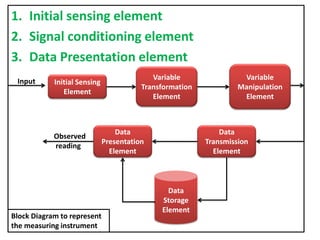
There are three types of element present in
general measuring instrument which are:-
1. Initial sensing element
2. Signal conditioning element
3. Data Presentation element
Initial Sensing
Element
Data
Presentation
Element
Variable
Manipulation
Element
Variable
Transformation
Element
Data
Transmission
Element
Input
Observed
reading
Data
Storage
Element
Block Diagram to represent
the measuring instrument
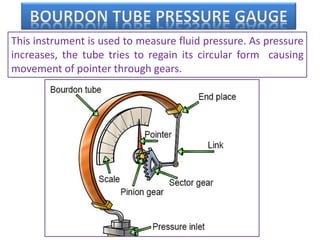
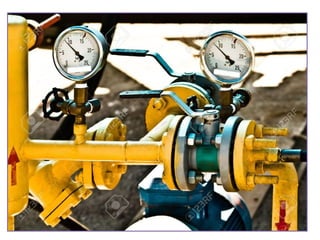
This instrument is used to measure fluid pressure. As pressure
increases, the tube tries to regain its circular form causing
movement of pointer through gears.
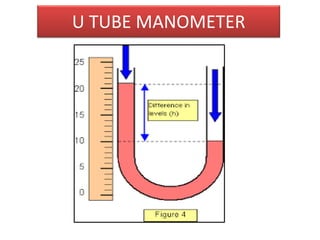
U TUBE MANOMETER
DIGITAL MANOMETER
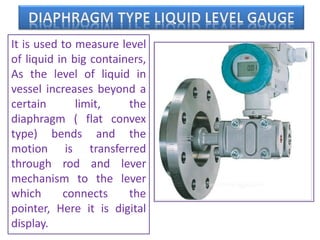
It is used to measure level
of liquid in big containers,
As the level of liquid in
vessel increases beyond a
certain limit, the
diaphragm ( flat convex
type) bends and the
motion is transferred
through rod and lever
mechanism to the lever
which connects the
pointer, Here it is digital
display.
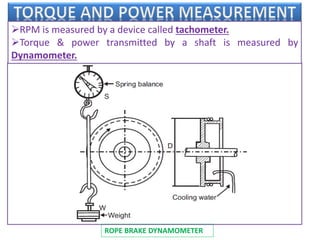
RPM is measured by a device called tachometer.
Torque & power transmitted by a shaft is measured by
Dynamometer.
ROPE BRAKE DYNAMOMETER
MECHANICAL TACHOMETER
TEMPERATURE MEASUREMENT
Temperature devices can be of following types:
• Liquid Expansion device like liquid filled and
mercury filled thermometer.
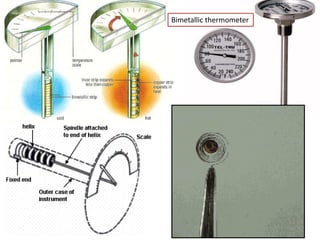
• Bimetallic thermometer
• Electrical sensors like thermocouple and
thermistor
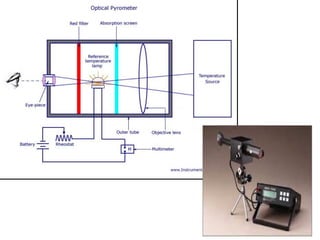
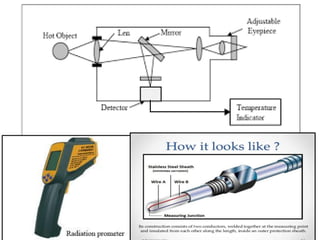
• Pyrometers which can be radiation(700-2000oC)
and optical pyrometer(850-1200oC).It is used for
measuring very high temperature without any
physical contact with the hot body.
Bimetallic thermometer
VIBRATION MEASUREMENT
Vibration refers to repeated cyclic oscillations of a
system.It may be due to misalignment of mating
parts,unbalanced rotating parts or some external
unbalanced force or from design, installation etc.
Excessive vibrations in machines can lead to
accumulation of stress, fatigue and ultimately
failure of parts. It can also induced dimensional
errors in the component being machined. So
vibration analysis is important for Thermal Power
Plants, Refineries plant, petrochemical plants.
OUR OBJECTIVES IS:-
• To increase equipment protection.
• To improve safety for personnel.
• To improve maintenance procedures.
• To detect problems early.
• To avoid catastrophic failures.
• To extend equipment life.
• To enhance operations.
Therefore we try to prevent vibration.
Some equipments which we need to
analyze are:
• Boiler feed pumps,
• Circulating water pumps,
• Condensate extraction pumps,
• Induced draft fans (ID fan),
• Force draft fans (FD fan),
• Raw water pumps,
• Cooling water pumps,
• Pipe vibrations,
• Journal Bearings
• Gears
• Compressors etc.
Note:
As automation is done
in plants so now a
days sound and
vibration softwares
are used for
measurement and for
piping special
softwares like Pulsim
,CAESAR etc are used.
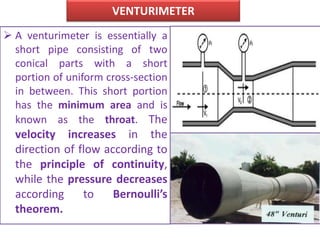
VENTURIMETER
 A venturimeter is essentially a
short pipe consisting of two
conical parts with a short
portion of uniform cross-section
in between. This short portion
has the minimum area and is
known as the throat. The
velocity increases in the
direction of flow according to
the principle of continuity,
while the pressure decreases
according to Bernoulli’s
theorem.
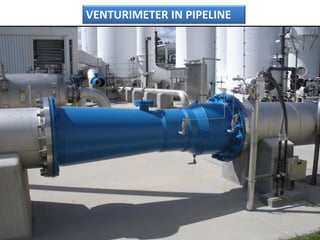
VENTURIMETER IN PIPELINE
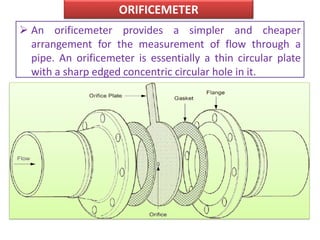
ORIFICEMETER
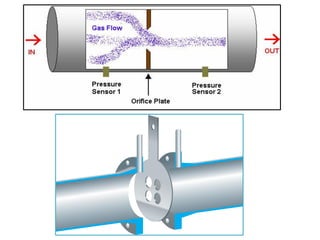
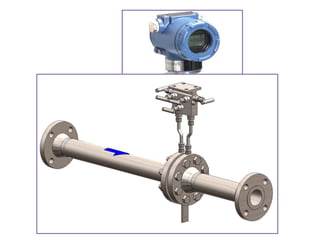
 An orificemeter provides a simpler and cheaper
arrangement for the measurement of flow through a
pipe. An orificemeter is essentially a thin circular plate
with a sharp edged concentric circular hole in it.
METROLOGY
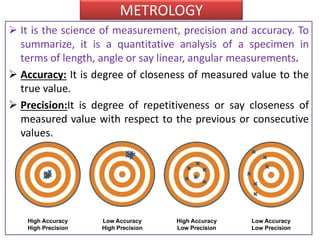
 It is the science of measurement, precision and accuracy. To
summarize, it is a quantitative analysis of a specimen in
terms of length, angle or say linear, angular measurements.
 Accuracy: It is degree of closeness of measured value to the
true value.
 Precision:It is degree of repetitiveness or say closeness of
measured value with respect to the previous or consecutive
values.
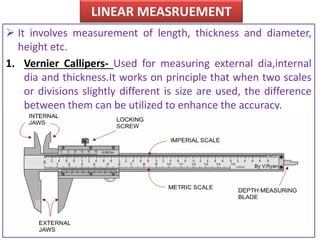
LINEAR MEASRUEMENT
 It involves measurement of length, thickness and diameter,
height etc.
1. Vernier Callipers- Used for measuring external dia,internal
dia and thickness.It works on principle that when two scales
or divisions slightly different is size are used, the difference
between them can be utilized to enhance the accuracy.
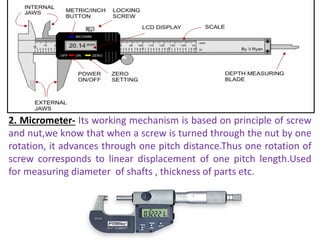
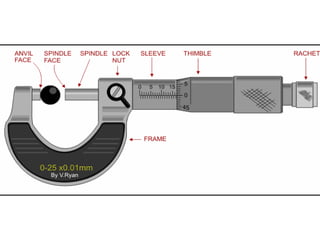
2. Micrometer- Its working mechanism is based on principle of screw
and nut,we know that when a screw is turned through the nut by one
rotation, it advances through one pitch distance.Thus one rotation of
screw corresponds to linear displacement of one pitch length.Used
for measuring diameter of shafts , thickness of parts etc.
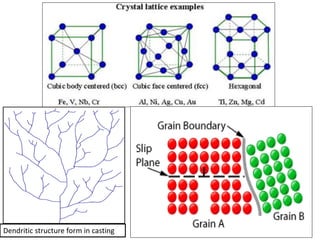
In Material science we talk about 3 levels of structure:
 Macro Structure( < 100x): External geometrical
characteristics of a material that can be observed by
naked eye. For Eg- length, width,grooves,notches etc.
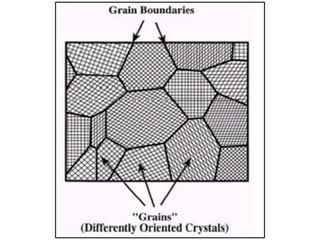
 Micro Structure( ≥ 100x): Internal structural
characteristics of a material which can be observed
under microscope at high magnifications of order ≥
100x.For eg- grains,grain boundaries, phases etc.
 Crystal Structure: Exhibit three dimensional long range
periodicity of arrangement of atoms,or ions or
molecules in the internal structure depending on which
we have metals, ceramics and polymers respectively.
Dendritic structure form in casting
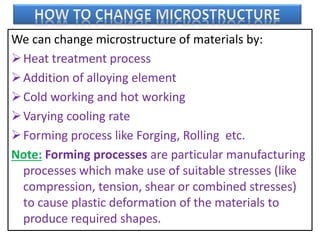
We can change microstructure of materials by:
Heat treatment process
Addition of alloying element
Cold working and hot working
Varying cooling rate
Forming process like Forging, Rolling etc.
Note: Forming processes are particular manufacturing
processes which make use of suitable stresses (like
compression, tension, shear or combined stresses)
to cause plastic deformation of the materials to
produce required shapes.
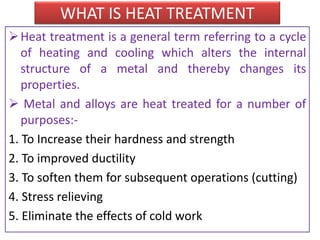
WHAT IS HEAT TREATMENT
Heat treatment is a general term referring to a cycle
of heating and cooling which alters the internal
structure of a metal and thereby changes its
properties.
 Metal and alloys are heat treated for a number of
purposes:-
1. To Increase their hardness and strength
2. To improved ductility
3. To soften them for subsequent operations (cutting)
4. Stress relieving
5. Eliminate the effects of cold work
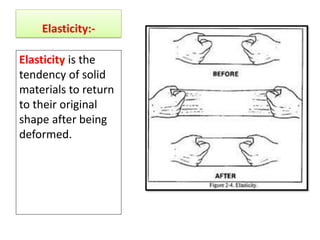
Elasticity:-
Elasticity is the
tendency of solid
materials to return
to their original
shape after being
deformed.
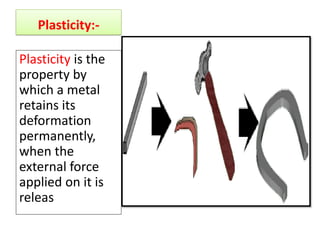
Plasticity:-
Plasticity is the
property by
which a metal
retains its
deformation
permanently,
when the
external force
applied on it is
releas
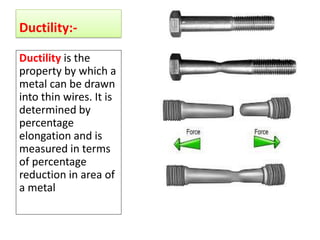
Ductility:-
Ductility is the
property by which a
metal can be drawn
into thin wires. It is
determined by
percentage
elongation and is
measured in terms
of percentage
reduction in area of
a metal
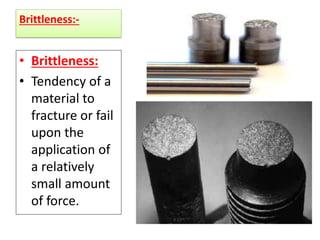
Brittleness:-
• Brittleness:
• Tendency of a
material to
fracture or fail
upon the
application of
a relatively
small amount
of force.
Creep:
• When a metal is subjected to a constant force
at high temperature below its yield point, for a
prolonged period of time, it undergoes a
permanent deformation.
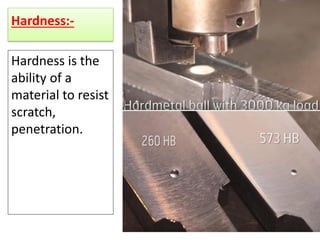
Hardness:-
Hardness is the
ability of a
material to resist
scratch,
penetration.
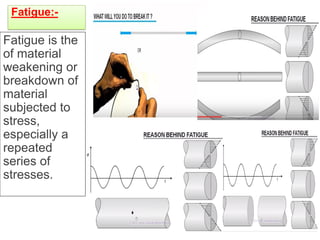
Fatigue:-
Fatigue is the
of material
weakening or
breakdown of
material
subjected to
stress,
especially a
repeated
series of
stresses.
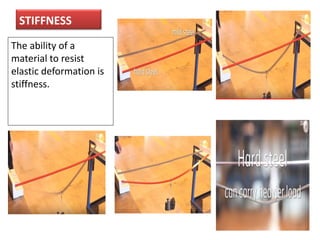
STIFFNESS
The ability of a
material to resist
elastic deformation is
stiffness.
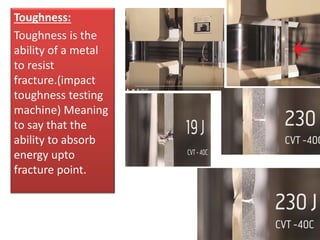
Toughness:
Toughness is the
ability of a metal
to resist
fracture.(impact
toughness testing
machine) Meaning
to say that the
ability to absorb
energy upto
fracture point.
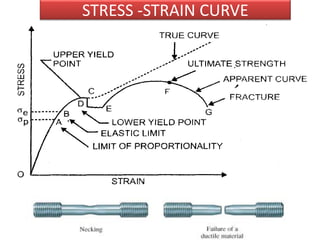
STRESS -STRAIN CURVE
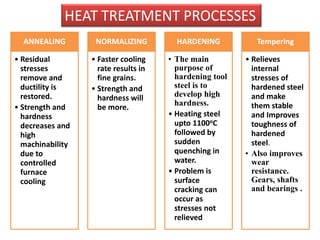
HEAT TREATMENT PROCESSES
ANNEALING
• Residual
stresses
remove and
ductility is
restored.
• Strength and
hardness
decreases and
high
machinability
due to
controlled
furnace
cooling
NORMALIZING
• Faster cooling
rate results in
fine grains.
• Strength and
hardness will
be more.
HARDENING
• The main
purpose of
hardening tool
steel is to
develop high
hardness.
• Heating steel
upto 1100oC
followed by
sudden
quenching in
water.
• Problem is
surface
cracking can
occur as
stresses not
relieved
Tempering
• Relieves
internal
stresses of
hardened steel
and make
them stable
and Improves
toughness of
hardened
steel.
• Also improves
wear
resistance.
Gears, shafts
and bearings .
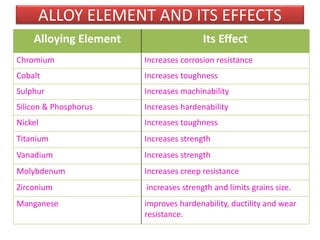
ALLOY ELEMENT AND ITS EFFECTS
Alloying Element Its Effect
Chromium Increases corrosion resistance
Cobalt Increases toughness
Sulphur Increases machinability
Silicon & Phosphorus Increases hardenability
Nickel Increases toughness
Titanium Increases strength
Vanadium Increases strength
Molybdenum Increases creep resistance
Zirconium increases strength and limits grains size.
Manganese improves hardenability, ductility and wear
resistance.
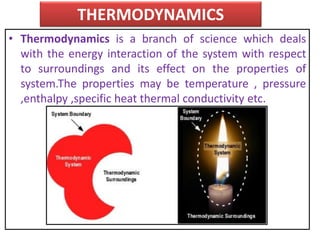
THERMODYNAMICS
• Thermodynamics is a branch of science which deals
with the energy interaction of the system with respect
to surroundings and its effect on the properties of
system.The properties may be temperature , pressure
,enthalpy ,specific heat thermal conductivity etc.
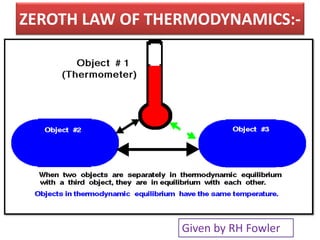
ZEROTH LAW OF THERMODYNAMICS:-
Given by RH Fowler
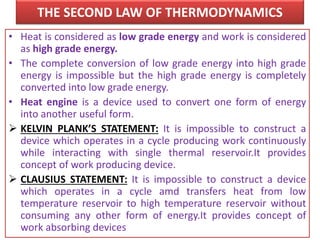
• Heat is considered as low grade energy and work is considered
as high grade energy.
• The complete conversion of low grade energy into high grade
energy is impossible but the high grade energy is completely
converted into low grade energy.
• Heat engine is a device used to convert one form of energy
into another useful form.
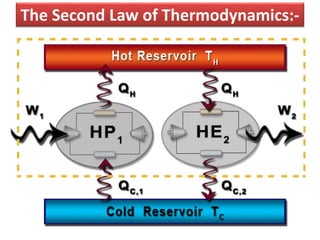
 KELVIN PLANK’S STATEMENT: It is impossible to construct a
device which operates in a cycle producing work continuously
while interacting with single thermal reservoir.It provides
concept of work producing device.
 CLAUSIUS STATEMENT: It is impossible to construct a device
which operates in a cycle amd transfers heat from low
temperature reservoir to high temperature reservoir without
consuming any other form of energy.It provides concept of
work absorbing devices
THE SECOND LAW OF THERMODYNAMICS
The Second Law of Thermodynamics:-
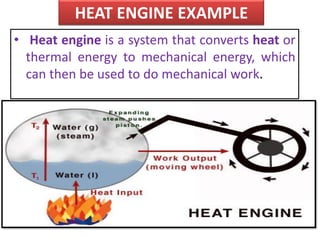
HEAT ENGINE EXAMPLE
• Heat engine is a system that converts heat or
thermal energy to mechanical energy, which
can then be used to do mechanical work.
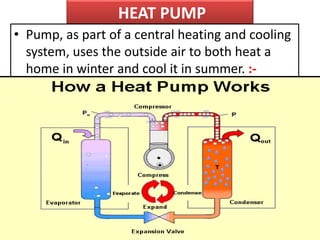
HEAT PUMP
• Pump, as part of a central heating and cooling
system, uses the outside air to both heat a
home in winter and cool it in summer. :-
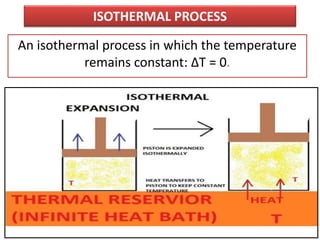
ISOTHERMAL PROCESS
An isothermal process in which the temperature
remains constant: ΔT = 0.
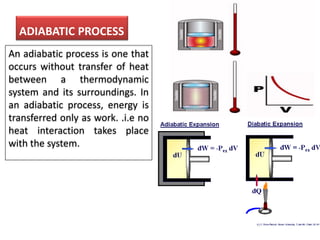
ADIABATIC PROCESS
An adiabatic process is one that
occurs without transfer of heat
between a thermodynamic
system and its surroundings. In
an adiabatic process, energy is
transferred only as work. .i.e no
heat interaction takes place
with the system.
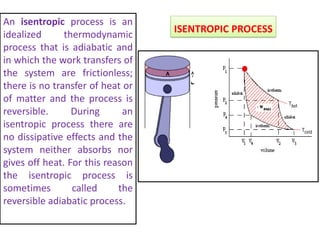
ISENTROPIC PROCESS
An isentropic process is an
idealized thermodynamic
process that is adiabatic and
in which the work transfers of
the system are frictionless;
there is no transfer of heat or
of matter and the process is
reversible. During an
isentropic process there are
no dissipative effects and the
system neither absorbs nor
gives off heat. For this reason
the isentropic process is
sometimes called the
reversible adiabatic process.
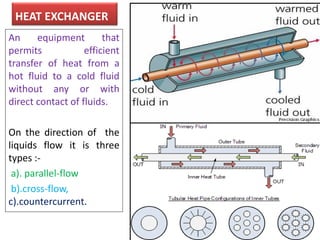
HEAT EXCHANGER
An equipment that
permits efficient
transfer of heat from a
hot fluid to a cold fluid
without any or with
direct contact of fluids.
On the direction of the
liquids flow it is three
types :-
a). parallel-flow
b).cross-flow,
c).countercurrent.
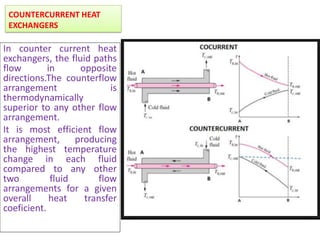
COUNTERCURRENT HEAT
EXCHANGERS
In counter current heat
exchangers, the fluid paths
flow in opposite
directions.The counterflow
arrangement is
thermodynamically
superior to any other flow
arrangement.
It is most efficient flow
arrangement, producing
the highest temperature
change in each fluid
compared to any other
two fluid flow
arrangements for a given
overall heat transfer
coeficient.
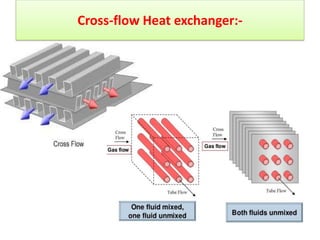
Cross-flow Heat exchanger:-
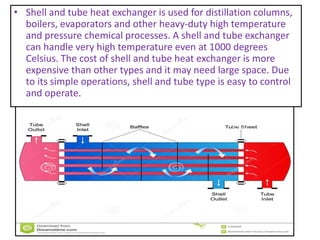
• Shell and tube heat exchanger is used for distillation columns,
boilers, evaporators and other heavy-duty high temperature
and pressure chemical processes. A shell and tube exchanger
can handle very high temperature even at 1000 degrees
Celsius. The cost of shell and tube heat exchanger is more
expensive than other types and it may need large space. Due
to its simple operations, shell and tube type is easy to control
and operate.
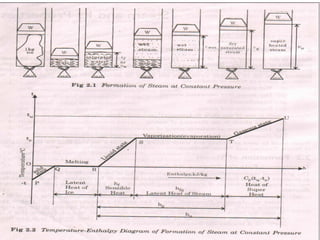
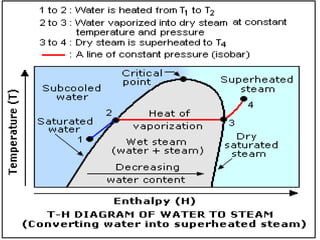
STEAM
• Steam is the vapour or gaseous phase of water.
• It is produced by heating of water and carries
large quantities of heat within itself.
• Hence, it could be used as a working substance
for heat engines and steam turbines
• Quality of steam or dryness fraction is used to
quantify the amount of water within steam. If
steam contains 10% water by mass, it's said to be
90% dry, or have a dryness fraction of 0.9.
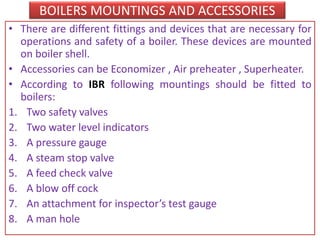
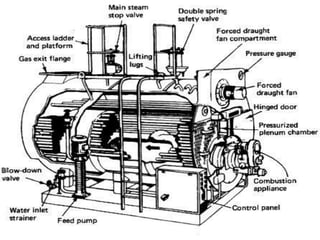
BOILERS MOUNTINGS AND ACCESSORIES
• There are different fittings and devices that are necessary for
operations and safety of a boiler. These devices are mounted
on boiler shell.
• Accessories can be Economizer , Air preheater , Superheater.
• According to IBR following mountings should be fitted to
boilers:
1. Two safety valves
2. Two water level indicators
3. A pressure gauge
4. A steam stop valve
5. A feed check valve
6. A blow off cock
7. An attachment for inspector’s test gauge
8. A man hole
CASTING
casting
CASTING PROCESS
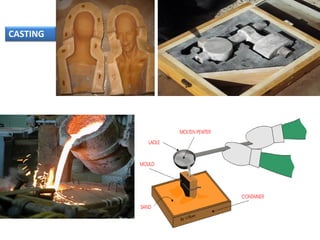
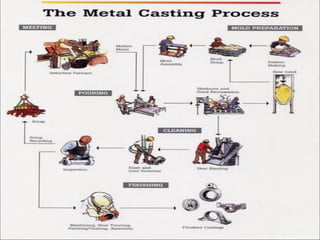
• Manufacturing of a machine part by melting (heating a metal
or alloy above its melting point ) and pouring the liquid
metal/alloy in a cavity approximately of same shape and size
as the machine part is called casting process. After the liquid
metal cools and solidifies, it acquires the shape and size of the
cavity and resembles the required finished product. The
place, where castings are made is called foundry.
• The casting procedure:
• Preparation of a pattern,
• Preparation of a mould with the help of the pattern,
• Melting of metal or alloy in a furnace,
• Pouring of molten metal into mould cavity,
• Breaking the mould to retrieve the casting,
• Cleaning the casting and cutting off risers, runners etc., (this
operation is called ‘fettling’),
• Inspection of casting.
TWO CATEGORIES OF CASTING PROCESSES
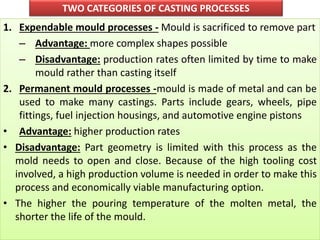
1. Expendable mould processes - Mould is sacrificed to remove part
– Advantage: more complex shapes possible
– Disadvantage: production rates often limited by time to make
mould rather than casting itself
2. Permanent mould processes -mould is made of metal and can be
used to make many castings. Parts include gears, wheels, pipe
fittings, fuel injection housings, and automotive engine pistons
• Advantage: higher production rates
• Disadvantage: Part geometry is limited with this process as the
mold needs to open and close. Because of the high tooling cost
involved, a high production volume is needed in order to make this
process and economically viable manufacturing option.
• The higher the pouring temperature of the molten metal, the
shorter the life of the mould.
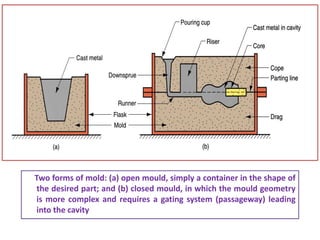
Two forms of mold: (a) open mould, simply a container in the shape of
the desired part; and (b) closed mould, in which the mould geometry
is more complex and requires a gating system (passageway) leading
into the cavity
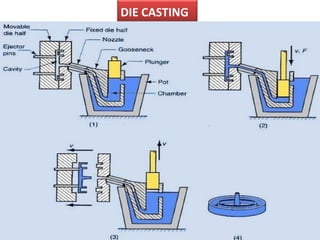
DIE CASTING
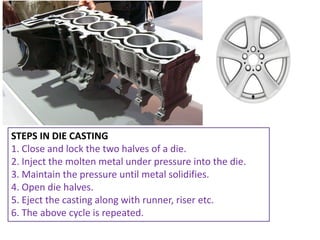
STEPS IN DIE CASTING
1. Close and lock the two halves of a die.
2. Inject the molten metal under pressure into the die.
3. Maintain the pressure until metal solidifies.
4. Open die halves.
5. Eject the casting along with runner, riser etc.
6. The above cycle is repeated.
METAL FORMING PROCESS
• Forming processes are particular manufacturing
processes which make use of suitable stresses (like
compression, tension, shear or combined stresses) to
cause plastic deformation of the materials to produce
required shapes.
• During forming processes no material is removed, i.e.
they are deformed and displaced
• Some examples of forming processes are:
1. Forging
2. Extrusion
3. Rolling
4. Sheet metal working
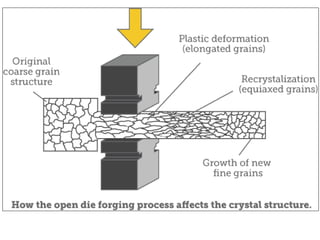
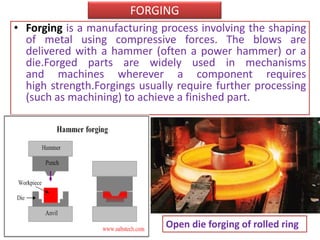
FORGING
• Forging is a manufacturing process involving the shaping
of metal using compressive forces. The blows are
delivered with a hammer (often a power hammer) or a
die.Forged parts are widely used in mechanisms
and machines wherever a component requires
high strength.Forgings usually require further processing
(such as machining) to achieve a finished part.
Open die forging of rolled ring
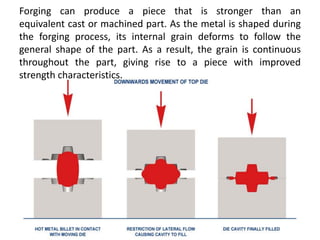
Forging can produce a piece that is stronger than an
equivalent cast or machined part. As the metal is shaped during
the forging process, its internal grain deforms to follow the
general shape of the part. As a result, the grain is continuous
throughout the part, giving rise to a piece with improved
strength characteristics.
Rolling
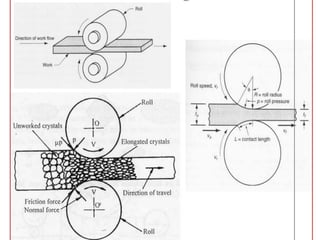
• Rolling is the most extensively used metal forming process.
• The material to be rolled is drawn by means of friction into the two
revolving roll gap.
• The compressive forces applied by the rolls reduce the thickness of
the material or changes its cross sectional area.
• The geometry of the product depend on the contour of the roll
gap.
• Roll materials are cast iron, cast steel and forged steel because of
high strength and wear resistance requirements.
• Hot rolls are generally rough so that they can bite the work, and
cold rolls are ground and polished for good work.
• In rolling the crystals get elongated in the rolling direction. In cold
rolling,crystal more or less retain the elongated shape but in hot
rolling ,they start reforming after coming out from the deformation
zone
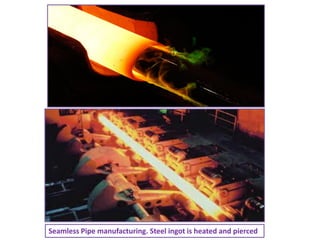
Seamless Pipe manufacturing. Steel ingot is heated and pierced
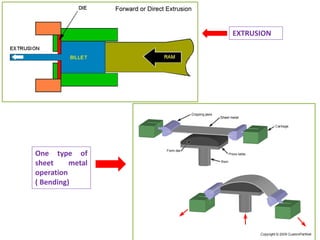
EXTRUSION
One type of
sheet metal
operation
( Bending)
MACHINING
• Machining is a process in which a piece of raw material
is cut into a desired final shape and size by a controlled
material-removal process.
• Machining is the most important of the manufacturing
processes. Machining can be defined as the process of
removing material from a workpiece in the form of chips.
The term metal cutting is used when the material is
metallic. Most machining has very low set-up cost
compared to forming, molding, and casting processes.
However, machining is much more expensive for high
volumes. Machining is necessary where tight tolerances
on dimensions and finishes are required.
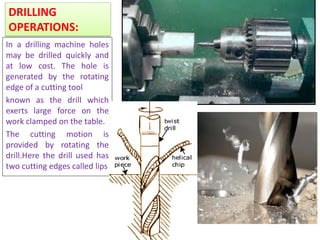
DRILLING
OPERATIONS:
In a drilling machine holes
may be drilled quickly and
at low cost. The hole is
generated by the rotating
edge of a cutting tool
known as the drill which
exerts large force on the
work clamped on the table.
The cutting motion is
provided by rotating the
drill.Here the drill used has
two cutting edges called lips
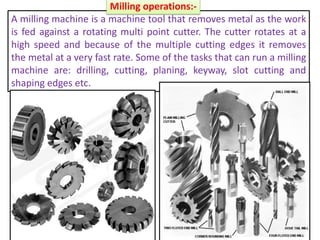
A milling machine is a machine tool that removes metal as the work
is fed against a rotating multi point cutter. The cutter rotates at a
high speed and because of the multiple cutting edges it removes
the metal at a very fast rate. Some of the tasks that can run a milling
machine are: drilling, cutting, planing, keyway, slot cutting and
shaping edges etc.
Milling operations:-
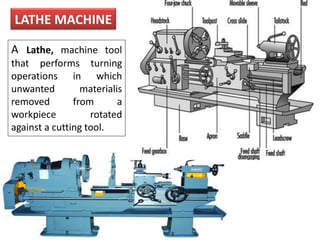
LATHE MACHINE
A Lathe, machine tool
that performs turning
operations in which
unwanted materialis
removed from a
workpiece rotated
against a cutting tool.
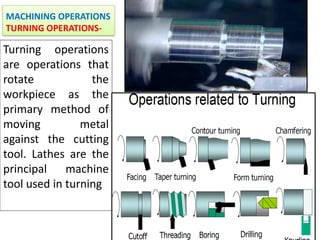
MACHINING OPERATIONS
TURNING OPERATIONS-
Turning operations
are operations that
rotate the
workpiece as the
primary method of
moving metal
against the cutting
tool. Lathes are the
principal machine
tool used in turning
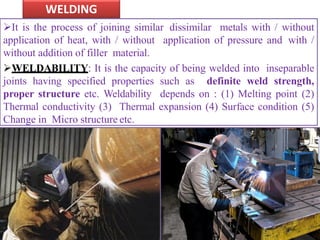
WELDING
It is the process of joining similar dissimilar metals with / without
application of heat, with / without application of pressure and with /
without addition of filler material.
WELDABILITY: It is the capacity of being welded into inseparable
joints having specified properties such as definite weld strength,
proper structure etc. Weldability depends on : (1) Melting point (2)
Thermal conductivity (3) Thermal expansion (4) Surface condition (5)
Change in Micro structure etc.
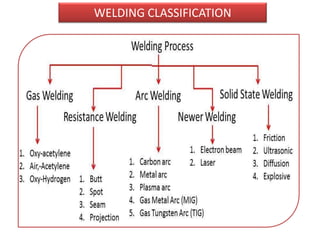
WELDING CLASSIFICATION
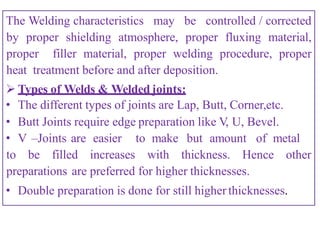
The Welding characteristics may be controlled / corrected
by proper shielding atmosphere, proper fluxing material,
proper filler material, proper welding procedure, proper
heat treatment before and after deposition.
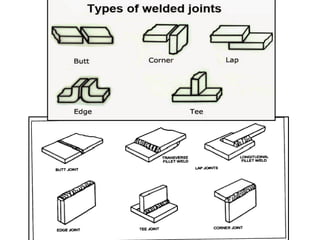
 Types of Welds & Welded joints:
• The different types of joints are Lap, Butt, Corner,etc.
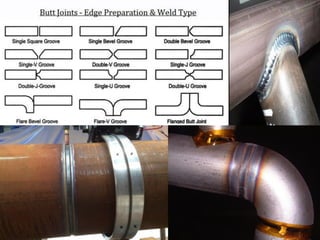
• Butt Joints require edge preparation like V, U, Bevel.
• V –Joints are easier to make but amount of metal
to be filled increases with thickness. Hence other
preparations are preferred for higher thicknesses.
• Double preparation is done for still higherthicknesses.
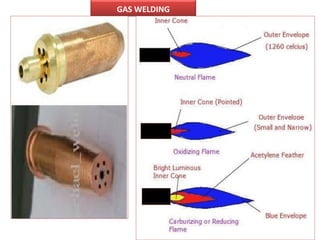
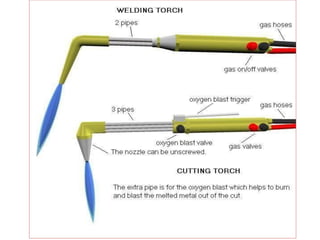
GAS WELDING
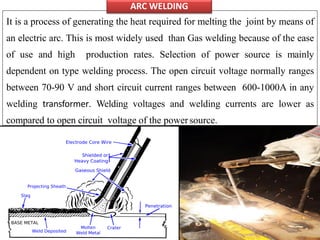
It is a process of generating the heat required for melting the joint by means of
an electric arc. This is most widely used than Gas welding because of the ease
of use and high production rates. Selection of power source is mainly
dependent on type welding process. The open circuit voltage normally ranges
between 70-90 V and short circuit current ranges between 600-1000A in any
welding transformer. Welding voltages and welding currents are lower as
compared to open circuit voltage of the powersource.
ARC WELDING
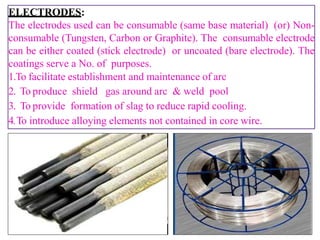
ELECTRODES:
The electrodes used can be consumable (same base material) (or) Non-
consumable (Tungsten, Carbon or Graphite). The consumable electrode
can be either coated (stick electrode) or uncoated (bare electrode). The
coatings serve a No. of purposes.
1.To facilitate establishment and maintenance of arc
2. To produce shield gas around arc & weld pool
3. To provide formation of slag to reduce rapid cooling.
4.To introduce alloying elements not contained in core wire.
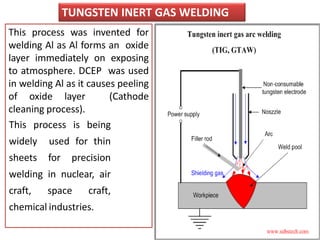
TUNGSTEN INERT GAS WELDING
This process was invented for
welding Al as Al forms an oxide
layer immediately on exposing
to atmosphere. DCEP was used
in welding Al as it causes peeling
of oxide layer (Cathode
cleaning process).
This process is being
widely used for thin
sheets for precision
welding in nuclear, air
craft, space craft,
chemical industries.
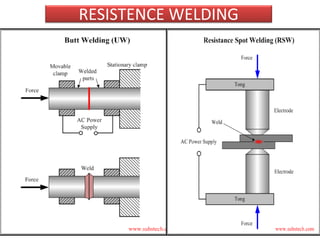
RESISTENCE WELDING
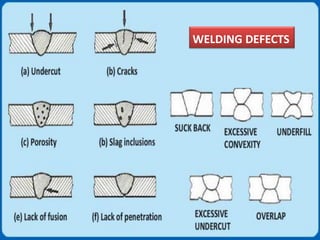
WELDING DEFECTS
• Elasticity
• Plasticity
• Ductility and Brittleness
• Malleability
• Toughness
• Hardness
• Creep and Fatigue
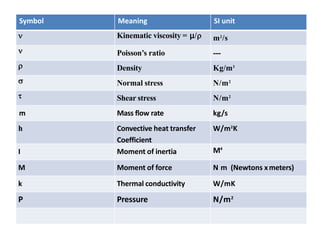
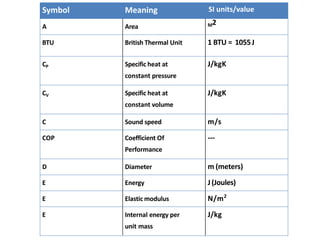
Symbol Meaning SI units/value
A Area M2
BTU British Thermal Unit 1 BTU = 1055J
CP Specific heat at
constant pressure
J/kgK
CV Specific heat at
constant volume
J/kgK
C Sound speed m/s
COP Coefficient Of
Performance
---
D Diameter m (meters)
E Energy J (Joules)
E Elastic modulus N/m2
E Internal energy per
unit mass
J/kg
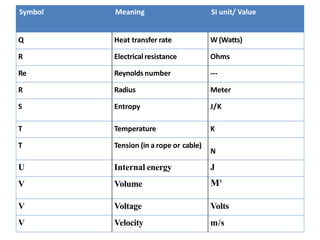
Symbol Meaning SI unit/ Value
Q Heat transfer rate W (Watts)
R Electricalresistance Ohms
Re Reynolds number ---
R Radius Meter
S Entropy J/K
T Temperature K
T Tension (in a rope or cable)
N
U Internal energy J
V Volume M3
V Voltage Volts
V Velocity m/s
Symbol Meaning SI unit
 Kinematic viscosity = µ/ m2
/s
 Poisson’s ratio ---
 Density Kg/m3
 Normal stress N/m2
 Shear stress N/m2
m Mass flow rate kg/s
h Convective heat transfer
Coefficient
W/m2
K
I Moment of inertia M4
M Moment of force N m (Newtons xmeters)
k Thermal conductivity W/mK
P Pressure N/m2
PROPERTIES OF FLUIDS
• Matter exists in two states- the solid state and
the fluid state.This classification of matter is
based on the spacing between different
molecules of matter as well as on the
behaviour of matter when subjected to
stresses. Because molecules in solid state are
spaced very closely, solids possess
compactness and rigidity of form. The
molecules in fluid can move more freely
within the fluid mass.
PROPERTIES OF FLUIDS:-
• THE PROPERTIES OF FLUIDS ARE:-
• 1 VISCOSITY
• 2. Density
• 3. Specific weight
• 4. Specific gravity
• 5. compressiblity
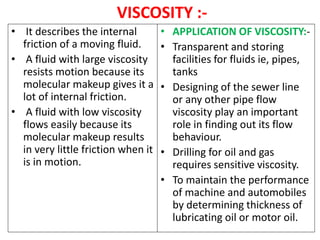
1. VISCOSITY :-
• It describes the internal friction of a moving
fluid.
• A fluid with large viscosity resists motion
because its molecular makeup gives it a lot of
internal friction.
• A fluid with low viscosity flows easily because
its molecular makeup results in very little
friction when it is in motion.
VISCOSITY :-
• It describes the internal
friction of a moving fluid.
• A fluid with large viscosity
resists motion because its
molecular makeup gives it a
lot of internal friction.
• A fluid with low viscosity
flows easily because its
molecular makeup results
in very little friction when it
is in motion.
• APPLICATION OF VISCOSITY:-
• Transparent and storing
facilities for fluids ie, pipes,
tanks
• Designing of the sewer line
or any other pipe flow
viscosity play an important
role in finding out its flow
behaviour.
• Drilling for oil and gas
requires sensitive viscosity.
• To maintain the performance
of machine and automobiles
by determining thickness of
lubricating oil or motor oil.
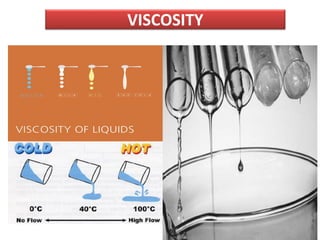
VISCOSITY
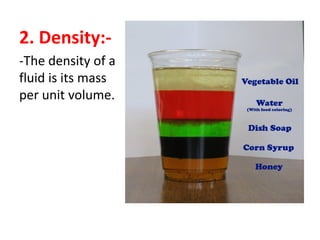
2. Density:-
-The density of a
fluid is its mass
per unit volume.
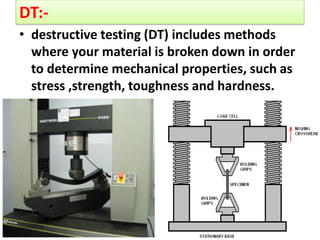
DT:-
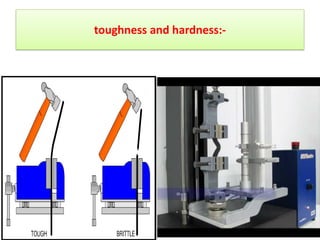
• destructive testing (DT) includes methods
where your material is broken down in order
to determine mechanical properties, such as
stress ,strength, toughness and hardness.
toughness and hardness:-
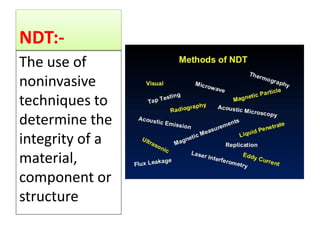
NDT:-
The use of
noninvasive
techniques to
determine the
integrity of a
material,
component or
structure
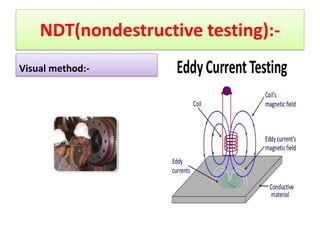
NDT(nondestructive testing):-
Visual method:-
NDT(nondestructive testing):-
Mannual TAPE testing method:-
Ultrasonic method Tape testing
method:- :-
NDT(nondestructive testing):-
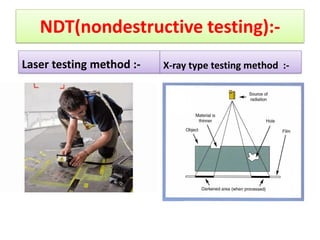
Laser testing method :- X-ray type testing method :-
NDT(nondestructive testing):-
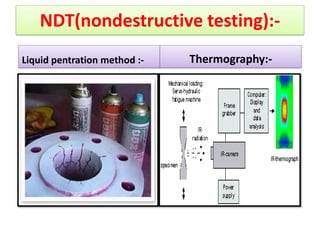
Liquid pentration method :- Thermography:-
Presentation on mechanical engineering

Presentation on mechanical engineering

  • 2.
    Mechanical engineering isthe discipline that applies the principles of engineering, physics, and materials science for the design, analysis, manufacturing, and maintenance of mechanical systems. It is the branch of engineering that involves the design, production, and operation of machinery. Material Science is the study of relationship between structure and properties of engineering materials.The reason for structure in materials is manufacturing process like machining, casting.
  • 3.
    Petro-chemicals and Refineries Heating,Ventilating andAir Conditioning Engine, Transmissions Power plants Designing Fluid mechanics Manufacturing Material science Stress analysis CAD and CAM Measurement and Metrology Maintenance- Preventive,Breakdown and time based.
  • 4.
     Measurement maybe defined as branch of engineering that deals with measuring devices that are used to determine various parameters of a system or a process. Measuring instruments are useful in process industries like textile plants, for measuring and controlling variables like pressure, temperature, viscosity and flow rate etc. There are three types of element present in general measuring instrument which are:-
  • 5.
    1. Initial sensingelement 2. Signal conditioning element 3. Data Presentation element Initial Sensing Element Data Presentation Element Variable Manipulation Element Variable Transformation Element Data Transmission Element Input Observed reading Data Storage Element Block Diagram to represent the measuring instrument
  • 6.
    This instrument isused to measure fluid pressure. As pressure increases, the tube tries to regain its circular form causing movement of pointer through gears.
  • 8.
  • 9.
  • 10.
    It is usedto measure level of liquid in big containers, As the level of liquid in vessel increases beyond a certain limit, the diaphragm ( flat convex type) bends and the motion is transferred through rod and lever mechanism to the lever which connects the pointer, Here it is digital display.
  • 11.
    RPM is measuredby a device called tachometer. Torque & power transmitted by a shaft is measured by Dynamometer. ROPE BRAKE DYNAMOMETER
  • 12.
  • 13.
    TEMPERATURE MEASUREMENT Temperature devicescan be of following types: • Liquid Expansion device like liquid filled and mercury filled thermometer. • Bimetallic thermometer • Electrical sensors like thermocouple and thermistor • Pyrometers which can be radiation(700-2000oC) and optical pyrometer(850-1200oC).It is used for measuring very high temperature without any physical contact with the hot body.
  • 14.
  • 17.
    VIBRATION MEASUREMENT Vibration refersto repeated cyclic oscillations of a system.It may be due to misalignment of mating parts,unbalanced rotating parts or some external unbalanced force or from design, installation etc. Excessive vibrations in machines can lead to accumulation of stress, fatigue and ultimately failure of parts. It can also induced dimensional errors in the component being machined. So vibration analysis is important for Thermal Power Plants, Refineries plant, petrochemical plants.
  • 18.
    OUR OBJECTIVES IS:- •To increase equipment protection. • To improve safety for personnel. • To improve maintenance procedures. • To detect problems early. • To avoid catastrophic failures. • To extend equipment life. • To enhance operations. Therefore we try to prevent vibration.
  • 19.
    Some equipments whichwe need to analyze are: • Boiler feed pumps, • Circulating water pumps, • Condensate extraction pumps, • Induced draft fans (ID fan), • Force draft fans (FD fan), • Raw water pumps, • Cooling water pumps, • Pipe vibrations, • Journal Bearings • Gears • Compressors etc. Note: As automation is done in plants so now a days sound and vibration softwares are used for measurement and for piping special softwares like Pulsim ,CAESAR etc are used.
  • 20.
    VENTURIMETER  A venturimeteris essentially a short pipe consisting of two conical parts with a short portion of uniform cross-section in between. This short portion has the minimum area and is known as the throat. The velocity increases in the direction of flow according to the principle of continuity, while the pressure decreases according to Bernoulli’s theorem.
  • 21.
  • 22.
    ORIFICEMETER  An orificemeterprovides a simpler and cheaper arrangement for the measurement of flow through a pipe. An orificemeter is essentially a thin circular plate with a sharp edged concentric circular hole in it.
  • 25.
    METROLOGY  It isthe science of measurement, precision and accuracy. To summarize, it is a quantitative analysis of a specimen in terms of length, angle or say linear, angular measurements.  Accuracy: It is degree of closeness of measured value to the true value.  Precision:It is degree of repetitiveness or say closeness of measured value with respect to the previous or consecutive values.
  • 26.
    LINEAR MEASRUEMENT  Itinvolves measurement of length, thickness and diameter, height etc. 1. Vernier Callipers- Used for measuring external dia,internal dia and thickness.It works on principle that when two scales or divisions slightly different is size are used, the difference between them can be utilized to enhance the accuracy.
  • 27.
    2. Micrometer- Itsworking mechanism is based on principle of screw and nut,we know that when a screw is turned through the nut by one rotation, it advances through one pitch distance.Thus one rotation of screw corresponds to linear displacement of one pitch length.Used for measuring diameter of shafts , thickness of parts etc.
  • 29.
    In Material sciencewe talk about 3 levels of structure:  Macro Structure( < 100x): External geometrical characteristics of a material that can be observed by naked eye. For Eg- length, width,grooves,notches etc.  Micro Structure( ≥ 100x): Internal structural characteristics of a material which can be observed under microscope at high magnifications of order ≥ 100x.For eg- grains,grain boundaries, phases etc.  Crystal Structure: Exhibit three dimensional long range periodicity of arrangement of atoms,or ions or molecules in the internal structure depending on which we have metals, ceramics and polymers respectively.
  • 30.
  • 32.
    We can changemicrostructure of materials by: Heat treatment process Addition of alloying element Cold working and hot working Varying cooling rate Forming process like Forging, Rolling etc. Note: Forming processes are particular manufacturing processes which make use of suitable stresses (like compression, tension, shear or combined stresses) to cause plastic deformation of the materials to produce required shapes.
  • 34.
    WHAT IS HEATTREATMENT Heat treatment is a general term referring to a cycle of heating and cooling which alters the internal structure of a metal and thereby changes its properties.  Metal and alloys are heat treated for a number of purposes:- 1. To Increase their hardness and strength 2. To improved ductility 3. To soften them for subsequent operations (cutting) 4. Stress relieving 5. Eliminate the effects of cold work
  • 35.
    Elasticity:- Elasticity is the tendencyof solid materials to return to their original shape after being deformed.
  • 36.
    Plasticity:- Plasticity is the propertyby which a metal retains its deformation permanently, when the external force applied on it is releas
  • 37.
    Ductility:- Ductility is the propertyby which a metal can be drawn into thin wires. It is determined by percentage elongation and is measured in terms of percentage reduction in area of a metal
  • 38.
    Brittleness:- • Brittleness: • Tendencyof a material to fracture or fail upon the application of a relatively small amount of force.
  • 39.
    Creep: • When ametal is subjected to a constant force at high temperature below its yield point, for a prolonged period of time, it undergoes a permanent deformation.
  • 40.
    Hardness:- Hardness is the abilityof a material to resist scratch, penetration.
  • 41.
    Fatigue:- Fatigue is the ofmaterial weakening or breakdown of material subjected to stress, especially a repeated series of stresses.
  • 42.
    STIFFNESS The ability ofa material to resist elastic deformation is stiffness.
  • 43.
    Toughness: Toughness is the abilityof a metal to resist fracture.(impact toughness testing machine) Meaning to say that the ability to absorb energy upto fracture point.
  • 44.
  • 45.
    HEAT TREATMENT PROCESSES ANNEALING •Residual stresses remove and ductility is restored. • Strength and hardness decreases and high machinability due to controlled furnace cooling NORMALIZING • Faster cooling rate results in fine grains. • Strength and hardness will be more. HARDENING • The main purpose of hardening tool steel is to develop high hardness. • Heating steel upto 1100oC followed by sudden quenching in water. • Problem is surface cracking can occur as stresses not relieved Tempering • Relieves internal stresses of hardened steel and make them stable and Improves toughness of hardened steel. • Also improves wear resistance. Gears, shafts and bearings .
  • 46.
    ALLOY ELEMENT ANDITS EFFECTS Alloying Element Its Effect Chromium Increases corrosion resistance Cobalt Increases toughness Sulphur Increases machinability Silicon & Phosphorus Increases hardenability Nickel Increases toughness Titanium Increases strength Vanadium Increases strength Molybdenum Increases creep resistance Zirconium increases strength and limits grains size. Manganese improves hardenability, ductility and wear resistance.
  • 47.
    THERMODYNAMICS • Thermodynamics isa branch of science which deals with the energy interaction of the system with respect to surroundings and its effect on the properties of system.The properties may be temperature , pressure ,enthalpy ,specific heat thermal conductivity etc.
  • 48.
    ZEROTH LAW OFTHERMODYNAMICS:- Given by RH Fowler
  • 50.
    • Heat isconsidered as low grade energy and work is considered as high grade energy. • The complete conversion of low grade energy into high grade energy is impossible but the high grade energy is completely converted into low grade energy. • Heat engine is a device used to convert one form of energy into another useful form.  KELVIN PLANK’S STATEMENT: It is impossible to construct a device which operates in a cycle producing work continuously while interacting with single thermal reservoir.It provides concept of work producing device.  CLAUSIUS STATEMENT: It is impossible to construct a device which operates in a cycle amd transfers heat from low temperature reservoir to high temperature reservoir without consuming any other form of energy.It provides concept of work absorbing devices THE SECOND LAW OF THERMODYNAMICS
  • 51.
    The Second Lawof Thermodynamics:-
  • 52.
    HEAT ENGINE EXAMPLE •Heat engine is a system that converts heat or thermal energy to mechanical energy, which can then be used to do mechanical work.
  • 53.
    HEAT PUMP • Pump,as part of a central heating and cooling system, uses the outside air to both heat a home in winter and cool it in summer. :-
  • 54.
    ISOTHERMAL PROCESS An isothermalprocess in which the temperature remains constant: ΔT = 0.
  • 55.
    ADIABATIC PROCESS An adiabaticprocess is one that occurs without transfer of heat between a thermodynamic system and its surroundings. In an adiabatic process, energy is transferred only as work. .i.e no heat interaction takes place with the system.
  • 56.
    ISENTROPIC PROCESS An isentropicprocess is an idealized thermodynamic process that is adiabatic and in which the work transfers of the system are frictionless; there is no transfer of heat or of matter and the process is reversible. During an isentropic process there are no dissipative effects and the system neither absorbs nor gives off heat. For this reason the isentropic process is sometimes called the reversible adiabatic process.
  • 57.
    HEAT EXCHANGER An equipmentthat permits efficient transfer of heat from a hot fluid to a cold fluid without any or with direct contact of fluids. On the direction of the liquids flow it is three types :- a). parallel-flow b).cross-flow, c).countercurrent.
  • 58.
    COUNTERCURRENT HEAT EXCHANGERS In countercurrent heat exchangers, the fluid paths flow in opposite directions.The counterflow arrangement is thermodynamically superior to any other flow arrangement. It is most efficient flow arrangement, producing the highest temperature change in each fluid compared to any other two fluid flow arrangements for a given overall heat transfer coeficient.
  • 59.
  • 60.
    • Shell andtube heat exchanger is used for distillation columns, boilers, evaporators and other heavy-duty high temperature and pressure chemical processes. A shell and tube exchanger can handle very high temperature even at 1000 degrees Celsius. The cost of shell and tube heat exchanger is more expensive than other types and it may need large space. Due to its simple operations, shell and tube type is easy to control and operate.
  • 61.
    STEAM • Steam isthe vapour or gaseous phase of water. • It is produced by heating of water and carries large quantities of heat within itself. • Hence, it could be used as a working substance for heat engines and steam turbines • Quality of steam or dryness fraction is used to quantify the amount of water within steam. If steam contains 10% water by mass, it's said to be 90% dry, or have a dryness fraction of 0.9.
  • 64.
    BOILERS MOUNTINGS ANDACCESSORIES • There are different fittings and devices that are necessary for operations and safety of a boiler. These devices are mounted on boiler shell. • Accessories can be Economizer , Air preheater , Superheater. • According to IBR following mountings should be fitted to boilers: 1. Two safety valves 2. Two water level indicators 3. A pressure gauge 4. A steam stop valve 5. A feed check valve 6. A blow off cock 7. An attachment for inspector’s test gauge 8. A man hole
  • 66.
  • 67.
  • 68.
    CASTING PROCESS • Manufacturingof a machine part by melting (heating a metal or alloy above its melting point ) and pouring the liquid metal/alloy in a cavity approximately of same shape and size as the machine part is called casting process. After the liquid metal cools and solidifies, it acquires the shape and size of the cavity and resembles the required finished product. The place, where castings are made is called foundry. • The casting procedure: • Preparation of a pattern, • Preparation of a mould with the help of the pattern, • Melting of metal or alloy in a furnace, • Pouring of molten metal into mould cavity, • Breaking the mould to retrieve the casting, • Cleaning the casting and cutting off risers, runners etc., (this operation is called ‘fettling’), • Inspection of casting.
  • 69.
    TWO CATEGORIES OFCASTING PROCESSES 1. Expendable mould processes - Mould is sacrificed to remove part – Advantage: more complex shapes possible – Disadvantage: production rates often limited by time to make mould rather than casting itself 2. Permanent mould processes -mould is made of metal and can be used to make many castings. Parts include gears, wheels, pipe fittings, fuel injection housings, and automotive engine pistons • Advantage: higher production rates • Disadvantage: Part geometry is limited with this process as the mold needs to open and close. Because of the high tooling cost involved, a high production volume is needed in order to make this process and economically viable manufacturing option. • The higher the pouring temperature of the molten metal, the shorter the life of the mould.
  • 70.
    Two forms ofmold: (a) open mould, simply a container in the shape of the desired part; and (b) closed mould, in which the mould geometry is more complex and requires a gating system (passageway) leading into the cavity
  • 71.
  • 72.
    STEPS IN DIECASTING 1. Close and lock the two halves of a die. 2. Inject the molten metal under pressure into the die. 3. Maintain the pressure until metal solidifies. 4. Open die halves. 5. Eject the casting along with runner, riser etc. 6. The above cycle is repeated.
  • 73.
    METAL FORMING PROCESS •Forming processes are particular manufacturing processes which make use of suitable stresses (like compression, tension, shear or combined stresses) to cause plastic deformation of the materials to produce required shapes. • During forming processes no material is removed, i.e. they are deformed and displaced • Some examples of forming processes are: 1. Forging 2. Extrusion 3. Rolling 4. Sheet metal working
  • 74.
    FORGING • Forging isa manufacturing process involving the shaping of metal using compressive forces. The blows are delivered with a hammer (often a power hammer) or a die.Forged parts are widely used in mechanisms and machines wherever a component requires high strength.Forgings usually require further processing (such as machining) to achieve a finished part. Open die forging of rolled ring
  • 75.
    Forging can producea piece that is stronger than an equivalent cast or machined part. As the metal is shaped during the forging process, its internal grain deforms to follow the general shape of the part. As a result, the grain is continuous throughout the part, giving rise to a piece with improved strength characteristics.
  • 76.
    Rolling • Rolling isthe most extensively used metal forming process. • The material to be rolled is drawn by means of friction into the two revolving roll gap. • The compressive forces applied by the rolls reduce the thickness of the material or changes its cross sectional area. • The geometry of the product depend on the contour of the roll gap. • Roll materials are cast iron, cast steel and forged steel because of high strength and wear resistance requirements. • Hot rolls are generally rough so that they can bite the work, and cold rolls are ground and polished for good work. • In rolling the crystals get elongated in the rolling direction. In cold rolling,crystal more or less retain the elongated shape but in hot rolling ,they start reforming after coming out from the deformation zone
  • 78.
    Seamless Pipe manufacturing.Steel ingot is heated and pierced
  • 79.
    EXTRUSION One type of sheetmetal operation ( Bending)
  • 80.
    MACHINING • Machining isa process in which a piece of raw material is cut into a desired final shape and size by a controlled material-removal process. • Machining is the most important of the manufacturing processes. Machining can be defined as the process of removing material from a workpiece in the form of chips. The term metal cutting is used when the material is metallic. Most machining has very low set-up cost compared to forming, molding, and casting processes. However, machining is much more expensive for high volumes. Machining is necessary where tight tolerances on dimensions and finishes are required.
  • 81.
    DRILLING OPERATIONS: In a drillingmachine holes may be drilled quickly and at low cost. The hole is generated by the rotating edge of a cutting tool known as the drill which exerts large force on the work clamped on the table. The cutting motion is provided by rotating the drill.Here the drill used has two cutting edges called lips
  • 82.
    A milling machineis a machine tool that removes metal as the work is fed against a rotating multi point cutter. The cutter rotates at a high speed and because of the multiple cutting edges it removes the metal at a very fast rate. Some of the tasks that can run a milling machine are: drilling, cutting, planing, keyway, slot cutting and shaping edges etc. Milling operations:-
  • 83.
    LATHE MACHINE A Lathe,machine tool that performs turning operations in which unwanted materialis removed from a workpiece rotated against a cutting tool.
  • 84.
    MACHINING OPERATIONS TURNING OPERATIONS- Turningoperations are operations that rotate the workpiece as the primary method of moving metal against the cutting tool. Lathes are the principal machine tool used in turning
  • 85.
    WELDING It is theprocess of joining similar dissimilar metals with / without application of heat, with / without application of pressure and with / without addition of filler material. WELDABILITY: It is the capacity of being welded into inseparable joints having specified properties such as definite weld strength, proper structure etc. Weldability depends on : (1) Melting point (2) Thermal conductivity (3) Thermal expansion (4) Surface condition (5) Change in Micro structure etc.
  • 86.
  • 87.
    The Welding characteristicsmay be controlled / corrected by proper shielding atmosphere, proper fluxing material, proper filler material, proper welding procedure, proper heat treatment before and after deposition.  Types of Welds & Welded joints: • The different types of joints are Lap, Butt, Corner,etc. • Butt Joints require edge preparation like V, U, Bevel. • V –Joints are easier to make but amount of metal to be filled increases with thickness. Hence other preparations are preferred for higher thicknesses. • Double preparation is done for still higherthicknesses.
  • 90.
  • 92.
    It is aprocess of generating the heat required for melting the joint by means of an electric arc. This is most widely used than Gas welding because of the ease of use and high production rates. Selection of power source is mainly dependent on type welding process. The open circuit voltage normally ranges between 70-90 V and short circuit current ranges between 600-1000A in any welding transformer. Welding voltages and welding currents are lower as compared to open circuit voltage of the powersource. ARC WELDING
  • 93.
    ELECTRODES: The electrodes usedcan be consumable (same base material) (or) Non- consumable (Tungsten, Carbon or Graphite). The consumable electrode can be either coated (stick electrode) or uncoated (bare electrode). The coatings serve a No. of purposes. 1.To facilitate establishment and maintenance of arc 2. To produce shield gas around arc & weld pool 3. To provide formation of slag to reduce rapid cooling. 4.To introduce alloying elements not contained in core wire.
  • 94.
    TUNGSTEN INERT GASWELDING This process was invented for welding Al as Al forms an oxide layer immediately on exposing to atmosphere. DCEP was used in welding Al as it causes peeling of oxide layer (Cathode cleaning process). This process is being widely used for thin sheets for precision welding in nuclear, air craft, space craft, chemical industries.
  • 95.
  • 96.
  • 97.
    • Elasticity • Plasticity •Ductility and Brittleness • Malleability • Toughness • Hardness • Creep and Fatigue
  • 98.
    Symbol Meaning SIunits/value A Area M2 BTU British Thermal Unit 1 BTU = 1055J CP Specific heat at constant pressure J/kgK CV Specific heat at constant volume J/kgK C Sound speed m/s COP Coefficient Of Performance --- D Diameter m (meters) E Energy J (Joules) E Elastic modulus N/m2 E Internal energy per unit mass J/kg
  • 99.
    Symbol Meaning SIunit/ Value Q Heat transfer rate W (Watts) R Electricalresistance Ohms Re Reynolds number --- R Radius Meter S Entropy J/K T Temperature K T Tension (in a rope or cable) N U Internal energy J V Volume M3 V Voltage Volts V Velocity m/s
  • 100.
    Symbol Meaning SIunit  Kinematic viscosity = µ/ m2 /s  Poisson’s ratio ---  Density Kg/m3  Normal stress N/m2  Shear stress N/m2 m Mass flow rate kg/s h Convective heat transfer Coefficient W/m2 K I Moment of inertia M4 M Moment of force N m (Newtons xmeters) k Thermal conductivity W/mK P Pressure N/m2
  • 101.
    PROPERTIES OF FLUIDS •Matter exists in two states- the solid state and the fluid state.This classification of matter is based on the spacing between different molecules of matter as well as on the behaviour of matter when subjected to stresses. Because molecules in solid state are spaced very closely, solids possess compactness and rigidity of form. The molecules in fluid can move more freely within the fluid mass.
  • 102.
    PROPERTIES OF FLUIDS:- •THE PROPERTIES OF FLUIDS ARE:- • 1 VISCOSITY • 2. Density • 3. Specific weight • 4. Specific gravity • 5. compressiblity
  • 103.
    1. VISCOSITY :- •It describes the internal friction of a moving fluid. • A fluid with large viscosity resists motion because its molecular makeup gives it a lot of internal friction. • A fluid with low viscosity flows easily because its molecular makeup results in very little friction when it is in motion.
  • 104.
    VISCOSITY :- • Itdescribes the internal friction of a moving fluid. • A fluid with large viscosity resists motion because its molecular makeup gives it a lot of internal friction. • A fluid with low viscosity flows easily because its molecular makeup results in very little friction when it is in motion. • APPLICATION OF VISCOSITY:- • Transparent and storing facilities for fluids ie, pipes, tanks • Designing of the sewer line or any other pipe flow viscosity play an important role in finding out its flow behaviour. • Drilling for oil and gas requires sensitive viscosity. • To maintain the performance of machine and automobiles by determining thickness of lubricating oil or motor oil.
  • 105.
  • 106.
    2. Density:- -The densityof a fluid is its mass per unit volume.
  • 107.
    DT:- • destructive testing(DT) includes methods where your material is broken down in order to determine mechanical properties, such as stress ,strength, toughness and hardness.
  • 108.
  • 109.
    NDT:- The use of noninvasive techniquesto determine the integrity of a material, component or structure
  • 110.
  • 111.
    NDT(nondestructive testing):- Mannual TAPEtesting method:- Ultrasonic method Tape testing method:- :-
  • 112.
    NDT(nondestructive testing):- Laser testingmethod :- X-ray type testing method :-
  • 113.