LAKSHMI NARAIN COLLEGE
OF TECH. & SCI.
GUIDED BY: SUBMITTED BY:
PROF. ABHISHEK B.
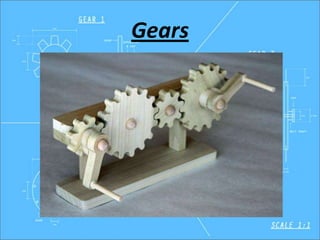
Gears
CONTENT
• Introduction of gears
• Classification of gears
• Types of gears
• Nomenclature of Spur gear
• Forms of teeth
• Gear train
• Types of gear train
• Application of gears
Introduction
Gears are used to transmit motion from one
shaft to another or between shaft and a slide.
This is achieved by successfully engaging teeth.
Gears used no intermediate links or connector
and transmit the motion by direct contact. The
surface of two bodies make a tangential
contact. The two bodies have either a rolling or
a sliding motion along the tangent at the point
of contact.
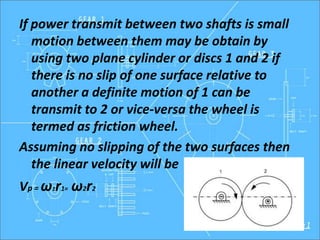
If power transmit between two shafts is small
motion between them may be obtain by
using two plane cylinder or discs 1 and 2 if
there is no slip of one surface relative to
another a definite motion of 1 can be
transmit to 2 or vice-versa the wheel is
termed as friction wheel.
Assuming no slipping of the two surfaces then
the linear velocity will be
Vp = ω1r1= ω2r2
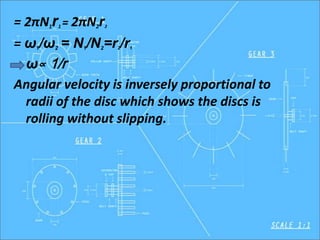
= 2πN1r1 = 2πN2r2
= ω1/ω2 = N1/N2=r2/r1
ω∝ 1/r
Angular velocity is inversely proportional to
radii of the disc which shows the discs is
rolling without slipping.
CLASSIFICATION OF TOOTHED
WHEELS
According to the position of axes of the shafts:
1. Parallel
2. Intersecting
3. Non-Intersecting & Non-Parallel
According to the peripheral velocity of the gears:
1. Low velocity
2. Medium velocity
3. High velocity
According to the type of gearing:
1. External gearing
2. Internal gearing
3. Rack & Pinion
According to the position of teeth on the gear
surface:
1. Straight
2. Inclined
3. Curved
Types of Gears
• Spur gears
• Helical gears
• Bevel gears
• Worm gears
• Rack & Pinion gears
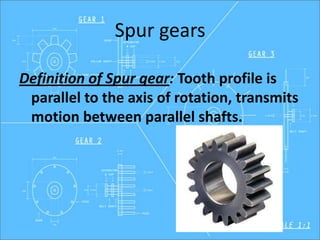
Spur gears
Definition of Spur gear: Tooth profile is
parallel to the axis of rotation, transmits
motion between parallel shafts.
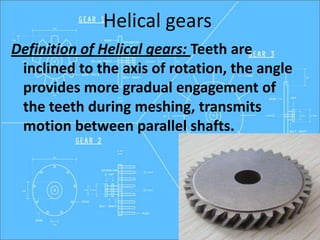
Helical gears
Definition of Helical gears: Teeth are
inclined to the axis of rotation, the angle
provides more gradual engagement of
the teeth during meshing, transmits
motion between parallel shafts.
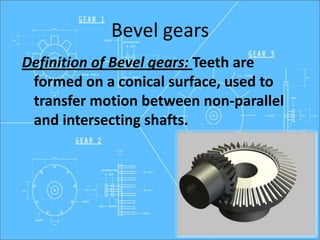
Bevel gears
Definition of Bevel gears: Teeth are
formed on a conical surface, used to
transfer motion between non-parallel
and intersecting shafts.
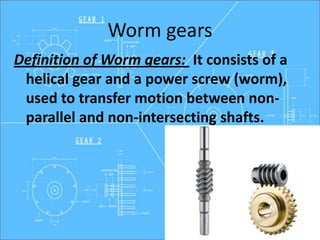
Worm gears
Definition of Worm gears: It consists of a
helical gear and a power screw (worm),
used to transfer motion between non-
parallel and non-intersecting shafts.
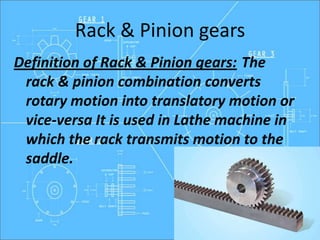
Rack & Pinion gears
Definition of Rack & Pinion gears: The
rack & pinion combination converts
rotary motion into translatory motion or
vice-versa It is used in Lathe machine in
which the rack transmits motion to the
saddle.
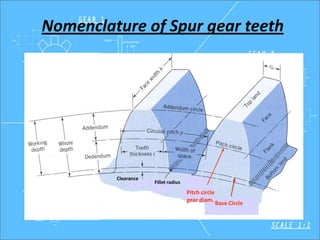
Nomenclature of Spur gear teeth
Pitch circle
gear diam.
Fillet radius
Clearance
Base Circle
TERMINOLOGY
• Top land- It is the surface of the top of the
tooth.
• Bottom land- The surface of the bottom of
the tooth.
• Face- Tooth surface between the pitch circle
and the top land.
• Flank- Tooth surface between the pitch circle
& the bottom land.
• Addendum- It is the radial height of the tooth
above the pitch circle.
• Dedendum- It is the radial depth of the tooth
below the pitch circle.
• Space width- It is the width of the tooth
space along the pitch circle.
• Face width- The length of the tooth parallel
to the gear axis.
• Tooth thickness- It is the thickness at the
tooth measured along the
pitch circle.
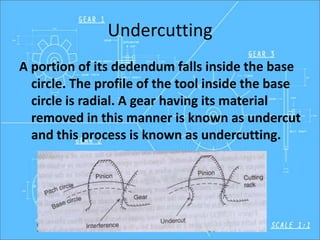
Undercutting
A portion of its dedendum falls inside the base
circle. The profile of the tool inside the base
circle is radial. A gear having its material
removed in this manner is known as undercut
and this process is known as undercutting.
Forms of teeth
• Cycloidal teeth
• Involute teeth
Gear Train
A gear train is a combination of gears used to
transmit motion from one shaft to another.
There are different types of gear train:
1. Simple gear train
2. Compound gear train
3. Reverted gear train
4. Planetary or epicyclic gear train
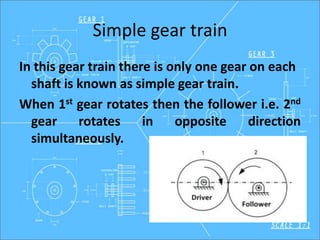
Simple gear train
In this gear train there is only one gear on each
shaft is known as simple gear train.
When 1st gear rotates then the follower i.e. 2nd
gear rotates in opposite direction
simultaneously.
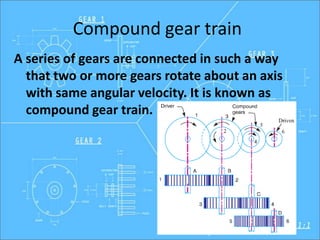
Compound gear train
A series of gears are connected in such a way
that two or more gears rotate about an axis
with same angular velocity. It is known as
compound gear train.
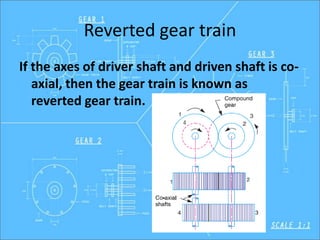
Reverted gear train
If the axes of driver shaft and driven shaft is co-
axial, then the gear train is known as
reverted gear train.
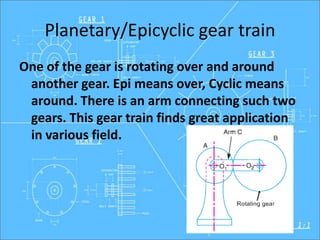
Planetary/Epicyclic gear train
One of the gear is rotating over and around
another gear. Epi means over, Cyclic means
around. There is an arm connecting such two
gears. This gear train finds great application
in various field.
Advantages:
1. It transmit exact velocity ratio.
2. It has high efficiency.
3. It has reliable service.
4. It may be used to transmit large power.
Disadvantages:
1. The manufacture of gears requires special
tools and equipments.
2. The error in cutting teeth may cause
vibration & noise during operation.
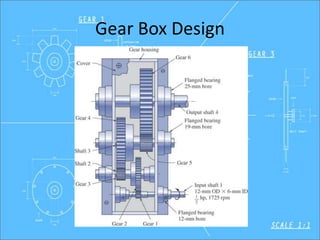
Gear Box Design
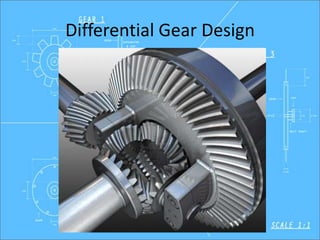
Differential Gear Design
THANKS FOR WATCHING!

GEARS

  • 1.
    LAKSHMI NARAIN COLLEGE OFTECH. & SCI. GUIDED BY: SUBMITTED BY: PROF. ABHISHEK B.
  • 2.
  • 3.
    CONTENT • Introduction ofgears • Classification of gears • Types of gears • Nomenclature of Spur gear • Forms of teeth • Gear train • Types of gear train • Application of gears
  • 4.
    Introduction Gears are usedto transmit motion from one shaft to another or between shaft and a slide. This is achieved by successfully engaging teeth. Gears used no intermediate links or connector and transmit the motion by direct contact. The surface of two bodies make a tangential contact. The two bodies have either a rolling or a sliding motion along the tangent at the point of contact.
  • 5.
    If power transmitbetween two shafts is small motion between them may be obtain by using two plane cylinder or discs 1 and 2 if there is no slip of one surface relative to another a definite motion of 1 can be transmit to 2 or vice-versa the wheel is termed as friction wheel. Assuming no slipping of the two surfaces then the linear velocity will be Vp = ω1r1= ω2r2
  • 6.
    = 2πN1r1 =2πN2r2 = ω1/ω2 = N1/N2=r2/r1 ω∝ 1/r Angular velocity is inversely proportional to radii of the disc which shows the discs is rolling without slipping.
  • 7.
    CLASSIFICATION OF TOOTHED WHEELS Accordingto the position of axes of the shafts: 1. Parallel 2. Intersecting 3. Non-Intersecting & Non-Parallel According to the peripheral velocity of the gears: 1. Low velocity 2. Medium velocity 3. High velocity
  • 8.
    According to thetype of gearing: 1. External gearing 2. Internal gearing 3. Rack & Pinion According to the position of teeth on the gear surface: 1. Straight 2. Inclined 3. Curved
  • 9.
    Types of Gears •Spur gears • Helical gears • Bevel gears • Worm gears • Rack & Pinion gears
  • 10.
    Spur gears Definition ofSpur gear: Tooth profile is parallel to the axis of rotation, transmits motion between parallel shafts.
  • 11.
    Helical gears Definition ofHelical gears: Teeth are inclined to the axis of rotation, the angle provides more gradual engagement of the teeth during meshing, transmits motion between parallel shafts.
  • 12.
    Bevel gears Definition ofBevel gears: Teeth are formed on a conical surface, used to transfer motion between non-parallel and intersecting shafts.
  • 13.
    Worm gears Definition ofWorm gears: It consists of a helical gear and a power screw (worm), used to transfer motion between non- parallel and non-intersecting shafts.
  • 14.
    Rack & Piniongears Definition of Rack & Pinion gears: The rack & pinion combination converts rotary motion into translatory motion or vice-versa It is used in Lathe machine in which the rack transmits motion to the saddle.
  • 15.
    Nomenclature of Spurgear teeth Pitch circle gear diam. Fillet radius Clearance Base Circle
  • 16.
    TERMINOLOGY • Top land-It is the surface of the top of the tooth. • Bottom land- The surface of the bottom of the tooth. • Face- Tooth surface between the pitch circle and the top land. • Flank- Tooth surface between the pitch circle & the bottom land.
  • 17.
    • Addendum- Itis the radial height of the tooth above the pitch circle. • Dedendum- It is the radial depth of the tooth below the pitch circle. • Space width- It is the width of the tooth space along the pitch circle. • Face width- The length of the tooth parallel to the gear axis. • Tooth thickness- It is the thickness at the tooth measured along the pitch circle.
  • 18.
    Undercutting A portion ofits dedendum falls inside the base circle. The profile of the tool inside the base circle is radial. A gear having its material removed in this manner is known as undercut and this process is known as undercutting.
  • 19.
    Forms of teeth •Cycloidal teeth • Involute teeth
  • 20.
    Gear Train A geartrain is a combination of gears used to transmit motion from one shaft to another. There are different types of gear train: 1. Simple gear train 2. Compound gear train 3. Reverted gear train 4. Planetary or epicyclic gear train
  • 21.
    Simple gear train Inthis gear train there is only one gear on each shaft is known as simple gear train. When 1st gear rotates then the follower i.e. 2nd gear rotates in opposite direction simultaneously.
  • 22.
    Compound gear train Aseries of gears are connected in such a way that two or more gears rotate about an axis with same angular velocity. It is known as compound gear train.
  • 23.
    Reverted gear train Ifthe axes of driver shaft and driven shaft is co- axial, then the gear train is known as reverted gear train.
  • 24.
    Planetary/Epicyclic gear train Oneof the gear is rotating over and around another gear. Epi means over, Cyclic means around. There is an arm connecting such two gears. This gear train finds great application in various field.
  • 25.
    Advantages: 1. It transmitexact velocity ratio. 2. It has high efficiency. 3. It has reliable service. 4. It may be used to transmit large power. Disadvantages: 1. The manufacture of gears requires special tools and equipments. 2. The error in cutting teeth may cause vibration & noise during operation.
  • 26.
  • 27.
  • 28.