MECHANICAL ENGINEERING
The “GAeRS” of
future
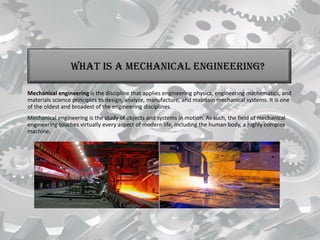
Mechanical engineering is the discipline that applies engineering physics, engineering mathematics, and
materials science principles to design, analyze, manufacture, and maintain mechanical systems. It is one
of the oldest and broadest of the engineering disciplines.
Mechanical engineering is the study of objects and systems in motion. As such, the field of mechanical
engineering touches virtually every aspect of modern life, including the human body, a highly complex
machine.
What is a MECHANICAL ENGINEERING?
Thermodynamic statics Manufacturing
Heat transfer Theory of machines Metallurgy
Energy conversation Dynamic Automatic control
Fluid mechanics Kinematics Industrial automation
Material science Automobile
Vibrations Engineering economics
CAD/Machine design
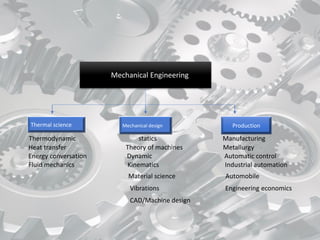
Mechanical Engineering
Thermal science Mechanical design Production
Thermal science
Thermodynamic: is the branch of science which deals with energy
transfer and it effects on properties of the substance.
Amount of heat transfer taking place while appear from one state to
another is the main concern of thermodynamic.
Heat transfer: heat transfer is the passage of thermal energy from a
hot to cool body.
Energy conversation: energy conversation is also known as energy
transformation. It is the prosses of changing energy from one form to
another.(ex. Rotational, Electrical energy, heating and cooling)
Fluids mechanics:Fluid mechanics is the study of the behaviour of
liquids and gases, and particularly the forces that they produce.
MECHANICAL DESIGN
STATICS: It is the subdivision of mechanics that is concerned with the
forces that act on bodies at rest under state in which opposing forces.
Theory of machines: theory of machines is the branch of science which
deals with study of relative motion between various parts of machines
and forces acted on them.
Dynamics: is the branch of mechanics concerned with the study
of forces and their effects on motion.
Kinematics: the branch of mechanics concerned with the motion of
objects without reference to the forces which cause the motion.
Material science: it deals with the fundamental properties
characteristics of material.it is an interdisciplinary involving the
properties of matter and its applications to various areas of science and
engineering
Vibrations: mechanical vibrations is the study of measurement of
periodic process of oscillations with respect to equilibrium point.
Concentration will be given to such as beams, springs, plates and
membranes vibration isolation and balancing of rotating and
reciprocating machinery.
CAD: computer aided design is a technology for design and
technical documentation.
Machine design: machine design is a creation of plans for
machine to perform desired function.
PRODUCTION
Manufacturing: Engineering involves in the creation and operation of technical process to
convert the raw material to required parts.
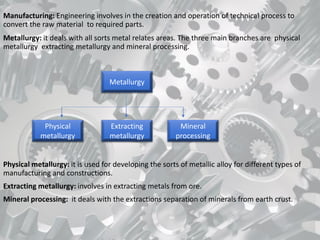
Metallurgy: it deals with all sorts metal relates areas. The three main branches are physical
metallurgy extracting metallurgy and mineral processing.
Physical metallurgy: it is used for developing the sorts of metallic alloy for different types of
manufacturing and constructions.
Extracting metallurgy: involves in extracting metals from ore.
Mineral processing: it deals with the extractions separation of minerals from earth crust.
Physical
metallurgy
Extracting
metallurgy
Mineral
processing
Metallurgy
Automatic control: it is a philosophy of analyzing designing a system that can self regulate a
machine or industrial process.
Industrial automation: automation is use to control system and information technology to
reduce the human work in production.
Automobile engineering: Automobile engineering is a very vast subject describing various
automobile systems in an automobile like chassis system, suspension, transmission, cooling,
lubrication, steering, etc. It involves various fundamentals of engineering like fluid mechanics,
strength of materials, CAD/CAM electrical and electronic systems.
Engineering economics: it deals with the technical consideration and comparison between
technical alternative as expressed in financial terms.
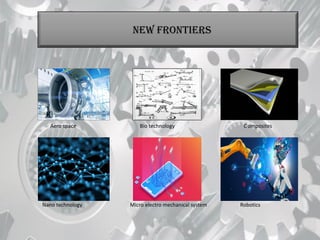
Aero space Bio technology C omposites
Nano technology Micro electro mechanical system Robotics
NEW FRONTIERS
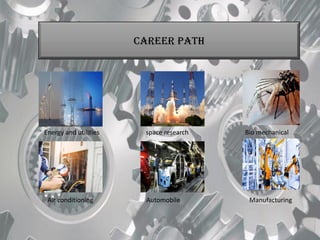
Energy and utilities space research Bio mechanical
Air conditioning Automobile Manufacturing
CAREER PATH
"
thank you
MECHANICAL ENGINEERING

Mechanical ppt

  • 1.
  • 2.
    Mechanical engineering isthe discipline that applies engineering physics, engineering mathematics, and materials science principles to design, analyze, manufacture, and maintain mechanical systems. It is one of the oldest and broadest of the engineering disciplines. Mechanical engineering is the study of objects and systems in motion. As such, the field of mechanical engineering touches virtually every aspect of modern life, including the human body, a highly complex machine. What is a MECHANICAL ENGINEERING?
  • 3.
    Thermodynamic statics Manufacturing Heattransfer Theory of machines Metallurgy Energy conversation Dynamic Automatic control Fluid mechanics Kinematics Industrial automation Material science Automobile Vibrations Engineering economics CAD/Machine design Mechanical Engineering Thermal science Mechanical design Production
  • 4.
  • 5.
    Thermodynamic: is thebranch of science which deals with energy transfer and it effects on properties of the substance. Amount of heat transfer taking place while appear from one state to another is the main concern of thermodynamic. Heat transfer: heat transfer is the passage of thermal energy from a hot to cool body. Energy conversation: energy conversation is also known as energy transformation. It is the prosses of changing energy from one form to another.(ex. Rotational, Electrical energy, heating and cooling) Fluids mechanics:Fluid mechanics is the study of the behaviour of liquids and gases, and particularly the forces that they produce.
  • 6.
  • 7.
    STATICS: It isthe subdivision of mechanics that is concerned with the forces that act on bodies at rest under state in which opposing forces. Theory of machines: theory of machines is the branch of science which deals with study of relative motion between various parts of machines and forces acted on them. Dynamics: is the branch of mechanics concerned with the study of forces and their effects on motion. Kinematics: the branch of mechanics concerned with the motion of objects without reference to the forces which cause the motion. Material science: it deals with the fundamental properties characteristics of material.it is an interdisciplinary involving the properties of matter and its applications to various areas of science and engineering
  • 8.
    Vibrations: mechanical vibrationsis the study of measurement of periodic process of oscillations with respect to equilibrium point. Concentration will be given to such as beams, springs, plates and membranes vibration isolation and balancing of rotating and reciprocating machinery. CAD: computer aided design is a technology for design and technical documentation. Machine design: machine design is a creation of plans for machine to perform desired function.
  • 9.
  • 10.
    Manufacturing: Engineering involvesin the creation and operation of technical process to convert the raw material to required parts. Metallurgy: it deals with all sorts metal relates areas. The three main branches are physical metallurgy extracting metallurgy and mineral processing. Physical metallurgy: it is used for developing the sorts of metallic alloy for different types of manufacturing and constructions. Extracting metallurgy: involves in extracting metals from ore. Mineral processing: it deals with the extractions separation of minerals from earth crust. Physical metallurgy Extracting metallurgy Mineral processing Metallurgy
  • 11.
    Automatic control: itis a philosophy of analyzing designing a system that can self regulate a machine or industrial process. Industrial automation: automation is use to control system and information technology to reduce the human work in production. Automobile engineering: Automobile engineering is a very vast subject describing various automobile systems in an automobile like chassis system, suspension, transmission, cooling, lubrication, steering, etc. It involves various fundamentals of engineering like fluid mechanics, strength of materials, CAD/CAM electrical and electronic systems. Engineering economics: it deals with the technical consideration and comparison between technical alternative as expressed in financial terms.
  • 12.
    Aero space Biotechnology C omposites Nano technology Micro electro mechanical system Robotics NEW FRONTIERS
  • 13.
    Energy and utilitiesspace research Bio mechanical Air conditioning Automobile Manufacturing CAREER PATH "
  • 14.