CRICKET BOWLING
MACHINE
Submitted by:
ABHINAV JOSE(UR12EE003)
PRAVEEN PERUMAL G(UR12EE101)
ROHIT K ANIL(UR12EE112)
Guided by:
Dr. J. JAYAKUMAR
ASSISTANT PROFESSOR
EEE
OBJECTIVE
▪To develop a cost effective (economic) and compact
cricket bowling machine.
▪To provide provision for using sping, hard ball and rubber ball.
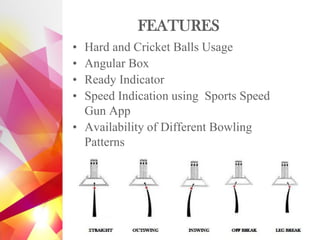
▪To provide provision for using various pattern of bowling style
such as straight, outswing, inswing, offbreak, leg break.
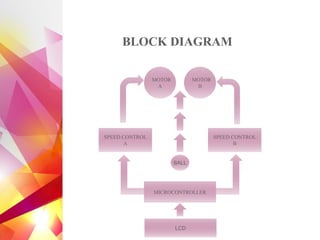
BLOCK DIAGRAM
MOTOR
A
MOTOR
B
BALL
SPEED CONTROL
A
SPEED CONTROL
B
LCD
MICROCONTROLLER
COMPONENTS USED
• Induction Motors
[2500rpm, 0.35HP,
0.5amp]
• Trolley Wheels
[diameter=21cm]
• Electronic Regulators
• Ball Bearing
• Antifriction Bearing
• Sleeve Bearing
• Flange Bolts
• Screws
• Metal Frame
• Proximity Sensor
• AT89S52
Microcontroller
• IC 7805
• LED
• LCD 16×2
FEATURES
• Hard and Cricket Balls Usage
• Angular Box
• Ready Indicator
• Speed Indication using Sports Speed
Gun App
• Availability of Different Bowling
Patterns
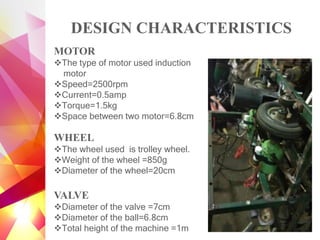
DESIGN CHARACTERISTICS
MOTOR
❖The type of motor used induction
motor
❖Speed=2500rpm
❖Current=0.5amp
❖Torque=1.5kg
❖Space between two motor=6.8cm
WHEEL
❖The wheel used is trolley wheel.
❖Weight of the wheel =850g
❖Diameter of the wheel=20cm
VALVE
❖Diameter of the valve =7cm
❖Diameter of the ball=6.8cm
❖Total height of the machine =1m
SELECTION OF WHEEL
• We have undergone testing different types of wheels
such as Auto wheel, Scooter wheel and Trolley
wheel.
• After testing, we obtained good efficiency from
trolley wheel compared to other wheels.
• Also, it provides more friction, less in size and
weight.
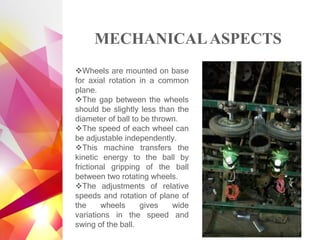
MECHANICALASPECTS
❖Wheels are mounted on base
for axial rotation in a common
plane.
❖The gap between the wheels
should be slightly less than the
diameter of ball to be thrown.
❖The speed of each wheel can
be adjustable independently.
❖This machine transfers the
kinetic energy to the ball by
frictional gripping of the ball
between two rotating wheels.
❖The adjustments of relative
speeds and rotation of plane of
the wheels gives wide
variations in the speed and
swing of the ball.
❖POWER SUPPLY UNIT
❖MICROCONTROLLER UNIT
❖LCD DISPLAY
❖PROXIMITY SENSOR
SPEED CONTROL
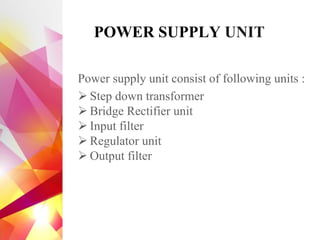
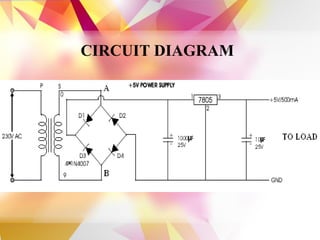
POWER SUPPLY UNIT
Power supply unit consist of following units :
➢ Step down transformer
➢ Bridge Rectifier unit
➢ Input filter
➢ Regulator unit
➢ Output filter
CIRCUIT DIAGRAM
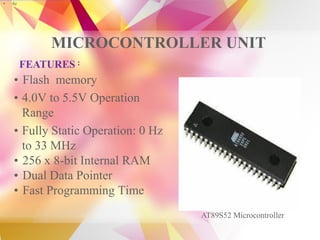
MICROCONTROLLER UNIT
FEATURES :
• Flash memory
• 4.0V to 5.5V Operation
Range
• Fully Static Operation: 0 Hz
to 33 MHz
• 256 x 8-bit Internal RAM
• Dual Data Pointer
• Fast Programming Time
• 4e
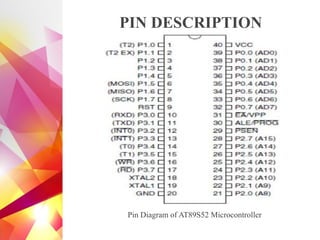
AT89S52 Microcontroller
PIN DESCRIPTION
Pin Diagram of AT89S52 Microcontroller
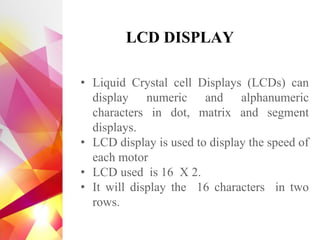
• Liquid Crystal cell Displays (LCDs) can
display numeric and alphanumeric
characters in dot, matrix and segment
displays.
• LCD display is used to display the speed of
each motor
• LCD used is 16 X 2.
• It will display the 16 characters in two
rows.
LCD DISPLAY
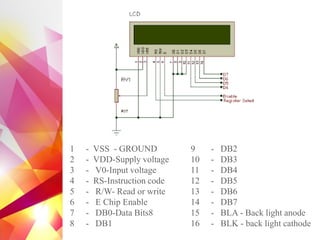
1 - VSS - GROUND
2 - VDD-Supply voltage
3 - V0-Input voltage
4 - RS-Instruction code
5 - R/W- Read or write
6 - E Chip Enable
7 - DB0-Data Bits8
8 - DB1
9 - DB2
10 - DB3
11 - DB4
12 - DB5
13 - DB6
14 - DB7
15 - BLA - Back light anode
16 - BLK - back light cathode
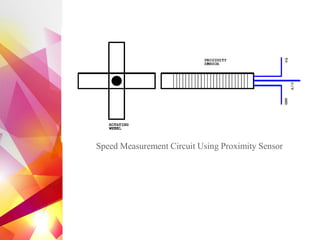
PROXIMITY SENSOR
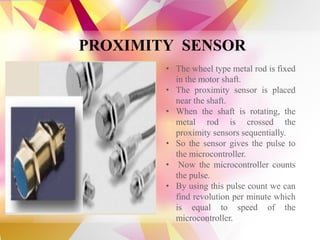
• The wheel type metal rod is fixed
in the motor shaft.
• The proximity sensor is placed
near the shaft.
• When the shaft is rotating, the
metal rod is crossed the
proximity sensors sequentially.
• So the sensor gives the pulse to
the microcontroller.
• Now the microcontroller counts
the pulse.
• By using this pulse count we can
find revolution per minute which
is equal to speed of the
microcontroller.
Speed Measurement Circuit Using Proximity Sensor
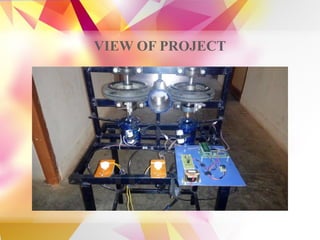
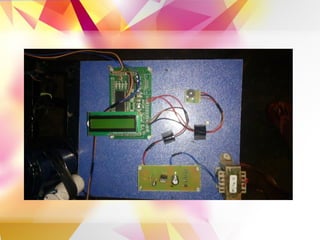
VIEW OF PROJECT
WORK DONE
❖Execution of various bowling styles
❖Measurement of speed of the ball using Sports
Speed Gun app.
❖Case study of different styles of bowling such as
straight, outswing, inswing, offbreak, leg break
❖Provision to use different types of balls for the
machine to bowl.
FUTURE WORKS
• Introducing of different bowler’s bowling
technology using neural technology
• Usage of obstacle sensor for safety
measures of people crossing near the
bowling machine while in operating mode
REFERENCES
• S .S. Roy, A. Maapatra, N. P. Mukherjee, U Datta, U. Nandy, S. Karmakar, A.
Chatterjee.(2005) “Design of an Improved Cricket Ball Throwing Machine”
• Abhijit Mahapatra, Avik Chatterjee and Shibendu Shekhar Roy (2010)
“Modelling and Simulation of Cricket Bowling Machine”, International J. of
Recent Trends in Engineering and Technology, Vol. 3
• Akshay R. Varhade, HrushikeshV. Tiwari and Pratik D. Patangrao
(2013)“Cricket Bowling Machine” , International Journal of Engineering
Research & Technology (IJERT)
• RAZA Ali, DIEGEL Olaf and ARIF Khalid Mahmood (2014) “Robowler:
Design and development of a cricket bowling machine ensuring ball seam
position” ,Springer
• QUT Digital Repository(http://eprints.qut.edu.au/)
• AT89S52 - Atmel (http://www.atmel.com/images/doc1919.pdf/)
• Leverage Cricket Bowling Machine
(http://www..bowlingmachine.co.in/pro_crikcet_bowling_machines/)

Presentation on Cricket Bowling Machine

  • 1.
    CRICKET BOWLING MACHINE Submitted by: ABHINAVJOSE(UR12EE003) PRAVEEN PERUMAL G(UR12EE101) ROHIT K ANIL(UR12EE112) Guided by: Dr. J. JAYAKUMAR ASSISTANT PROFESSOR EEE
  • 2.
    OBJECTIVE ▪To develop acost effective (economic) and compact cricket bowling machine. ▪To provide provision for using sping, hard ball and rubber ball. ▪To provide provision for using various pattern of bowling style such as straight, outswing, inswing, offbreak, leg break.
  • 3.
  • 4.
    COMPONENTS USED • InductionMotors [2500rpm, 0.35HP, 0.5amp] • Trolley Wheels [diameter=21cm] • Electronic Regulators • Ball Bearing • Antifriction Bearing • Sleeve Bearing • Flange Bolts • Screws • Metal Frame • Proximity Sensor • AT89S52 Microcontroller • IC 7805 • LED • LCD 16×2
  • 5.
    FEATURES • Hard andCricket Balls Usage • Angular Box • Ready Indicator • Speed Indication using Sports Speed Gun App • Availability of Different Bowling Patterns
  • 6.
    DESIGN CHARACTERISTICS MOTOR ❖The typeof motor used induction motor ❖Speed=2500rpm ❖Current=0.5amp ❖Torque=1.5kg ❖Space between two motor=6.8cm WHEEL ❖The wheel used is trolley wheel. ❖Weight of the wheel =850g ❖Diameter of the wheel=20cm VALVE ❖Diameter of the valve =7cm ❖Diameter of the ball=6.8cm ❖Total height of the machine =1m
  • 7.
    SELECTION OF WHEEL •We have undergone testing different types of wheels such as Auto wheel, Scooter wheel and Trolley wheel. • After testing, we obtained good efficiency from trolley wheel compared to other wheels. • Also, it provides more friction, less in size and weight.
  • 8.
    MECHANICALASPECTS ❖Wheels are mountedon base for axial rotation in a common plane. ❖The gap between the wheels should be slightly less than the diameter of ball to be thrown. ❖The speed of each wheel can be adjustable independently. ❖This machine transfers the kinetic energy to the ball by frictional gripping of the ball between two rotating wheels. ❖The adjustments of relative speeds and rotation of plane of the wheels gives wide variations in the speed and swing of the ball.
  • 9.
    ❖POWER SUPPLY UNIT ❖MICROCONTROLLERUNIT ❖LCD DISPLAY ❖PROXIMITY SENSOR SPEED CONTROL
  • 10.
    POWER SUPPLY UNIT Powersupply unit consist of following units : ➢ Step down transformer ➢ Bridge Rectifier unit ➢ Input filter ➢ Regulator unit ➢ Output filter
  • 11.
  • 12.
    MICROCONTROLLER UNIT FEATURES : •Flash memory • 4.0V to 5.5V Operation Range • Fully Static Operation: 0 Hz to 33 MHz • 256 x 8-bit Internal RAM • Dual Data Pointer • Fast Programming Time • 4e AT89S52 Microcontroller
  • 13.
    PIN DESCRIPTION Pin Diagramof AT89S52 Microcontroller
  • 14.
    • Liquid Crystalcell Displays (LCDs) can display numeric and alphanumeric characters in dot, matrix and segment displays. • LCD display is used to display the speed of each motor • LCD used is 16 X 2. • It will display the 16 characters in two rows. LCD DISPLAY
  • 15.
    1 - VSS- GROUND 2 - VDD-Supply voltage 3 - V0-Input voltage 4 - RS-Instruction code 5 - R/W- Read or write 6 - E Chip Enable 7 - DB0-Data Bits8 8 - DB1 9 - DB2 10 - DB3 11 - DB4 12 - DB5 13 - DB6 14 - DB7 15 - BLA - Back light anode 16 - BLK - back light cathode
  • 16.
    PROXIMITY SENSOR • Thewheel type metal rod is fixed in the motor shaft. • The proximity sensor is placed near the shaft. • When the shaft is rotating, the metal rod is crossed the proximity sensors sequentially. • So the sensor gives the pulse to the microcontroller. • Now the microcontroller counts the pulse. • By using this pulse count we can find revolution per minute which is equal to speed of the microcontroller.
  • 17.
    Speed Measurement CircuitUsing Proximity Sensor
  • 18.
  • 20.
    WORK DONE ❖Execution ofvarious bowling styles ❖Measurement of speed of the ball using Sports Speed Gun app. ❖Case study of different styles of bowling such as straight, outswing, inswing, offbreak, leg break ❖Provision to use different types of balls for the machine to bowl.
  • 21.
    FUTURE WORKS • Introducingof different bowler’s bowling technology using neural technology • Usage of obstacle sensor for safety measures of people crossing near the bowling machine while in operating mode
  • 22.
    REFERENCES • S .S.Roy, A. Maapatra, N. P. Mukherjee, U Datta, U. Nandy, S. Karmakar, A. Chatterjee.(2005) “Design of an Improved Cricket Ball Throwing Machine” • Abhijit Mahapatra, Avik Chatterjee and Shibendu Shekhar Roy (2010) “Modelling and Simulation of Cricket Bowling Machine”, International J. of Recent Trends in Engineering and Technology, Vol. 3 • Akshay R. Varhade, HrushikeshV. Tiwari and Pratik D. Patangrao (2013)“Cricket Bowling Machine” , International Journal of Engineering Research & Technology (IJERT) • RAZA Ali, DIEGEL Olaf and ARIF Khalid Mahmood (2014) “Robowler: Design and development of a cricket bowling machine ensuring ball seam position” ,Springer • QUT Digital Repository(http://eprints.qut.edu.au/) • AT89S52 - Atmel (http://www.atmel.com/images/doc1919.pdf/) • Leverage Cricket Bowling Machine (http://www..bowlingmachine.co.in/pro_crikcet_bowling_machines/)