AQUATIC ORGANISM
AND THEIR ADAPTATIONS
Mark Angelo B. Muncada, RFP
Aquatic Adaptations
Adaptation is an evolutionary process whereby an organism
becomes increasingly well-suited to living in a particular habitat. It
is not a quick process!
 Natural selection over many generations makes helpful traits
more common in a population. This occurs because individuals
with these traits are better adapted to the environment and
therefore more likely to survive and breed.
In other words, an adaptation is a feature of an organism
that enables it to live in a particular habitat.
When animals live in the water, they must have special
adaptations to help them survive in an aquatic habitat. The
more time an animal spends in the water, the more
adaptations the animal will have for an aquatic life. Below
are examples of some of these adaptations:
1.Streamlined body reduces friction when the animal
moves through the water.
2.Smooth, almost furless body helps aquatic
mammals move through the water with little friction.
3.Dense fur helps streamline the bodies of some
aquatic mammals and keeps them warm.
4.Dense waterproof feathers keep cold water away
from bird's skin and prevent wetting of the feathers.
5.Webbed feet, formed from thin skin between the toes, work like
paddles.
6.Long legs and necks keep the bodies of wading birds out of the water
and are thin, light, and easy to move, and the long neck helps the birds
to reach the water, or below it, for food.
7.Strainers in the mouth filter food particles from the water.
8.Flippers provide a large surface for pushing against water and act like
paddles.
9.Eyes positioned on top of the head allow animals to hide almost
fully submerged in water and still detect predators or prey above the
water.
10.Nostrils positioned near the top of the head allow animals to come to
the surface to breathe while only a small part of the body can be seen.
11.Nostrils close when the animal goes under the water.
12.Blubber, a thick layer of fat or oil stored between the skin and
muscles of the body, provides insulation.
13.Transparent eyelids cover the eyes of animals swimming underwater.
14.Flattened tails serve as paddles.
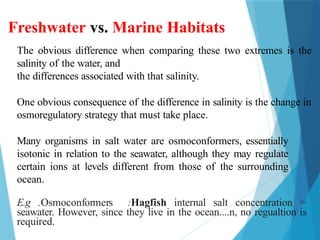
Freshwater vs. Marine Habitats
The obvious difference when comparing these two extremes is the
salinity of the water, and
the differences associated with that salinity.
One obvious consequence of the difference in salinity is the change in
osmoregulatory strategy that must take place.
Many organisms in salt water are osmoconformers, essentially
isotonic in relation to the seawater, although they may regulate
certain ions at levels different from those of the surrounding
ocean.
E.g .Osmoconformers :Hagfish internal salt concentration =
seawater. However, since they live in the ocean....n, no regualtion is
required.
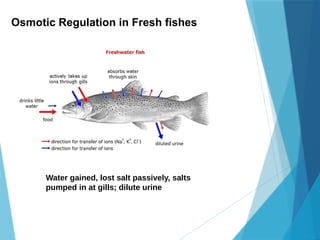
Osmotic Regulation in Fresh fishes
Water gained, lost salt passively, salts
pumped in at gills; dilute urine
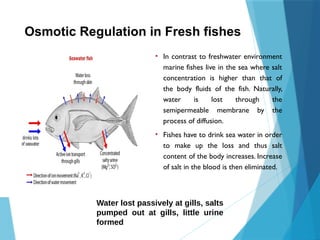
Osmotic Regulation in Fresh fishes
• In contrast to freshwater environment
marine fishes live in the sea where salt
concentration is higher than that of
the body fluids of the fish. Naturally,
water is lost through the
semipermeable membrane by the
process of diffusion.
• Fishes have to drink sea water in order
to make up the loss and thus salt
content of the body increases. Increase
of salt in the blood is then eliminated.
Water lost passively at gills, salts
pumped out at gills, little urine
formed
There are two main types of osmoregulatory
environments in which aquatic animals live:
freshwater and marine.
Aquatic animals are either euryhaline or
stenohaline, depending on their
ability to tolerate different salinities.
Animals that maintain an osmotic difference
between their body fluid and the surrounding
environment are osmoregulators. Freshwater
animals (all osmoregulators) include invertebrates,
fishes, amphibians, reptiles, and mammals.
 Cartilaginous fishes such as sharks, rays, and skates, have
plasma that is
approximately isosmotic to seawater.
 This unusually high osmotic concentration (compared to that of
other vertebrates) is maintained by high levels of urea and
trimethylamine oxide (TMAO) in the blood.
 In most vertebrates, levels of urea this high would damage
proteins, but the presence of the TMAO helps to stabilize these
protein molecules against the adverse effects of urea.
 Excess inorganic electrolytes, such as Na+ and Cl- which diffuse
into the blood at the gills, are excreted by way of the kidneys
and also by means of a special excretory organ called the rectal
gland that is located at the end of the alimentary canal.
 The freshwater animals are generally hyper osmotic to their
environment.
 The problems that they face because of this are that they are
subject to swelling by the movement of water(endosmosis) into
their bodies owing to the osmotic gradient, and they are subject to
the continual loss of body salts to the surrounding environment
(which has a low salt content).
 The way these animals deal with these problems is to
produce a large volume of dilute urine.
 The kidney absorbs the salts that are needed, and the rest of the
water is excreted. Another way these animals deal with lack of salt
is by obtaining it from the food they ingest.
 A key salt replacement mechanism for freshwater animals is
active transport of salt from the external dilute medium
across the epithelium into the interstitial fluid and blood.
Amphibian’s skin and fish gills are active in this process.
 Among marine animals, most invertebrates are osmoconformers whereas
most vertebrates are osmoregulators.
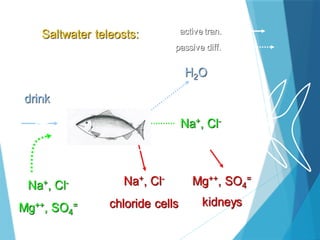
 There is a tendency for marine fishes to lose water to the environment
through the gill epithelium. The net result of combined osmotic work of
the gills and kidneys in the marine teleosts is a net retention of water by
the kidneys.
 Marine reptiles (iguanas, sea turtles, crocodiles, and sea snakes) drink
seawater to obtain a supply of water but are unable to produce a
concentrated urine that is significantly hyperosmotic to their body fluids.
They compensate for this by the use of specialized glands for the secretion
of salts in a strong hyperosmotic fluid.
 Salt glands are generally located above the orbit of the eye and nose in
lizards. The salt glands of marine reptiles secrete a sufficiently concentrated
salt solution to enable them to drink saltwater even though their kidneys are
unable to produce urine more concentrated than seawater.
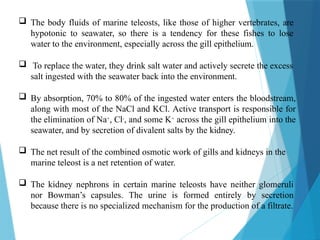
 The body fluids of marine teleosts, like those of higher vertebrates, are
hypotonic to seawater, so there is a tendency for these fishes to lose
water to the environment, especially across the gill epithelium.
 To replace the water, they drink salt water and actively secrete the excess
salt ingested with the seawater back into the environment.
 By absorption, 70% to 80% of the ingested water enters the bloodstream,
along with most of the NaCl and KCl. Active transport is responsible for
the elimination of Na+, Cl-, and some K+ across the gill epithelium into the
seawater, and by secretion of divalent salts by the kidney.
 The net result of the combined osmotic work of gills and kidneys in the
marine teleost is a net retention of water.
 The kidney nephrons in certain marine teleosts have neither glomeruli
nor Bowman’s capsules. The urine is formed entirely by secretion
because there is no specialized mechanism for the production of a filtrate.
 Marine animals with these salt glands compensate for the
inability of their kidney to produce urine that is strongly
hypertonic relative to body fluids.
 Marine animals lacking salt glands avoid drinking seawater, and
obtain water entirely from their food intake and metabolism.
These animals depend on their kidneys for maintaining
osmotic balance.
 Sea lions, seals, and a couple of marine mammals that live in
saltwater do not have external salt-secreting organs like that of
the birds and reptiles, yet they still survive in the ocean.
 Mammals cannot drink seawater, and would become
quickly dehydrated if they did.
 These mammals face the same problems as the desert
animals. Because mammals cannot consume seawater, a
different hydration method needs to be found.
 They have highly efficient kidneys capable of producing
very hypertonic urine.
 These animals also rely on metabolic water (water produced
as an end product of cellular metabolism) and water from
feeding on fishes and invertebrates.
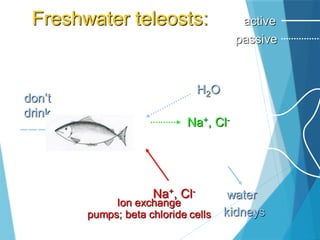
 Organisms in freshwater have the reverse problem. They tend to
take on water from the environment, and, in expelling the excess
water, may lose important ions.
Freshwater fishes tend to take in water passively and remove it
actively through the osmotic work of kidneys. They lose salts to
the dilute environment and replace them by actively absorbing
ions from the surrounding fluids into their bodies through the
gills.
Freshwater teleosts’ bodies are hypertonic to the environment
and water diffuses into them, so they maintain water balance by
producing large volumes of dilute urine.
Marine Mammal Adaptations
Deep Diving
 Generally, marine mammal lungs are proportionately smaller than
human, but they:
 Use oxygen more efficiently. They fill their lungs and exchange 90%
of the air in each breath, have high blood volume, and their blood
chemistry allows greater oxygen retention (the high red blood cell
count and increased myoglobin make their muscle tissue and blood
dark red).
 Have a high tolerance to lactic acid and carbon dioxide. Their
muscles can work anaerobically (without oxygen) while they
hold their breath.
 Can tolerate tremendous atmospheric pressure at great depths.
Lungs and ribs are
collapsible, air spaces are minimized, and nitrogen absorption
is limited.
Thermoregulation
Marine mammals are endotherms and have developed methods to retain
heat in cold seas (physiologically, biochemically, anatomically, or behaviorally), yet
must be able to lose excess heat when they are on land or extremely active in the
water.
If the problem were one of simply evolving methods to stay warm in a cold ocean,
it would be much easier to wrap themselves in deep blubber and fur or to stay very
active and not have to deal with the consequences of heat loading.
However, the difficulty of that solution is that the animal could get too warm, which
would in turn would cause problems with metabolic regulation, reproductive
chemistry, neural function, and so on. Thus, the thermoregulatory mechanisms that
have evolved in marine mammals function not only to conserve heat, but to dump
it when necessary.
A. Marine mammals have no unusual heat-
generating mechanisms or tissues that are not seen in
any other mammal.
For example, while some large warm-bodied fishes have
specialized heat-generating tissues
behind their eyes, no such organs or tissues exist in
marine mammals.
The only heat-generating specialized tissue that has ever been found in marine
mammals is brown fat in harp seal. This tissue is thermogenically active via
oxidation of lipid compounds, but only for about the first 3 days after birth.
This is an important source of heat for these young pups, but not unique, as
brown fat is found in other terrestrial mammals where it serves the same
purpose.
It is suggested that they must have adapted significant ways to alter the heat
loss through reduced conduction and convection. They have done this through
the use of blubber, fur, and vascular adaptations.
 A unifying characteristic of most marine mammals is that they spend a
great portion of their lives, if not their entire lives, in a water environment
that is significantly colder than their core temperature of 37°C.
 Based on the discussion earlier on the fundamental aspects of
thermoregulation, it should be clear that this aquatic life represents a
significant thermal challenge to these mammals.
 While radiation and evaporation are probably insignificant sources of heat
loss,
conduction and convection are massive.
 However, in the Antarctic, seals will move to the relatively warm polar water
(at —1.8 C°) when the real or wind chill temperature outside falls
below about —40 C°.
Marine mammals use either fur or blubber for insulation and, like all
endotherms, balance their metabolic heat production with various pathways
of heat loss.
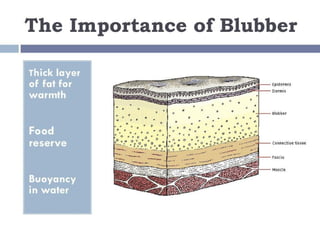
B. Blubber is a fat layer beneath the skin. It is a complex, active tissue that
consists of a loose, spongy material where the matrix of the sponge is made up
of collagen fibers and the volume is made of adipocytes (fat, or lipid cells). As
the blubber layer increases or decreases, the collagen matrix remains the same,
and it is the movement of lipid in and out of that matrix that accounts for the
change in blubber quality and characteristics. However, all blubber is not the
same; it varies from species to species in terms of the ratio of collagen to lipid
and it can even vary within the same animal from location to location or with
depth.
Blubber acts as an internal insulator for marine mammals because it occurs
below the skin layer.
C.Fur:
 As with terrestrial mammals, fur in marine mammals functions by
trapping dry air next to the skin and keeping water (or cold air for a land
mammal) away from the skin surface.
 Thus, the gradient here is from the skin outward with a warm skin surface
and cold outer layers of the fur.
 The most-cited example of the use of fur by a marine mammal is that of
the sea otter and it provides an excellent example of how this animal lives
in a cold environment (Williams et al., 1992).
 The sea otter is faced with a major thermal challenge, as it is a small
mammal (large surface area to volume ratio through which to lose heat). It
utilizes a dense fur with a series of guard hairs and under-furs to keep its skin
warm. However, the cost of this luxurious fur coat is a tremendous amount
of maintenance with up to 12% of daily energy expenditure being spent on
grooming the coat.
Many species of seals utilize blubber for thermal
protection as adults, but will use a
specialized fur, called lanugo, as newborns.
Lanugo, or pup fur, is a very effective insulator in the
air and is usually both long and very “fluffy.” On
newborn pups, it functions as protection against the
cold air during the time that they are on land or ice
for nursing.
Lanugo is useless in water and allows the skin to
chill to essentially water temperature. A pup must
shed its lanugo and develop a significant blubber
layer before it can enter the water and be an effective
swimmer and diver.
D. Vascular Adaptations:It is in the area of vascular adaptions
for thermoregulation that marine mammals have evolved several
unusual adaptations. The first of these is termed the reteb mirabile,
which is Latin for a “wonderful net.”
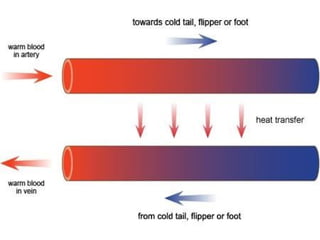
This net, which is a countercur-rent heat exchanger (Scholander and
Schevill, 1955), involves an intertwined network of veins and
arteries such that the cold blood returning from the extremities in
the veins runs next to the warm blood going out to extremities in
the arteries.
Marine mammals have exquisite control of blood flow in their
body not only for thermoregulation but also for diving. The
results show that the animals tend to defer heat regulation and
favor oxygen conservation vascular adjustments when both must
coincide (Noren et al., 1999).
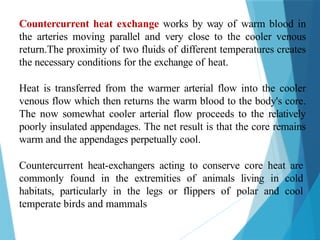
Countercurrent heat exchange works by way of warm blood in
the arteries moving parallel and very close to the cooler venous
return.The proximity of two fluids of different temperatures creates
the necessary conditions for the exchange of heat.
Heat is transferred from the warmer arterial flow into the cooler
venous flow which then returns the warm blood to the body's core.
The now somewhat cooler arterial flow proceeds to the relatively
poorly insulated appendages. The net result is that the core remains
warm and the appendages perpetually cool.
Countercurrent heat-exchangers acting to conserve core heat are
commonly found in the extremities of animals living in cold
habitats, particularly in the legs or flippers of polar and cool
temperate birds and mammals
 The next vascular adjustment seen in marine mammals deals with
those mammals that utilize thick blubber as an insulating
material.
 As mentioned several times earlier, this is a good technique for
staying warm, but can cause serious problems if trying to cool.
In fact, large whales have such a tremendous thermal mass and a
low surface area to volume ratio that they may have a much more
serious problem dumping heat than conserving it (Hokkanen,
1990).
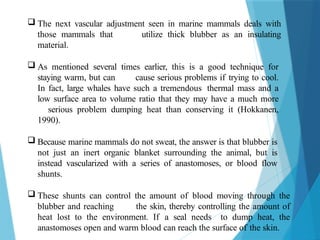
 Because marine mammals do not sweat, the answer is that blubber is
not just an inert organic blanket surrounding the animal, but is
instead vascularized with a series of anastomoses, or blood flow
shunts.
 These shunts can control the amount of blood moving through the
blubber and reaching the skin, thereby controlling the amount of
heat lost to the environment. If a seal needs to dump heat, the
anastomoses open and warm blood can reach the surface of the skin.
E. Behavioral Thermoregulation
 Most of the mechanisms discussed earlier are biochemical, anatomical, or
physiological mechanisms for regulating heat production or loss in a
marine mammal. Of course, a marine mammal is not a static system and the
animal can alter the demands placed upon it with behavioral
modification.
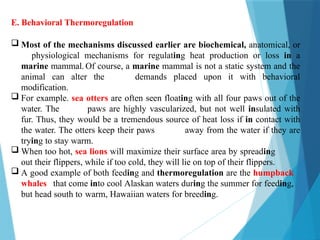
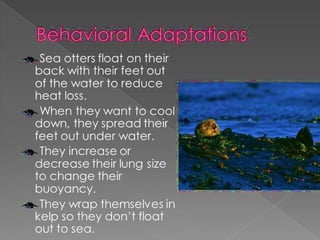
 For example. sea otters are often seen floating with all four paws out of the
water. The paws are highly vascularized, but not well insulated with
fur. Thus, they would be a tremendous source of heat loss if in contact with
the water. The otters keep their paws away from the water if they are
trying to stay warm.
 When too hot, sea lions will maximize their surface area by spreading
out their flippers, while if too cold, they will lie on top of their flippers.
 A good example of both feeding and thermoregulation are the humpback
whales that come into cool Alaskan waters during the summer for feeding,
but head south to warm, Hawaiian waters for breeding.
Diel Vertical Migration in Zooplanktons:
The migration occurs when organisms move up to the epipelagic zone at
night and return to the mesopelagic zone of the oceans or to the
hypolimnion zone of lakes during the day.
The word diel comes from the Latin dies day, and means a 24-hour period.
It is referred to as the greatest migration in the world in terms of biomass.
DVM is one of the world’s most massive animal migrations as an enormous
amount of herbivorous biomass moves daily up and down the water column.
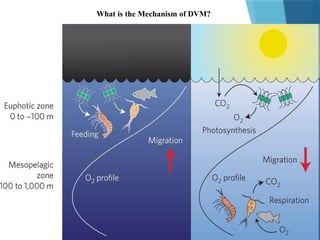
What is the Mechanism of DVM?
The phenomenon of diel vertical
migration
 The behavioural phenomenon of diel vertical migration (DVM) of meso
zooplankton in marine and freshwater ecosystems is widely known.
 In the presence of hazards like visual predation by planktivorous fish large
zooplankton individuals or species (e.g. cladocerans, copepods) only
spend the night in surface waters (epilimnion).
 During the day they stay in the lower and darker water layers (hypolimnion)
often crossing the thermocline during their migration downwards and
upwards.
 Thus, in stratified lakes of the temperate region zooplankton regularly
experiences strong differences in temperature between day and night.
 Vertical migration is induced by chemical trigger substances, so called
kairomones (Dodson 1988; Loose and Dawidowicz 1994)
produced by the planktivorous fish.
 Most research on anti-predator behaviour concerns aquatic systems
(Kats and Dill,
1998).
 A good example of anti-predator behaviour is diel vertical migration
(DVM) of Daphnia as an escape from visually hunting fish (Lampert,
1989, 1993).
 Many zooplankton species descend before dawn and rise during dusk, thus
living deeper in the water column during the day than during the night.
Over the last 10 years attention has been focused on the significance of
migration behaviour for predator avoidance , and on the phenotypic
induction of this migration behaviour by predator kairomone.
 Temperature in the hypolimnion or deep waters is less which could be
a possible reason though not the only important factor that affects
migrating and non- migrating zooplankton populations.
 Migrating zooplankton also experience different food conditions during
the day as non-migrating daphnids do.
 Early studies on this subject suggested that migrating zooplankton
experience lower amounts of food during the day due to less food in the
hypolimnion than in the epilimnion.
 However the studies also suggest that negative temperature effects might
be stronger than positive food effects in those lakes because zooplankton
still migrated into the epilimnion.
Zooplankton have more mobility than phytoplankton and of course, are not
concerned with their location relative to the sun.
In general, they exhibit a broader distribution vertically in the water column
and
their position and abundance are related to their food supply.
 To prevent sinking small zooplankton increase their frictional resistance to the
water by increasing the surface area, relative to it’s small volume. Resistance to
sinking is also assisted by spines, hairs, wing-like structures, and other
surface extensions arming zooplankton.
 Adaptations for zooplankton include means of feeding, locomotion, and
buoyancy.
 Elaborate appendages increase surface area and buoyancy while also aiding in
feeding. Some jellyfish have gas bladders which can be filled to increase
buoyancy when rising upward in the water column and can be emptied when
sinking.
 Other jelly-fish and arrow worms which have a gelatinous watery body
increase buoyancy by eliminating heavy ions and replacing them with chloride
ions. Storage of fats and oils also increase buoyancy.
Adaptations in Zooplanktons:
All species of plankton have been forced to develop certain structural
adaptations to be able to float in the water column.
Adaptations include: flat bodies, lateral spines, oil droplets, floats filled with
gases, sheaths made of gel-like substances, and ion replacement.
All other adaptations keep plankton from sinking quickly to the bottom.
Zooplankton have also adapted mechanisms to deter fish (their heaviest
predator) including: transparent bodies, bright colors, bad tastes, red coloring
in deeper water, and cyclomorphosis.
Cyclomorphosis occurs when predators release chemicals in the water that
signal zooplankton, such as rotifers or cladocerans, to increase their spines and
protective shields.
 Seasonal polymorphism, or cyclomorphosis, is found among many zooplankton, but
is most conspicuous among the Cladocera.
 Adaptive significance of cyclomorphic growth likely centers on reducing predation
by allowing continued growth of peripheral transparent structures without enlarging
the central portion of the body visible to fish.
 Small cladocerans that increase size by cyclomorphic growth reduce capture success
by invertebrate predators like copepods. A combination of environmental parameters
has been shown to induce internal growth factors (hormones) that influence
differential growth: increased temperature, turbulence, photoperiod, and
food enhance cyclomorphosis in daphnid cladocerans.
 Changes in rotifer growth form include elongation in relation to body width,
enlargement, reduction in size, and production of lateral spines which reduce
predation success.
 Cyclomorphosis is lacking in copepods, which, by means of rapid, evasive
swimming movements, can defend themselves better from invertebrate
predators than can most rotifers and cladocerans.
THANK YOU!!!

Lecture 2 Aquatic AdaptationsSSSSSSSSSSSS .pptx

  • 1.
    AQUATIC ORGANISM AND THEIRADAPTATIONS Mark Angelo B. Muncada, RFP
  • 2.
    Aquatic Adaptations Adaptation isan evolutionary process whereby an organism becomes increasingly well-suited to living in a particular habitat. It is not a quick process!  Natural selection over many generations makes helpful traits more common in a population. This occurs because individuals with these traits are better adapted to the environment and therefore more likely to survive and breed. In other words, an adaptation is a feature of an organism that enables it to live in a particular habitat.
  • 3.
    When animals livein the water, they must have special adaptations to help them survive in an aquatic habitat. The more time an animal spends in the water, the more adaptations the animal will have for an aquatic life. Below are examples of some of these adaptations: 1.Streamlined body reduces friction when the animal moves through the water. 2.Smooth, almost furless body helps aquatic mammals move through the water with little friction. 3.Dense fur helps streamline the bodies of some aquatic mammals and keeps them warm. 4.Dense waterproof feathers keep cold water away from bird's skin and prevent wetting of the feathers.
  • 4.
    5.Webbed feet, formedfrom thin skin between the toes, work like paddles. 6.Long legs and necks keep the bodies of wading birds out of the water and are thin, light, and easy to move, and the long neck helps the birds to reach the water, or below it, for food. 7.Strainers in the mouth filter food particles from the water. 8.Flippers provide a large surface for pushing against water and act like paddles. 9.Eyes positioned on top of the head allow animals to hide almost fully submerged in water and still detect predators or prey above the water. 10.Nostrils positioned near the top of the head allow animals to come to the surface to breathe while only a small part of the body can be seen. 11.Nostrils close when the animal goes under the water. 12.Blubber, a thick layer of fat or oil stored between the skin and muscles of the body, provides insulation. 13.Transparent eyelids cover the eyes of animals swimming underwater. 14.Flattened tails serve as paddles.
  • 5.
    Freshwater vs. MarineHabitats The obvious difference when comparing these two extremes is the salinity of the water, and the differences associated with that salinity. One obvious consequence of the difference in salinity is the change in osmoregulatory strategy that must take place. Many organisms in salt water are osmoconformers, essentially isotonic in relation to the seawater, although they may regulate certain ions at levels different from those of the surrounding ocean. E.g .Osmoconformers :Hagfish internal salt concentration = seawater. However, since they live in the ocean....n, no regualtion is required.
  • 6.
    Osmotic Regulation inFresh fishes Water gained, lost salt passively, salts pumped in at gills; dilute urine
  • 7.
    Osmotic Regulation inFresh fishes • In contrast to freshwater environment marine fishes live in the sea where salt concentration is higher than that of the body fluids of the fish. Naturally, water is lost through the semipermeable membrane by the process of diffusion. • Fishes have to drink sea water in order to make up the loss and thus salt content of the body increases. Increase of salt in the blood is then eliminated. Water lost passively at gills, salts pumped out at gills, little urine formed
  • 8.
    There are twomain types of osmoregulatory environments in which aquatic animals live: freshwater and marine. Aquatic animals are either euryhaline or stenohaline, depending on their ability to tolerate different salinities. Animals that maintain an osmotic difference between their body fluid and the surrounding environment are osmoregulators. Freshwater animals (all osmoregulators) include invertebrates, fishes, amphibians, reptiles, and mammals.
  • 9.
     Cartilaginous fishessuch as sharks, rays, and skates, have plasma that is approximately isosmotic to seawater.  This unusually high osmotic concentration (compared to that of other vertebrates) is maintained by high levels of urea and trimethylamine oxide (TMAO) in the blood.  In most vertebrates, levels of urea this high would damage proteins, but the presence of the TMAO helps to stabilize these protein molecules against the adverse effects of urea.  Excess inorganic electrolytes, such as Na+ and Cl- which diffuse into the blood at the gills, are excreted by way of the kidneys and also by means of a special excretory organ called the rectal gland that is located at the end of the alimentary canal.
  • 10.
     The freshwateranimals are generally hyper osmotic to their environment.  The problems that they face because of this are that they are subject to swelling by the movement of water(endosmosis) into their bodies owing to the osmotic gradient, and they are subject to the continual loss of body salts to the surrounding environment (which has a low salt content).  The way these animals deal with these problems is to produce a large volume of dilute urine.  The kidney absorbs the salts that are needed, and the rest of the water is excreted. Another way these animals deal with lack of salt is by obtaining it from the food they ingest.
  • 11.
     A keysalt replacement mechanism for freshwater animals is active transport of salt from the external dilute medium across the epithelium into the interstitial fluid and blood. Amphibian’s skin and fish gills are active in this process.
  • 12.
     Among marineanimals, most invertebrates are osmoconformers whereas most vertebrates are osmoregulators.  There is a tendency for marine fishes to lose water to the environment through the gill epithelium. The net result of combined osmotic work of the gills and kidneys in the marine teleosts is a net retention of water by the kidneys.  Marine reptiles (iguanas, sea turtles, crocodiles, and sea snakes) drink seawater to obtain a supply of water but are unable to produce a concentrated urine that is significantly hyperosmotic to their body fluids. They compensate for this by the use of specialized glands for the secretion of salts in a strong hyperosmotic fluid.  Salt glands are generally located above the orbit of the eye and nose in lizards. The salt glands of marine reptiles secrete a sufficiently concentrated salt solution to enable them to drink saltwater even though their kidneys are unable to produce urine more concentrated than seawater.
  • 14.
     The bodyfluids of marine teleosts, like those of higher vertebrates, are hypotonic to seawater, so there is a tendency for these fishes to lose water to the environment, especially across the gill epithelium.  To replace the water, they drink salt water and actively secrete the excess salt ingested with the seawater back into the environment.  By absorption, 70% to 80% of the ingested water enters the bloodstream, along with most of the NaCl and KCl. Active transport is responsible for the elimination of Na+, Cl-, and some K+ across the gill epithelium into the seawater, and by secretion of divalent salts by the kidney.  The net result of the combined osmotic work of gills and kidneys in the marine teleost is a net retention of water.  The kidney nephrons in certain marine teleosts have neither glomeruli nor Bowman’s capsules. The urine is formed entirely by secretion because there is no specialized mechanism for the production of a filtrate.
  • 15.
     Marine animalswith these salt glands compensate for the inability of their kidney to produce urine that is strongly hypertonic relative to body fluids.  Marine animals lacking salt glands avoid drinking seawater, and obtain water entirely from their food intake and metabolism. These animals depend on their kidneys for maintaining osmotic balance.  Sea lions, seals, and a couple of marine mammals that live in saltwater do not have external salt-secreting organs like that of the birds and reptiles, yet they still survive in the ocean.
  • 16.
     Mammals cannotdrink seawater, and would become quickly dehydrated if they did.  These mammals face the same problems as the desert animals. Because mammals cannot consume seawater, a different hydration method needs to be found.  They have highly efficient kidneys capable of producing very hypertonic urine.  These animals also rely on metabolic water (water produced as an end product of cellular metabolism) and water from feeding on fishes and invertebrates.
  • 18.
     Organisms infreshwater have the reverse problem. They tend to take on water from the environment, and, in expelling the excess water, may lose important ions. Freshwater fishes tend to take in water passively and remove it actively through the osmotic work of kidneys. They lose salts to the dilute environment and replace them by actively absorbing ions from the surrounding fluids into their bodies through the gills. Freshwater teleosts’ bodies are hypertonic to the environment and water diffuses into them, so they maintain water balance by producing large volumes of dilute urine.
  • 19.
    Marine Mammal Adaptations DeepDiving  Generally, marine mammal lungs are proportionately smaller than human, but they:  Use oxygen more efficiently. They fill their lungs and exchange 90% of the air in each breath, have high blood volume, and their blood chemistry allows greater oxygen retention (the high red blood cell count and increased myoglobin make their muscle tissue and blood dark red).  Have a high tolerance to lactic acid and carbon dioxide. Their muscles can work anaerobically (without oxygen) while they hold their breath.  Can tolerate tremendous atmospheric pressure at great depths. Lungs and ribs are collapsible, air spaces are minimized, and nitrogen absorption is limited.
  • 20.
    Thermoregulation Marine mammals areendotherms and have developed methods to retain heat in cold seas (physiologically, biochemically, anatomically, or behaviorally), yet must be able to lose excess heat when they are on land or extremely active in the water. If the problem were one of simply evolving methods to stay warm in a cold ocean, it would be much easier to wrap themselves in deep blubber and fur or to stay very active and not have to deal with the consequences of heat loading. However, the difficulty of that solution is that the animal could get too warm, which would in turn would cause problems with metabolic regulation, reproductive chemistry, neural function, and so on. Thus, the thermoregulatory mechanisms that have evolved in marine mammals function not only to conserve heat, but to dump it when necessary.
  • 21.
    A. Marine mammalshave no unusual heat- generating mechanisms or tissues that are not seen in any other mammal. For example, while some large warm-bodied fishes have specialized heat-generating tissues behind their eyes, no such organs or tissues exist in marine mammals. The only heat-generating specialized tissue that has ever been found in marine mammals is brown fat in harp seal. This tissue is thermogenically active via oxidation of lipid compounds, but only for about the first 3 days after birth. This is an important source of heat for these young pups, but not unique, as brown fat is found in other terrestrial mammals where it serves the same purpose. It is suggested that they must have adapted significant ways to alter the heat loss through reduced conduction and convection. They have done this through the use of blubber, fur, and vascular adaptations.
  • 22.
     A unifyingcharacteristic of most marine mammals is that they spend a great portion of their lives, if not their entire lives, in a water environment that is significantly colder than their core temperature of 37°C.  Based on the discussion earlier on the fundamental aspects of thermoregulation, it should be clear that this aquatic life represents a significant thermal challenge to these mammals.  While radiation and evaporation are probably insignificant sources of heat loss, conduction and convection are massive.  However, in the Antarctic, seals will move to the relatively warm polar water (at —1.8 C°) when the real or wind chill temperature outside falls below about —40 C°.
  • 23.
    Marine mammals useeither fur or blubber for insulation and, like all endotherms, balance their metabolic heat production with various pathways of heat loss. B. Blubber is a fat layer beneath the skin. It is a complex, active tissue that consists of a loose, spongy material where the matrix of the sponge is made up of collagen fibers and the volume is made of adipocytes (fat, or lipid cells). As the blubber layer increases or decreases, the collagen matrix remains the same, and it is the movement of lipid in and out of that matrix that accounts for the change in blubber quality and characteristics. However, all blubber is not the same; it varies from species to species in terms of the ratio of collagen to lipid and it can even vary within the same animal from location to location or with depth. Blubber acts as an internal insulator for marine mammals because it occurs below the skin layer.
  • 26.
    C.Fur:  As withterrestrial mammals, fur in marine mammals functions by trapping dry air next to the skin and keeping water (or cold air for a land mammal) away from the skin surface.  Thus, the gradient here is from the skin outward with a warm skin surface and cold outer layers of the fur.  The most-cited example of the use of fur by a marine mammal is that of the sea otter and it provides an excellent example of how this animal lives in a cold environment (Williams et al., 1992).  The sea otter is faced with a major thermal challenge, as it is a small mammal (large surface area to volume ratio through which to lose heat). It utilizes a dense fur with a series of guard hairs and under-furs to keep its skin warm. However, the cost of this luxurious fur coat is a tremendous amount of maintenance with up to 12% of daily energy expenditure being spent on grooming the coat.
  • 27.
    Many species ofseals utilize blubber for thermal protection as adults, but will use a specialized fur, called lanugo, as newborns. Lanugo, or pup fur, is a very effective insulator in the air and is usually both long and very “fluffy.” On newborn pups, it functions as protection against the cold air during the time that they are on land or ice for nursing. Lanugo is useless in water and allows the skin to chill to essentially water temperature. A pup must shed its lanugo and develop a significant blubber layer before it can enter the water and be an effective swimmer and diver.
  • 28.
    D. Vascular Adaptations:Itis in the area of vascular adaptions for thermoregulation that marine mammals have evolved several unusual adaptations. The first of these is termed the reteb mirabile, which is Latin for a “wonderful net.” This net, which is a countercur-rent heat exchanger (Scholander and Schevill, 1955), involves an intertwined network of veins and arteries such that the cold blood returning from the extremities in the veins runs next to the warm blood going out to extremities in the arteries. Marine mammals have exquisite control of blood flow in their body not only for thermoregulation but also for diving. The results show that the animals tend to defer heat regulation and favor oxygen conservation vascular adjustments when both must coincide (Noren et al., 1999).
  • 29.
    Countercurrent heat exchangeworks by way of warm blood in the arteries moving parallel and very close to the cooler venous return.The proximity of two fluids of different temperatures creates the necessary conditions for the exchange of heat. Heat is transferred from the warmer arterial flow into the cooler venous flow which then returns the warm blood to the body's core. The now somewhat cooler arterial flow proceeds to the relatively poorly insulated appendages. The net result is that the core remains warm and the appendages perpetually cool. Countercurrent heat-exchangers acting to conserve core heat are commonly found in the extremities of animals living in cold habitats, particularly in the legs or flippers of polar and cool temperate birds and mammals
  • 31.
     The nextvascular adjustment seen in marine mammals deals with those mammals that utilize thick blubber as an insulating material.  As mentioned several times earlier, this is a good technique for staying warm, but can cause serious problems if trying to cool. In fact, large whales have such a tremendous thermal mass and a low surface area to volume ratio that they may have a much more serious problem dumping heat than conserving it (Hokkanen, 1990).  Because marine mammals do not sweat, the answer is that blubber is not just an inert organic blanket surrounding the animal, but is instead vascularized with a series of anastomoses, or blood flow shunts.  These shunts can control the amount of blood moving through the blubber and reaching the skin, thereby controlling the amount of heat lost to the environment. If a seal needs to dump heat, the anastomoses open and warm blood can reach the surface of the skin.
  • 32.
    E. Behavioral Thermoregulation Most of the mechanisms discussed earlier are biochemical, anatomical, or physiological mechanisms for regulating heat production or loss in a marine mammal. Of course, a marine mammal is not a static system and the animal can alter the demands placed upon it with behavioral modification.  For example. sea otters are often seen floating with all four paws out of the water. The paws are highly vascularized, but not well insulated with fur. Thus, they would be a tremendous source of heat loss if in contact with the water. The otters keep their paws away from the water if they are trying to stay warm.  When too hot, sea lions will maximize their surface area by spreading out their flippers, while if too cold, they will lie on top of their flippers.  A good example of both feeding and thermoregulation are the humpback whales that come into cool Alaskan waters during the summer for feeding, but head south to warm, Hawaiian waters for breeding.
  • 34.
    Diel Vertical Migrationin Zooplanktons: The migration occurs when organisms move up to the epipelagic zone at night and return to the mesopelagic zone of the oceans or to the hypolimnion zone of lakes during the day. The word diel comes from the Latin dies day, and means a 24-hour period. It is referred to as the greatest migration in the world in terms of biomass. DVM is one of the world’s most massive animal migrations as an enormous amount of herbivorous biomass moves daily up and down the water column.
  • 35.
    What is theMechanism of DVM?
  • 36.
    The phenomenon ofdiel vertical migration  The behavioural phenomenon of diel vertical migration (DVM) of meso zooplankton in marine and freshwater ecosystems is widely known.  In the presence of hazards like visual predation by planktivorous fish large zooplankton individuals or species (e.g. cladocerans, copepods) only spend the night in surface waters (epilimnion).  During the day they stay in the lower and darker water layers (hypolimnion) often crossing the thermocline during their migration downwards and upwards.  Thus, in stratified lakes of the temperate region zooplankton regularly experiences strong differences in temperature between day and night.
  • 37.
     Vertical migrationis induced by chemical trigger substances, so called kairomones (Dodson 1988; Loose and Dawidowicz 1994) produced by the planktivorous fish.  Most research on anti-predator behaviour concerns aquatic systems (Kats and Dill, 1998).  A good example of anti-predator behaviour is diel vertical migration (DVM) of Daphnia as an escape from visually hunting fish (Lampert, 1989, 1993).  Many zooplankton species descend before dawn and rise during dusk, thus living deeper in the water column during the day than during the night. Over the last 10 years attention has been focused on the significance of migration behaviour for predator avoidance , and on the phenotypic induction of this migration behaviour by predator kairomone.
  • 38.
     Temperature inthe hypolimnion or deep waters is less which could be a possible reason though not the only important factor that affects migrating and non- migrating zooplankton populations.  Migrating zooplankton also experience different food conditions during the day as non-migrating daphnids do.  Early studies on this subject suggested that migrating zooplankton experience lower amounts of food during the day due to less food in the hypolimnion than in the epilimnion.  However the studies also suggest that negative temperature effects might be stronger than positive food effects in those lakes because zooplankton still migrated into the epilimnion.
  • 39.
    Zooplankton have moremobility than phytoplankton and of course, are not concerned with their location relative to the sun. In general, they exhibit a broader distribution vertically in the water column and their position and abundance are related to their food supply.  To prevent sinking small zooplankton increase their frictional resistance to the water by increasing the surface area, relative to it’s small volume. Resistance to sinking is also assisted by spines, hairs, wing-like structures, and other surface extensions arming zooplankton.  Adaptations for zooplankton include means of feeding, locomotion, and buoyancy.  Elaborate appendages increase surface area and buoyancy while also aiding in feeding. Some jellyfish have gas bladders which can be filled to increase buoyancy when rising upward in the water column and can be emptied when sinking.  Other jelly-fish and arrow worms which have a gelatinous watery body increase buoyancy by eliminating heavy ions and replacing them with chloride ions. Storage of fats and oils also increase buoyancy.
  • 40.
    Adaptations in Zooplanktons: Allspecies of plankton have been forced to develop certain structural adaptations to be able to float in the water column. Adaptations include: flat bodies, lateral spines, oil droplets, floats filled with gases, sheaths made of gel-like substances, and ion replacement. All other adaptations keep plankton from sinking quickly to the bottom. Zooplankton have also adapted mechanisms to deter fish (their heaviest predator) including: transparent bodies, bright colors, bad tastes, red coloring in deeper water, and cyclomorphosis. Cyclomorphosis occurs when predators release chemicals in the water that signal zooplankton, such as rotifers or cladocerans, to increase their spines and protective shields.
  • 41.
     Seasonal polymorphism,or cyclomorphosis, is found among many zooplankton, but is most conspicuous among the Cladocera.  Adaptive significance of cyclomorphic growth likely centers on reducing predation by allowing continued growth of peripheral transparent structures without enlarging the central portion of the body visible to fish.  Small cladocerans that increase size by cyclomorphic growth reduce capture success by invertebrate predators like copepods. A combination of environmental parameters has been shown to induce internal growth factors (hormones) that influence differential growth: increased temperature, turbulence, photoperiod, and food enhance cyclomorphosis in daphnid cladocerans.  Changes in rotifer growth form include elongation in relation to body width, enlargement, reduction in size, and production of lateral spines which reduce predation success.  Cyclomorphosis is lacking in copepods, which, by means of rapid, evasive swimming movements, can defend themselves better from invertebrate predators than can most rotifers and cladocerans.
  • 42.