Abnormal Psychology
 Schizophrenia is one of the most common of the serious mental disorders
 Signs and symptoms are variable and include changes in perception, emotion,
cognition, thinking, and behavior. The expression of these manifestations varies
across patients and over time, but the effect of the illness is always severe and is
usually long lasting.
 The disorder usually begins before age 25 years, persists throughout life,
and effect persons of all social classes. Both patients and their families
often suffer from poor care and social ostracism because of wide spread
ignorance about the disorder.
 Clinicians should appreciate that the diagnosis of schizophrenia is based
entirely on the psychiatric history and mental status examination. .
 There is no laboratory test for schizophrenia.
 Kraepelin translated Morel’s démence précoce into dementia
precox,.
 term that emphasized the change in cognition (dementia) and early
onset (precox) of the disorder.
 Patients with dementia precox were described as having a long-term
deteriorating course and the clinical symptoms of hallucinations and
delusions.

 Another separate condition called paranoia was characterized by
persistent persecutory delusions.
 These patients lacked the deteriorating course of dementia precox
and the intermittent symptoms of manic-depressive psychosis.
 Bleuler identified specific fundamental (or primary) symptoms of
schizophrenia to develop his theory about the internal mental schisms of
patients.
 These symptoms included associational disturbances of thought, especially
looseness, affective disturbances, autism, and ambivalence, summarized as
the four As: associations, affect, autism, and ambivalence.
 Bleuler also identified accessory (secondary) symptoms, which included
the symptoms that Kraepelin saw as major indicators of dementia precox:
hallucinations and delusions.
 In the United States, the lifetime prevalence of schizophrenia is about 1
percent, which means that about one person in 100 will develop
schizophrenia during their lifetime.
 The Epidemiologic Catchment Area study sponsored by the National
Institute of Mental Health reported a lifetime prevalence of 0.6 to 1.9
percent. In the United States.
 The peak ages of onset are 10 to 25 years for men and
25 to 35 years for women.
 Approximately 3 to 10 percent of women with schizophrenia
present with disease onset after age 40 years.
 About 90 percent of patients in treatment for schizophrenia are
between 15 and 55 years old.
Onset of schizophrenia before age 10 years or after age 60 years is
extremely rare.
 Some studies have indicated that men are more likely to be impaired
by negative symptoms (described later) than are women and that
women are more likely to have better social functioning than are
men before disease onset.
 In general, the outcome for female schizophrenia patients is better than that
for male schizophrenia patients. When onset occurs after age 45 years, the
disorder is characterized as late-onset schizophrenia.
 Reproductive Factors - The number of children born to
parents with schizophrenia is continually increasing. The fertility rate for
persons with schizophrenia is close to that for the general population.
 First-degree biological relatives of persons with schizophrenia have a ten
times greater risk for developing the disease than the general population
 Medical Illness - Persons with schizophrenia have a higher
mortality rate from accidents and natural causes than the general
population.
 Institution- or treatment-related variables do not explain the increased
mortality rate, but the higher rate may be related to the fact that the diagnosis
and treatment of medical and surgical conditions in schizophrenia patients can
be clinical challenges.
 Several studies have shown that up to 80 percent of all schizophrenia
patients have significant concurrent medical illnesses and that up to 50
percent of these conditions may be undiagnosed.
 Three Major key issues to find the clinical signs and symptoms of
schizophrenia.
 A - No clinical sign or symptom is path gnomonic for schizophrenia.
 B - Every sign or symptom seen in schizophrenia occurs in other psychiatric
and neurological disorders.
 C- This observation is contrary to the often-heard clinical opinion that certain
signs and symptoms are diagnostic of schizophrenia.
 Example – This observation is contrary to the often-heard clinical opinion
that certain signs and symptoms are diagnostic of schizophrenia.
 Therefore, a patient’s history is essential for the diagnosis of schizophrenia; clinicians
cannot diagnose schizophrenia simply by results of a mental status examination, which
may vary.
 Second, a patient’s symptoms change with time.
 For example, a patient may have intermittent hallucinations and a varying ability to
perform adequately in social situations, or significant symptoms of a mood disorder may
come and go during the course of schizophrenia.
 Third, clinicians must take into account the patient’s educational level,
intellectual ability, and cultural and sub cultural membership.
 The symptoms of schizophrenia can be divided into three dimensions:
positive symptoms, negative symptoms, and disorganization.
 Positive Symptoms
 Negative Symptoms
 disorganization
 Delusions
 Hallucinations
 What is Delusions – Called The Bharm…
 There are two forms of psychotic symptoms
 Delusions :- persistent false beliefs that are held despite evidence that the
beliefs are incorrect or exaggerate reality. The content of delusions can vary
across psychological disorders.
 Hallucinations :- are sensations that are so vivid that the perceived
objects or events seem real, although they are not. Hallucinations can
occur
in any of the five senses, but the most common type is auditory
hallucinations, in particular, hearing voices.

 However, a hallucination—in and of itself—does not indicate psychosis
or a psychological disorder. Rather, this form of psychotic symptom must
arise in a context that renders it unusual and indicates impaired functioning
 specifically, hearing voices Most common type experienced by people with
schizophrenia.
 [The voices] have returned with a vengeance, bringing hell to my
nights and days. With scathing criticism and a constant scornful
commentary on everything I do, they sometimes order me to do
things I shouldn’t. So far, I’ve stopped myself, but I might not
always be able to. . . . (Wagner & Spiro, 2005, )
 People with schizophrenia can sometimes speak incoherently, although
they may not necessarily be aware that other people cannot understand
what they are saying,
 One type of disorganized speech is word salad. which is a random stream
of seemingly unconnected words.
 That’s wish-bell. Double vision. It’s like walking across a person’s
eye and reflecting personality. It works on you, like dying and going
to the spiritual world, but landing in the Vella world.

(Marengo et al., 1985,)
In this case, “wish-bell” is the neologism; it doesn’t exist, nor does
it have an obvious meaning or function as a metaphor.
 Catatonic behavior is a marked decrease in reactivity to the environment.
This ranges from conflict to instructions {negativism); to maintaining a
rigid, inappropriate or bizarre posture; to a complete lack of verbal and
motor responses {mutism and stupor)
 It can also include purposeless and excessive motor activity without
obvious cause {catatonic excitement).
 Other features are repeated stereotyped movements, staring, grimacing,
mutism, and the echoing of speech. Although catatonia has historically
been associated with schizophrenia, catatonic symptoms are nonspecific
and may occur in other mental disorder.
 (e.g., bipolar or depressive disorders with catatonia) and in medical
conditions (catatonic disorder due to another medical condition).
 Positive symptoms, also called psychotic symptoms, include
hallucinations and delusions.
 The term positive symptoms of schizophrenia does not involve that these symptoms
are beneficial or adaptive. Rather, it suggests that they are characterized by the
presence of unusual response (such as hearing a voice that is not really there).
 Positive symptoms are those that reflect an excess or distortion in a
normal repertoire of behavior and experience, such as delusions and
hallucinations.
 Two negative symptoms are particularly prominent in schizophrenia
 A - diminished emotional expression B- avolition
 Diminished emotional expression:-
 includes reductions in the expression of emotions in the face, eye contact,
intonation of speech (prosody), and movements of the hand, head, and face that
normally give an emotional emphasis to speech (alogia, which means very
little speech )
 Avolition is a decrease in motivated self-initiated purposeful
activities.
 The individual may sit for long periods of time and show little
interest in participating in work or social activities.
 Other negative symptoms include
 A - alogia,
 B- anhedonia,
 C -asociality.
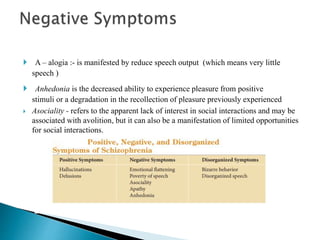
 A – alogia :- is manifested by reduce speech output (which means very little
speech )
 Anhedonia is the decreased ability to experience pleasure from positive
stimuli or a degradation in the recollection of pleasure previously experienced
 Asociality - refers to the apparent lack of interest in social interactions and may be
associated with avolition, but it can also be a manifestation of limited opportunities
for social interactions.
 Some Factor Involve for causes of Schizophrenia –
 Biological Factor
 Social Factor
 Psychological Factor
 Research method
 Environmental factor
 In the Biological Factor some included like
 Genetics :-
 Family Studies
 Adoption Studies :- The first adoption study of schizophrenia began by
identifying records for a group of 49 children who were born between 1915
and 1945 while their mothers were hospitalized for schizophrenia (Heston,
1966). All the children were apparently normal at birth and were separated
from their mothers within three days of birth
 Pregnancy and Birth Complications
 Neuropathology
 Structural Brain Imaging
 Functional Brain Imaging
:-
 The role of neurological abnormalities in schizophrenia has been
highlighted by a study of identical twins conducted by investigators
at the National Institute of Mental Health (NIMH). Participants
included 27 pairs of twins discordant for schizophrenia and 13
pairs that were concordant for the disorder. Changes in brain
structure, measured by MRI, and changes in brain function,
measured by cerebral blood flow, were prominent in the twins who
had developed schizophrenia.
 Most of the attention devoted to psychological factors and schizophrenia
has focused on patterns of behavior and communication within families.
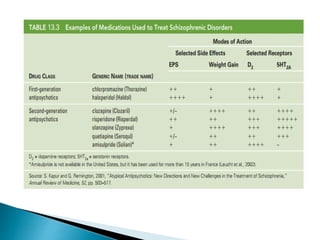
 Antipsychotic medication
 Second-Generation Antipsychotics
 Maintenance Medication
 Motor Side Effects of Medication
 Family-Oriented Aftercare
Social Skills Training
 Assertive Community Treatment
 DSM – V
 Abnormal Psychology Butcher
 Abnormal Psychology Robert Emery

Schizophrenia - A Mental Disorder

  • 1.
  • 2.
     Schizophrenia isone of the most common of the serious mental disorders  Signs and symptoms are variable and include changes in perception, emotion, cognition, thinking, and behavior. The expression of these manifestations varies across patients and over time, but the effect of the illness is always severe and is usually long lasting.  The disorder usually begins before age 25 years, persists throughout life, and effect persons of all social classes. Both patients and their families often suffer from poor care and social ostracism because of wide spread ignorance about the disorder.
  • 3.
     Clinicians shouldappreciate that the diagnosis of schizophrenia is based entirely on the psychiatric history and mental status examination. .  There is no laboratory test for schizophrenia.
  • 4.
     Kraepelin translatedMorel’s démence précoce into dementia precox,.  term that emphasized the change in cognition (dementia) and early onset (precox) of the disorder.  Patients with dementia precox were described as having a long-term deteriorating course and the clinical symptoms of hallucinations and delusions. 
  • 5.
     Another separatecondition called paranoia was characterized by persistent persecutory delusions.  These patients lacked the deteriorating course of dementia precox and the intermittent symptoms of manic-depressive psychosis.
  • 6.
     Bleuler identifiedspecific fundamental (or primary) symptoms of schizophrenia to develop his theory about the internal mental schisms of patients.  These symptoms included associational disturbances of thought, especially looseness, affective disturbances, autism, and ambivalence, summarized as the four As: associations, affect, autism, and ambivalence.  Bleuler also identified accessory (secondary) symptoms, which included the symptoms that Kraepelin saw as major indicators of dementia precox: hallucinations and delusions.
  • 7.
     In theUnited States, the lifetime prevalence of schizophrenia is about 1 percent, which means that about one person in 100 will develop schizophrenia during their lifetime.  The Epidemiologic Catchment Area study sponsored by the National Institute of Mental Health reported a lifetime prevalence of 0.6 to 1.9 percent. In the United States.
  • 8.
     The peakages of onset are 10 to 25 years for men and 25 to 35 years for women.  Approximately 3 to 10 percent of women with schizophrenia present with disease onset after age 40 years.  About 90 percent of patients in treatment for schizophrenia are between 15 and 55 years old. Onset of schizophrenia before age 10 years or after age 60 years is extremely rare.
  • 9.
     Some studieshave indicated that men are more likely to be impaired by negative symptoms (described later) than are women and that women are more likely to have better social functioning than are men before disease onset.  In general, the outcome for female schizophrenia patients is better than that for male schizophrenia patients. When onset occurs after age 45 years, the disorder is characterized as late-onset schizophrenia.
  • 10.
     Reproductive Factors- The number of children born to parents with schizophrenia is continually increasing. The fertility rate for persons with schizophrenia is close to that for the general population.  First-degree biological relatives of persons with schizophrenia have a ten times greater risk for developing the disease than the general population
  • 11.
     Medical Illness- Persons with schizophrenia have a higher mortality rate from accidents and natural causes than the general population.  Institution- or treatment-related variables do not explain the increased mortality rate, but the higher rate may be related to the fact that the diagnosis and treatment of medical and surgical conditions in schizophrenia patients can be clinical challenges.  Several studies have shown that up to 80 percent of all schizophrenia patients have significant concurrent medical illnesses and that up to 50 percent of these conditions may be undiagnosed.
  • 12.
     Three Majorkey issues to find the clinical signs and symptoms of schizophrenia.  A - No clinical sign or symptom is path gnomonic for schizophrenia.  B - Every sign or symptom seen in schizophrenia occurs in other psychiatric and neurological disorders.  C- This observation is contrary to the often-heard clinical opinion that certain signs and symptoms are diagnostic of schizophrenia.  Example – This observation is contrary to the often-heard clinical opinion that certain signs and symptoms are diagnostic of schizophrenia.
  • 13.
     Therefore, apatient’s history is essential for the diagnosis of schizophrenia; clinicians cannot diagnose schizophrenia simply by results of a mental status examination, which may vary.  Second, a patient’s symptoms change with time.  For example, a patient may have intermittent hallucinations and a varying ability to perform adequately in social situations, or significant symptoms of a mood disorder may come and go during the course of schizophrenia.  Third, clinicians must take into account the patient’s educational level, intellectual ability, and cultural and sub cultural membership.
  • 14.
     The symptomsof schizophrenia can be divided into three dimensions: positive symptoms, negative symptoms, and disorganization.  Positive Symptoms  Negative Symptoms  disorganization  Delusions  Hallucinations
  • 15.
     What isDelusions – Called The Bharm…  There are two forms of psychotic symptoms  Delusions :- persistent false beliefs that are held despite evidence that the beliefs are incorrect or exaggerate reality. The content of delusions can vary across psychological disorders.  Hallucinations :- are sensations that are so vivid that the perceived objects or events seem real, although they are not. Hallucinations can occur in any of the five senses, but the most common type is auditory hallucinations, in particular, hearing voices. 
  • 16.
     However, ahallucination—in and of itself—does not indicate psychosis or a psychological disorder. Rather, this form of psychotic symptom must arise in a context that renders it unusual and indicates impaired functioning  specifically, hearing voices Most common type experienced by people with schizophrenia.  [The voices] have returned with a vengeance, bringing hell to my nights and days. With scathing criticism and a constant scornful commentary on everything I do, they sometimes order me to do things I shouldn’t. So far, I’ve stopped myself, but I might not always be able to. . . . (Wagner & Spiro, 2005, )
  • 17.
     People withschizophrenia can sometimes speak incoherently, although they may not necessarily be aware that other people cannot understand what they are saying,  One type of disorganized speech is word salad. which is a random stream of seemingly unconnected words.  That’s wish-bell. Double vision. It’s like walking across a person’s eye and reflecting personality. It works on you, like dying and going to the spiritual world, but landing in the Vella world.  (Marengo et al., 1985,) In this case, “wish-bell” is the neologism; it doesn’t exist, nor does it have an obvious meaning or function as a metaphor.
  • 18.
     Catatonic behavioris a marked decrease in reactivity to the environment. This ranges from conflict to instructions {negativism); to maintaining a rigid, inappropriate or bizarre posture; to a complete lack of verbal and motor responses {mutism and stupor)  It can also include purposeless and excessive motor activity without obvious cause {catatonic excitement).  Other features are repeated stereotyped movements, staring, grimacing, mutism, and the echoing of speech. Although catatonia has historically been associated with schizophrenia, catatonic symptoms are nonspecific and may occur in other mental disorder.
  • 19.
     (e.g., bipolaror depressive disorders with catatonia) and in medical conditions (catatonic disorder due to another medical condition).
  • 20.
     Positive symptoms,also called psychotic symptoms, include hallucinations and delusions.  The term positive symptoms of schizophrenia does not involve that these symptoms are beneficial or adaptive. Rather, it suggests that they are characterized by the presence of unusual response (such as hearing a voice that is not really there).  Positive symptoms are those that reflect an excess or distortion in a normal repertoire of behavior and experience, such as delusions and hallucinations.
  • 21.
     Two negativesymptoms are particularly prominent in schizophrenia  A - diminished emotional expression B- avolition  Diminished emotional expression:-  includes reductions in the expression of emotions in the face, eye contact, intonation of speech (prosody), and movements of the hand, head, and face that normally give an emotional emphasis to speech (alogia, which means very little speech )
  • 22.
     Avolition isa decrease in motivated self-initiated purposeful activities.  The individual may sit for long periods of time and show little interest in participating in work or social activities.  Other negative symptoms include  A - alogia,  B- anhedonia,  C -asociality.
  • 23.
     A –alogia :- is manifested by reduce speech output (which means very little speech )  Anhedonia is the decreased ability to experience pleasure from positive stimuli or a degradation in the recollection of pleasure previously experienced  Asociality - refers to the apparent lack of interest in social interactions and may be associated with avolition, but it can also be a manifestation of limited opportunities for social interactions.
  • 24.
     Some FactorInvolve for causes of Schizophrenia –  Biological Factor  Social Factor  Psychological Factor  Research method  Environmental factor
  • 25.
     In theBiological Factor some included like  Genetics :-  Family Studies  Adoption Studies :- The first adoption study of schizophrenia began by identifying records for a group of 49 children who were born between 1915 and 1945 while their mothers were hospitalized for schizophrenia (Heston, 1966). All the children were apparently normal at birth and were separated from their mothers within three days of birth
  • 26.
     Pregnancy andBirth Complications  Neuropathology  Structural Brain Imaging  Functional Brain Imaging :-
  • 27.
     The roleof neurological abnormalities in schizophrenia has been highlighted by a study of identical twins conducted by investigators at the National Institute of Mental Health (NIMH). Participants included 27 pairs of twins discordant for schizophrenia and 13 pairs that were concordant for the disorder. Changes in brain structure, measured by MRI, and changes in brain function, measured by cerebral blood flow, were prominent in the twins who had developed schizophrenia.
  • 28.
     Most ofthe attention devoted to psychological factors and schizophrenia has focused on patterns of behavior and communication within families.
  • 29.
     Antipsychotic medication Second-Generation Antipsychotics  Maintenance Medication  Motor Side Effects of Medication
  • 31.
     Family-Oriented Aftercare SocialSkills Training  Assertive Community Treatment
  • 32.
     DSM –V  Abnormal Psychology Butcher  Abnormal Psychology Robert Emery