

-Gopika P
Nair
T.Y.B.A
 The hallmark of schizophrenia is a significant loss
of contact with reality, referred to as psychosis.
 It encompasses several differing types of
relatively severe mental disorder..
 As the APA(1997) has put it, "It is likely that
schizophrenia is the final common pathway for a
group of disorders with a variety of etiologies,
courses, and outcomes.”
 Typical schizophrenic- detached from reality, lost
adequate mental integration & communication
with the surrounding environment.
 Benedict Morel: Used the term ‘dementia
precoce’(mental deterioration at an early age)to
describe the condition and to distinguish it from
the dementing disorders of the old age.
 Emil Kraepelin: This illness develops relatively
early in life, and its course is likely deteriorating
and chronic; deterioration reminded dementia
(„Dementia praecox“), but was not followed by
any organic changes of the brain, detectable at that
time.
 Eugen Bleuler: He renamed Kraepelin’s dementia
praecox as schizophrenia (1911); he recognized the
cognitive impairment in this illness, which he
named as a „splitting“ of mind.
 As prevalent as epilepsy.
 Life time risk – 1%
 People whose fathers were older- 2-3 times more
risk
 Avg onset – 25 years for men and 29 for women.
 Majority of cases- late adolescence &early
adulthood.
 Males develop a more severe form of the disorder.
 Point prevalence- 0.2 – 2 %
 Lifetime prevalence- 0.%
 Incidence rate of new cases of schizo. In the U.S -
0.2% per year.
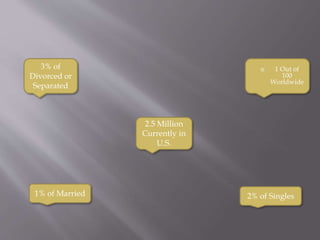
 1 Out of
100
Worldwide
3% of
Divorced or
Separated
2.5 Million
Currently in
U.S.
2% of Singles1% of Married
 D.S.M 4 CRITERIA:
 2 or more of these symptoms present for a significant
portion of time during a 1 month period-
1) Hallucinations
2) Delusions
3) Disorganized speech
4) Catatonic behavior
5) Negative symptoms
 Dysfunction in work, interpersonal relations or self
care.
 Signs of disturbance for atleast 6 months sith atleast 1
month of symptoms listed above,
 Positive syndrome schizophrenia: emotional
turmoil, motor agitation, delusions, hallucination,
minimal cognitive impairment, sudden onset etc.
 Negative syndrome schizophrenia: apathy,
emotional flattening, asociality, poverty of speech,
insidious onset, chronic course.
 Type I- positive + (good response to drugs, limbic
system abnormalities, normal brain ventricles)
 Type II- negative+(uncertain response to drugs,
frontal lobe abnormalities, enlarged brain
ventricles)
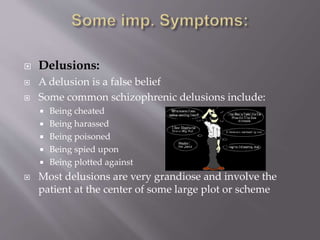
 Delusions:
 A delusion is a false belief
 Some common schizophrenic delusions include:
 Being cheated
 Being harassed
 Being poisoned
 Being spied upon
 Being plotted against
 Most delusions are very grandiose and involve the
patient at the center of some large plot or scheme
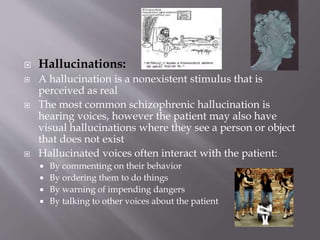
 Hallucinations:
 A hallucination is a nonexistent stimulus that is
perceived as real
 The most common schizophrenic hallucination is
hearing voices, however the patient may also have
visual hallucinations where they see a person or object
that does not exist
 Hallucinated voices often interact with the patient:
 By commenting on their behavior
 By ordering them to do things
 By warning of impending dangers
 By talking to other voices about the patient
 Disturbance of associative linking: cognitive
slippage , derailment, loosening or incoherence,
word salad.
 Disturbance of thought content
 Disruption of perception
 Emotional dysfunction: anhedonia(emotional
shallowness)
 Confused sense of self
 Disrupted volition- goal directed activity is
disrupted.
 Retreat to an inner world
 Disturbed motor behavior.
 Undifferentiated :
a) Waste basket category
b) Mixed symptom picture
c) Most patients remain undifferentiated for a
long period
d) Not an early or slow insidious onset
e) Sudden breakdown.
f) Recurrent episodes- common.
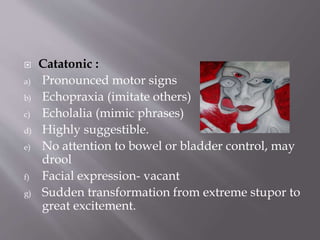
 Catatonic :
a) Pronounced motor signs
b) Echopraxia (imitate others)
c) Echolalia (mimic phrases)
d) Highly suggestible.
e) No attention to bowel or bladder control, may
drool
f) Facial expression- vacant
g) Sudden transformation from extreme stupor to
great excitement.
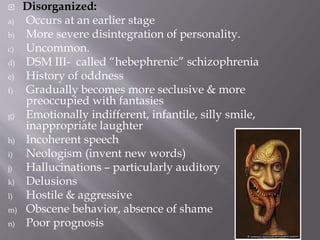
 Disorganized:
a) Occurs at an earlier stage
b) More severe disintegration of personality.
c) Uncommon.
d) DSM III- called “hebephrenic” schizophrenia
e) History of oddness
f) Gradually becomes more seclusive & more
preoccupied with fantasies
g) Emotionally indifferent, infantile, silly smile,
inappropriate laughter
h) Incoherent speech
i) Neologism (invent new words)
j) Hallucinations – particularly auditory
k) Delusions
l) Hostile & aggressive
m) Obscene behavior, absence of shame
n) Poor prognosis
 Paranoid:
a) History of increasing suspiciousness
b) Severe difficulty in interpersonal relationships
c) Absurd , illogical & changing delusions
d) Persecutory delusions
e) Themes of grandeur
f) Higher lever of adaptive coping & cognitive
integrative skills
g) Less bizarre behavior
h) Less extreme withdrawal from the outside world.
 Residual type
 Schizoaffective disorder- schizophrenia+ mood
disorders
 Schizophreniform disorder
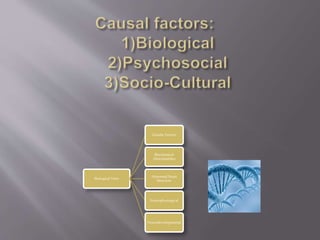
Biological View
Genetic Factors
Biochemical
Abnormalities
Abnormal Brain
Structure
Neurophysiogical
Neurodevelopmental
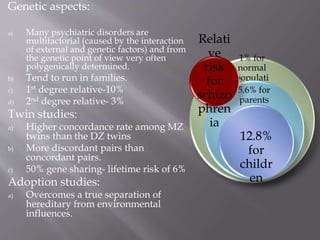
Genetic aspects:
a) Many psychiatric disorders are
multifactorial (caused by the interaction
of external and genetic factors) and from
the genetic point of view very often
polygenically determined.
b) Tend to run in families.
c) 1st degree relative-10%
d) 2nd degree relative- 3%
Twin studies:
a) Higher concordance rate among MZ
twins than the DZ twins
b) More discordant pairs than
concordant pairs.
c) 50% gene sharing- lifetime risk of 6%
Adoption studies:
a) Overcomes a true separation of
hereditary from environmental
influences.
1% for
normal
populati
on5.6% for
parents
12.8%
for
childr
en
Relati
ve
risk
for
schizo
phren
ia
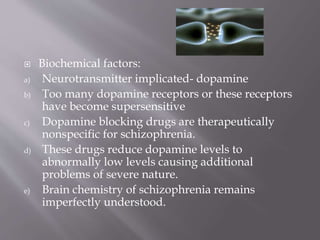
 Biochemical factors:
a) Neurotransmitter implicated- dopamine
b) Too many dopamine receptors or these receptors
have become supersensitive
c) Dopamine blocking drugs are therapeutically
nonspecific for schizophrenia.
d) These drugs reduce dopamine levels to
abnormally low levels causing additional
problems of severe nature.
e) Brain chemistry of schizophrenia remains
imperfectly understood.
 Neurophysiological factors:
a) Inappropriate autonomic arousal
b) Disruptions in normal attentional and
information processing capabilities
c) Deficient in the ability to track a moving target
visually (SPEM deficit)
d) Close relatives share this SPEM deficit
e) Anomalies are also seen in EEG reactions to
momentary sensory stimulation.
f) Reflex hyperactivity & deficit performance in
neuro-psychological testing .
g) Behavioral deficits such as poor p[erceptual
motor coordination or anomalies in reaction time
performance suggesting neurological
impairment.
 Neuroanatomical :
a) Abnormal enlargement of brain’s ventricles
b) Enlarged sulci
c) Deficient size of temporal lobes
d) Some of these abnormalities could be due to
long term use of antipsychotic medications
e) Frontal, temporolimbic, basal ganglia are
chiefly involved in integrative functions
f) Hypofrontality
 Neurodevelopmental:
 Schizophrenics are more likely to have been
born in the winter & early spring moths
 Early motor abnormalities – an extremely
strong predictor of later schizophrenia.
 Rh incompatibility also seems to be associated
with an increased risk of schizophrenia
 Maternal influenza in 2nd trimister is associated
with impaired fetal growth, obsterical
complications and later developing
schizophrenia.
 Common factor between stillbirths and
schizophrenia.
 Faulty communication:
• Double blind communication
• Communication deviance
• These amorphous and fragmented communications
may reflect genetic susceptibility to schizophrenia on
part of the relative.
 Families and role of stress:
• Patients who returned home to their families had
higher chances of relapse than who returned to live
alone.
• EE is also seen as a predictor of relapse
• High EE- environment doubled the chances of relapse
 Growing up in an urban environment increases
the risk of developing schizophrenia
 Immigrants have higher risk than the natives in
developing schizophrenia
 Immigrants with darker skin have a much
higher risk than do immigrants with lighter
skin.
 Occurs less often in traditional , less well-
developed cultures.
 Lower the socio-economic status, the higher the
prevalence of schizophrenia.
 Clinical outcome:
• 15-25 years after developing schizophrenia,
around 38% patients have a favorable outcome
of being recovered.
• Only 16 % recover to the extent that they no
longer need treatment.
• For around 12% , long term institutionalization
is necessary.
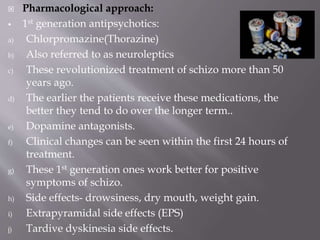
 Pharmacological approach:
 1st generation antipsychotics:
a) Chlorpromazine(Thorazine)
b) Also referred to as neuroleptics
c) These revolutionized treatment of schizo more than 50
years ago.
d) The earlier the patients receive these medications, the
better they tend to do over the longer term..
e) Dopamine antagonists.
f) Clinical changes can be seen within the first 24 hours of
treatment.
g) These 1st generation ones work better for positive
symptoms of schizo.
h) Side effects- drowsiness, dry mouth, weight gain.
i) Extrapyramidal side effects (EPS)
j) Tardive dyskinesia side effects.
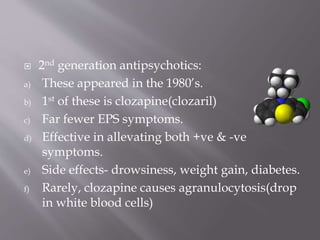
 2nd generation antipsychotics:
a) These appeared in the 1980’s.
b) 1st of these is clozapine(clozaril)
c) Far fewer EPS symptoms.
d) Effective in allevating both +ve & -ve
symptoms.
e) Side effects- drowsiness, weight gain, diabetes.
f) Rarely, clozapine causes agranulocytosis(drop
in white blood cells)
Psychosocial approach:
Mental health patients have been slow to realize the
limitations of an exclusively pharmacological approach to
the treatment of schizophrenia.
Family therapy:
• Working with patients and their families
• To educate them about schizo
• To help them improve their coping & problem solving
skills
• To enhance communication skills.
Case management:
• People who help patients find services they need to
function in the community.
• Refers them to people who will provide the needed
service.
Social skills training:
• To help patients acquire the skills to function better in the day
to day life.
• Employment, relationship, self-care skills .
• Skills in managing medications.
Cognitive behavioral therapy:
• The goal is to decrease the intensity of positive treatments,
reduce relapse & decrease social disability.
• Patients who received cbt showed decreases in hallucination
& delusions.
Individual psychotherapy:
• Involves a staged, non psychodynamical approach oriented to
the learning of coping skills for managing emotion & stressful
events.
 The hope for a reliable cure for schizo has not
yet materialized nor can it be discerned
anywhere on the horizon. Antipsychotic
medications are not a cure. The psychosocial
based efforts to compensate for the
shortcomings of antipsychotic medication in
treating schizo are not really “in place”.
However, an effective approach is giving our
support and unconditional love to these
patients.
Schizophrenia
Schizophrenia

Schizophrenia

  • 1.
  • 2.
     The hallmarkof schizophrenia is a significant loss of contact with reality, referred to as psychosis.  It encompasses several differing types of relatively severe mental disorder..  As the APA(1997) has put it, "It is likely that schizophrenia is the final common pathway for a group of disorders with a variety of etiologies, courses, and outcomes.”  Typical schizophrenic- detached from reality, lost adequate mental integration & communication with the surrounding environment.
  • 3.
     Benedict Morel:Used the term ‘dementia precoce’(mental deterioration at an early age)to describe the condition and to distinguish it from the dementing disorders of the old age.  Emil Kraepelin: This illness develops relatively early in life, and its course is likely deteriorating and chronic; deterioration reminded dementia („Dementia praecox“), but was not followed by any organic changes of the brain, detectable at that time.  Eugen Bleuler: He renamed Kraepelin’s dementia praecox as schizophrenia (1911); he recognized the cognitive impairment in this illness, which he named as a „splitting“ of mind.
  • 4.
     As prevalentas epilepsy.  Life time risk – 1%  People whose fathers were older- 2-3 times more risk  Avg onset – 25 years for men and 29 for women.  Majority of cases- late adolescence &early adulthood.  Males develop a more severe form of the disorder.  Point prevalence- 0.2 – 2 %  Lifetime prevalence- 0.%  Incidence rate of new cases of schizo. In the U.S - 0.2% per year.
  • 5.
     1 Outof 100 Worldwide 3% of Divorced or Separated 2.5 Million Currently in U.S. 2% of Singles1% of Married
  • 6.
     D.S.M 4CRITERIA:  2 or more of these symptoms present for a significant portion of time during a 1 month period- 1) Hallucinations 2) Delusions 3) Disorganized speech 4) Catatonic behavior 5) Negative symptoms  Dysfunction in work, interpersonal relations or self care.  Signs of disturbance for atleast 6 months sith atleast 1 month of symptoms listed above,
  • 7.
     Positive syndromeschizophrenia: emotional turmoil, motor agitation, delusions, hallucination, minimal cognitive impairment, sudden onset etc.  Negative syndrome schizophrenia: apathy, emotional flattening, asociality, poverty of speech, insidious onset, chronic course.  Type I- positive + (good response to drugs, limbic system abnormalities, normal brain ventricles)  Type II- negative+(uncertain response to drugs, frontal lobe abnormalities, enlarged brain ventricles)
  • 8.
     Delusions:  Adelusion is a false belief  Some common schizophrenic delusions include:  Being cheated  Being harassed  Being poisoned  Being spied upon  Being plotted against  Most delusions are very grandiose and involve the patient at the center of some large plot or scheme
  • 9.
     Hallucinations:  Ahallucination is a nonexistent stimulus that is perceived as real  The most common schizophrenic hallucination is hearing voices, however the patient may also have visual hallucinations where they see a person or object that does not exist  Hallucinated voices often interact with the patient:  By commenting on their behavior  By ordering them to do things  By warning of impending dangers  By talking to other voices about the patient
  • 10.
     Disturbance ofassociative linking: cognitive slippage , derailment, loosening or incoherence, word salad.  Disturbance of thought content  Disruption of perception  Emotional dysfunction: anhedonia(emotional shallowness)  Confused sense of self  Disrupted volition- goal directed activity is disrupted.  Retreat to an inner world  Disturbed motor behavior.
  • 11.
     Undifferentiated : a)Waste basket category b) Mixed symptom picture c) Most patients remain undifferentiated for a long period d) Not an early or slow insidious onset e) Sudden breakdown. f) Recurrent episodes- common.
  • 12.
     Catatonic : a)Pronounced motor signs b) Echopraxia (imitate others) c) Echolalia (mimic phrases) d) Highly suggestible. e) No attention to bowel or bladder control, may drool f) Facial expression- vacant g) Sudden transformation from extreme stupor to great excitement.
  • 13.
     Disorganized: a) Occursat an earlier stage b) More severe disintegration of personality. c) Uncommon. d) DSM III- called “hebephrenic” schizophrenia e) History of oddness f) Gradually becomes more seclusive & more preoccupied with fantasies g) Emotionally indifferent, infantile, silly smile, inappropriate laughter h) Incoherent speech i) Neologism (invent new words) j) Hallucinations – particularly auditory k) Delusions l) Hostile & aggressive m) Obscene behavior, absence of shame n) Poor prognosis
  • 14.
     Paranoid: a) Historyof increasing suspiciousness b) Severe difficulty in interpersonal relationships c) Absurd , illogical & changing delusions d) Persecutory delusions e) Themes of grandeur f) Higher lever of adaptive coping & cognitive integrative skills g) Less bizarre behavior h) Less extreme withdrawal from the outside world.
  • 15.
     Residual type Schizoaffective disorder- schizophrenia+ mood disorders  Schizophreniform disorder
  • 16.
    Biological View Genetic Factors Biochemical Abnormalities AbnormalBrain Structure Neurophysiogical Neurodevelopmental
  • 17.
    Genetic aspects: a) Manypsychiatric disorders are multifactorial (caused by the interaction of external and genetic factors) and from the genetic point of view very often polygenically determined. b) Tend to run in families. c) 1st degree relative-10% d) 2nd degree relative- 3% Twin studies: a) Higher concordance rate among MZ twins than the DZ twins b) More discordant pairs than concordant pairs. c) 50% gene sharing- lifetime risk of 6% Adoption studies: a) Overcomes a true separation of hereditary from environmental influences. 1% for normal populati on5.6% for parents 12.8% for childr en Relati ve risk for schizo phren ia
  • 18.
     Biochemical factors: a)Neurotransmitter implicated- dopamine b) Too many dopamine receptors or these receptors have become supersensitive c) Dopamine blocking drugs are therapeutically nonspecific for schizophrenia. d) These drugs reduce dopamine levels to abnormally low levels causing additional problems of severe nature. e) Brain chemistry of schizophrenia remains imperfectly understood.
  • 19.
     Neurophysiological factors: a)Inappropriate autonomic arousal b) Disruptions in normal attentional and information processing capabilities c) Deficient in the ability to track a moving target visually (SPEM deficit) d) Close relatives share this SPEM deficit e) Anomalies are also seen in EEG reactions to momentary sensory stimulation. f) Reflex hyperactivity & deficit performance in neuro-psychological testing . g) Behavioral deficits such as poor p[erceptual motor coordination or anomalies in reaction time performance suggesting neurological impairment.
  • 20.
     Neuroanatomical : a)Abnormal enlargement of brain’s ventricles b) Enlarged sulci c) Deficient size of temporal lobes d) Some of these abnormalities could be due to long term use of antipsychotic medications e) Frontal, temporolimbic, basal ganglia are chiefly involved in integrative functions f) Hypofrontality
  • 21.
     Neurodevelopmental:  Schizophrenicsare more likely to have been born in the winter & early spring moths  Early motor abnormalities – an extremely strong predictor of later schizophrenia.  Rh incompatibility also seems to be associated with an increased risk of schizophrenia  Maternal influenza in 2nd trimister is associated with impaired fetal growth, obsterical complications and later developing schizophrenia.  Common factor between stillbirths and schizophrenia.
  • 22.
     Faulty communication: •Double blind communication • Communication deviance • These amorphous and fragmented communications may reflect genetic susceptibility to schizophrenia on part of the relative.  Families and role of stress: • Patients who returned home to their families had higher chances of relapse than who returned to live alone. • EE is also seen as a predictor of relapse • High EE- environment doubled the chances of relapse
  • 23.
     Growing upin an urban environment increases the risk of developing schizophrenia  Immigrants have higher risk than the natives in developing schizophrenia  Immigrants with darker skin have a much higher risk than do immigrants with lighter skin.  Occurs less often in traditional , less well- developed cultures.  Lower the socio-economic status, the higher the prevalence of schizophrenia.
  • 24.
     Clinical outcome: •15-25 years after developing schizophrenia, around 38% patients have a favorable outcome of being recovered. • Only 16 % recover to the extent that they no longer need treatment. • For around 12% , long term institutionalization is necessary.
  • 25.
     Pharmacological approach: 1st generation antipsychotics: a) Chlorpromazine(Thorazine) b) Also referred to as neuroleptics c) These revolutionized treatment of schizo more than 50 years ago. d) The earlier the patients receive these medications, the better they tend to do over the longer term.. e) Dopamine antagonists. f) Clinical changes can be seen within the first 24 hours of treatment. g) These 1st generation ones work better for positive symptoms of schizo. h) Side effects- drowsiness, dry mouth, weight gain. i) Extrapyramidal side effects (EPS) j) Tardive dyskinesia side effects.
  • 26.
     2nd generationantipsychotics: a) These appeared in the 1980’s. b) 1st of these is clozapine(clozaril) c) Far fewer EPS symptoms. d) Effective in allevating both +ve & -ve symptoms. e) Side effects- drowsiness, weight gain, diabetes. f) Rarely, clozapine causes agranulocytosis(drop in white blood cells)
  • 27.
    Psychosocial approach: Mental healthpatients have been slow to realize the limitations of an exclusively pharmacological approach to the treatment of schizophrenia. Family therapy: • Working with patients and their families • To educate them about schizo • To help them improve their coping & problem solving skills • To enhance communication skills. Case management: • People who help patients find services they need to function in the community. • Refers them to people who will provide the needed service.
  • 28.
    Social skills training: •To help patients acquire the skills to function better in the day to day life. • Employment, relationship, self-care skills . • Skills in managing medications. Cognitive behavioral therapy: • The goal is to decrease the intensity of positive treatments, reduce relapse & decrease social disability. • Patients who received cbt showed decreases in hallucination & delusions. Individual psychotherapy: • Involves a staged, non psychodynamical approach oriented to the learning of coping skills for managing emotion & stressful events.
  • 29.
     The hopefor a reliable cure for schizo has not yet materialized nor can it be discerned anywhere on the horizon. Antipsychotic medications are not a cure. The psychosocial based efforts to compensate for the shortcomings of antipsychotic medication in treating schizo are not really “in place”. However, an effective approach is giving our support and unconditional love to these patients.