SCHIZOPHRENIA
Ms. Shruti Biswas
M.Sc ( MHN)
Clinical Instructor
SVCON, Pune
 1908 – Swiss Psychiatrist Eugene
Bleuler
Derived from Greek Word Skhizo
( Split) and Phren ( Mind )
 In ICD10 , - F 20- F29;
Schizophrenia,
Schizotypal and
delusional disorders
INTRODUCTION
DEFINITION
 Schizophrenia is a psychotic condition
characterized by a disturbance in thinking,
emotions, volitions and faculties in the
presence of clear consciousness, which
usually leads to social withdrawal.
 Schizophrenia is a common type of
psychosis characterized by hallucinations
and /or delusions, personality changes,
withdrawal and serious thought and speech
disturbances.
CLASSIFICATION (ICD10)
F20-F29 Schizophrenia, Schizotypal and
Delusional Disorders
F20 Schizophrenia
F20.0 Paranoid schizophrenia
F20.1 Hebephrenic schizophrenia
F20.2 Catatonic schizophrenia
F20.3 Undifferentiated schizophrenia
F20.4 Post-schizophrenic depression
F20.5 Residual schizophrenia
F20.6 Simple schizophrenia
F20.8 Other schizophrenia
F20.9 Schizophrenia, unspecified
F21 Schizotypal disorder
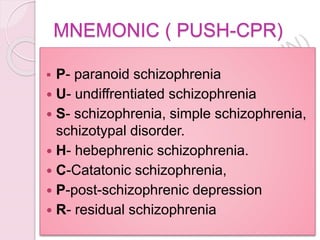
MNEMONIC ( PUSH-CPR)
 P- paranoid schizophrenia
 U- undiffrentiated schizophrenia
 S- schizophrenia, simple schizophrenia,
schizotypal disorder.
 H- hebephrenic schizophrenia.
 C-Catatonic schizophrenia,
 P-post-schizophrenic depression
 R- residual schizophrenia
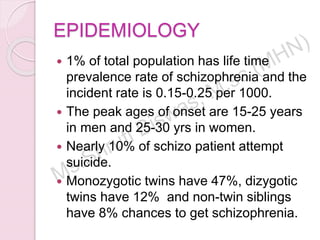
EPIDEMIOLOGY
 1% of total population has life time
prevalence rate of schizophrenia and the
incident rate is 0.15-0.25 per 1000.
 The peak ages of onset are 15-25 years
in men and 25-30 yrs in women.
 Nearly 10% of schizo patient attempt
suicide.
 Monozygotic twins have 47%, dizygotic
twins have 12% and non-twin siblings
have 8% chances to get schizophrenia.
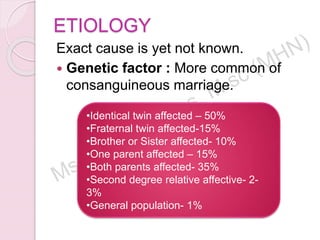
ETIOLOGY
Exact cause is yet not known.
 Genetic factor : More common of
consanguineous marriage.
•Identical twin affected – 50%
•Fraternal twin affected-15%
•Brother or Sister affected- 10%
•One parent affected – 15%
•Both parents affected- 35%
•Second degree relative affective- 2-
3%
•General population- 1%
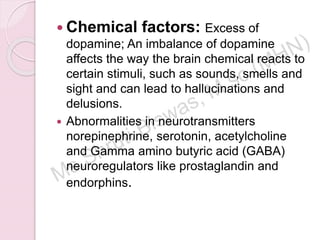
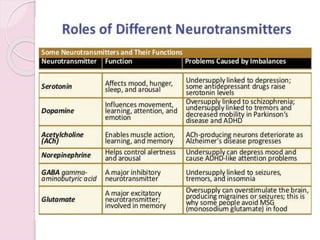
 Chemical factors: Excess of
dopamine; An imbalance of dopamine
affects the way the brain chemical reacts to
certain stimuli, such as sounds, smells and
sight and can lead to hallucinations and
delusions.
 Abnormalities in neurotransmitters
norepinephrine, serotonin, acetylcholine
and Gamma amino butyric acid (GABA)
neuroregulators like prostaglandin and
endorphins.
 Neurostructural Theories/Brain
Abnormality: research suggests that the
prefrontal cortex and limbic cortex may
never fully develop in the brain of person
with schizophrenia.
 Abnormal brain structure and function.
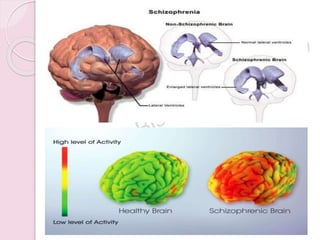
 Enlarged Ventricles
 Decreased brain volume
 Smaller temporal and frontal
lobes,Cerebellum and limbic structures and
less grey matter.
 Prenatal and peri-natal risk factors:
Multiple non-genetic factors influence
the development of schizophrenia.
•Maternal influenza
•Birth during late winter and
early spring.
•Complication in pregnancy.
 Psychological Factor:
Schizophrenogenic mothers, lack of real
parents, dependency on mothers, anxious
mother, parental marital discord, Double
blind communication by parents , stressful
life.
 Social Factor: Low social class ,
Poverty, abuse, family problems, social
disorganization.
 Stress Diathesis model: integration of
biological, psychosocial and environmental
factors
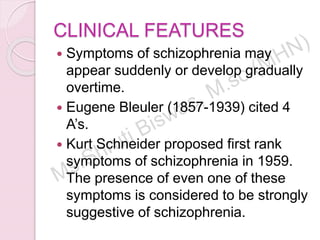
CLINICAL FEATURES
 Symptoms of schizophrenia may
appear suddenly or develop gradually
overtime.
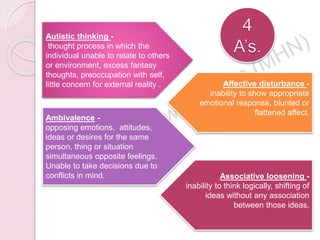
 Eugene Bleuler (1857-1939) cited 4
A’s.
 Kurt Schneider proposed first rank
symptoms of schizophrenia in 1959.
The presence of even one of these
symptoms is considered to be strongly
suggestive of schizophrenia.
Autistic thinking -
thought process in which the
individual unable to relate to others
or environment, excess fantasy
thoughts, preoccupation with self,
little concern for external reality .
Ambivalence -
opposing emotions, attitudes,
ideas or desires for the same
person, thing or situation
simultaneous opposite feelings.
Unable to take decisions due to
conflicts in mind.
Affective disturbance -
inability to show appropriate
emotional response, blunted or
flattened affect.
Associative loosening -
inability to think logically, shifting of
ideas without any association
between those ideas.
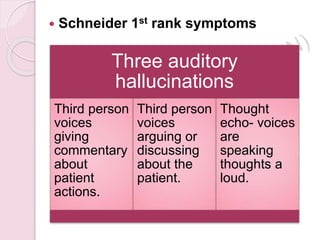
 Schneider 1st rank symptoms
Three auditory
hallucinations
Third person
voices
giving
commentary
about
patient
actions.
Third person
voices
arguing or
discussing
about the
patient.
Thought
echo- voices
are
speaking
thoughts a
loud.
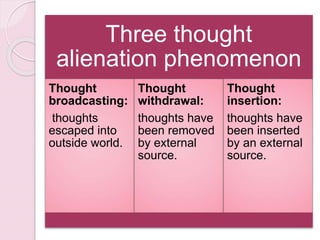
Three thought
alienation phenomenon
Thought
broadcasting:
thoughts
escaped into
outside world.
Thought
withdrawal:
thoughts have
been removed
by external
source.
Thought
insertion:
thoughts have
been inserted
by an external
source.
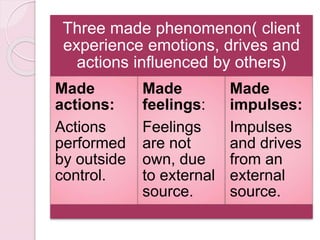
Three made phenomenon( client
experience emotions, drives and
actions influenced by others)
Made
actions:
Actions
performed
by outside
control.
Made
feelings:
Feelings
are not
own, due
to external
source.
Made
impulses:
Impulses
and drives
from an
external
source.
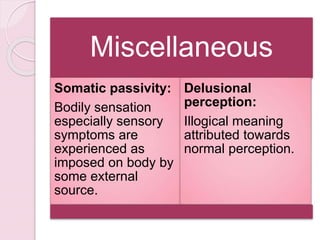
Miscellaneous
Somatic passivity:
Bodily sensation
especially sensory
symptoms are
experienced as
imposed on body by
some external
source.
Delusional
perception:
Illogical meaning
attributed towards
normal perception.
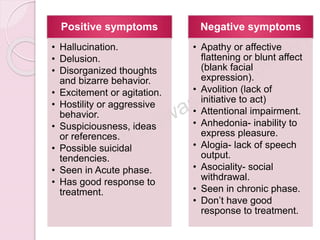
Positive symptoms
• Hallucination.
• Delusion.
• Disorganized thoughts
and bizarre behavior.
• Excitement or agitation.
• Hostility or aggressive
behavior.
• Suspiciousness, ideas
or references.
• Possible suicidal
tendencies.
• Seen in Acute phase.
• Has good response to
treatment.
Negative symptoms
• Apathy or affective
flattening or blunt affect
(blank facial
expression).
• Avolition (lack of
initiative to act)
• Attentional impairment.
• Anhedonia- inability to
express pleasure.
• Alogia- lack of speech
output.
• Asociality- social
withdrawal.
• Seen in chronic phase.
• Don’t have good
response to treatment.
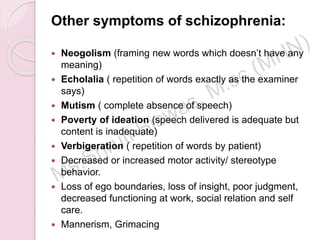
Other symptoms of schizophrenia:
 Neogolism (framing new words which doesn’t have any
meaning)
 Echolalia ( repetition of words exactly as the examiner
says)
 Mutism ( complete absence of speech)
 Poverty of ideation (speech delivered is adequate but
content is inadequate)
 Verbigeration ( repetition of words by patient)
 Decreased or increased motor activity/ stereotype
behavior.
 Loss of ego boundaries, loss of insight, poor judgment,
decreased functioning at work, social relation and self
care.
 Mannerism, Grimacing
CLINICAL TYPES
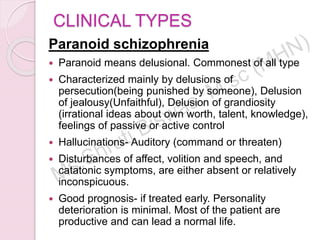
Paranoid schizophrenia
 Paranoid means delusional. Commonest of all type
 Characterized mainly by delusions of
persecution(being punished by someone), Delusion
of jealousy(Unfaithful), Delusion of grandiosity
(irrational ideas about own worth, talent, knowledge),
feelings of passive or active control
 Hallucinations- Auditory (command or threaten)
 Disturbances of affect, volition and speech, and
catatonic symptoms, are either absent or relatively
inconspicuous.
 Good prognosis- if treated early. Personality
deterioration is minimal. Most of the patient are
productive and can lead a normal life.
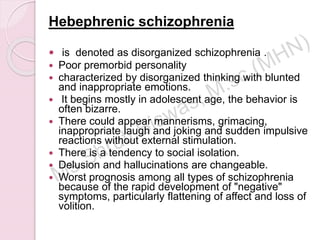
Hebephrenic schizophrenia
 is denoted as disorganized schizophrenia .
 Poor premorbid personality
 characterized by disorganized thinking with blunted
and inappropriate emotions.
 It begins mostly in adolescent age, the behavior is
often bizarre.
 There could appear mannerisms, grimacing,
inappropriate laugh and joking and sudden impulsive
reactions without external stimulation.
 There is a tendency to social isolation.
 Delusion and hallucinations are changeable.
 Worst prognosis among all types of schizophrenia
because of the rapid development of "negative"
symptoms, particularly flattening of affect and loss of
volition.
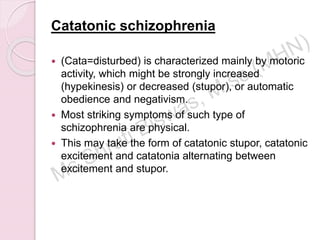
Catatonic schizophrenia
 (Cata=disturbed) is characterized mainly by motoric
activity, which might be strongly increased
(hypekinesis) or decreased (stupor), or automatic
obedience and negativism.
 Most striking symptoms of such type of
schizophrenia are physical.
 This may take the form of catatonic stupor, catatonic
excitement and catatonia alternating between
excitement and stupor.
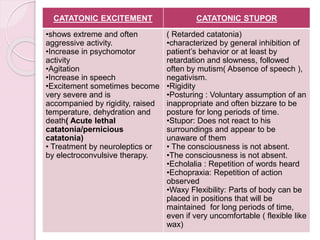
CATATONIC EXCITEMENT CATATONIC STUPOR
•shows extreme and often
aggressive activity.
•Increase in psychomotor
activity
•Agitation
•Increase in speech
•Excitement sometimes become
very severe and is
accompanied by rigidity, raised
temperature, dehydration and
death( Acute lethal
catatonia/pernicious
catatonia)
• Treatment by neuroleptics or
by electroconvulsive therapy.
( Retarded catatonia)
•characterized by general inhibition of
patient’s behavior or at least by
retardation and slowness, followed
often by mutism( Absence of speech ),
negativism.
•Rigidity
•Posturing : Voluntary assumption of an
inappropriate and often bizzare to be
posture for long periods of time.
•Stupor: Does not react to his
surroundings and appear to be
unaware of them
• The consciousness is not absent.
•The consciousness is not absent.
•Echolalia : Repetition of words heard
•Echopraxia: Repetition of action
observed
•Waxy Flexibility: Parts of body can be
placed in positions that will be
maintained for long periods of time,
even if very uncomfortable ( flexible like
wax)
Residual Schizophrenia
 A chronic stage in the development of
schizophrenia with clear succession from
the initial stage with one or more
episodes characterized by general
criteria of schizophrenia to the late stage
with long-lasting negative symptoms and
deterioration (not necessarily
irreversible).
 At least one episode of schizophrenia in
the past but without prominent psychotic
symptoms at present
Undifferentiated Schizophrenia
 Psychotic conditions meeting the
general diagnostic criteria for
schizophrenia but not conforming to
any of the subtypes in F20.0-F20.2, or
exhibiting the features of more than
one of them without a clear
predominance of a particular set of
diagnostic characteristics.
Simple Schizophrenia
 Simple schizophrenia is characterized by
early and slowly developing initial stage
 with growing social isolation, withdrawal,
small activity, passivity, avolition and
dependence on the others.
 Insidious and progressive development of
prominent Negative symptoms
 The patients are indifferent, without any
initiative and volition. There is not
expressed the presence of hallucinations
and delusions
 The prognosis is very poor
Post-schizophrenic Depression
 A depressive episode, which may be
prolonged, arising in the aftermath of a
schizophrenic illness. Some
schizophrenic symptoms, either
positive or negative, must still be
present but they no longer dominate
the clinical picture.
 These depressive states are
associated with an increased risk of
suicide.
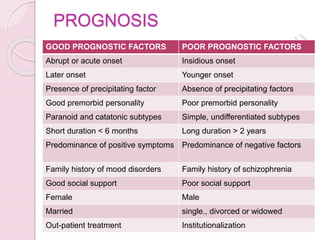
PROGNOSIS
GOOD PROGNOSTIC FACTORS POOR PROGNOSTIC FACTORS
Abrupt or acute onset Insidious onset
Later onset Younger onset
Presence of precipitating factor Absence of precipitating factors
Good premorbid personality Poor premorbid personality
Paranoid and catatonic subtypes Simple, undifferentiated subtypes
Short duration < 6 months Long duration > 2 years
Predominance of positive symptoms Predominance of negative factors
Family history of mood disorders Family history of schizophrenia
Good social support Poor social support
Female Male
Married single., divorced or widowed
Out-patient treatment Institutionalization
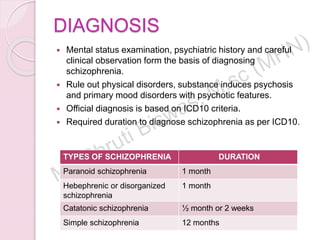
DIAGNOSIS
 Mental status examination, psychiatric history and careful
clinical observation form the basis of diagnosing
schizophrenia.
 Rule out physical disorders, substance induces psychosis
and primary mood disorders with psychotic features.
 Official diagnosis is based on ICD10 criteria.
 Required duration to diagnose schizophrenia as per ICD10.
TYPES OF SCHIZOPHRENIA DURATION
Paranoid schizophrenia 1 month
Hebephrenic or disorganized
schizophrenia
1 month
Catatonic schizophrenia ½ month or 2 weeks
Simple schizophrenia 12 months
INVESTIGATIONS
 No diagnostic test definitively confirms schizophrenia.
 Tests may be done to rule out disorders that cause psychosis
including vitamin deficiencies, uremia, electrolyte imbalances.
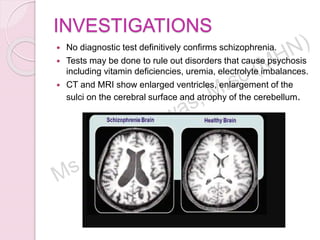
 CT and MRI show enlarged ventricles, enlargement of the
sulci on the cerebral surface and atrophy of the cerebellum.
TREATMENT MODALITITES
Goal :
 To reduce the symptoms
 To decrease the chances of a relapse,
or return of symptoms.
 The acute psychotic schizophrenic
patients will respond usually to
antipsychotic medication.
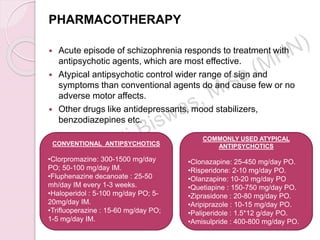
PHARMACOTHERAPY
 Acute episode of schizophrenia responds to treatment with
antipsychotic agents, which are most effective.
 Atypical antipsychotic control wider range of sign and
symptoms than conventional agents do and cause few or no
adverse motor affects.
 Other drugs like antidepressants, mood stabilizers,
benzodiazepines etc.
CONVENTIONAL ANTIPSYCHOTICS
•Clorpromazine: 300-1500 mg/day
PO; 50-100 mg/day IM.
•Fluphenazine decanoate : 25-50
mh/day IM every 1-3 weeks.
•Haloperidol : 5-100 mg/day PO; 5-
20mg/day IM.
•Trifluoperazine : 15-60 mg/day PO;
1-5 mg/day IM.
COMMONLY USED ATYPICAL
ANTIPSYCHOTICS
•Clonazapine: 25-450 mg/day PO.
•Risperidone: 2-10 mg/day PO.
•Olanzapine: 10-20 mg/day PO
•Quetiapine : 150-750 mg/day PO.
•Ziprasidone : 20-80 mg/day PO.
•Aripiprazole : 10-15 mg/day PO.
•Paliperidole : 1.5*12 g/day PO.
•Amisulpride : 400-800 mg/day PO.
ELECTROCOMPULSIVE THERAPY
Indications for ECT in schizophrenia
include:
 Catatonic stupor
 Uncontrolled catatonic excitement
 Severe side-effects with drugs
 Schizophrenic refractory to all other
forms of treatment.
 Usually 8-12 ECT’s are needed.
PSYCHOLOGICAL THERAPIES
Group therapy
Social interaction, sense of
cohesiveness, identification
and reality testing is achieved.
Behavior therapy
Useful in reducing the
frequency of bizarre, disturbing
and deviant behavior and
increase appropriate behavior
Cognitive therapy
use to improve cognitive
distortions like reducing
distractibility and
correcting judgment.
 Social skill training
 Addresses the behavior such
as poor eye contact, odd
facial expression, and lack of
spontaneity in social situation
through videos, role-play and
assignments
Psychosocial
rehabilitation
 Includes activity therapy to
develop the work habit,
training in new vocation or
retraining previous skills for
job placement.
 Family therapy
 Consist of brief program
of family education about
schizophrenia
NURSING MANAGEMENT
 Acute patient are less likely to be able to contribute t their
history.
 Data may obtained from family members.
 Assessment includes information regarding previous incidence
or psychotic episodes.
 Observe behavior pattern, posturing, psychomotor, disturbance,
hygiene and appearance.
 Identify type of disturbances the patient is experiencing.
 Ask about feelings while thought alterations are evident.
 Note down effect and emotional tone.
 Assess the theme of delusion.
 Assess speech pattern.
 Assess ability to perform self-care.
 Determine any suicidal attempts.
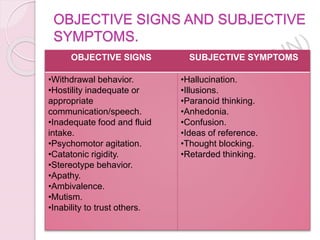
OBJECTIVE SIGNS AND SUBJECTIVE
SYMPTOMS.
OBJECTIVE SIGNS SUBJECTIVE SYMPTOMS
•Withdrawal behavior.
•Hostility inadequate or
appropriate
communication/speech.
•Inadequate food and fluid
intake.
•Psychomotor agitation.
•Catatonic rigidity.
•Stereotype behavior.
•Apathy.
•Ambivalence.
•Mutism.
•Inability to trust others.
•Hallucination.
•Illusions.
•Paranoid thinking.
•Anhedonia.
•Confusion.
•Ideas of reference.
•Thought blocking.
•Retarded thinking.
NURSING DIAGNOSIS
 Disturbed thought process, related to inability to trust, panic
anxiety, possible hereditary or biochemical factors evidence by
delusional thinking, extreme suspiciousness of others.
 Ineffective health maintenance related to inability to trust,
extreme suspiciousness evidence by poor diet intake,
inadequate food and fluid intake, difficulty in falling asleep.
 Self-care deficit related to withdrawal, regression, panic
anxiety, cognitive impairment, inability to trust, evidence by
difficulty in carrying out task associated with hygiene,
grooming, eating, sleeping.
 Potential for violence, self-directed or at others, related to
command hallucinations evidence by physical violence,
destruction of objects in the environment or self-destructive
behavior.
 Risk for self- inflicted or life threatening injury related to
command hallucinations evidenced by suicidal ideas, plans or
attempts.
OTHER PSYCHOTIC DISORDERS
Term psychosis is defined ad gross impairment in reality testing,
marked disturbances in personality with impaired social and
occupational functioning and presence of characteristic
symptoms like delusions and hallucinations.
ICD10 includes disorders under this category:
F22- persistent delusional
F23- acute and transient psychotic disorders
F24- induced delusional disorders
F25- schizoaffective disorders
Persistent Delusional Disorders
 Includes a variety of disorders in which
long-standing delusions constitute the only,
or the most conspicuous, clinical
characteristic and which cannot be
classified as organic, schizophrenic or
affective.
 Their origin is probably heterogeneous, but
it seems, that there is some relation to
schizophrenia.
Acute and Transient Psychotic
Disorders
 The criteria should be the following features:
◦ acute beginning (to two weeks)
◦ presence of typical symptoms (quickly changing
“polymorphic symptoms”)
◦ presence of typical schizophrenic symptoms.
 Complete recovery usually occurs within a few
months, often within a few weeks or even days.
 The disorder may or may not be associated with
acute stress, defined as usually stressful events
preceding the onset by one to two weeks.
Induced Delusional Disorder
 A delusional disorder shared by two or more
people with close emotional links. Only one of the
people suffers from a genuine psychotic disorder;
the delusions are induced in the other(s) and
usually disappear when the people are separated.
 The original delusions of dominant member and
his partner are usually chronic, either persecutory
or megalomanic.
Schizoaffective Disorders
 Episodic disorders in which both affective and
schizophrenic symptoms are prominent but which
do not justify a diagnosis of either schizophrenia or
depressive or manic episodes.
 Patients suffering from periodic schizoaffective
disorders, especially with manic symptoms, have
usually good prognosis with full remissions without
any remaining defects.
Depressed type
 Poor appetite
 Weight loss or gain
 Sleep disturbances
 Agitation
 Lack of energy
 Lack of interest in usual activities
 Hopelessness
 Guilt
 Inability to think
 Suicidal thought
Manic type
 Increased activity
 Increased talking
 Rapid thoughts
 Less sleep
 Agitation
 Inflated self esteem
 Distractibility
 Self destructive
 Dangerous behaviour
GERIATRIC CONSIDERATIONS
• Late onset schizophrenia ( after 45 yrs of age)
characterized by paranoid ideations along with
varying degrees of impairment can be observed in
older patient.
• Psychosis in elderly may be co morbid with
depression or dementia.
• Antipsychotics and psychotherapy will be helpful
for elders to reduced psychotic symptoms.
FLLOW-UP, HOME CARE,
REHABILITATION.
 FOLLOW UP- regular follow-up by psychiatry nurse to
prevent relapse. Proper documentation and provide guidance
and counseling.
 HOME CARE- educate family members. Instruct family
members about medications and side effects. Teach to
identify symptoms, dangers, threat and notify the treating
doctor.
 REHABILITATION- means to restore the health status of
mentally ill individuals as early as possible.
 Services such as: day hospitals, half-way homes, long-term
homes, occupational therapy, social skill training, monetary
management skills, recreational therapy, cognitive training.
SCHIZOPHRENIA

SCHIZOPHRENIA

  • 1.
    SCHIZOPHRENIA Ms. Shruti Biswas M.Sc( MHN) Clinical Instructor SVCON, Pune
  • 2.
     1908 –Swiss Psychiatrist Eugene Bleuler Derived from Greek Word Skhizo ( Split) and Phren ( Mind )  In ICD10 , - F 20- F29; Schizophrenia, Schizotypal and delusional disorders INTRODUCTION
  • 3.
    DEFINITION  Schizophrenia isa psychotic condition characterized by a disturbance in thinking, emotions, volitions and faculties in the presence of clear consciousness, which usually leads to social withdrawal.  Schizophrenia is a common type of psychosis characterized by hallucinations and /or delusions, personality changes, withdrawal and serious thought and speech disturbances.
  • 4.
    CLASSIFICATION (ICD10) F20-F29 Schizophrenia,Schizotypal and Delusional Disorders F20 Schizophrenia F20.0 Paranoid schizophrenia F20.1 Hebephrenic schizophrenia F20.2 Catatonic schizophrenia F20.3 Undifferentiated schizophrenia F20.4 Post-schizophrenic depression F20.5 Residual schizophrenia F20.6 Simple schizophrenia F20.8 Other schizophrenia F20.9 Schizophrenia, unspecified F21 Schizotypal disorder
  • 5.
    MNEMONIC ( PUSH-CPR) P- paranoid schizophrenia  U- undiffrentiated schizophrenia  S- schizophrenia, simple schizophrenia, schizotypal disorder.  H- hebephrenic schizophrenia.  C-Catatonic schizophrenia,  P-post-schizophrenic depression  R- residual schizophrenia
  • 6.
    EPIDEMIOLOGY  1% oftotal population has life time prevalence rate of schizophrenia and the incident rate is 0.15-0.25 per 1000.  The peak ages of onset are 15-25 years in men and 25-30 yrs in women.  Nearly 10% of schizo patient attempt suicide.  Monozygotic twins have 47%, dizygotic twins have 12% and non-twin siblings have 8% chances to get schizophrenia.
  • 7.
    ETIOLOGY Exact cause isyet not known.  Genetic factor : More common of consanguineous marriage. •Identical twin affected – 50% •Fraternal twin affected-15% •Brother or Sister affected- 10% •One parent affected – 15% •Both parents affected- 35% •Second degree relative affective- 2- 3% •General population- 1%
  • 8.
     Chemical factors:Excess of dopamine; An imbalance of dopamine affects the way the brain chemical reacts to certain stimuli, such as sounds, smells and sight and can lead to hallucinations and delusions.  Abnormalities in neurotransmitters norepinephrine, serotonin, acetylcholine and Gamma amino butyric acid (GABA) neuroregulators like prostaglandin and endorphins.
  • 10.
     Neurostructural Theories/Brain Abnormality:research suggests that the prefrontal cortex and limbic cortex may never fully develop in the brain of person with schizophrenia.  Abnormal brain structure and function.  Enlarged Ventricles  Decreased brain volume  Smaller temporal and frontal lobes,Cerebellum and limbic structures and less grey matter.
  • 11.
     Prenatal andperi-natal risk factors: Multiple non-genetic factors influence the development of schizophrenia. •Maternal influenza •Birth during late winter and early spring. •Complication in pregnancy.
  • 12.
     Psychological Factor: Schizophrenogenicmothers, lack of real parents, dependency on mothers, anxious mother, parental marital discord, Double blind communication by parents , stressful life.  Social Factor: Low social class , Poverty, abuse, family problems, social disorganization.  Stress Diathesis model: integration of biological, psychosocial and environmental factors
  • 13.
    CLINICAL FEATURES  Symptomsof schizophrenia may appear suddenly or develop gradually overtime.  Eugene Bleuler (1857-1939) cited 4 A’s.  Kurt Schneider proposed first rank symptoms of schizophrenia in 1959. The presence of even one of these symptoms is considered to be strongly suggestive of schizophrenia.
  • 14.
    Autistic thinking - thoughtprocess in which the individual unable to relate to others or environment, excess fantasy thoughts, preoccupation with self, little concern for external reality . Ambivalence - opposing emotions, attitudes, ideas or desires for the same person, thing or situation simultaneous opposite feelings. Unable to take decisions due to conflicts in mind. Affective disturbance - inability to show appropriate emotional response, blunted or flattened affect. Associative loosening - inability to think logically, shifting of ideas without any association between those ideas.
  • 15.
     Schneider 1strank symptoms Three auditory hallucinations Third person voices giving commentary about patient actions. Third person voices arguing or discussing about the patient. Thought echo- voices are speaking thoughts a loud.
  • 16.
    Three thought alienation phenomenon Thought broadcasting: thoughts escapedinto outside world. Thought withdrawal: thoughts have been removed by external source. Thought insertion: thoughts have been inserted by an external source.
  • 17.
    Three made phenomenon(client experience emotions, drives and actions influenced by others) Made actions: Actions performed by outside control. Made feelings: Feelings are not own, due to external source. Made impulses: Impulses and drives from an external source.
  • 18.
    Miscellaneous Somatic passivity: Bodily sensation especiallysensory symptoms are experienced as imposed on body by some external source. Delusional perception: Illogical meaning attributed towards normal perception.
  • 19.
    Positive symptoms • Hallucination. •Delusion. • Disorganized thoughts and bizarre behavior. • Excitement or agitation. • Hostility or aggressive behavior. • Suspiciousness, ideas or references. • Possible suicidal tendencies. • Seen in Acute phase. • Has good response to treatment. Negative symptoms • Apathy or affective flattening or blunt affect (blank facial expression). • Avolition (lack of initiative to act) • Attentional impairment. • Anhedonia- inability to express pleasure. • Alogia- lack of speech output. • Asociality- social withdrawal. • Seen in chronic phase. • Don’t have good response to treatment.
  • 20.
    Other symptoms ofschizophrenia:  Neogolism (framing new words which doesn’t have any meaning)  Echolalia ( repetition of words exactly as the examiner says)  Mutism ( complete absence of speech)  Poverty of ideation (speech delivered is adequate but content is inadequate)  Verbigeration ( repetition of words by patient)  Decreased or increased motor activity/ stereotype behavior.  Loss of ego boundaries, loss of insight, poor judgment, decreased functioning at work, social relation and self care.  Mannerism, Grimacing
  • 21.
    CLINICAL TYPES Paranoid schizophrenia Paranoid means delusional. Commonest of all type  Characterized mainly by delusions of persecution(being punished by someone), Delusion of jealousy(Unfaithful), Delusion of grandiosity (irrational ideas about own worth, talent, knowledge), feelings of passive or active control  Hallucinations- Auditory (command or threaten)  Disturbances of affect, volition and speech, and catatonic symptoms, are either absent or relatively inconspicuous.  Good prognosis- if treated early. Personality deterioration is minimal. Most of the patient are productive and can lead a normal life.
  • 22.
    Hebephrenic schizophrenia  isdenoted as disorganized schizophrenia .  Poor premorbid personality  characterized by disorganized thinking with blunted and inappropriate emotions.  It begins mostly in adolescent age, the behavior is often bizarre.  There could appear mannerisms, grimacing, inappropriate laugh and joking and sudden impulsive reactions without external stimulation.  There is a tendency to social isolation.  Delusion and hallucinations are changeable.  Worst prognosis among all types of schizophrenia because of the rapid development of "negative" symptoms, particularly flattening of affect and loss of volition.
  • 23.
    Catatonic schizophrenia  (Cata=disturbed)is characterized mainly by motoric activity, which might be strongly increased (hypekinesis) or decreased (stupor), or automatic obedience and negativism.  Most striking symptoms of such type of schizophrenia are physical.  This may take the form of catatonic stupor, catatonic excitement and catatonia alternating between excitement and stupor.
  • 24.
    CATATONIC EXCITEMENT CATATONICSTUPOR •shows extreme and often aggressive activity. •Increase in psychomotor activity •Agitation •Increase in speech •Excitement sometimes become very severe and is accompanied by rigidity, raised temperature, dehydration and death( Acute lethal catatonia/pernicious catatonia) • Treatment by neuroleptics or by electroconvulsive therapy. ( Retarded catatonia) •characterized by general inhibition of patient’s behavior or at least by retardation and slowness, followed often by mutism( Absence of speech ), negativism. •Rigidity •Posturing : Voluntary assumption of an inappropriate and often bizzare to be posture for long periods of time. •Stupor: Does not react to his surroundings and appear to be unaware of them • The consciousness is not absent. •The consciousness is not absent. •Echolalia : Repetition of words heard •Echopraxia: Repetition of action observed •Waxy Flexibility: Parts of body can be placed in positions that will be maintained for long periods of time, even if very uncomfortable ( flexible like wax)
  • 25.
    Residual Schizophrenia  Achronic stage in the development of schizophrenia with clear succession from the initial stage with one or more episodes characterized by general criteria of schizophrenia to the late stage with long-lasting negative symptoms and deterioration (not necessarily irreversible).  At least one episode of schizophrenia in the past but without prominent psychotic symptoms at present
  • 26.
    Undifferentiated Schizophrenia  Psychoticconditions meeting the general diagnostic criteria for schizophrenia but not conforming to any of the subtypes in F20.0-F20.2, or exhibiting the features of more than one of them without a clear predominance of a particular set of diagnostic characteristics.
  • 27.
    Simple Schizophrenia  Simpleschizophrenia is characterized by early and slowly developing initial stage  with growing social isolation, withdrawal, small activity, passivity, avolition and dependence on the others.  Insidious and progressive development of prominent Negative symptoms  The patients are indifferent, without any initiative and volition. There is not expressed the presence of hallucinations and delusions  The prognosis is very poor
  • 28.
    Post-schizophrenic Depression  Adepressive episode, which may be prolonged, arising in the aftermath of a schizophrenic illness. Some schizophrenic symptoms, either positive or negative, must still be present but they no longer dominate the clinical picture.  These depressive states are associated with an increased risk of suicide.
  • 29.
    PROGNOSIS GOOD PROGNOSTIC FACTORSPOOR PROGNOSTIC FACTORS Abrupt or acute onset Insidious onset Later onset Younger onset Presence of precipitating factor Absence of precipitating factors Good premorbid personality Poor premorbid personality Paranoid and catatonic subtypes Simple, undifferentiated subtypes Short duration < 6 months Long duration > 2 years Predominance of positive symptoms Predominance of negative factors Family history of mood disorders Family history of schizophrenia Good social support Poor social support Female Male Married single., divorced or widowed Out-patient treatment Institutionalization
  • 30.
    DIAGNOSIS  Mental statusexamination, psychiatric history and careful clinical observation form the basis of diagnosing schizophrenia.  Rule out physical disorders, substance induces psychosis and primary mood disorders with psychotic features.  Official diagnosis is based on ICD10 criteria.  Required duration to diagnose schizophrenia as per ICD10. TYPES OF SCHIZOPHRENIA DURATION Paranoid schizophrenia 1 month Hebephrenic or disorganized schizophrenia 1 month Catatonic schizophrenia ½ month or 2 weeks Simple schizophrenia 12 months
  • 31.
    INVESTIGATIONS  No diagnostictest definitively confirms schizophrenia.  Tests may be done to rule out disorders that cause psychosis including vitamin deficiencies, uremia, electrolyte imbalances.  CT and MRI show enlarged ventricles, enlargement of the sulci on the cerebral surface and atrophy of the cerebellum.
  • 33.
    TREATMENT MODALITITES Goal : To reduce the symptoms  To decrease the chances of a relapse, or return of symptoms.  The acute psychotic schizophrenic patients will respond usually to antipsychotic medication.
  • 34.
    PHARMACOTHERAPY  Acute episodeof schizophrenia responds to treatment with antipsychotic agents, which are most effective.  Atypical antipsychotic control wider range of sign and symptoms than conventional agents do and cause few or no adverse motor affects.  Other drugs like antidepressants, mood stabilizers, benzodiazepines etc. CONVENTIONAL ANTIPSYCHOTICS •Clorpromazine: 300-1500 mg/day PO; 50-100 mg/day IM. •Fluphenazine decanoate : 25-50 mh/day IM every 1-3 weeks. •Haloperidol : 5-100 mg/day PO; 5- 20mg/day IM. •Trifluoperazine : 15-60 mg/day PO; 1-5 mg/day IM. COMMONLY USED ATYPICAL ANTIPSYCHOTICS •Clonazapine: 25-450 mg/day PO. •Risperidone: 2-10 mg/day PO. •Olanzapine: 10-20 mg/day PO •Quetiapine : 150-750 mg/day PO. •Ziprasidone : 20-80 mg/day PO. •Aripiprazole : 10-15 mg/day PO. •Paliperidole : 1.5*12 g/day PO. •Amisulpride : 400-800 mg/day PO.
  • 35.
    ELECTROCOMPULSIVE THERAPY Indications forECT in schizophrenia include:  Catatonic stupor  Uncontrolled catatonic excitement  Severe side-effects with drugs  Schizophrenic refractory to all other forms of treatment.  Usually 8-12 ECT’s are needed.
  • 36.
    PSYCHOLOGICAL THERAPIES Group therapy Socialinteraction, sense of cohesiveness, identification and reality testing is achieved. Behavior therapy Useful in reducing the frequency of bizarre, disturbing and deviant behavior and increase appropriate behavior Cognitive therapy use to improve cognitive distortions like reducing distractibility and correcting judgment.
  • 37.
     Social skilltraining  Addresses the behavior such as poor eye contact, odd facial expression, and lack of spontaneity in social situation through videos, role-play and assignments Psychosocial rehabilitation  Includes activity therapy to develop the work habit, training in new vocation or retraining previous skills for job placement.  Family therapy  Consist of brief program of family education about schizophrenia
  • 38.
    NURSING MANAGEMENT  Acutepatient are less likely to be able to contribute t their history.  Data may obtained from family members.  Assessment includes information regarding previous incidence or psychotic episodes.  Observe behavior pattern, posturing, psychomotor, disturbance, hygiene and appearance.  Identify type of disturbances the patient is experiencing.  Ask about feelings while thought alterations are evident.  Note down effect and emotional tone.  Assess the theme of delusion.  Assess speech pattern.  Assess ability to perform self-care.  Determine any suicidal attempts.
  • 39.
    OBJECTIVE SIGNS ANDSUBJECTIVE SYMPTOMS. OBJECTIVE SIGNS SUBJECTIVE SYMPTOMS •Withdrawal behavior. •Hostility inadequate or appropriate communication/speech. •Inadequate food and fluid intake. •Psychomotor agitation. •Catatonic rigidity. •Stereotype behavior. •Apathy. •Ambivalence. •Mutism. •Inability to trust others. •Hallucination. •Illusions. •Paranoid thinking. •Anhedonia. •Confusion. •Ideas of reference. •Thought blocking. •Retarded thinking.
  • 40.
    NURSING DIAGNOSIS  Disturbedthought process, related to inability to trust, panic anxiety, possible hereditary or biochemical factors evidence by delusional thinking, extreme suspiciousness of others.  Ineffective health maintenance related to inability to trust, extreme suspiciousness evidence by poor diet intake, inadequate food and fluid intake, difficulty in falling asleep.  Self-care deficit related to withdrawal, regression, panic anxiety, cognitive impairment, inability to trust, evidence by difficulty in carrying out task associated with hygiene, grooming, eating, sleeping.  Potential for violence, self-directed or at others, related to command hallucinations evidence by physical violence, destruction of objects in the environment or self-destructive behavior.  Risk for self- inflicted or life threatening injury related to command hallucinations evidenced by suicidal ideas, plans or attempts.
  • 41.
    OTHER PSYCHOTIC DISORDERS Termpsychosis is defined ad gross impairment in reality testing, marked disturbances in personality with impaired social and occupational functioning and presence of characteristic symptoms like delusions and hallucinations. ICD10 includes disorders under this category: F22- persistent delusional F23- acute and transient psychotic disorders F24- induced delusional disorders F25- schizoaffective disorders
  • 42.
    Persistent Delusional Disorders Includes a variety of disorders in which long-standing delusions constitute the only, or the most conspicuous, clinical characteristic and which cannot be classified as organic, schizophrenic or affective.  Their origin is probably heterogeneous, but it seems, that there is some relation to schizophrenia.
  • 43.
    Acute and TransientPsychotic Disorders  The criteria should be the following features: ◦ acute beginning (to two weeks) ◦ presence of typical symptoms (quickly changing “polymorphic symptoms”) ◦ presence of typical schizophrenic symptoms.  Complete recovery usually occurs within a few months, often within a few weeks or even days.  The disorder may or may not be associated with acute stress, defined as usually stressful events preceding the onset by one to two weeks.
  • 44.
    Induced Delusional Disorder A delusional disorder shared by two or more people with close emotional links. Only one of the people suffers from a genuine psychotic disorder; the delusions are induced in the other(s) and usually disappear when the people are separated.  The original delusions of dominant member and his partner are usually chronic, either persecutory or megalomanic.
  • 45.
    Schizoaffective Disorders  Episodicdisorders in which both affective and schizophrenic symptoms are prominent but which do not justify a diagnosis of either schizophrenia or depressive or manic episodes.  Patients suffering from periodic schizoaffective disorders, especially with manic symptoms, have usually good prognosis with full remissions without any remaining defects.
  • 46.
    Depressed type  Poorappetite  Weight loss or gain  Sleep disturbances  Agitation  Lack of energy  Lack of interest in usual activities  Hopelessness  Guilt  Inability to think  Suicidal thought
  • 47.
    Manic type  Increasedactivity  Increased talking  Rapid thoughts  Less sleep  Agitation  Inflated self esteem  Distractibility  Self destructive  Dangerous behaviour
  • 48.
    GERIATRIC CONSIDERATIONS • Lateonset schizophrenia ( after 45 yrs of age) characterized by paranoid ideations along with varying degrees of impairment can be observed in older patient. • Psychosis in elderly may be co morbid with depression or dementia. • Antipsychotics and psychotherapy will be helpful for elders to reduced psychotic symptoms.
  • 49.
    FLLOW-UP, HOME CARE, REHABILITATION. FOLLOW UP- regular follow-up by psychiatry nurse to prevent relapse. Proper documentation and provide guidance and counseling.  HOME CARE- educate family members. Instruct family members about medications and side effects. Teach to identify symptoms, dangers, threat and notify the treating doctor.  REHABILITATION- means to restore the health status of mentally ill individuals as early as possible.  Services such as: day hospitals, half-way homes, long-term homes, occupational therapy, social skill training, monetary management skills, recreational therapy, cognitive training.