Medienzentrum, Zertifikatskurs E-Teaching.TUD
Dresden
Workshop „Modern Teaching and Learning
Methods“
Presentation of examples for modern scenarios
with digital media
Modern Teaching and Learning Methods Folie Nr. 2
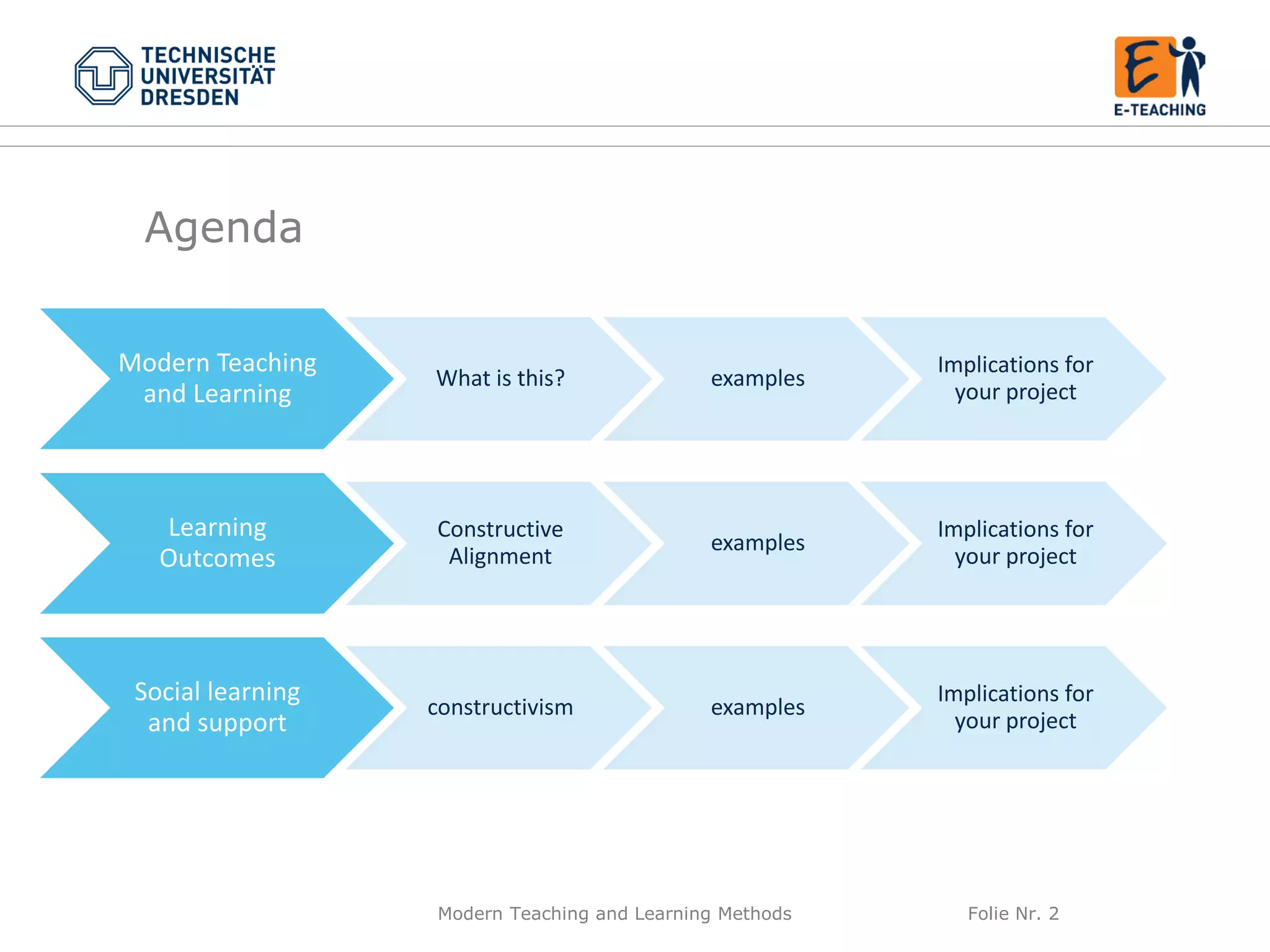
Agenda
Modern Teaching
and Learning
What is this? examples
Implications for
your project
Learning
Outcomes
Constructive
Alignment
examples
Implications for
your project
Social learning
and support
constructivism examples
Implications for
your project
Modern Teaching and Learning Methods Folie Nr. 3
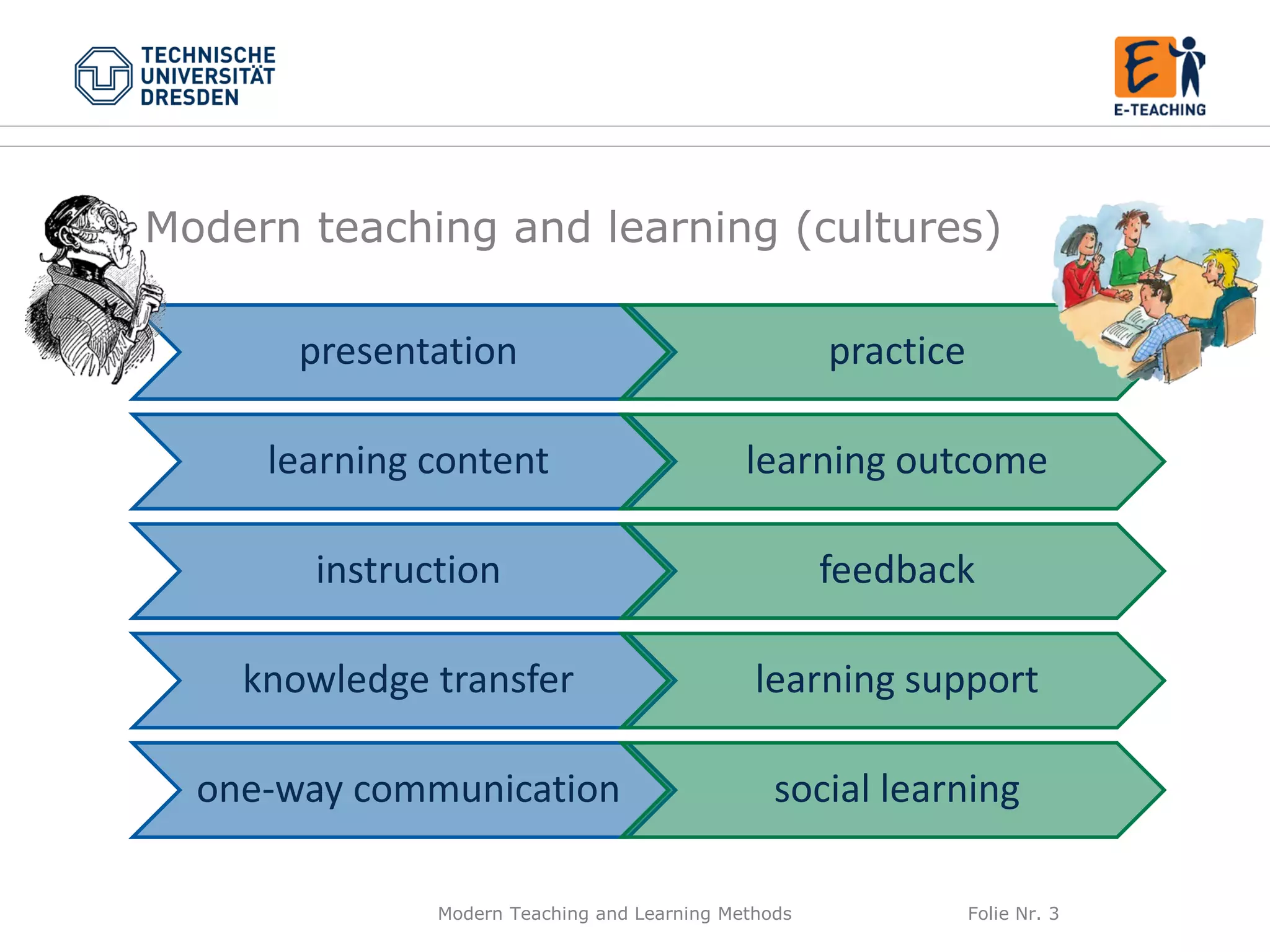
Modern teaching and learning (cultures)
presentation practice
learning content learning outcome
instruction feedback
knowledge transfer learning support
one-way communication social learning
Modern Teaching and Learning Methods Folie Nr. 4
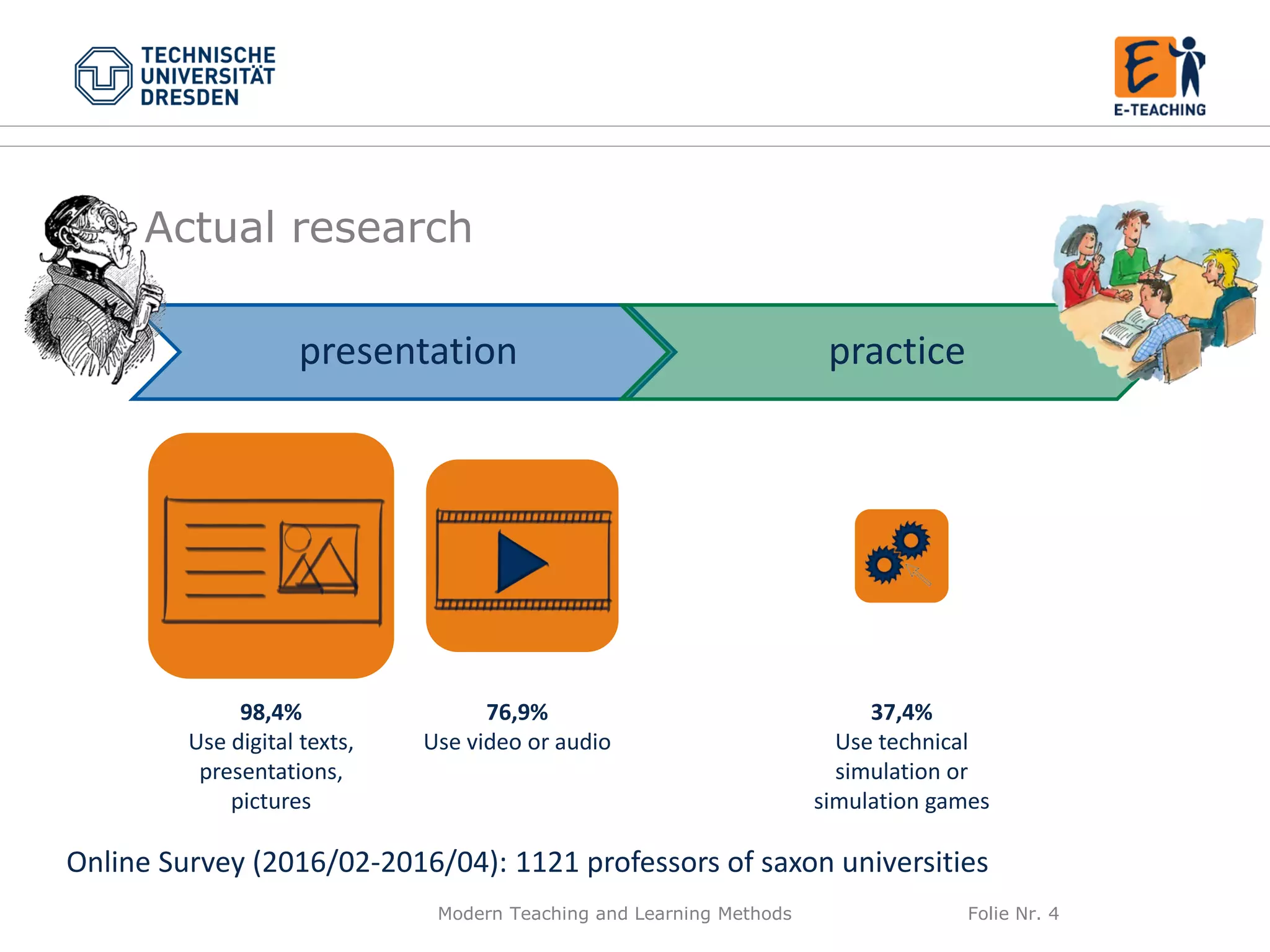
Actual research
presentation practice
Online Survey (2016/02-2016/04): 1121 professors of saxon universities
98,4%
Use digital texts,
presentations,
pictures
76,9%
Use video or audio
37,4%
Use technical
simulation or
simulation games
Modern Teaching and Learning Methods Folie Nr. 5
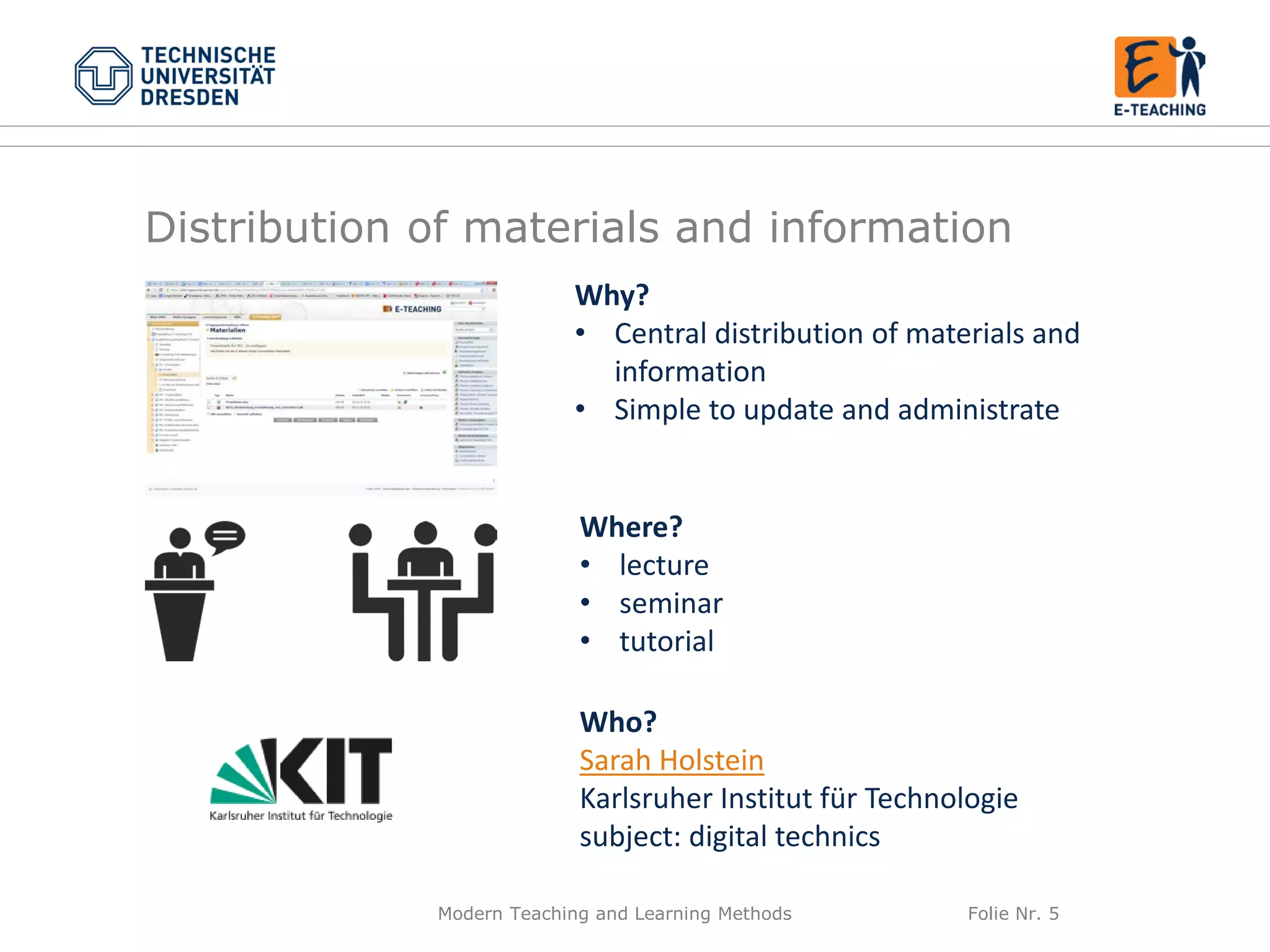
Why?
• Central distribution of materials and
information
• Simple to update and administrate
Where?
• lecture
• seminar
• tutorial
Who?
Sarah Holstein
Karlsruher Institut für Technologie
subject: digital technics
Distribution of materials and information
Modern Teaching and Learning Methods Folie Nr. 6
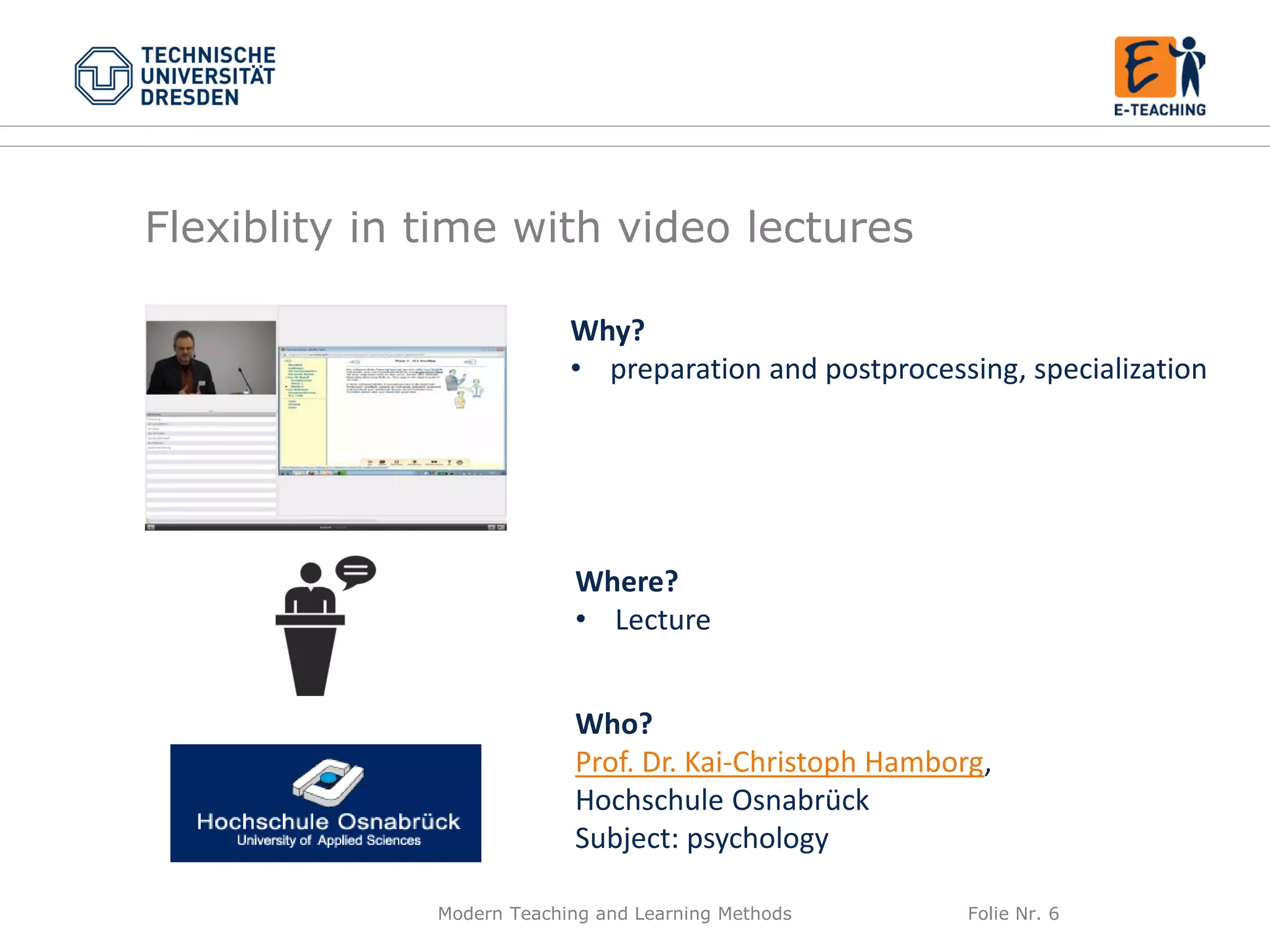
Why?
• preparation and postprocessing, specialization
Where?
• Lecture
Who?
Prof. Dr. Kai-Christoph Hamborg,
Hochschule Osnabrück
Subject: psychology
Flexiblity in time with video lectures
Modern Teaching and Learning Methods Folie Nr. 7
Why?
• repetition
• Acceleration and temporal expansion
• Special angles
Where?
• lecture
Who?
TU Clausthal
Subjects: chemistry
Demonstration with digital media
Modern Teaching and Learning Methods Folie Nr. 8
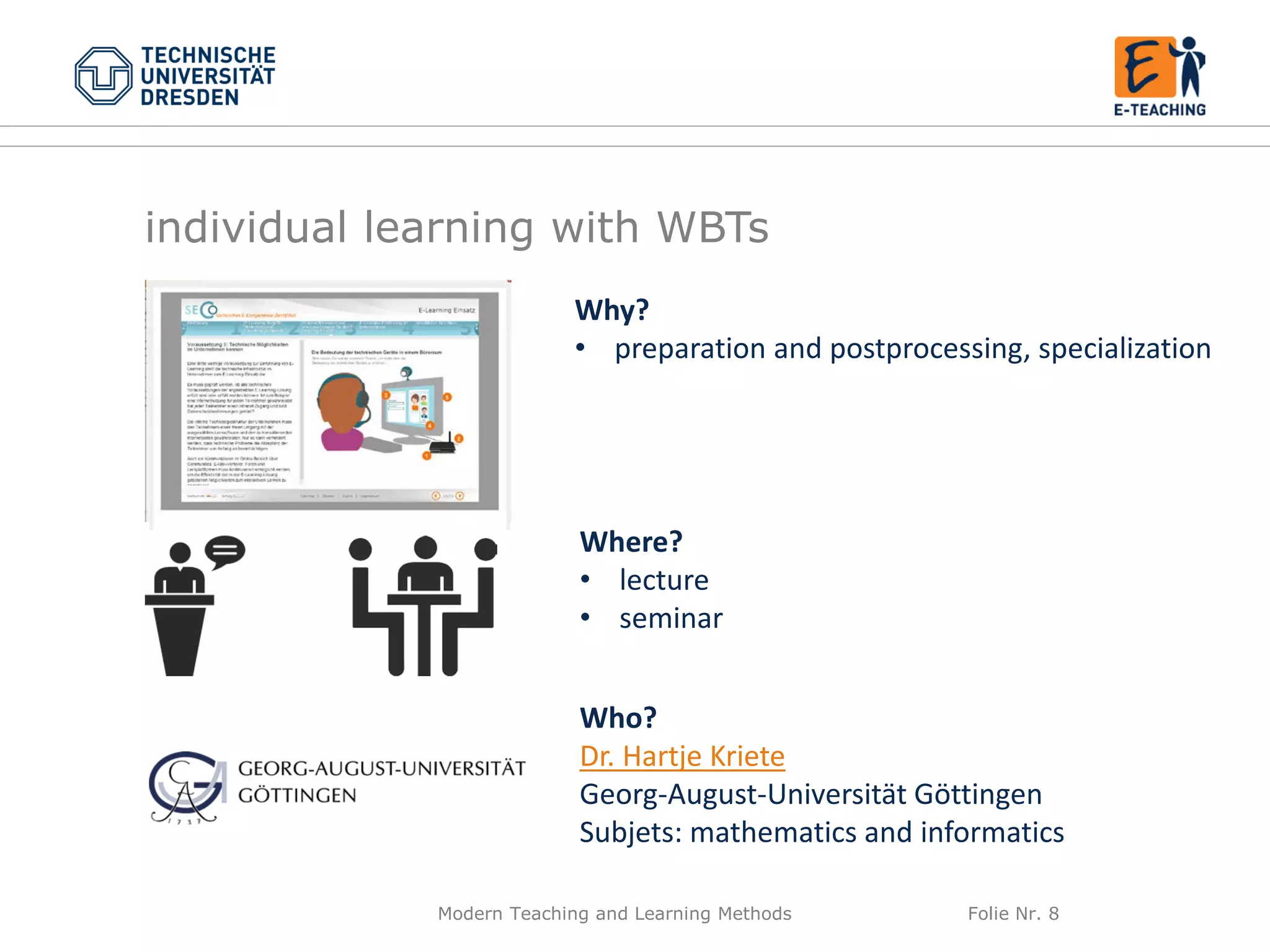
Why?
• preparation and postprocessing, specialization
Where?
• lecture
• seminar
Who?
Dr. Hartje Kriete
Georg-August-Universität Göttingen
Subjets: mathematics and informatics
individual learning with WBTs
Modern Teaching and Learning Methods Folie Nr. 9
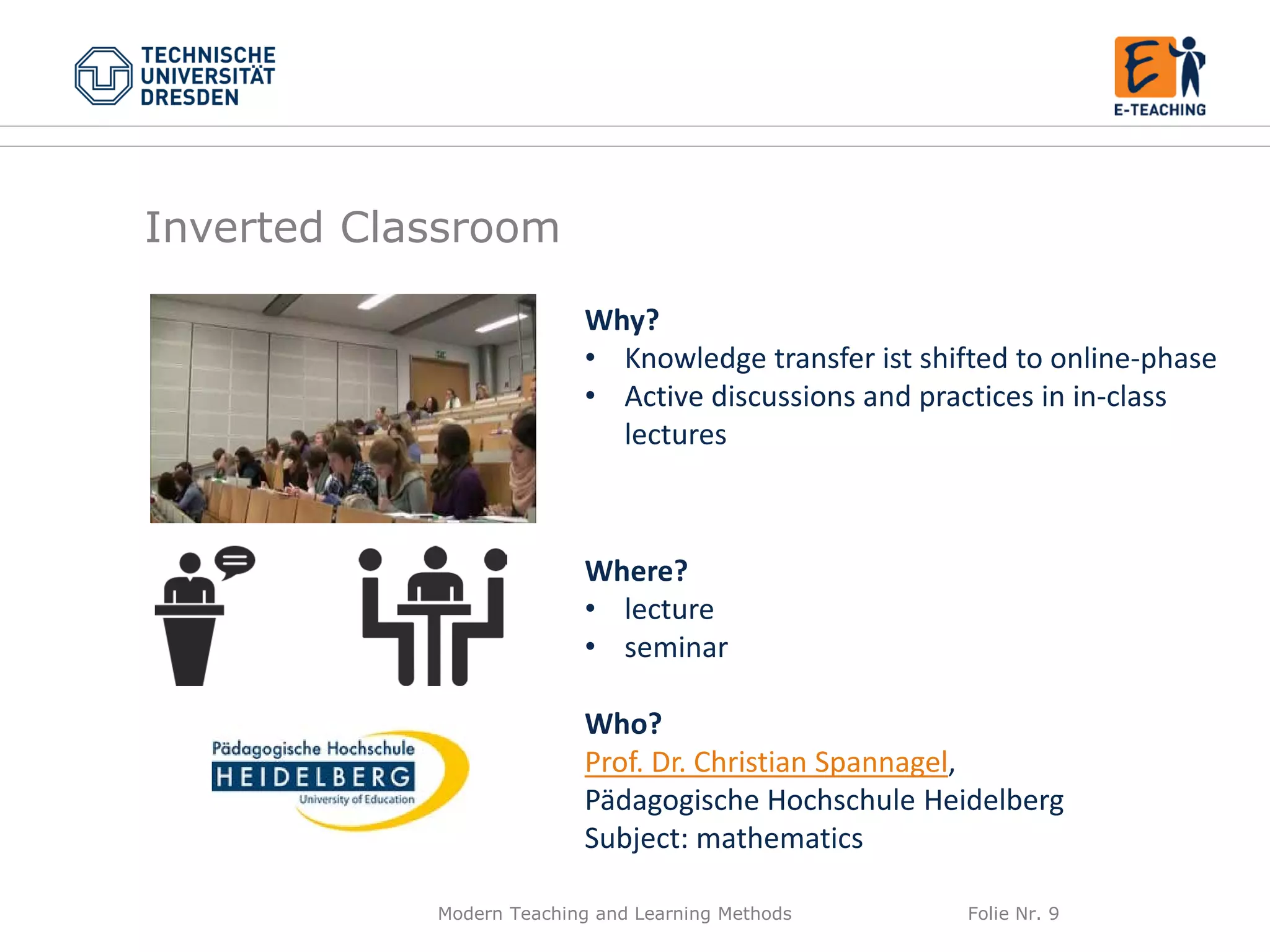
Why?
• Knowledge transfer ist shifted to online-phase
• Active discussions and practices in in-class
lectures
Where?
• lecture
• seminar
Who?
Prof. Dr. Christian Spannagel,
Pädagogische Hochschule Heidelberg
Subject: mathematics
Inverted Classroom
Modern Teaching and Learning Methods Folie Nr. 10
Implications for your project
• Which format do you want to realize (online,
presence, blended learning)?
• What kind of contents and activities do you
plan?
• What kind of materials do you (want to)
have (other than texts)?
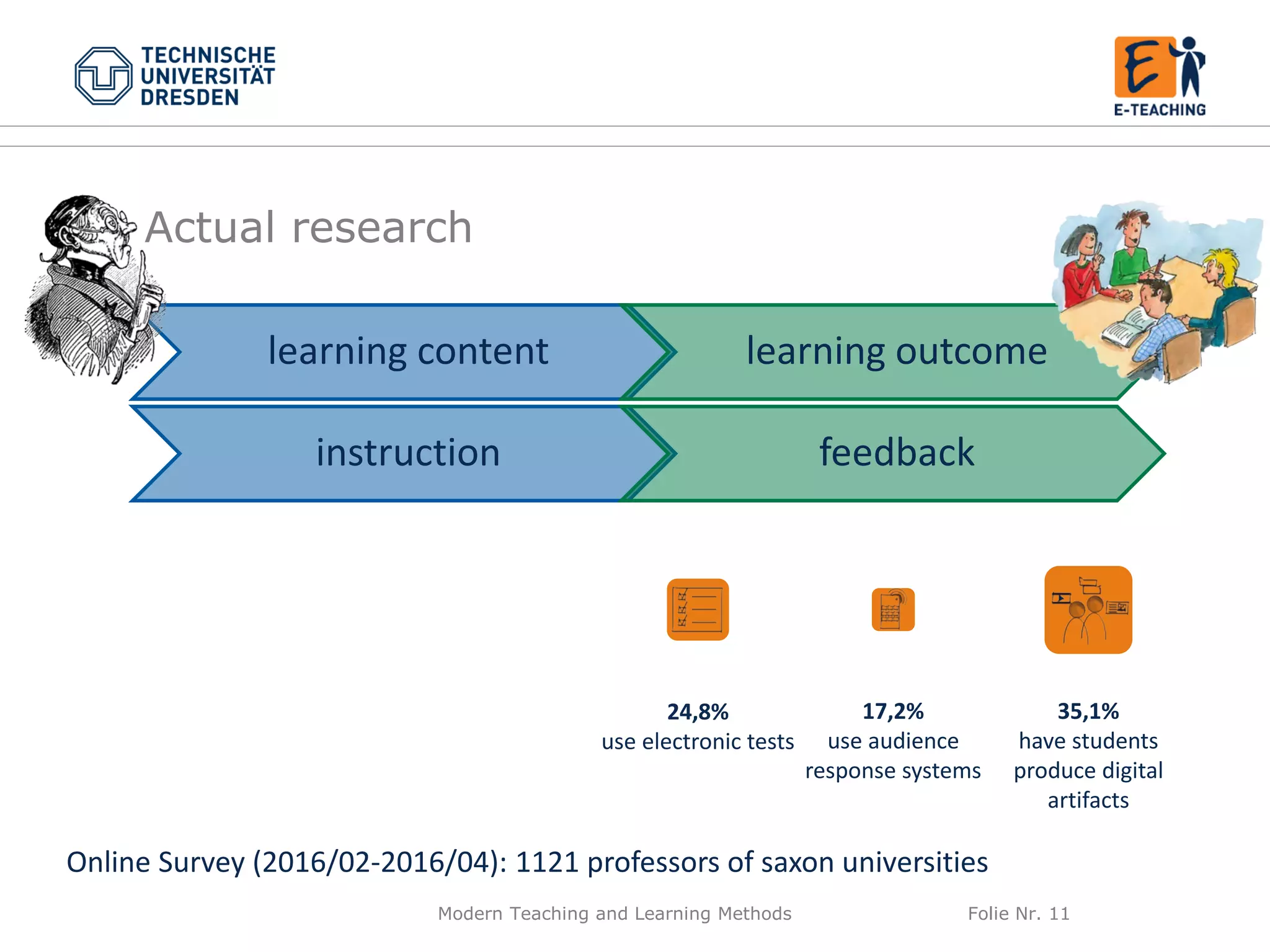
Modern Teaching and Learning Methods Folie Nr. 11
instruction feedback
Actual research
learning content learning outcome
Online Survey (2016/02-2016/04): 1121 professors of saxon universities
24,8%
use electronic tests
17,2%
use audience
response systems
35,1%
have students
produce digital
artifacts
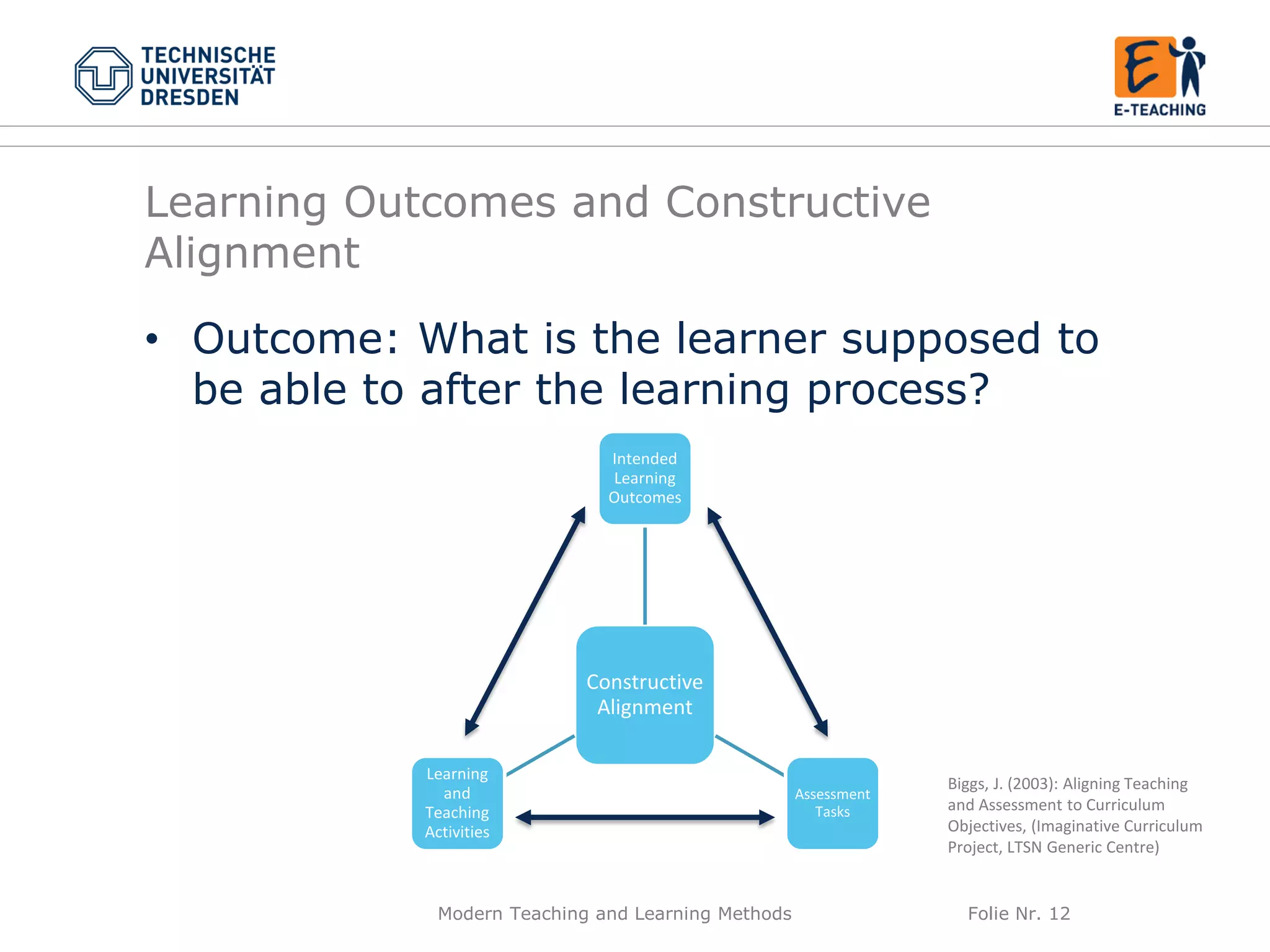
Modern Teaching and Learning Methods Folie Nr. 12
Learning Outcomes and Constructive
Alignment
• Outcome: What is the learner supposed to
be able to after the learning process?
Constructive
Alignment
Intended
Learning
Outcomes
Assessment
Tasks
Learning
and
Teaching
Activities
Biggs, J. (2003): Aligning Teaching
and Assessment to Curriculum
Objectives, (Imaginative Curriculum
Project, LTSN Generic Centre)
Modern Teaching and Learning Methods Folie Nr. 13
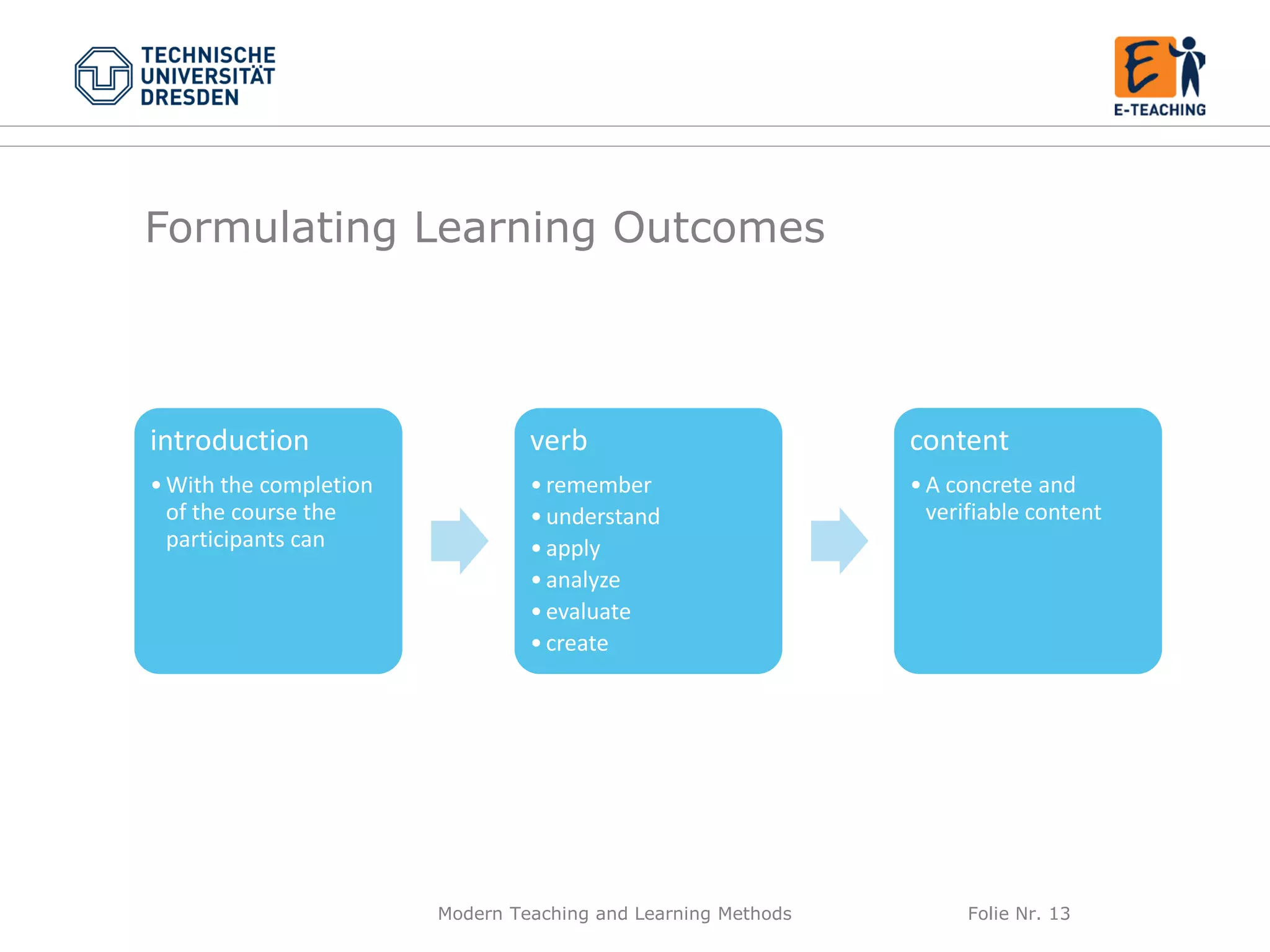
Formulating Learning Outcomes
introduction
•With the completion
of the course the
participants can
verb
•remember
•understand
•apply
•analyze
•evaluate
•create
content
•A concrete and
verifiable content
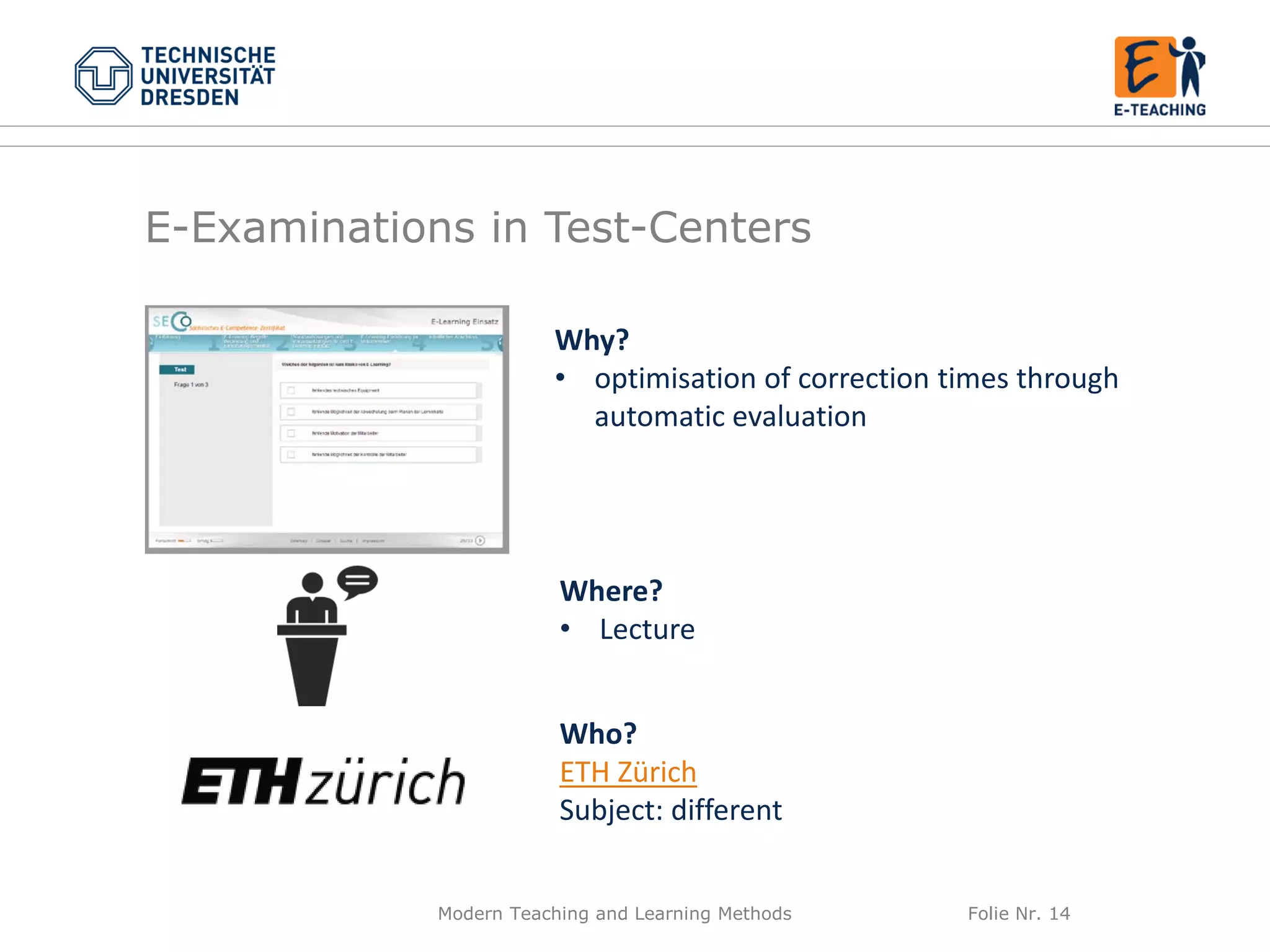
Modern Teaching and Learning Methods Folie Nr. 14
Why?
• optimisation of correction times through
automatic evaluation
Where?
• Lecture
Who?
ETH Zürich
Subject: different
E-Examinations in Test-Centers
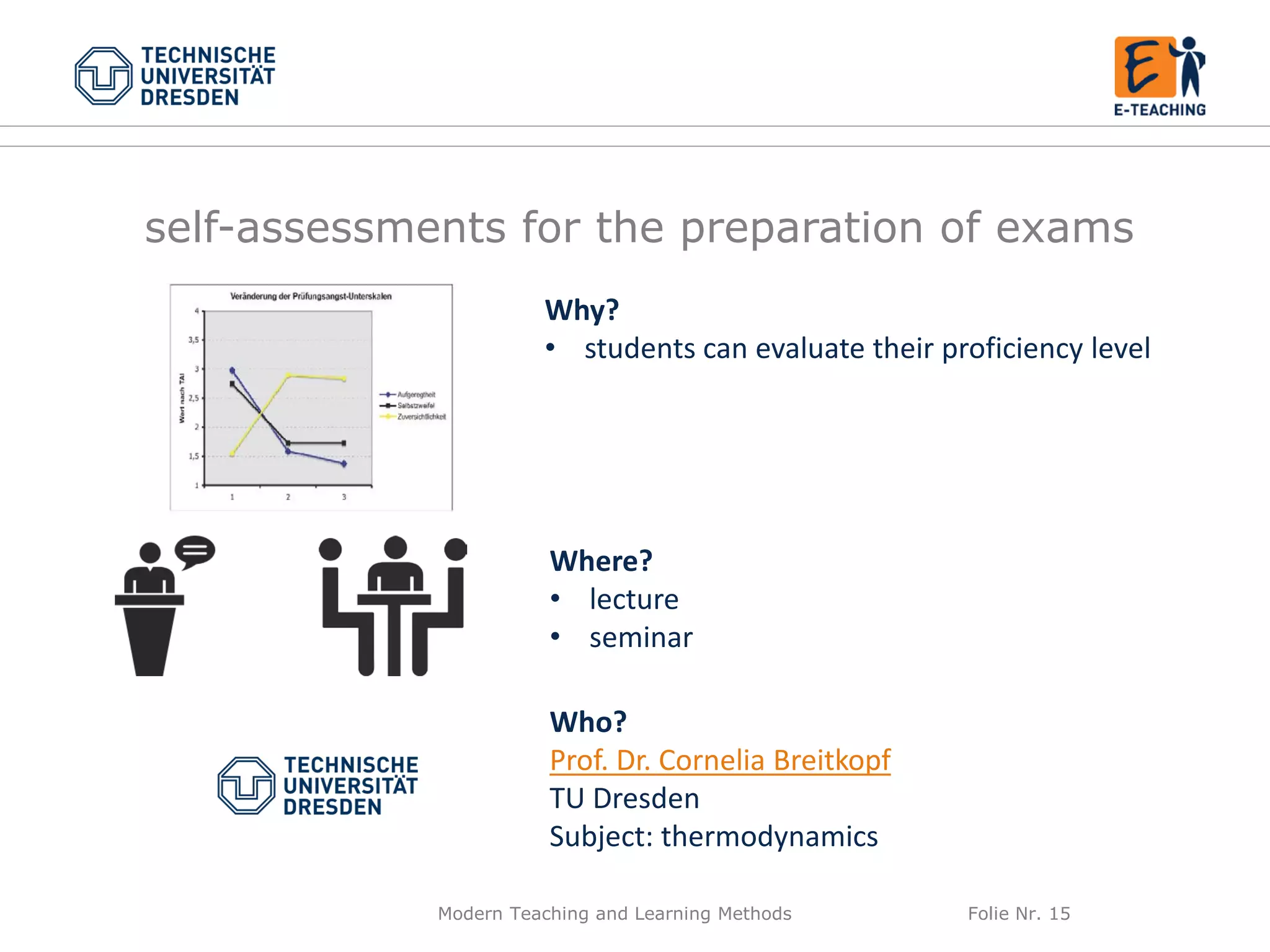
Modern Teaching and Learning Methods Folie Nr. 15
Why?
• students can evaluate their proficiency level
Where?
• lecture
• seminar
Who?
Prof. Dr. Cornelia Breitkopf
TU Dresden
Subject: thermodynamics
self-assessments for the preparation of exams
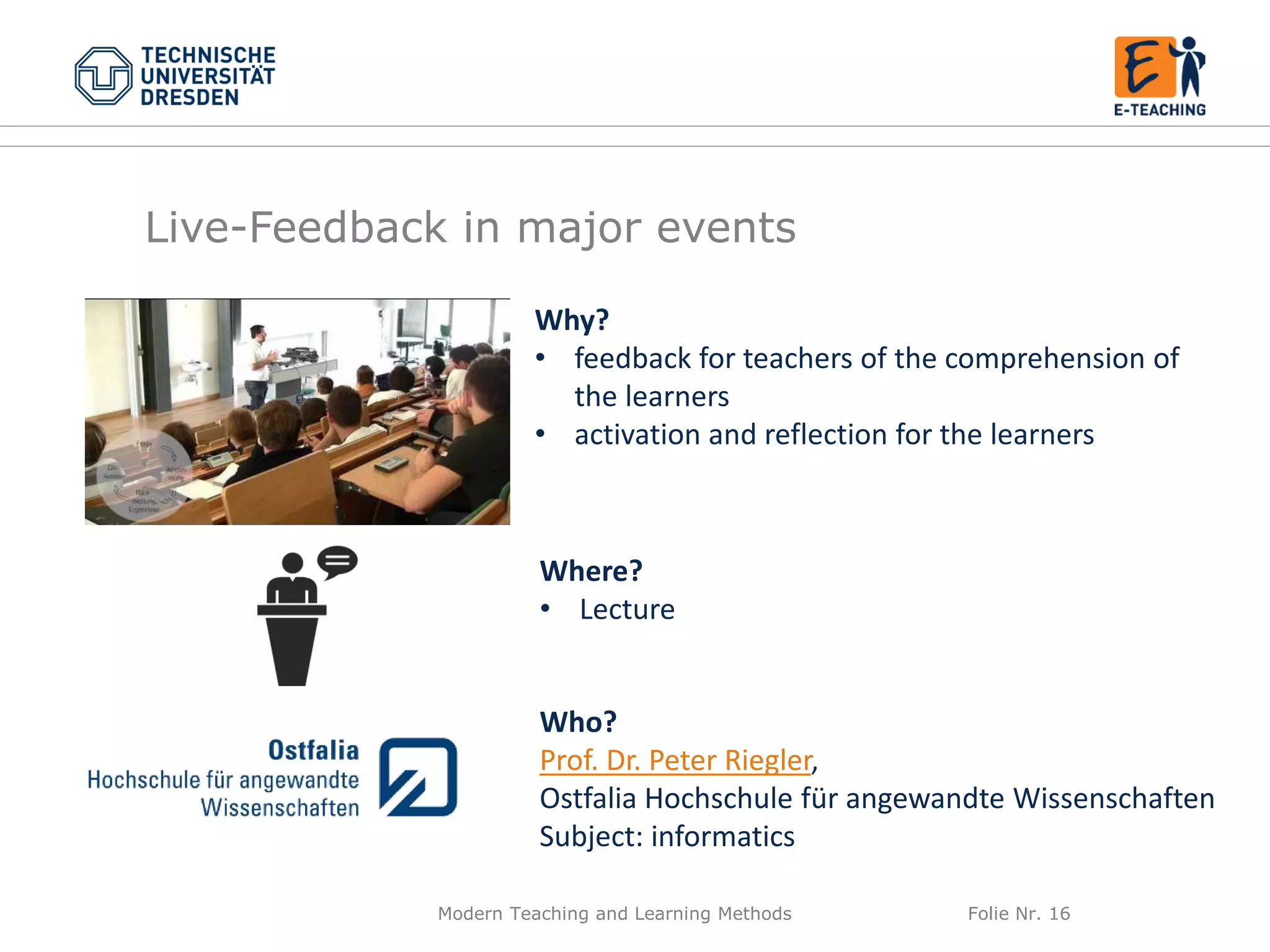
Modern Teaching and Learning Methods Folie Nr. 16
Why?
• feedback for teachers of the comprehension of
the learners
• activation and reflection for the learners
Where?
• Lecture
Who?
Prof. Dr. Peter Riegler,
Ostfalia Hochschule für angewandte Wissenschaften
Subject: informatics
Live-Feedback in major events
Modern Teaching and Learning Methods Folie Nr. 17
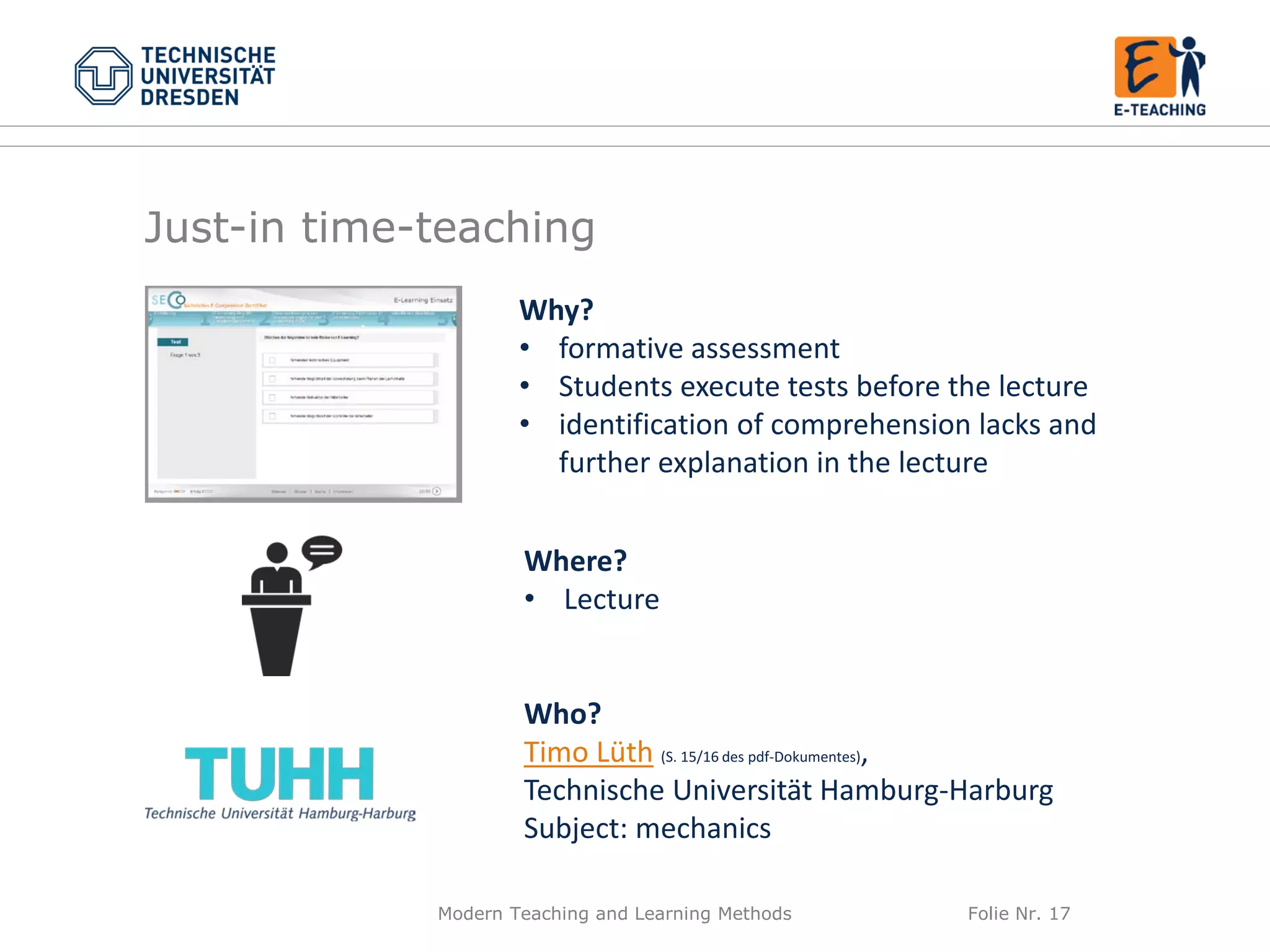
Why?
• formative assessment
• Students execute tests before the lecture
• identification of comprehension lacks and
further explanation in the lecture
Where?
• Lecture
Who?
Timo Lüth (S. 15/16 des pdf-Dokumentes),
Technische Universität Hamburg-Harburg
Subject: mechanics
Just-in time-teaching
Modern Teaching and Learning Methods Folie Nr. 18
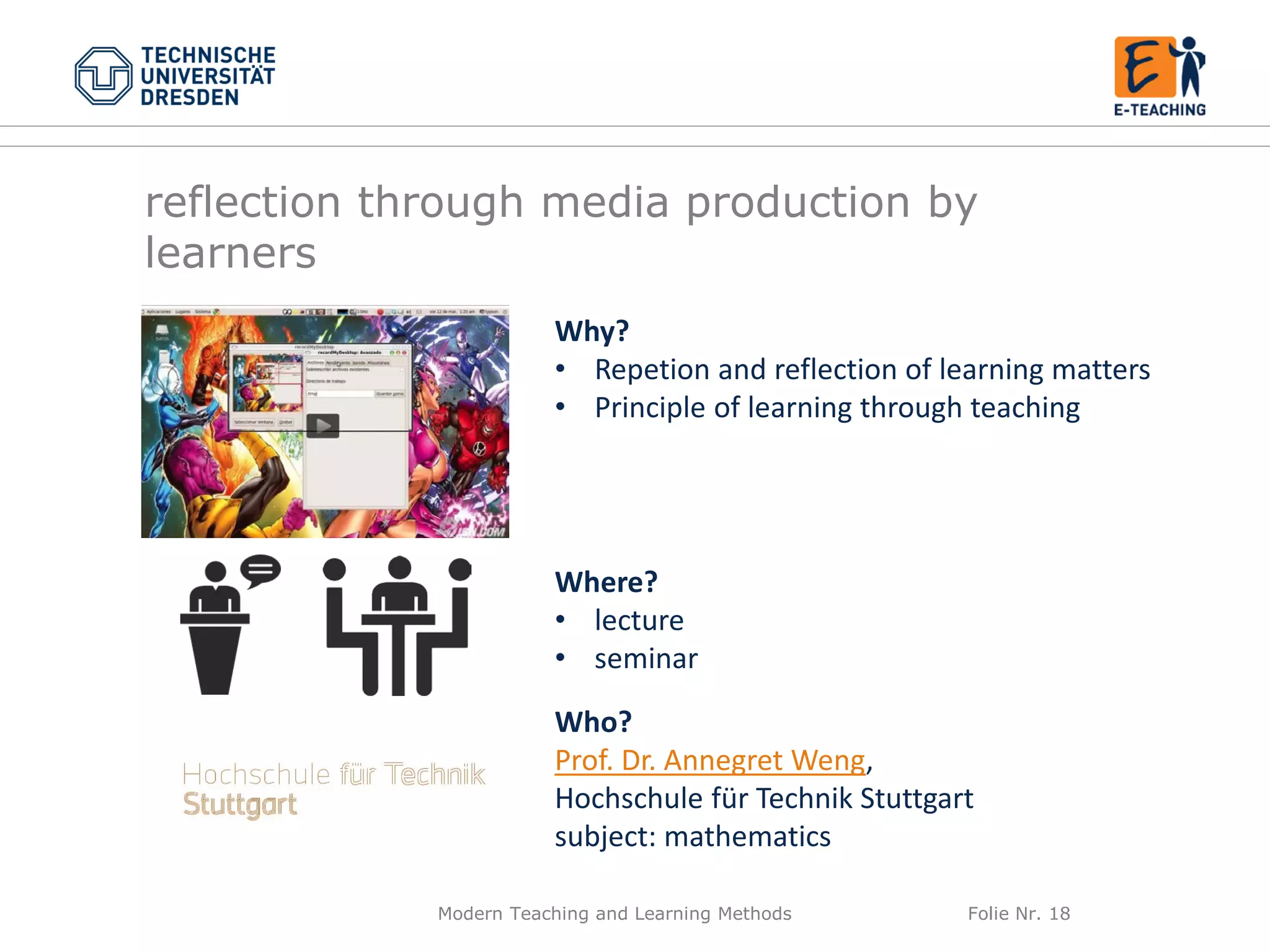
Why?
• Repetion and reflection of learning matters
• Principle of learning through teaching
Where?
• lecture
• seminar
Who?
Prof. Dr. Annegret Weng,
Hochschule für Technik Stuttgart
subject: mathematics
reflection through media production by
learners
Modern Teaching and Learning Methods Folie Nr. 19
Implications for your project
• What are your learning outcomes?
• How do you verify them?
Modern Teaching and Learning Methods Folie Nr. 20
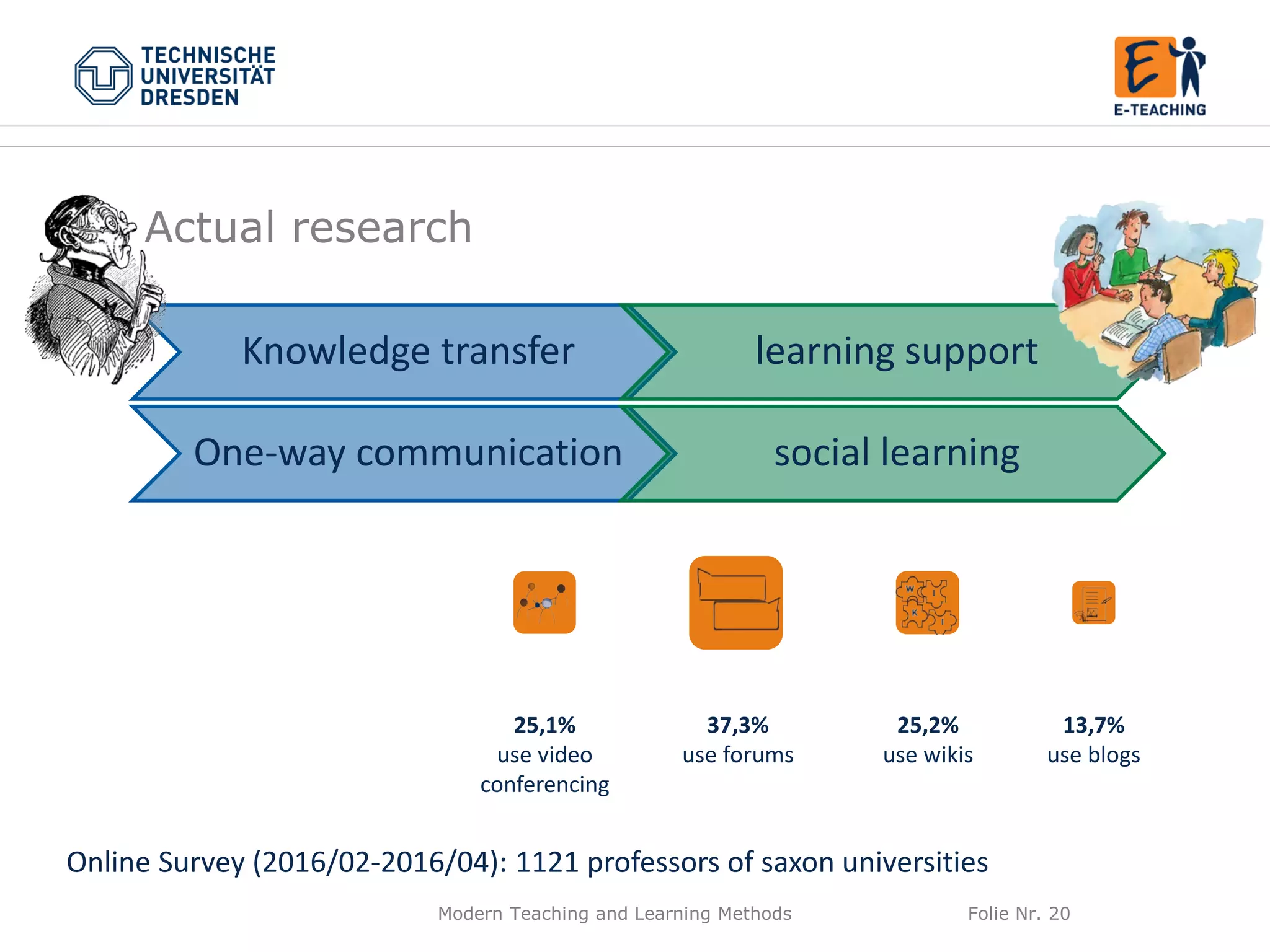
One-way communication social learning
Actual research
Knowledge transfer learning support
Online Survey (2016/02-2016/04): 1121 professors of saxon universities
25,2%
use wikis
13,7%
use blogs
25,1%
use video
conferencing
37,3%
use forums
Modern Teaching and Learning Methods Folie Nr. 21
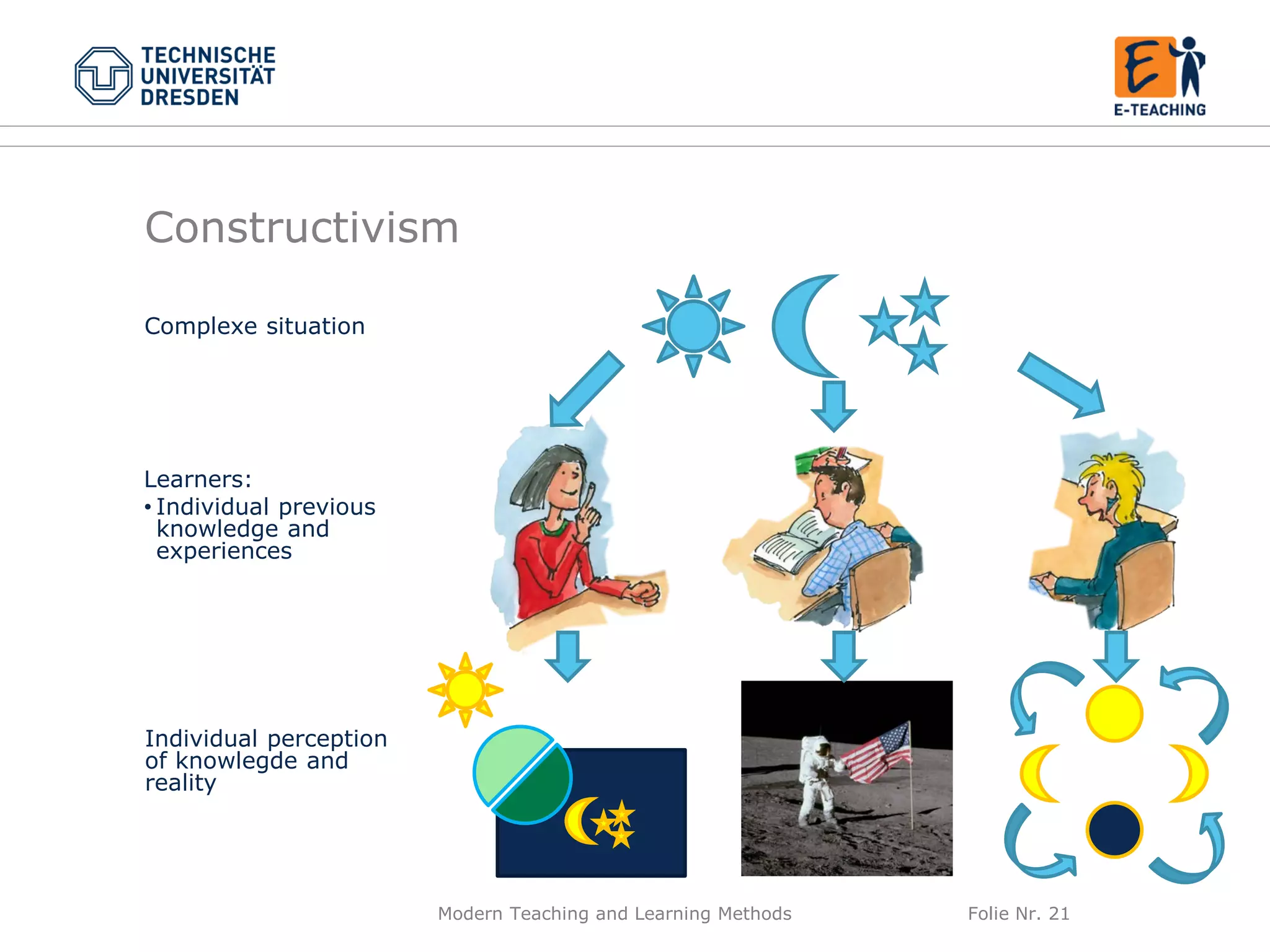
Constructivism
Complexe situation
Learners:
• Individual previous
knowledge and
experiences
Individual perception
of knowlegde and
reality
Modern Teaching and Learning Methods Folie Nr. 22
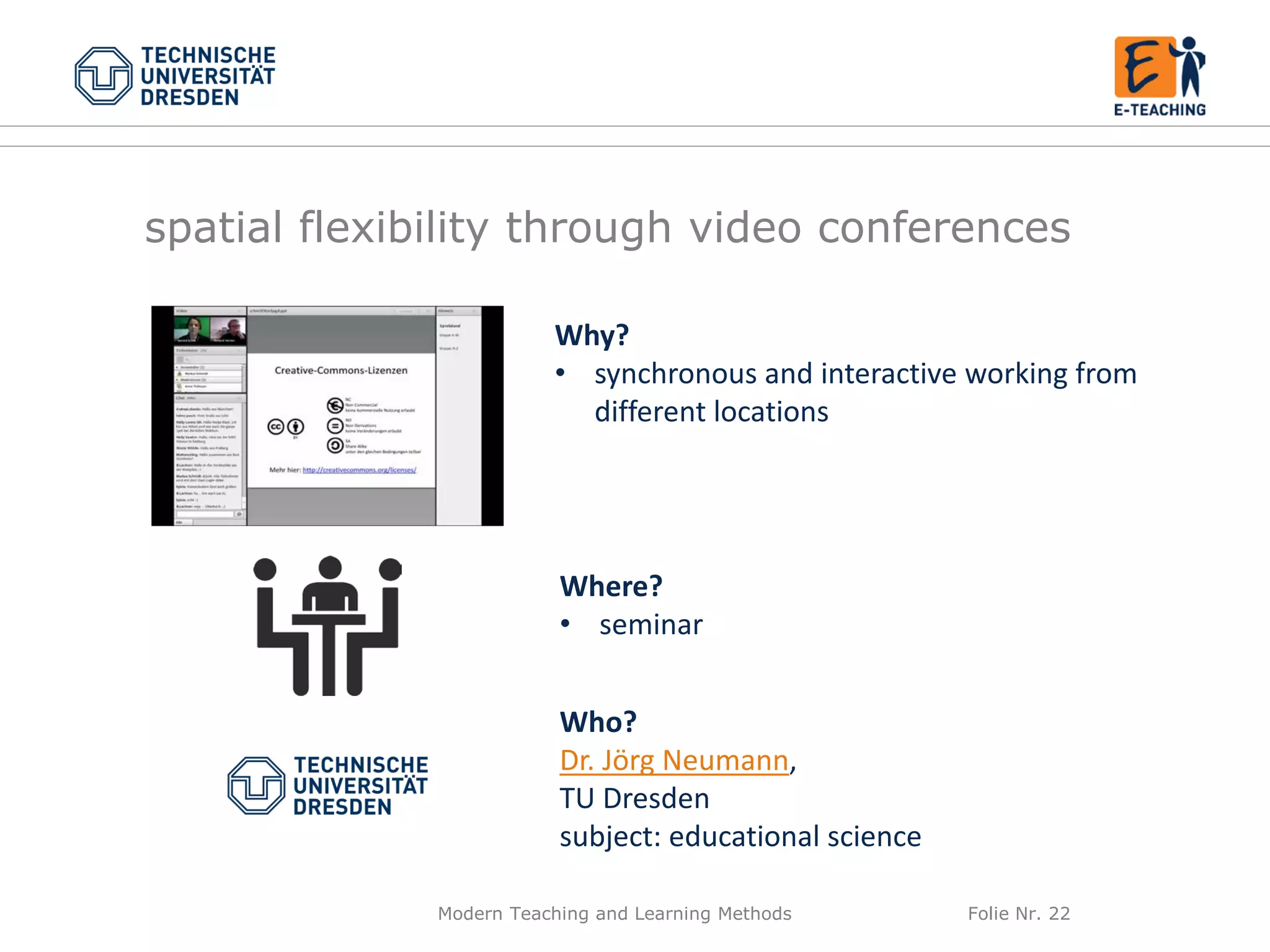
Why?
• synchronous and interactive working from
different locations
Where?
• seminar
Who?
Dr. Jörg Neumann,
TU Dresden
subject: educational science
spatial flexibility through video conferences
Modern Teaching and Learning Methods Folie Nr. 23
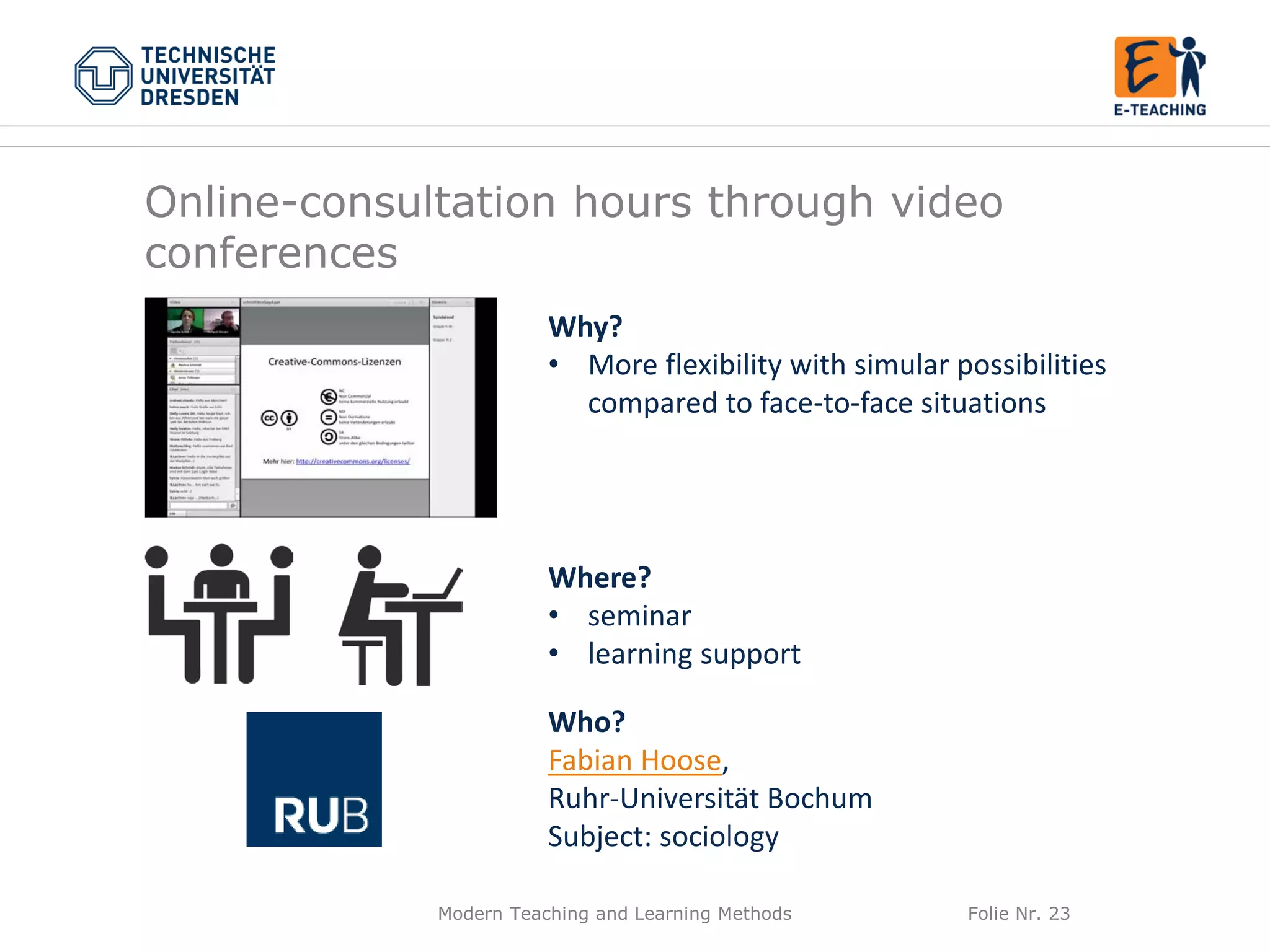
Why?
• More flexibility with simular possibilities
compared to face-to-face situations
Where?
• seminar
• learning support
Who?
Fabian Hoose,
Ruhr-Universität Bochum
Subject: sociology
Online-consultation hours through video
conferences
Modern Teaching and Learning Methods Folie Nr. 24
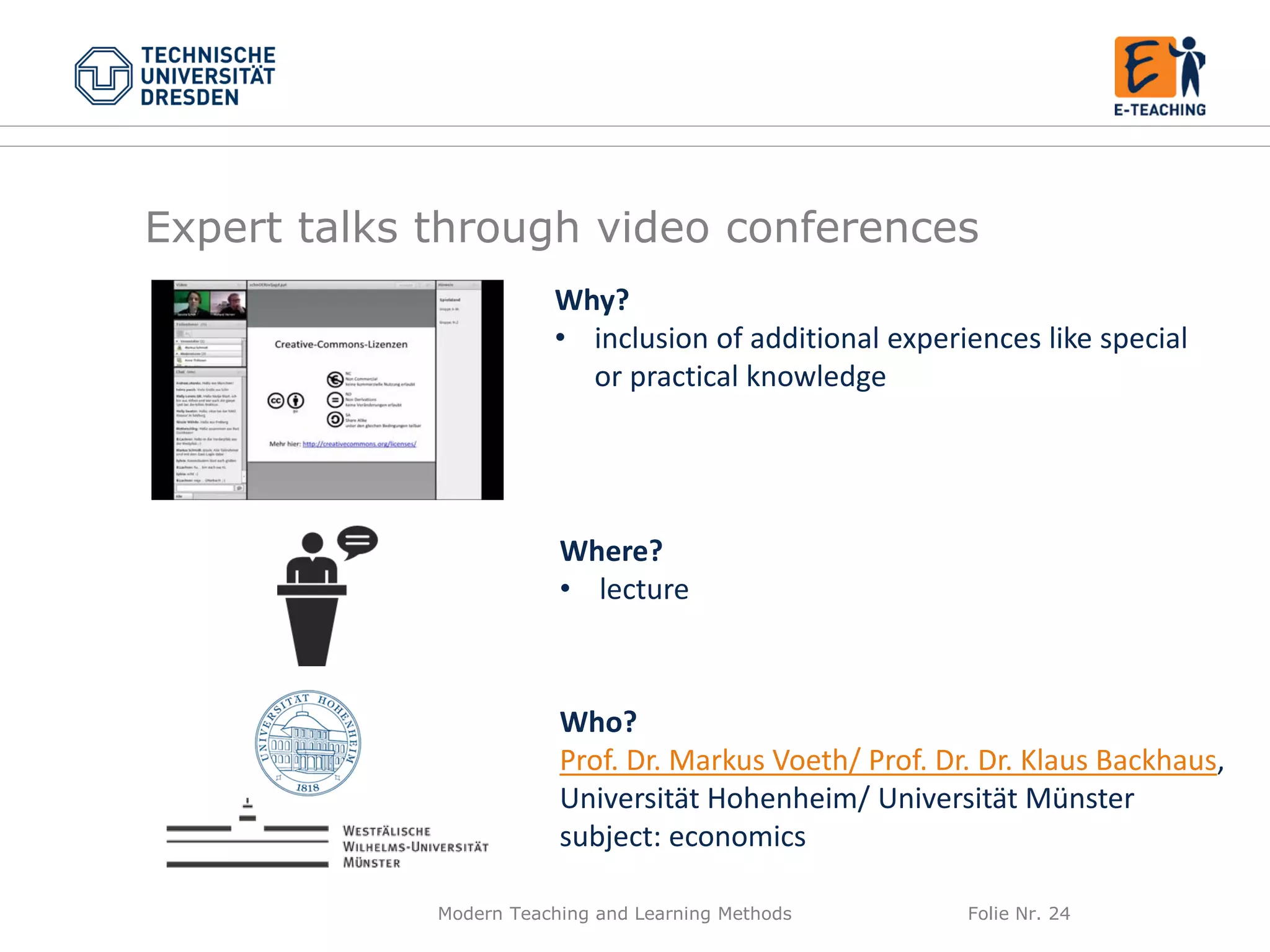
Why?
• inclusion of additional experiences like special
or practical knowledge
Where?
• lecture
Who?
Prof. Dr. Markus Voeth/ Prof. Dr. Dr. Klaus Backhaus,
Universität Hohenheim/ Universität Münster
subject: economics
Expert talks through video conferences
Modern Teaching and Learning Methods Folie Nr. 25
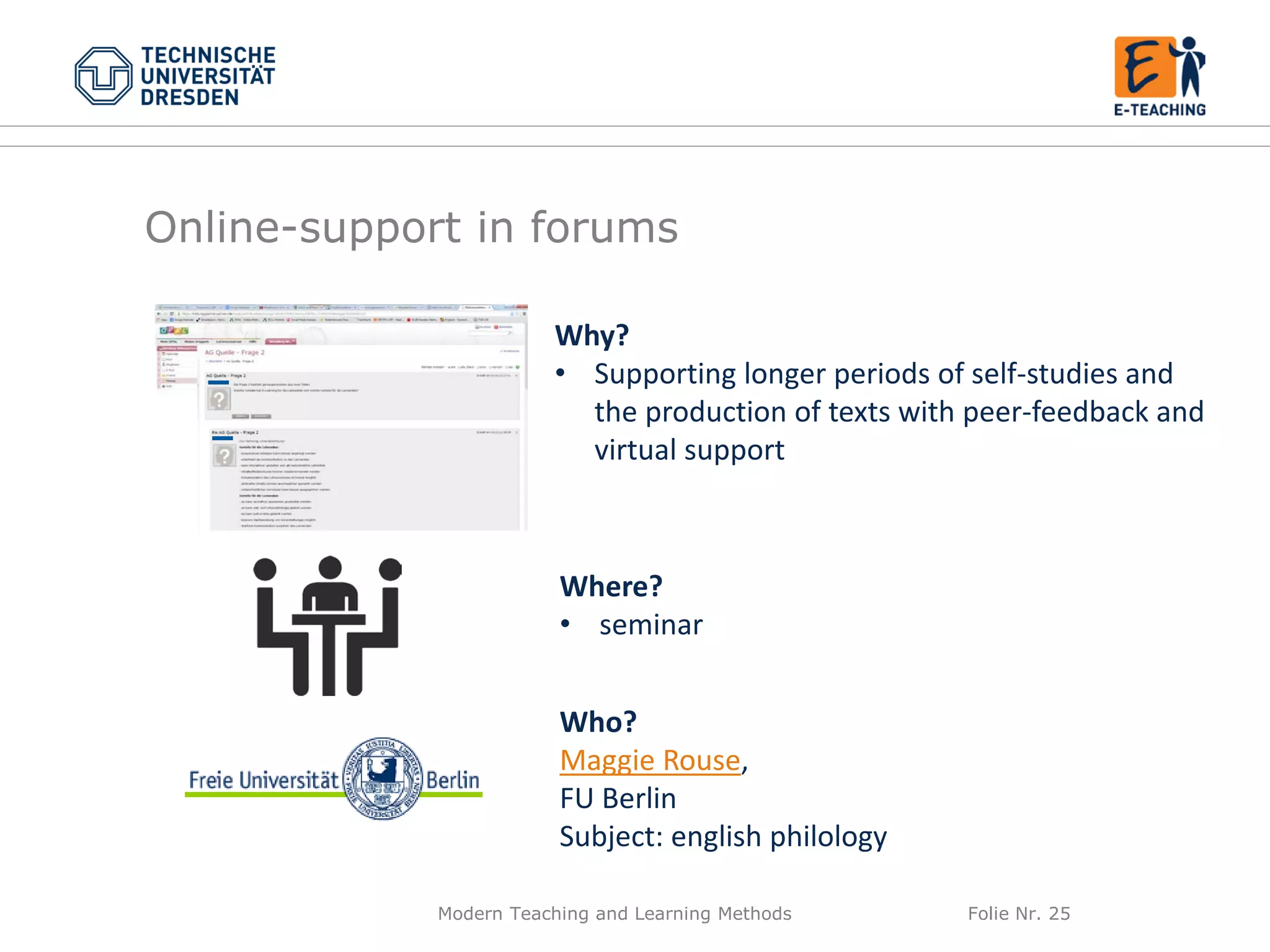
Why?
• Supporting longer periods of self-studies and
the production of texts with peer-feedback and
virtual support
Where?
• seminar
Who?
Maggie Rouse,
FU Berlin
Subject: english philology
Online-support in forums
Modern Teaching and Learning Methods Folie Nr. 26
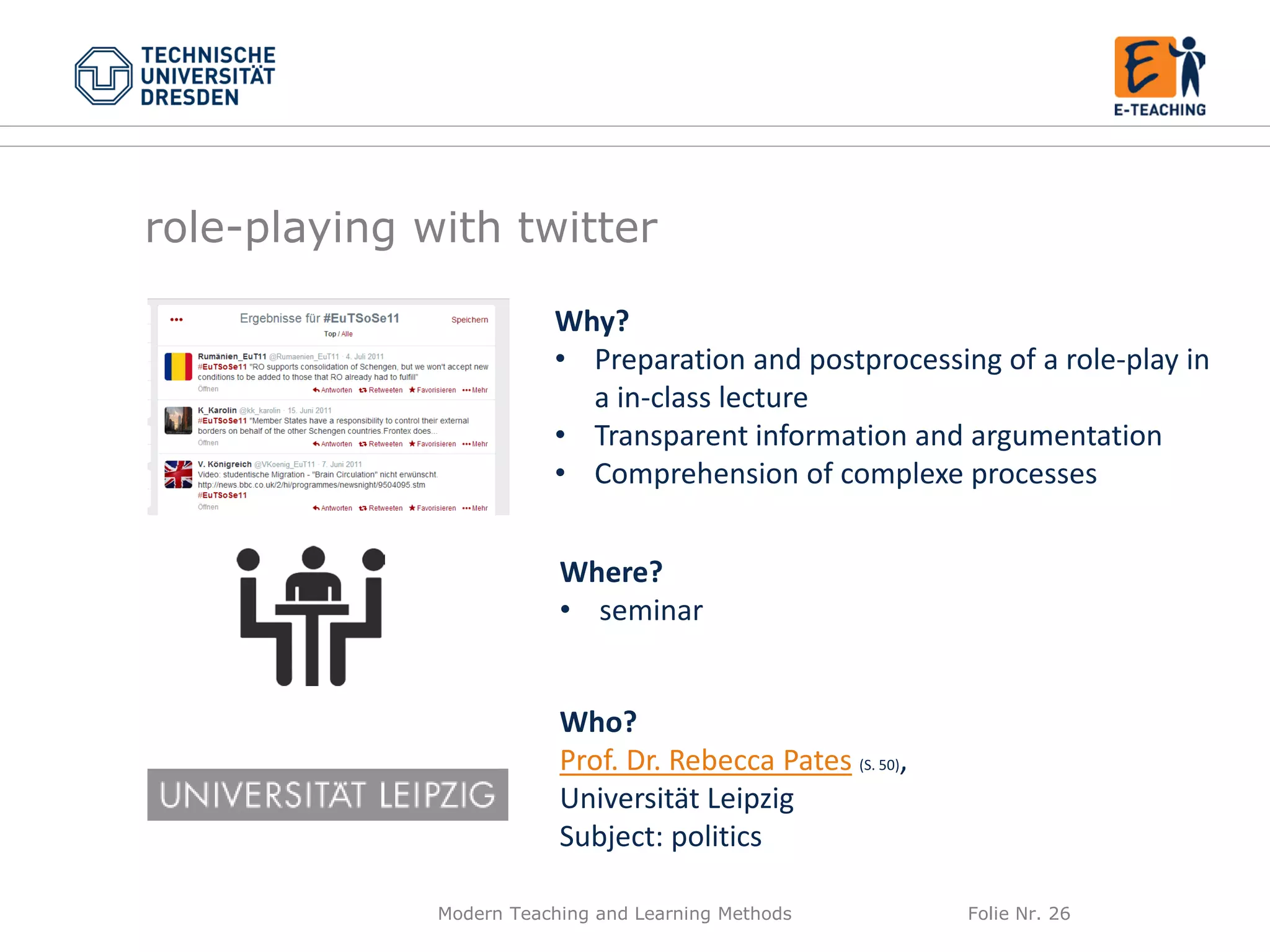
Why?
• Preparation and postprocessing of a role-play in
a in-class lecture
• Transparent information and argumentation
• Comprehension of complexe processes
Where?
• seminar
Who?
Prof. Dr. Rebecca Pates (S. 50),
Universität Leipzig
Subject: politics
role-playing with twitter
Modern Teaching and Learning Methods Folie Nr. 27
Implications for your project
• How can you activate your learners?
• practical assignments
• activities
Modern Teaching and Learning Methods Folie Nr. 28
references of pictures:
Screenshot aus dem OPAL-Kurs des Qualifizierungsangebotes E-Teaching.TUD.
Vorschau auf „Observing an ANT Colony (Superorganism)“ von McZusatz. (CC BY SA)
Animation der Reaktion Kupfer/Salpetersäure von Universität Siegen.
Screenshot aus dem SECo-Modul „E-Learning Einsatz“ von SECo. (CC BY SA)
Ausschnitt aus dem Vortrag "Mehrwert durch das Inverted Classroom-Modell am Beispiel der Anglistik" von
Prof. Dr. Jürgen Handke. (CC BY SA NC)
Ausschnitt aus dem Webinar „SchnOERzeljagd“ von Sandra Schön. (CC BY SA)
Abbildung Prüfungsangst von Nadia Fritsche. (gemeinfrei)
Ausschnitt aus dem YouTube-Video „eFeedback in Vorlesungen“ von elsa Didaktik. (CC-BY)
Ausschnitt aus dem YouTube-Video „Das aktive Plenum“ von Christian Spannagel. (CC-BY)
Screenshot aus dem Videotutorial „RecordmyDesktop“ von Styp152. (CC BY)
Screenshot der Twitter-Suchergebnisse für den Hashtag #EuTSoSe11.

Presentation of examples of modern scenarios with digital media

  • 1.
    Medienzentrum, Zertifikatskurs E-Teaching.TUD Dresden Workshop„Modern Teaching and Learning Methods“ Presentation of examples for modern scenarios with digital media
  • 2.
    Modern Teaching andLearning Methods Folie Nr. 2 Agenda Modern Teaching and Learning What is this? examples Implications for your project Learning Outcomes Constructive Alignment examples Implications for your project Social learning and support constructivism examples Implications for your project
  • 3.
    Modern Teaching andLearning Methods Folie Nr. 3 Modern teaching and learning (cultures) presentation practice learning content learning outcome instruction feedback knowledge transfer learning support one-way communication social learning
  • 4.
    Modern Teaching andLearning Methods Folie Nr. 4 Actual research presentation practice Online Survey (2016/02-2016/04): 1121 professors of saxon universities 98,4% Use digital texts, presentations, pictures 76,9% Use video or audio 37,4% Use technical simulation or simulation games
  • 5.
    Modern Teaching andLearning Methods Folie Nr. 5 Why? • Central distribution of materials and information • Simple to update and administrate Where? • lecture • seminar • tutorial Who? Sarah Holstein Karlsruher Institut für Technologie subject: digital technics Distribution of materials and information
  • 6.
    Modern Teaching andLearning Methods Folie Nr. 6 Why? • preparation and postprocessing, specialization Where? • Lecture Who? Prof. Dr. Kai-Christoph Hamborg, Hochschule Osnabrück Subject: psychology Flexiblity in time with video lectures
  • 7.
    Modern Teaching andLearning Methods Folie Nr. 7 Why? • repetition • Acceleration and temporal expansion • Special angles Where? • lecture Who? TU Clausthal Subjects: chemistry Demonstration with digital media
  • 8.
    Modern Teaching andLearning Methods Folie Nr. 8 Why? • preparation and postprocessing, specialization Where? • lecture • seminar Who? Dr. Hartje Kriete Georg-August-Universität Göttingen Subjets: mathematics and informatics individual learning with WBTs
  • 9.
    Modern Teaching andLearning Methods Folie Nr. 9 Why? • Knowledge transfer ist shifted to online-phase • Active discussions and practices in in-class lectures Where? • lecture • seminar Who? Prof. Dr. Christian Spannagel, Pädagogische Hochschule Heidelberg Subject: mathematics Inverted Classroom
  • 10.
    Modern Teaching andLearning Methods Folie Nr. 10 Implications for your project • Which format do you want to realize (online, presence, blended learning)? • What kind of contents and activities do you plan? • What kind of materials do you (want to) have (other than texts)?
  • 11.
    Modern Teaching andLearning Methods Folie Nr. 11 instruction feedback Actual research learning content learning outcome Online Survey (2016/02-2016/04): 1121 professors of saxon universities 24,8% use electronic tests 17,2% use audience response systems 35,1% have students produce digital artifacts
  • 12.
    Modern Teaching andLearning Methods Folie Nr. 12 Learning Outcomes and Constructive Alignment • Outcome: What is the learner supposed to be able to after the learning process? Constructive Alignment Intended Learning Outcomes Assessment Tasks Learning and Teaching Activities Biggs, J. (2003): Aligning Teaching and Assessment to Curriculum Objectives, (Imaginative Curriculum Project, LTSN Generic Centre)
  • 13.
    Modern Teaching andLearning Methods Folie Nr. 13 Formulating Learning Outcomes introduction •With the completion of the course the participants can verb •remember •understand •apply •analyze •evaluate •create content •A concrete and verifiable content
  • 14.
    Modern Teaching andLearning Methods Folie Nr. 14 Why? • optimisation of correction times through automatic evaluation Where? • Lecture Who? ETH Zürich Subject: different E-Examinations in Test-Centers
  • 15.
    Modern Teaching andLearning Methods Folie Nr. 15 Why? • students can evaluate their proficiency level Where? • lecture • seminar Who? Prof. Dr. Cornelia Breitkopf TU Dresden Subject: thermodynamics self-assessments for the preparation of exams
  • 16.
    Modern Teaching andLearning Methods Folie Nr. 16 Why? • feedback for teachers of the comprehension of the learners • activation and reflection for the learners Where? • Lecture Who? Prof. Dr. Peter Riegler, Ostfalia Hochschule für angewandte Wissenschaften Subject: informatics Live-Feedback in major events
  • 17.
    Modern Teaching andLearning Methods Folie Nr. 17 Why? • formative assessment • Students execute tests before the lecture • identification of comprehension lacks and further explanation in the lecture Where? • Lecture Who? Timo Lüth (S. 15/16 des pdf-Dokumentes), Technische Universität Hamburg-Harburg Subject: mechanics Just-in time-teaching
  • 18.
    Modern Teaching andLearning Methods Folie Nr. 18 Why? • Repetion and reflection of learning matters • Principle of learning through teaching Where? • lecture • seminar Who? Prof. Dr. Annegret Weng, Hochschule für Technik Stuttgart subject: mathematics reflection through media production by learners
  • 19.
    Modern Teaching andLearning Methods Folie Nr. 19 Implications for your project • What are your learning outcomes? • How do you verify them?
  • 20.
    Modern Teaching andLearning Methods Folie Nr. 20 One-way communication social learning Actual research Knowledge transfer learning support Online Survey (2016/02-2016/04): 1121 professors of saxon universities 25,2% use wikis 13,7% use blogs 25,1% use video conferencing 37,3% use forums
  • 21.
    Modern Teaching andLearning Methods Folie Nr. 21 Constructivism Complexe situation Learners: • Individual previous knowledge and experiences Individual perception of knowlegde and reality
  • 22.
    Modern Teaching andLearning Methods Folie Nr. 22 Why? • synchronous and interactive working from different locations Where? • seminar Who? Dr. Jörg Neumann, TU Dresden subject: educational science spatial flexibility through video conferences
  • 23.
    Modern Teaching andLearning Methods Folie Nr. 23 Why? • More flexibility with simular possibilities compared to face-to-face situations Where? • seminar • learning support Who? Fabian Hoose, Ruhr-Universität Bochum Subject: sociology Online-consultation hours through video conferences
  • 24.
    Modern Teaching andLearning Methods Folie Nr. 24 Why? • inclusion of additional experiences like special or practical knowledge Where? • lecture Who? Prof. Dr. Markus Voeth/ Prof. Dr. Dr. Klaus Backhaus, Universität Hohenheim/ Universität Münster subject: economics Expert talks through video conferences
  • 25.
    Modern Teaching andLearning Methods Folie Nr. 25 Why? • Supporting longer periods of self-studies and the production of texts with peer-feedback and virtual support Where? • seminar Who? Maggie Rouse, FU Berlin Subject: english philology Online-support in forums
  • 26.
    Modern Teaching andLearning Methods Folie Nr. 26 Why? • Preparation and postprocessing of a role-play in a in-class lecture • Transparent information and argumentation • Comprehension of complexe processes Where? • seminar Who? Prof. Dr. Rebecca Pates (S. 50), Universität Leipzig Subject: politics role-playing with twitter
  • 27.
    Modern Teaching andLearning Methods Folie Nr. 27 Implications for your project • How can you activate your learners? • practical assignments • activities
  • 28.
    Modern Teaching andLearning Methods Folie Nr. 28 references of pictures: Screenshot aus dem OPAL-Kurs des Qualifizierungsangebotes E-Teaching.TUD. Vorschau auf „Observing an ANT Colony (Superorganism)“ von McZusatz. (CC BY SA) Animation der Reaktion Kupfer/Salpetersäure von Universität Siegen. Screenshot aus dem SECo-Modul „E-Learning Einsatz“ von SECo. (CC BY SA) Ausschnitt aus dem Vortrag "Mehrwert durch das Inverted Classroom-Modell am Beispiel der Anglistik" von Prof. Dr. Jürgen Handke. (CC BY SA NC) Ausschnitt aus dem Webinar „SchnOERzeljagd“ von Sandra Schön. (CC BY SA) Abbildung Prüfungsangst von Nadia Fritsche. (gemeinfrei) Ausschnitt aus dem YouTube-Video „eFeedback in Vorlesungen“ von elsa Didaktik. (CC-BY) Ausschnitt aus dem YouTube-Video „Das aktive Plenum“ von Christian Spannagel. (CC-BY) Screenshot aus dem Videotutorial „RecordmyDesktop“ von Styp152. (CC BY) Screenshot der Twitter-Suchergebnisse für den Hashtag #EuTSoSe11.