Date: in 12 ptsEducation
and Culture
HOW TO
PREPARE A
COMPETITIVE
PROJECT
PROPOSAL?
Date: in 12 ptsEducation
and Culture
Preparing the application based
on the requirements of the call
Erasmus+
Date: in 12 ptsEducation
and Culture
 Submission on-line to EACEA
 eForm & Annexes
 Criteria
o Eligibility Criteria
o Exclusion Criteria
o Selection Criteria
o Award Criteria
Common requirements for all Erasmus+
International dimension – Centralised Actions
Erasmus+
Date: in 12 ptsEducation
and Culture
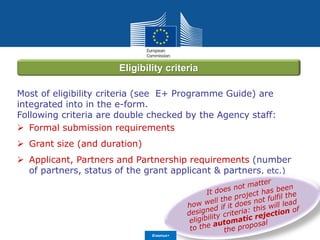
Most of eligibility criteria (see E+ Programme Guide) are
integrated into in the e-form.
Following criteria are double checked by the Agency staff:
 Formal submission requirements
 Grant size (and duration)
 Applicant, Partners and Partnership requirements (number
of partners, status of the grant applicant & partners, etc.)
Eligibility criteria
Erasmus+
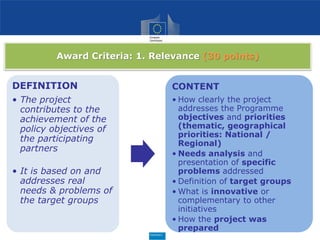
DEFINITION
• The project
contributes to the
achievement of the
policy objectives of
the participating
partners
• It is based on and
addresses real
needs & problems of
the target groups
CONTENT
• How clearly the project
addresses the Programme
objectives and priorities
(thematic, geographical
priorities: National /
Regional)
• Needs analysis and
presentation of specific
problems addressed
• Definition of target groups
• What is innovative or
complementary to other
initiatives
• How the project was
prepared
Award Criteria: 1. Relevance (30 points)
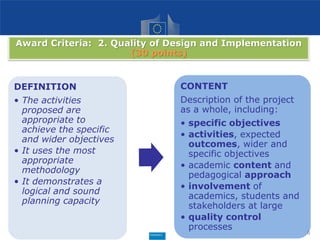
DEFINITION
• The activities
proposed are
appropriate to
achieve the specific
and wider objectives
• It uses the most
appropriate
methodology
• It demonstrates a
logical and sound
planning capacity
CONTENT
Description of the project
as a whole, including:
• specific objectives
• activities, expected
outcomes, wider and
specific objectives
• academic content and
pedagogical approach
• involvement of
academics, students and
stakeholders at large
• quality control
processes
6
Award Criteria: 2. Quality of Design and Implementation
(30 points)
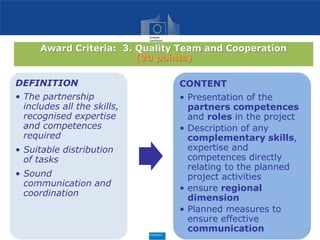
DEFINITION
• The partnership
includes all the skills,
recognised expertise
and competences
required
• Suitable distribution
of tasks
• Sound
communication and
coordination
CONTENT
• Presentation of the
partners competences
and roles in the project
• Description of any
complementary skills,
expertise and
competences directly
relating to the planned
project activities
• ensure regional
dimension
• Planned measures to
ensure effective
communication 7
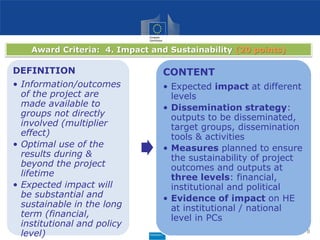
Award Criteria: 3. Quality Team and Cooperation
(20 points)
DEFINITION
• Information/outcomes
of the project are
made available to
groups not directly
involved (multiplier
effect)
• Optimal use of the
results during &
beyond the project
lifetime
• Expected impact will
be substantial and
sustainable in the long
term (financial,
institutional and policy
level)
CONTENT
• Expected impact at different
levels
• Dissemination strategy:
outputs to be disseminated,
target groups, dissemination
tools & activities
• Measures planned to ensure
the sustainability of project
outcomes and outputs at
three levels: financial,
institutional and political
• Evidence of impact on HE
at institutional / national
level in PCs
8
Award Criteria: 4. Impact and Sustainability (20 points)
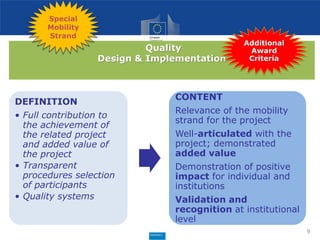
Quality
Design & Implementation
DEFINITION
• Full contribution to
the achievement of
the related project
and added value of
the project
• Transparent
procedures selection
of participants
• Quality systems
CONTENT
Relevance of the mobility
strand for the project
Well-articulated with the
project; demonstrated
added value
Demonstration of positive
impact for individual and
institutions
Validation and
recognition at institutional
level
9
Additional
Award
Criteria
Special
Mobility
Strand
Date: in 12 ptsEducation
and Culture
Application form and
requirements
Erasmus+
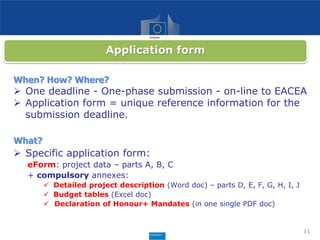
When? How? Where?
 One deadline - One-phase submission - on-line to EACEA
 Application form = unique reference information for the
submission deadline.
What?
 Specific application form:
eForm: project data – parts A, B, C
+ compulsory annexes:
 Detailed project description (Word doc) – parts D, E, F, G, H, I, J
 Budget tables (Excel doc)
 Declaration of Honour+ Mandates (in one single PDF doc)
11
Application form
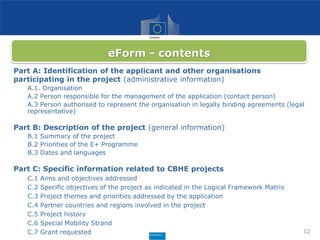
Part A: Identification of the applicant and other organisations
participating in the project (administrative information)
A.1. Organisation
A.2 Person responsible for the management of the application (contact person)
A.3 Person authorised to represent the organisation in legally binding agreements (legal
representative)
Part B: Description of the project (general information)
B.1 Summary of the project
B.2 Priorities of the E+ Programme
B.3 Dates and languages
Part C: Specific information related to CBHE projects
C.1 Aims and objectives addressed
C.2 Specific objectives of the project as indicated in the Logical Framework Matrix
C.3 Project themes and priorities addressed by the application
C.4 Partner countries and regions involved in the project
C.5 Project history
C.6 Special Mobility Strand
C.7 Grant requested 12
eForm - contents
13
eForm compulsory ATTACHMENTS - 1
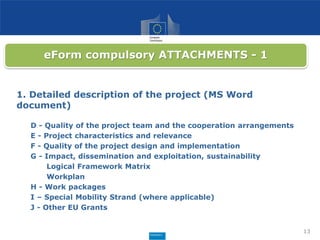
1. Detailed description of the project (MS Word
document)
D - Quality of the project team and the cooperation arrangements
E - Project characteristics and relevance
F - Quality of the project design and implementation
G - Impact, dissemination and exploitation, sustainability
Logical Framework Matrix
Workplan
H - Work packages
I – Special Mobility Strand (where applicable)
J - Other EU Grants
14
eForm compulsory ATTACHMENTS - 2
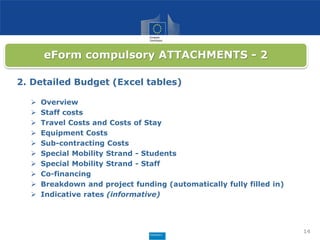
2. Detailed Budget (Excel tables)
 Overview
 Staff costs
 Travel Costs and Costs of Stay
 Equipment Costs
 Sub-contracting Costs
 Special Mobility Strand - Students
 Special Mobility Strand - Staff
 Co-financing
 Breakdown and project funding (automatically fully filled in)
 Indicative rates (informative)
15
eForm compulsory ATTACHMENTS - 2
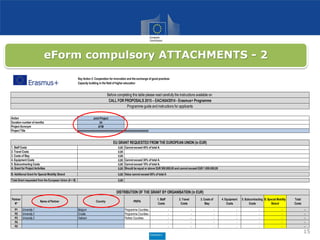
Key Action 2: Cooperation for innovation and the exchange of good practices
Capacity building in the field of higher education
Joint Project
24
ATM
0,00
0,00
0,00
0,00
0,00
0,00
0
0,00
0,00
Partner
N°
Name of Partner Country PR/PA
1. Staff
Costs
2. Travel
Costs
3. Costs of
Stay
4. Equipment
Costs
5. Subcontracting
Costs
B. Special Mobility
Strand
Total
Costs
P1 University 1 Belgium Programme Countries - - - - - - -
P2 University 2 Croatia Programme Countries - - - - - - -
P3 University 3 Vietnam Partner Countries - - - - - - -
P4 - - - - - - -
P5 - - - - - - -
B. Additional Grant for Special Mobility Strand
DISTRIBUTION OF THE GRANT BY ORGANISATION (in EUR)
2. Travel Costs
3. Costs of Stay
4. Equipment Costs
5. Subcontracting Costs
Total Grant requested from the European Union (A + B)
A. Grant for Project Activities Should be equal or above EUR 500.000,00 and cannot exceed EUR 1.000.000,00
Value cannot exceed 80% of total A
Cannot exceed 10% of total A.
Cannot exceed 30% of total A.
Cannot exceed 40% of total A.
Before completing this table please read carefully the instructions available on
CALL FOR PROPOSALS 2015 – EAC/A04/2014 - Erasmus+ Programme
Programme guide and instructions for applicants
Action
Duration number of months
Project Acronym
EU GRANT REQUESTED FROM THE EUROPEAN UNION (in EUR)
1. Staff Costs
Project Title xxxxxxxxxxxxxxxxxxxxxxxxxxxxxxxxxxxxxxxxxxxxxxxxxx
Financing mechanism for staff costs
(see Programme Guide page 158,
160 and page 161 Table A and B)
Amount
Unit costs
Subdivided in 4
categories and country
groups
(4 groups for Programme
and 4 groups for Partner
Countries)
per manager involved per day
Max.
40% of
the total
grant
per researcher/ teacher/trainer
involved per day
per technician involved per day
per administrative staff involved
per day
16
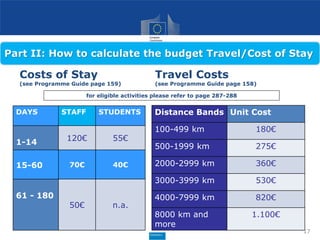
Part II: How to calculate the budget - STAFF
COSTS
DAYS STAFF STUDENTS
1-14 120€ 55€
15-60 70€ 40€
61 - 180
50€ n.a.
Distance Bands Unit Cost
100-499 km 180€
500-1999 km 275€
2000-2999 km 360€
3000-3999 km 530€
4000-7999 km 820€
8000 km and
more
1.100€
17
Unit costs per day Unit costs
Part II: How to calculate the budget Travel/Cost of Stay
Costs of Stay
(see Programme Guide page 159)
Travel Costs
(see Programme Guide page 158)
for eligible activities please refer to page 287-288
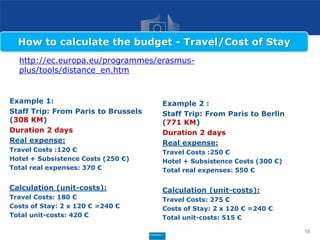
http://ec.europa.eu/programmes/erasmus-
plus/tools/distance_en.htm
Example 1:
Staff Trip: From Paris to Brussels
(308 KM)
Duration 2 days
Real expense:
Travel Costs :120 €
Hotel + Subsistence Costs (250 €)
Total real expenses: 370 €
Calculation (unit-costs):
Travel Costs: 180 €
Costs of Stay: 2 x 120 € =240 €
Total unit-costs: 420 €
18
Example 2 :
Staff Trip: From Paris to Berlin
(771 KM)
Duration 2 days
Real expense:
Travel Costs :250 €
Hotel + Subsistence Costs (300 €)
Total real expenses: 550 €
Calculation (unit-costs):
Travel Costs: 275 €
Costs of Stay: 2 x 120 € =240 €
Total unit-costs: 515 €
How to calculate the budget - Travel/Cost of Stay
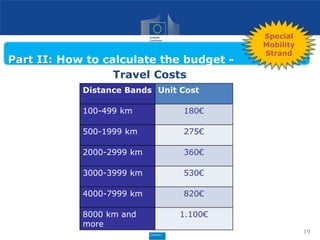
Distance Bands Unit Cost
100-499 km 180€
500-1999 km 275€
2000-2999 km 360€
3000-3999 km 530€
4000-7999 km 820€
8000 km and
more
1.100€
19
Part II: How to calculate the budget -
Travel Costs
Special
Mobility
Strand
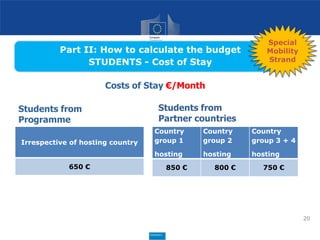
Part II: How to calculate the budget
STUDENTS - Cost of Stay
Costs of Stay €/Month
20
Students from
Programme
Countries
Irrespective of hosting country
650 €
Country
group 1
hosting
Country
group 2
hosting
Country
group 3 + 4
hosting
850 € 800 € 750 €
Students from
Partner countries
Special
Mobility
Strand
Part II: How to calculate the budget
STAFF Costs of Stay
Cost of Stay €/Day
Staff from Partner Countries
Cost of Stay €/Day
Staff from Programme Countries
21
Days
Country
group 1
hosting
Country
group 2
hosting
Country
group 3
hosting
Country
group 4
hosting
1-14 160 € 140 € 120 € 100 €
15-
60
112 € 98 € 84 € 70 €
Days
Irrespective of
hosting
country
1-14 160 €
15-60 112 €
Special
Mobility
Strand
22
eForm compulsory ATTACHMENTS - 3
3. Declaration of Honours + Mandates (PDF)
 Declaration of Honours – only from the Applicant
organisation
 Mandates – from all partners (except for P1 – Applicant)
- not required for Associated Partners (if applicable)
- must be scanned and attached in one single document, with
Mandates keeping the order as in List of Partners (P1-Pn)
Date: in 12 ptsEducation
and Culture
 Successful vs. good proposals
 How should I start?
 Drafting a good proposal
 When can I start?
Date: in 12 ptsEducation
and Culture
A successful proposal
 demonstrates that the combination of all its elements
will produce concrete and sustainable results for the
benefit of all the parties concerned.
 Has been prepared and agreed jointly by the
partnership-> a joint institutional commitment
 Has received the full commitment and support of the
participating institutions.
 Is ready to start immediately after the
selection decision.
Date: in 12 ptsEducation
and Culture
1. You have a "broad knowledge" of Erasmus+
 What/who is it for? How does it work? What activities does it
support and how? Who could help you understand it better?
2. You have a concrete idea for an international cooperation. project
 Does it fit the programme' s objectives, priorities, requirements,
intervention modalities, etc.?
 Does it address your institution /sector /country needs?
3. Your idea is supported by your institution
 You have discussed it with the relevant authorities
 You will be supported for the proposal preparation and, if
successful, the project implementation
4. You can set up/be part of an international partnership for carrying
out the project?
Date: in 12 ptsEducation
and Culture
 Start locally
 In your institution
(other colleagues, services, departments, authorities)
 Among local stakeholders (other universities, education providers,
employers, local / regional / national authorities, NEOs in Partner
Countries)
 International partners
 Colleagues/Organisations you/your partners have worked with in the
past
Partners are not individuals, they are organisations
 Each partner must
 Bring a concrete added value to the project
 Gain a concrete added value from the project
 Cooperation is based on trust, confidence and on formalised agreements
Date: in 12 ptsEducation
and Culture
 Drafting the proposal is a shared exercise
 It reflects the partners shared responsibilities at project
implementation stage
 It requires regular revisions/rewriting in order to ensure
 Consistency and coherence
 Comprehensiveness
 Fulfilment of all the E+ Action requirements
- Choose the language common/comfortable to all project partners
- Have your final draft proofread by a colleague not involved in the proposal
Date: in 12 ptsEducation
and Culture
 COHERENT: in its entirety; avoid contradictions; avoid "patchwork"
 SIMPLE: better a few well-chosen words than long/vague explanations
 CONCRETE: down to the point, justify your statements, bring proofs
 CLEAR: Follow the questions and answer them in the right order
 EXPLICIT: do not take anything for granted, don't assume: experts
cannot read your mind; avoid abbreviations or explain them
 RIGOROUS: the application is the basis on which your project will be
implemented; it is also the cornerstone of your partnership commitment
 FOCUSED: stick to what is asked
 COMPLETE: ensure (twice!) you have followed all the instructions and
that the proposal fulfils all the mandatory requirements.
Date: in 12 ptsEducation
and Culture
When to start? Now!
 Propose / Discuss potential cooperation projects within your
institution
 If a mobility action is in view,
 What type of mobility: staff or student? (level of study,
duration, thematic area, type of activities)
 What added value can you offer to incoming students / staff?
 Does your university fulfil the principles of the Erasmus
Charter ?
 On what criteria will you select your EU mobility partners?
Date: in 12 pts
 Respect the Call requirements & criteria
 Be clear, well-structured, concise and to
the point (see guiding questions in the
Application Form)
 Target oriented
 Manageable partnership
 Cost-effective
Date: in 12 ptsEducation
and Culture
1. A good proposal is (much) more than a
successful proposal.
2. Nobody else knows your institution/country
needs better than you.
3. Have everybody on board as early as
possible.
Good luck !!
CONCLUSIONS
Date: in 12 ptsEducation
and Culture

Erasmus + How to prepare a competitive project proposal?

  • 1.
    Date: in 12ptsEducation and Culture HOW TO PREPARE A COMPETITIVE PROJECT PROPOSAL?
  • 2.
    Date: in 12ptsEducation and Culture Preparing the application based on the requirements of the call Erasmus+
  • 3.
    Date: in 12ptsEducation and Culture  Submission on-line to EACEA  eForm & Annexes  Criteria o Eligibility Criteria o Exclusion Criteria o Selection Criteria o Award Criteria Common requirements for all Erasmus+ International dimension – Centralised Actions Erasmus+
  • 4.
    Date: in 12ptsEducation and Culture Most of eligibility criteria (see E+ Programme Guide) are integrated into in the e-form. Following criteria are double checked by the Agency staff:  Formal submission requirements  Grant size (and duration)  Applicant, Partners and Partnership requirements (number of partners, status of the grant applicant & partners, etc.) Eligibility criteria Erasmus+
  • 5.
    DEFINITION • The project contributesto the achievement of the policy objectives of the participating partners • It is based on and addresses real needs & problems of the target groups CONTENT • How clearly the project addresses the Programme objectives and priorities (thematic, geographical priorities: National / Regional) • Needs analysis and presentation of specific problems addressed • Definition of target groups • What is innovative or complementary to other initiatives • How the project was prepared Award Criteria: 1. Relevance (30 points)
  • 6.
    DEFINITION • The activities proposedare appropriate to achieve the specific and wider objectives • It uses the most appropriate methodology • It demonstrates a logical and sound planning capacity CONTENT Description of the project as a whole, including: • specific objectives • activities, expected outcomes, wider and specific objectives • academic content and pedagogical approach • involvement of academics, students and stakeholders at large • quality control processes 6 Award Criteria: 2. Quality of Design and Implementation (30 points)
  • 7.
    DEFINITION • The partnership includesall the skills, recognised expertise and competences required • Suitable distribution of tasks • Sound communication and coordination CONTENT • Presentation of the partners competences and roles in the project • Description of any complementary skills, expertise and competences directly relating to the planned project activities • ensure regional dimension • Planned measures to ensure effective communication 7 Award Criteria: 3. Quality Team and Cooperation (20 points)
  • 8.
    DEFINITION • Information/outcomes of theproject are made available to groups not directly involved (multiplier effect) • Optimal use of the results during & beyond the project lifetime • Expected impact will be substantial and sustainable in the long term (financial, institutional and policy level) CONTENT • Expected impact at different levels • Dissemination strategy: outputs to be disseminated, target groups, dissemination tools & activities • Measures planned to ensure the sustainability of project outcomes and outputs at three levels: financial, institutional and political • Evidence of impact on HE at institutional / national level in PCs 8 Award Criteria: 4. Impact and Sustainability (20 points)
  • 9.
    Quality Design & Implementation DEFINITION •Full contribution to the achievement of the related project and added value of the project • Transparent procedures selection of participants • Quality systems CONTENT Relevance of the mobility strand for the project Well-articulated with the project; demonstrated added value Demonstration of positive impact for individual and institutions Validation and recognition at institutional level 9 Additional Award Criteria Special Mobility Strand
  • 10.
    Date: in 12ptsEducation and Culture Application form and requirements Erasmus+
  • 11.
    When? How? Where? One deadline - One-phase submission - on-line to EACEA  Application form = unique reference information for the submission deadline. What?  Specific application form: eForm: project data – parts A, B, C + compulsory annexes:  Detailed project description (Word doc) – parts D, E, F, G, H, I, J  Budget tables (Excel doc)  Declaration of Honour+ Mandates (in one single PDF doc) 11 Application form
  • 12.
    Part A: Identificationof the applicant and other organisations participating in the project (administrative information) A.1. Organisation A.2 Person responsible for the management of the application (contact person) A.3 Person authorised to represent the organisation in legally binding agreements (legal representative) Part B: Description of the project (general information) B.1 Summary of the project B.2 Priorities of the E+ Programme B.3 Dates and languages Part C: Specific information related to CBHE projects C.1 Aims and objectives addressed C.2 Specific objectives of the project as indicated in the Logical Framework Matrix C.3 Project themes and priorities addressed by the application C.4 Partner countries and regions involved in the project C.5 Project history C.6 Special Mobility Strand C.7 Grant requested 12 eForm - contents
  • 13.
    13 eForm compulsory ATTACHMENTS- 1 1. Detailed description of the project (MS Word document) D - Quality of the project team and the cooperation arrangements E - Project characteristics and relevance F - Quality of the project design and implementation G - Impact, dissemination and exploitation, sustainability Logical Framework Matrix Workplan H - Work packages I – Special Mobility Strand (where applicable) J - Other EU Grants
  • 14.
    14 eForm compulsory ATTACHMENTS- 2 2. Detailed Budget (Excel tables)  Overview  Staff costs  Travel Costs and Costs of Stay  Equipment Costs  Sub-contracting Costs  Special Mobility Strand - Students  Special Mobility Strand - Staff  Co-financing  Breakdown and project funding (automatically fully filled in)  Indicative rates (informative)
  • 15.
    15 eForm compulsory ATTACHMENTS- 2 Key Action 2: Cooperation for innovation and the exchange of good practices Capacity building in the field of higher education Joint Project 24 ATM 0,00 0,00 0,00 0,00 0,00 0,00 0 0,00 0,00 Partner N° Name of Partner Country PR/PA 1. Staff Costs 2. Travel Costs 3. Costs of Stay 4. Equipment Costs 5. Subcontracting Costs B. Special Mobility Strand Total Costs P1 University 1 Belgium Programme Countries - - - - - - - P2 University 2 Croatia Programme Countries - - - - - - - P3 University 3 Vietnam Partner Countries - - - - - - - P4 - - - - - - - P5 - - - - - - - B. Additional Grant for Special Mobility Strand DISTRIBUTION OF THE GRANT BY ORGANISATION (in EUR) 2. Travel Costs 3. Costs of Stay 4. Equipment Costs 5. Subcontracting Costs Total Grant requested from the European Union (A + B) A. Grant for Project Activities Should be equal or above EUR 500.000,00 and cannot exceed EUR 1.000.000,00 Value cannot exceed 80% of total A Cannot exceed 10% of total A. Cannot exceed 30% of total A. Cannot exceed 40% of total A. Before completing this table please read carefully the instructions available on CALL FOR PROPOSALS 2015 – EAC/A04/2014 - Erasmus+ Programme Programme guide and instructions for applicants Action Duration number of months Project Acronym EU GRANT REQUESTED FROM THE EUROPEAN UNION (in EUR) 1. Staff Costs Project Title xxxxxxxxxxxxxxxxxxxxxxxxxxxxxxxxxxxxxxxxxxxxxxxxxx
  • 16.
    Financing mechanism forstaff costs (see Programme Guide page 158, 160 and page 161 Table A and B) Amount Unit costs Subdivided in 4 categories and country groups (4 groups for Programme and 4 groups for Partner Countries) per manager involved per day Max. 40% of the total grant per researcher/ teacher/trainer involved per day per technician involved per day per administrative staff involved per day 16 Part II: How to calculate the budget - STAFF COSTS
  • 17.
    DAYS STAFF STUDENTS 1-14120€ 55€ 15-60 70€ 40€ 61 - 180 50€ n.a. Distance Bands Unit Cost 100-499 km 180€ 500-1999 km 275€ 2000-2999 km 360€ 3000-3999 km 530€ 4000-7999 km 820€ 8000 km and more 1.100€ 17 Unit costs per day Unit costs Part II: How to calculate the budget Travel/Cost of Stay Costs of Stay (see Programme Guide page 159) Travel Costs (see Programme Guide page 158) for eligible activities please refer to page 287-288
  • 18.
    http://ec.europa.eu/programmes/erasmus- plus/tools/distance_en.htm Example 1: Staff Trip:From Paris to Brussels (308 KM) Duration 2 days Real expense: Travel Costs :120 € Hotel + Subsistence Costs (250 €) Total real expenses: 370 € Calculation (unit-costs): Travel Costs: 180 € Costs of Stay: 2 x 120 € =240 € Total unit-costs: 420 € 18 Example 2 : Staff Trip: From Paris to Berlin (771 KM) Duration 2 days Real expense: Travel Costs :250 € Hotel + Subsistence Costs (300 €) Total real expenses: 550 € Calculation (unit-costs): Travel Costs: 275 € Costs of Stay: 2 x 120 € =240 € Total unit-costs: 515 € How to calculate the budget - Travel/Cost of Stay
  • 19.
    Distance Bands UnitCost 100-499 km 180€ 500-1999 km 275€ 2000-2999 km 360€ 3000-3999 km 530€ 4000-7999 km 820€ 8000 km and more 1.100€ 19 Part II: How to calculate the budget - Travel Costs Special Mobility Strand
  • 20.
    Part II: Howto calculate the budget STUDENTS - Cost of Stay Costs of Stay €/Month 20 Students from Programme Countries Irrespective of hosting country 650 € Country group 1 hosting Country group 2 hosting Country group 3 + 4 hosting 850 € 800 € 750 € Students from Partner countries Special Mobility Strand
  • 21.
    Part II: Howto calculate the budget STAFF Costs of Stay Cost of Stay €/Day Staff from Partner Countries Cost of Stay €/Day Staff from Programme Countries 21 Days Country group 1 hosting Country group 2 hosting Country group 3 hosting Country group 4 hosting 1-14 160 € 140 € 120 € 100 € 15- 60 112 € 98 € 84 € 70 € Days Irrespective of hosting country 1-14 160 € 15-60 112 € Special Mobility Strand
  • 22.
    22 eForm compulsory ATTACHMENTS- 3 3. Declaration of Honours + Mandates (PDF)  Declaration of Honours – only from the Applicant organisation  Mandates – from all partners (except for P1 – Applicant) - not required for Associated Partners (if applicable) - must be scanned and attached in one single document, with Mandates keeping the order as in List of Partners (P1-Pn)
  • 23.
    Date: in 12ptsEducation and Culture  Successful vs. good proposals  How should I start?  Drafting a good proposal  When can I start?
  • 24.
    Date: in 12ptsEducation and Culture A successful proposal  demonstrates that the combination of all its elements will produce concrete and sustainable results for the benefit of all the parties concerned.  Has been prepared and agreed jointly by the partnership-> a joint institutional commitment  Has received the full commitment and support of the participating institutions.  Is ready to start immediately after the selection decision.
  • 25.
    Date: in 12ptsEducation and Culture 1. You have a "broad knowledge" of Erasmus+  What/who is it for? How does it work? What activities does it support and how? Who could help you understand it better? 2. You have a concrete idea for an international cooperation. project  Does it fit the programme' s objectives, priorities, requirements, intervention modalities, etc.?  Does it address your institution /sector /country needs? 3. Your idea is supported by your institution  You have discussed it with the relevant authorities  You will be supported for the proposal preparation and, if successful, the project implementation 4. You can set up/be part of an international partnership for carrying out the project?
  • 26.
    Date: in 12ptsEducation and Culture  Start locally  In your institution (other colleagues, services, departments, authorities)  Among local stakeholders (other universities, education providers, employers, local / regional / national authorities, NEOs in Partner Countries)  International partners  Colleagues/Organisations you/your partners have worked with in the past Partners are not individuals, they are organisations  Each partner must  Bring a concrete added value to the project  Gain a concrete added value from the project  Cooperation is based on trust, confidence and on formalised agreements
  • 27.
    Date: in 12ptsEducation and Culture  Drafting the proposal is a shared exercise  It reflects the partners shared responsibilities at project implementation stage  It requires regular revisions/rewriting in order to ensure  Consistency and coherence  Comprehensiveness  Fulfilment of all the E+ Action requirements - Choose the language common/comfortable to all project partners - Have your final draft proofread by a colleague not involved in the proposal
  • 28.
    Date: in 12ptsEducation and Culture  COHERENT: in its entirety; avoid contradictions; avoid "patchwork"  SIMPLE: better a few well-chosen words than long/vague explanations  CONCRETE: down to the point, justify your statements, bring proofs  CLEAR: Follow the questions and answer them in the right order  EXPLICIT: do not take anything for granted, don't assume: experts cannot read your mind; avoid abbreviations or explain them  RIGOROUS: the application is the basis on which your project will be implemented; it is also the cornerstone of your partnership commitment  FOCUSED: stick to what is asked  COMPLETE: ensure (twice!) you have followed all the instructions and that the proposal fulfils all the mandatory requirements.
  • 29.
    Date: in 12ptsEducation and Culture When to start? Now!  Propose / Discuss potential cooperation projects within your institution  If a mobility action is in view,  What type of mobility: staff or student? (level of study, duration, thematic area, type of activities)  What added value can you offer to incoming students / staff?  Does your university fulfil the principles of the Erasmus Charter ?  On what criteria will you select your EU mobility partners?
  • 30.
    Date: in 12pts  Respect the Call requirements & criteria  Be clear, well-structured, concise and to the point (see guiding questions in the Application Form)  Target oriented  Manageable partnership  Cost-effective
  • 31.
    Date: in 12ptsEducation and Culture 1. A good proposal is (much) more than a successful proposal. 2. Nobody else knows your institution/country needs better than you. 3. Have everybody on board as early as possible. Good luck !! CONCLUSIONS
  • 32.
    Date: in 12ptsEducation and Culture