A renewed modernisation agenda for
higher education
Julie Anderson, European Commission
Hagen, 29 October 2015
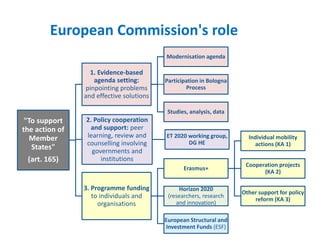
"To support
the action of
Member
States"
(art. 165)
1. Evidence-based
agenda setting:
pinpointing problems
and effective solutions
Modernisation agenda
Participation in Bologna
Process
Studies, analysis, data
2. Policy cooperation
and support: peer
learning, review and
counselling involving
governments and
institutions
ET 2020 working group,
DG HE
3. Programme funding
to individuals and
organisations
Erasmus+
Individual mobility
actions (KA 1)
Cooperation projects
(KA 2)
Other support for policy
reform (KA 3)
Horizon 2020
(researchers, research
and innovation)
European Structural and
Investment Funds (ESF)
European Commission's role
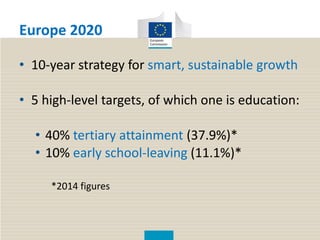
Europe 2020
• 10-year strategy for smart, sustainable growth
• 5 high-level targets, of which one is education:
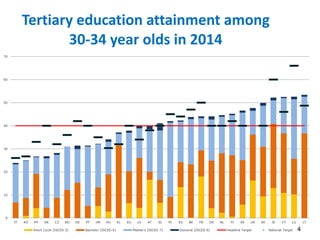
• 40% tertiary attainment (37.9%)*
• 10% early school-leaving (11.1%)*
*2014 figures
4
0
10
20
30
40
50
60
70
IT RO MT SK CZ BG DE PT HR HU EL EU LV AT SI PL ES BE FR DK NL FI EE UK SE IE CY LU LT
Tertiary education attainment among
30-34 year olds in 2014
Short Cycle (ISCED 5) Bachelor (ISCED 6) Master's (ISCED 7) Doctoral (ISCED 8) Headline Target National Target
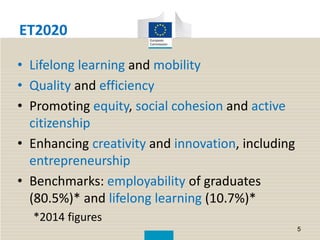
ET2020
• Lifelong learning and mobility
• Quality and efficiency
• Promoting equity, social cohesion and active
citizenship
• Enhancing creativity and innovation, including
entrepreneurship
• Benchmarks: employability of graduates
(80.5%)* and lifelong learning (10.7%)*
*2014 figures
5
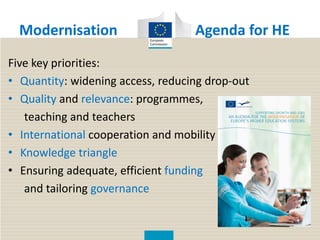
Five key priorities:
• Quantity: widening access, reducing drop-out
• Quality and relevance: programmes,
teaching and teachers
• International cooperation and mobility
• Knowledge triangle
• Ensuring adequate, efficient funding
and tailoring governance
Modernisation Agenda for HE
Challenges
• Economic and social challenges
• Expanding student population
• Need to raise quality of learning and teaching*
• Skills gaps and mismatches
• New technologies*
• Flexible learning pathways
• Need for effective HE systems–value for money
*High-Level Group on the Modernisation of Higher
Education reports
Process
• Consultation process to be launched in late
November
• Meetings with stakeholders
• Cooperation with Presidencies: NL Presidency
conference
• Formulate policy by late 2016
Broad Themes
• Promote relevant learning and
teaching
• Help HEIs become strong regional
innovators
• Create a real EU higher education and
research space
Relevance
• Better system-level intelligence and steering
• Student-centred learning and teaching
• Effective use of digital technologies
• Help HEIs link better to the outside world:
work-based learning and university-employer
interaction
• Support active and engaged citizens and
strengthen civic responsibility in universities
Regional Innovation
• University as centre of regional innovation
• Encourage institutional specialisation
according to regional strengths
• Inter-disciplinary and inter-sectoral
cooperation
• Optimise digital networking to support
linkages between HEIs and regional actors
International Cooperation
• A more coordinated EU approach to cross-
border cooperation between HEIs
• Removing barriers to and promoting student,
researcher and staff mobility
• Improving the recognition of academic
qualifications
Digitalisation Opportunities
• Make courses more student-centred
• Facilitate national and international
cooperation between institutions
• Innovate: develop new forms of courses
• Improve access and lifelong learning
HOWEVER:
• Need to ensure quality assurance, recognition
and support for students and teachers
Digitalisation Actions
• High-Level Group on the Modernisation of
Higher Education report on new modes of
learning and teaching in higher education,
October 2014: 15 recommendations
• Changing Pedagogical Landscapes study
• Studies on open education with Institute for
Prospective Technological Studies
• Peer learning with member states
Views?
• Are the three broad areas relevant in your
higher education context?
• Are there other areas on which you would like
to see an EU focus?
• How can the European Commission support
institutions in the areas of online, open and
flexible education?

2015 j. anderson a renewed modernisation for

  • 1.
    A renewed modernisationagenda for higher education Julie Anderson, European Commission Hagen, 29 October 2015
  • 2.
    "To support the actionof Member States" (art. 165) 1. Evidence-based agenda setting: pinpointing problems and effective solutions Modernisation agenda Participation in Bologna Process Studies, analysis, data 2. Policy cooperation and support: peer learning, review and counselling involving governments and institutions ET 2020 working group, DG HE 3. Programme funding to individuals and organisations Erasmus+ Individual mobility actions (KA 1) Cooperation projects (KA 2) Other support for policy reform (KA 3) Horizon 2020 (researchers, research and innovation) European Structural and Investment Funds (ESF) European Commission's role
  • 3.
    Europe 2020 • 10-yearstrategy for smart, sustainable growth • 5 high-level targets, of which one is education: • 40% tertiary attainment (37.9%)* • 10% early school-leaving (11.1%)* *2014 figures
  • 4.
    4 0 10 20 30 40 50 60 70 IT RO MTSK CZ BG DE PT HR HU EL EU LV AT SI PL ES BE FR DK NL FI EE UK SE IE CY LU LT Tertiary education attainment among 30-34 year olds in 2014 Short Cycle (ISCED 5) Bachelor (ISCED 6) Master's (ISCED 7) Doctoral (ISCED 8) Headline Target National Target
  • 5.
    ET2020 • Lifelong learningand mobility • Quality and efficiency • Promoting equity, social cohesion and active citizenship • Enhancing creativity and innovation, including entrepreneurship • Benchmarks: employability of graduates (80.5%)* and lifelong learning (10.7%)* *2014 figures 5
  • 6.
    Five key priorities: •Quantity: widening access, reducing drop-out • Quality and relevance: programmes, teaching and teachers • International cooperation and mobility • Knowledge triangle • Ensuring adequate, efficient funding and tailoring governance Modernisation Agenda for HE
  • 7.
    Challenges • Economic andsocial challenges • Expanding student population • Need to raise quality of learning and teaching* • Skills gaps and mismatches • New technologies* • Flexible learning pathways • Need for effective HE systems–value for money *High-Level Group on the Modernisation of Higher Education reports
  • 8.
    Process • Consultation processto be launched in late November • Meetings with stakeholders • Cooperation with Presidencies: NL Presidency conference • Formulate policy by late 2016
  • 9.
    Broad Themes • Promoterelevant learning and teaching • Help HEIs become strong regional innovators • Create a real EU higher education and research space
  • 10.
    Relevance • Better system-levelintelligence and steering • Student-centred learning and teaching • Effective use of digital technologies • Help HEIs link better to the outside world: work-based learning and university-employer interaction • Support active and engaged citizens and strengthen civic responsibility in universities
  • 11.
    Regional Innovation • Universityas centre of regional innovation • Encourage institutional specialisation according to regional strengths • Inter-disciplinary and inter-sectoral cooperation • Optimise digital networking to support linkages between HEIs and regional actors
  • 12.
    International Cooperation • Amore coordinated EU approach to cross- border cooperation between HEIs • Removing barriers to and promoting student, researcher and staff mobility • Improving the recognition of academic qualifications
  • 13.
    Digitalisation Opportunities • Makecourses more student-centred • Facilitate national and international cooperation between institutions • Innovate: develop new forms of courses • Improve access and lifelong learning HOWEVER: • Need to ensure quality assurance, recognition and support for students and teachers
  • 14.
    Digitalisation Actions • High-LevelGroup on the Modernisation of Higher Education report on new modes of learning and teaching in higher education, October 2014: 15 recommendations • Changing Pedagogical Landscapes study • Studies on open education with Institute for Prospective Technological Studies • Peer learning with member states
  • 15.
    Views? • Are thethree broad areas relevant in your higher education context? • Are there other areas on which you would like to see an EU focus? • How can the European Commission support institutions in the areas of online, open and flexible education?