Sergey Sosnovsky, Saarland University / DFKI
MathGeAr Project
Project Profile
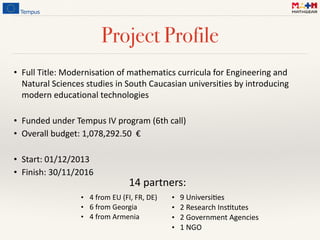
• Full	
  Title:	
  Modernisation	
  of	
  mathematics	
  curricula	
  for	
  Engineering	
  and	
  
Natural	
  Sciences	
  studies	
  in	
  South	
  Caucasian	
  universities	
  by	
  introducing	
  
modern	
  educational	
  technologies	
  	
  
• Funded	
  under	
  Tempus	
  IV	
  program	
  (6th	
  call)	
  
• Overall	
  budget:	
  1,078,292.50	
  	
  €	
  
• Start:	
  01/12/2013	
  
• Finish:	
  30/11/2016
• 9	
  UniversiRes	
  
• 2	
  Research	
  InsRtutes	
  
• 2	
  Government	
  Agencies	
  
• 1	
  NGO
14	
  partners:
• 4	
  from	
  EU	
  (FI,	
  FR,	
  DE)	
  
• 6	
  from	
  Georgia	
  
• 4	
  from	
  Armenia
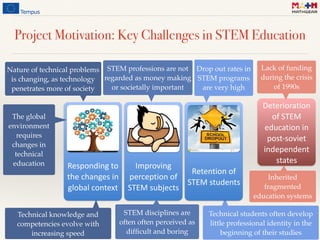
Technical students often develop
little professional identity in the
beginning of their studies
Project Motivation: Key Challenges in STEM Education
Responding	
  to	
  
the	
  changes	
  in	
  
global	
  context
Improving	
  
perception	
  of	
  
STEM	
  subjects
Retention	
  of	
  
STEM	
  students
Technical knowledge and
competencies evolve with
increasing speed
Nature of technical problems
is changing, as technology
penetrates more of society
The global
environment
requires
changes in
technical
education
STEM professions are not
regarded as money making
or societally important
STEM disciplines are
often often perceived as
difficult and boring
Drop out rates in
STEM programs
are very high
Deterioration	
  
of	
  STEM	
  
education	
  in	
  
post-­‐soviet	
  
independent	
  
states
Lack of funding
during the crisis
of 1990s
Inherited
fragmented
education systems
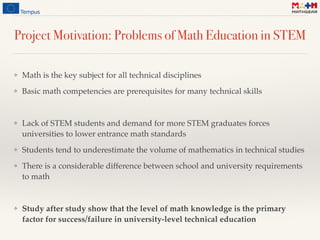
Project Motivation: Problems of Math Education in STEM
❖ Math is the key subject for all technical disciplines
❖ Basic math competencies are prerequisites for many technical skills
❖ Lack of STEM students and demand for more STEM graduates forces
universities to lower entrance math standards
❖ Students tend to underestimate the volume of mathematics in technical studies
❖ There is a considerable difference between school and university requirements
to math
❖ Study after study show that the level of math knowledge is the primary
factor for success/failure in university-level technical education
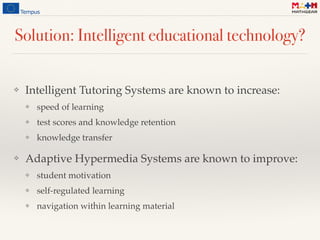
Solution: Intelligent educational technology?
❖ Intelligent Tutoring Systems are known to increase:
❖ speed of learning
❖ test scores and knowledge retention
❖ knowledge transfer
❖ Adaptive Hypermedia Systems are known to improve:
❖ student motivation
❖ self-regulated learning
❖ navigation within learning material
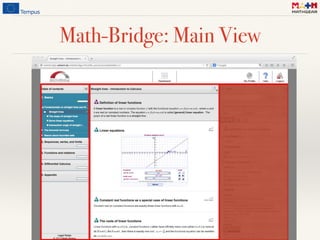
Math-Bridge: Main View
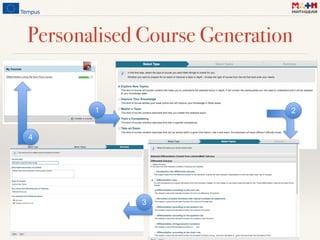
Personalised Course Generation
1 2
3
4
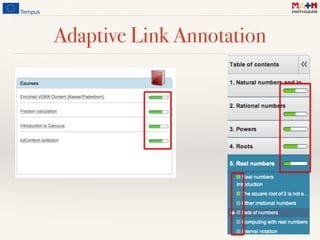
Adaptive Link Annotation
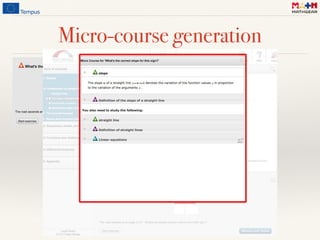
Micro-course generation
Project Objectives
❖ Implement a comparative analysis of national math syllabi and best
teaching practices for STEM disciplines
❖ Modernise math syllabi for a selected set of engineering and sciences
curricula
❖ Localise the European e-Learning platform Math-Bridge and
introduce it as a part of partner university courses
❖ Build a capacity in local universities to effectively maintain and use
Math-Bridge.
❖ Conduct a pilot evaluation of the new curricula enhanced with
Math-Bridge
❖ Disseminate the results of the project.
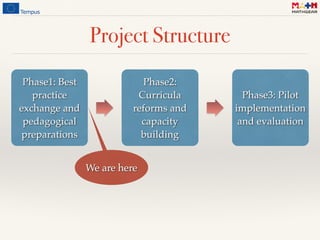
Project Structure
Phase1: Best
practice
exchange and
pedagogical
preparations
Phase2:
Curricula
reforms and
capacity
building
Phase3: Pilot
implementation
and evaluation
We are here
Phase 1: Best Practice Exchange and Preparations
❖ Define a methodology for Math curricula comparison
❖ Conduct a series of Study visits to EU universities
❖ Conduct a series of case studies between EU and partner
Universities on the compatibility of their STEP curricula
❖ Define recommendations for structural curricula
improvements in line with the Bologna principles
❖ Identify the areas most suitable for the introduction of e-
Learning tools (using Math-Bridge)
❖ Write a book “Modernisation of mathematical curricula for
STEM studies in Caucasian countries”
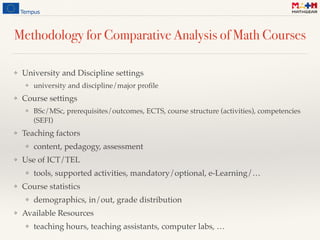
Methodology for Comparative Analysis of Math Courses
❖ University and Discipline settings
❖ university and discipline/major profile
❖ Course settings
❖ BSc/MSc, prerequisites/outcomes, ECTS, course structure (activities), competencies
(SEFI)
❖ Teaching factors
❖ content, pedagogy, assessment
❖ Use of ICT/TEL
❖ tools, supported activities, mandatory/optional, e-Learning/…
❖ Course statistics
❖ demographics, in/out, grade distribution
❖ Available Resources
❖ teaching hours, teaching assistants, computer labs, …
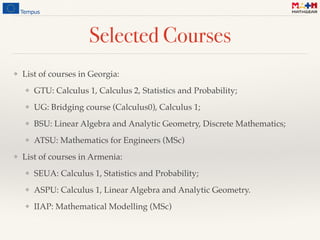
Selected Courses
❖ List of courses in Georgia:
❖ GTU: Calculus 1, Calculus 2, Statistics and Probability;
❖ UG: Bridging course (Calculus0), Calculus 1;
❖ BSU: Linear Algebra and Analytic Geometry, Discrete Mathematics;
❖ ATSU: Mathematics for Engineers (MSc)
❖ List of courses in Armenia:
❖ SEUA: Calculus 1, Statistics and Probability;
❖ ASPU: Calculus 1, Linear Algebra and Analytic Geometry.
❖ IIAP: Mathematical Modelling (MSc)
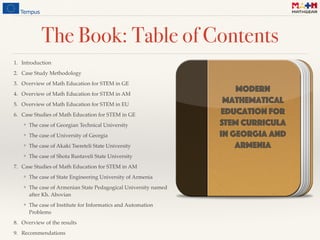
The Book: Table of Contents
1. Introduction
2. Case Study Methodology
3. Overview of Math Education for STEM in GE
4. Overview of Math Education for STEM in AM
5. Overview of Math Education for STEM in EU
6. Case Studies of Math Education for STEM in GE
❖ The case of Georgian Technical University
❖ The case of University of Georgia
❖ The case of Akaki Tsereteli State University
❖ The case of Shota Rustaveli State University
7. Case Studies of Math Education for STEM in AM
❖ The case of State Engineering University of Armenia
❖ The case of Armenian State Pedagogical University named
after Kh. Abovian
❖ The case of Institute for Informatics and Automation
Problems
8. Overview of the results
9. Recommendations
Modern
mathematical
Education for
STEM curricula

in Georgia and
Armenia
Phase 2: Curricular Reform and Capacity Building
❖ For a selected set of STEM curricula develop several
updated math teaching programs
❖ Pay special attention to the introduction of e-Learning
methods and tools (with the help of Math-Bridge)
❖ Select eLearning math content and appropriate
assessment material
❖ Localise Math-Bridge platform into Armenian and
Georgian and train teachers to use it
Phase 3: Implementation and Evaluation
❖ Implement updated courses within Math-Bridge
❖ Design and conduct large-scale pilot evaluation
studies
❖ Analyse the results and verify the impact of the
updated curricula (enhanced with Math-Bridge)
❖ Disseminate the outcomes
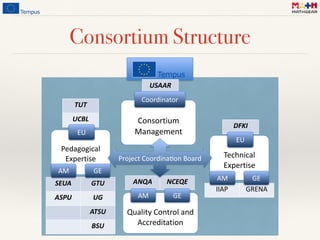
Consortium Structure
Consortium	
  
Management
ANQA NCEQE
Quality	
  Control	
  and	
  
Accreditation
GEAM
TUT
UCBL
SEUA GTU
ASPU UG
ATSU
BSU
Pedagogical	
  
Expertise
EU
AM GE
DFKI
IIAP GRENA
Technical	
  

Expertise
EU
AM GE
USAAR
Coordinator
Project(Coordina.on(Board(
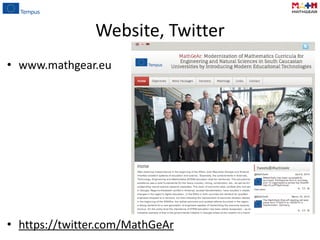
Website,	
  Twitter
• www.mathgear.eu	
  
• https://twitter.com/MathGeAr
Mathgear Overview

Mathgear Overview

  • 1.
    Sergey Sosnovsky, SaarlandUniversity / DFKI MathGeAr Project
  • 2.
    Project Profile • Full  Title:  Modernisation  of  mathematics  curricula  for  Engineering  and   Natural  Sciences  studies  in  South  Caucasian  universities  by  introducing   modern  educational  technologies     • Funded  under  Tempus  IV  program  (6th  call)   • Overall  budget:  1,078,292.50    €   • Start:  01/12/2013   • Finish:  30/11/2016 • 9  UniversiRes   • 2  Research  InsRtutes   • 2  Government  Agencies   • 1  NGO 14  partners: • 4  from  EU  (FI,  FR,  DE)   • 6  from  Georgia   • 4  from  Armenia
  • 3.
    Technical students oftendevelop little professional identity in the beginning of their studies Project Motivation: Key Challenges in STEM Education Responding  to   the  changes  in   global  context Improving   perception  of   STEM  subjects Retention  of   STEM  students Technical knowledge and competencies evolve with increasing speed Nature of technical problems is changing, as technology penetrates more of society The global environment requires changes in technical education STEM professions are not regarded as money making or societally important STEM disciplines are often often perceived as difficult and boring Drop out rates in STEM programs are very high Deterioration   of  STEM   education  in   post-­‐soviet   independent   states Lack of funding during the crisis of 1990s Inherited fragmented education systems
  • 4.
    Project Motivation: Problemsof Math Education in STEM ❖ Math is the key subject for all technical disciplines ❖ Basic math competencies are prerequisites for many technical skills ❖ Lack of STEM students and demand for more STEM graduates forces universities to lower entrance math standards ❖ Students tend to underestimate the volume of mathematics in technical studies ❖ There is a considerable difference between school and university requirements to math ❖ Study after study show that the level of math knowledge is the primary factor for success/failure in university-level technical education
  • 5.
    Solution: Intelligent educationaltechnology? ❖ Intelligent Tutoring Systems are known to increase: ❖ speed of learning ❖ test scores and knowledge retention ❖ knowledge transfer ❖ Adaptive Hypermedia Systems are known to improve: ❖ student motivation ❖ self-regulated learning ❖ navigation within learning material
  • 6.
  • 7.
  • 8.
  • 9.
  • 10.
    Project Objectives ❖ Implementa comparative analysis of national math syllabi and best teaching practices for STEM disciplines ❖ Modernise math syllabi for a selected set of engineering and sciences curricula ❖ Localise the European e-Learning platform Math-Bridge and introduce it as a part of partner university courses ❖ Build a capacity in local universities to effectively maintain and use Math-Bridge. ❖ Conduct a pilot evaluation of the new curricula enhanced with Math-Bridge ❖ Disseminate the results of the project.
  • 11.
    Project Structure Phase1: Best practice exchangeand pedagogical preparations Phase2: Curricula reforms and capacity building Phase3: Pilot implementation and evaluation We are here
  • 12.
    Phase 1: BestPractice Exchange and Preparations ❖ Define a methodology for Math curricula comparison ❖ Conduct a series of Study visits to EU universities ❖ Conduct a series of case studies between EU and partner Universities on the compatibility of their STEP curricula ❖ Define recommendations for structural curricula improvements in line with the Bologna principles ❖ Identify the areas most suitable for the introduction of e- Learning tools (using Math-Bridge) ❖ Write a book “Modernisation of mathematical curricula for STEM studies in Caucasian countries”
  • 13.
    Methodology for ComparativeAnalysis of Math Courses ❖ University and Discipline settings ❖ university and discipline/major profile ❖ Course settings ❖ BSc/MSc, prerequisites/outcomes, ECTS, course structure (activities), competencies (SEFI) ❖ Teaching factors ❖ content, pedagogy, assessment ❖ Use of ICT/TEL ❖ tools, supported activities, mandatory/optional, e-Learning/… ❖ Course statistics ❖ demographics, in/out, grade distribution ❖ Available Resources ❖ teaching hours, teaching assistants, computer labs, …
  • 14.
    Selected Courses ❖ Listof courses in Georgia: ❖ GTU: Calculus 1, Calculus 2, Statistics and Probability; ❖ UG: Bridging course (Calculus0), Calculus 1; ❖ BSU: Linear Algebra and Analytic Geometry, Discrete Mathematics; ❖ ATSU: Mathematics for Engineers (MSc) ❖ List of courses in Armenia: ❖ SEUA: Calculus 1, Statistics and Probability; ❖ ASPU: Calculus 1, Linear Algebra and Analytic Geometry. ❖ IIAP: Mathematical Modelling (MSc)
  • 15.
    The Book: Tableof Contents 1. Introduction 2. Case Study Methodology 3. Overview of Math Education for STEM in GE 4. Overview of Math Education for STEM in AM 5. Overview of Math Education for STEM in EU 6. Case Studies of Math Education for STEM in GE ❖ The case of Georgian Technical University ❖ The case of University of Georgia ❖ The case of Akaki Tsereteli State University ❖ The case of Shota Rustaveli State University 7. Case Studies of Math Education for STEM in AM ❖ The case of State Engineering University of Armenia ❖ The case of Armenian State Pedagogical University named after Kh. Abovian ❖ The case of Institute for Informatics and Automation Problems 8. Overview of the results 9. Recommendations Modern mathematical Education for STEM curricula
 in Georgia and Armenia
  • 16.
    Phase 2: CurricularReform and Capacity Building ❖ For a selected set of STEM curricula develop several updated math teaching programs ❖ Pay special attention to the introduction of e-Learning methods and tools (with the help of Math-Bridge) ❖ Select eLearning math content and appropriate assessment material ❖ Localise Math-Bridge platform into Armenian and Georgian and train teachers to use it
  • 17.
    Phase 3: Implementationand Evaluation ❖ Implement updated courses within Math-Bridge ❖ Design and conduct large-scale pilot evaluation studies ❖ Analyse the results and verify the impact of the updated curricula (enhanced with Math-Bridge) ❖ Disseminate the outcomes
  • 18.
    Consortium Structure Consortium   Management ANQANCEQE Quality  Control  and   Accreditation GEAM TUT UCBL SEUA GTU ASPU UG ATSU BSU Pedagogical   Expertise EU AM GE DFKI IIAP GRENA Technical  
 Expertise EU AM GE USAAR Coordinator Project(Coordina.on(Board(
  • 19.
    Website,  Twitter • www.mathgear.eu   • https://twitter.com/MathGeAr