Recommendations for QA of e-learning
ENQA WG on QA and e-learning
Esther Huertas (Chair)
21/09/2017 1
2
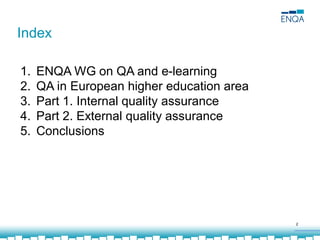
Index
1. ENQA WG on QA and e-learning
2. QA in European higher education area
3. Part 1. Internal quality assurance
4. Part 2. External quality assurance
5. Conclusions
3
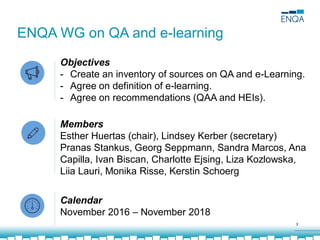
ENQA WG on QA and e-learning
Objectives
- Create an inventory of sources on QA and e-Learning.
- Agree on definition of e-learning.
- Agree on recommendations (QAA and HEIs).
Members
Esther Huertas (chair), Lindsey Kerber (secretary)
Pranas Stankus, Georg Seppmann, Sandra Marcos, Ana
Capilla, Ivan Biscan, Charlotte Ejsing, Liza Kozlowska,
Liia Lauri, Monika Risse, Kerstin Schoerg
Calendar
November 2016 – November 2018
4
Quality Assurance in the European Higher
Education Area
• Generic, not specific  provide the framework and
common basis for national and institutional activities.
• Standards and guidelines for QA, not quality as such.
• Apply to all higher education offered in the EHEA regardless
of the mode of study or place of delivery (TNE, e-learning,
short courses…).
• Thus all types of e-learning included as well as all phases
included in a learning process (e-assessment).
• Apply to all types of QA activities and agencies (quality
audits, programme accreditation, institutional assessment...).
• Quality assurance can serve a variety of purposes:
enhancement – accountability.
5
1
2
3
PART 1. INTERNAL
QUALITY ASSURANCE
PART 2. EXTERNAL
QUALITY ASSURANCE
PART 3. QUALITY
ASSURANCE AGENCIES
European Standards and Guidelines
All standards are fully
applicable to e-learning
provision
6
Part 1. Internal Quality Assurance
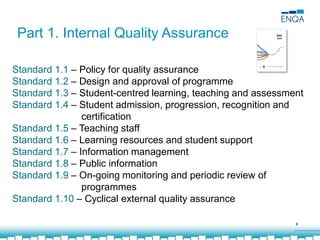
Standard 1.1 – Policy for quality assurance
Standard 1.2 – Design and approval of programme
Standard 1.3 – Student-centred learning, teaching and assessment
Standard 1.4 – Student admission, progression, recognition and
certification
Standard 1.5 – Teaching staff
Standard 1.6 – Learning resources and student support
Standard 1.7 – Information management
Standard 1.8 – Public information
Standard 1.9 – On-going monitoring and periodic review of
programmes
Standard 1.10 – Cyclical external quality assurance
7
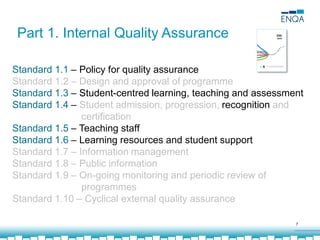
Part 1. Internal Quality Assurance
Standard 1.1 – Policy for quality assurance
Standard 1.2 – Design and approval of programme
Standard 1.3 – Student-centred learning, teaching and assessment
Standard 1.4 – Student admission, progression, recognition and
certification
Standard 1.5 – Teaching staff
Standard 1.6 – Learning resources and student support
Standard 1.7 – Information management
Standard 1.8 – Public information
Standard 1.9 – On-going monitoring and periodic review of
programmes
Standard 1.10 – Cyclical external quality assurance
8
Part 1. Internal Quality Assurance
1.1
1.3
- Ensure that e-learning is strategic at the institution
(‘new providers’).
- Pedagogical model and innovation should be part of
institutional strategy.
- Institutional policies should cover the constituent’s
elements of quality; course development; teaching
and learning; course structure; student support;
faculty support; technology; student assessment;
examination security.
- Instructional design (innovation).
- E-assessment (authorship and authentication).
Standard 1.1 – Policy for quality assurance
Standard 1.3 – Student-centred learning, teaching and assessment
9
Part 1. Internal Quality Assurance
1.5
1.6
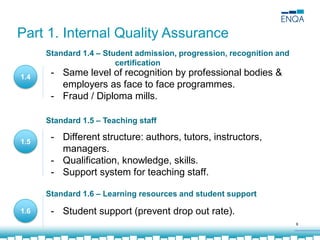
1.4
- Same level of recognition by professional bodies &
employers as face to face programmes.
- Fraud / Diploma mills.
- Different structure: authors, tutors, instructors,
managers.
- Qualification, knowledge, skills.
- Support system for teaching staff.
- Student support (prevent drop out rate).
Standard 1.4 – Student admission, progression, recognition and
certification
Standard 1.5 – Teaching staff
Standard 1.6 – Learning resources and student support
10
Part 2. External Quality Assurance
Standard 2.1 – Consideration of internal quality assurance
Standard 2.2 – Designing methodologies fit for purpose
Standard 2.3 – Implementing processes
Standard 2.4 – Peer-review experts
Standard 2.5 – Criteria for outcomes
Standard 2.6 – Reporting
Standard 2.7 – Complaints and appeals
11
Part 2. External Quality Assurance
Standard 2.1 – Consideration of internal quality assurance
Standard 2.2 – Designing methodologies fit for purpose
Standard 2.3 – Implementing processes
Standard 2.4 – Peer-review experts
Standard 2.5 – Criteria for outcomes
Standard 2.6 – Reporting
Standard 2.7 – Complaints and appeals
12
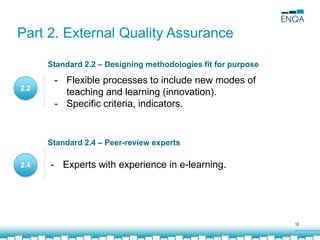
2.2
2.4
- Flexible processes to include new modes of
teaching and learning (innovation).
- Specific criteria, indicators.
- Experts with experience in e-learning.
Part 2. External Quality Assurance
Standard 2.2 – Designing methodologies fit for purpose
Standard 2.4 – Peer-review experts
13
- E-learning provisions fulfil the same standards (ESG) as
traditional ones.
- The work of ENQA’s WG should be discussed through
different stakeholders.
- There are challenges from HEIs, government and QAA point
of view.
Conclusions
14
Thank you!

[EADTU-ENQA PLA] Recommendations for QA of e-learning

  • 1.
    Recommendations for QAof e-learning ENQA WG on QA and e-learning Esther Huertas (Chair) 21/09/2017 1
  • 2.
    2 Index 1. ENQA WGon QA and e-learning 2. QA in European higher education area 3. Part 1. Internal quality assurance 4. Part 2. External quality assurance 5. Conclusions
  • 3.
    3 ENQA WG onQA and e-learning Objectives - Create an inventory of sources on QA and e-Learning. - Agree on definition of e-learning. - Agree on recommendations (QAA and HEIs). Members Esther Huertas (chair), Lindsey Kerber (secretary) Pranas Stankus, Georg Seppmann, Sandra Marcos, Ana Capilla, Ivan Biscan, Charlotte Ejsing, Liza Kozlowska, Liia Lauri, Monika Risse, Kerstin Schoerg Calendar November 2016 – November 2018
  • 4.
    4 Quality Assurance inthe European Higher Education Area • Generic, not specific  provide the framework and common basis for national and institutional activities. • Standards and guidelines for QA, not quality as such. • Apply to all higher education offered in the EHEA regardless of the mode of study or place of delivery (TNE, e-learning, short courses…). • Thus all types of e-learning included as well as all phases included in a learning process (e-assessment). • Apply to all types of QA activities and agencies (quality audits, programme accreditation, institutional assessment...). • Quality assurance can serve a variety of purposes: enhancement – accountability.
  • 5.
    5 1 2 3 PART 1. INTERNAL QUALITYASSURANCE PART 2. EXTERNAL QUALITY ASSURANCE PART 3. QUALITY ASSURANCE AGENCIES European Standards and Guidelines All standards are fully applicable to e-learning provision
  • 6.
    6 Part 1. InternalQuality Assurance Standard 1.1 – Policy for quality assurance Standard 1.2 – Design and approval of programme Standard 1.3 – Student-centred learning, teaching and assessment Standard 1.4 – Student admission, progression, recognition and certification Standard 1.5 – Teaching staff Standard 1.6 – Learning resources and student support Standard 1.7 – Information management Standard 1.8 – Public information Standard 1.9 – On-going monitoring and periodic review of programmes Standard 1.10 – Cyclical external quality assurance
  • 7.
    7 Part 1. InternalQuality Assurance Standard 1.1 – Policy for quality assurance Standard 1.2 – Design and approval of programme Standard 1.3 – Student-centred learning, teaching and assessment Standard 1.4 – Student admission, progression, recognition and certification Standard 1.5 – Teaching staff Standard 1.6 – Learning resources and student support Standard 1.7 – Information management Standard 1.8 – Public information Standard 1.9 – On-going monitoring and periodic review of programmes Standard 1.10 – Cyclical external quality assurance
  • 8.
    8 Part 1. InternalQuality Assurance 1.1 1.3 - Ensure that e-learning is strategic at the institution (‘new providers’). - Pedagogical model and innovation should be part of institutional strategy. - Institutional policies should cover the constituent’s elements of quality; course development; teaching and learning; course structure; student support; faculty support; technology; student assessment; examination security. - Instructional design (innovation). - E-assessment (authorship and authentication). Standard 1.1 – Policy for quality assurance Standard 1.3 – Student-centred learning, teaching and assessment
  • 9.
    9 Part 1. InternalQuality Assurance 1.5 1.6 1.4 - Same level of recognition by professional bodies & employers as face to face programmes. - Fraud / Diploma mills. - Different structure: authors, tutors, instructors, managers. - Qualification, knowledge, skills. - Support system for teaching staff. - Student support (prevent drop out rate). Standard 1.4 – Student admission, progression, recognition and certification Standard 1.5 – Teaching staff Standard 1.6 – Learning resources and student support
  • 10.
    10 Part 2. ExternalQuality Assurance Standard 2.1 – Consideration of internal quality assurance Standard 2.2 – Designing methodologies fit for purpose Standard 2.3 – Implementing processes Standard 2.4 – Peer-review experts Standard 2.5 – Criteria for outcomes Standard 2.6 – Reporting Standard 2.7 – Complaints and appeals
  • 11.
    11 Part 2. ExternalQuality Assurance Standard 2.1 – Consideration of internal quality assurance Standard 2.2 – Designing methodologies fit for purpose Standard 2.3 – Implementing processes Standard 2.4 – Peer-review experts Standard 2.5 – Criteria for outcomes Standard 2.6 – Reporting Standard 2.7 – Complaints and appeals
  • 12.
    12 2.2 2.4 - Flexible processesto include new modes of teaching and learning (innovation). - Specific criteria, indicators. - Experts with experience in e-learning. Part 2. External Quality Assurance Standard 2.2 – Designing methodologies fit for purpose Standard 2.4 – Peer-review experts
  • 13.
    13 - E-learning provisionsfulfil the same standards (ESG) as traditional ones. - The work of ENQA’s WG should be discussed through different stakeholders. - There are challenges from HEIs, government and QAA point of view. Conclusions
  • 14.
  • 15.