Revised Math teaching plans within STEM curricula
Anushavan Makaryan
ANQA
Joint MathGeAr/MetaMath
Workshop on Math-Bridge enabled Teaching Strategies and
Development of Educational Materials in Math-Bridge, 30.11 –
03.12.2015, DFKI, Saarbrücken, Germany
 Activity 2.1 Curricula modernization
Each partner University will select one BSc and MSci curricula from the
STEM spectrum.
The working group formed in every partner University from Math
Departments and STEM departments will revise the math component of
the curricula using knowledge and recommendations obtained within WP1 /
SEFI competences/.
Central focal points: baseline math competencies; target math
competencies; content; etc. Documenting. Internal evaluation and quality
control.
6/7/2016
2
ANQA
6/7/2016
3
ANQA
Recommendations for compliance with national
standards and Bologna principles
MathGeAr Project
Curricular Evaluation Workshop #3 ,
Yerevan, 27-29 April, 2015
Learning Outcomes Approach to Higher Education: Some Principles
6/7/2016
4
ANQA
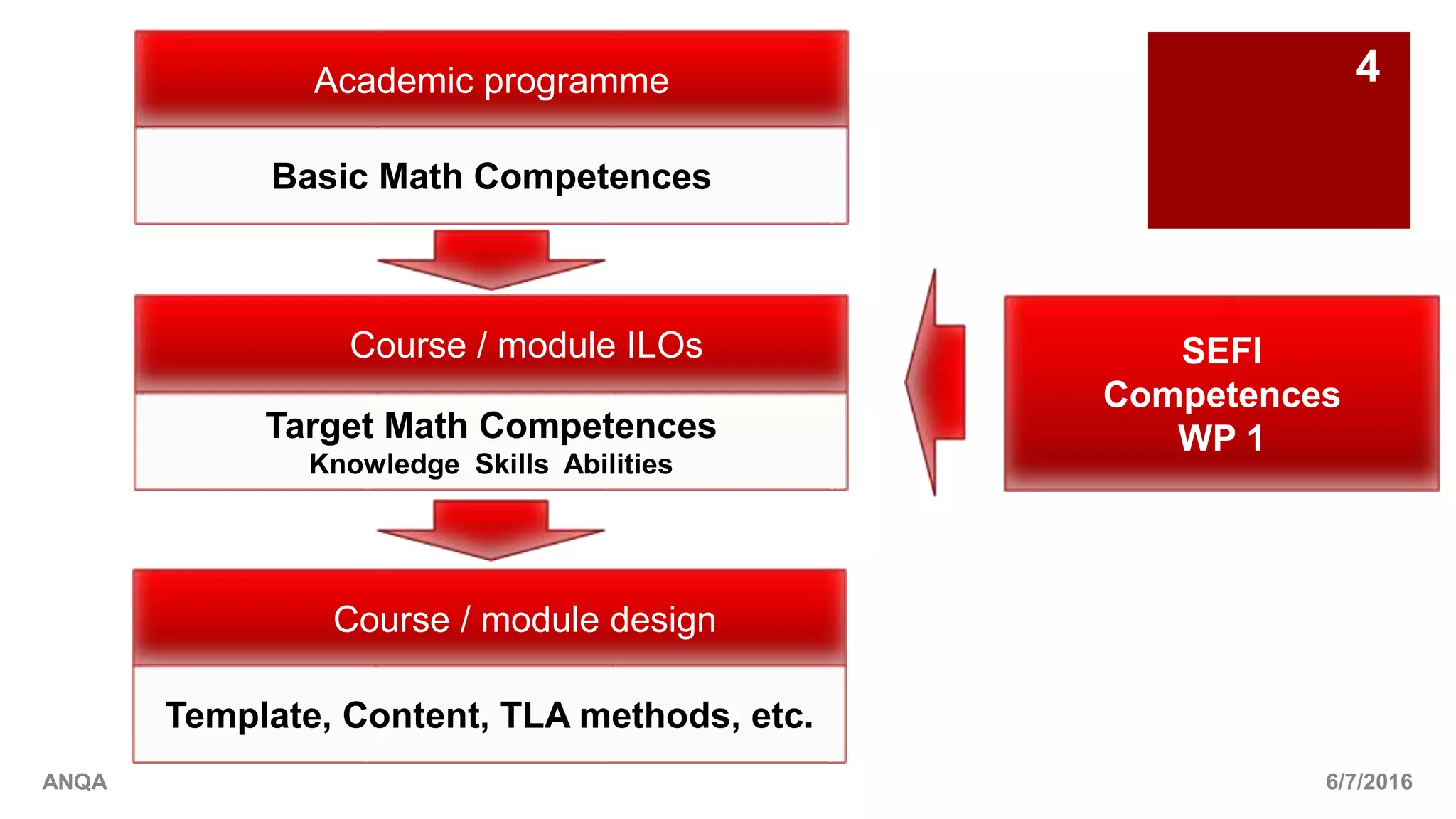
Academic programme
Basic Math Competences
Course / module ILOs
Target Math Competences
Knowledge Skills Abilities
Course / module design
Template, Content, TLA methods, etc.
SEFI
Competences
WP 1
Institutional Accreditation
 ACADEMIC PROGRAM STRUCTURE
Procedures on new academic programs, courses and modules development and approval should
include a clear and comprehensive process, which alleges that following is discussed and described:
 objectives, subject and modules of the academic program,
 intended learning outcomes of the program as well as of each course and of the course module,
 compliance of the plan with the stated objectives and the intended learning outcomes ,
 learning mode/ full-time, part-time, distance/ and load expressed by ECTS credits,
 teaching and learning methods in compliance with the learning outcomes,
6/7/2016
5
ANQA
Institutional Accreditation
 ACADEMIC PROGRAM STRUCTURE
Procedures on new academic programs, courses and modules development and approval should
include a clear and comprehensive process, which alleges that following is discussed and described:
 program compliance with the needs of Armenian, European and international labour market,
 required information resources,
 fair, well-grounded and standards’ corresponding embedded mechanisms of student assessment,
 sufficient mechanisms of students’ admission, progress and transfer, diploma supplement in
accordance with the National Qualifications Framework and the like.
6/7/2016
6
ANQA
Programm Accreditation
1. ACADEMIC PROGRAMME DESIGN AND APPROVAL
1.3. The academic programme is thoroughly formulated according to intended
learning outcomes.
1.5. The programmes of the TLI are contextually coherent with other relevant
programmes and promote mobility of students and staff as well as
internationalization.
6/7/2016
7
ANQA
Programm Accreditation
3. TEACHING AND LEARNING PRACTICES
3.1. The academic programme clearly defines the teaching and learning
approaches necessary to achieve the intended learning outcomes.
3.2. The academic programme ensures the implementation of progressive
approaches accepted at international level.
6/7/2016
8
ANQA
Programm Accreditation
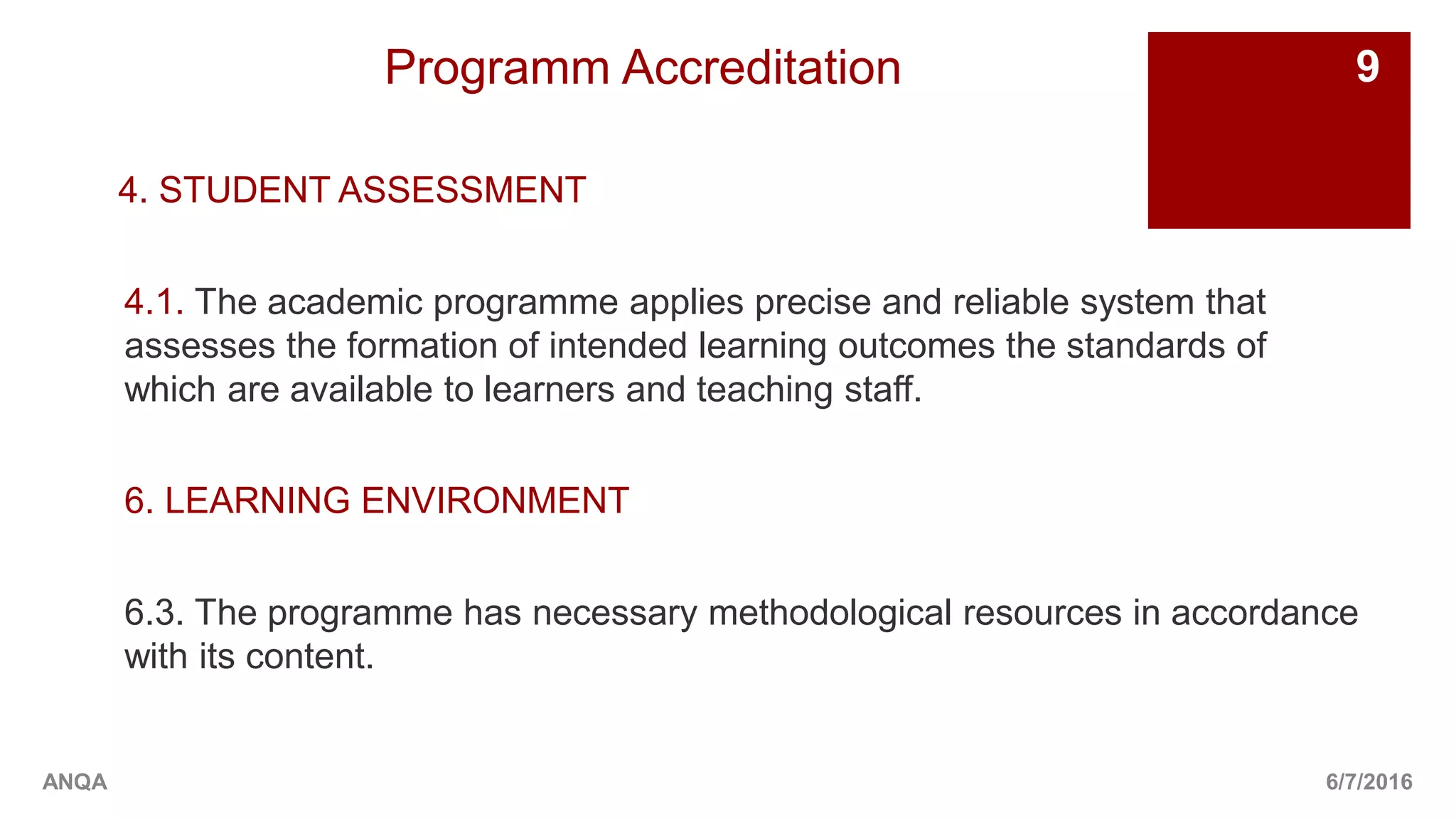
4. STUDENT ASSESSMENT
4.1. The academic programme applies precise and reliable system that
assesses the formation of intended learning outcomes the standards of
which are available to learners and teaching staff.
6. LEARNING ENVIRONMENT
6.3. The programme has necessary methodological resources in accordance
with its content.
6/7/2016
9
ANQA
6/7/2016
10
ANQA
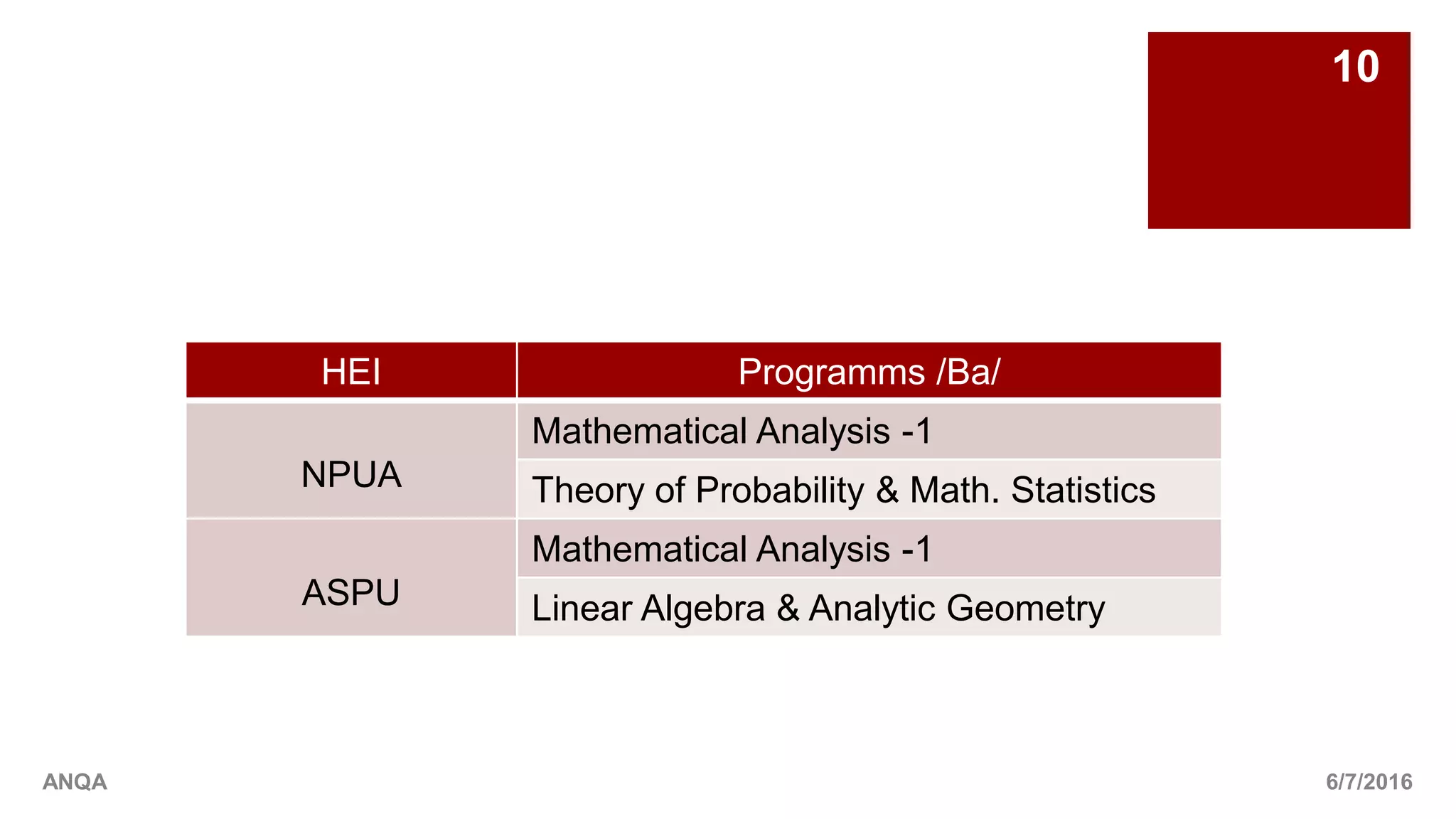
HEI Programms /Ba/
NPUA
Mathematical Analysis -1
Theory of Probability & Math. Statistics
ASPU
Mathematical Analysis -1
Linear Algebra & Analytic Geometry
6/7/2016
11
ANQA
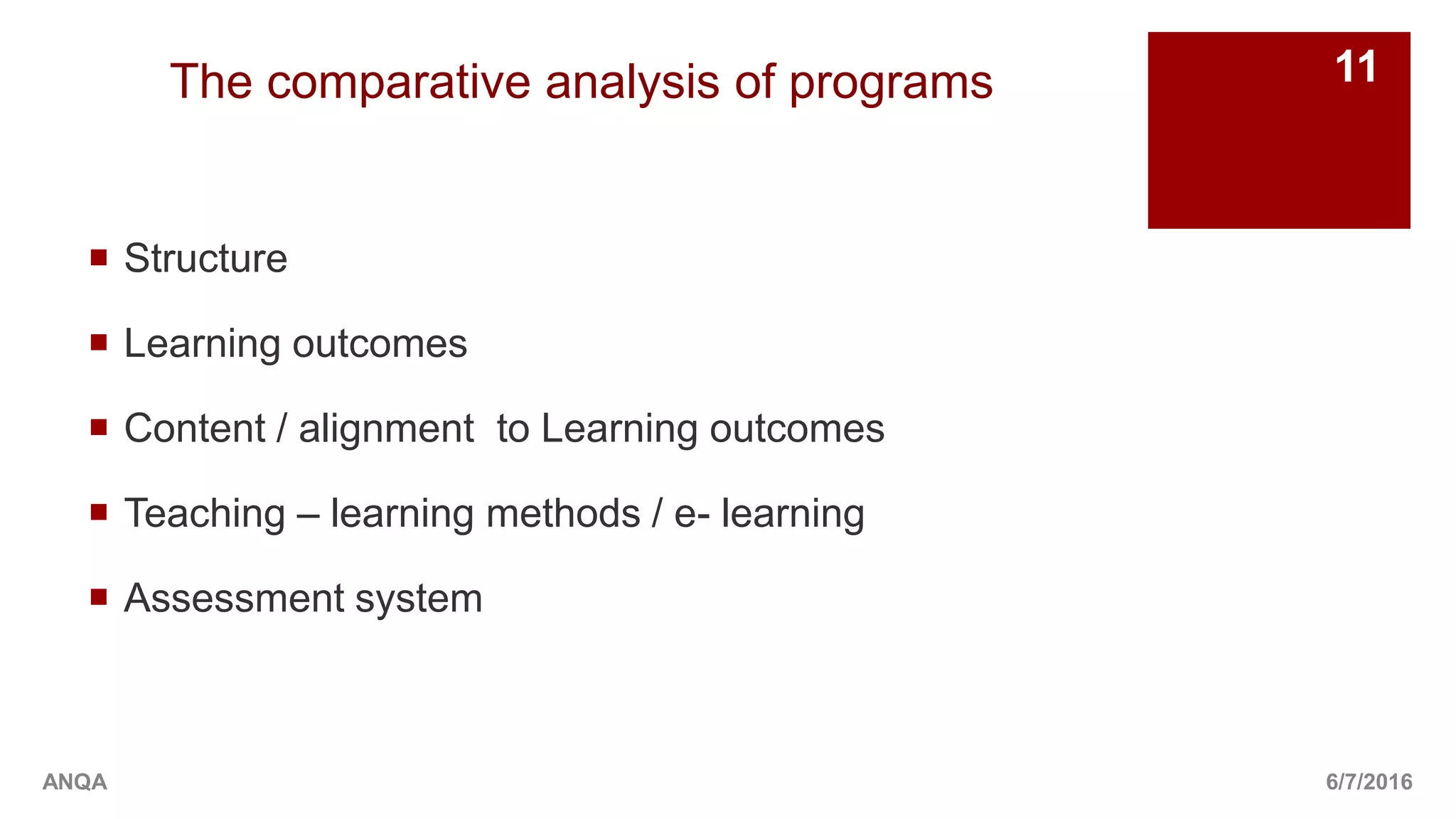
 Structure
 Learning outcomes
 Content / alignment to Learning outcomes
 Teaching – learning methods / e- learning
 Assessment system
The comparative analysis of programs
6/7/2016
12
ANQA
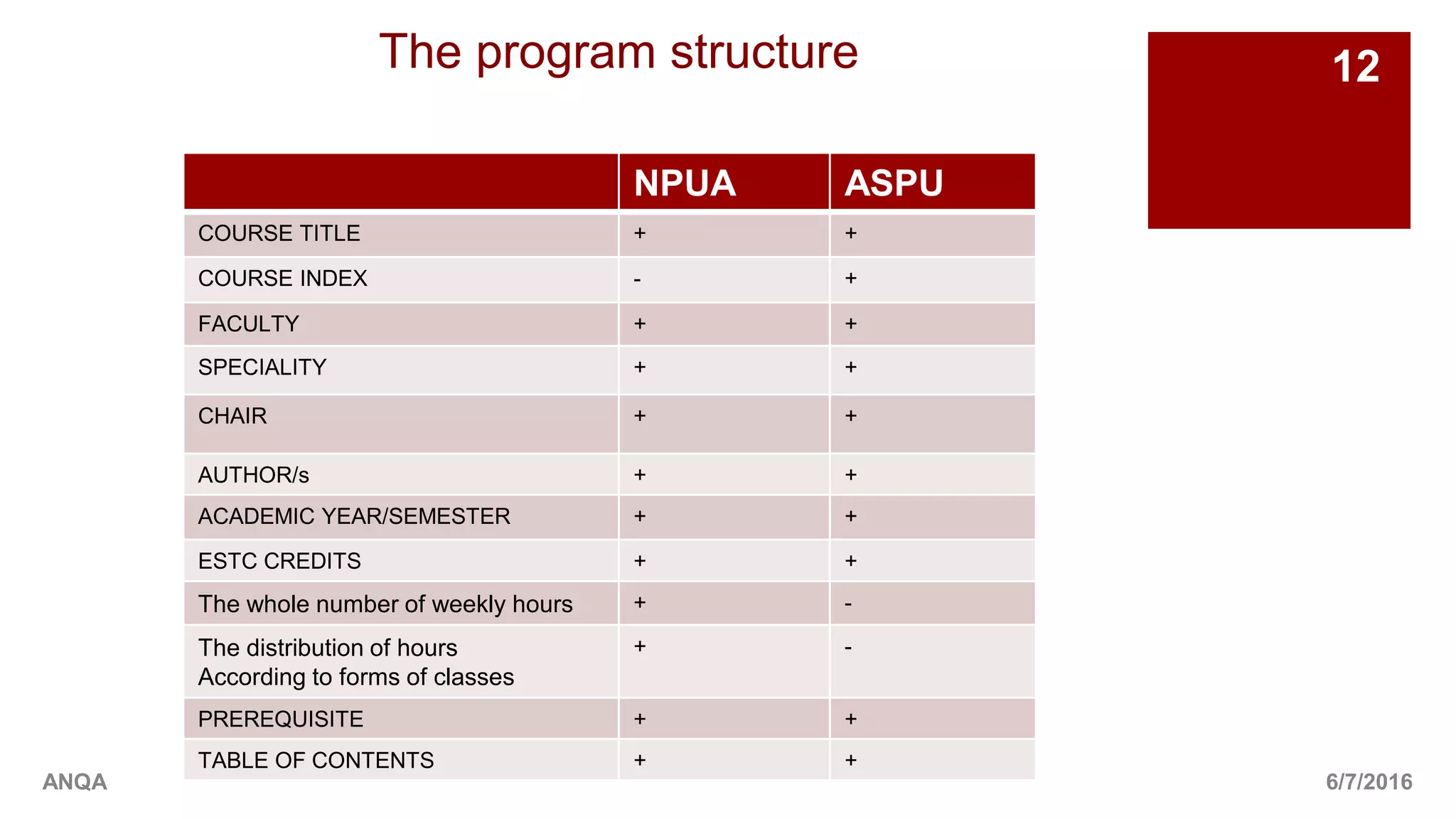
The program structure
NPUA ASPU
COURSE TITLE + +
COURSE INDEX - +
FACULTY + +
SPECIALITY + +
CHAIR + +
AUTHOR/s + +
ACADEMIC YEAR/SEMESTER + +
ESTC CREDITS + +
The whole number of weekly hours + -
The distribution of hours
According to forms of classes
+ -
PREREQUISITE + +
TABLE OF CONTENTS + +
6/7/2016
13
ANQA
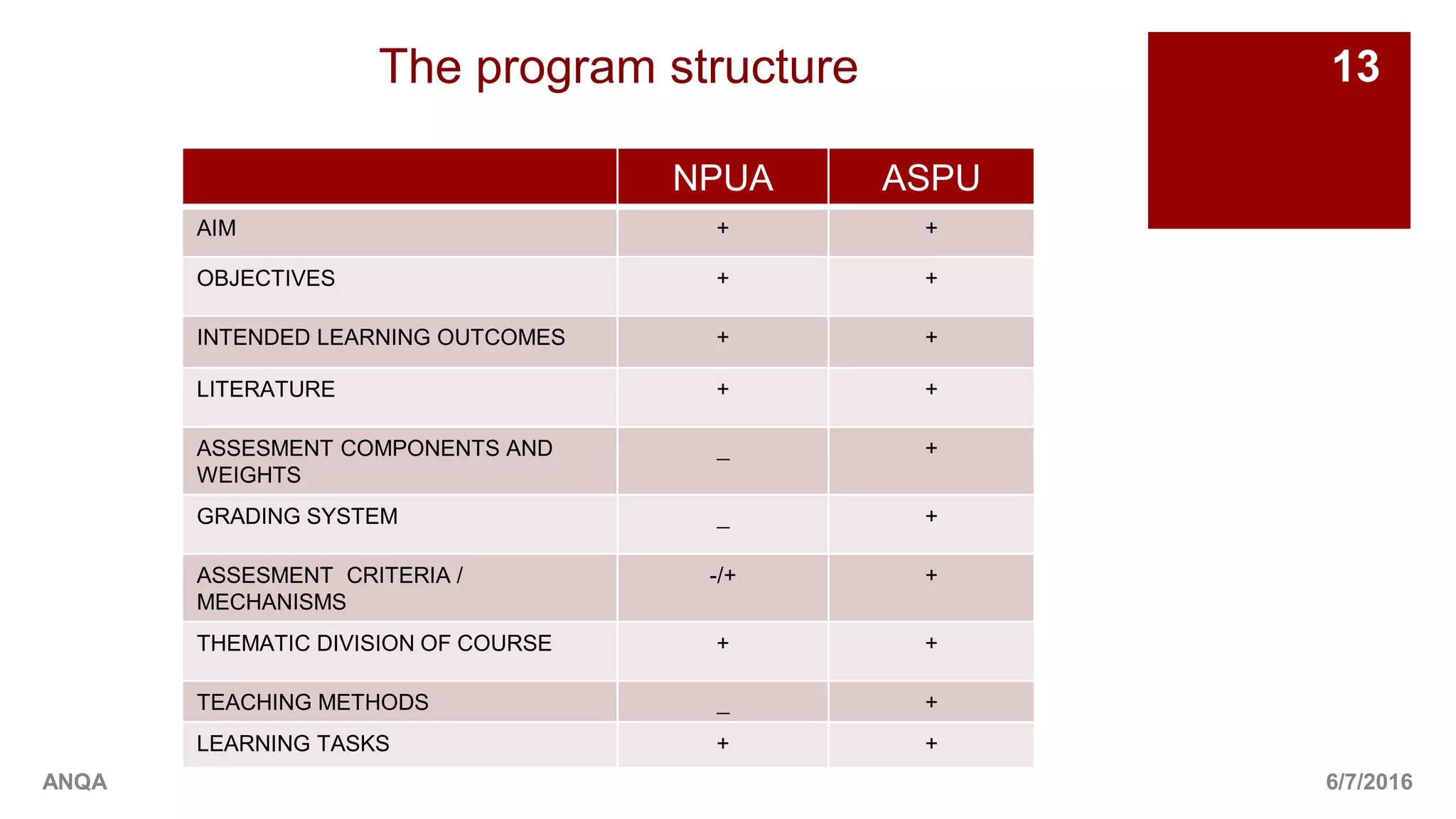
The program structure
NPUA ASPU
AIM + +
OBJECTIVES + +
INTENDED LEARNING OUTCOMES + +
LITERATURE + +
ASSESMENT COMPONENTS AND
WEIGHTS
_ +
GRADING SYSTEM _ +
ASSESMENT CRITERIA /
MECHANISMS
-/+ +
THEMATIC DIVISION OF COURSE + +
TEACHING METHODS _ +
LEARNING TASKS + +
6/7/2016
14
ANQA
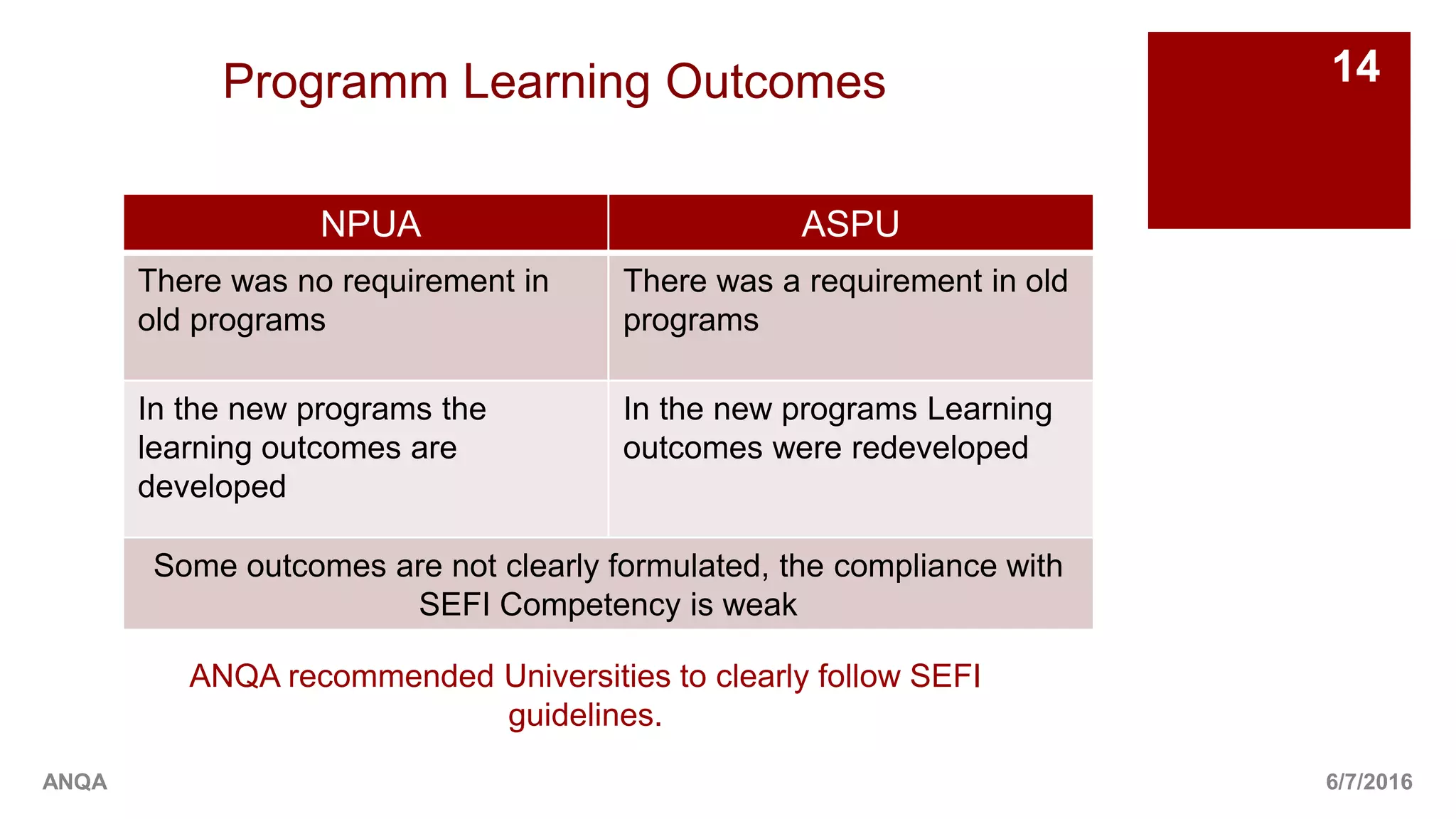
Programm Learning Outcomes
NPUA ASPU
There was no requirement in
old programs
There was a requirement in old
programs
In the new programs the
learning outcomes are
developed
In the new programs Learning
outcomes were redeveloped
Some outcomes are not clearly formulated, the compliance with
SEFI Competency is weak
ANQA recommended Universities to clearly follow SEFI
guidelines.
6/7/2016
15
ANQA
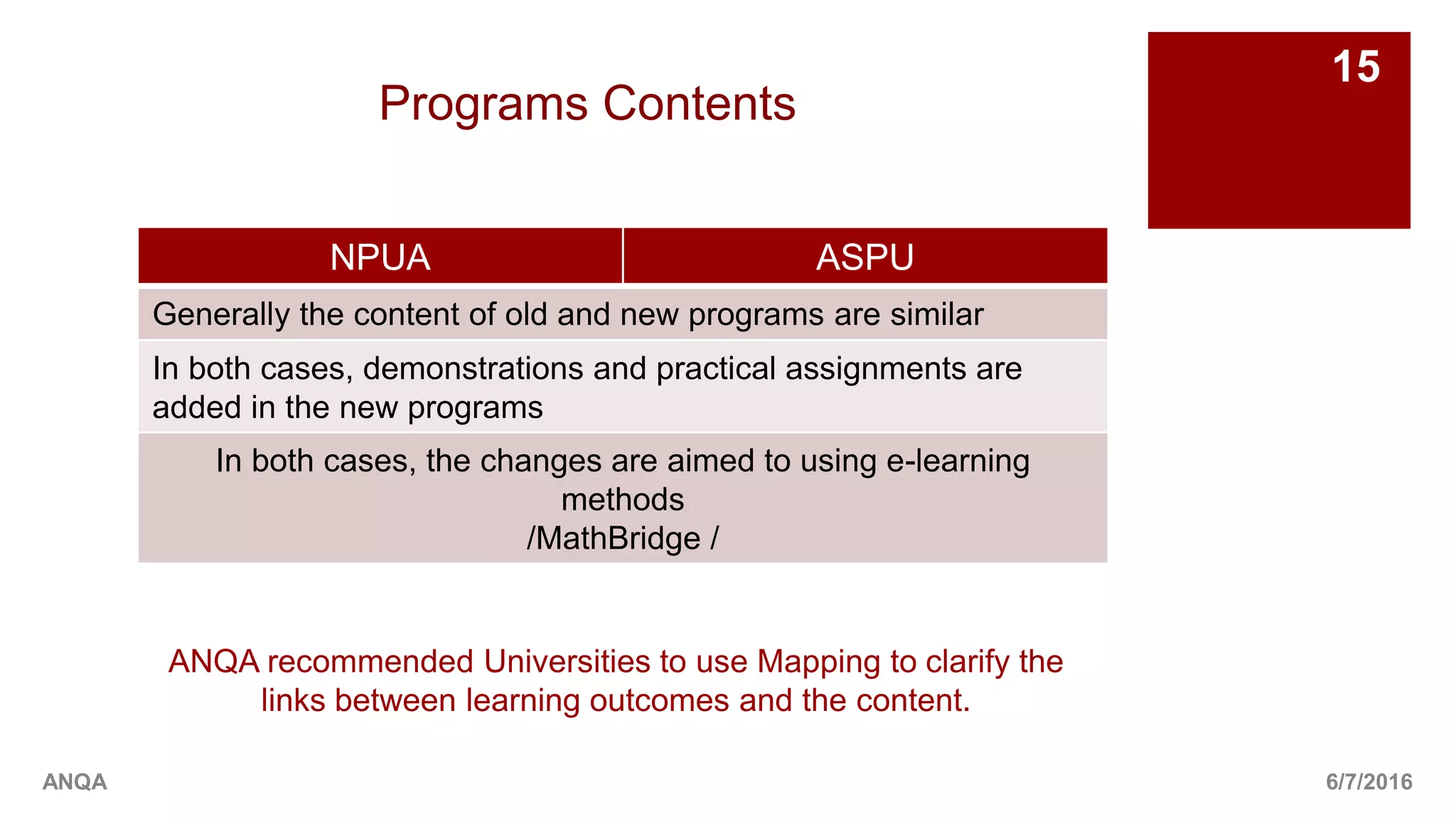
Programs Contents
NPUA ASPU
Generally the content of old and new programs are similar
In both cases, demonstrations and practical assignments are
added in the new programs
In both cases, the changes are aimed to using e-learning
methods
/MathBridge /
ANQA recommended Universities to use Mapping to clarify the
links between learning outcomes and the content.
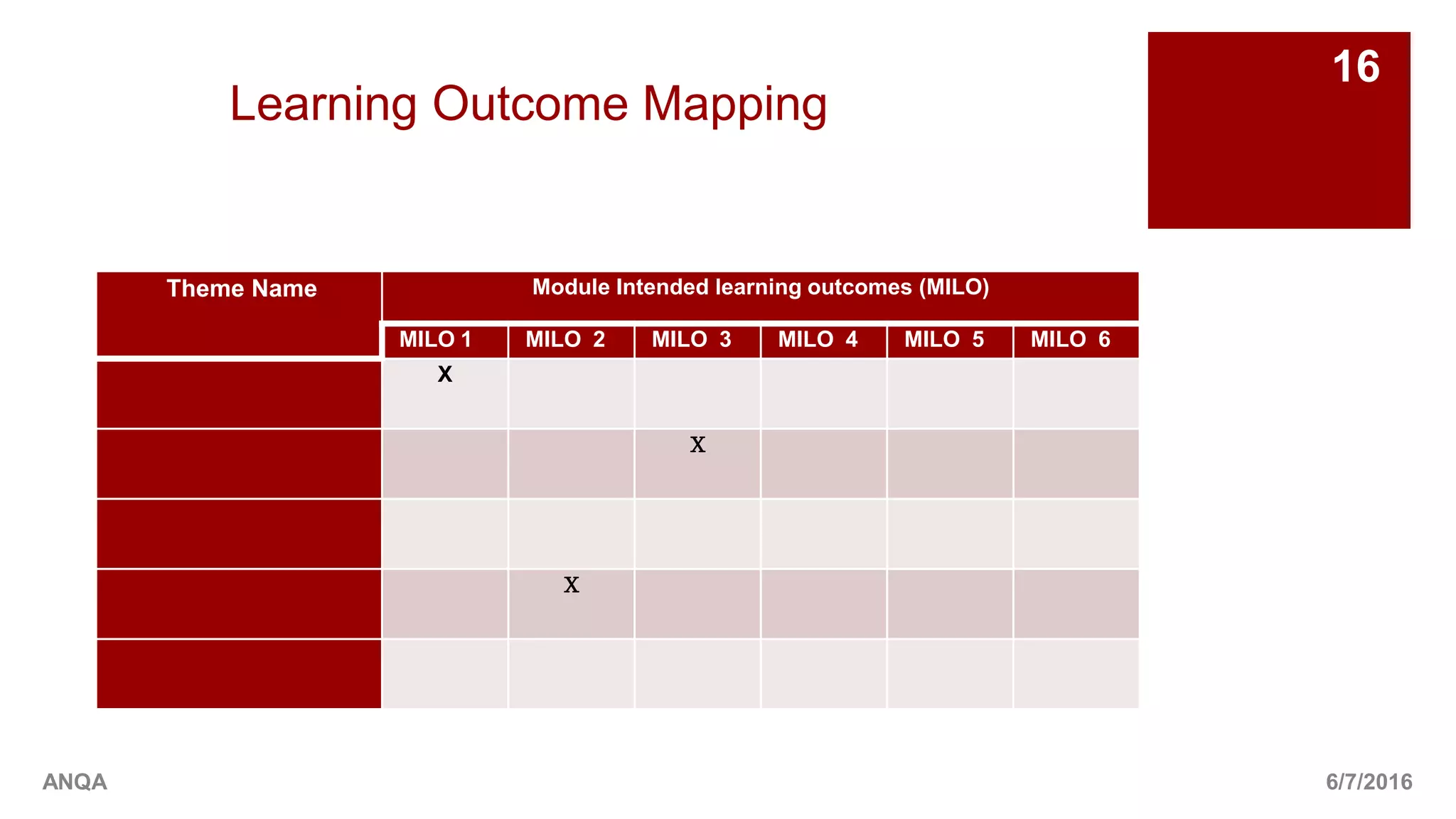
Learning Outcome Mapping
Theme Name Module Intended learning outcomes (MILO)
MILO 1 MILO 2 MILO 3 MILO 4 MILO 5 MILO 6
X
X
X
6/7/2016ANQA
16
6/7/2016
17
ANQA
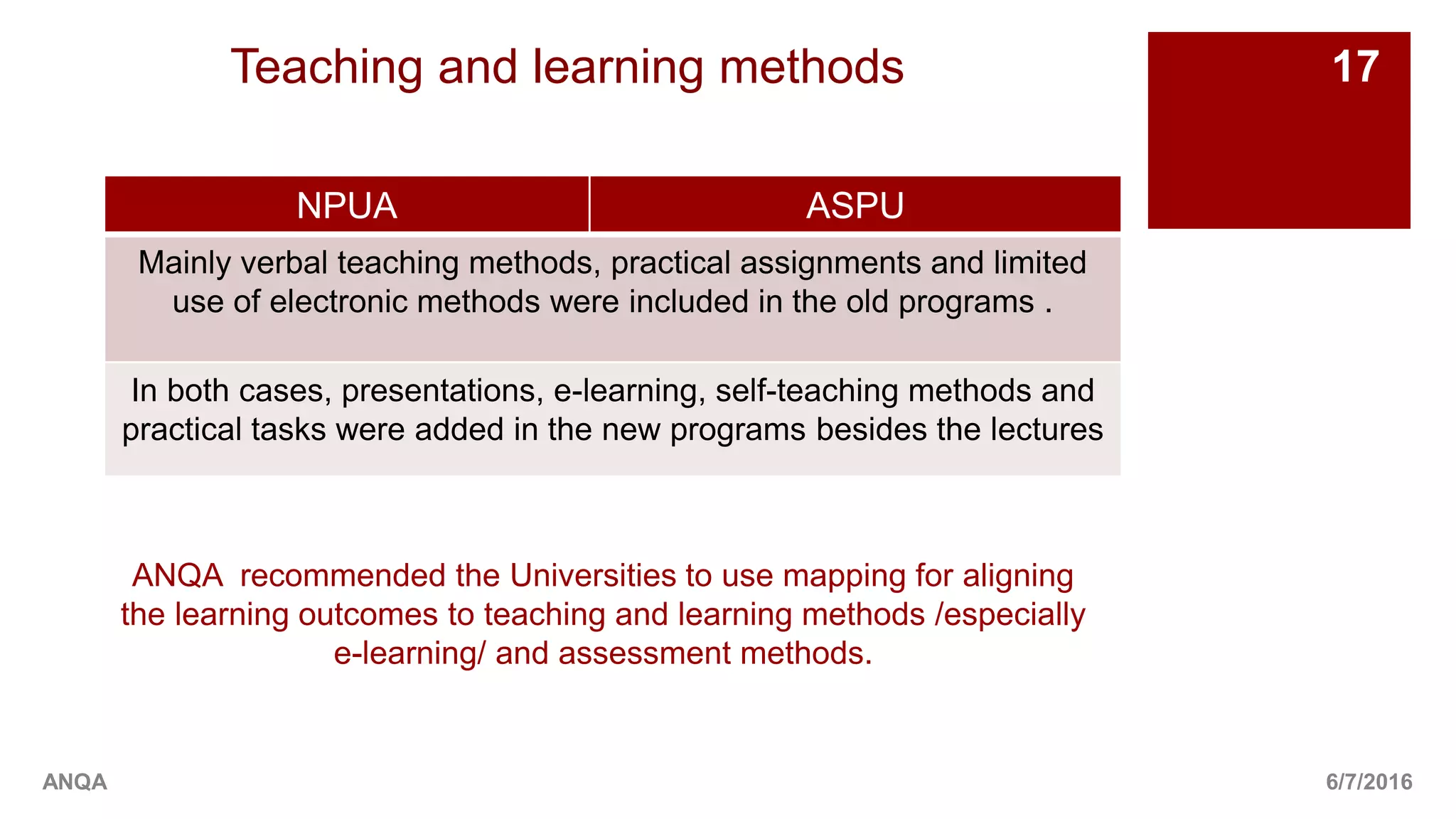
Teaching and learning methods
NPUA ASPU
Mainly verbal teaching methods, practical assignments and limited
use of electronic methods were included in the old programs .
In both cases, presentations, e-learning, self-teaching methods and
practical tasks were added in the new programs besides the lectures
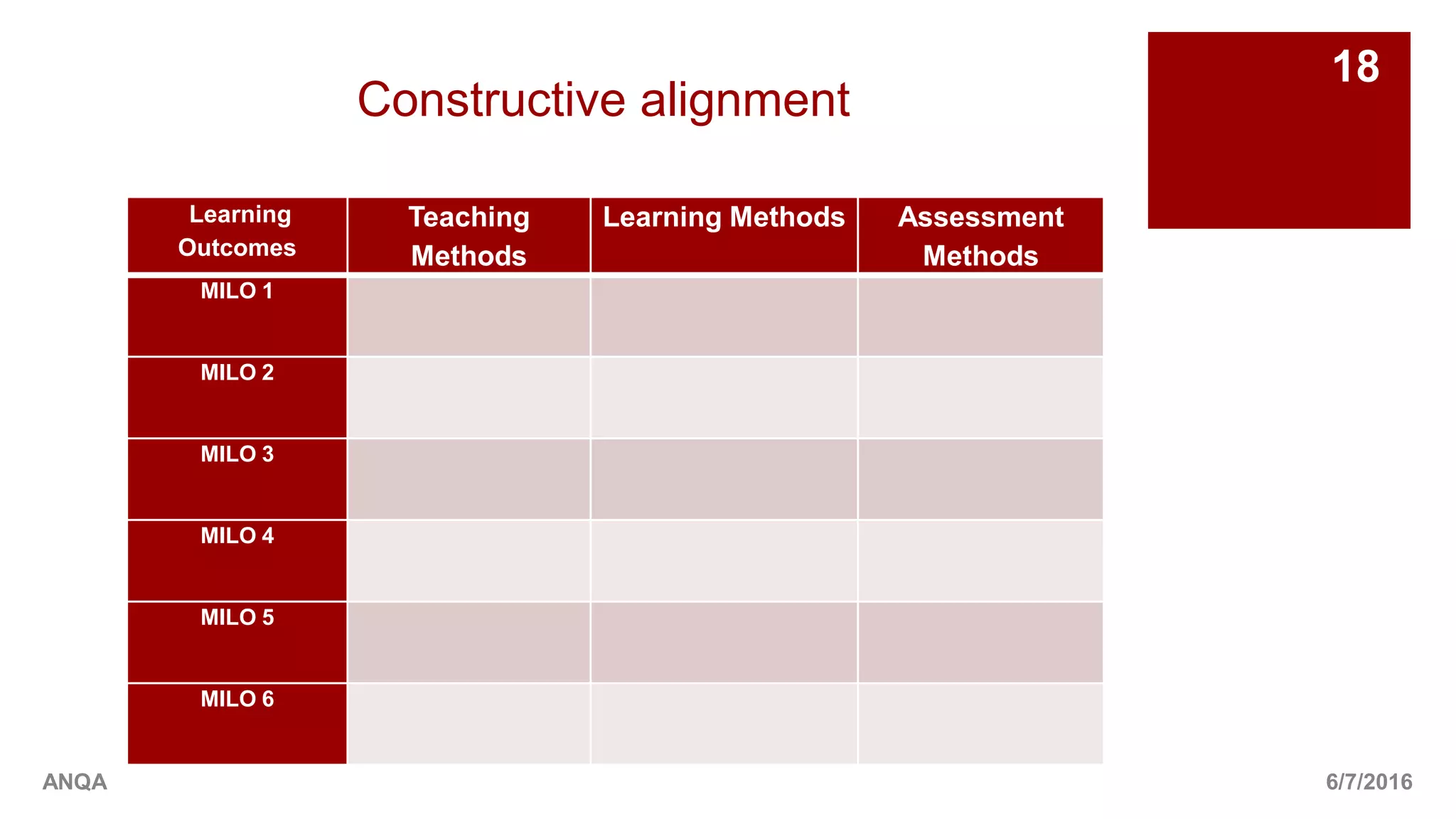
ANQA recommended the Universities to use mapping for aligning
the learning outcomes to teaching and learning methods /especially
e-learning/ and assessment methods.
Learning
Outcomes
Teaching
Methods
Learning Methods Assessment
Methods
MILO 1
MILO 2
MILO 3
MILO 4
MILO 5
MILO 6
6/7/2016ANQA
18
Constructive alignment
THANK YOU
a.makaryan@anqa.am
info@anqa.am
www.anqa.am
6/7/2016
19
ANQA

Revised Math teaching plans with STEM curricula

  • 1.
    Revised Math teachingplans within STEM curricula Anushavan Makaryan ANQA Joint MathGeAr/MetaMath Workshop on Math-Bridge enabled Teaching Strategies and Development of Educational Materials in Math-Bridge, 30.11 – 03.12.2015, DFKI, Saarbrücken, Germany
  • 2.
     Activity 2.1Curricula modernization Each partner University will select one BSc and MSci curricula from the STEM spectrum. The working group formed in every partner University from Math Departments and STEM departments will revise the math component of the curricula using knowledge and recommendations obtained within WP1 / SEFI competences/. Central focal points: baseline math competencies; target math competencies; content; etc. Documenting. Internal evaluation and quality control. 6/7/2016 2 ANQA
  • 3.
    6/7/2016 3 ANQA Recommendations for compliancewith national standards and Bologna principles MathGeAr Project Curricular Evaluation Workshop #3 , Yerevan, 27-29 April, 2015 Learning Outcomes Approach to Higher Education: Some Principles
  • 4.
    6/7/2016 4 ANQA Academic programme Basic MathCompetences Course / module ILOs Target Math Competences Knowledge Skills Abilities Course / module design Template, Content, TLA methods, etc. SEFI Competences WP 1
  • 5.
    Institutional Accreditation  ACADEMICPROGRAM STRUCTURE Procedures on new academic programs, courses and modules development and approval should include a clear and comprehensive process, which alleges that following is discussed and described:  objectives, subject and modules of the academic program,  intended learning outcomes of the program as well as of each course and of the course module,  compliance of the plan with the stated objectives and the intended learning outcomes ,  learning mode/ full-time, part-time, distance/ and load expressed by ECTS credits,  teaching and learning methods in compliance with the learning outcomes, 6/7/2016 5 ANQA
  • 6.
    Institutional Accreditation  ACADEMICPROGRAM STRUCTURE Procedures on new academic programs, courses and modules development and approval should include a clear and comprehensive process, which alleges that following is discussed and described:  program compliance with the needs of Armenian, European and international labour market,  required information resources,  fair, well-grounded and standards’ corresponding embedded mechanisms of student assessment,  sufficient mechanisms of students’ admission, progress and transfer, diploma supplement in accordance with the National Qualifications Framework and the like. 6/7/2016 6 ANQA
  • 7.
    Programm Accreditation 1. ACADEMICPROGRAMME DESIGN AND APPROVAL 1.3. The academic programme is thoroughly formulated according to intended learning outcomes. 1.5. The programmes of the TLI are contextually coherent with other relevant programmes and promote mobility of students and staff as well as internationalization. 6/7/2016 7 ANQA
  • 8.
    Programm Accreditation 3. TEACHINGAND LEARNING PRACTICES 3.1. The academic programme clearly defines the teaching and learning approaches necessary to achieve the intended learning outcomes. 3.2. The academic programme ensures the implementation of progressive approaches accepted at international level. 6/7/2016 8 ANQA
  • 9.
    Programm Accreditation 4. STUDENTASSESSMENT 4.1. The academic programme applies precise and reliable system that assesses the formation of intended learning outcomes the standards of which are available to learners and teaching staff. 6. LEARNING ENVIRONMENT 6.3. The programme has necessary methodological resources in accordance with its content. 6/7/2016 9 ANQA
  • 10.
    6/7/2016 10 ANQA HEI Programms /Ba/ NPUA MathematicalAnalysis -1 Theory of Probability & Math. Statistics ASPU Mathematical Analysis -1 Linear Algebra & Analytic Geometry
  • 11.
    6/7/2016 11 ANQA  Structure  Learningoutcomes  Content / alignment to Learning outcomes  Teaching – learning methods / e- learning  Assessment system The comparative analysis of programs
  • 12.
    6/7/2016 12 ANQA The program structure NPUAASPU COURSE TITLE + + COURSE INDEX - + FACULTY + + SPECIALITY + + CHAIR + + AUTHOR/s + + ACADEMIC YEAR/SEMESTER + + ESTC CREDITS + + The whole number of weekly hours + - The distribution of hours According to forms of classes + - PREREQUISITE + + TABLE OF CONTENTS + +
  • 13.
    6/7/2016 13 ANQA The program structure NPUAASPU AIM + + OBJECTIVES + + INTENDED LEARNING OUTCOMES + + LITERATURE + + ASSESMENT COMPONENTS AND WEIGHTS _ + GRADING SYSTEM _ + ASSESMENT CRITERIA / MECHANISMS -/+ + THEMATIC DIVISION OF COURSE + + TEACHING METHODS _ + LEARNING TASKS + +
  • 14.
    6/7/2016 14 ANQA Programm Learning Outcomes NPUAASPU There was no requirement in old programs There was a requirement in old programs In the new programs the learning outcomes are developed In the new programs Learning outcomes were redeveloped Some outcomes are not clearly formulated, the compliance with SEFI Competency is weak ANQA recommended Universities to clearly follow SEFI guidelines.
  • 15.
    6/7/2016 15 ANQA Programs Contents NPUA ASPU Generallythe content of old and new programs are similar In both cases, demonstrations and practical assignments are added in the new programs In both cases, the changes are aimed to using e-learning methods /MathBridge / ANQA recommended Universities to use Mapping to clarify the links between learning outcomes and the content.
  • 16.
    Learning Outcome Mapping ThemeName Module Intended learning outcomes (MILO) MILO 1 MILO 2 MILO 3 MILO 4 MILO 5 MILO 6 X X X 6/7/2016ANQA 16
  • 17.
    6/7/2016 17 ANQA Teaching and learningmethods NPUA ASPU Mainly verbal teaching methods, practical assignments and limited use of electronic methods were included in the old programs . In both cases, presentations, e-learning, self-teaching methods and practical tasks were added in the new programs besides the lectures ANQA recommended the Universities to use mapping for aligning the learning outcomes to teaching and learning methods /especially e-learning/ and assessment methods.
  • 18.
    Learning Outcomes Teaching Methods Learning Methods Assessment Methods MILO1 MILO 2 MILO 3 MILO 4 MILO 5 MILO 6 6/7/2016ANQA 18 Constructive alignment
  • 19.

Editor's Notes

  • #2 Պարզաբանում. Կանաչ գույնով ընդծված են այն բառերը, որոնք փոփոխության են ենթարկվել: Կապույտով նշվածները ինձ համար անհասկանալի կամ տարակուսանք առաջացնող բառեր կամ մտքեր են: Մեկնաբանություններն արվել են համապատասխան լուսապատկերների վերջում:
  • #3 Այստեղ կարելի է հստակեցնել (հպանցիկորեն) սահմանումները՝ բուն նյութին անցնելը սահուն դարձնելու համար: Կարելի է նաև կարճ հարցադրումներով պարզել ունկնդիրների՝ խնդրի վերաբերյալ իմացության մակարդակը:
  • #4 Մասսայականացումը որպես հետևանք գլոբալացման
  • #6 Այստեղ կարելի է հստակեցնել (հպանցիկորեն) սահմանումները՝ բուն նյութին անցնելը սահուն դարձնելու համար: Կարելի է նաև կարճ հարցադրումներով պարզել ունկնդիրների՝ խնդրի վերաբերյալ իմացության մակարդակը:
  • #7 Այստեղ կարելի է հստակեցնել (հպանցիկորեն) սահմանումները՝ բուն նյութին անցնելը սահուն դարձնելու համար: Կարելի է նաև կարճ հարցադրումներով պարզել ունկնդիրների՝ խնդրի վերաբերյալ իմացության մակարդակը:
  • #8 Այստեղ կարելի է հստակեցնել (հպանցիկորեն) սահմանումները՝ բուն նյութին անցնելը սահուն դարձնելու համար: Կարելի է նաև կարճ հարցադրումներով պարզել ունկնդիրների՝ խնդրի վերաբերյալ իմացության մակարդակը:
  • #9 Այստեղ կարելի է հստակեցնել (հպանցիկորեն) սահմանումները՝ բուն նյութին անցնելը սահուն դարձնելու համար: Կարելի է նաև կարճ հարցադրումներով պարզել ունկնդիրների՝ խնդրի վերաբերյալ իմացության մակարդակը:
  • #10 Այստեղ կարելի է հստակեցնել (հպանցիկորեն) սահմանումները՝ բուն նյութին անցնելը սահուն դարձնելու համար: Կարելի է նաև կարճ հարցադրումներով պարզել ունկնդիրների՝ խնդրի վերաբերյալ իմացության մակարդակը:
  • #11 Այստեղ կարելի է հստակեցնել (հպանցիկորեն) սահմանումները՝ բուն նյութին անցնելը սահուն դարձնելու համար: Կարելի է նաև կարճ հարցադրումներով պարզել ունկնդիրների՝ խնդրի վերաբերյալ իմացության մակարդակը:
  • #12 Այստեղ կարելի է հստակեցնել (հպանցիկորեն) սահմանումները՝ բուն նյութին անցնելը սահուն դարձնելու համար: Կարելի է նաև կարճ հարցադրումներով պարզել ունկնդիրների՝ խնդրի վերաբերյալ իմացության մակարդակը:
  • #13 Այստեղ կարելի է հստակեցնել (հպանցիկորեն) սահմանումները՝ բուն նյութին անցնելը սահուն դարձնելու համար: Կարելի է նաև կարճ հարցադրումներով պարզել ունկնդիրների՝ խնդրի վերաբերյալ իմացության մակարդակը:
  • #14 Այստեղ կարելի է հստակեցնել (հպանցիկորեն) սահմանումները՝ բուն նյութին անցնելը սահուն դարձնելու համար: Կարելի է նաև կարճ հարցադրումներով պարզել ունկնդիրների՝ խնդրի վերաբերյալ իմացության մակարդակը:
  • #15 Այստեղ կարելի է հստակեցնել (հպանցիկորեն) սահմանումները՝ բուն նյութին անցնելը սահուն դարձնելու համար: Կարելի է նաև կարճ հարցադրումներով պարզել ունկնդիրների՝ խնդրի վերաբերյալ իմացության մակարդակը:
  • #16 Այստեղ կարելի է հստակեցնել (հպանցիկորեն) սահմանումները՝ բուն նյութին անցնելը սահուն դարձնելու համար: Կարելի է նաև կարճ հարցադրումներով պարզել ունկնդիրների՝ խնդրի վերաբերյալ իմացության մակարդակը:
  • #18 Այստեղ կարելի է հստակեցնել (հպանցիկորեն) սահմանումները՝ բուն նյութին անցնելը սահուն դարձնելու համար: Կարելի է նաև կարճ հարցադրումներով պարզել ունկնդիրների՝ խնդրի վերաբերյալ իմացության մակարդակը: