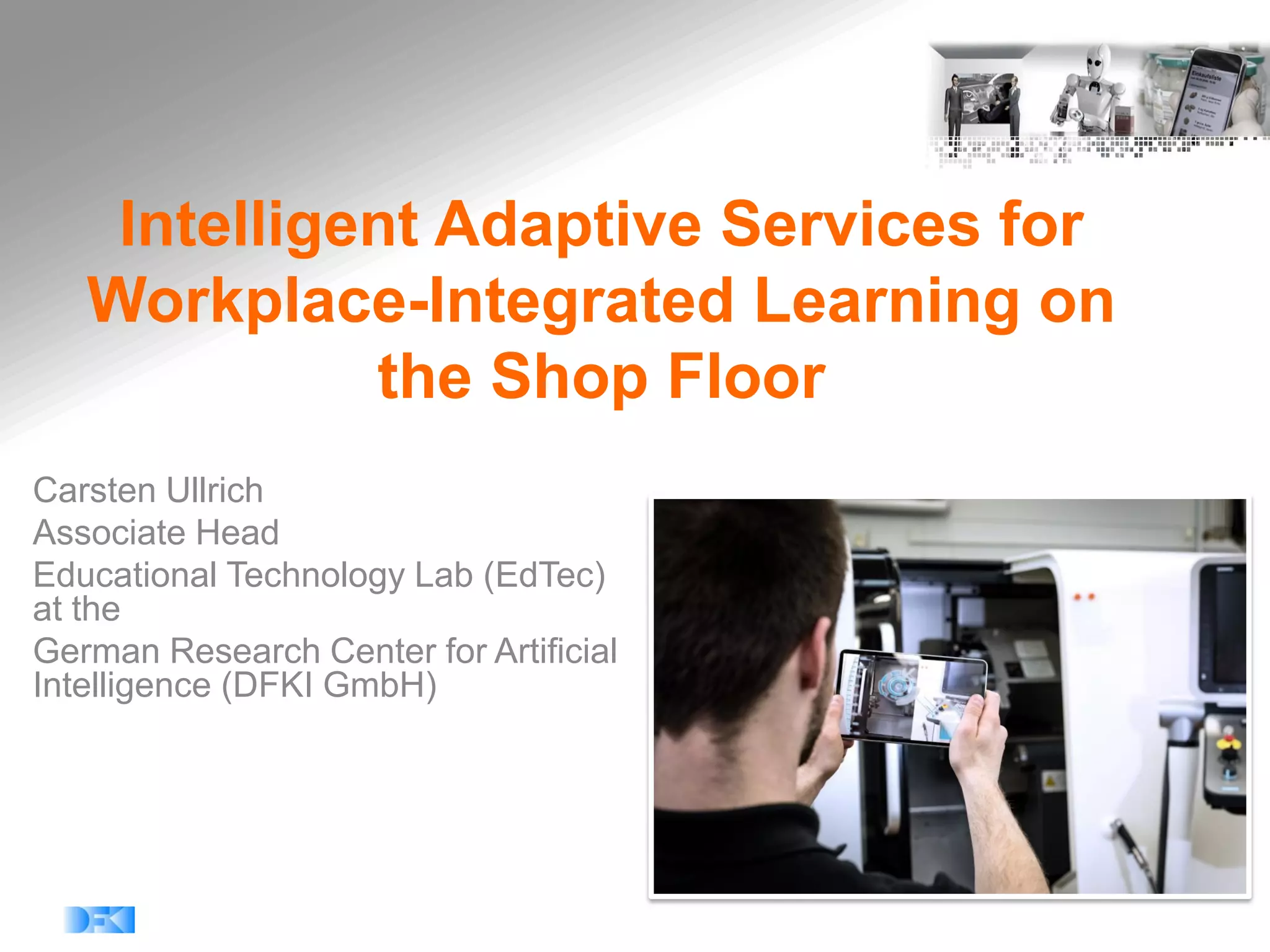
Intelligent Adaptive Services for
Workplace-Integrated Learning on
the Shop Floor
Carsten Ullrich
Associate Head
Educational Technology Lab (EdTec)
at the
German Research Center for Artificial
Intelligence (DFKI GmbH)
The Workplace is
Transforming
• Challenges for Europe's manufacturing industry:
– Accelerating innovation
– Shorter product cycles
– Ever increasing number of product variants
– Smaller batch sizes (batch size 1)
– … while keeping/increasing level of competitiveness
– … with fewer and fewer employees
23.05.2016Carsten Ullrich, Tempus Workshop
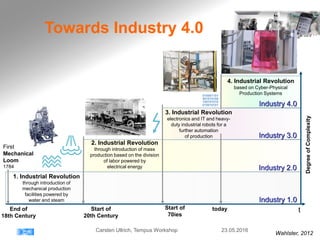
Towards Industry 4.0
tEnd of
18th Century
Start of
20th Century
First
Mechanical
Loom
1784
1. Industrial Revolution
through introduction of
mechanical production
facilities powered by
water and steam
2. Industrial Revolution
through introduction of mass
production based on the division
of labor powered by
electrical energy
Start of
70ies
4. Industrial Revolution
based on Cyber-Physical
Production Systems
today
010001101
001010100
100101010
010010101
Industry 1.0
Industry 2.0
Industry 3.0
Industry 4.0
DegreeofComplexity
3. Industrial Revolution
electronics and IT and heavy-
duty industrial robots for a
further automation
of production
Wahlster, 2012
23.05.2016Carsten Ullrich, Tempus Workshop
Cyber-Physical
(Production) Systems
• Cyber-physical system
– physical entity
– and its virtual representation
• Cyber-physical production system
– classic production technology
– virtual representations of all its parts: product, machines,
operator
• Not just physical interactions, but also software
– Machine and product communicate with each other
– Decentralized: factories optimize and control manufacturing
processes themselves
– The smart product, the smart machine and the augmented
operator
23.05.2016Carsten Ullrich, Tempus Workshop
Industry 4.0 / Smart
Manufacturing
• Transformation of Workplace is a reality, all
buzzwords aside
– Digitalization
– Internet of Things
• Seen as a change to transform the organization
of work
23.05.2016Carsten Ullrich, Tempus Workshop
Human Operators at
Tomorrow’s Workplace
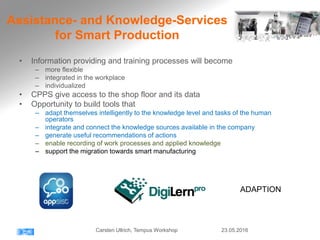
• Despite the increasing automation, human operators have
place on shop floor  with changed roles
• Technological innovation cannot be considered in isolation, but
requires an integrated approach drawing from technical,
organizational and human aspects.
• CPS and other new technologies increase complexity of
– usage and maintenance of production lines
– control of the production process
 Mastering this complexity and flexibility requires
• larger amounts of knowledge and
deeper job expertise than ever before
• other forms of organizing work:
teams that take responsibilities,
operate independently
23.05.2016Carsten Ullrich, Tempus Workshop (Hirsch-Kreinsen, 2014)
Assistance- and Knowledge-Services
for Smart Production
• Information providing and training processes will become
– more flexible
– integrated in the workplace
– individualized
• CPPS give access to the shop floor and its data
• Opportunity to build tools that
– adapt themselves intelligently to the knowledge level and tasks of the human
operators
– integrate and connect the knowledge sources available in the company
– generate useful recommendations of actions
– enable recording of work processes and applied knowledge
– support the migration towards smart manufacturing
ADAPTION
23.05.2016Carsten Ullrich, Tempus Workshop
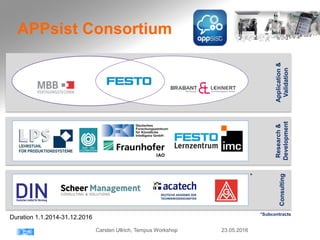
APPsist Consortium
Application&
Validation
Research&
Development
Consulting
*Subcontracts
*
Duration 1.1.2014-31.12.2016
23.05.2016Carsten Ullrich, Tempus Workshop
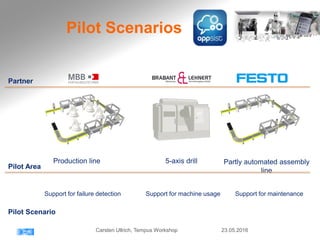
Partly automated assembly
line
Support for maintenance
5-axis drill
Support for machine usage
Pilot Scenarios
Partner
Pilot Area
Pilot Scenario
Production line
Support for failure detection
23.05.2016Carsten Ullrich, Tempus Workshop
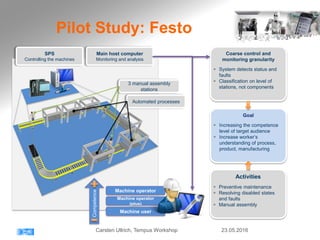
3 manual assembly
stations
Main host computer
Monitoring and analysis
SPS
Controlling the machines
Coarse control and
monitoring granularity
 System detects status and
faults
 Classification on level of
stations, not components
Activities
 Preventive maintenance
 Resolving disabled states
and faults
 Manual assembly
Goal
 Increasing the competence
level of target audience
 Increase worker’s
understanding of process,
product, manufacturing
Automated processes
Machine user
Machine operator
(plus)
Machine operator
Competence
Pilot Study: Festo
23.05.2016Carsten Ullrich, Tempus Workshop
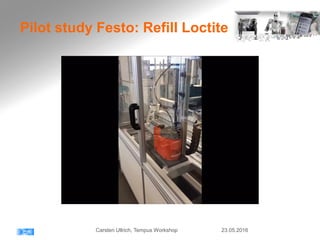
Pilot study Festo: Refill Loctite
23.05.2016Carsten Ullrich, Tempus Workshop
Aim: Assistance and
Knowledge Acquisition
• Support employee:
– Assistance: Depending on the context
• Reacting to the current situation on the shop floor, e.g.,
Loctite is empty
• Aim: Fullfill KPIs
– Learning: Depending on the employee
• Long-term development goals (e.g., working towards a new
job position)
• Aim: Learning
23.05.2016Carsten Ullrich, Tempus Workshop
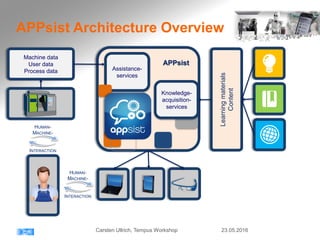
APPsist Architecture Overview
Learningmaterials
Content
Machine data
User data
Process data
APPsist
HUMAN-
MACHINE-
INTERACTION
HUMAN-
MACHINE-
INTERACTION
Assistance-
services
Knowledge-
acquisition-
services
23.05.2016Carsten Ullrich, Tempus Workshop
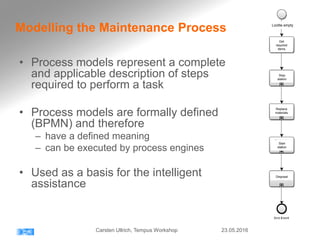
Modelling the Maintenance Process
• Process models represent a complete
and applicable description of steps
required to perform a task
• Process models are formally defined
(BPMN) and therefore
– have a defined meaning
– can be executed by process engines
• Used as a basis for the intelligent
assistance
Loctite empty
Get
required
items
Stop
station
Replace
materials
Start
station
Disposal
23.05.2016Carsten Ullrich, Tempus Workshop
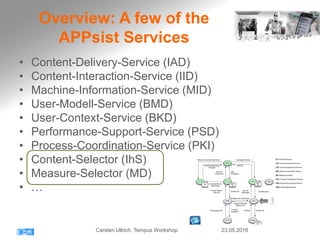
Overview: A few of the
APPsist Services
• Content-Delivery-Service (IAD)
• Content-Interaction-Service (IID)
• Machine-Information-Service (MID)
• User-Modell-Service (BMD)
• User-Context-Service (BKD)
• Performance-Support-Service (PSD)
• Process-Coordination-Service (PKI)
• Content-Selector (IhS)
• Measure-Selector (MD)
• …
23.05.2016Carsten Ullrich, Tempus Workshop
Service Description
• Performance-Support-Service (PSD)
– Guides the users through the assistance process.
• Process-Coordination-Service (PKI)
– Instantiates and administers processes, reacting to incoming events and
coordinates other services relevant for current process.
• Content-Selector (IhS)
– Retrieves content adapted to individual user and context based on rules
– Uses semantic knowledge repository for reasoning.
• Measure-Selector (MD)
– Determines applicable assistance processes according to user and machine
state based on rules.
– Uses semantic knowledge repository for reasoning.
23.05.2016Carsten Ullrich, Tempus Workshop
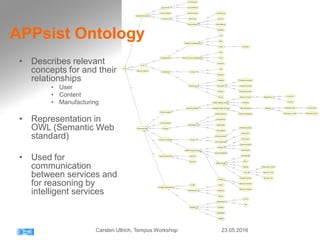
APPsist Ontology
• Describes relevant
concepts for and their
relationships
• User
• Content
• Manufacturing
• Representation in
OWL (Semantic Web
standard)
• Used for
communication
between services and
for reasoning by
intelligent services
23.05.2016Carsten Ullrich, Tempus Workshop
User Model
• Connection to domain-model concepts
• Concepts from domain-model are enriched with user specific
values
– Number of executions (for process-steps)
– Number of views (for contents/documents)
– Number of usages (manufacturing/production objects)
• Relevant user properties
• Workplace-groups
• Permissions
• „State“: main activity (KPI), secondary activities
• Development goals
• Mastered measures
23.05.2016Carsten Ullrich, Tempus Workshop
Examples of Adaptivity for
Smart Manufacturing
• Adaptivity with respect to three parameters:
• Assistance: Depending on the context
– Reacting to the current situation on the shop floor, e.g., Loctite is
empty
– Aim: Fullfill KPIs
• Learning: Depending on the employee
– Reacting to recently occurring events (e.g., a large number of
correctly or incorrectly performed measures)
– Long-term development goals (e.g., working towards a new job
position)
– Aim: Learning
23.05.2016Carsten Ullrich, Tempus Workshop
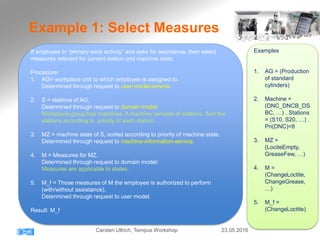
If employee in “primary work activity” and asks for assistance, then select
measures relevant for current station und machine state:
Procedure:
1. AG= workplace unit to which employee is assigned to.
Determined through request to user-model-service.
2. S = stations of AG.
Determined through request to domain model:
Workplace-group has machines. A machine consists of stations. Sort the
stations according to priority of each station.
3. MZ = machine state of S, sorted according to priority of machine state.
Determined through request to machine-information-service.
4. M = Measures for MZ.
Determined through request to domain model:
Measures are applicable to states.
5. M_f = Those measures of M the employee is authorized to perform
(with/without assistance).
Determined through request to user model.
Result: M_f
Example 1: Select Measures
Examples
1. AG = (Production
of standard
cylinders)
2. Machine =
(DNC_DNCB_DS
BC, …) . Stations
= (S10, S20, …) .
Pri(DNC)=8
3. MZ =
(LociteEmpty,
GreaseFew, …)
4. M =
(ChangeLoctite,
ChangeGrease,
…)
5. M_f =
(ChangeLoctite)
23.05.2016Carsten Ullrich, Tempus Workshop
If employee in secondary activity (time for learning) and asks for training, then select
measures that are relevant for development goals.
A goal setting interview has set the development goals: content L, and/or employment group
B, and/or production items P.
Procedure:
1. B = Employment group. Determined by query to user model.
2. M = Relevant measure for B. Determined through query to domain model.
3. M_n = M without mastered measures. Determined through query to user model.
Result = M_n with instruction that these measures will be relevant in the future and can be
practiced in a learning factory or read anytime (without using a machine).
Example 2: Select Measures
23.05.2016Carsten Ullrich, Tempus Workshop
If employee in “primary work activity” and asks for information, then select content relevant for
current station und machine state:
Procedure:
1. Z = Currently relevant machine states and stations (see previous rules).
2. A = Currently relevant machines
3. I = Content about Z and content about A.
Result= Content I.
Example Rules: Select Content
If employee in secondary activity (time for learning) and asks for content, then select
content relevant for development goals.
A goal setting interview has set the development goals: content L, and/or employment
group B, and/or production items P.
Procedure:
1. I_1 = Content that covers one/several of the following: employment group B,
tasks of B, and/or production entities P.
2. I_BR = Content that describes production entities relevant for B.
3. M = Measures relevant for B.
4. I_M = Content that describes production entities used for performing M.
5. I_T = I_B + I_F + I_BR + I_P+ I_M
6. I_S = I_T with sorting that moves already seen content to back of queue.
Result: Content L + I_S, with L marked as obligatory.
23.05.2016Carsten Ullrich, Tempus Workshop
DigiLernPro: Digital Learning Scenarios
for workplace-integrated knowledge and
performance support
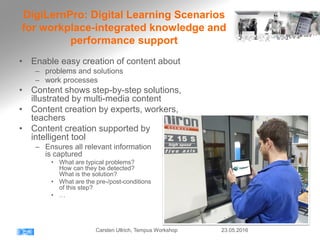
• Enable easy creation of content about
– problems and solutions
– work processes
• Content shows step-by-step solutions,
illustrated by multi-media content
• Content creation by experts, workers,
teachers
• Content creation supported by
intelligent tool
– Ensures all relevant information
is captured
• What are typical problems?
How can they be detected?
What is the solution?
• What are the pre-/post-conditions
of this step?
• …
23.05.2016Carsten Ullrich, Tempus Workshop
Content Creation in DigiLernPro 1/2
23.05.2016Carsten Ullrich, Tempus Workshop
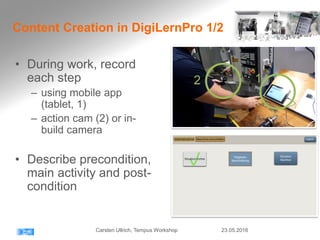
• During work, record
each step
– using mobile app
(tablet, 1)
– action cam (2) or in-
build camera
• Describe precondition,
main activity and post-
condition
2 1
Content Creation in DigiLernPro 2/2
23.05.2016Carsten Ullrich, Tempus Workshop
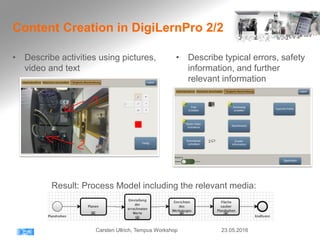
• Describe activities using pictures,
video and text
• Describe typical errors, safety
information, and further
relevant information
Result: Process Model including the relevant media:
Intelligent Authoring Support
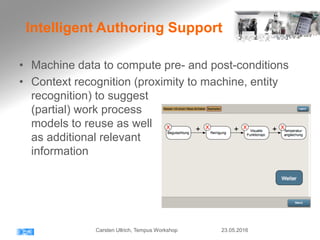
• Machine data to compute pre- and post-conditions
• Context recognition (proximity to machine, entity
recognition) to suggest
(partial) work process
models to reuse as well
as additional relevant
information
23.05.2016Carsten Ullrich, Tempus Workshop
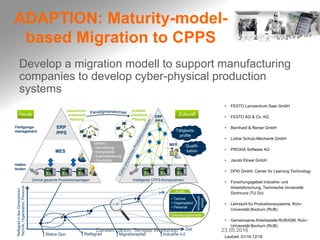
ADAPTION: Maturity-model-
based Migration to CPPS
Develop a migration modell to support manufacturing
companies to develop cyber-physical production
systems
Status Quo Migrationspfad
Zeit
ReifegradindenDimensionen
Technik,Organisation,Personal
Industrie 4.0
Heute Zukunft
Qualifi-
kation
höhere …
• Vernetzung
• Komplexität
• Automatisierung
• Flexibilität
Tätigkeits-
profile
ERP
/PPS
ERP
/PPS
Fertigungs-
management
Hallen-
boden
ressourcen-
orientierte
Planung
produkt-
orientierte
Planung
Intelligente CPPS-KomponentenZentral geplante Produktionsanlagen
MES
• Technik
• Organisation
• Personal
Wirtschaft-
lichkeit
Umsetzungskonzept
Audits
MES
Reifegrad
• FESTO Lernzentrum Saar GmbH
• FESTO AG & Co. KG
• Bernhard & Reiner GmbH
• Lothar Schulz-Mechanik GmbH
• PROXIA Software AG
• Jacobi Eloxal GmbH
• DFKI GmbH, Center for Learning Technology
• Forschungsgebiet Industrie- und
Arbeitsforschung, Technische Universität
Dortmund (TU Do)
• Lehrstuhl für Produktionssysteme, Ruhr-
Universität Bochum (RUB)
• Gemeinsame Arbeitsstelle RUB/IGM, Ruhr-
Universität Bochum (RUB)
Laufzeit: 01/16-12/18
23.05.2016Carsten Ullrich, Tempus Workshop
Thank you
Carsten Ullrich
carsten.ullrich@dfki.de

Intelligent Adaptive Services for Workplace-Integrated Learning on the Shop Floor

  • 1.
    Intelligent Adaptive Servicesfor Workplace-Integrated Learning on the Shop Floor Carsten Ullrich Associate Head Educational Technology Lab (EdTec) at the German Research Center for Artificial Intelligence (DFKI GmbH)
  • 2.
    The Workplace is Transforming •Challenges for Europe's manufacturing industry: – Accelerating innovation – Shorter product cycles – Ever increasing number of product variants – Smaller batch sizes (batch size 1) – … while keeping/increasing level of competitiveness – … with fewer and fewer employees 23.05.2016Carsten Ullrich, Tempus Workshop
  • 3.
    Towards Industry 4.0 tEndof 18th Century Start of 20th Century First Mechanical Loom 1784 1. Industrial Revolution through introduction of mechanical production facilities powered by water and steam 2. Industrial Revolution through introduction of mass production based on the division of labor powered by electrical energy Start of 70ies 4. Industrial Revolution based on Cyber-Physical Production Systems today 010001101 001010100 100101010 010010101 Industry 1.0 Industry 2.0 Industry 3.0 Industry 4.0 DegreeofComplexity 3. Industrial Revolution electronics and IT and heavy- duty industrial robots for a further automation of production Wahlster, 2012 23.05.2016Carsten Ullrich, Tempus Workshop
  • 4.
    Cyber-Physical (Production) Systems • Cyber-physicalsystem – physical entity – and its virtual representation • Cyber-physical production system – classic production technology – virtual representations of all its parts: product, machines, operator • Not just physical interactions, but also software – Machine and product communicate with each other – Decentralized: factories optimize and control manufacturing processes themselves – The smart product, the smart machine and the augmented operator 23.05.2016Carsten Ullrich, Tempus Workshop
  • 5.
    Industry 4.0 /Smart Manufacturing • Transformation of Workplace is a reality, all buzzwords aside – Digitalization – Internet of Things • Seen as a change to transform the organization of work 23.05.2016Carsten Ullrich, Tempus Workshop
  • 6.
    Human Operators at Tomorrow’sWorkplace • Despite the increasing automation, human operators have place on shop floor  with changed roles • Technological innovation cannot be considered in isolation, but requires an integrated approach drawing from technical, organizational and human aspects. • CPS and other new technologies increase complexity of – usage and maintenance of production lines – control of the production process  Mastering this complexity and flexibility requires • larger amounts of knowledge and deeper job expertise than ever before • other forms of organizing work: teams that take responsibilities, operate independently 23.05.2016Carsten Ullrich, Tempus Workshop (Hirsch-Kreinsen, 2014)
  • 7.
    Assistance- and Knowledge-Services forSmart Production • Information providing and training processes will become – more flexible – integrated in the workplace – individualized • CPPS give access to the shop floor and its data • Opportunity to build tools that – adapt themselves intelligently to the knowledge level and tasks of the human operators – integrate and connect the knowledge sources available in the company – generate useful recommendations of actions – enable recording of work processes and applied knowledge – support the migration towards smart manufacturing ADAPTION 23.05.2016Carsten Ullrich, Tempus Workshop
  • 8.
  • 9.
    Partly automated assembly line Supportfor maintenance 5-axis drill Support for machine usage Pilot Scenarios Partner Pilot Area Pilot Scenario Production line Support for failure detection 23.05.2016Carsten Ullrich, Tempus Workshop
  • 10.
    3 manual assembly stations Mainhost computer Monitoring and analysis SPS Controlling the machines Coarse control and monitoring granularity  System detects status and faults  Classification on level of stations, not components Activities  Preventive maintenance  Resolving disabled states and faults  Manual assembly Goal  Increasing the competence level of target audience  Increase worker’s understanding of process, product, manufacturing Automated processes Machine user Machine operator (plus) Machine operator Competence Pilot Study: Festo 23.05.2016Carsten Ullrich, Tempus Workshop
  • 11.
    Pilot study Festo:Refill Loctite 23.05.2016Carsten Ullrich, Tempus Workshop
  • 12.
    Aim: Assistance and KnowledgeAcquisition • Support employee: – Assistance: Depending on the context • Reacting to the current situation on the shop floor, e.g., Loctite is empty • Aim: Fullfill KPIs – Learning: Depending on the employee • Long-term development goals (e.g., working towards a new job position) • Aim: Learning 23.05.2016Carsten Ullrich, Tempus Workshop
  • 13.
    APPsist Architecture Overview Learningmaterials Content Machinedata User data Process data APPsist HUMAN- MACHINE- INTERACTION HUMAN- MACHINE- INTERACTION Assistance- services Knowledge- acquisition- services 23.05.2016Carsten Ullrich, Tempus Workshop
  • 14.
    Modelling the MaintenanceProcess • Process models represent a complete and applicable description of steps required to perform a task • Process models are formally defined (BPMN) and therefore – have a defined meaning – can be executed by process engines • Used as a basis for the intelligent assistance Loctite empty Get required items Stop station Replace materials Start station Disposal 23.05.2016Carsten Ullrich, Tempus Workshop
  • 15.
    Overview: A fewof the APPsist Services • Content-Delivery-Service (IAD) • Content-Interaction-Service (IID) • Machine-Information-Service (MID) • User-Modell-Service (BMD) • User-Context-Service (BKD) • Performance-Support-Service (PSD) • Process-Coordination-Service (PKI) • Content-Selector (IhS) • Measure-Selector (MD) • … 23.05.2016Carsten Ullrich, Tempus Workshop
  • 16.
    Service Description • Performance-Support-Service(PSD) – Guides the users through the assistance process. • Process-Coordination-Service (PKI) – Instantiates and administers processes, reacting to incoming events and coordinates other services relevant for current process. • Content-Selector (IhS) – Retrieves content adapted to individual user and context based on rules – Uses semantic knowledge repository for reasoning. • Measure-Selector (MD) – Determines applicable assistance processes according to user and machine state based on rules. – Uses semantic knowledge repository for reasoning. 23.05.2016Carsten Ullrich, Tempus Workshop
  • 17.
    APPsist Ontology • Describesrelevant concepts for and their relationships • User • Content • Manufacturing • Representation in OWL (Semantic Web standard) • Used for communication between services and for reasoning by intelligent services 23.05.2016Carsten Ullrich, Tempus Workshop
  • 18.
    User Model • Connectionto domain-model concepts • Concepts from domain-model are enriched with user specific values – Number of executions (for process-steps) – Number of views (for contents/documents) – Number of usages (manufacturing/production objects) • Relevant user properties • Workplace-groups • Permissions • „State“: main activity (KPI), secondary activities • Development goals • Mastered measures 23.05.2016Carsten Ullrich, Tempus Workshop
  • 19.
    Examples of Adaptivityfor Smart Manufacturing • Adaptivity with respect to three parameters: • Assistance: Depending on the context – Reacting to the current situation on the shop floor, e.g., Loctite is empty – Aim: Fullfill KPIs • Learning: Depending on the employee – Reacting to recently occurring events (e.g., a large number of correctly or incorrectly performed measures) – Long-term development goals (e.g., working towards a new job position) – Aim: Learning 23.05.2016Carsten Ullrich, Tempus Workshop
  • 20.
    If employee in“primary work activity” and asks for assistance, then select measures relevant for current station und machine state: Procedure: 1. AG= workplace unit to which employee is assigned to. Determined through request to user-model-service. 2. S = stations of AG. Determined through request to domain model: Workplace-group has machines. A machine consists of stations. Sort the stations according to priority of each station. 3. MZ = machine state of S, sorted according to priority of machine state. Determined through request to machine-information-service. 4. M = Measures for MZ. Determined through request to domain model: Measures are applicable to states. 5. M_f = Those measures of M the employee is authorized to perform (with/without assistance). Determined through request to user model. Result: M_f Example 1: Select Measures Examples 1. AG = (Production of standard cylinders) 2. Machine = (DNC_DNCB_DS BC, …) . Stations = (S10, S20, …) . Pri(DNC)=8 3. MZ = (LociteEmpty, GreaseFew, …) 4. M = (ChangeLoctite, ChangeGrease, …) 5. M_f = (ChangeLoctite) 23.05.2016Carsten Ullrich, Tempus Workshop
  • 21.
    If employee insecondary activity (time for learning) and asks for training, then select measures that are relevant for development goals. A goal setting interview has set the development goals: content L, and/or employment group B, and/or production items P. Procedure: 1. B = Employment group. Determined by query to user model. 2. M = Relevant measure for B. Determined through query to domain model. 3. M_n = M without mastered measures. Determined through query to user model. Result = M_n with instruction that these measures will be relevant in the future and can be practiced in a learning factory or read anytime (without using a machine). Example 2: Select Measures 23.05.2016Carsten Ullrich, Tempus Workshop
  • 22.
    If employee in“primary work activity” and asks for information, then select content relevant for current station und machine state: Procedure: 1. Z = Currently relevant machine states and stations (see previous rules). 2. A = Currently relevant machines 3. I = Content about Z and content about A. Result= Content I. Example Rules: Select Content If employee in secondary activity (time for learning) and asks for content, then select content relevant for development goals. A goal setting interview has set the development goals: content L, and/or employment group B, and/or production items P. Procedure: 1. I_1 = Content that covers one/several of the following: employment group B, tasks of B, and/or production entities P. 2. I_BR = Content that describes production entities relevant for B. 3. M = Measures relevant for B. 4. I_M = Content that describes production entities used for performing M. 5. I_T = I_B + I_F + I_BR + I_P+ I_M 6. I_S = I_T with sorting that moves already seen content to back of queue. Result: Content L + I_S, with L marked as obligatory. 23.05.2016Carsten Ullrich, Tempus Workshop
  • 23.
    DigiLernPro: Digital LearningScenarios for workplace-integrated knowledge and performance support • Enable easy creation of content about – problems and solutions – work processes • Content shows step-by-step solutions, illustrated by multi-media content • Content creation by experts, workers, teachers • Content creation supported by intelligent tool – Ensures all relevant information is captured • What are typical problems? How can they be detected? What is the solution? • What are the pre-/post-conditions of this step? • … 23.05.2016Carsten Ullrich, Tempus Workshop
  • 24.
    Content Creation inDigiLernPro 1/2 23.05.2016Carsten Ullrich, Tempus Workshop • During work, record each step – using mobile app (tablet, 1) – action cam (2) or in- build camera • Describe precondition, main activity and post- condition 2 1
  • 25.
    Content Creation inDigiLernPro 2/2 23.05.2016Carsten Ullrich, Tempus Workshop • Describe activities using pictures, video and text • Describe typical errors, safety information, and further relevant information Result: Process Model including the relevant media:
  • 26.
    Intelligent Authoring Support •Machine data to compute pre- and post-conditions • Context recognition (proximity to machine, entity recognition) to suggest (partial) work process models to reuse as well as additional relevant information 23.05.2016Carsten Ullrich, Tempus Workshop
  • 27.
    ADAPTION: Maturity-model- based Migrationto CPPS Develop a migration modell to support manufacturing companies to develop cyber-physical production systems Status Quo Migrationspfad Zeit ReifegradindenDimensionen Technik,Organisation,Personal Industrie 4.0 Heute Zukunft Qualifi- kation höhere … • Vernetzung • Komplexität • Automatisierung • Flexibilität Tätigkeits- profile ERP /PPS ERP /PPS Fertigungs- management Hallen- boden ressourcen- orientierte Planung produkt- orientierte Planung Intelligente CPPS-KomponentenZentral geplante Produktionsanlagen MES • Technik • Organisation • Personal Wirtschaft- lichkeit Umsetzungskonzept Audits MES Reifegrad • FESTO Lernzentrum Saar GmbH • FESTO AG & Co. KG • Bernhard & Reiner GmbH • Lothar Schulz-Mechanik GmbH • PROXIA Software AG • Jacobi Eloxal GmbH • DFKI GmbH, Center for Learning Technology • Forschungsgebiet Industrie- und Arbeitsforschung, Technische Universität Dortmund (TU Do) • Lehrstuhl für Produktionssysteme, Ruhr- Universität Bochum (RUB) • Gemeinsame Arbeitsstelle RUB/IGM, Ruhr- Universität Bochum (RUB) Laufzeit: 01/16-12/18 23.05.2016Carsten Ullrich, Tempus Workshop
  • 28.