Addressing the Retention Gap in MOOCs:
Towards a Motivational Framework for
MOOCs Instructional Design
Christothea Herodotou,
The Open University, UK
Stylianos Mystakidis,
University of Patras & University of Jyväskylä
26/8/2015 1EARLI2015
MOOCs
• Massive Open Online Courses e.g. Coursera, edX,
Futurelearn.
• High drop-out rates – completion rates lower than 10%
• Should module completion be a requirement?
• MOOCs design currently focused on cognitive and technical
aspects of learning
Our aim:
To develop a framework -Open Quest Framework-which will
potentially tackle the need for motivating learners towards
MOOC completion and contribute to the affective realm of
course design.
26/8/2015 EARLI2015 2
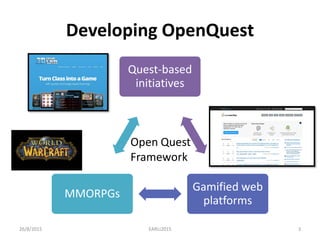
Developing OpenQuest
Quest-based
initiatives
Gamified web
platforms
MMORPGs
26/8/2015 EARLI2015 3
Open Quest
Framework
Underpinnings of OpenQuest
• Self-determination theory (Ryan, Rigby, &
Przybylski, 2006)
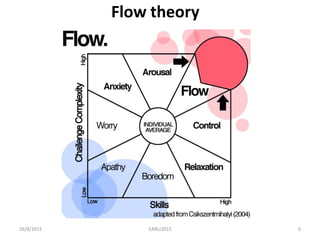
• Flow theory (Csikszentmihalyi, 1990)
• Situated Motivational Affordances
(Deterding, 2011)
26/8/2015 EARLI2015 4
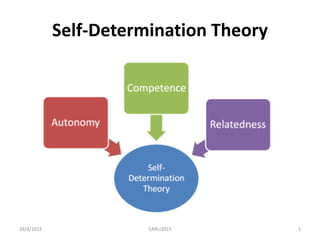
Self-Determination Theory
26/8/2015 5EARLI2015
Flow theory
26/8/2015 6EARLI2015
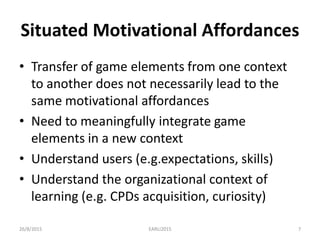
Situated Motivational Affordances
• Transfer of game elements from one context
to another does not necessarily lead to the
same motivational affordances
• Need to meaningfully integrate game
elements in a new context
• Understand users (e.g.expectations, skills)
• Understand the organizational context of
learning (e.g. CPDs acquisition, curiosity)
26/8/2015 EARLI2015 7
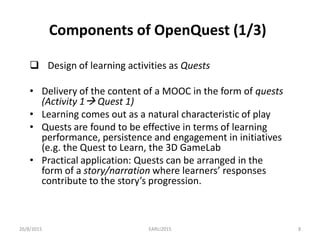
Components of OpenQuest (1/3)
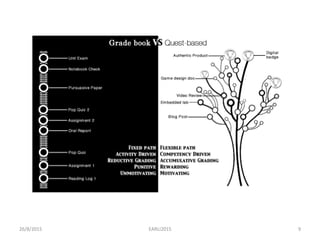
 Design of learning activities as Quests
• Delivery of the content of a MOOC in the form of quests
(Activity 1 Quest 1)
• Learning comes out as a natural characteristic of play
• Quests are found to be effective in terms of learning
performance, persistence and engagement in initiatives
(e.g. the Quest to Learn, the 3D GameLab
• Practical application: Quests can be arranged in the
form of a story/narration where learners’ responses
contribute to the story’s progression.
26/8/2015 EARLI2015 8
26/8/2015 EARLI2015 9
Components of OpenQuest (2/3)
 Social elements
Reputation systems as rewards to learners
e.g. badges, social and scientific scores
- Effective in reinforcing participation
and creation of a community of learners
(e.g. iSpot).
Adaptable leaderboards
- Contrasting learner’s performance to
meaningfully-related others (e.g.,
teammates) increases intrinsic
motivation.
26/8/2015 EARLI2015 10
Components of OpenQuest (3/3)
Collaborative mechanisms
- Motivational cornerstone of successful multi-
user games explaining persistence in gaming
- Course participation can be enhanced by
performance responsibility towards peers in
team coursework.
Well-designed feedback through timed
triggers and unexpected rewards
- Reinforce learners’ participation.
26/8/2015 EARLI2015 11
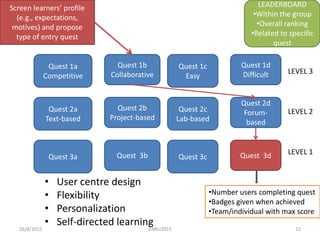
• User centre design
• Flexibility
• Personalization
• Self-directed learning
26/8/2015 EARLI2015 12
Quest 1a
Competitive
Quest 1b
Collaborative
Quest 1c
Easy
Quest 1d
Difficult
LEVEL 1
Quest 2a
Text-based
Quest 2b
Project-based
Quest 2c
Lab-based
Quest 2d
Forum-
based
Quest 3a Quest 3b Quest 3c Quest 3d
LEVEL 2
LEVEL 3
Screen learners’ profile
(e.g., expectations,
motives) and propose
type of entry quest
•Number users completing quest
•Badges given when achieved
•Team/individual with max score
LEADERBOARD
•Within the group
•Overall ranking
•Related to specific
quest
Challenges
• Although evidence favour the effectiveness of the proposed
mechanisms, engagement may not be long-term but due to
a novelty effect.
• Factors including initial motivations for MOOC registration,
learners’ characteristics and ways of engagement in MOOCs
may mediate the success or failure of the proposed
framework.
• Subsequent studies will monitor participants engagement
with a MOOC (e.g. learning analytics) in order to inform
and refine the design of the proposed framework.
26/8/2015 EARLI2015 13
Christothea Herodotou
christothea.herodotou@open.ac.uk
Stylianos Mystakidis
smyst@upatras.gr
26/8/2015 14EARLI2015
Thank you!

Addressing the retention gap in MOOCs

  • 1.
    Addressing the RetentionGap in MOOCs: Towards a Motivational Framework for MOOCs Instructional Design Christothea Herodotou, The Open University, UK Stylianos Mystakidis, University of Patras & University of Jyväskylä 26/8/2015 1EARLI2015
  • 2.
    MOOCs • Massive OpenOnline Courses e.g. Coursera, edX, Futurelearn. • High drop-out rates – completion rates lower than 10% • Should module completion be a requirement? • MOOCs design currently focused on cognitive and technical aspects of learning Our aim: To develop a framework -Open Quest Framework-which will potentially tackle the need for motivating learners towards MOOC completion and contribute to the affective realm of course design. 26/8/2015 EARLI2015 2
  • 3.
  • 4.
    Underpinnings of OpenQuest •Self-determination theory (Ryan, Rigby, & Przybylski, 2006) • Flow theory (Csikszentmihalyi, 1990) • Situated Motivational Affordances (Deterding, 2011) 26/8/2015 EARLI2015 4
  • 5.
  • 6.
  • 7.
    Situated Motivational Affordances •Transfer of game elements from one context to another does not necessarily lead to the same motivational affordances • Need to meaningfully integrate game elements in a new context • Understand users (e.g.expectations, skills) • Understand the organizational context of learning (e.g. CPDs acquisition, curiosity) 26/8/2015 EARLI2015 7
  • 8.
    Components of OpenQuest(1/3)  Design of learning activities as Quests • Delivery of the content of a MOOC in the form of quests (Activity 1 Quest 1) • Learning comes out as a natural characteristic of play • Quests are found to be effective in terms of learning performance, persistence and engagement in initiatives (e.g. the Quest to Learn, the 3D GameLab • Practical application: Quests can be arranged in the form of a story/narration where learners’ responses contribute to the story’s progression. 26/8/2015 EARLI2015 8
  • 9.
  • 10.
    Components of OpenQuest(2/3)  Social elements Reputation systems as rewards to learners e.g. badges, social and scientific scores - Effective in reinforcing participation and creation of a community of learners (e.g. iSpot). Adaptable leaderboards - Contrasting learner’s performance to meaningfully-related others (e.g., teammates) increases intrinsic motivation. 26/8/2015 EARLI2015 10
  • 11.
    Components of OpenQuest(3/3) Collaborative mechanisms - Motivational cornerstone of successful multi- user games explaining persistence in gaming - Course participation can be enhanced by performance responsibility towards peers in team coursework. Well-designed feedback through timed triggers and unexpected rewards - Reinforce learners’ participation. 26/8/2015 EARLI2015 11
  • 12.
    • User centredesign • Flexibility • Personalization • Self-directed learning 26/8/2015 EARLI2015 12 Quest 1a Competitive Quest 1b Collaborative Quest 1c Easy Quest 1d Difficult LEVEL 1 Quest 2a Text-based Quest 2b Project-based Quest 2c Lab-based Quest 2d Forum- based Quest 3a Quest 3b Quest 3c Quest 3d LEVEL 2 LEVEL 3 Screen learners’ profile (e.g., expectations, motives) and propose type of entry quest •Number users completing quest •Badges given when achieved •Team/individual with max score LEADERBOARD •Within the group •Overall ranking •Related to specific quest
  • 13.
    Challenges • Although evidencefavour the effectiveness of the proposed mechanisms, engagement may not be long-term but due to a novelty effect. • Factors including initial motivations for MOOC registration, learners’ characteristics and ways of engagement in MOOCs may mediate the success or failure of the proposed framework. • Subsequent studies will monitor participants engagement with a MOOC (e.g. learning analytics) in order to inform and refine the design of the proposed framework. 26/8/2015 EARLI2015 13
  • 14.