Presenter: Dr. Ashleigh Molloy Director Transformation Education Institute [email_address] www.transedinstitute.org NRC Paraprofessional Conference Hartford, Connecticut 2008 Paraprofessionals Fuelling Change
Session Objectives Validation of a paras role in fuelling change. To learn strategies that promote student success. Identification of the significant role paras serve in facilitating inclusion Present current research on learning styles. Provide a healthy presentation based on the release of endorphins  www.transedinstitute.org
What are Paraprofessionals? (My Take) Paras are like… BAYER ASPIRIN They work miracles. Paras are like… FORD They have better ideas. www.transedinstitute.org
What are Paraprofessionals? Paras are like… COKE They are the real thing. Paras are like… HALLMARK CARDS They care enough to send their very best. www.transedinstitute.org
What are Paraprofessionals? Paras are like… GENERAL ELECTRIC They bring good things to life. Paras are like… ALLSTATE Your in good hands with them. www.transedinstitute.org
What are Paraprofessionals? Paras are like… V0-5 HAIR SPRAY They hold through all kinds of weather. Paras are like… US POSTAL SERVICE Neither rain, nor snow, nor ice will keep them from their appointed task. www.transedinstitute.org
But Most of all… C.E.C supporters are like FROSTED FLAKES. They’re  GRRRRREAT!!!!! What are Paraprofessionals? www.transedinstitute.org
 
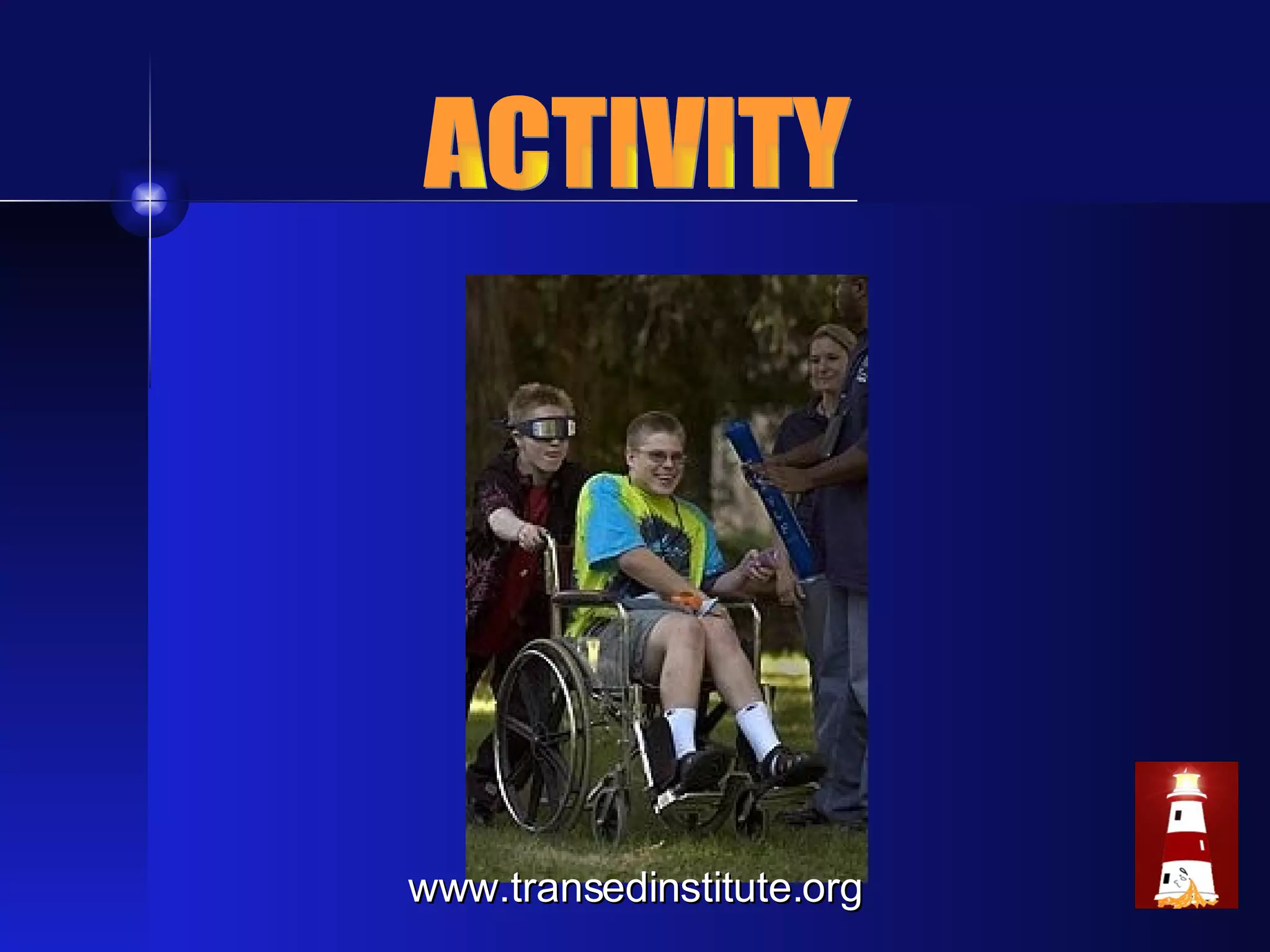
ACTIVITY www.transedinstitute.org
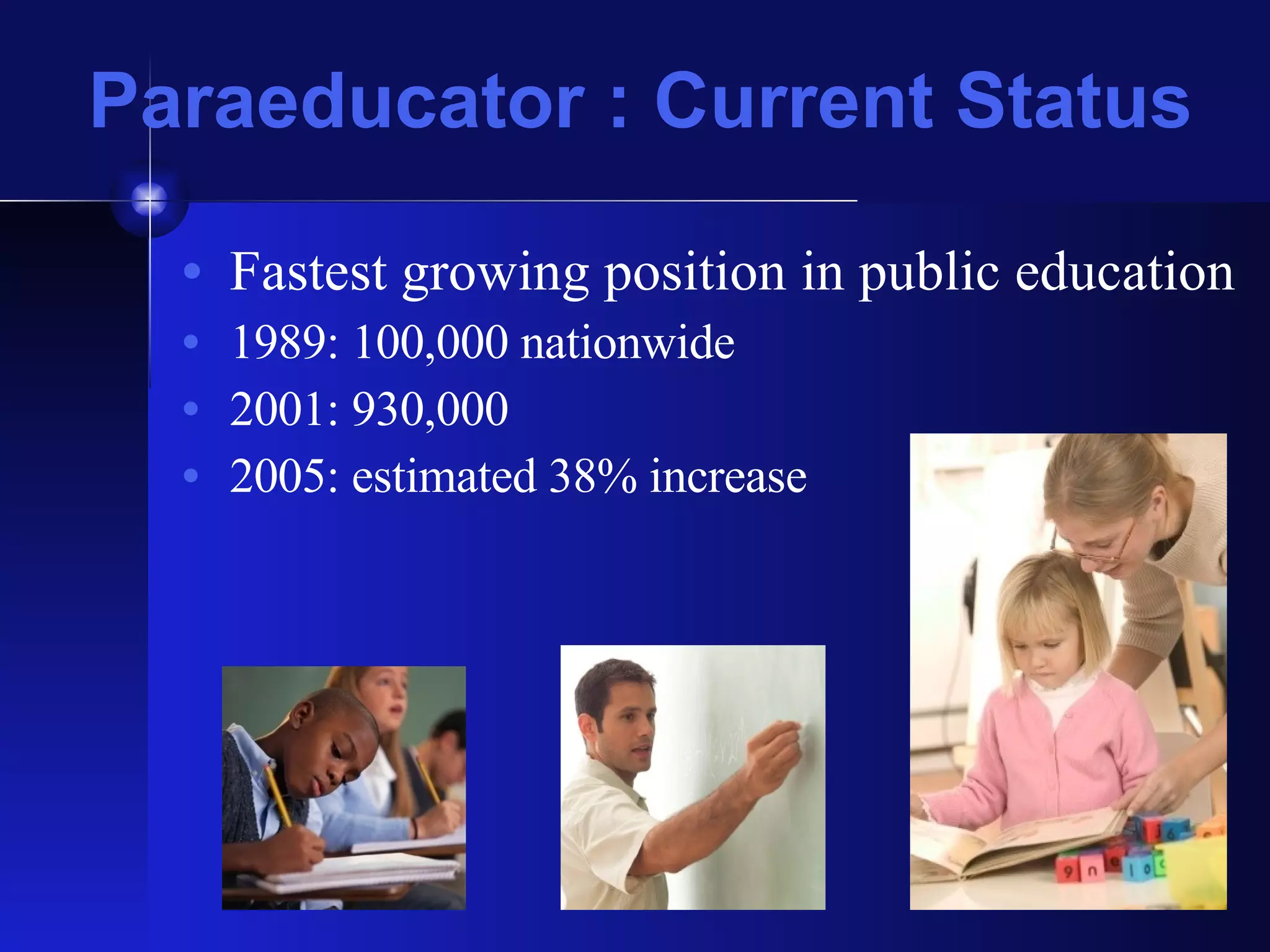
Paraeducator : Current Status Fastest growing position in public education 1989: 100,000 nationwide 2001: 930,000 2005: estimated 38% increase
What is a Paraprofessional? (Haim Ginott) “ I’ve come to a frightening conclusion that I am  the   decisive element   in the classroom .  It’s my personal approach that creates the climate…I possess a tremendous power to make a child’s life miserable or joyous.  I can be a tool of torture or an instrument of inspiration.  I can humiliate or humour, hurt or heal.  In all situations, it is my response that decides whether a crisis will be escalated or de-escalated and a child humanized or dehumanized.”
Elevator Video
Fuelling Change: Your Tool Box Experiential knowledge You come with experiential knowledge based on your previous roles in life.  These include being a sibling, parent, family, community member and working roles.  These are lived experiences that empowers one with skills and abilities that have been accumulated. Literacy examples: reading bedtime stories, oral communication of day’s events at dinner table. Numeracy examples: helping with math homework, board games, activities. Formal knowledge Schooling Professional development and courses
Para as Partner in Student Goals To increase independence and decrease dependence. To assist the student to reach his/her potential (using the IEP where applicable as the road map). To increase peer interaction and inclusion. To use appropriate strategies and materials. To model appropriate behaviour and communication. To achieve student success.
Create a Sense of Welcome
Para’s Goals Lifelong learner Effective service to students Empowered (internally and externally) contributor Supporter of inclusion Collaborative team  member
Paraprofessional’s Hope I wish for a teacher who will see me as a colleague with contributions to make. I wish for a teacher who will see me as an assistant to all children, though with particular focus on a few. I wish for a teacher who will ask for my ideas. I wish for a teacher who will see me as a person, but feel free to guide me as a tool to benefit children. I wish for a teacher who will challenge me to do my best. I wish for a teacher in whom I can see a role model   Gary Bunch, York University
T  ogether E  ach A  chieves M  ore
Plane video
Teams Moving Forward Respect and communication.   That’s what teachers and paras say makes an effective classroom team. Paras are better able to use research-based techniques when the teachers are also using them. Paras do a better job of assisting students individually when the special education teacher and classroom teacher communicate about what kinds of assistance the child needs, what kinds of modifications, how the para can help other students etc.
“ Knowledge is Power” Albert Einstein
Knowledge is Power Teams work best if you know the following: What is to be done What teaching, process and evaluation accommodations need to be created for the student to be successful? Adapted materials Manual supports (scribing, reading, holding) Extra time to do the work, less  work to do Incorporating multi-model strategies Added visual, auditory or tactile cues
What support does the para need to be helpful to the student? Time to find or create materials Help in creating materials Training in the use of materials or equipment Training in the use of specific teaching or behavioural techniques
What is the para to do if the student does not cooperate? Is there a behaviour program in place?  The para should be able to give information about the student’s response to accommodations and other supports.
Who is to offer the support? No student needs support all the time; sometimes having the student work with peers is helpful and necessary. Sometimes the student must work with the teacher to build the student-teacher relationship which is critical to learning. At times, the student needs to work alone to experience autonomy of learning, if he/she has never worked alone, he/she may think she can’t. 6 foot rule
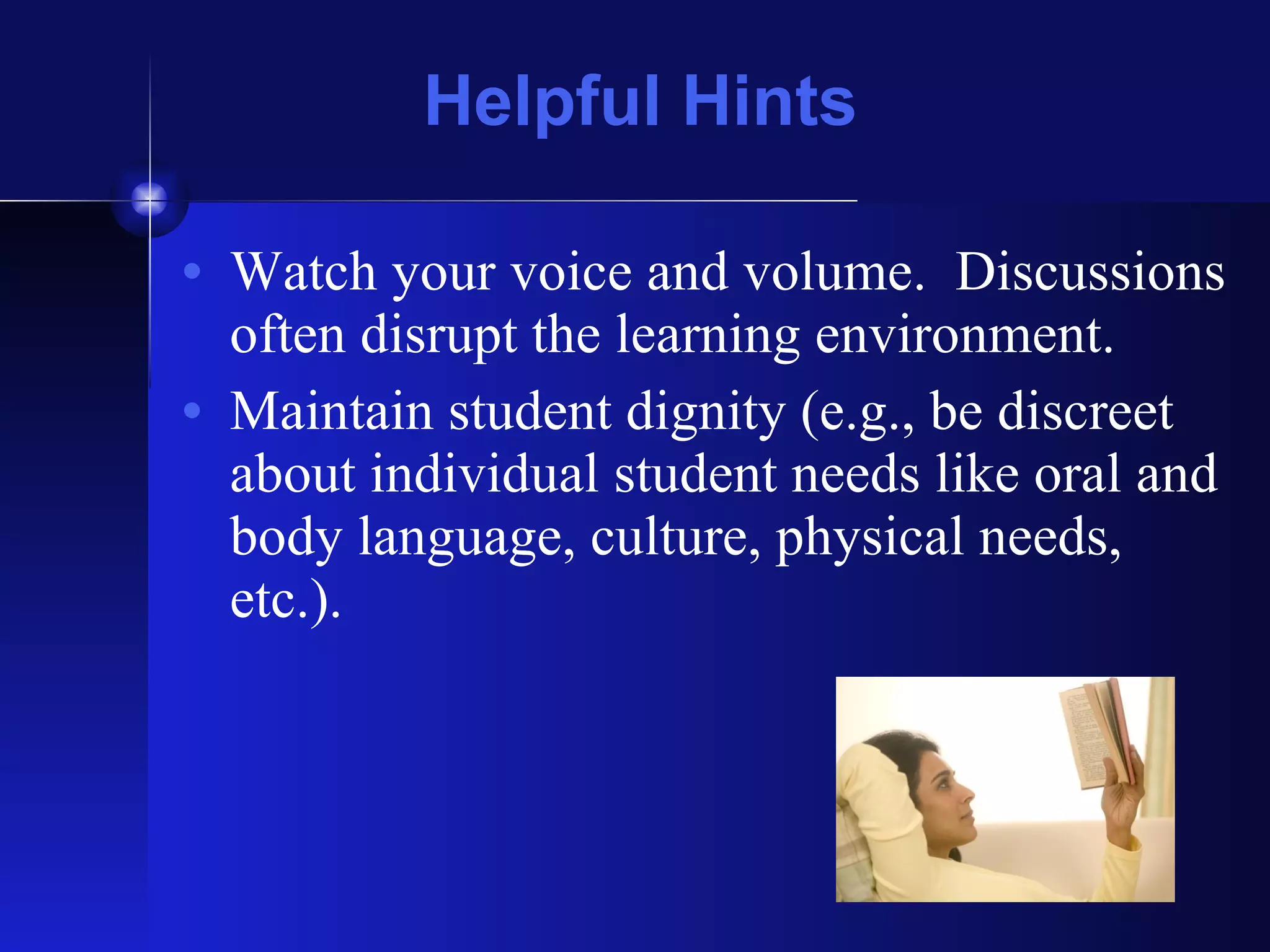
Helpful Hints Watch your voice and volume.  Discussions often disrupt the learning environment. Maintain student dignity (e.g., be discreet about individual student needs like oral and body language, culture, physical needs, etc.).
Group Activity
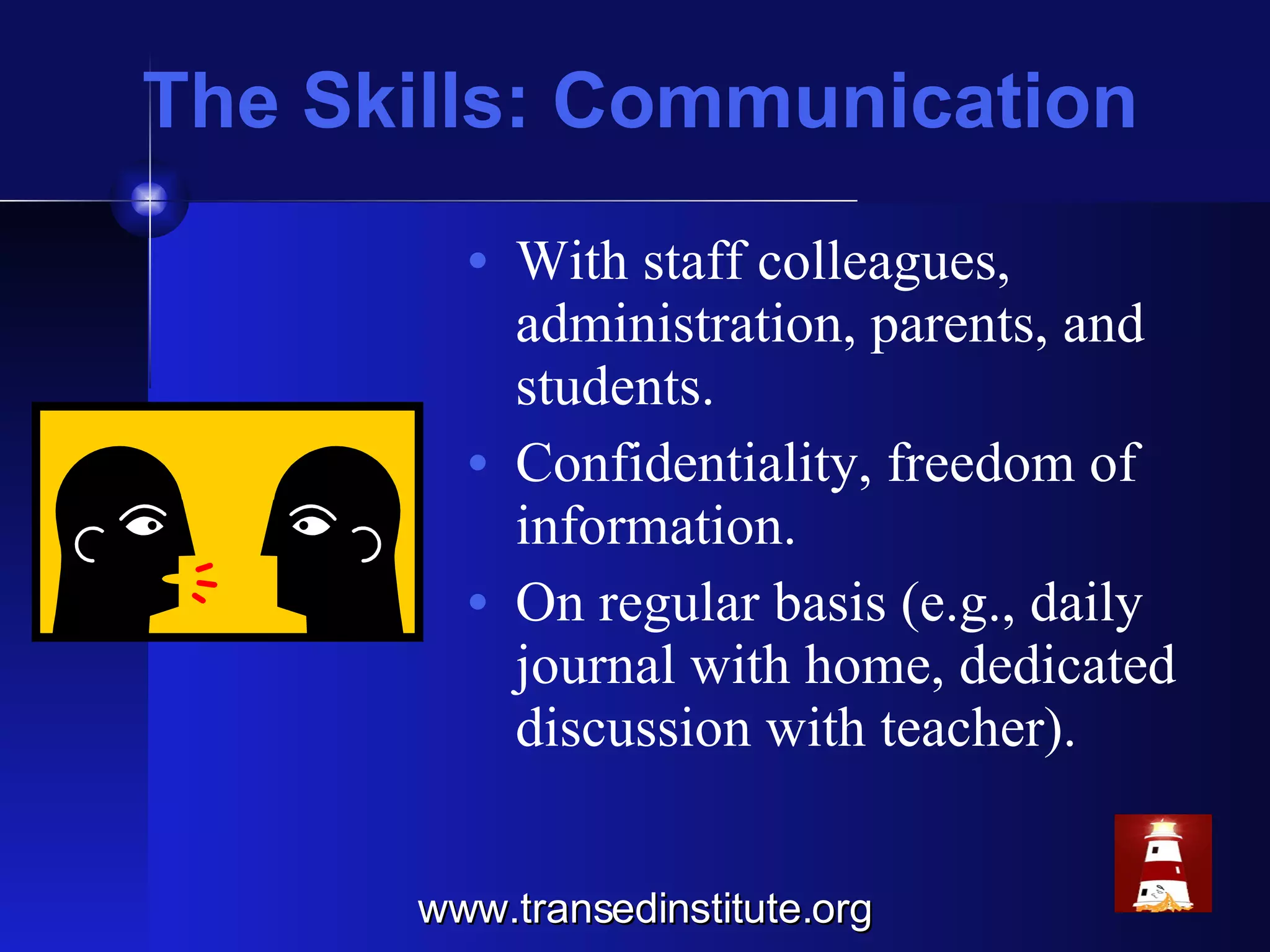
The Skills: Communication With staff colleagues, administration, parents, and students. Confidentiality, freedom of information. On regular basis (e.g., daily journal with home, dedicated discussion with teacher). www.transedinstitute.org
Principles of Communication 7% is verbal (what you actually say with words) 93% is non-verbal - Tone, volume, cadence (38%) - Body language and facial expression (55%)
 
Sensory Modality
The Para as “Change Agent” in Inclusion   Research and Methodology
The Meaning of Inclusion When one student is not a full participant in his/her school community, then we are all at risk Inclusion: A Matter of Social Justice ASCD, October 2003 www.transedinstitute.org
The Meaning of Inclusion Much of the best research suggests that for struggling learners, homogeneous learning experiences are not beneficial. e.g., Oakes, 1985; Slavin, 1993 www.transedinstitute.org
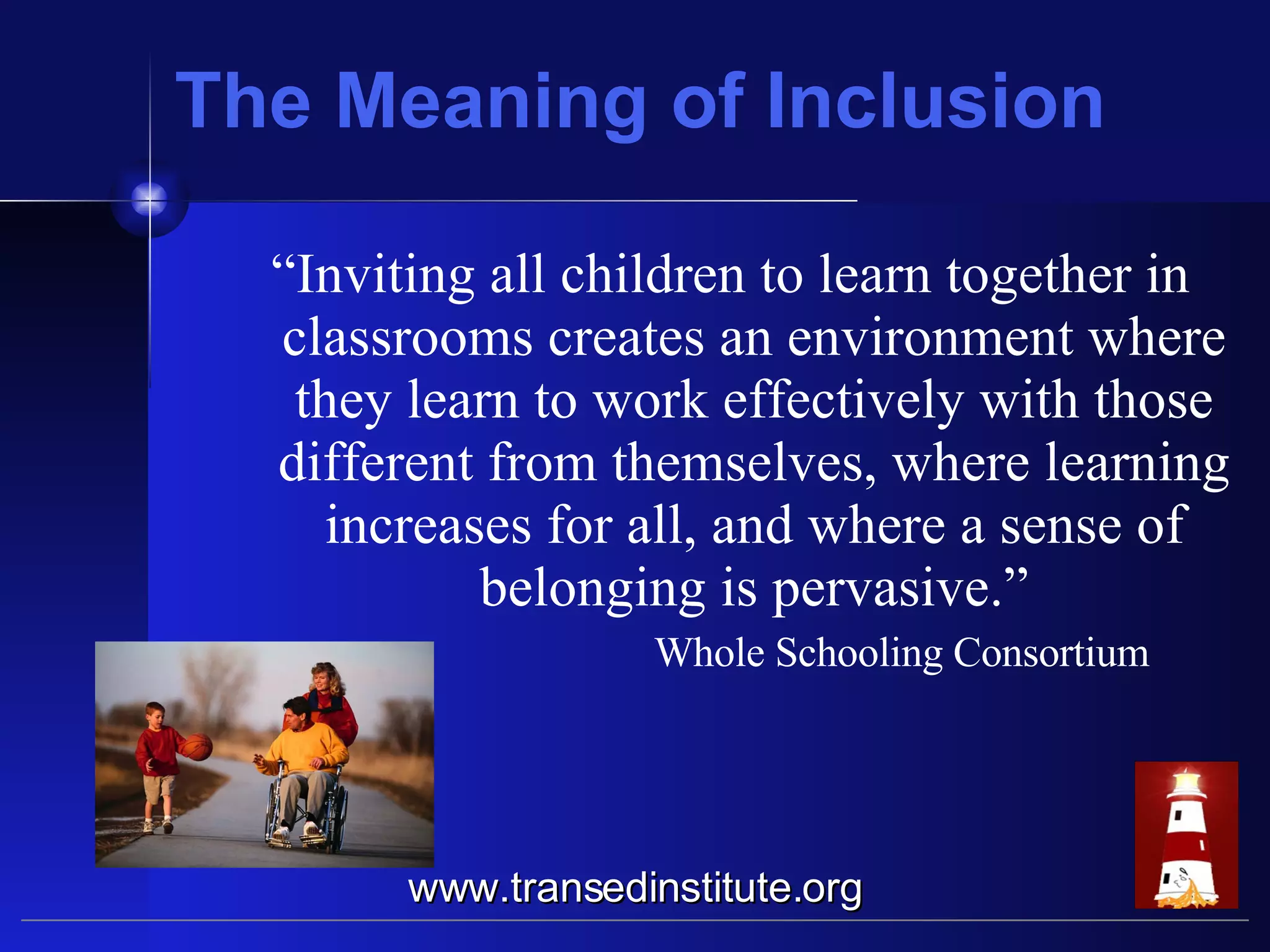
The Meaning of Inclusion “ Inviting all children to learn together in classrooms creates an environment where they learn to work effectively with those different from themselves, where learning increases for all, and where a sense of belonging is pervasive.” Whole Schooling Consortium www.transedinstitute.org
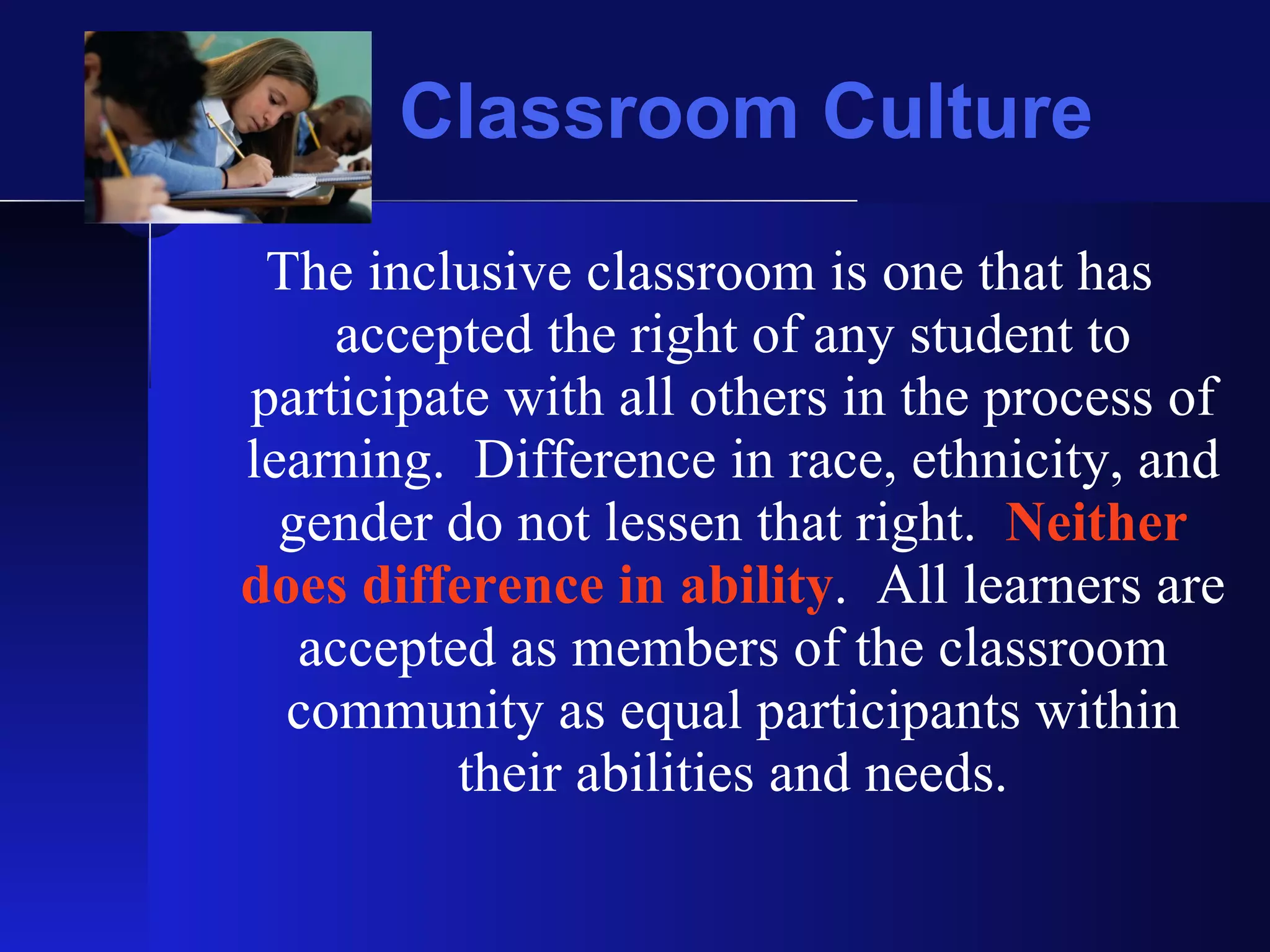
Classroom Culture The inclusive classroom is one that has accepted the right of any student to participate with all others in the process of learning.  Difference in race, ethnicity, and gender do not lessen that right.  Neither does difference in ability .  All learners are accepted as members of the classroom community as equal participants within their abilities and needs.
Inclusion: Basic Principles Each student should participate, at some level, in all classroom activities. All children have individual abilities and needs that should be recognized. All children are learners. Teachers, paras and students are colleagues in the act of learning. www.transedinstitute.org
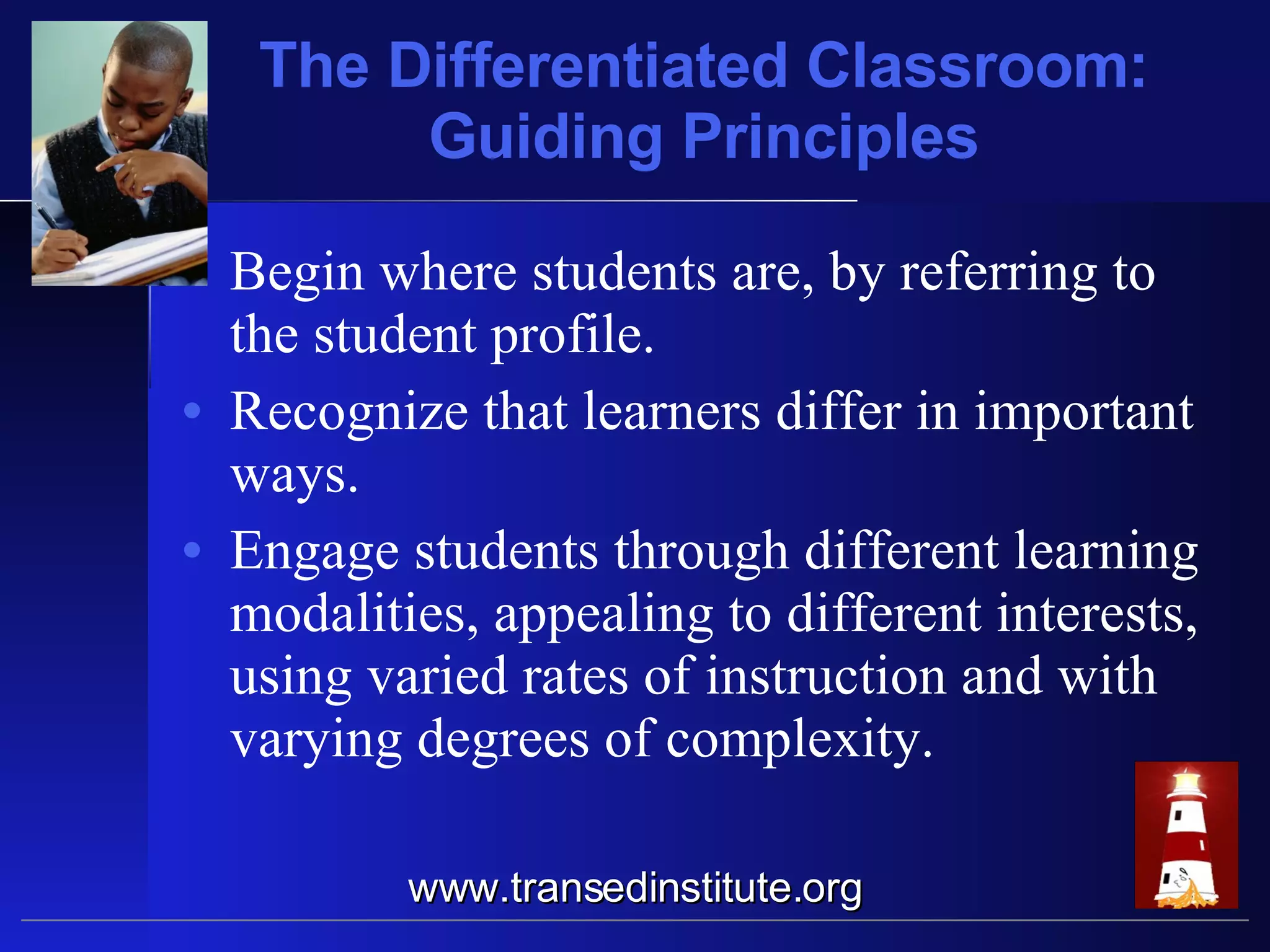
The Differentiated Classroom: Guiding Principles Begin where students are, by referring to the student profile. Recognize that learners differ in important ways. Engage students through different learning modalities, appealing to different interests, using varied rates of instruction and with varying degrees of complexity. www.transedinstitute.org
The Differentiated Classroom: Guiding Principles Individual benchmarks for learning. Do not assume one learner’s road map applies to another learner. Flexible schedules to accommodate the learner. Shape the curriculum and environment to each learner. Adapted from: The Differentiated Classroom Carol Ann Tomlinson 1999 www.transedinstitute.org
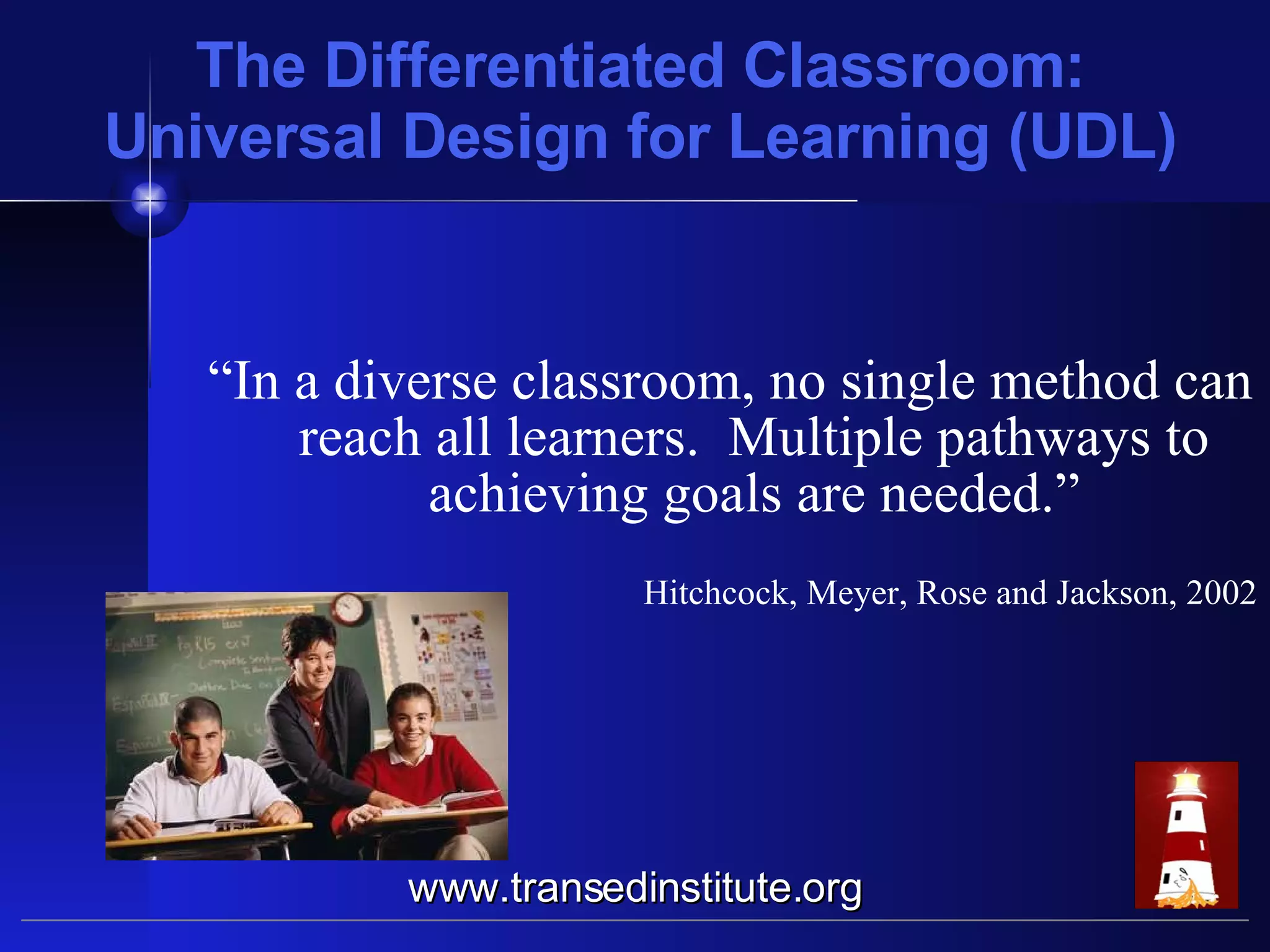
The Differentiated Classroom: Universal Design for Learning (UDL) “ With the premise that each student can benefit from a flexible curriculum offering clear goals, multiple pathways for reaching those goals, and fair and accurate assessment, the Universal Design Curriculum reflects an understanding that each learner is unique.” Hitchcock, Meyer, Rose and Jackson, 2002 www.transedinstitute.org
The Differentiated Classroom: Universal Design for Learning (UDL) Universality and equity Develop class profile. Apply wide range of instructional methods to meet needs of all students. Flexibility and inclusion Make use of all senses, technology, assessment strategies, and ways of using space. www.transedinstitute.org
The Differentiated Classroom: Universal Design for Learning (UDL) Appropriately designed space Clear sight, resources at reach, space for assistive devices, hand grip size, minimization of distraction. Simplicity Communicating consistent expectations. Arranging info sequentially. Breaking down instructions into small steps. Providing effective feedback. Safety Adapted from: Education for All, Ontario Ministry of Education, 2005 www.transedinstitute.org
The Differentiated Classroom: Universal Design for Learning (UDL) “ In a diverse classroom, no single method can reach all learners.  Multiple pathways to achieving goals are needed.” Hitchcock, Meyer, Rose and Jackson, 2002 www.transedinstitute.org
What is Differentiated Instruction? Differentiation is not a set of tools but a philosophy that an educator embraces to reach the unique needs of every learner.  Gregory and Chapman, 2002 The practice of adjusting the curriculum, teaching strategies and the classroom environment to meet the needs of all students ( Tomlinson, 2001) A way of responding to student differences related to their learning readiness, interests, and learning profile
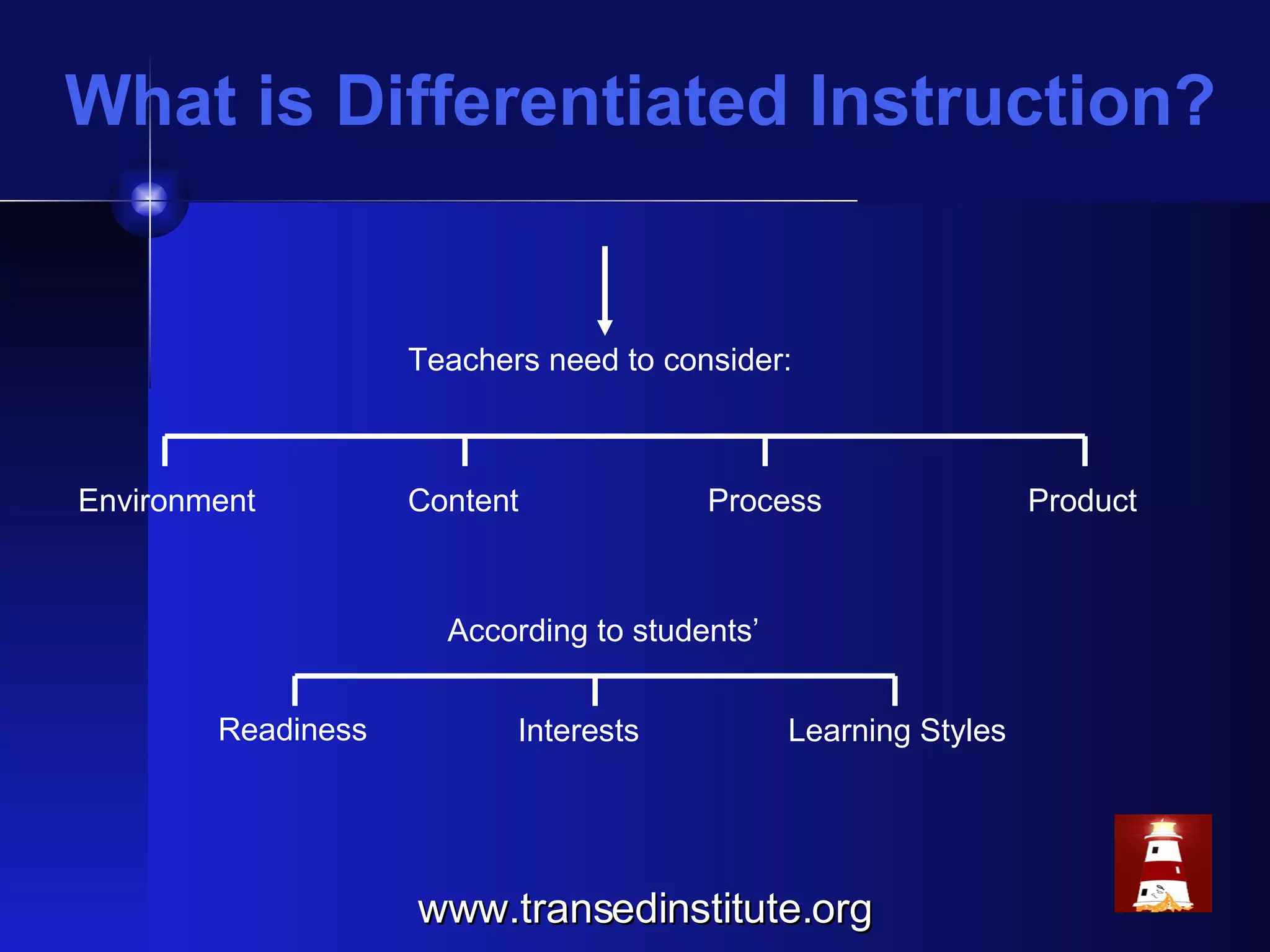
What is Differentiated Instruction? Teachers need to consider: Environment Content Process Product According to students’ Readiness Interests Learning Styles www.transedinstitute.org
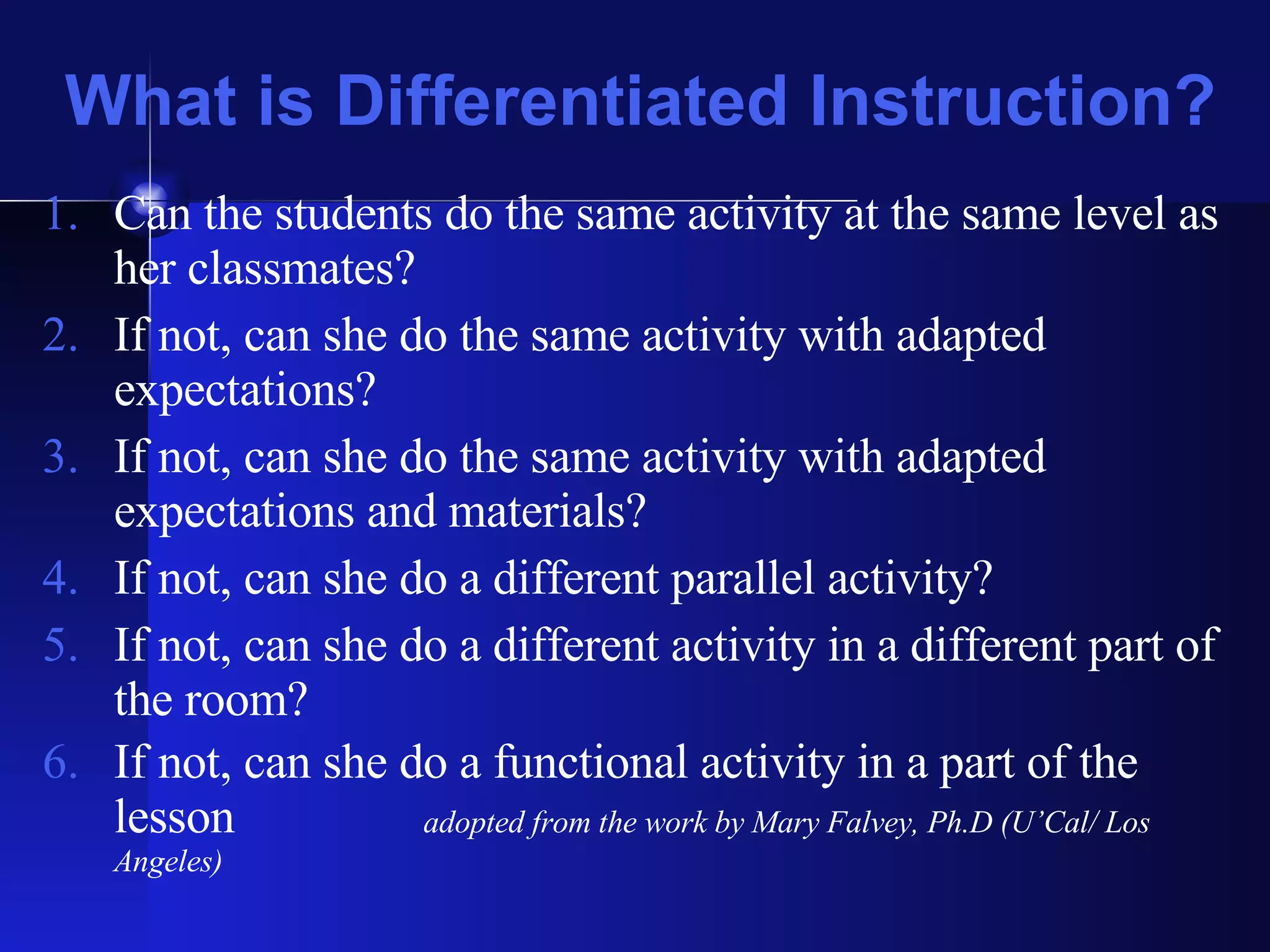
What is Differentiated Instruction? Can the students do the same activity at the same level as her classmates?  If not, can she do the same activity with adapted expectations?  If not, can she do the same activity with adapted expectations and materials? If not, can she do a different parallel activity? If not, can she do a different activity in a different part of the room? If not, can she do a functional activity in a part of the lesson adopted from the work by Mary Falvey, Ph.D (U’Cal/ Los Angeles)
A Framework Student  factors Curriculum  Factors Content (input) Process  (how) Product (output) Readiness Interest Learning Profile
How Boys and Girls Learn Learning and behavior disorders: Boys make up 90% of discipline problems Boys make up 2/3 of the learning disabled Boys make up 90% of the behaviorally disabled Boys make up 80% of ADD/ADHD diagnoses Boys make up 70% of those with serious drug and alcohol problems
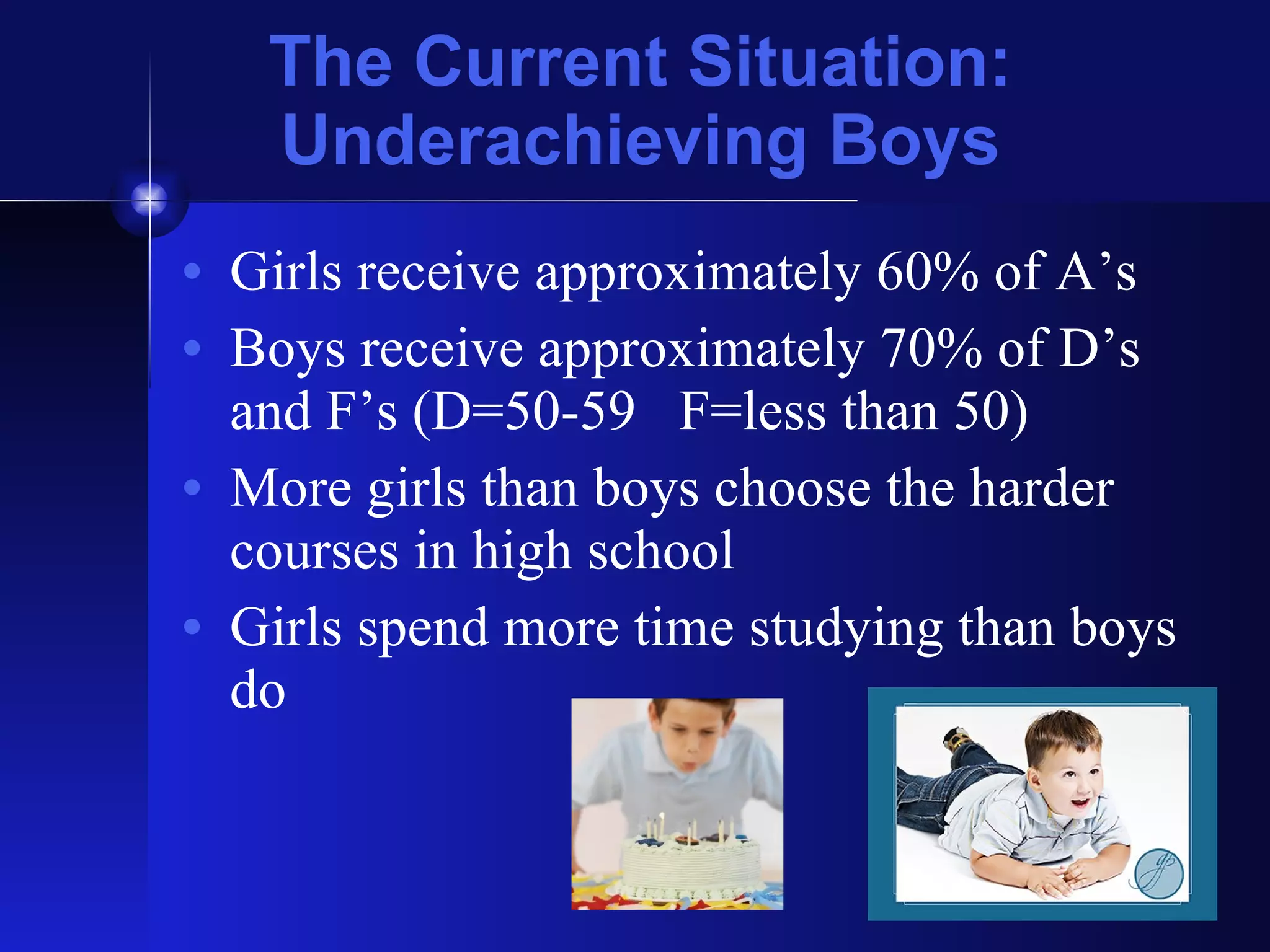
The Current Situation: Underachieving Boys Girls receive approximately 60% of A’s Boys receive approximately 70% of D’s and F’s (D=50-59  F=less than 50) More girls than boys choose the harder courses in high school Girls spend more time studying than boys do
The Unique Nature of Boys Boys love movement and space Girls: WORDS; Boys: ACTION Vision is the male’s best-developed mode of sensing and acquiring information. (Michael Gurian, 1995)
Boys and Literacy Testing 1 1/2 years’ difference in language development between boys and girls. “ standardized” testing does not take this difference into account. boys will always be “behind”.
Boys and Literacy: Practical Strategies
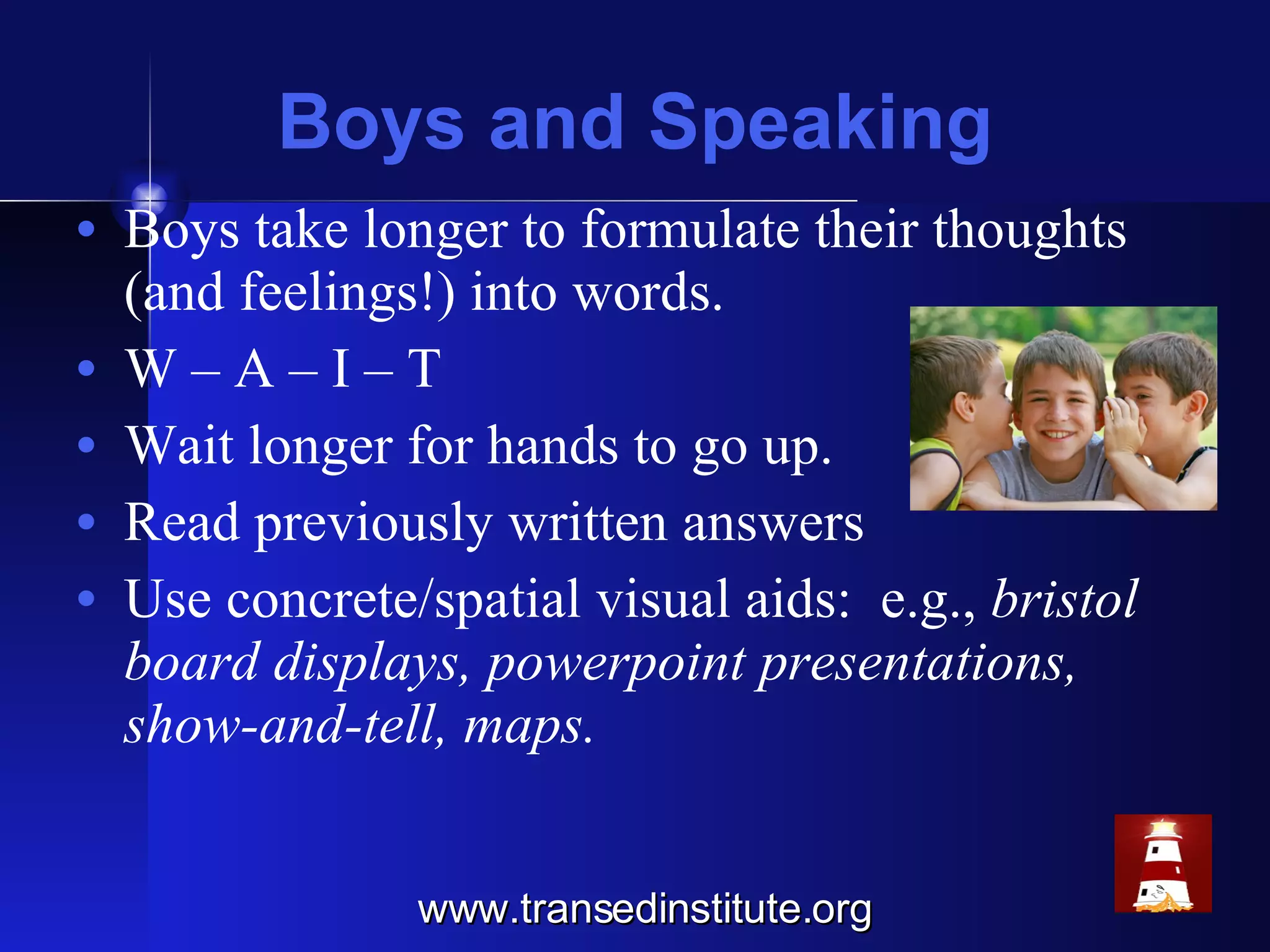
Boys and Speaking Boys take longer to formulate their thoughts (and feelings!) into words. W – A – I – T  Wait longer for hands to go up. Read previously written answers Use concrete/spatial visual aids:  e.g.,  bristol board displays, powerpoint presentations, show-and-tell, maps. www.transedinstitute.org
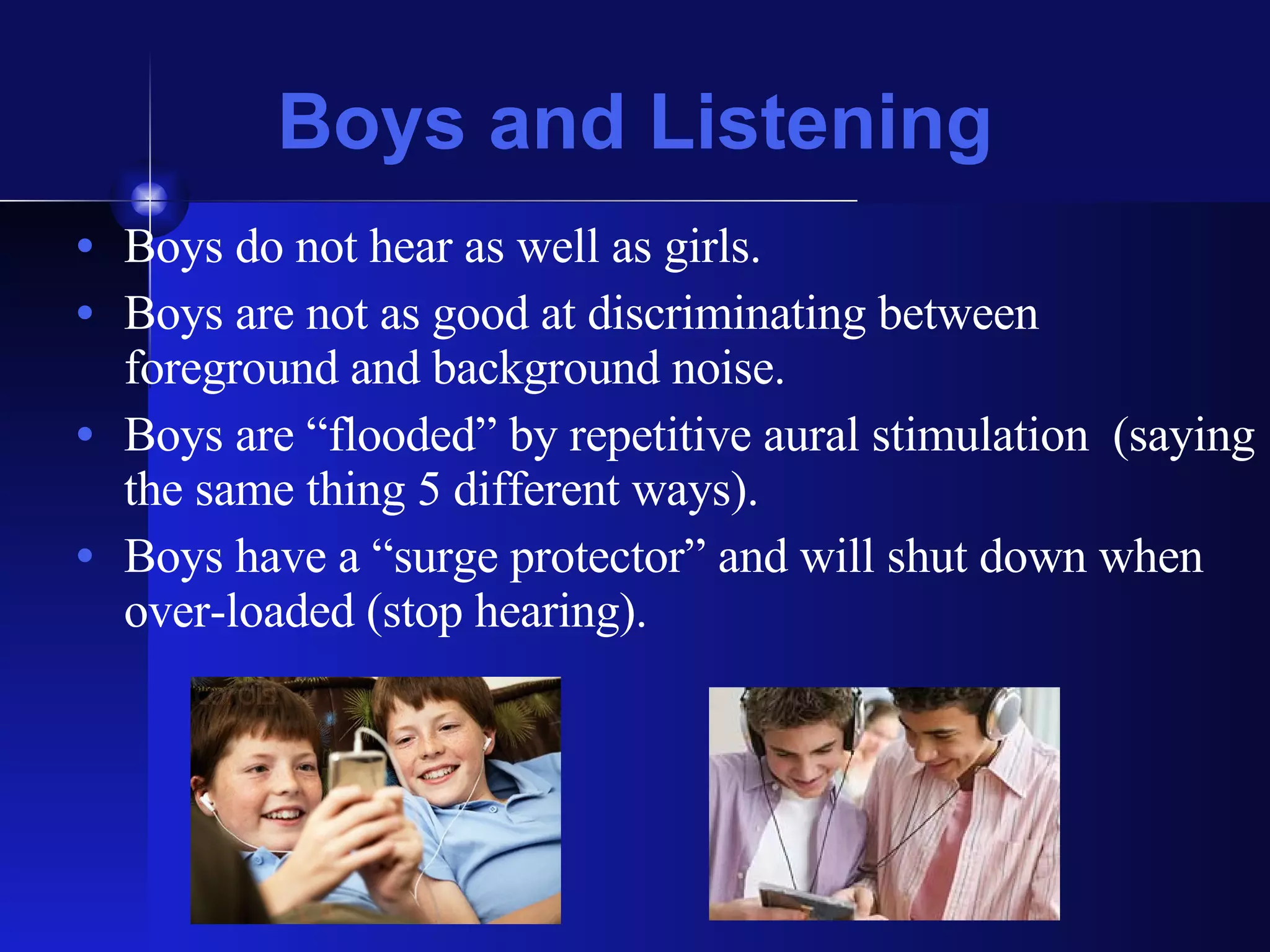
Boys and Listening Boys do not hear as well as girls. Boys are not as good at discriminating between foreground and background noise. Boys are “flooded” by repetitive aural stimulation  (saying the same thing 5 different ways). Boys have a “surge protector” and will shut down when over-loaded (stop hearing).
Boys and Reading Read to them aloud (the primacy of story) Draw/doodle while listening. Give choice of whether to read aloud and for how long (“reading trauma”). Give choice of reading material. Diagramming stories -  make it visual/spatial (maps, plot graphs, charts, board games). Drama.
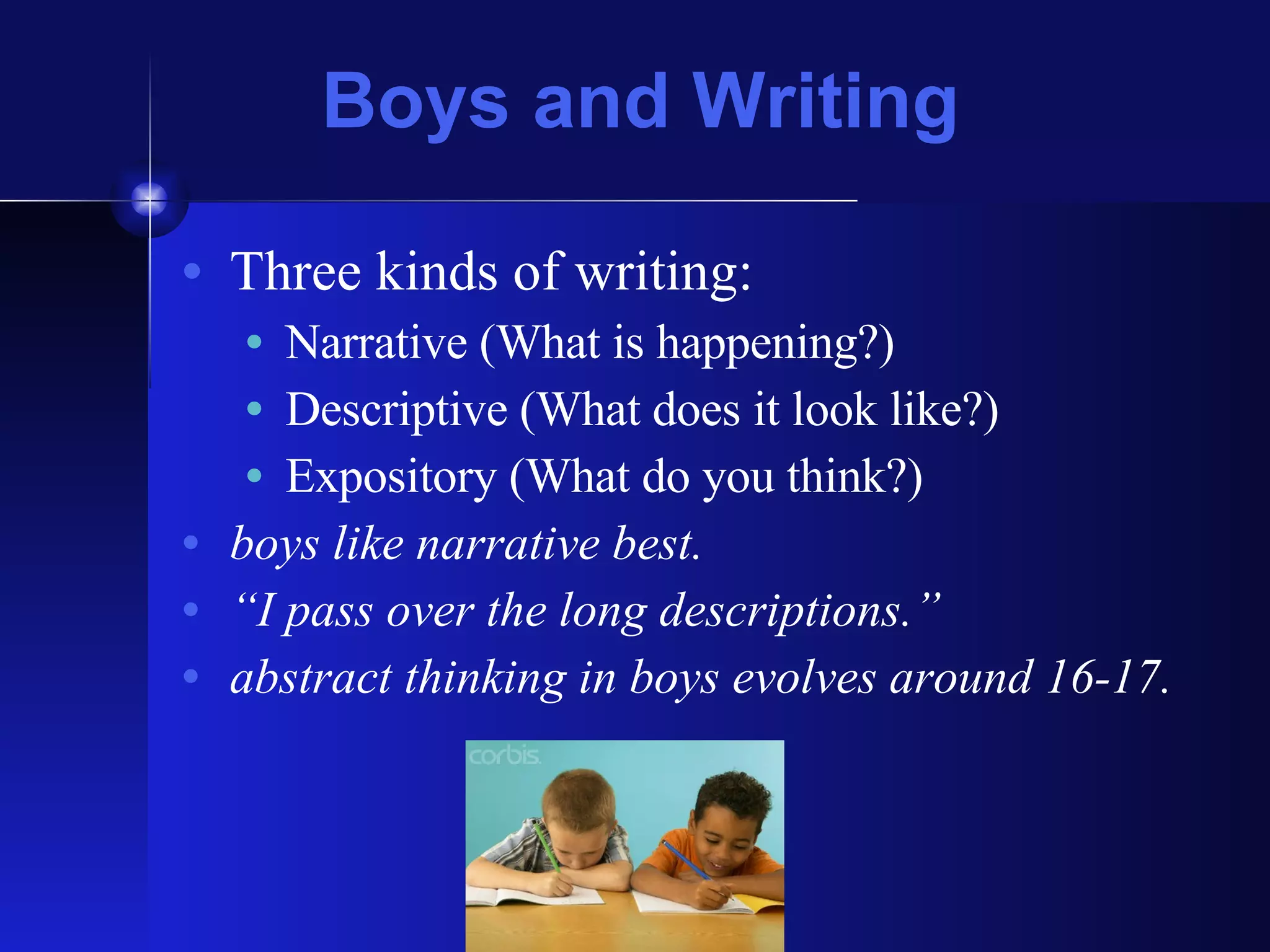
Boys and Writing Three kinds of writing:  Narrative (What is happening?) Descriptive (What does it look like?) Expository (What do you think?) boys like narrative best. “ I pass over the long descriptions.” abstract thinking in boys evolves around 16-17.
Call-on Ratios Boys get called on more than girls, usually for negative reasons. Boys dominate, attention seek. Girls pull back. Boys act out. Girls act in. Girls need one-on-one connection as much or more than the boys do.
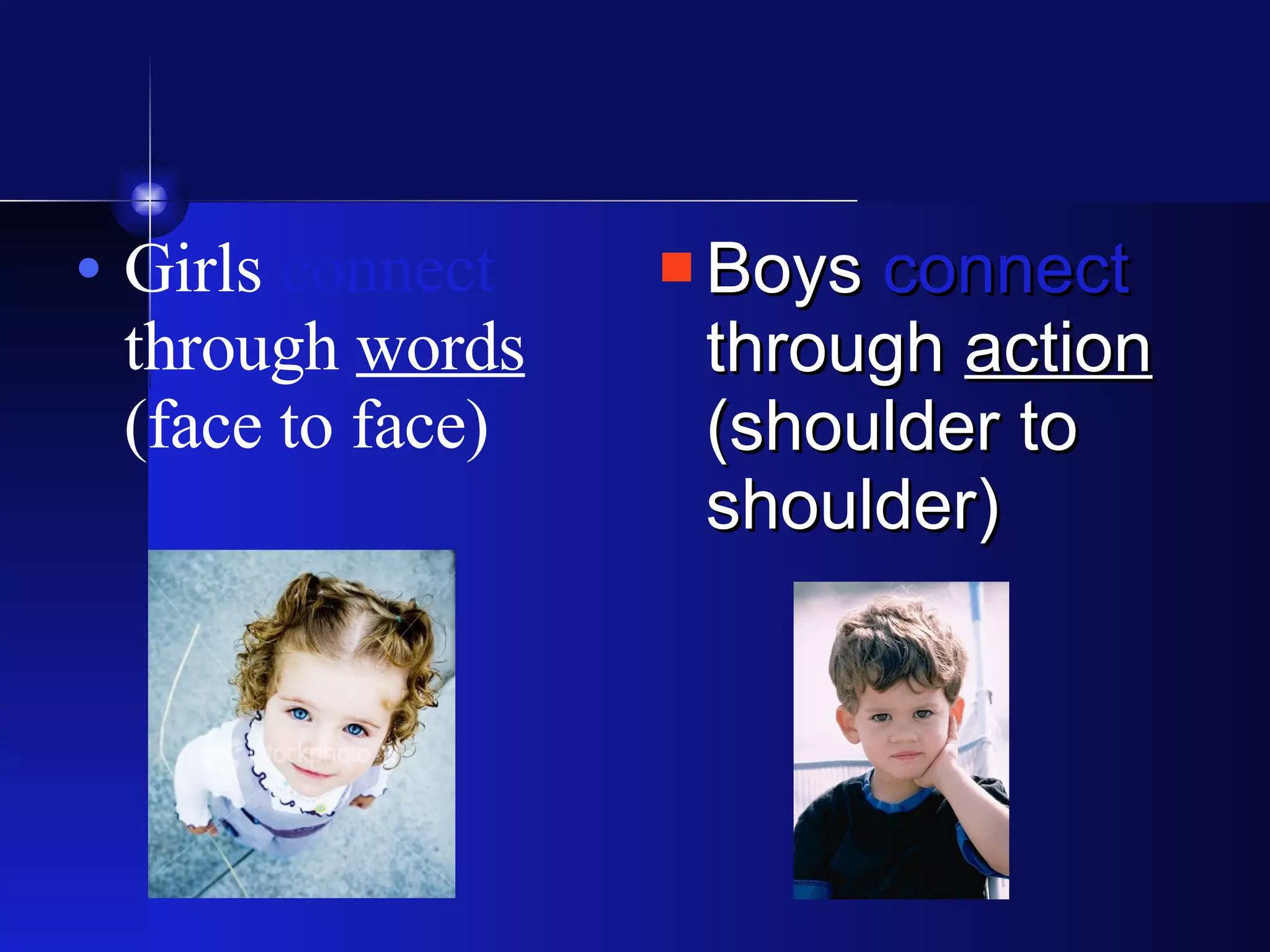
Girls  connect  through  words  (face to face) Boys  connect  through  action  (shoulder to shoulder)
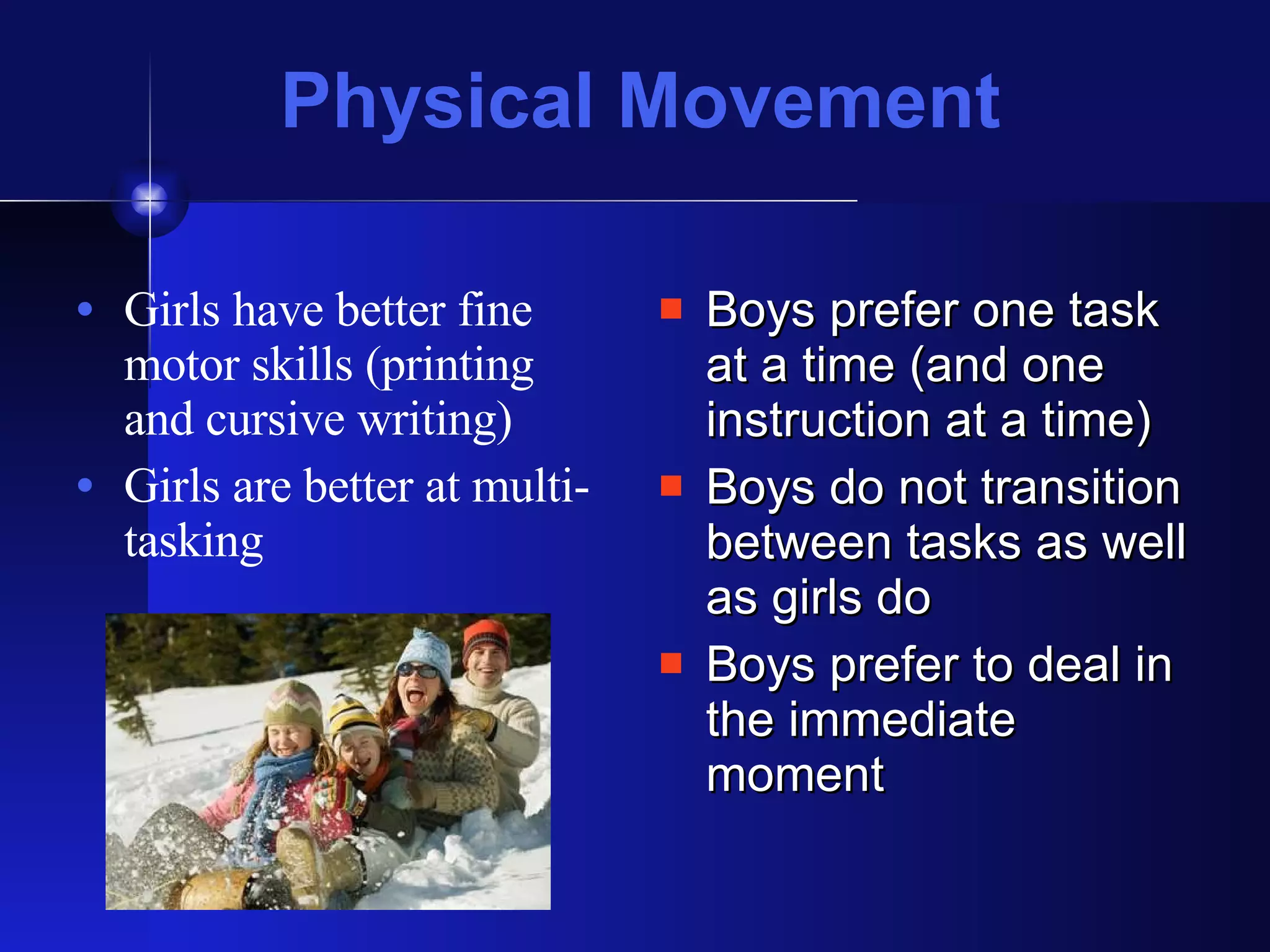
Physical Movement Girls have better fine motor skills (printing and cursive writing) Girls are better at multi-tasking Boys prefer one task at a time (and one instruction at a time) Boys do not transition between tasks as well as girls do Boys prefer to deal in the immediate moment
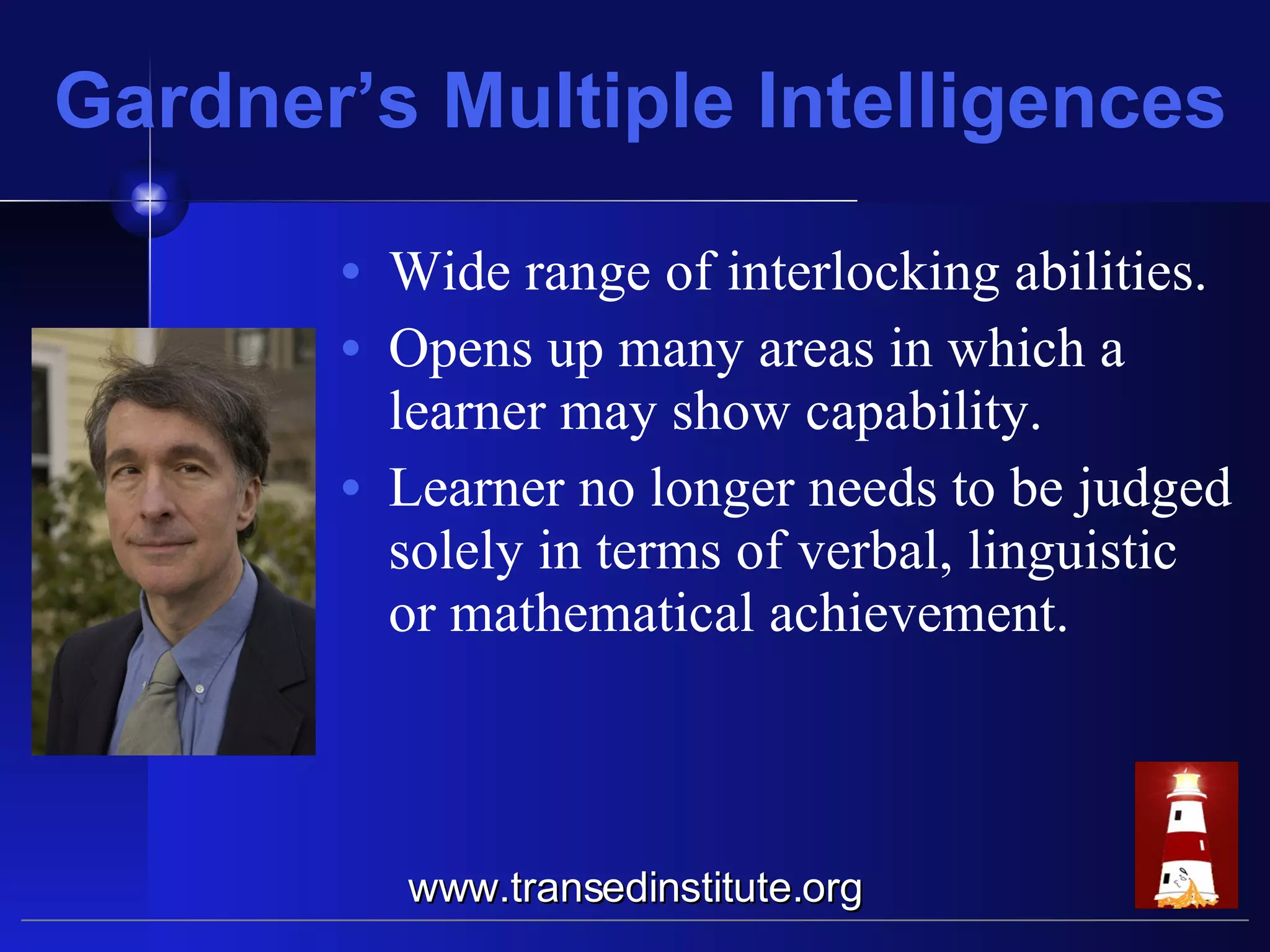
Gardner’s Multiple Intelligences Wide range of interlocking abilities. Opens up many areas in which a learner may show capability. Learner no longer needs to be judged solely in terms of verbal, linguistic or mathematical achievement. www.transedinstitute.org
Gardner’s Multiple Intelligences Intelligence Example Visuo/spatial (picture-smart) Navigator, sculptor, architect Existentialist  (abstract-smart) Philosopher, theorist Interpersonal (people smart) Counselor, politician, salesperson Intrapersonal (self-smart) Researcher, novelist, entrepreneur Bodily/kinesthetic (body smart) Athlete, firefighter, actor Musical/rhythmic (music smart) Musician, composer, DJ Verbal/linguistic (word-smart) Journalist, teacher, lawyer Logical/mathematical (logic-smart) Engineer, programmer, accountant Naturalist (nature-smart) Environmentalist, farmer, botanist
Learning Styles “ I never teach my pupils; I only attempt to provide the conditions in which they can learn.” Albert Einstein www.transedinstitute.org
Paraprofessional Reflection Open, honest and direct communication is a very important part of developing a healthy education team.  Requires that your team actually finds time to meet.  Use a formal agenda in order to stay focused on our tasks.  Discuss: Training/concerns/curriculum planning.
Paraprofessionals Do Make A Difference: A Parent’s Reflection In my personal experience, paras have always made a difference in my daughter’s life. Lindsey, who has Down syndrome, started junior kindergarten at the young age of 4.  I was totally overwhelmed with the idea of my baby girl away from mom.  Elizabeth Mora was assigned to be Lindsey’s para.  She was with Lindsey through the primary  grades.
To say this lady made a difference in my daughter’s life is an understatement. This para was compassionate, caring, patient, loving and very much the advocate for Lindsey.  Yet she was firm and did chastise when the need arose.  They understood each other. When Lindsey started school, she was well on her way to read.  She loved books.  Elizabeth continued the reading, taught manners and helped Lindsey with peer-interaction.  Our little girl became very sociable at school with most of the other students.  Thank you Elizabeth!  Grateful Mom, Michelle Molloy
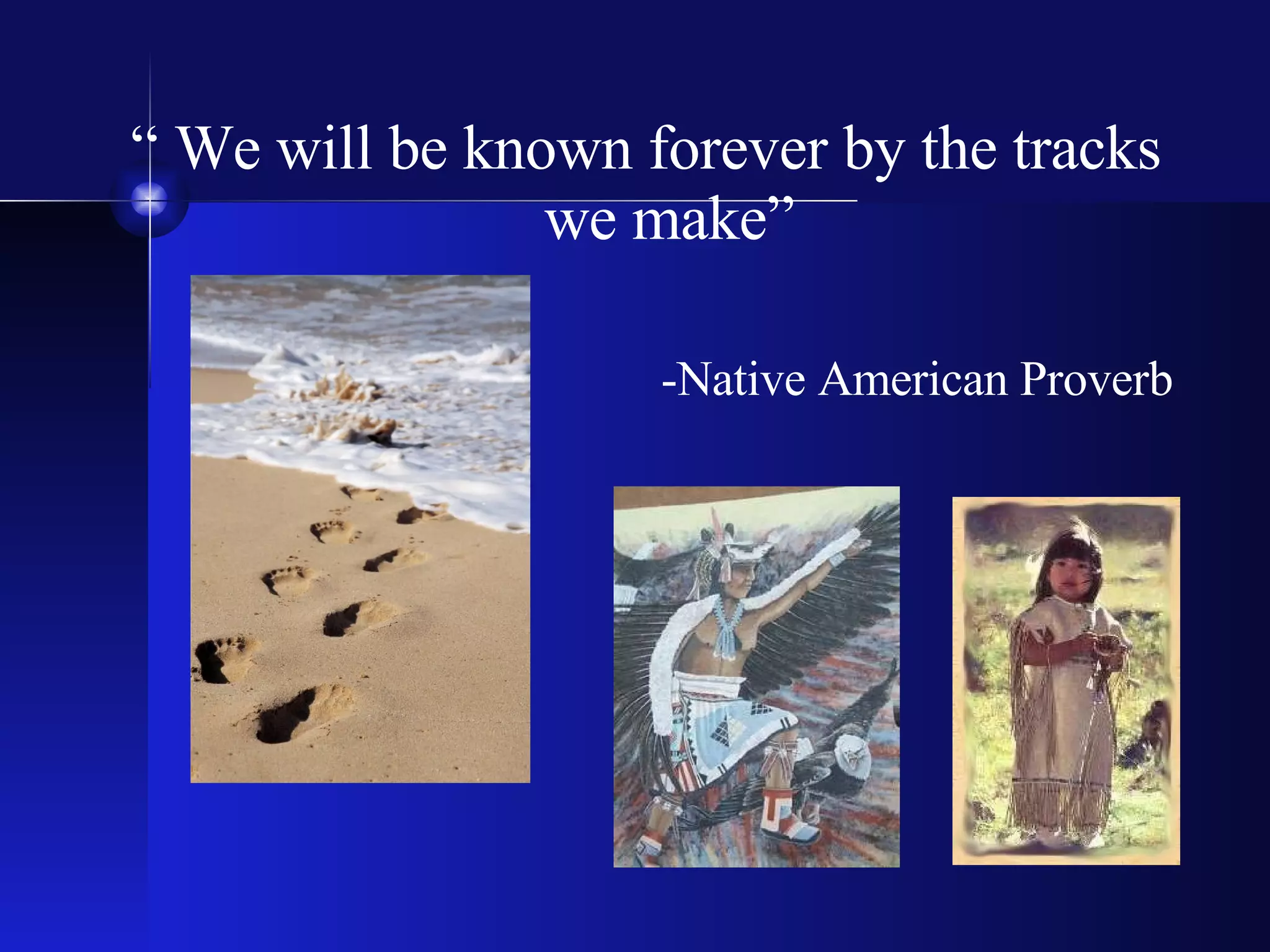
“  We will be known forever by the tracks we make” -Native American Proverb
Resources Ask a specialist, website answering questions in the areas of Behavior, ADHD, Medical Issues, Assistive Technology and Secondary Issues  www.dcn-cde.ca.gov Authors: - Kent Gerlach - Anna Lou Pickett - Terry Wallace - Marilyn Likins  Dr Ash’s Contact:  [email_address]
Town Hall Session Sharing Questions? Connecticut www.transedinstitute Copyright © 2007 Transformation Ed. Institute

Paraprofessional sFueling Change

  • 1.
    Presenter: Dr. AshleighMolloy Director Transformation Education Institute [email_address] www.transedinstitute.org NRC Paraprofessional Conference Hartford, Connecticut 2008 Paraprofessionals Fuelling Change
  • 2.
    Session Objectives Validationof a paras role in fuelling change. To learn strategies that promote student success. Identification of the significant role paras serve in facilitating inclusion Present current research on learning styles. Provide a healthy presentation based on the release of endorphins www.transedinstitute.org
  • 3.
    What are Paraprofessionals?(My Take) Paras are like… BAYER ASPIRIN They work miracles. Paras are like… FORD They have better ideas. www.transedinstitute.org
  • 4.
    What are Paraprofessionals?Paras are like… COKE They are the real thing. Paras are like… HALLMARK CARDS They care enough to send their very best. www.transedinstitute.org
  • 5.
    What are Paraprofessionals?Paras are like… GENERAL ELECTRIC They bring good things to life. Paras are like… ALLSTATE Your in good hands with them. www.transedinstitute.org
  • 6.
    What are Paraprofessionals?Paras are like… V0-5 HAIR SPRAY They hold through all kinds of weather. Paras are like… US POSTAL SERVICE Neither rain, nor snow, nor ice will keep them from their appointed task. www.transedinstitute.org
  • 7.
    But Most ofall… C.E.C supporters are like FROSTED FLAKES. They’re GRRRRREAT!!!!! What are Paraprofessionals? www.transedinstitute.org
  • 8.
  • 9.
  • 10.
    Paraeducator : CurrentStatus Fastest growing position in public education 1989: 100,000 nationwide 2001: 930,000 2005: estimated 38% increase
  • 11.
    What is aParaprofessional? (Haim Ginott) “ I’ve come to a frightening conclusion that I am the decisive element in the classroom . It’s my personal approach that creates the climate…I possess a tremendous power to make a child’s life miserable or joyous. I can be a tool of torture or an instrument of inspiration. I can humiliate or humour, hurt or heal. In all situations, it is my response that decides whether a crisis will be escalated or de-escalated and a child humanized or dehumanized.”
  • 12.
  • 13.
    Fuelling Change: YourTool Box Experiential knowledge You come with experiential knowledge based on your previous roles in life. These include being a sibling, parent, family, community member and working roles. These are lived experiences that empowers one with skills and abilities that have been accumulated. Literacy examples: reading bedtime stories, oral communication of day’s events at dinner table. Numeracy examples: helping with math homework, board games, activities. Formal knowledge Schooling Professional development and courses
  • 14.
    Para as Partnerin Student Goals To increase independence and decrease dependence. To assist the student to reach his/her potential (using the IEP where applicable as the road map). To increase peer interaction and inclusion. To use appropriate strategies and materials. To model appropriate behaviour and communication. To achieve student success.
  • 15.
    Create a Senseof Welcome
  • 16.
    Para’s Goals Lifelonglearner Effective service to students Empowered (internally and externally) contributor Supporter of inclusion Collaborative team member
  • 17.
    Paraprofessional’s Hope Iwish for a teacher who will see me as a colleague with contributions to make. I wish for a teacher who will see me as an assistant to all children, though with particular focus on a few. I wish for a teacher who will ask for my ideas. I wish for a teacher who will see me as a person, but feel free to guide me as a tool to benefit children. I wish for a teacher who will challenge me to do my best. I wish for a teacher in whom I can see a role model Gary Bunch, York University
  • 18.
    T ogetherE ach A chieves M ore
  • 19.
  • 20.
    Teams Moving ForwardRespect and communication. That’s what teachers and paras say makes an effective classroom team. Paras are better able to use research-based techniques when the teachers are also using them. Paras do a better job of assisting students individually when the special education teacher and classroom teacher communicate about what kinds of assistance the child needs, what kinds of modifications, how the para can help other students etc.
  • 21.
    “ Knowledge isPower” Albert Einstein
  • 22.
    Knowledge is PowerTeams work best if you know the following: What is to be done What teaching, process and evaluation accommodations need to be created for the student to be successful? Adapted materials Manual supports (scribing, reading, holding) Extra time to do the work, less work to do Incorporating multi-model strategies Added visual, auditory or tactile cues
  • 23.
    What support doesthe para need to be helpful to the student? Time to find or create materials Help in creating materials Training in the use of materials or equipment Training in the use of specific teaching or behavioural techniques
  • 24.
    What is thepara to do if the student does not cooperate? Is there a behaviour program in place? The para should be able to give information about the student’s response to accommodations and other supports.
  • 25.
    Who is tooffer the support? No student needs support all the time; sometimes having the student work with peers is helpful and necessary. Sometimes the student must work with the teacher to build the student-teacher relationship which is critical to learning. At times, the student needs to work alone to experience autonomy of learning, if he/she has never worked alone, he/she may think she can’t. 6 foot rule
  • 26.
    Helpful Hints Watchyour voice and volume. Discussions often disrupt the learning environment. Maintain student dignity (e.g., be discreet about individual student needs like oral and body language, culture, physical needs, etc.).
  • 27.
  • 28.
    The Skills: CommunicationWith staff colleagues, administration, parents, and students. Confidentiality, freedom of information. On regular basis (e.g., daily journal with home, dedicated discussion with teacher). www.transedinstitute.org
  • 29.
    Principles of Communication7% is verbal (what you actually say with words) 93% is non-verbal - Tone, volume, cadence (38%) - Body language and facial expression (55%)
  • 30.
  • 31.
  • 32.
    The Para as“Change Agent” in Inclusion Research and Methodology
  • 33.
    The Meaning ofInclusion When one student is not a full participant in his/her school community, then we are all at risk Inclusion: A Matter of Social Justice ASCD, October 2003 www.transedinstitute.org
  • 34.
    The Meaning ofInclusion Much of the best research suggests that for struggling learners, homogeneous learning experiences are not beneficial. e.g., Oakes, 1985; Slavin, 1993 www.transedinstitute.org
  • 35.
    The Meaning ofInclusion “ Inviting all children to learn together in classrooms creates an environment where they learn to work effectively with those different from themselves, where learning increases for all, and where a sense of belonging is pervasive.” Whole Schooling Consortium www.transedinstitute.org
  • 36.
    Classroom Culture Theinclusive classroom is one that has accepted the right of any student to participate with all others in the process of learning. Difference in race, ethnicity, and gender do not lessen that right. Neither does difference in ability . All learners are accepted as members of the classroom community as equal participants within their abilities and needs.
  • 37.
    Inclusion: Basic PrinciplesEach student should participate, at some level, in all classroom activities. All children have individual abilities and needs that should be recognized. All children are learners. Teachers, paras and students are colleagues in the act of learning. www.transedinstitute.org
  • 38.
    The Differentiated Classroom:Guiding Principles Begin where students are, by referring to the student profile. Recognize that learners differ in important ways. Engage students through different learning modalities, appealing to different interests, using varied rates of instruction and with varying degrees of complexity. www.transedinstitute.org
  • 39.
    The Differentiated Classroom:Guiding Principles Individual benchmarks for learning. Do not assume one learner’s road map applies to another learner. Flexible schedules to accommodate the learner. Shape the curriculum and environment to each learner. Adapted from: The Differentiated Classroom Carol Ann Tomlinson 1999 www.transedinstitute.org
  • 40.
    The Differentiated Classroom:Universal Design for Learning (UDL) “ With the premise that each student can benefit from a flexible curriculum offering clear goals, multiple pathways for reaching those goals, and fair and accurate assessment, the Universal Design Curriculum reflects an understanding that each learner is unique.” Hitchcock, Meyer, Rose and Jackson, 2002 www.transedinstitute.org
  • 41.
    The Differentiated Classroom:Universal Design for Learning (UDL) Universality and equity Develop class profile. Apply wide range of instructional methods to meet needs of all students. Flexibility and inclusion Make use of all senses, technology, assessment strategies, and ways of using space. www.transedinstitute.org
  • 42.
    The Differentiated Classroom:Universal Design for Learning (UDL) Appropriately designed space Clear sight, resources at reach, space for assistive devices, hand grip size, minimization of distraction. Simplicity Communicating consistent expectations. Arranging info sequentially. Breaking down instructions into small steps. Providing effective feedback. Safety Adapted from: Education for All, Ontario Ministry of Education, 2005 www.transedinstitute.org
  • 43.
    The Differentiated Classroom:Universal Design for Learning (UDL) “ In a diverse classroom, no single method can reach all learners. Multiple pathways to achieving goals are needed.” Hitchcock, Meyer, Rose and Jackson, 2002 www.transedinstitute.org
  • 44.
    What is DifferentiatedInstruction? Differentiation is not a set of tools but a philosophy that an educator embraces to reach the unique needs of every learner. Gregory and Chapman, 2002 The practice of adjusting the curriculum, teaching strategies and the classroom environment to meet the needs of all students ( Tomlinson, 2001) A way of responding to student differences related to their learning readiness, interests, and learning profile
  • 45.
    What is DifferentiatedInstruction? Teachers need to consider: Environment Content Process Product According to students’ Readiness Interests Learning Styles www.transedinstitute.org
  • 46.
    What is DifferentiatedInstruction? Can the students do the same activity at the same level as her classmates? If not, can she do the same activity with adapted expectations? If not, can she do the same activity with adapted expectations and materials? If not, can she do a different parallel activity? If not, can she do a different activity in a different part of the room? If not, can she do a functional activity in a part of the lesson adopted from the work by Mary Falvey, Ph.D (U’Cal/ Los Angeles)
  • 47.
    A Framework Student factors Curriculum Factors Content (input) Process (how) Product (output) Readiness Interest Learning Profile
  • 48.
    How Boys andGirls Learn Learning and behavior disorders: Boys make up 90% of discipline problems Boys make up 2/3 of the learning disabled Boys make up 90% of the behaviorally disabled Boys make up 80% of ADD/ADHD diagnoses Boys make up 70% of those with serious drug and alcohol problems
  • 49.
    The Current Situation:Underachieving Boys Girls receive approximately 60% of A’s Boys receive approximately 70% of D’s and F’s (D=50-59 F=less than 50) More girls than boys choose the harder courses in high school Girls spend more time studying than boys do
  • 50.
    The Unique Natureof Boys Boys love movement and space Girls: WORDS; Boys: ACTION Vision is the male’s best-developed mode of sensing and acquiring information. (Michael Gurian, 1995)
  • 51.
    Boys and LiteracyTesting 1 1/2 years’ difference in language development between boys and girls. “ standardized” testing does not take this difference into account. boys will always be “behind”.
  • 52.
    Boys and Literacy:Practical Strategies
  • 53.
    Boys and SpeakingBoys take longer to formulate their thoughts (and feelings!) into words. W – A – I – T Wait longer for hands to go up. Read previously written answers Use concrete/spatial visual aids: e.g., bristol board displays, powerpoint presentations, show-and-tell, maps. www.transedinstitute.org
  • 54.
    Boys and ListeningBoys do not hear as well as girls. Boys are not as good at discriminating between foreground and background noise. Boys are “flooded” by repetitive aural stimulation (saying the same thing 5 different ways). Boys have a “surge protector” and will shut down when over-loaded (stop hearing).
  • 55.
    Boys and ReadingRead to them aloud (the primacy of story) Draw/doodle while listening. Give choice of whether to read aloud and for how long (“reading trauma”). Give choice of reading material. Diagramming stories - make it visual/spatial (maps, plot graphs, charts, board games). Drama.
  • 56.
    Boys and WritingThree kinds of writing: Narrative (What is happening?) Descriptive (What does it look like?) Expository (What do you think?) boys like narrative best. “ I pass over the long descriptions.” abstract thinking in boys evolves around 16-17.
  • 57.
    Call-on Ratios Boysget called on more than girls, usually for negative reasons. Boys dominate, attention seek. Girls pull back. Boys act out. Girls act in. Girls need one-on-one connection as much or more than the boys do.
  • 58.
    Girls connect through words (face to face) Boys connect through action (shoulder to shoulder)
  • 59.
    Physical Movement Girlshave better fine motor skills (printing and cursive writing) Girls are better at multi-tasking Boys prefer one task at a time (and one instruction at a time) Boys do not transition between tasks as well as girls do Boys prefer to deal in the immediate moment
  • 60.
    Gardner’s Multiple IntelligencesWide range of interlocking abilities. Opens up many areas in which a learner may show capability. Learner no longer needs to be judged solely in terms of verbal, linguistic or mathematical achievement. www.transedinstitute.org
  • 61.
    Gardner’s Multiple IntelligencesIntelligence Example Visuo/spatial (picture-smart) Navigator, sculptor, architect Existentialist (abstract-smart) Philosopher, theorist Interpersonal (people smart) Counselor, politician, salesperson Intrapersonal (self-smart) Researcher, novelist, entrepreneur Bodily/kinesthetic (body smart) Athlete, firefighter, actor Musical/rhythmic (music smart) Musician, composer, DJ Verbal/linguistic (word-smart) Journalist, teacher, lawyer Logical/mathematical (logic-smart) Engineer, programmer, accountant Naturalist (nature-smart) Environmentalist, farmer, botanist
  • 62.
    Learning Styles “I never teach my pupils; I only attempt to provide the conditions in which they can learn.” Albert Einstein www.transedinstitute.org
  • 63.
    Paraprofessional Reflection Open,honest and direct communication is a very important part of developing a healthy education team. Requires that your team actually finds time to meet. Use a formal agenda in order to stay focused on our tasks. Discuss: Training/concerns/curriculum planning.
  • 64.
    Paraprofessionals Do MakeA Difference: A Parent’s Reflection In my personal experience, paras have always made a difference in my daughter’s life. Lindsey, who has Down syndrome, started junior kindergarten at the young age of 4. I was totally overwhelmed with the idea of my baby girl away from mom. Elizabeth Mora was assigned to be Lindsey’s para. She was with Lindsey through the primary grades.
  • 65.
    To say thislady made a difference in my daughter’s life is an understatement. This para was compassionate, caring, patient, loving and very much the advocate for Lindsey. Yet she was firm and did chastise when the need arose. They understood each other. When Lindsey started school, she was well on her way to read. She loved books. Elizabeth continued the reading, taught manners and helped Lindsey with peer-interaction. Our little girl became very sociable at school with most of the other students. Thank you Elizabeth! Grateful Mom, Michelle Molloy
  • 66.
    “ Wewill be known forever by the tracks we make” -Native American Proverb
  • 67.
    Resources Ask aspecialist, website answering questions in the areas of Behavior, ADHD, Medical Issues, Assistive Technology and Secondary Issues www.dcn-cde.ca.gov Authors: - Kent Gerlach - Anna Lou Pickett - Terry Wallace - Marilyn Likins Dr Ash’s Contact: [email_address]
  • 68.
    Town Hall SessionSharing Questions? Connecticut www.transedinstitute Copyright © 2007 Transformation Ed. Institute