Shelagh A. Gallagher, Linda P. Robinson, Richard Courtright, Sneha Shah-Coltrane
http://www.rfwp.com
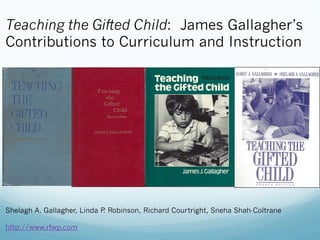
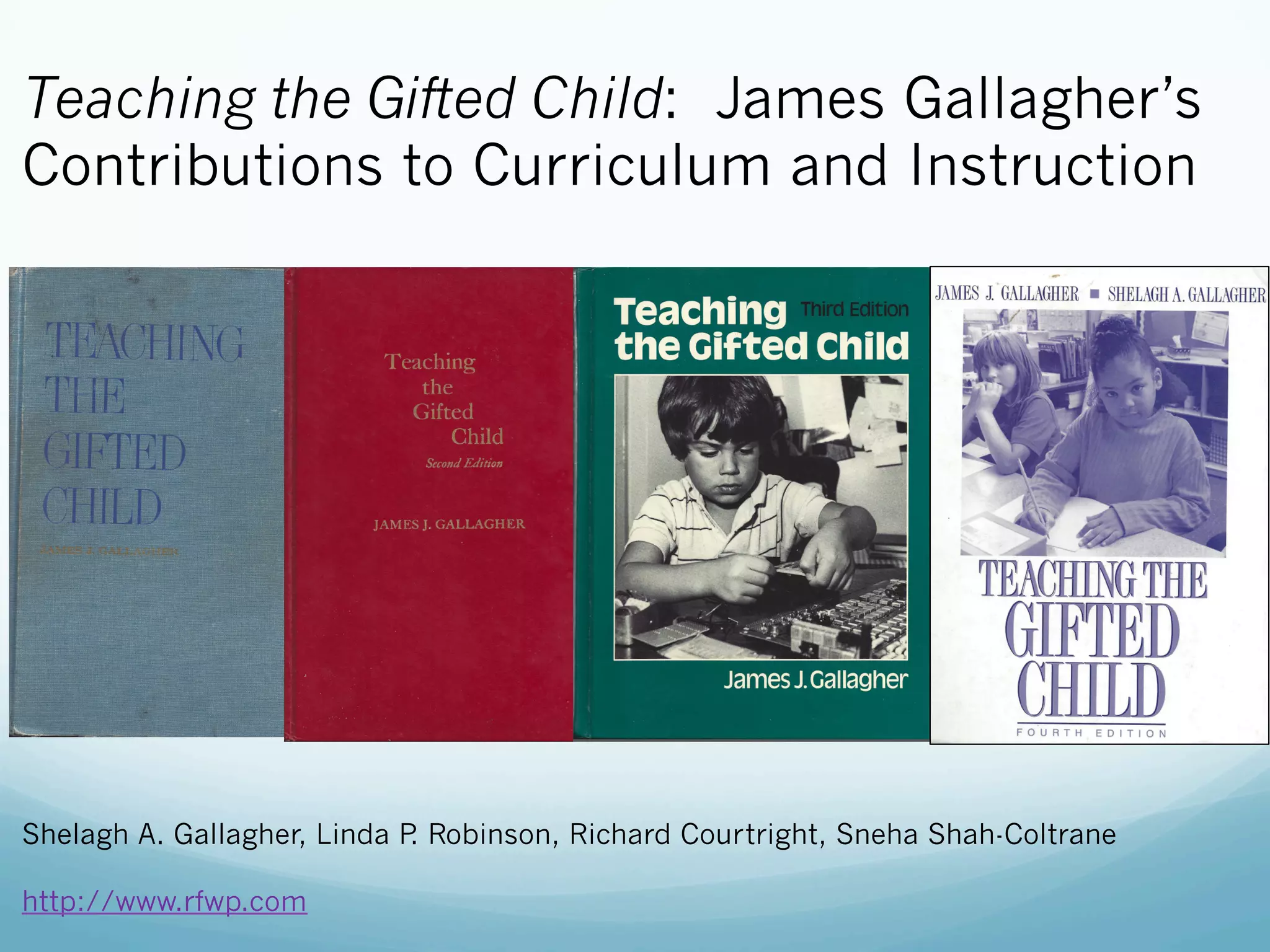
Teaching the Gifted Child: James Gallagher’s
Contributions to Curriculum and Instruction
Teaching the
Gifted Child
Era 1:
1964
Table of Contents
1 - Definition of Gifted Children
2 - Characteristics of Gifted Children
3 – Low Producers Among Gifted Children
4 – The Changing School Program for the Gifted
5 – Arithmetic for the Gifted
6 – Science for the Gifted
7 - Social Studies for the Gifted
8 – Creativity and Gifted Children
9 – Discovery and Inquiry – Tools for Teaching the Gifted
10 – Programming for Low-Producing Gifted Children
11 – Administrative Changes for the Gifted
12 – Personnel for Work with the Gifted
Four Profiles of Gifted
Learners
Cranshaw
Zelda
Joe
Juan
Classroom
Conversations
Gallagher Speech Presented at
NAGC, April, 1965
“Theoretically the curriculum should be
based on these fundamental
characteristics which set the gifted child
apart from the average child. In my opinion
this has not been effective because it
presented the teacher with a literally
impossible task.”
“It is as though we would ask a perfectly
good general practitioner to not only treat
his clients effectively but also to do basic
research in biochemistry, initiate a whole
new family of antibiotics, test and evaluate
them, then apply them appropriately.”
“Then when these bewildered individuals
fail, as they must inevitably fail, we would
then throw up our hands at their
bewildering incompetency.”
Chapter 5:
Arithmetic for the
Gifted
“One obligation of teachers of gifted
children is to allow them the
opportunity of seeing such a
structure, and not to be so concerned
with the solution of an individual
problem as to neglect the over-all
pattern, structure and order” (p.104).
Chapter
6:
Science
for the
Gifted
“For gifted children, the
approach should stress a
deep and prolonged emphasis
on one topic, rather than a
superficial bee-flitting
approach to many topics….
The particular area of study…
is probably not terribly
important.
What is important is that the
student experience the
excitement of inquiry, of
striving to solve a difficult
problem and, finally, of
understanding, in depth, the
topic under study.” (p. 130).
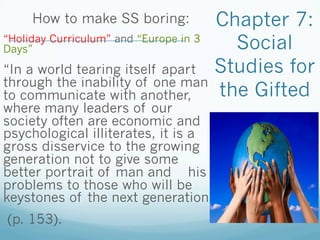
Chapter 7:
Social
Studies for
the Gifted
How to make SS boring:
“Holiday Curriculum” and “Europe in 3
Days”
“In a world tearing itself apart
through the inability of one man
to communicate with another,
where many leaders of our
society often are economic and
psychological illiterates, it is a
gross disservice to the growing
generation not to give some
better portrait of man and his
problems to those who will be
keystones of the next generation”
(p. 153).
•  Advanced Conceptualization
•  Teaching for Generalizations
•  Dramatizing the Human
Element
•  The Importance of
Methodology
•  The Right to Inquire
QUESTIONING STUDIES
“Preliminary Report on Analyses of
Classroom Interaction”
(1963)
James J. Gallagher and Mary Jane Aschner
!  Investigated productive thought
processes in gifted children.
!  Five consecutive classroom sessions
in 12 classrooms of intellectually
superior junior high children in SS,
math, science and English.
“Three Studies of the Classroom”
James J. Gallagher
Study 1 – Productive Thinking Study
118 boys; 117 girls
Jr. high and high school
Study 2 - Topic Classification Across
Content Areas with the Same
Training
Study 3 – Biological Sciences
Curriculum Study (BSCS, 1959)
OVERALL
! Productive Thinking
! Topics Related to
Generalization
! Relationship to Teacher
Questions and Study Talk and
Questions
! Variation
! Summarizing
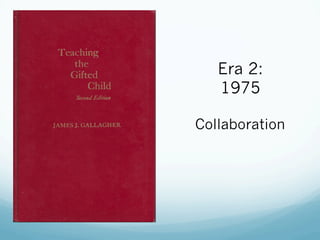
Era 2:
1975
Collaboration
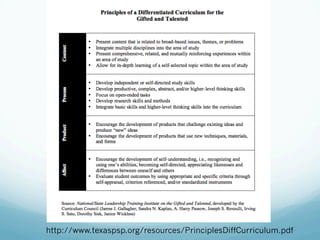
http://www.texaspsp.org/resources/PrinciplesDiffCurriculum.pdf
Content
!  Present content that is related to broad-
based issues, themes, or problems
!  Integrate multiple disciplines into area of
study
!  Present comprehensive, related, and
mutually reinforcing experiences within an
area of study
!  Allow for in-depth learning of a self-selected
topic within the area of study
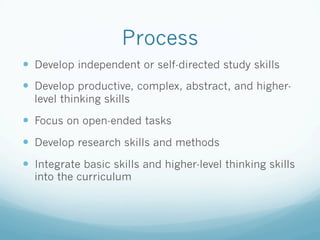
Process
!  Develop independent or self-directed study skills
!  Develop productive, complex, abstract, and higher-
level thinking skills
!  Focus on open-ended tasks
!  Develop research skills and methods
!  Integrate basic skills and higher-level thinking skills
into the curriculum
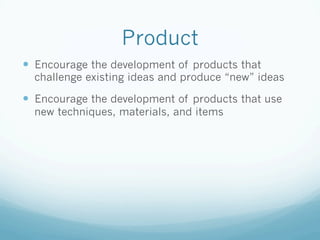
Product
!  Encourage the development of products that
challenge existing ideas and produce “new” ideas
!  Encourage the development of products that use
new techniques, materials, and items
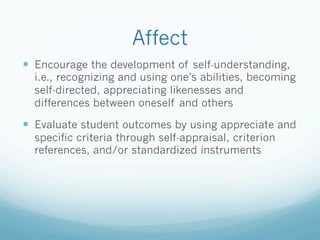
Affect
!  Encourage the development of self-understanding,
i.e., recognizing and using one’s abilities, becoming
self-directed, appreciating likenesses and
differences between oneself and others
!  Evaluate student outcomes by using appreciate and
specific criteria through self-appraisal, criterion
references, and/or standardized instruments
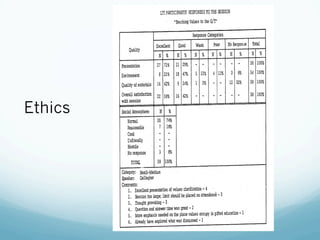
Ethics
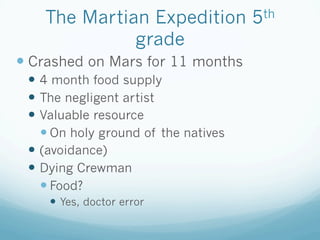
The Martian Expedition 5th
grade
! Crashed on Mars for 11 months
!  4 month food supply
!  The negligent artist
!  Valuable resource
! On holy ground of the natives
!  (avoidance)
!  Dying Crewman
! Food?
!  Yes, doctor error
The Kids
JuanSam
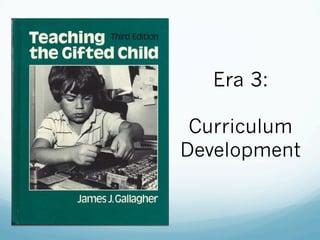
Era 3:
Curriculum
Development
The Challenge of Curriculum
Development
!  To design and develop such curriculum, the
K-12 teacher requires an impressive variety of
skills and knowledge.
!  The range of knowledge and skills that address
sophisticated content in a variety of areas will
rarely be found in a single human being.
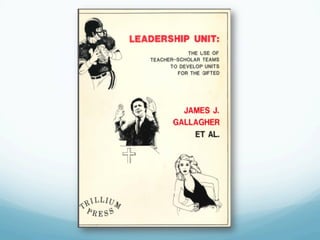
To address this problem, James Gallagher implemented
the Content Specialist model in developing curriculum,
based on the idea that...
The sophisticated knowledge of the content
areas is in the possession of scholars and
academicians who are often found in
university settings…
A Solution to the
Challenge
“…whereas the special knowledge of how to design
experiences and programs for specific gifted youngsters is
most likely in the possession of experienced and capable
special [gifted] education teachers.
The physical and psychological distance between
persons with these attributes has been inhibiting
sophisticated program development during the past
several decades.”
A Solution to the
Challenge
Combining problem-based
learning with the content
specialist model:
!  Helps students make connections between classroom
learning and the real world;
!  Fosters an inventive spirit in students so they recognize
the world’s problems and needs and think of how to
design, test, redesign, and implement practical solutions;
!  Provides high level content specific knowledge of a field
for the rigor gifted students require; and,
!  Allows educators to focus on the development of the
problem-based, interdisciplinary project.
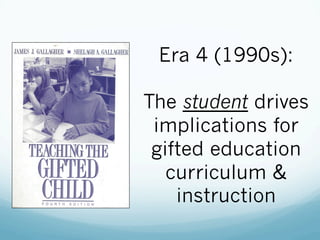
Era 4 (1990s):
The student drives
implications for
gifted education
curriculum &
instruction
•  4th version
Last version and still current
•  With Dr. Shelagh Gallagher
•  New Student Profile, Stephanie,
representing the artistically gifted child
•  Still guides all of our work today,
regarding curriculum and instruction for
students who need advanced learning
NC’s Nine Model Sites
!  9 LEAs selected/volunteered to “de-centralize” state process
for ID, C & I, Teacher Preparation, Evaluation (1993-96).
Agreed to financial commitment.
!  Needs assessment & recommendations to local school
boards, facilitated by S.T.A.G.E. (Javits and NCDPI funding)
!  “Designing, building, and flying the airplane at the same
time.”
!  Outcome: State Legislation, Article 9B (1996).
!  Continues mandate to identify and serve AIG students but
focuses on local and student needs, not just a one-size fits all
model.
!  Every LEA develops a three year gifted local plan with its own
identification and programming components (among others)
to be approved by Local School Boards and reviewed by State
Board of Education.
Continued Impact in NC Today
Continued Era 4 (2000s)
All focused on the student
!  Article 9B still growing strong.
!  NC AIG Program Standards: Differentiated Curriculum and
Instruction Standard, Total School Programming
!  Regional Support Structure
!  Student Data to guide programming and policies
!  Variety of services for our AIG students – DEPs –
program based on student needs.
!  Credit by Demonstrated Mastery, Early Graduation, Early
Entry to K, Differentiation Expectations K-12, NCSSM,
NCSOA, Career and College Promise, CIHS, AP/IB, U-
STARS~PLUS
Using Problem-based Learning to
Explore Unseen
Academic Potential
Shelagh A. Gallagher
Engaged Education, sgallagher5@carolina.rr.com
James J. Gallagher
University of North Carolina-Chapel Hill, james.gallagher@unc.edu
Available at: http://dx.doi.org/10.7771/1541-5015.1322
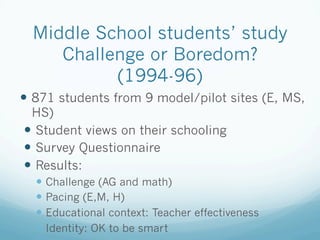
Middle School students’ study
Challenge or Boredom?
(1994-96)
!  871 students from 9 model/pilot sites (E, MS,
HS)
!  Student views on their schooling
!  Survey Questionnaire
!  Results:
! Challenge (AG and math)
! Pacing (E,M, H)
! Educational context: Teacher effectiveness
! Identity: OK to be smart
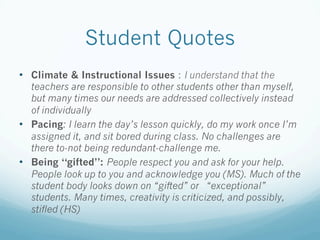
Student Quotes
•  Climate & Instructional Issues : I understand that the
teachers are responsible to other students other than myself,
but many times our needs are addressed collectively instead
of individually
•  Pacing: I learn the day’s lesson quickly, do my work once I’m
assigned it, and sit bored during class. No challenges are
there to-not being redundant-challenge me.
•  Being “gifted”: People respect you and ask for your help.
People look up to you and acknowledge you (MS). Much of the
student body looks down on “gifted” or “exceptional”
students. Many times, creativity is criticized, and possibly,
stifled (HS)
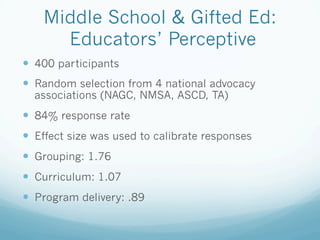
Middle School & Gifted Ed:
Educators’ Perceptive
!  400 participants
!  Random selection from 4 national advocacy
associations (NAGC, NMSA, ASCD, TA)
!  84% response rate
!  Effect size was used to calibrate responses
!  Grouping: 1.76
!  Curriculum: 1.07
!  Program delivery: .89
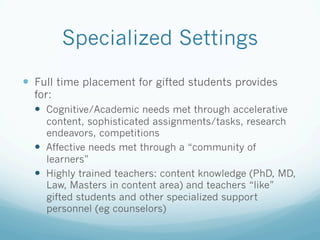
Specialized Settings
!  Full time placement for gifted students provides
for:
!  Cognitive/Academic needs met through accelerative
content, sophisticated assignments/tasks, research
endeavors, competitions
!  Affective needs met through a “community of
learners”
!  Highly trained teachers: content knowledge (PhD, MD,
Law, Masters in content area) and teachers “like”
gifted students and other specialized support
personnel (eg counselors)
When given appropriate education opportunities,
children who are gifted will become increasingly
knowledgeable; therefore, their need for
differentiation increases as well, as compared to
others of their age, experience, and environment.
-James J. Gallagher

Teachingthe giftedchildgallagherrobinsoncourtrightcoltrane

  • 1.
    Shelagh A. Gallagher,Linda P. Robinson, Richard Courtright, Sneha Shah-Coltrane http://www.rfwp.com Teaching the Gifted Child: James Gallagher’s Contributions to Curriculum and Instruction
  • 2.
  • 3.
    Table of Contents 1- Definition of Gifted Children 2 - Characteristics of Gifted Children 3 – Low Producers Among Gifted Children 4 – The Changing School Program for the Gifted 5 – Arithmetic for the Gifted 6 – Science for the Gifted 7 - Social Studies for the Gifted 8 – Creativity and Gifted Children 9 – Discovery and Inquiry – Tools for Teaching the Gifted 10 – Programming for Low-Producing Gifted Children 11 – Administrative Changes for the Gifted 12 – Personnel for Work with the Gifted
  • 4.
    Four Profiles ofGifted Learners Cranshaw Zelda Joe Juan Classroom Conversations
  • 5.
    Gallagher Speech Presentedat NAGC, April, 1965 “Theoretically the curriculum should be based on these fundamental characteristics which set the gifted child apart from the average child. In my opinion this has not been effective because it presented the teacher with a literally impossible task.”
  • 6.
    “It is asthough we would ask a perfectly good general practitioner to not only treat his clients effectively but also to do basic research in biochemistry, initiate a whole new family of antibiotics, test and evaluate them, then apply them appropriately.” “Then when these bewildered individuals fail, as they must inevitably fail, we would then throw up our hands at their bewildering incompetency.”
  • 7.
    Chapter 5: Arithmetic forthe Gifted “One obligation of teachers of gifted children is to allow them the opportunity of seeing such a structure, and not to be so concerned with the solution of an individual problem as to neglect the over-all pattern, structure and order” (p.104).
  • 8.
    Chapter 6: Science for the Gifted “For giftedchildren, the approach should stress a deep and prolonged emphasis on one topic, rather than a superficial bee-flitting approach to many topics…. The particular area of study… is probably not terribly important. What is important is that the student experience the excitement of inquiry, of striving to solve a difficult problem and, finally, of understanding, in depth, the topic under study.” (p. 130).
  • 9.
    Chapter 7: Social Studies for theGifted How to make SS boring: “Holiday Curriculum” and “Europe in 3 Days” “In a world tearing itself apart through the inability of one man to communicate with another, where many leaders of our society often are economic and psychological illiterates, it is a gross disservice to the growing generation not to give some better portrait of man and his problems to those who will be keystones of the next generation” (p. 153).
  • 10.
    •  Advanced Conceptualization • Teaching for Generalizations •  Dramatizing the Human Element •  The Importance of Methodology •  The Right to Inquire
  • 11.
    QUESTIONING STUDIES “Preliminary Reporton Analyses of Classroom Interaction” (1963) James J. Gallagher and Mary Jane Aschner !  Investigated productive thought processes in gifted children. !  Five consecutive classroom sessions in 12 classrooms of intellectually superior junior high children in SS, math, science and English. “Three Studies of the Classroom” James J. Gallagher Study 1 – Productive Thinking Study 118 boys; 117 girls Jr. high and high school Study 2 - Topic Classification Across Content Areas with the Same Training Study 3 – Biological Sciences Curriculum Study (BSCS, 1959)
  • 12.
    OVERALL ! Productive Thinking ! Topics Relatedto Generalization ! Relationship to Teacher Questions and Study Talk and Questions ! Variation ! Summarizing
  • 13.
  • 14.
  • 15.
    Content !  Present contentthat is related to broad- based issues, themes, or problems !  Integrate multiple disciplines into area of study !  Present comprehensive, related, and mutually reinforcing experiences within an area of study !  Allow for in-depth learning of a self-selected topic within the area of study
  • 16.
    Process !  Develop independentor self-directed study skills !  Develop productive, complex, abstract, and higher- level thinking skills !  Focus on open-ended tasks !  Develop research skills and methods !  Integrate basic skills and higher-level thinking skills into the curriculum
  • 17.
    Product !  Encourage thedevelopment of products that challenge existing ideas and produce “new” ideas !  Encourage the development of products that use new techniques, materials, and items
  • 18.
    Affect !  Encourage thedevelopment of self-understanding, i.e., recognizing and using one’s abilities, becoming self-directed, appreciating likenesses and differences between oneself and others !  Evaluate student outcomes by using appreciate and specific criteria through self-appraisal, criterion references, and/or standardized instruments
  • 19.
  • 20.
    The Martian Expedition5th grade ! Crashed on Mars for 11 months !  4 month food supply !  The negligent artist !  Valuable resource ! On holy ground of the natives !  (avoidance) !  Dying Crewman ! Food? !  Yes, doctor error
  • 21.
  • 22.
  • 24.
    The Challenge ofCurriculum Development !  To design and develop such curriculum, the K-12 teacher requires an impressive variety of skills and knowledge. !  The range of knowledge and skills that address sophisticated content in a variety of areas will rarely be found in a single human being.
  • 25.
    To address thisproblem, James Gallagher implemented the Content Specialist model in developing curriculum, based on the idea that... The sophisticated knowledge of the content areas is in the possession of scholars and academicians who are often found in university settings… A Solution to the Challenge
  • 26.
    “…whereas the specialknowledge of how to design experiences and programs for specific gifted youngsters is most likely in the possession of experienced and capable special [gifted] education teachers. The physical and psychological distance between persons with these attributes has been inhibiting sophisticated program development during the past several decades.” A Solution to the Challenge
  • 27.
    Combining problem-based learning withthe content specialist model: !  Helps students make connections between classroom learning and the real world; !  Fosters an inventive spirit in students so they recognize the world’s problems and needs and think of how to design, test, redesign, and implement practical solutions; !  Provides high level content specific knowledge of a field for the rigor gifted students require; and, !  Allows educators to focus on the development of the problem-based, interdisciplinary project.
  • 30.
    Era 4 (1990s): Thestudent drives implications for gifted education curriculum & instruction
  • 31.
    •  4th version Lastversion and still current •  With Dr. Shelagh Gallagher •  New Student Profile, Stephanie, representing the artistically gifted child •  Still guides all of our work today, regarding curriculum and instruction for students who need advanced learning
  • 32.
    NC’s Nine ModelSites !  9 LEAs selected/volunteered to “de-centralize” state process for ID, C & I, Teacher Preparation, Evaluation (1993-96). Agreed to financial commitment. !  Needs assessment & recommendations to local school boards, facilitated by S.T.A.G.E. (Javits and NCDPI funding) !  “Designing, building, and flying the airplane at the same time.” !  Outcome: State Legislation, Article 9B (1996). !  Continues mandate to identify and serve AIG students but focuses on local and student needs, not just a one-size fits all model. !  Every LEA develops a three year gifted local plan with its own identification and programming components (among others) to be approved by Local School Boards and reviewed by State Board of Education.
  • 33.
    Continued Impact inNC Today Continued Era 4 (2000s) All focused on the student !  Article 9B still growing strong. !  NC AIG Program Standards: Differentiated Curriculum and Instruction Standard, Total School Programming !  Regional Support Structure !  Student Data to guide programming and policies !  Variety of services for our AIG students – DEPs – program based on student needs. !  Credit by Demonstrated Mastery, Early Graduation, Early Entry to K, Differentiation Expectations K-12, NCSSM, NCSOA, Career and College Promise, CIHS, AP/IB, U- STARS~PLUS
  • 34.
    Using Problem-based Learningto Explore Unseen Academic Potential Shelagh A. Gallagher Engaged Education, sgallagher5@carolina.rr.com James J. Gallagher University of North Carolina-Chapel Hill, james.gallagher@unc.edu Available at: http://dx.doi.org/10.7771/1541-5015.1322
  • 36.
    Middle School students’study Challenge or Boredom? (1994-96) !  871 students from 9 model/pilot sites (E, MS, HS) !  Student views on their schooling !  Survey Questionnaire !  Results: ! Challenge (AG and math) ! Pacing (E,M, H) ! Educational context: Teacher effectiveness ! Identity: OK to be smart
  • 37.
    Student Quotes •  Climate& Instructional Issues : I understand that the teachers are responsible to other students other than myself, but many times our needs are addressed collectively instead of individually •  Pacing: I learn the day’s lesson quickly, do my work once I’m assigned it, and sit bored during class. No challenges are there to-not being redundant-challenge me. •  Being “gifted”: People respect you and ask for your help. People look up to you and acknowledge you (MS). Much of the student body looks down on “gifted” or “exceptional” students. Many times, creativity is criticized, and possibly, stifled (HS)
  • 38.
    Middle School &Gifted Ed: Educators’ Perceptive !  400 participants !  Random selection from 4 national advocacy associations (NAGC, NMSA, ASCD, TA) !  84% response rate !  Effect size was used to calibrate responses !  Grouping: 1.76 !  Curriculum: 1.07 !  Program delivery: .89
  • 39.
    Specialized Settings !  Fulltime placement for gifted students provides for: !  Cognitive/Academic needs met through accelerative content, sophisticated assignments/tasks, research endeavors, competitions !  Affective needs met through a “community of learners” !  Highly trained teachers: content knowledge (PhD, MD, Law, Masters in content area) and teachers “like” gifted students and other specialized support personnel (eg counselors)
  • 40.
    When given appropriateeducation opportunities, children who are gifted will become increasingly knowledgeable; therefore, their need for differentiation increases as well, as compared to others of their age, experience, and environment. -James J. Gallagher