Autism 101
The who, what, why and how
By Courtney Butorac, M. Ed, BCBA
What is Autism Spectrum Disorder?
 Autism is a complex developmental
disability affecting individuals in the areas of social
interaction and communication.
 Individuals with ASD also have restricted and
repetitive behavior, interests and activities.
 Autism is a spectrum disorder – ranging from mild to
severe. Some individuals will have mild functional
impairments, while others are unable to perform
daily activities independently
Early Signs of Autism
 No babbling by 12 months
 No pointing or gesturing by 12 months
 No single words by 16 months
 No 2-word phrases by 24 months
 Loss of previously acquired skills, especially language
 Lack of joint attention (child does not draw other’s attention to objects in the
environment)
 Child does not respond to his/her name
 Lack of pretend, imitative and functional play appropriate to developmental age
 Failure to develop peer relationships appropriate to developmental age
 Child does not imitate others’ behaviors
 Child is rigid in routines or has very difficult transitions
 Child engages in repetitive or stereotypical behavior
 Child has unusual responses to sensory stimuli
What causes ASD?
 Autism has no single cause.
 Currently, researchers believe that it is
attributed to several genes and possibly
environmental factors.
 The theory that autism is caused by
vaccines has been debunked.
Autism by the Numbers
 Autism is the fastest-growing developmental disability in the U.S.
 As of April 26, 2018, the prevalence of autism is 1 in 59.
 Over 1.5 million individuals in the United States have been diagnosed with
autism spectrum disorder.
 The diagnosis rate for autism is rising 10-17% each year.
 Males are 4 times more likely than females to be diagnosed with autism. It
has been shown to be much more difficult to diagnose girls.
 Autism know no racial, ethnic, or economic barriers, yet white children are
7% more likely than Black and 22% more likely than Hispanic children to be
identified with ASD
 Approximately 2/3 of children with ASD do not have an intellectual
disability
 Infants with an older sibling with an ASD diagnosis are at an elevated risk
for ASD and ASD symptoms
 More children will be diagnosed with autism this year than with AIDS,
diabetes & cancer combined
Autism Speaks 2018
Common saying
If you know one person
with autism, you know one
person with autism.
Common Strengths in Autism
 Strong rote memory and memory for facts
 Good attention to detail
 Strong ability to attend and dive into areas of interest
 Strong moral code, often very loyal and reliable
 Creative thinking skills
 Can be very logical and think of things visually
 Honest and nonjudgemental
 Strong rule followers
Common Challenges with Autism:
Social
 Friendship management
 Sharing a friend
 Dealing with peer pressure
 Getting attention in the positive way
 Conflict management
 Asserting yourself
 Dealing with teasing
 Giving and accepting criticism
 Play skills
 Joining in play
 Compromising
 Dealing with not getting what you want
Common Challenges with Autism:
Social
 Difficulty connecting to others without similar
interests
 Perceiving unwritten rules of social interaction.
 Difficulty expressing empathy in ways that others
expect or understand
 Difficulty perceiving emotional states of others
 Difficulty with perspective taking
 Theory of mind
This Photo by Unknown Author is licensed under CC BY-NC-ND
Question
How does a lack of perspective
taking make social skills
difficult?
Answer
 Problem solving
 Reciprocal conversation
 Sharing
 Respecting personal boundaries
 Oversharing
 Blunt/honest
Real life examples
Specific challenges that might come up as kids get older
 Insensitivity to other people’s feelings
 Commenting on appearance
 Inability to take into account what other people know
 Referring to events without background knowledge
 Inability to negotiate friendships by reading and responding to intention
 If people don’t respond in the expected way (the way they have been taught)
 Inability to read the listener’s level of interest in one’s speech
 Monologuing
 Inability to detect a speaker’s intended meaning
 Acting literally on what people say “you do that again…”
Simon Baron Cohen, "Teaching Children with Autism to Mind-Read"
More Examples
 Inability to anticipate what others might think about one’s actions
 Personal space, TMI
 Inability to understand misunderstandings
 Not understanding why others make mistakes
 Inability to deceive or understand deception
 Being open to exploitation
 Inability to understand the reasons behind people’s actions
 Not understanding the reasons for accommodations
 Inability to understand “unwritten rules” or conventions
 What you should and shouldn’t say
Simon Baron Cohen, "Teaching Children with Autism to Mind-Read"
Common Challenges with Autism:
Emotional
 Recognizing emotions in others and self
 Difficulty regulating emotions
 Overreaction
 Lack of coping skills
 Anxiety
Foreign country
 Depression
Common challenges with Autism:
Cognitive
 Executive functioning
 Initiate
 Working memory
 Shift
 Organize
 Plan
 Monitor
 Emotional control
 inhibit
Common challenges with Autism:
Cognitive
 Flexibility and rigidity
 Changes in schedule
 Environmental changes
 Routines
 Black and white
 Rule bound – which makes them ruler police
 Lack of adaptability
Common Challenges with Autism:
Cognitive – restrictive interests and routines
 Want to stick to one topic
 Order and consistency
 More rigidity
 Often highly interested in something
 https://www.bing.com/videos/search?q=autism+and+special+interest&&view
=detail&mid=915A8FC35F85C142241B915A8FC35F85C142241B&rvsmid=6ECF01
0EB13B0FC69D0E6ECF010EB13B0FC69D0E&FORM=VDRVRV
Example of inflexibility
 https://www.youtube.com/watch?v=WS55-q4fOjU
Common challenges with Autism:
Academics
 Reading
 Main idea/summary
 Inferential reasoning
 Prediction
 Math
 Word problems
 Explaining thinking
 Writing
 Multiple executive functioning skills
 Explaining thinking
Common Challenges with Autism:
Verbal Communication/Language
 Rules of conversation (Initiating, maintaining and ending conversations, turn
taking, eye contact, face the speaker, stay on topic, personal space)
 Talking too much about their topic
 Inability to verbalize (communicate other ways)
 Literal interpretation of language
 Asking for help or clarification
 Formalized use of language
 Coping with uncertainty (saying “I don’t know)
 Slow processing
 Knowing when to interrupt
Common Challenges with Autism:
Verbal Communication/Language
 Melody of speech/tone (prosody)- tone, volume, and intonation
 https://www.bing.com/videos/search?q=fun+with+flags+sheldon+body+language&
&view=detail&mid=F92727D8515E2ABB24E1F92727D8515E2ABB24E1&&FORM=VRDG
AR
 Understanding tone of voice
 “I didn’t steal the cookie from the cookie jar.”
 Vocalizing thoughts – no social filter
 Verbal fluency
 Joint attention
 Commenting
 Repetition of the same phrases
 https://www.bing.com/videos/search?q=laurie+bream+silicon+valley&&view=detai
l&mid=A30F87FCE341FB46B148A30F87FCE341FB46B148&&FORM=VRDGAR
Common Challenges with Autism:
Nonverbal Communication
 Reading social cues
 Hidden rules of society
 Reading emotions
 http://www.msnbc.msn.com/id/7019005/ns/nbcnightlynews/t/movies-help-
doctors-discover-autistic-minds/#.UCGZGKPO-So
 https://www.bing.com/videos/search?q=diary+of+a+wimpy+kid+musical+tryo
uts&&view=detail&mid=E46CE3757B74F228AA91E46CE3757B74F228AA91&&FO
RM=VRDGAR
 https://www.bing.com/videos/search?q=the+best+of+the+office&&view=deta
il&mid=A4C81F7EAB8E01F81FFFA4C81F7EAB8E01F81FFF&&FORM=VRDGAR
 Minute 2:56
Common Challenges with Autism:
Sensory
 Visual – lights, busy environment
 Hear – clock ticking – Youtube video
 Smell – scents like perfume, food
 Taste – hot/cold
 Tactile – textures scratchy/ tags
Common Challenges with Autism:
Sensory
 Proprioceptive – sensations from joints, muscles
and connective tissues that underlie body
awareness
Hanging, pushing heavy objects, carrying
 Vestibular – the sense of movement, centered in
the inner ear
swinging, spinning, hanging upside down
Common Challenges with Autism:
Motor
 Difficulties with prediction and anticipation
 Affect motor planning and motor learning
 Also affects postural stability and balance
 Joint hypermobility/low muscle tone
 Affect stability and muscle strength
 Associated with toe walking
 Anxious/fearful temperament
 Affects willingness to participate in challenging tasks
 Leads to avoidance and limited experience
 Other: Ball skills, running gait, rhythm
Common Challenges with Autism:
Restrictive Interests and Routines
 Want to stick to one topic
 Order and consistency
 More rigidity
 Often highly interested in something
 https://www.bing.com/videos/search?q=autism+and+spec
ial+interest&&view=detail&mid=915A8FC35F85C142241B9
15A8FC35F85C142241B&rvsmid=6ECF010EB13B0FC69D0E6E
CF010EB13B0FC69D0E&FORM=VDRVRV
Analyze this video
 Sheldon goes to jail
 https://www.bing.com/videos/search?q=sheldon+goes+to+jail&view=detail&
mid=BEB18E5A9F3F0B83C2BCBEB18E5A9F3F0B83C2BC&FORM=VIRE
How do we Teach Students with Autism:
General
 Visual supports
 Social stories
 Power cards
 Top secret mission cards
How do we Teach Students with Autism:
Social
 Teach social skills!
 Role play
 Superflex
 The A-team
 Social scripts
 Video modeling
 https://www.youtube.com/watch?v=9GofBaXi2sE
 Set up situations for practice
How do we Teach Students with Autism:
Social
 Use other children as cues of what to do (do you see other
children…)
 Use proximal praise (great job sitting Michael)
 Encourage cooperative games (you may need to support them)
 Encourage friendships – recess club, lunch buddies
 Use minimal and consistent language and model appropriate
interactions
 Teach the whole class about tolerance and ways to make
friends
 Teach general social skills
How do we Teach Students with Autism:
Social
 Perspective taking
 Bubble talk
 Scenario from multiple perspectives
 Pictures with different perspectives
This Photo by Unknown Author is licensed under CC BY-
NC-ND
How do we Teach Students with Autism:
Emotional
 1-5 chart
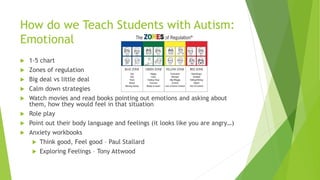
 Zones of regulation
 Big deal vs little deal
 Calm down strategies
 Watch movies and read books pointing out emotions and asking about
them, how they would feel in that situation
 Role play
 Point out their body language and feelings (it looks like you are angry…)
 Anxiety workbooks
 Think good, Feel good – Paul Stallard
 Exploring Feelings – Tony Attwood
How do we Teach Students with Autism:
Cognitive
 Extra time
 Teach how to self monitor
 Use timers, motivators
 Teach planning skills
 Use checklist/charts/to do lists
 Teach desk organization (pictures, tape)
 Teach about impulse control
 Give warnings about changes and transitions
 Use schedules
How do we Teach Students with Autism:
Cognitive
 Flexibility training
 “Max gets Inflexible” – Courtney Butorac
 Stroop test
 Teach flexible categories
 Play mad-libs
 Change endings to stories
 Teach about the “Ruler Police”
How do we Teach Students with Autism:
Academics
 Reading
 Access and build background knowledge
 Preteach vocabulary, show pictures
 Create mental images
 Picture walk through the book
 Make connections
 Venn diagram
 Engage in consistent discussion
 Graphic organizer
 Summarize understanding
 Main idea – practice this
How do we Teach Students with Autism:
Academics
 Math
 Break down the problem
 Read the problems aloud
 USE VISUALS!
 Use concrete items
 Writing
 Lego writing
 Comic strip writing
 Use their special interests to build
 Graphic organizers
 Assistive technology
 Prewriting sensory activities
 Editing checklists
 Hand over hand, highlight, copy
How do we Teach Students with Autism:
Verbal Communication & Language
 Work with the SLP (Speech Language Pathologist)
 Model commenting and compliments
 Model tone and emphasis
 Use social scripts
 Video modeling
 Pragmatics – look at a picture and describe what is happening
 Questions
 Assistive technology
 PECS
How do we Teach Students with Autism:
Verbal Communication & Language
 Think it, don’t say it
 Personal thought bubbles
 Teach about when to interrupt
 Teach how to ask for help
 Use visual cards
 Model sympathetic comments
 Teach turn taking in conversation
 Teach idioms and metaphors
 Verbally demonstrate different emphasis and tone
How do we Teach Students with Autism:
Nonverbal Communication
 Watch videos
 Demonstrate body language
 Charades
 Emotions bingo
 Teach the hidden rules
 Go through different scenarios and teach how to act in those
situations
 Role play
 https://www.youtube.com/watch?v=jSiPHq-UTJA
How do we Teach Students with Autism:
Sensory
 Work with the OT (Occupational Therapist)
 Vestibular – swing, spin, run around
 Proprioceptive - Heavy work – carry, push, recycle – lap pad, chewing gum
 Tactile – kinetic sand, water beads, beans, squeeze balls
 Visual – hats, dim lights, minimize visual distractions, study carrels
 Smell – just be aware of what you are wearing, what you are cooking
 Hear – headphones, music
 Include sensory breaks
 Meaningful jobs
 Meditation
 Different kinds of chairs, allow for standing, fidgets,
How do we Teach Students with Autism:
Motor
 Work with your OT/PT
 Hand strengthening
 Practice ball skills
 Balance boards – catch ball
 Handwriting exercises
 Assistive technology
 Mazes
Behavior
 Behavior is a big part of Autism
 Next session, we will talk about small ways to prevent big behaviors
Resources
 The A-Team books - www.sociallearning.org
 Superflex, Social Behavior Mapping, Social Thinking –
www.socialthinking.com
 Everyday Speech *video modeling - www.everydayspeech.com
 PECS - https://www.nationalautismresources.com/the-picture-exchange-
communication-system-pecs
 “Zones of Regulation” - http://www.zonesofregulation.com/index.html
 “Think Good, Feel Good” – Paul Stallard
 “Exploring Feelings” – Tony Attwood
 www.autismspeaks.org

Session #24: Autism 101 Handouts

  • 1.
    Autism 101 The who,what, why and how By Courtney Butorac, M. Ed, BCBA
  • 2.
    What is AutismSpectrum Disorder?  Autism is a complex developmental disability affecting individuals in the areas of social interaction and communication.  Individuals with ASD also have restricted and repetitive behavior, interests and activities.  Autism is a spectrum disorder – ranging from mild to severe. Some individuals will have mild functional impairments, while others are unable to perform daily activities independently
  • 3.
    Early Signs ofAutism  No babbling by 12 months  No pointing or gesturing by 12 months  No single words by 16 months  No 2-word phrases by 24 months  Loss of previously acquired skills, especially language  Lack of joint attention (child does not draw other’s attention to objects in the environment)  Child does not respond to his/her name  Lack of pretend, imitative and functional play appropriate to developmental age  Failure to develop peer relationships appropriate to developmental age  Child does not imitate others’ behaviors  Child is rigid in routines or has very difficult transitions  Child engages in repetitive or stereotypical behavior  Child has unusual responses to sensory stimuli
  • 4.
    What causes ASD? Autism has no single cause.  Currently, researchers believe that it is attributed to several genes and possibly environmental factors.  The theory that autism is caused by vaccines has been debunked.
  • 5.
    Autism by theNumbers  Autism is the fastest-growing developmental disability in the U.S.  As of April 26, 2018, the prevalence of autism is 1 in 59.  Over 1.5 million individuals in the United States have been diagnosed with autism spectrum disorder.  The diagnosis rate for autism is rising 10-17% each year.  Males are 4 times more likely than females to be diagnosed with autism. It has been shown to be much more difficult to diagnose girls.  Autism know no racial, ethnic, or economic barriers, yet white children are 7% more likely than Black and 22% more likely than Hispanic children to be identified with ASD  Approximately 2/3 of children with ASD do not have an intellectual disability  Infants with an older sibling with an ASD diagnosis are at an elevated risk for ASD and ASD symptoms  More children will be diagnosed with autism this year than with AIDS, diabetes & cancer combined Autism Speaks 2018
  • 6.
    Common saying If youknow one person with autism, you know one person with autism.
  • 7.
    Common Strengths inAutism  Strong rote memory and memory for facts  Good attention to detail  Strong ability to attend and dive into areas of interest  Strong moral code, often very loyal and reliable  Creative thinking skills  Can be very logical and think of things visually  Honest and nonjudgemental  Strong rule followers
  • 8.
    Common Challenges withAutism: Social  Friendship management  Sharing a friend  Dealing with peer pressure  Getting attention in the positive way  Conflict management  Asserting yourself  Dealing with teasing  Giving and accepting criticism  Play skills  Joining in play  Compromising  Dealing with not getting what you want
  • 9.
    Common Challenges withAutism: Social  Difficulty connecting to others without similar interests  Perceiving unwritten rules of social interaction.  Difficulty expressing empathy in ways that others expect or understand  Difficulty perceiving emotional states of others  Difficulty with perspective taking  Theory of mind
  • 10.
    This Photo byUnknown Author is licensed under CC BY-NC-ND
  • 11.
    Question How does alack of perspective taking make social skills difficult?
  • 12.
    Answer  Problem solving Reciprocal conversation  Sharing  Respecting personal boundaries  Oversharing  Blunt/honest
  • 13.
    Real life examples Specificchallenges that might come up as kids get older  Insensitivity to other people’s feelings  Commenting on appearance  Inability to take into account what other people know  Referring to events without background knowledge  Inability to negotiate friendships by reading and responding to intention  If people don’t respond in the expected way (the way they have been taught)  Inability to read the listener’s level of interest in one’s speech  Monologuing  Inability to detect a speaker’s intended meaning  Acting literally on what people say “you do that again…” Simon Baron Cohen, "Teaching Children with Autism to Mind-Read"
  • 14.
    More Examples  Inabilityto anticipate what others might think about one’s actions  Personal space, TMI  Inability to understand misunderstandings  Not understanding why others make mistakes  Inability to deceive or understand deception  Being open to exploitation  Inability to understand the reasons behind people’s actions  Not understanding the reasons for accommodations  Inability to understand “unwritten rules” or conventions  What you should and shouldn’t say Simon Baron Cohen, "Teaching Children with Autism to Mind-Read"
  • 15.
    Common Challenges withAutism: Emotional  Recognizing emotions in others and self  Difficulty regulating emotions  Overreaction  Lack of coping skills  Anxiety Foreign country  Depression
  • 16.
    Common challenges withAutism: Cognitive  Executive functioning  Initiate  Working memory  Shift  Organize  Plan  Monitor  Emotional control  inhibit
  • 17.
    Common challenges withAutism: Cognitive  Flexibility and rigidity  Changes in schedule  Environmental changes  Routines  Black and white  Rule bound – which makes them ruler police  Lack of adaptability
  • 18.
    Common Challenges withAutism: Cognitive – restrictive interests and routines  Want to stick to one topic  Order and consistency  More rigidity  Often highly interested in something  https://www.bing.com/videos/search?q=autism+and+special+interest&&view =detail&mid=915A8FC35F85C142241B915A8FC35F85C142241B&rvsmid=6ECF01 0EB13B0FC69D0E6ECF010EB13B0FC69D0E&FORM=VDRVRV
  • 19.
    Example of inflexibility https://www.youtube.com/watch?v=WS55-q4fOjU
  • 20.
    Common challenges withAutism: Academics  Reading  Main idea/summary  Inferential reasoning  Prediction  Math  Word problems  Explaining thinking  Writing  Multiple executive functioning skills  Explaining thinking
  • 21.
    Common Challenges withAutism: Verbal Communication/Language  Rules of conversation (Initiating, maintaining and ending conversations, turn taking, eye contact, face the speaker, stay on topic, personal space)  Talking too much about their topic  Inability to verbalize (communicate other ways)  Literal interpretation of language  Asking for help or clarification  Formalized use of language  Coping with uncertainty (saying “I don’t know)  Slow processing  Knowing when to interrupt
  • 22.
    Common Challenges withAutism: Verbal Communication/Language  Melody of speech/tone (prosody)- tone, volume, and intonation  https://www.bing.com/videos/search?q=fun+with+flags+sheldon+body+language& &view=detail&mid=F92727D8515E2ABB24E1F92727D8515E2ABB24E1&&FORM=VRDG AR  Understanding tone of voice  “I didn’t steal the cookie from the cookie jar.”  Vocalizing thoughts – no social filter  Verbal fluency  Joint attention  Commenting  Repetition of the same phrases  https://www.bing.com/videos/search?q=laurie+bream+silicon+valley&&view=detai l&mid=A30F87FCE341FB46B148A30F87FCE341FB46B148&&FORM=VRDGAR
  • 23.
    Common Challenges withAutism: Nonverbal Communication  Reading social cues  Hidden rules of society  Reading emotions  http://www.msnbc.msn.com/id/7019005/ns/nbcnightlynews/t/movies-help- doctors-discover-autistic-minds/#.UCGZGKPO-So  https://www.bing.com/videos/search?q=diary+of+a+wimpy+kid+musical+tryo uts&&view=detail&mid=E46CE3757B74F228AA91E46CE3757B74F228AA91&&FO RM=VRDGAR  https://www.bing.com/videos/search?q=the+best+of+the+office&&view=deta il&mid=A4C81F7EAB8E01F81FFFA4C81F7EAB8E01F81FFF&&FORM=VRDGAR  Minute 2:56
  • 24.
    Common Challenges withAutism: Sensory  Visual – lights, busy environment  Hear – clock ticking – Youtube video  Smell – scents like perfume, food  Taste – hot/cold  Tactile – textures scratchy/ tags
  • 25.
    Common Challenges withAutism: Sensory  Proprioceptive – sensations from joints, muscles and connective tissues that underlie body awareness Hanging, pushing heavy objects, carrying  Vestibular – the sense of movement, centered in the inner ear swinging, spinning, hanging upside down
  • 26.
    Common Challenges withAutism: Motor  Difficulties with prediction and anticipation  Affect motor planning and motor learning  Also affects postural stability and balance  Joint hypermobility/low muscle tone  Affect stability and muscle strength  Associated with toe walking  Anxious/fearful temperament  Affects willingness to participate in challenging tasks  Leads to avoidance and limited experience  Other: Ball skills, running gait, rhythm
  • 27.
    Common Challenges withAutism: Restrictive Interests and Routines  Want to stick to one topic  Order and consistency  More rigidity  Often highly interested in something  https://www.bing.com/videos/search?q=autism+and+spec ial+interest&&view=detail&mid=915A8FC35F85C142241B9 15A8FC35F85C142241B&rvsmid=6ECF010EB13B0FC69D0E6E CF010EB13B0FC69D0E&FORM=VDRVRV
  • 28.
    Analyze this video Sheldon goes to jail  https://www.bing.com/videos/search?q=sheldon+goes+to+jail&view=detail& mid=BEB18E5A9F3F0B83C2BCBEB18E5A9F3F0B83C2BC&FORM=VIRE
  • 29.
    How do weTeach Students with Autism: General  Visual supports  Social stories  Power cards  Top secret mission cards
  • 30.
    How do weTeach Students with Autism: Social  Teach social skills!  Role play  Superflex  The A-team  Social scripts  Video modeling  https://www.youtube.com/watch?v=9GofBaXi2sE  Set up situations for practice
  • 31.
    How do weTeach Students with Autism: Social  Use other children as cues of what to do (do you see other children…)  Use proximal praise (great job sitting Michael)  Encourage cooperative games (you may need to support them)  Encourage friendships – recess club, lunch buddies  Use minimal and consistent language and model appropriate interactions  Teach the whole class about tolerance and ways to make friends  Teach general social skills
  • 32.
    How do weTeach Students with Autism: Social  Perspective taking  Bubble talk  Scenario from multiple perspectives  Pictures with different perspectives This Photo by Unknown Author is licensed under CC BY- NC-ND
  • 33.
    How do weTeach Students with Autism: Emotional  1-5 chart  Zones of regulation  Big deal vs little deal  Calm down strategies  Watch movies and read books pointing out emotions and asking about them, how they would feel in that situation  Role play  Point out their body language and feelings (it looks like you are angry…)  Anxiety workbooks  Think good, Feel good – Paul Stallard  Exploring Feelings – Tony Attwood
  • 34.
    How do weTeach Students with Autism: Cognitive  Extra time  Teach how to self monitor  Use timers, motivators  Teach planning skills  Use checklist/charts/to do lists  Teach desk organization (pictures, tape)  Teach about impulse control  Give warnings about changes and transitions  Use schedules
  • 35.
    How do weTeach Students with Autism: Cognitive  Flexibility training  “Max gets Inflexible” – Courtney Butorac  Stroop test  Teach flexible categories  Play mad-libs  Change endings to stories  Teach about the “Ruler Police”
  • 37.
    How do weTeach Students with Autism: Academics  Reading  Access and build background knowledge  Preteach vocabulary, show pictures  Create mental images  Picture walk through the book  Make connections  Venn diagram  Engage in consistent discussion  Graphic organizer  Summarize understanding  Main idea – practice this
  • 38.
    How do weTeach Students with Autism: Academics  Math  Break down the problem  Read the problems aloud  USE VISUALS!  Use concrete items  Writing  Lego writing  Comic strip writing  Use their special interests to build  Graphic organizers  Assistive technology  Prewriting sensory activities  Editing checklists  Hand over hand, highlight, copy
  • 39.
    How do weTeach Students with Autism: Verbal Communication & Language  Work with the SLP (Speech Language Pathologist)  Model commenting and compliments  Model tone and emphasis  Use social scripts  Video modeling  Pragmatics – look at a picture and describe what is happening  Questions  Assistive technology  PECS
  • 40.
    How do weTeach Students with Autism: Verbal Communication & Language  Think it, don’t say it  Personal thought bubbles  Teach about when to interrupt  Teach how to ask for help  Use visual cards  Model sympathetic comments  Teach turn taking in conversation  Teach idioms and metaphors  Verbally demonstrate different emphasis and tone
  • 41.
    How do weTeach Students with Autism: Nonverbal Communication  Watch videos  Demonstrate body language  Charades  Emotions bingo  Teach the hidden rules  Go through different scenarios and teach how to act in those situations  Role play  https://www.youtube.com/watch?v=jSiPHq-UTJA
  • 42.
    How do weTeach Students with Autism: Sensory  Work with the OT (Occupational Therapist)  Vestibular – swing, spin, run around  Proprioceptive - Heavy work – carry, push, recycle – lap pad, chewing gum  Tactile – kinetic sand, water beads, beans, squeeze balls  Visual – hats, dim lights, minimize visual distractions, study carrels  Smell – just be aware of what you are wearing, what you are cooking  Hear – headphones, music  Include sensory breaks  Meaningful jobs  Meditation  Different kinds of chairs, allow for standing, fidgets,
  • 43.
    How do weTeach Students with Autism: Motor  Work with your OT/PT  Hand strengthening  Practice ball skills  Balance boards – catch ball  Handwriting exercises  Assistive technology  Mazes
  • 44.
    Behavior  Behavior isa big part of Autism  Next session, we will talk about small ways to prevent big behaviors
  • 45.
    Resources  The A-Teambooks - www.sociallearning.org  Superflex, Social Behavior Mapping, Social Thinking – www.socialthinking.com  Everyday Speech *video modeling - www.everydayspeech.com  PECS - https://www.nationalautismresources.com/the-picture-exchange- communication-system-pecs  “Zones of Regulation” - http://www.zonesofregulation.com/index.html  “Think Good, Feel Good” – Paul Stallard  “Exploring Feelings” – Tony Attwood  www.autismspeaks.org