
Paraprofessional Orientation Do No Harm… What You Need to Know Within the First Few Days of Employment ___________________ Public Schools
Mission Statement Meet Individual Needs of Students With Disabilities Through Partnerships that Promote Life Long Learning and Self-Advocacy
AGENDA Special Education Rules and Regulations Paraprofessional Roles and Responsibilities Legal and Ethical Responsibilities Confidentiality Reporting Abuse and Neglect Vulnerable Adult Effective Teaming and Communication Questions You May Want to Ask
What is a Paraprofessional? MN 3525.0200 Definition SPECIAL EDUCATION –  Subp. 10a.  Paraprofessional.  “Paraprofessional” means a district employee who is primarily engaged in direct instruction with one or more pupils for instructional activities, physical or behavior management, or other purposes under the direction of a regular education or special education teacher or related services provider.
Benefits Paraprofessionals Offer in Educational Settings Expanded learning opportunities for persons with disabilities.  More individualized instruction.  Increased planning time for educators, supervisors, and others.  Better monitoring and evaluation of persons with disabilities.  Greater consistency in services.  Improved parent-school relationships.  Greater involvement of persons with disabilities in education and  other settings in the community at large.  Expanded vocational skill development for individuals with  disabilities.
Legislation MS125A.08(b) – (b) For paraprofessionals employed to work in programs for students with disabilities, the school board in each district shall ensure that - Before or immediately upon employment, each paraprofessional develops sufficient knowledge and skills in emergency procedures, building orientation, roles and responsibilities, confidentiality, vulnerability, and reportability, among other things, to begin meeting the needs of the students with whom the paraprofessional works;
Legislation MS125A.08(b) – continued 2.  Annual training opportunities are available to enable the paraprofessional to continue to further develop the knowledge and skills that are specific to the students with whom the paraprofessional works, including understanding disabilities, following lesson plans, and implementing follow-up instructional procedures and activities; and
Legislation MS125A.08(b) – continued A district wide process obligates each paraprofessional to work under the ongoing direction of a licensed teacher and, where appropriate and possible, the supervision of a school nurse .
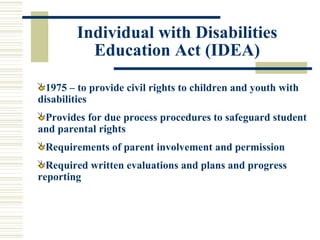
Individual with Disabilities Education Act (IDEA) 1975 – to provide civil rights to children and youth with disabilities Provides for due process procedures to safeguard student and parental rights Requirements of parent involvement and permission Required written evaluations and plans and progress reporting
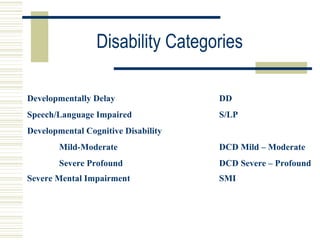
Developmentally Delay DD Speech/Language Impaired S/LP Developmental Cognitive Disability Mild-Moderate DCD Mild – Moderate Severe Profound  DCD Severe – Profound Severe Mental Impairment SMI Disability Categories
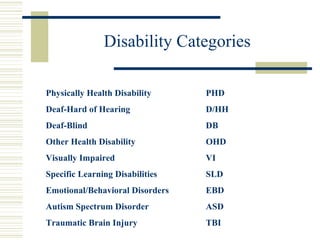
Disability Categories Physically Health Disability PHD Deaf-Hard of Hearing D/HH Deaf-Blind DB Other Health Disability OHD Visually Impaired VI Specific Learning Disabilities SLD Emotional/Behavioral Disorders EBD Autism Spectrum Disorder ASD Traumatic Brain Injury  TBI
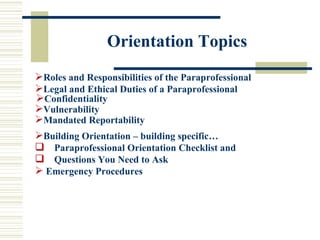
Orientation Topics Roles and Responsibilities of the Paraprofessional Legal and Ethical Duties of a Paraprofessional Confidentiality Vulnerability Mandated Reportability Building Orientation – building specific…  Paraprofessional Orientation Checklist and  Questions You Need to Ask Emergency Procedures
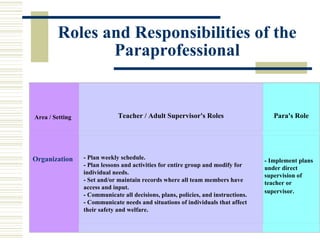
Roles and Responsibilities of the Paraprofessional Organization - Implement plans under direct supervision of teacher or supervisor.   Area / Setting Teacher / Adult Supervisor's Roles Para's Role - Plan weekly schedule.  - Plan lessons and activities for entire group and modify for individual needs. - Set and/or maintain records where all team members have access and input. - Communicate all decisions, plans, policies, and instructions. - Communicate needs and situations of individuals that affect their safety and welfare.
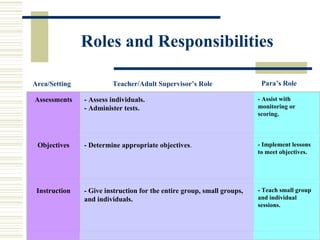
Roles and Responsibilities Area/Setting Teacher/Adult Supervisor’s Role Para’s Role Assessments - Assess individuals. - Administer tests.  - Assist with monitoring or scoring. Objectives - Determine appropriate objectives . - Implement lessons to meet objectives. Instruction - Give instruction for the entire group, small groups, and individuals. - Teach small group and individual sessions.
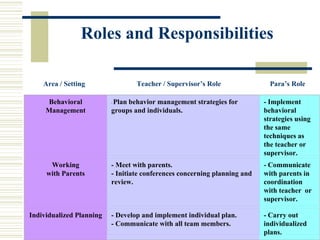
Roles and Responsibilities Area / Setting Teacher / Supervisor’s Role Para’s Role Behavioral Management -  Plan behavior management strategies for groups and individuals. - Implement behavioral strategies using the same techniques as the teacher or supervisor. Working with Parents - Meet with parents. - Initiate conferences concerning planning and review. - Communicate with parents in coordination with teacher  or supervisor. Individualized Planning - Develop and implement individual plan. - Communicate with all team members. - Carry out individualized plans.
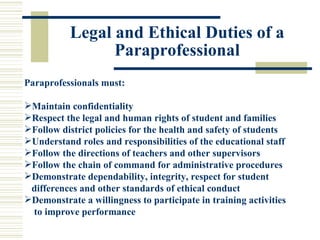
Legal and Ethical Duties of a Paraprofessional Paraprofessionals must: Maintain confidentiality Respect the legal and human rights of student and families Follow district policies for the health and safety of students Understand roles and responsibilities of the educational staff Follow the directions of teachers and other supervisors Follow the chain of command for administrative procedures Demonstrate dependability, integrity, respect for student  differences and other standards of ethical conduct Demonstrate a willingness to participate in training activities to improve performance
What Paraprofessionals Need to Know about Confidentiality Key Points: Federal law protects the privacy of student education records. Parents or age eligible (18yrs.) have the right to inspect and review the student’s education records maintained by the school. Schools must have written permission from the parent in order to release any information from the education record. Parental Access to Student Records Family Educational Rights and Privacy Act (FERPA)
Maintaining Confidentiality When Working with Students and Families Key Points:  The MN Government Data Practices Act protects individuals by prohibiting the sharing of information about them without their permission. Confidentiality is one of the most critical and important aspects of your job as a paraprofessional. It’s your legal responsibility to observe both the rights of individuals  and of parents in regards to data privacy. It is best to only share information about a student with the educational team. Follow the NEED TO KNOW policy as outlined by the district.
What Paraprofessionals Should Know About Laws Regarding Abuse and Neglect Mandated Reporting Maltreatment of Minors Act Maltreatment of Vulnerable Adults Act
Mandated Reporting Key Points: If you work with children and/or families, you are legally required to report suspected abuse or neglect.  All states impose a civil or criminal penalty on those who don’t report incidents. The Law requires that the person who believes a child is or has been maltreated make the report to law enforcement or child protection. As a mandated reporter it is important to understand some basic laws.
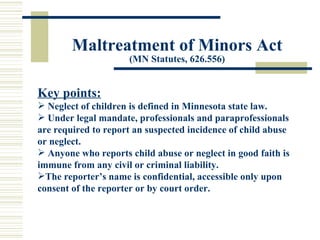
Maltreatment of Minors Act (MN Statutes, 626.556) Key points: Neglect of children is defined in Minnesota state law. Under legal mandate, professionals and paraprofessionals are required to report an suspected incidence of child abuse or neglect. Anyone who reports child abuse or neglect in good faith is immune from any civil or criminal liability. The reporter’s name is confidential, accessible only upon consent of the reporter or by court order.
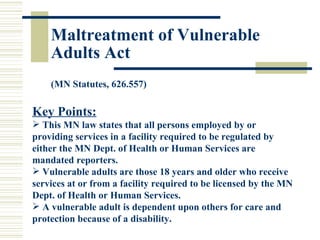
Maltreatment of Vulnerable Adults Act (MN Statutes, 626.557) Key Points: This MN law states that all persons employed by or providing services in a facility required to be regulated by either the MN Dept. of Health or Human Services are mandated reporters. Vulnerable adults are those 18 years and older who receive services at or from a facility required to be licensed by the MN Dept. of Health or Human Services. A vulnerable adult is dependent upon others for care and protection because of a disability.
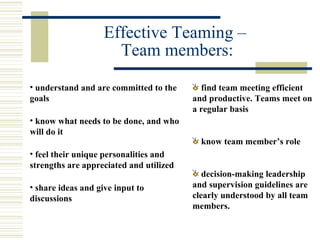
Effective Teaming –  Team members: understand and are committed to the goals  know what needs to be done, and who will do it  feel their unique personalities and strengths are appreciated and utilized  share ideas and give input to discussions  find team meeting efficient and productive. Teams meet on a regular basis   know team member’s role decision-making leadership and supervision guidelines are clearly understood by all team members.
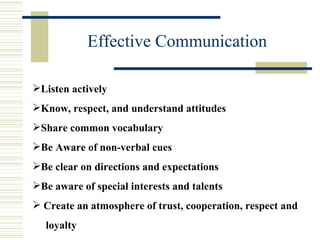
Effective Communication Listen actively Know, respect, and understand attitudes Share common vocabulary Be Aware of non-verbal cues Be clear on directions and expectations Be aware of special interests and talents   Create an atmosphere of trust, cooperation, respect and loyalty
Building Orientation Paraprofessional Orientation Checklist Questions You Need to Ask
Questions for Clarity COMMUNICATION   How will we communicate about the students (e.g., lesson plans, progress reports, written logs, regularly scheduled time, etc.)? What do you want me to communicate to you on a regular basis? What and how should I communicate with parents, teachers and staff?
Questions for Clarity ACADEMIC/INSTRUCTIONAL What are the needs of the student(s) with whom I will be working? Are there special instructional activities I should use with specific students? What are the priorities for each student I will be working with?  What lesson plan system will you provide? How should I report results of academic work to you?   Where should I document information regarding academics, behavior, schedule changes, etc.
Questions for Clarity CLASSROOM BEHAVIOR SUPPORTS What is your classroom positive behavior support plan? What are your classroom rules? What are the strengths and interests of the students I’ll be working with? How should I communicate to you regarding students’ behavior? What are your typical classroom routines and schedules ?
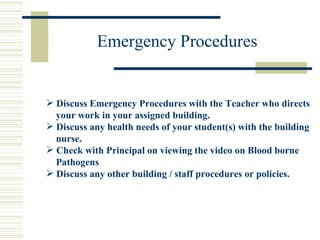
Emergency Procedures Discuss Emergency Procedures with the Teacher who directs  your work in your assigned building. Discuss any health needs of your student(s) with the building  nurse. Check with Principal on viewing the video on Blood borne  Pathogens Discuss any other building / staff procedures or policies.
Questions and Answers If you have any questions regarding Paraprofessional  Orientation, please contact your Supervising Teacher,  Principal, or Building Special Education Coordinator.
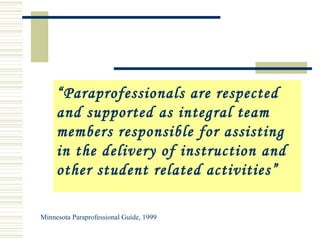
“ Paraprofessionals are respected and supported as integral team members responsible for assisting in the delivery of instruction and other student related activities”   Minnesota Paraprofessional Guide, 1999
The Key to Life is Balance

Paraprofessional Orientation: Need to Know

  • 1.
    Paraprofessional Orientation DoNo Harm… What You Need to Know Within the First Few Days of Employment ___________________ Public Schools
  • 2.
    Mission Statement MeetIndividual Needs of Students With Disabilities Through Partnerships that Promote Life Long Learning and Self-Advocacy
  • 3.
    AGENDA Special EducationRules and Regulations Paraprofessional Roles and Responsibilities Legal and Ethical Responsibilities Confidentiality Reporting Abuse and Neglect Vulnerable Adult Effective Teaming and Communication Questions You May Want to Ask
  • 4.
    What is aParaprofessional? MN 3525.0200 Definition SPECIAL EDUCATION – Subp. 10a. Paraprofessional. “Paraprofessional” means a district employee who is primarily engaged in direct instruction with one or more pupils for instructional activities, physical or behavior management, or other purposes under the direction of a regular education or special education teacher or related services provider.
  • 5.
    Benefits Paraprofessionals Offerin Educational Settings Expanded learning opportunities for persons with disabilities. More individualized instruction. Increased planning time for educators, supervisors, and others. Better monitoring and evaluation of persons with disabilities. Greater consistency in services. Improved parent-school relationships. Greater involvement of persons with disabilities in education and other settings in the community at large. Expanded vocational skill development for individuals with disabilities.
  • 6.
    Legislation MS125A.08(b) –(b) For paraprofessionals employed to work in programs for students with disabilities, the school board in each district shall ensure that - Before or immediately upon employment, each paraprofessional develops sufficient knowledge and skills in emergency procedures, building orientation, roles and responsibilities, confidentiality, vulnerability, and reportability, among other things, to begin meeting the needs of the students with whom the paraprofessional works;
  • 7.
    Legislation MS125A.08(b) –continued 2. Annual training opportunities are available to enable the paraprofessional to continue to further develop the knowledge and skills that are specific to the students with whom the paraprofessional works, including understanding disabilities, following lesson plans, and implementing follow-up instructional procedures and activities; and
  • 8.
    Legislation MS125A.08(b) –continued A district wide process obligates each paraprofessional to work under the ongoing direction of a licensed teacher and, where appropriate and possible, the supervision of a school nurse .
  • 9.
    Individual with DisabilitiesEducation Act (IDEA) 1975 – to provide civil rights to children and youth with disabilities Provides for due process procedures to safeguard student and parental rights Requirements of parent involvement and permission Required written evaluations and plans and progress reporting
  • 10.
    Developmentally Delay DDSpeech/Language Impaired S/LP Developmental Cognitive Disability Mild-Moderate DCD Mild – Moderate Severe Profound DCD Severe – Profound Severe Mental Impairment SMI Disability Categories
  • 11.
    Disability Categories PhysicallyHealth Disability PHD Deaf-Hard of Hearing D/HH Deaf-Blind DB Other Health Disability OHD Visually Impaired VI Specific Learning Disabilities SLD Emotional/Behavioral Disorders EBD Autism Spectrum Disorder ASD Traumatic Brain Injury TBI
  • 12.
    Orientation Topics Rolesand Responsibilities of the Paraprofessional Legal and Ethical Duties of a Paraprofessional Confidentiality Vulnerability Mandated Reportability Building Orientation – building specific… Paraprofessional Orientation Checklist and Questions You Need to Ask Emergency Procedures
  • 13.
    Roles and Responsibilitiesof the Paraprofessional Organization - Implement plans under direct supervision of teacher or supervisor. Area / Setting Teacher / Adult Supervisor's Roles Para's Role - Plan weekly schedule. - Plan lessons and activities for entire group and modify for individual needs. - Set and/or maintain records where all team members have access and input. - Communicate all decisions, plans, policies, and instructions. - Communicate needs and situations of individuals that affect their safety and welfare.
  • 14.
    Roles and ResponsibilitiesArea/Setting Teacher/Adult Supervisor’s Role Para’s Role Assessments - Assess individuals. - Administer tests. - Assist with monitoring or scoring. Objectives - Determine appropriate objectives . - Implement lessons to meet objectives. Instruction - Give instruction for the entire group, small groups, and individuals. - Teach small group and individual sessions.
  • 15.
    Roles and ResponsibilitiesArea / Setting Teacher / Supervisor’s Role Para’s Role Behavioral Management - Plan behavior management strategies for groups and individuals. - Implement behavioral strategies using the same techniques as the teacher or supervisor. Working with Parents - Meet with parents. - Initiate conferences concerning planning and review. - Communicate with parents in coordination with teacher or supervisor. Individualized Planning - Develop and implement individual plan. - Communicate with all team members. - Carry out individualized plans.
  • 16.
    Legal and EthicalDuties of a Paraprofessional Paraprofessionals must: Maintain confidentiality Respect the legal and human rights of student and families Follow district policies for the health and safety of students Understand roles and responsibilities of the educational staff Follow the directions of teachers and other supervisors Follow the chain of command for administrative procedures Demonstrate dependability, integrity, respect for student differences and other standards of ethical conduct Demonstrate a willingness to participate in training activities to improve performance
  • 17.
    What Paraprofessionals Needto Know about Confidentiality Key Points: Federal law protects the privacy of student education records. Parents or age eligible (18yrs.) have the right to inspect and review the student’s education records maintained by the school. Schools must have written permission from the parent in order to release any information from the education record. Parental Access to Student Records Family Educational Rights and Privacy Act (FERPA)
  • 18.
    Maintaining Confidentiality WhenWorking with Students and Families Key Points: The MN Government Data Practices Act protects individuals by prohibiting the sharing of information about them without their permission. Confidentiality is one of the most critical and important aspects of your job as a paraprofessional. It’s your legal responsibility to observe both the rights of individuals and of parents in regards to data privacy. It is best to only share information about a student with the educational team. Follow the NEED TO KNOW policy as outlined by the district.
  • 19.
    What Paraprofessionals ShouldKnow About Laws Regarding Abuse and Neglect Mandated Reporting Maltreatment of Minors Act Maltreatment of Vulnerable Adults Act
  • 20.
    Mandated Reporting KeyPoints: If you work with children and/or families, you are legally required to report suspected abuse or neglect. All states impose a civil or criminal penalty on those who don’t report incidents. The Law requires that the person who believes a child is or has been maltreated make the report to law enforcement or child protection. As a mandated reporter it is important to understand some basic laws.
  • 21.
    Maltreatment of MinorsAct (MN Statutes, 626.556) Key points: Neglect of children is defined in Minnesota state law. Under legal mandate, professionals and paraprofessionals are required to report an suspected incidence of child abuse or neglect. Anyone who reports child abuse or neglect in good faith is immune from any civil or criminal liability. The reporter’s name is confidential, accessible only upon consent of the reporter or by court order.
  • 22.
    Maltreatment of VulnerableAdults Act (MN Statutes, 626.557) Key Points: This MN law states that all persons employed by or providing services in a facility required to be regulated by either the MN Dept. of Health or Human Services are mandated reporters. Vulnerable adults are those 18 years and older who receive services at or from a facility required to be licensed by the MN Dept. of Health or Human Services. A vulnerable adult is dependent upon others for care and protection because of a disability.
  • 23.
    Effective Teaming – Team members: understand and are committed to the goals know what needs to be done, and who will do it feel their unique personalities and strengths are appreciated and utilized share ideas and give input to discussions find team meeting efficient and productive. Teams meet on a regular basis know team member’s role decision-making leadership and supervision guidelines are clearly understood by all team members.
  • 24.
    Effective Communication Listenactively Know, respect, and understand attitudes Share common vocabulary Be Aware of non-verbal cues Be clear on directions and expectations Be aware of special interests and talents   Create an atmosphere of trust, cooperation, respect and loyalty
  • 25.
    Building Orientation ParaprofessionalOrientation Checklist Questions You Need to Ask
  • 26.
    Questions for ClarityCOMMUNICATION How will we communicate about the students (e.g., lesson plans, progress reports, written logs, regularly scheduled time, etc.)? What do you want me to communicate to you on a regular basis? What and how should I communicate with parents, teachers and staff?
  • 27.
    Questions for ClarityACADEMIC/INSTRUCTIONAL What are the needs of the student(s) with whom I will be working? Are there special instructional activities I should use with specific students? What are the priorities for each student I will be working with? What lesson plan system will you provide? How should I report results of academic work to you? Where should I document information regarding academics, behavior, schedule changes, etc.
  • 28.
    Questions for ClarityCLASSROOM BEHAVIOR SUPPORTS What is your classroom positive behavior support plan? What are your classroom rules? What are the strengths and interests of the students I’ll be working with? How should I communicate to you regarding students’ behavior? What are your typical classroom routines and schedules ?
  • 29.
    Emergency Procedures DiscussEmergency Procedures with the Teacher who directs your work in your assigned building. Discuss any health needs of your student(s) with the building nurse. Check with Principal on viewing the video on Blood borne Pathogens Discuss any other building / staff procedures or policies.
  • 30.
    Questions and AnswersIf you have any questions regarding Paraprofessional Orientation, please contact your Supervising Teacher, Principal, or Building Special Education Coordinator.
  • 31.
    “ Paraprofessionals arerespected and supported as integral team members responsible for assisting in the delivery of instruction and other student related activities”   Minnesota Paraprofessional Guide, 1999
  • 32.
    The Key toLife is Balance