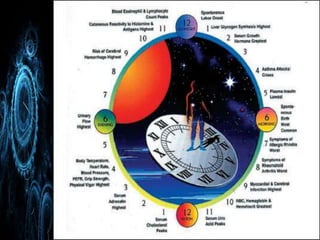
CHRONOPHARMACOKINETICS 
by, 
Syed Baseeruddin Alvi (09)
INTRODUCTION 
• Drug Absorption, Distribution, Metabolism and 
Elimination are influenced by many different 
physiological functions of the body which may 
vary with time. 
• Hence the time of day has to be regarded as an 
additional variable influencing the kinetics of a 
drug 
• The time of administration is a possible factor of 
variation in the k i n e t i c s o f a d r u g
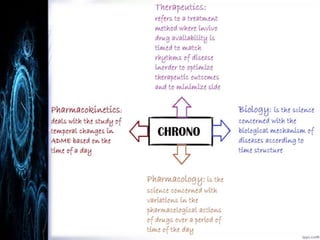
• Chronopharmacokinetics deals with the study 
of the temporal changes in absorption, 
distribution, metabolism and elimination and 
thus takes into account the influence of time 
on these different steps. 
i.e 
DEFINITION
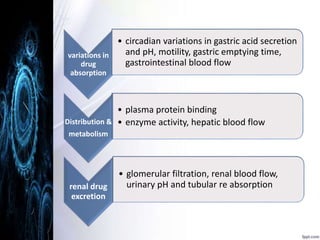
variations in 
drug 
absorption 
• circadian variations in gastric acid secretion 
and pH, motility, gastric emptying time, 
gastrointestinal blood flow 
• plasma protein binding 
Distribution & • enzyme activity, hepatic blood flow 
metabolism 
renal drug 
excretion 
• glomerular filtration, renal blood flow, 
urinary pH and tubular re absorption
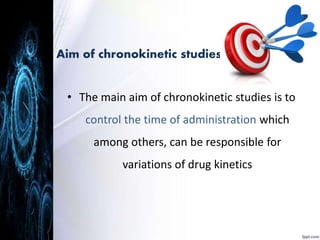
Aim of chronokinetic studies……. 
• The main aim of chronokinetic studies is to 
control the time of administration which 
among others, can be responsible for 
variations of drug kinetics
D r u g s t h a t u n d e r g o c h r o n o k i n e t i c s: 
Antibiotics 
• Experimental has shown that for Antibiotics 
such as beta-lactams that have concentration-independent 
killing effects in vitro, the time 
that the antibiotic concentration remains 
greater than the MIC(T> MIC) is the most 
important factor for determining the in vivo 
efficacy.
• Apart from that it has an effect on toxicity of 
certain drugs which may decrease at different 
time of day eg: 
Aminoglycosides: 
• Peak renal toxicity was observed when 
aminoglycosides were injected in the middle of 
the rest period of the experimental animals & 
vice versa 
• Gentamicin 
• Tobramycin: dark period( CLT & AUC) than light 
period.
Antihypertensive drugs: 
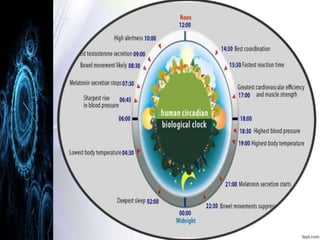
• Nearly all physiological functions as well as 
pathophysiological events display reproducible 
rhythmic changes within 24 hours of a day, 
including the cardiovascular system. 
• Chronopharmacokinetic studies with propranolol, 
oxprenolol, nifedipine, verapamil, etc. also revealed 
daily variations in the drugs' kinetics. 
• Cmax was higher and/or tmax shorter after 
morning than evening dosing
Valporic acid: 
• After oral administration, VPA concentrations 
in plasma were significantly higher in the 
morning than in the evening during the 
absorption phase. Cmax tended to be higher, 
tmax was shorter and absorption rate constant 
(ka) tended to be larger for VPA in the morning
Sumatriptan: 
• (sumatriptan is a drug of choice in migraine 
treatment) The mean area under the serum 
concentration time curve from time zero to 
the last time-point (AUC0-t), the area under 
the serum concentration-time curve from 
zero to infinity (AUC0-infinity), and the area 
under the first moment curve (AUMC) were 
significantly higher following the 07:00hr
• NSAID: ketoprofen: The rate of absorption of 
Ketoprofen was also found to be higher when 
it was administered in the morning 
Scope 
• New tools, such as new formulation 
procedures or pumps with constant or 
programmable delivery rates, now make it 
possible to deliver a drug at a definite time, or 
during a definite span of time
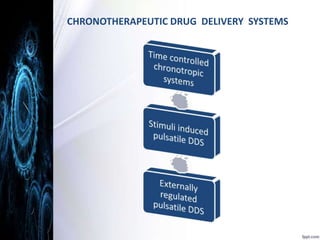
CHRONOTHERAPEUTIC DRUG DELIVERY SYSTEMS
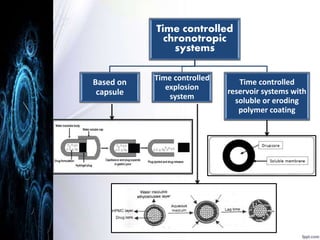
Time controlled 
chronotropic 
systems 
Based on 
capsule 
Time controlled 
explosion 
system 
Time controlled 
reservoir systems with 
soluble or eroding 
polymer coating
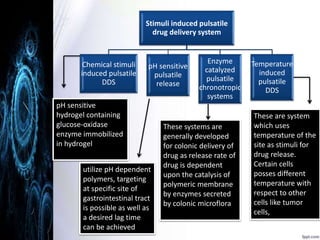
Stimuli induced pulsatile 
drug delivery system 
Chemical stimuli 
induced pulsatile 
DDS 
pH sensitive 
pulsatile 
release 
Enzyme 
catalyzed 
pulsatile 
chronotropic 
systems 
Temperature 
induced 
pulsatile 
DDS 
pH sensitive 
hydrogel containing 
glucose-oxidase 
enzyme immobilized 
in hydrogel 
utilize pH dependent 
polymers, targeting 
at specific site of 
gastrointestinal tract 
is possible as well as 
a desired lag time 
can be achieved 
These systems are 
generally developed 
for colonic delivery of 
drug as release rate of 
drug is dependent 
upon the catalysis of 
polymeric membrane 
by enzymes secreted 
by colonic microflora 
These are system 
which uses 
temperature of the 
site as stimuli for 
drug release. 
Certain cells 
posses different 
temperature with 
respect to other 
cells like tumor 
cells,
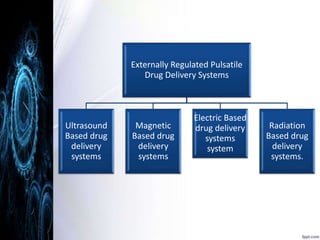
Externally Regulated Pulsatile 
Drug Delivery Systems 
Ultrasound 
Based drug 
delivery 
systems 
Magnetic 
Based drug 
delivery 
systems 
Electric Based 
drug delivery 
systems 
system 
Radiation 
Based drug 
delivery 
systems.
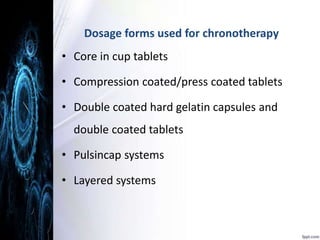
Dosage forms used for chronotherapy 
• Core in cup tablets 
• Compression coated/press coated tablets 
• Double coated hard gelatin capsules and 
double coated tablets 
• Pulsincap systems 
• Layered systems
 MERITS: 
·Predictable, and short gastric 
residence time 
·Less inter- and intra-subject 
variability 
·Improve bioavailability 
·Limited risk of local irritation 
·No risk of dose dumping 
·Flexibility in design 
·Improve stability 
 DEMERITS 
· Lack of manufacturing 
reproducibility and efficacy 
· Large number of process 
variables 
·Batch manufacturing process 
·Higher cost of production 
·Trained/skilled personal needed 
for Manufacturing
Slide Title 
Product A 
• Feature 1 
• Feature 2 
• Feature 3 
Product B 
• Feature 1 
• Feature 2 
• Feature 3 
Thank you

Chronopharmacokinetics..

  • 1.
    CHRONOPHARMACOKINETICS by, SyedBaseeruddin Alvi (09)
  • 3.
    INTRODUCTION • DrugAbsorption, Distribution, Metabolism and Elimination are influenced by many different physiological functions of the body which may vary with time. • Hence the time of day has to be regarded as an additional variable influencing the kinetics of a drug • The time of administration is a possible factor of variation in the k i n e t i c s o f a d r u g
  • 4.
    • Chronopharmacokinetics dealswith the study of the temporal changes in absorption, distribution, metabolism and elimination and thus takes into account the influence of time on these different steps. i.e DEFINITION
  • 5.
    variations in drug absorption • circadian variations in gastric acid secretion and pH, motility, gastric emptying time, gastrointestinal blood flow • plasma protein binding Distribution & • enzyme activity, hepatic blood flow metabolism renal drug excretion • glomerular filtration, renal blood flow, urinary pH and tubular re absorption
  • 7.
    Aim of chronokineticstudies……. • The main aim of chronokinetic studies is to control the time of administration which among others, can be responsible for variations of drug kinetics
  • 10.
    D r ug s t h a t u n d e r g o c h r o n o k i n e t i c s: Antibiotics • Experimental has shown that for Antibiotics such as beta-lactams that have concentration-independent killing effects in vitro, the time that the antibiotic concentration remains greater than the MIC(T> MIC) is the most important factor for determining the in vivo efficacy.
  • 11.
    • Apart fromthat it has an effect on toxicity of certain drugs which may decrease at different time of day eg: Aminoglycosides: • Peak renal toxicity was observed when aminoglycosides were injected in the middle of the rest period of the experimental animals & vice versa • Gentamicin • Tobramycin: dark period( CLT & AUC) than light period.
  • 12.
    Antihypertensive drugs: •Nearly all physiological functions as well as pathophysiological events display reproducible rhythmic changes within 24 hours of a day, including the cardiovascular system. • Chronopharmacokinetic studies with propranolol, oxprenolol, nifedipine, verapamil, etc. also revealed daily variations in the drugs' kinetics. • Cmax was higher and/or tmax shorter after morning than evening dosing
  • 13.
    Valporic acid: •After oral administration, VPA concentrations in plasma were significantly higher in the morning than in the evening during the absorption phase. Cmax tended to be higher, tmax was shorter and absorption rate constant (ka) tended to be larger for VPA in the morning
  • 14.
    Sumatriptan: • (sumatriptanis a drug of choice in migraine treatment) The mean area under the serum concentration time curve from time zero to the last time-point (AUC0-t), the area under the serum concentration-time curve from zero to infinity (AUC0-infinity), and the area under the first moment curve (AUMC) were significantly higher following the 07:00hr
  • 15.
    • NSAID: ketoprofen:The rate of absorption of Ketoprofen was also found to be higher when it was administered in the morning Scope • New tools, such as new formulation procedures or pumps with constant or programmable delivery rates, now make it possible to deliver a drug at a definite time, or during a definite span of time
  • 16.
  • 17.
    Time controlled chronotropic systems Based on capsule Time controlled explosion system Time controlled reservoir systems with soluble or eroding polymer coating
  • 18.
    Stimuli induced pulsatile drug delivery system Chemical stimuli induced pulsatile DDS pH sensitive pulsatile release Enzyme catalyzed pulsatile chronotropic systems Temperature induced pulsatile DDS pH sensitive hydrogel containing glucose-oxidase enzyme immobilized in hydrogel utilize pH dependent polymers, targeting at specific site of gastrointestinal tract is possible as well as a desired lag time can be achieved These systems are generally developed for colonic delivery of drug as release rate of drug is dependent upon the catalysis of polymeric membrane by enzymes secreted by colonic microflora These are system which uses temperature of the site as stimuli for drug release. Certain cells posses different temperature with respect to other cells like tumor cells,
  • 19.
    Externally Regulated Pulsatile Drug Delivery Systems Ultrasound Based drug delivery systems Magnetic Based drug delivery systems Electric Based drug delivery systems system Radiation Based drug delivery systems.
  • 20.
    Dosage forms usedfor chronotherapy • Core in cup tablets • Compression coated/press coated tablets • Double coated hard gelatin capsules and double coated tablets • Pulsincap systems • Layered systems
  • 21.
     MERITS: ·Predictable,and short gastric residence time ·Less inter- and intra-subject variability ·Improve bioavailability ·Limited risk of local irritation ·No risk of dose dumping ·Flexibility in design ·Improve stability  DEMERITS · Lack of manufacturing reproducibility and efficacy · Large number of process variables ·Batch manufacturing process ·Higher cost of production ·Trained/skilled personal needed for Manufacturing
  • 22.
    Slide Title ProductA • Feature 1 • Feature 2 • Feature 3 Product B • Feature 1 • Feature 2 • Feature 3 Thank you