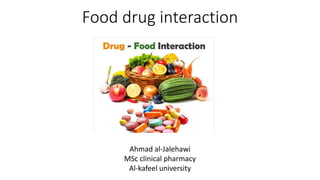
Food drug interaction
Ahmad al-Jalehawi
MSc clinical pharmacy
Al-kafeel university
• Food-drug interactions occur as a result of
pharmacokinetic or pharmacodynamics mechanisms.
• Reduction in the absorbance of a drug might be influenced by the
presence of food in the digestive tract. However, due to the
physiological response to food intake, particularly thegastric acid
secretion, may increase or reduce the bioavailability of certain
drugs
• The avoidance of such interactions could be possible if the drug is
taken 1 hour before or 2 h after eating the food.
• the interactions may also exist between foods and drugs (food-drug
interactions) and could be possible between drugs and herbs (drug-
herb interactions)
• The extent of food's effect on the absorption or metabolism of drugs
depends on the characteristics of the food, when the food is
consumed. The interaction of natural products and drugs is a common
hidden problem encountered in clinical practice
• it is very important to test meal conditions used in any conducted
study before making a clinical recommendation.
Vegetables
• Some vegetables (broccoli, Brussels sprouts, kale, parsley,
spinach, and others) had a high content of vitamin K .
• Eating large quantities of these vegetables interferes with
the safety and effectiveness of warfarin therapy.
•
Warfarin
• approximately 30% of people use herbal or natural product supplements on a regular basis.
• The potential for increased dietary protein intake to raise serum albumin levels and/or
cytochrome P450 activity has been postulated as mechanisms for the resulting decrease in
international normalized ratio (INRs).
• Eating charbroiled food may decrease warfarin activity, while eating cooked onions may
increase warfarin activity.
• with cranberry juice ingestion appeared to be associated with an elevated INR without
bleeding in elderly patient. cranberry juice may inhibit the activity of CYP2C9 .
•
Juice
• Several juices were found to have an interaction with medication by metabolizing and
altering transporters enzymes to a wider degree than initially described
• Naringin, an ingredient in most citrus fruits has been shown to reduce aliskiren uptake.
• Grapefruit juice was the first identified, but based on flavonoid and
furanocoumarin content other juices have also been shown to
interact with medication
grape fruit juice (GFJ) possesses high interaction with almost all types of drugs .
Numerous reports have documented drug interactions with GFJ that occur via
inhibition of CYP3A enzymes. Furanocoumarins present in GFJ inhibit the intestinal
CYP 3A4 and have been shown to increase the oral bioavailability of medications that
are CYP 3A4 substrates like Felodipine, midazolam, cyclosporine and raise their
concentrations above toxic levels.
• Grapefruit juice was found to have a significant effect on Aliskiren which is
recognized as a direct renin inhibitor indicated for the treatment of hypertension.
• A clinical study conducted on 11 healthy volunteers administered using 200 ml
single-strength of grapefruit juice (three times daily for five days) and 150 mg of
aliskiren on day 3 showed that relative to water, grapefruit juice significantly
reduced mean aliskiren by 61% .
• A study with 28 healthy volunteers receiving 300 mg aliskiren and either
water or grapefruit juice (300 ml) revealed a decrease of 38%
A study : 200 ml of orange juice, water for a frequency of three times daily for
a period of five days. On day 3, the volunteers ingested a single dose of 150 of
aliskiren. The result showed that orange juice reduced aliskiren geometric
mean by 62% relative to water while having no effect on elimination half-life
• GFJ is generally contraindicated to patients taking psychotropics and it is advised to inform
patients about described interaction.
• The overall exposure of some drugs can be increased by more than fivefold when taken
with GFJ and increase the risk of adverse effects.
• With new anticonvulsants, serum iron and sodium need to be monitored. Additionally,
users are advised to avoid drinking grape fruit juice within 1-2 hr(s) of taking these
anticonvulsants.
• Furanocoumarines and active bioflavonoids present in GFJ are also inhibitors of OATP
( organic anion transporting polypeptide )and when ingested concomitantly, can reduce
the oral bioavailability of the OATP substrate, fexofenadine.
• In a study : fexofenadine (60 mg) with 300 ml of either normal-strength apple juice or
water were orally taken. It was found that apple juice decreased fexofenadine mean 79%
compared to water
•
• However, some clinical studies with certain β-blockers, fexofenadine, and
fluoroquinolones have demonstrated that orange juice can reduce systemic exposure
by up to 83%
Protein rich food
• Phenytoin :
• when the preparation of phenytoin was given with a food source of protein, there was a
reduction in the amount of phenytoin absorbed. The protein source used in this study
consisted of concentrated cow's milk proteins
• The investigators suggest that this protein source could have impaired phenytoin
absorption because the albumin present became bound to the drug and the protein-drug
complex was then retained in the gut. Another possibility offered is that the protein acts
as a buffer at a pH outside the optimal range for absorption of the phenytoin.
Phenytoin is also less well absorbed when there is concurrent administration of folic acid
• Co-administration of phenytoin with high doses of another B vitamin, pyridoxine, may also
reduce the absorption of the drug
•
• In pediatric patients with asthma, it has been observed that wheezing
reappeared more rapidly when theophylline was administered with a
high-protein compared to a low-protein diet.
• High-protein diets increase, while low-protein diets decrease the rate
of drug metabolism.
General Food interaction
Griseofulvin :
• Food interference studies then indicated that the drug was better and more predictably
absorbed after ingestion of whole milk .griseofulvin is better absorbed when given after a
fatty meal. We have further observed that in patients on self-prescribed or physician-
prescribed low-fat diets, the effectiveness of griseofulvin is significantly reduced
• The absorption of rosuvastatin was significantly decreased in the fed state compared with
the fasting state, which suggests that rosuvastatin should be administered on an empty
stomach.
•
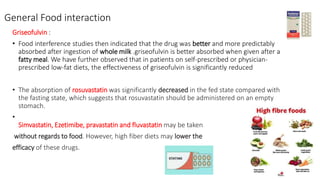
Simvastatin, Ezetimibe, pravastatin and fluvastatin may be taken
without regards to food. However, high fiber diets may lower the
efficacy of these drugs.
• albendazole
• Mean plasma concentrations and AUCs were 4.5 times higher when
albendazole was given with breakfast than when administered in the
fasting state. We conclude that therapy of echinococcosis with
albendazole requires the drug to be taken with meals and that
administration on an empty stomach might be more appropriate
when intraluminal effects are desired, e.g. for intestinal parasites
Beverages
• Colas containing phosphate and sugar may decrease the rate of drug absorption because
they delay the rate of stomach emptying.
However, the efficiency of drug absorption may be increased by concurrent intake of
beverages. Reasons include speedier dissolution of the drug, osmotic effects
Milk
• Ingestion of milk has long been known to interfere with the absorption of tetracyclines because
insoluble chelates are formed between the drug and the calcium present in the beverage .
• It has also been shown that milk decreases the bioavailability of the beta adrenergic blocking agent
sotalol. It has been suggested that this effect may also be due to an interaction with calcium .
• In premature infants, a milk feed does not influence the total amount of theophylline absorbed, but
decreases the rate of absorption, probably because of effects of the milk on stomach emptying.
monoamine oxidase inhibitors (MAOIs)
• Non selective (ex: phenelzine) , Selective (ex: moclobemide ,
selegiline )
• concerns about interaction with tyramine-containing food
(matured cheese, red wine, ripped bananas, yogurt, shrimp
paste and salami) or so called cheese reaction, since they are
capable of producing hypertensive crisis in patients taking
MAOIs.
• Tyramine is an indirectly acting sympathomimetic agent, is
degraded by MAO but in the presence of MAOIs, it escapes
degradation and reaches the systemic circulation where it is
taken up by the adrenergic neuron, leading to a hypertensive
crisis.
• transdermal formulations may provide a valuable therapeutic
option and eliminate the drug-food
Antihypertensive Drugs
• anti hypertensive drugs will benefit from concomitant moderate sodium
restricted diets.
• Propranolol serum levels may be increased if taken with rich protein food ,
Smoking may decrease its plasma levels of by increasing its metabolism
• The absorption of ACEs inhibitor ( Captopril ) is increased when taken on an
empty stomach (food decrease 35-40% bioavailabilty of captopril )
• .While GFJ increases the bioavailability of felodipine (Ca2 channel blocker).
• Licorice extract,is a potent inhibitor of 11- bet- hydroxyl steroid
dehydrogenase, it increases excess of cortisol to mineralocorticoid receptors
causing sodium retention and potassium depletion so increased blood
pressure and depression of the renin-angiotensin-aldosterone system
• A practical guideline for an acceptable daily intake of glycyrrhizic acid seems
to be 9.5 mg a day. This means no more than 10-30g liquorice and no more
than half a cup of liquorice tea a day.
Antibiotics
• A number of studies give evidence that fluoroquinolones forming slightly soluble complex with metal
ions of food show reduced bioavailability.
• Casein and calcium present in milk decrease the absorption of ciprofloxacin.
absorption of ciprofloxacin (500 mg) tablets can be reduced by concomitant ingestion of the GFJ.
should be discouraged.
• Azithromycin absorption is decreased when taken with food, resulting in a 43% reduction in
bioavailability.
• Tetracycline should be taken one hour before or two hours after meals, and not taken with milk
because it binds calcium and iron, forming insoluble chelates, and influencing its bioavailability.
• The effect of milk added to coffee or black tea on the bioavailability of tetracycline was evaluated in
healthy individuals. Results showed that even a little quantity of milk containing extremely small
amounts of calcium severely impair the absorption of the drug, so that the presence of this metal ion
should be carefully controlled in order to avoid decreasing the available tetracycline.
Analgesics and Antipyretic
• because food may slow the body absorption of acetaminophen. Co-administration of acetaminophen
with pectin delays its absorption and onset.
• NSAIDs like ibuprofen, naproxen, ketoprofen and others can cause stomach irritation and
thus they should be taken with food or milk
• The C max and AUC of ibuprofen were significantly increased after single and multiple doses of Coca-
Cola, thereby indicating increased extent of absorption of ibuprofen.
• The daily dosage and frequency of ibuprofen must be reduced when administered with Coca-Cola.
• Food intake did not appear to affect the extent of absorption (ie, total exposure) of oral Diclofenac
potassium soft gelatin capsule.
Theophylin
• High-fat meals may increase the amount of theophylline in the body, while high carbohydrate meals
may decrease it.
• Avoid alcohol if taking theophylline medications because it can increase the risk of side effects such as
nausea, vomiting, headache and irritability
• caffeine (e.g., chocolate, colas, coffee, and tea) since theophylline is a xanthine derivative and these
substances also contain xanthine. Hence consuming large amounts of these substances while taking
theophylline, increases the risk of drug toxicity
• It has been suggested that even if there were a significant effect of caffeine on theophylline
disposition, it may not be therapeutically important
thyroxin
• Recent evidence pointed out the role of gastric acid secretion on the subsequent intestinal
absorption of thyroxine in relation with the timing of food ingestion as well as with pH
impairment.
• Levothyroxine is a derivative of thyroxine. Grapefruit juice may slightly delay the absorption
of levothyroxine, but it seems to have only a minor effect on its bioavailability.
metronidazole
Its interaction with alcohol leads to acetaldehyde accumulation (disulfiram-like reaction) causing symptoms
such as skin redness, palpitations, nausea, vomiting, headache and in severe cases circulatory collapse.
advises to avoid alcohol during and for 48 hours after taking metronidazole. Overall the evidence for this
reaction appears to be weak
Alcohol
references
• brahma n. singh ,effects of food on clinical, pharmacokinetics , drug disposition ,clin pharmacokinet 1999 sep; 37 (3) 213-255
• bushra r, aslam n, khan ay. food-drug interactions. oman med j. 2011;26(2):77-83. doi:10.5001/omj.2011.21
• m. abd elgadir ,food–drug interaction and their clinical implications: selected investigations , international journal of pharmacy and
pharmaceutical sciences, vol 11, issue 3, 2019
• marwa noureldin,et al , drug-alcohol interactions: a review of three therapeutic classes ,us pharm. 2010;35(11):29-40.

Food drug interaction lecture

  • 1.
    Food drug interaction Ahmadal-Jalehawi MSc clinical pharmacy Al-kafeel university
  • 2.
    • Food-drug interactionsoccur as a result of pharmacokinetic or pharmacodynamics mechanisms. • Reduction in the absorbance of a drug might be influenced by the presence of food in the digestive tract. However, due to the physiological response to food intake, particularly thegastric acid secretion, may increase or reduce the bioavailability of certain drugs • The avoidance of such interactions could be possible if the drug is taken 1 hour before or 2 h after eating the food.
  • 3.
    • the interactionsmay also exist between foods and drugs (food-drug interactions) and could be possible between drugs and herbs (drug- herb interactions) • The extent of food's effect on the absorption or metabolism of drugs depends on the characteristics of the food, when the food is consumed. The interaction of natural products and drugs is a common hidden problem encountered in clinical practice • it is very important to test meal conditions used in any conducted study before making a clinical recommendation.
  • 4.
    Vegetables • Some vegetables(broccoli, Brussels sprouts, kale, parsley, spinach, and others) had a high content of vitamin K . • Eating large quantities of these vegetables interferes with the safety and effectiveness of warfarin therapy. •
  • 5.
    Warfarin • approximately 30%of people use herbal or natural product supplements on a regular basis. • The potential for increased dietary protein intake to raise serum albumin levels and/or cytochrome P450 activity has been postulated as mechanisms for the resulting decrease in international normalized ratio (INRs). • Eating charbroiled food may decrease warfarin activity, while eating cooked onions may increase warfarin activity. • with cranberry juice ingestion appeared to be associated with an elevated INR without bleeding in elderly patient. cranberry juice may inhibit the activity of CYP2C9 . •
  • 6.
    Juice • Several juiceswere found to have an interaction with medication by metabolizing and altering transporters enzymes to a wider degree than initially described • Naringin, an ingredient in most citrus fruits has been shown to reduce aliskiren uptake. • Grapefruit juice was the first identified, but based on flavonoid and furanocoumarin content other juices have also been shown to interact with medication grape fruit juice (GFJ) possesses high interaction with almost all types of drugs . Numerous reports have documented drug interactions with GFJ that occur via inhibition of CYP3A enzymes. Furanocoumarins present in GFJ inhibit the intestinal CYP 3A4 and have been shown to increase the oral bioavailability of medications that are CYP 3A4 substrates like Felodipine, midazolam, cyclosporine and raise their concentrations above toxic levels.
  • 7.
    • Grapefruit juicewas found to have a significant effect on Aliskiren which is recognized as a direct renin inhibitor indicated for the treatment of hypertension. • A clinical study conducted on 11 healthy volunteers administered using 200 ml single-strength of grapefruit juice (three times daily for five days) and 150 mg of aliskiren on day 3 showed that relative to water, grapefruit juice significantly reduced mean aliskiren by 61% . • A study with 28 healthy volunteers receiving 300 mg aliskiren and either water or grapefruit juice (300 ml) revealed a decrease of 38% A study : 200 ml of orange juice, water for a frequency of three times daily for a period of five days. On day 3, the volunteers ingested a single dose of 150 of aliskiren. The result showed that orange juice reduced aliskiren geometric mean by 62% relative to water while having no effect on elimination half-life
  • 8.
    • GFJ isgenerally contraindicated to patients taking psychotropics and it is advised to inform patients about described interaction. • The overall exposure of some drugs can be increased by more than fivefold when taken with GFJ and increase the risk of adverse effects. • With new anticonvulsants, serum iron and sodium need to be monitored. Additionally, users are advised to avoid drinking grape fruit juice within 1-2 hr(s) of taking these anticonvulsants. • Furanocoumarines and active bioflavonoids present in GFJ are also inhibitors of OATP ( organic anion transporting polypeptide )and when ingested concomitantly, can reduce the oral bioavailability of the OATP substrate, fexofenadine. • In a study : fexofenadine (60 mg) with 300 ml of either normal-strength apple juice or water were orally taken. It was found that apple juice decreased fexofenadine mean 79% compared to water •
  • 9.
    • However, someclinical studies with certain β-blockers, fexofenadine, and fluoroquinolones have demonstrated that orange juice can reduce systemic exposure by up to 83%
  • 10.
    Protein rich food •Phenytoin : • when the preparation of phenytoin was given with a food source of protein, there was a reduction in the amount of phenytoin absorbed. The protein source used in this study consisted of concentrated cow's milk proteins • The investigators suggest that this protein source could have impaired phenytoin absorption because the albumin present became bound to the drug and the protein-drug complex was then retained in the gut. Another possibility offered is that the protein acts as a buffer at a pH outside the optimal range for absorption of the phenytoin. Phenytoin is also less well absorbed when there is concurrent administration of folic acid • Co-administration of phenytoin with high doses of another B vitamin, pyridoxine, may also reduce the absorption of the drug •
  • 11.
    • In pediatricpatients with asthma, it has been observed that wheezing reappeared more rapidly when theophylline was administered with a high-protein compared to a low-protein diet. • High-protein diets increase, while low-protein diets decrease the rate of drug metabolism.
  • 12.
    General Food interaction Griseofulvin: • Food interference studies then indicated that the drug was better and more predictably absorbed after ingestion of whole milk .griseofulvin is better absorbed when given after a fatty meal. We have further observed that in patients on self-prescribed or physician- prescribed low-fat diets, the effectiveness of griseofulvin is significantly reduced • The absorption of rosuvastatin was significantly decreased in the fed state compared with the fasting state, which suggests that rosuvastatin should be administered on an empty stomach. • Simvastatin, Ezetimibe, pravastatin and fluvastatin may be taken without regards to food. However, high fiber diets may lower the efficacy of these drugs.
  • 13.
    • albendazole • Meanplasma concentrations and AUCs were 4.5 times higher when albendazole was given with breakfast than when administered in the fasting state. We conclude that therapy of echinococcosis with albendazole requires the drug to be taken with meals and that administration on an empty stomach might be more appropriate when intraluminal effects are desired, e.g. for intestinal parasites
  • 14.
    Beverages • Colas containingphosphate and sugar may decrease the rate of drug absorption because they delay the rate of stomach emptying. However, the efficiency of drug absorption may be increased by concurrent intake of beverages. Reasons include speedier dissolution of the drug, osmotic effects
  • 15.
    Milk • Ingestion ofmilk has long been known to interfere with the absorption of tetracyclines because insoluble chelates are formed between the drug and the calcium present in the beverage . • It has also been shown that milk decreases the bioavailability of the beta adrenergic blocking agent sotalol. It has been suggested that this effect may also be due to an interaction with calcium . • In premature infants, a milk feed does not influence the total amount of theophylline absorbed, but decreases the rate of absorption, probably because of effects of the milk on stomach emptying.
  • 16.
    monoamine oxidase inhibitors(MAOIs) • Non selective (ex: phenelzine) , Selective (ex: moclobemide , selegiline ) • concerns about interaction with tyramine-containing food (matured cheese, red wine, ripped bananas, yogurt, shrimp paste and salami) or so called cheese reaction, since they are capable of producing hypertensive crisis in patients taking MAOIs. • Tyramine is an indirectly acting sympathomimetic agent, is degraded by MAO but in the presence of MAOIs, it escapes degradation and reaches the systemic circulation where it is taken up by the adrenergic neuron, leading to a hypertensive crisis. • transdermal formulations may provide a valuable therapeutic option and eliminate the drug-food
  • 17.
    Antihypertensive Drugs • antihypertensive drugs will benefit from concomitant moderate sodium restricted diets. • Propranolol serum levels may be increased if taken with rich protein food , Smoking may decrease its plasma levels of by increasing its metabolism • The absorption of ACEs inhibitor ( Captopril ) is increased when taken on an empty stomach (food decrease 35-40% bioavailabilty of captopril ) • .While GFJ increases the bioavailability of felodipine (Ca2 channel blocker). • Licorice extract,is a potent inhibitor of 11- bet- hydroxyl steroid dehydrogenase, it increases excess of cortisol to mineralocorticoid receptors causing sodium retention and potassium depletion so increased blood pressure and depression of the renin-angiotensin-aldosterone system • A practical guideline for an acceptable daily intake of glycyrrhizic acid seems to be 9.5 mg a day. This means no more than 10-30g liquorice and no more than half a cup of liquorice tea a day.
  • 18.
    Antibiotics • A numberof studies give evidence that fluoroquinolones forming slightly soluble complex with metal ions of food show reduced bioavailability. • Casein and calcium present in milk decrease the absorption of ciprofloxacin. absorption of ciprofloxacin (500 mg) tablets can be reduced by concomitant ingestion of the GFJ. should be discouraged. • Azithromycin absorption is decreased when taken with food, resulting in a 43% reduction in bioavailability. • Tetracycline should be taken one hour before or two hours after meals, and not taken with milk because it binds calcium and iron, forming insoluble chelates, and influencing its bioavailability. • The effect of milk added to coffee or black tea on the bioavailability of tetracycline was evaluated in healthy individuals. Results showed that even a little quantity of milk containing extremely small amounts of calcium severely impair the absorption of the drug, so that the presence of this metal ion should be carefully controlled in order to avoid decreasing the available tetracycline.
  • 19.
    Analgesics and Antipyretic •because food may slow the body absorption of acetaminophen. Co-administration of acetaminophen with pectin delays its absorption and onset. • NSAIDs like ibuprofen, naproxen, ketoprofen and others can cause stomach irritation and thus they should be taken with food or milk • The C max and AUC of ibuprofen were significantly increased after single and multiple doses of Coca- Cola, thereby indicating increased extent of absorption of ibuprofen. • The daily dosage and frequency of ibuprofen must be reduced when administered with Coca-Cola. • Food intake did not appear to affect the extent of absorption (ie, total exposure) of oral Diclofenac potassium soft gelatin capsule.
  • 20.
    Theophylin • High-fat mealsmay increase the amount of theophylline in the body, while high carbohydrate meals may decrease it. • Avoid alcohol if taking theophylline medications because it can increase the risk of side effects such as nausea, vomiting, headache and irritability • caffeine (e.g., chocolate, colas, coffee, and tea) since theophylline is a xanthine derivative and these substances also contain xanthine. Hence consuming large amounts of these substances while taking theophylline, increases the risk of drug toxicity • It has been suggested that even if there were a significant effect of caffeine on theophylline disposition, it may not be therapeutically important
  • 21.
    thyroxin • Recent evidencepointed out the role of gastric acid secretion on the subsequent intestinal absorption of thyroxine in relation with the timing of food ingestion as well as with pH impairment. • Levothyroxine is a derivative of thyroxine. Grapefruit juice may slightly delay the absorption of levothyroxine, but it seems to have only a minor effect on its bioavailability.
  • 22.
    metronidazole Its interaction withalcohol leads to acetaldehyde accumulation (disulfiram-like reaction) causing symptoms such as skin redness, palpitations, nausea, vomiting, headache and in severe cases circulatory collapse. advises to avoid alcohol during and for 48 hours after taking metronidazole. Overall the evidence for this reaction appears to be weak Alcohol
  • 26.
    references • brahma n.singh ,effects of food on clinical, pharmacokinetics , drug disposition ,clin pharmacokinet 1999 sep; 37 (3) 213-255 • bushra r, aslam n, khan ay. food-drug interactions. oman med j. 2011;26(2):77-83. doi:10.5001/omj.2011.21 • m. abd elgadir ,food–drug interaction and their clinical implications: selected investigations , international journal of pharmacy and pharmaceutical sciences, vol 11, issue 3, 2019 • marwa noureldin,et al , drug-alcohol interactions: a review of three therapeutic classes ,us pharm. 2010;35(11):29-40.