CENTRIFUGAL  OIL CLEANER  FOR  DIESEL ENGINES Oilmax
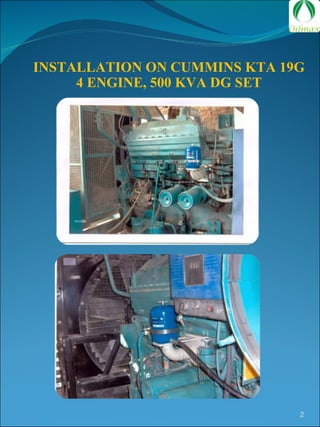
INSTALLATION ON CUMMINS KTA 19G 4 ENGINE, 500 KVA DG SET
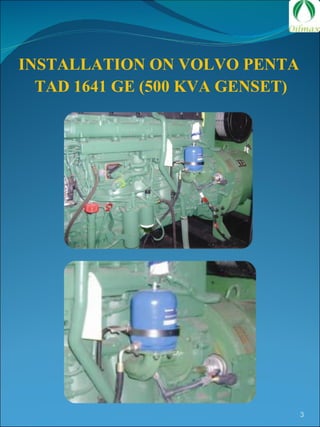
INSTALLATION ON VOLVO PENTA  TAD 1641 GE (500 KVA GENSET)
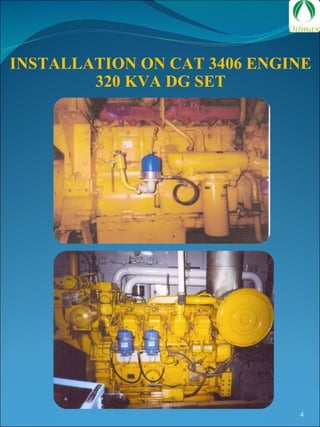
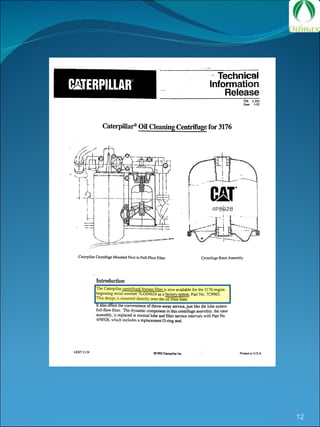
INSTALLATION ON CAT 3406 ENGINE 320 KVA DG SET
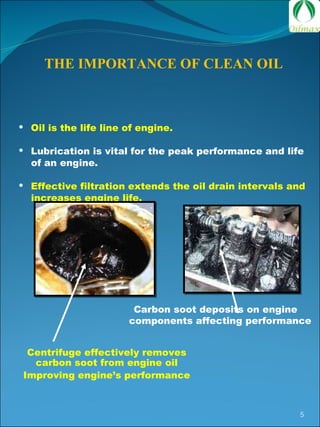
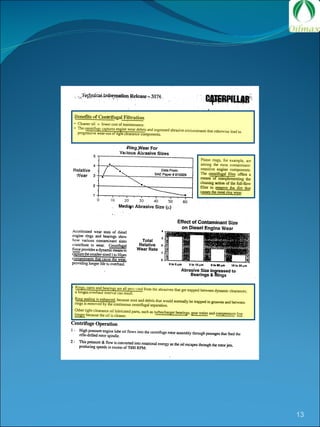
THE IMPORTANCE OF CLEAN OIL Oil is the life line of engine. Lubrication is vital for the peak performance and life  of an engine. Effective filtration extends the oil drain intervals and  increases engine life. Carbon soot deposits on engine components affecting performance  Centrifuge effectively removes carbon soot from engine oil Improving engine’s performance
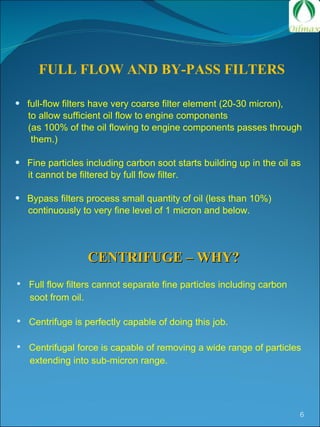
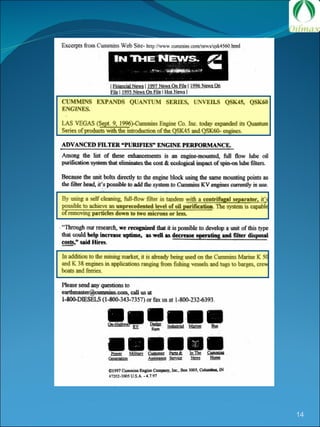
FULL FLOW AND BY-PASS FILTERS full-flow filters have very coarse filter element (20-30 micron),  to allow sufficient oil flow to engine components (as 100% of the oil flowing to engine components passes through  them.) Fine particles including carbon soot starts building up in the oil as  it cannot be filtered by full flow filter. Bypass filters process small quantity of oil (less than 10%) continuously to very fine level of 1 micron and below. CENTRIFUGE – WHY? Full flow filters cannot separate fine particles including carbon  soot from oil. Centrifuge is perfectly capable of doing this job. Centrifugal force is capable of removing a wide range of particles  extending into sub-micron range.
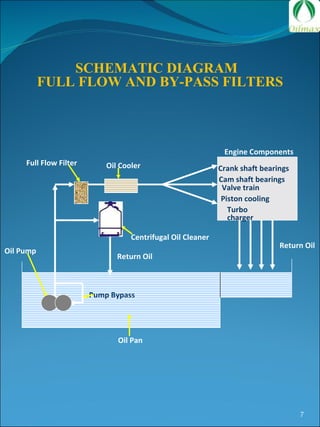
SCHEMATIC DIAGRAM FULL FLOW AND BY-PASS FILTERS Crank shaft bearings Cam shaft bearings Valve train Piston cooling Turbo charger Full Flow Filter Oil Cooler Centrifugal Oil Cleaner Oil Pump Pump Bypass Return Oil Oil Pan Engine Components Return Oil
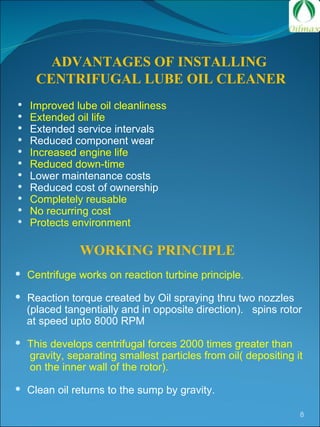
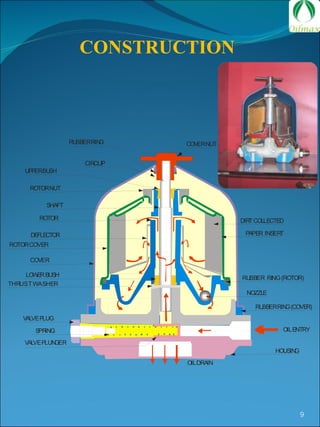
ADVANTAGES OF INSTALLING  CENTRIFUGAL LUBE OIL CLEANER Improved lube oil cleanliness Extended oil life Extended service intervals Reduced component wear Increased engine life Reduced down-time Lower maintenance costs Reduced cost of ownership Completely reusable  No recurring cost Protects environment WORKING PRINCIPLE Centrifuge works on reaction turbine principle.  Reaction torque created by Oil spraying thru two nozzles  (placed tangentially and in opposite direction).  spins rotor  at speed upto 8000 RPM  This develops centrifugal forces 2000 times greater than  gravity, separating smallest particles from oil( depositing it  on the inner wall of the rotor). Clean oil returns to the sump by gravity.
CONSTRUCTION
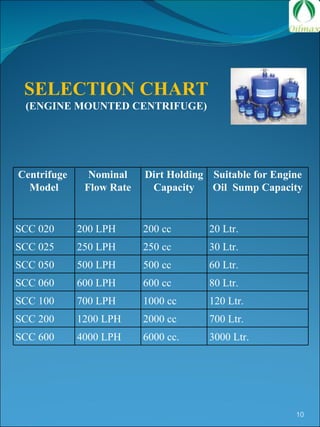
SELECTION CHART (ENGINE MOUNTED CENTRIFUGE) Centrifuge  Model Nominal Flow Rate Dirt Holding Capacity Suitable for Engine Oil  Sump Capacity SCC 020  200 LPH  200 cc  20 Ltr.  SCC 025  250 LPH  250 cc  30 Ltr.  SCC 050  500 LPH  500 cc  60 Ltr.  SCC 060  600 LPH  600 cc  80 Ltr.  SCC 100  700 LPH  1000 cc  120 Ltr.  SCC 200  1200 LPH  2000 cc  700 Ltr.  SCC 600  4000 LPH  6000 cc.  3000 Ltr.
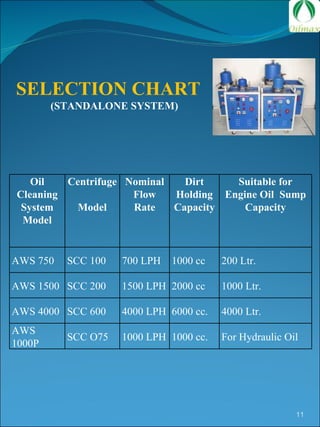
SELECTION CHART (STANDALONE SYSTEM) Oil Cleaning System Model Centrifuge  Model Nominal Flow Rate Dirt Holding Capacity Suitable for Engine Oil  Sump Capacity AWS 750 SCC 100  700 LPH  1000 cc  200 Ltr.  AWS 1500 SCC 200  1500 LPH  2000 cc  1000 Ltr.  AWS 4000 SCC 600  4000 LPH  6000 cc.  4000 Ltr.  AWS 1000P SCC O75  1000 LPH  1000 cc.  For Hydraulic Oil
Presentation disel engines

Presentation disel engines

  • 1.
    CENTRIFUGAL OILCLEANER FOR DIESEL ENGINES Oilmax
  • 2.
    INSTALLATION ON CUMMINSKTA 19G 4 ENGINE, 500 KVA DG SET
  • 3.
    INSTALLATION ON VOLVOPENTA TAD 1641 GE (500 KVA GENSET)
  • 4.
    INSTALLATION ON CAT3406 ENGINE 320 KVA DG SET
  • 5.
    THE IMPORTANCE OFCLEAN OIL Oil is the life line of engine. Lubrication is vital for the peak performance and life of an engine. Effective filtration extends the oil drain intervals and increases engine life. Carbon soot deposits on engine components affecting performance Centrifuge effectively removes carbon soot from engine oil Improving engine’s performance
  • 6.
    FULL FLOW ANDBY-PASS FILTERS full-flow filters have very coarse filter element (20-30 micron), to allow sufficient oil flow to engine components (as 100% of the oil flowing to engine components passes through them.) Fine particles including carbon soot starts building up in the oil as it cannot be filtered by full flow filter. Bypass filters process small quantity of oil (less than 10%) continuously to very fine level of 1 micron and below. CENTRIFUGE – WHY? Full flow filters cannot separate fine particles including carbon soot from oil. Centrifuge is perfectly capable of doing this job. Centrifugal force is capable of removing a wide range of particles extending into sub-micron range.
  • 7.
    SCHEMATIC DIAGRAM FULLFLOW AND BY-PASS FILTERS Crank shaft bearings Cam shaft bearings Valve train Piston cooling Turbo charger Full Flow Filter Oil Cooler Centrifugal Oil Cleaner Oil Pump Pump Bypass Return Oil Oil Pan Engine Components Return Oil
  • 8.
    ADVANTAGES OF INSTALLING CENTRIFUGAL LUBE OIL CLEANER Improved lube oil cleanliness Extended oil life Extended service intervals Reduced component wear Increased engine life Reduced down-time Lower maintenance costs Reduced cost of ownership Completely reusable No recurring cost Protects environment WORKING PRINCIPLE Centrifuge works on reaction turbine principle. Reaction torque created by Oil spraying thru two nozzles (placed tangentially and in opposite direction). spins rotor at speed upto 8000 RPM This develops centrifugal forces 2000 times greater than gravity, separating smallest particles from oil( depositing it on the inner wall of the rotor). Clean oil returns to the sump by gravity.
  • 9.
  • 10.
    SELECTION CHART (ENGINEMOUNTED CENTRIFUGE) Centrifuge Model Nominal Flow Rate Dirt Holding Capacity Suitable for Engine Oil Sump Capacity SCC 020 200 LPH 200 cc 20 Ltr. SCC 025 250 LPH 250 cc 30 Ltr. SCC 050 500 LPH 500 cc 60 Ltr. SCC 060 600 LPH 600 cc 80 Ltr. SCC 100 700 LPH 1000 cc 120 Ltr. SCC 200 1200 LPH 2000 cc 700 Ltr. SCC 600 4000 LPH 6000 cc. 3000 Ltr.
  • 11.
    SELECTION CHART (STANDALONESYSTEM) Oil Cleaning System Model Centrifuge Model Nominal Flow Rate Dirt Holding Capacity Suitable for Engine Oil Sump Capacity AWS 750 SCC 100 700 LPH 1000 cc 200 Ltr. AWS 1500 SCC 200 1500 LPH 2000 cc 1000 Ltr. AWS 4000 SCC 600 4000 LPH 6000 cc. 4000 Ltr. AWS 1000P SCC O75 1000 LPH 1000 cc. For Hydraulic Oil

Editor's Notes