Objective
 Purpose -Lube oil system
 Components of Lube oil system
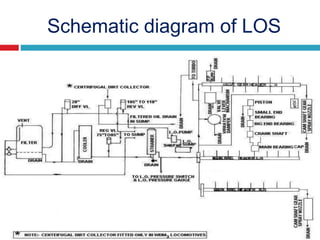
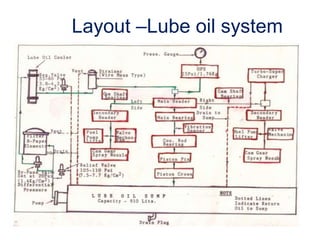
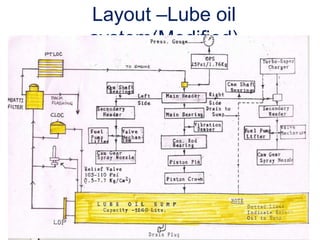
 Schematic Diagrams of Lube oil system
 Various lubricating points
 Trouble shooting of Lube oil system
 Action to reduce high lube oil consumption
Purpose of Lube Oil System
 Reduce friction and wear.
 Cooling of bearing ,pistons etc.
 Protection -From corrosion, rust, surface
damages and wear.
 Clean and free from carbon, lacquer deposits
and prevent damage due to deposits.
Components-Lube oil system
 Lube oil pump( Gear type.)
 Spring loaded Relief valve ,(Adjusted to 7.5
kg/cm2)
 Lube oil filter tank (8 nos filter, pore size-12-16
micron)/Moatti filter
 Conv.Lube oil cooler/Plate type lube oil cooler
 Regulating valve(Adjusted to 5.5- 6.0kg/cm2 in
WDM2 & 7.4 kg/cm2 in WDM3A)
 Centrifuge Cleaner(start at 2.5 kgf/cm2)
 Oil sump (1260 lts) RR606 multigrade oil.
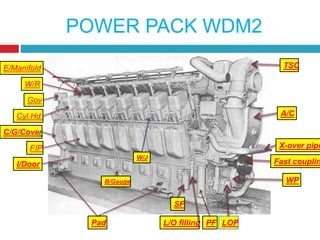
POWER PACK WDM2
W/R
Gov
Cyl.Hd.
C/G/Cover
FIP
I/Door
TSC
A/C
X-over pipe
Fast couplin
WP
E/Manifold
Pad LOP
PF
SF
L/O filling
B/Gauge
W/J
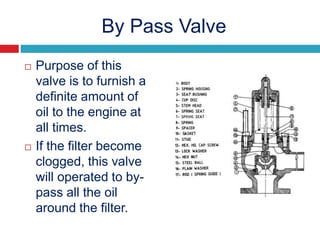
By Pass Valve
 Purpose of this
valve is to furnish a
definite amount of
oil to the engine at
all times.
 If the filter become
clogged, this valve
will operated to by-
pass all the oil
around the filter.
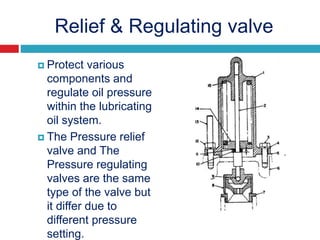
Relief & Regulating valve
 Protect various
components and
regulate oil pressure
within the lubricating
oil system.
 The Pressure relief
valve and The
Pressure regulating
valves are the same
type of the valve but
it differ due to
different pressure
setting.
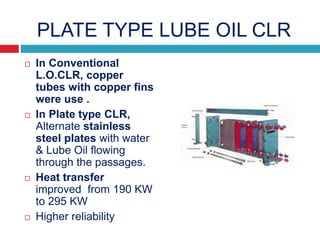
PLATE TYPE LUBE OIL CLR
 In Conventional
L.O.CLR, copper
tubes with copper fins
were use .
 In Plate type CLR,
Alternate stainless
steel plates with water
& Lube Oil flowing
through the passages.
 Heat transfer
improved from 190 KW
to 295 KW
 Higher reliability
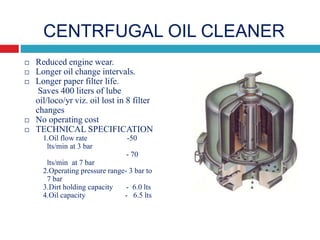
CENTRFUGAL OIL CLEANER
 Reduced engine wear.
 Longer oil change intervals.
 Longer paper filter life.
Saves 400 liters of lube
oil/loco/yr viz. oil lost in 8 filter
changes
 No operating cost
 TECHNICAL SPECIFICATION
1.Oil flow rate -50
lts/min at 3 bar
- 70
lts/min at 7 bar
2.Operating pressure range- 3 bar to
7 bar
3.Dirt holding capacity - 6.0 lts
4.Oil capacity - 6.5 lts
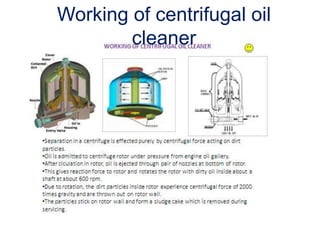
Working of centrifugal oil
cleaner
Moatti filter & Parts
 The complete filter
comprises three
main assemblies,
these are:
 Filter housing
 Filtering unit
 Hydraulic motor
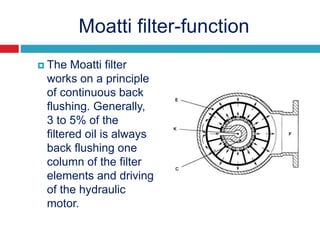
Moatti filter-function
 The Moatti filter
works on a principle
of continuous back
flushing. Generally,
3 to 5% of the
filtered oil is always
back flushing one
column of the filter
elements and driving
of the hydraulic
motor.
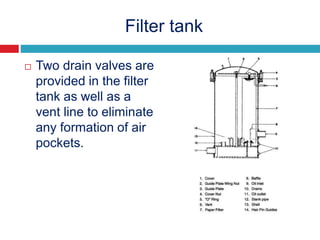
Filter tank
 Two drain valves are
provided in the filter
tank as well as a
vent line to eliminate
any formation of air
pockets.
Schematic diagram of LOS
Layout –Lube oil system
Layout –Lube oil
system(Modified)
LUBRICATION POINTS
 FROM MAIN HEADER PIPE
 All Main bearing
 Crank pin ,Connecting rod big
bearing & crank pin journals.
further through riffle hole lub oil
reach to Gudgen pin (Piston pin)
&bearings
 From piston pin to piston to
piston crown (For cooling the
piston)
 Splash lubrication of Cylinder
liner (when oil is returning to the
sump after cooling the piston)
 FROM SECONDARY HEADER
(LEFT SIDE)
 Cam shaft bearing .
 V/V lever mechanism & Cam
lobe.
 Cam gear for cam shaft drive.
 FROM SECONDARY HEADER
(RIGHT SIDE)
 Cam shaft bearing .
 V/V lever mechanism & Cam
lobe.
 Cam gear for cam shaft drive.
 OTHER CONNECTIONS (R/S)
 To Governor ( From right side
secondary header)
 To TSC(for bearing)
 FROM NEAR STRAINER
 Pressure gauge & OPS
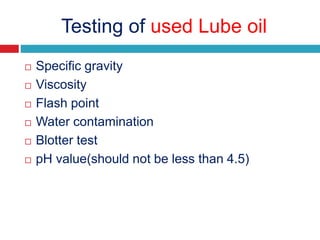
Testing of used Lube oil
 Specific gravity
 Viscosity
 Flash point
 Water contamination
 Blotter test
 pH value(should not be less than 4.5)
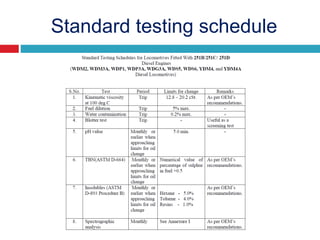
Standard testing schedule
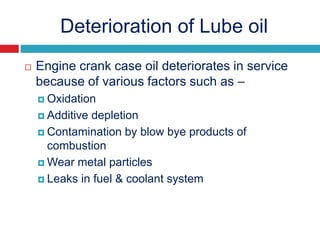
Deterioration of Lube oil
 Engine crank case oil deteriorates in service
because of various factors such as –
 Oxidation
 Additive depletion
 Contamination by blow bye products of
combustion
 Wear metal particles
 Leaks in fuel & coolant system
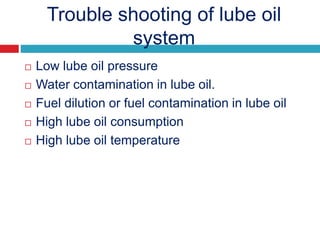
Trouble shooting of lube oil
system
 Low lube oil pressure
 Water contamination in lube oil.
 Fuel dilution or fuel contamination in lube oil
 High lube oil consumption
 High lube oil temperature
CAUSES OF LOW LUBE OIL
PRESSURE
1. Lube oil pump discharge capacity low.
2. Diesel engine temps high.
3. Wrong Pressure setting of relief /regulating valve
4. Poor Quality of lube oil
5. Choking of filter /strainer
6. Low lube oil level in c/case.
7. Contaminated lube oil . (water/fuel oil)
8. Excessive/clearance in bearings.
9. Leakage in pipe line
CAUSES OF WATER
CONTAMINATION
 In case of water contamination white smoke
also comes from Crank case exhaust
 Cylinder liner O Ring defective.
 Cylinder liner sleeve defective .
 Cracked cylinder liner .
 Cracked cylinder head.
 TSC casing crack.
CAUSES OF FUEL DILUTION
 In case of fuel contamination, FIP fuel control
rack may be locked if it is identified .
 NOZZLES Dribbling.
 Wrong setting of Fuel injection timing in particular
FIP.
 Cam lobe worn out and push rod defective.
 Improper cam gear setting .
CAUSES OF HIGH L/OIL
CONSn.
 Clearance between Valve &Valve guide is
more.
 Engine Piston rings worn out.
 Turbo oil seal damaged
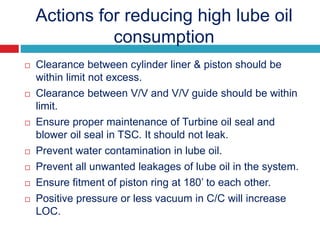
Actions for reducing high lube oil
consumption
 Clearance between cylinder liner & piston should be
within limit not excess.
 Clearance between V/V and V/V guide should be within
limit.
 Ensure proper maintenance of Turbine oil seal and
blower oil seal in TSC. It should not leak.
 Prevent water contamination in lube oil.
 Prevent all unwanted leakages of lube oil in the system.
 Ensure fitment of piston ring at 180’ to each other.
 Positive pressure or less vacuum in C/C will increase
LOC.
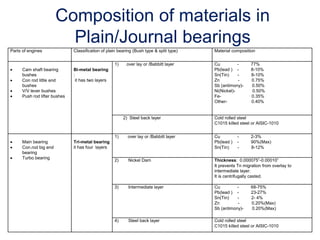
Composition of materials in
Plain/Journal bearings
Parts of engines Classification of plain bearing (Bush type & split type) Material composition
 Cam shaft bearing
bushes
 Con rod little end
bushes
 V/V lever bushes
 Push rod lifter bushes
Bi-metal bearing
:
it has two layers
1) over lay or /Babbitt layer Cu - 77%
Pb(lead ) - 8-10%
Sn(Tin) - 8-10%
Zn - 0.75%
Sb (antimony)- 0.50%
Ni(Nickel)- 0.50%
Fe- 0.35%
Other- 0.40%
2) Steel back layer Cold rolled steel
C1015 killed steel or AISIC-1010
 Main bearing
 Con.rod big end
bearing
 Turbo bearing
Tri-metal bearing
it has four layers
1) over lay or /Babbitt layer Cu - 2-3%
Pb(lead ) - 90%(Max)
Sn(Tin) - 8-12%
2) Nickel Dam Thickness: 0.000075”-0.00010”
It prevents Tn migration from overlay to
intermediate layer.
It is centrifugally casted.
3) Intermediate layer Cu - 68-75%
Pb(lead ) - 23-27%
Sn(Tin) - 2- 4%
Zn - 0.20%(Max)
Sb (antimony)- 0.20%(Max)
4) Steel back layer Cold rolled steel
C1015 killed steel or AISIC-1010
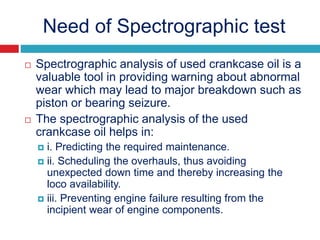
Need of Spectrographic test
 Spectrographic analysis of used crankcase oil is a
valuable tool in providing warning about abnormal
wear which may lead to major breakdown such as
piston or bearing seizure.
 The spectrographic analysis of the used
crankcase oil helps in:
 i. Predicting the required maintenance.
 ii. Scheduling the overhauls, thus avoiding
unexpected down time and thereby increasing the
loco availability.
 iii. Preventing engine failure resulting from the
incipient wear of engine components.
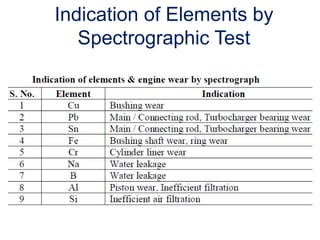
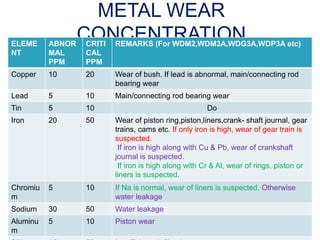
Indication of Elements by
Spectrographic Test
METAL WEAR
CONCENTRATION
ELEME
NT
ABNOR
MAL
PPM
CRITI
CAL
PPM
REMARKS (For WDM2,WDM3A,WDG3A,WDP3A etc)
Copper 10 20 Wear of bush. If lead is abnormal, main/connecting rod
bearing wear
Lead 5 10 Main/connecting rod bearing wear
Tin 5 10 Do
Iron 20 50 Wear of piston ring,piston,liners,crank- shaft journal, gear
trains, cams etc. If only iron is high, wear of gear train is
suspected.
If iron is high along with Cu & Pb, wear of crankshaft
journal is suspected.
If iron is high along with Cr & Al, wear of rings, piston or
liners is suspected.
Chromiu
m
5 10 If Na is normal, wear of liners is suspected. Otherwise
water leakage
Sodium 30 50 Water leakage
Aluminu
m
5 10 Piston wear
Thanking you

1.0 Alco-LUBE OIL SYSTEM -V2.ppt

  • 1.
    Objective  Purpose -Lubeoil system  Components of Lube oil system  Schematic Diagrams of Lube oil system  Various lubricating points  Trouble shooting of Lube oil system  Action to reduce high lube oil consumption
  • 2.
    Purpose of LubeOil System  Reduce friction and wear.  Cooling of bearing ,pistons etc.  Protection -From corrosion, rust, surface damages and wear.  Clean and free from carbon, lacquer deposits and prevent damage due to deposits.
  • 3.
    Components-Lube oil system Lube oil pump( Gear type.)  Spring loaded Relief valve ,(Adjusted to 7.5 kg/cm2)  Lube oil filter tank (8 nos filter, pore size-12-16 micron)/Moatti filter  Conv.Lube oil cooler/Plate type lube oil cooler  Regulating valve(Adjusted to 5.5- 6.0kg/cm2 in WDM2 & 7.4 kg/cm2 in WDM3A)  Centrifuge Cleaner(start at 2.5 kgf/cm2)  Oil sump (1260 lts) RR606 multigrade oil.
  • 4.
    POWER PACK WDM2 W/R Gov Cyl.Hd. C/G/Cover FIP I/Door TSC A/C X-overpipe Fast couplin WP E/Manifold Pad LOP PF SF L/O filling B/Gauge W/J
  • 5.
    By Pass Valve Purpose of this valve is to furnish a definite amount of oil to the engine at all times.  If the filter become clogged, this valve will operated to by- pass all the oil around the filter.
  • 6.
    Relief & Regulatingvalve  Protect various components and regulate oil pressure within the lubricating oil system.  The Pressure relief valve and The Pressure regulating valves are the same type of the valve but it differ due to different pressure setting.
  • 7.
    PLATE TYPE LUBEOIL CLR  In Conventional L.O.CLR, copper tubes with copper fins were use .  In Plate type CLR, Alternate stainless steel plates with water & Lube Oil flowing through the passages.  Heat transfer improved from 190 KW to 295 KW  Higher reliability
  • 8.
    CENTRFUGAL OIL CLEANER Reduced engine wear.  Longer oil change intervals.  Longer paper filter life. Saves 400 liters of lube oil/loco/yr viz. oil lost in 8 filter changes  No operating cost  TECHNICAL SPECIFICATION 1.Oil flow rate -50 lts/min at 3 bar - 70 lts/min at 7 bar 2.Operating pressure range- 3 bar to 7 bar 3.Dirt holding capacity - 6.0 lts 4.Oil capacity - 6.5 lts
  • 9.
  • 10.
    Moatti filter &Parts  The complete filter comprises three main assemblies, these are:  Filter housing  Filtering unit  Hydraulic motor
  • 11.
    Moatti filter-function  TheMoatti filter works on a principle of continuous back flushing. Generally, 3 to 5% of the filtered oil is always back flushing one column of the filter elements and driving of the hydraulic motor.
  • 12.
    Filter tank  Twodrain valves are provided in the filter tank as well as a vent line to eliminate any formation of air pockets.
  • 13.
  • 14.
  • 15.
  • 16.
    LUBRICATION POINTS  FROMMAIN HEADER PIPE  All Main bearing  Crank pin ,Connecting rod big bearing & crank pin journals. further through riffle hole lub oil reach to Gudgen pin (Piston pin) &bearings  From piston pin to piston to piston crown (For cooling the piston)  Splash lubrication of Cylinder liner (when oil is returning to the sump after cooling the piston)  FROM SECONDARY HEADER (LEFT SIDE)  Cam shaft bearing .  V/V lever mechanism & Cam lobe.  Cam gear for cam shaft drive.  FROM SECONDARY HEADER (RIGHT SIDE)  Cam shaft bearing .  V/V lever mechanism & Cam lobe.  Cam gear for cam shaft drive.  OTHER CONNECTIONS (R/S)  To Governor ( From right side secondary header)  To TSC(for bearing)  FROM NEAR STRAINER  Pressure gauge & OPS
  • 17.
    Testing of usedLube oil  Specific gravity  Viscosity  Flash point  Water contamination  Blotter test  pH value(should not be less than 4.5)
  • 18.
  • 19.
    Deterioration of Lubeoil  Engine crank case oil deteriorates in service because of various factors such as –  Oxidation  Additive depletion  Contamination by blow bye products of combustion  Wear metal particles  Leaks in fuel & coolant system
  • 20.
    Trouble shooting oflube oil system  Low lube oil pressure  Water contamination in lube oil.  Fuel dilution or fuel contamination in lube oil  High lube oil consumption  High lube oil temperature
  • 21.
    CAUSES OF LOWLUBE OIL PRESSURE 1. Lube oil pump discharge capacity low. 2. Diesel engine temps high. 3. Wrong Pressure setting of relief /regulating valve 4. Poor Quality of lube oil 5. Choking of filter /strainer 6. Low lube oil level in c/case. 7. Contaminated lube oil . (water/fuel oil) 8. Excessive/clearance in bearings. 9. Leakage in pipe line
  • 22.
    CAUSES OF WATER CONTAMINATION In case of water contamination white smoke also comes from Crank case exhaust  Cylinder liner O Ring defective.  Cylinder liner sleeve defective .  Cracked cylinder liner .  Cracked cylinder head.  TSC casing crack.
  • 23.
    CAUSES OF FUELDILUTION  In case of fuel contamination, FIP fuel control rack may be locked if it is identified .  NOZZLES Dribbling.  Wrong setting of Fuel injection timing in particular FIP.  Cam lobe worn out and push rod defective.  Improper cam gear setting .
  • 24.
    CAUSES OF HIGHL/OIL CONSn.  Clearance between Valve &Valve guide is more.  Engine Piston rings worn out.  Turbo oil seal damaged
  • 25.
    Actions for reducinghigh lube oil consumption  Clearance between cylinder liner & piston should be within limit not excess.  Clearance between V/V and V/V guide should be within limit.  Ensure proper maintenance of Turbine oil seal and blower oil seal in TSC. It should not leak.  Prevent water contamination in lube oil.  Prevent all unwanted leakages of lube oil in the system.  Ensure fitment of piston ring at 180’ to each other.  Positive pressure or less vacuum in C/C will increase LOC.
  • 26.
    Composition of materialsin Plain/Journal bearings Parts of engines Classification of plain bearing (Bush type & split type) Material composition  Cam shaft bearing bushes  Con rod little end bushes  V/V lever bushes  Push rod lifter bushes Bi-metal bearing : it has two layers 1) over lay or /Babbitt layer Cu - 77% Pb(lead ) - 8-10% Sn(Tin) - 8-10% Zn - 0.75% Sb (antimony)- 0.50% Ni(Nickel)- 0.50% Fe- 0.35% Other- 0.40% 2) Steel back layer Cold rolled steel C1015 killed steel or AISIC-1010  Main bearing  Con.rod big end bearing  Turbo bearing Tri-metal bearing it has four layers 1) over lay or /Babbitt layer Cu - 2-3% Pb(lead ) - 90%(Max) Sn(Tin) - 8-12% 2) Nickel Dam Thickness: 0.000075”-0.00010” It prevents Tn migration from overlay to intermediate layer. It is centrifugally casted. 3) Intermediate layer Cu - 68-75% Pb(lead ) - 23-27% Sn(Tin) - 2- 4% Zn - 0.20%(Max) Sb (antimony)- 0.20%(Max) 4) Steel back layer Cold rolled steel C1015 killed steel or AISIC-1010
  • 27.
    Need of Spectrographictest  Spectrographic analysis of used crankcase oil is a valuable tool in providing warning about abnormal wear which may lead to major breakdown such as piston or bearing seizure.  The spectrographic analysis of the used crankcase oil helps in:  i. Predicting the required maintenance.  ii. Scheduling the overhauls, thus avoiding unexpected down time and thereby increasing the loco availability.  iii. Preventing engine failure resulting from the incipient wear of engine components.
  • 28.
    Indication of Elementsby Spectrographic Test
  • 29.
    METAL WEAR CONCENTRATION ELEME NT ABNOR MAL PPM CRITI CAL PPM REMARKS (ForWDM2,WDM3A,WDG3A,WDP3A etc) Copper 10 20 Wear of bush. If lead is abnormal, main/connecting rod bearing wear Lead 5 10 Main/connecting rod bearing wear Tin 5 10 Do Iron 20 50 Wear of piston ring,piston,liners,crank- shaft journal, gear trains, cams etc. If only iron is high, wear of gear train is suspected. If iron is high along with Cu & Pb, wear of crankshaft journal is suspected. If iron is high along with Cr & Al, wear of rings, piston or liners is suspected. Chromiu m 5 10 If Na is normal, wear of liners is suspected. Otherwise water leakage Sodium 30 50 Water leakage Aluminu m 5 10 Piston wear
  • 30.