“Computer & Computation”
 Muhammad Azeem Zahid (10)
 Hafiz Burhan Ahmad (06)
 Usama Iqbal (12)
 Muhammad Muneeb (90)
 Farooq Ali (32)
3/17/2015 1
DATA:
 Unorganized collection of facts which is able to be organized
into useful information.
Storage:
Storage holds data, instructions, and information for future
use.
 For example, computers can store hundreds or millions of
customer names and addresses. Storage holds these items
permanently.
Storage devices:
Hardware components that read data from and write data to
storage media called storage devices.
3/17/2015 3
There are three types of storage devices.
1) Magnetic Storage Devices
2) Optical Storage Devices
3) Solid-State Storage Devices:
3/17/2015 4
 Such devices, coated with magnetically
sensitive material (i.e. Iron Oxide that react to a
magnetic material)
 Uses magnet to access data
 Use binary relation to store data (1 and 0 form)
 The storage capacity is unlimited.
 Magnetic disk are less vulnerable to data
corruption due to careless handling.
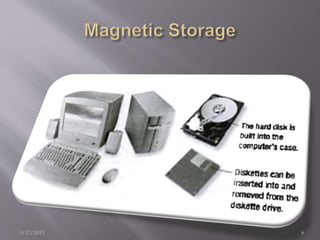
 E.g. (Floppy Disk, Hard Disk)
3/17/2015 5
3/17/2015 6
 Use laser to read data and write data to the
reflective surface of optical disc
 They are better storage medium than magnetic
storage devices.
 Optical disc storage system consists of a
metallic or plastic disk.
 Due to there compact size and light weight,
optical disks are easy to handle store and port
from one place to another.
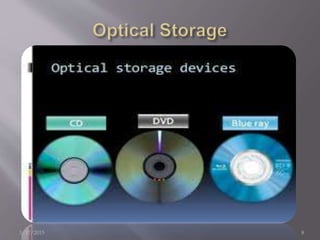
 E.g. (CD, DVD, And Blue Ray Disc)
3/17/2015 7
3/17/2015 8
 Non volatile
 Less Expensive from blue rays
 High Speed
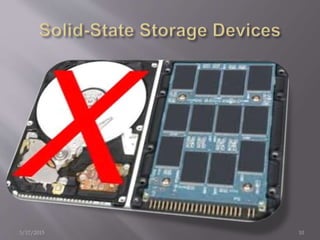
 They stored data on memory circuits rather
than disk or tapes.
 They store data electronically not in a magnetic
or optical form.
 They don’t need to move a head or sensor to
find data.
 E.g. ( Flash drive, Memory Cards)
3/17/2015 9
3/17/2015 10
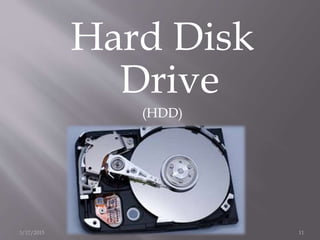
Hard Disk
Drive
(HDD)
3/17/2015 11
“Introduced by IBM in 1956 became the
dominant secondary storage device for
general purpose computers by the early
1960s”
 Data storage device for storing and retrieving
digital information using platters (rapidly rotating
disks).
 Non volatile.
 Individual blocks of data can be stored or retrieved
in any order rather than sequentially.
 It consist one or more rigid platters.
3/17/2015 12
There's just a large shiny, circular "plate" of
magnetic material called a platter, divided
into billions of tiny areas. Each one of those
areas can be independently magnetized (to
store a 1) or demagnetized (to store a 0)
Hard disk drive (HDD) records the data by
magnetizing ferromagnetic material
directionally to represent either 0 or 1 binary
digit. They read the data back by
magnetization of the material.
3/17/2015 13
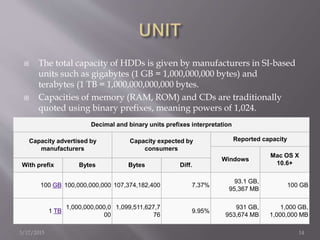
 The total capacity of HDDs is given by manufacturers in SI-based
units such as gigabytes (1 GB = 1,000,000,000 bytes) and
terabytes (1 TB = 1,000,000,000,000 bytes.
 Capacities of memory (RAM, ROM) and CDs are traditionally
quoted using binary prefixes, meaning powers of 1,024.
Decimal and binary units prefixes interpretation
Capacity advertised by
manufacturers
Capacity expected by
consumers
Reported capacity
Windows
Mac OS X
10.6+With prefix Bytes Bytes Diff.
100 GB 100,000,000,000 107,374,182,400 7.37%
93.1 GB,
95,367 MB
100 GB
1 TB
1,000,000,000,0
00
1,099,511,627,7
76
9.95%
931 GB,
953,674 MB
1,000 GB,
1,000,000 MB
3/17/2015 14
There are two ways to measure the performance
of a hard disk.
1) Data rate:
It is the number of bytes per seconds
that the drive can delivers to the CPU the rate
between 5 and 40 megabytes are common.
3/17/2015 15
2) Seek Time:
The seek time is the amount of time
between when the CPU request the file and
when the first byte of the file is sent to the
CPU. Times Between 10 and 20 milliseconds
are common.
3/17/2015 16
 More than 200 companies have manufactured HDDs
over time.
 Most popular production companies today:
Western Digital, Seagate, and Toshiba.
 Worldwide revenues for disk storage were $32 billion
in 2013, down about 3% from 2012..
 The estimated 2013 market shares are about 40–45%
each for Seagate and Western Digital and 13–16% for
Toshiba.
3/17/2015 17
There are types of hard drive.
1) ZIP/ Bernoulli disk.
2) Disk pack.
3) Winchester Disk.
3/17/2015 18
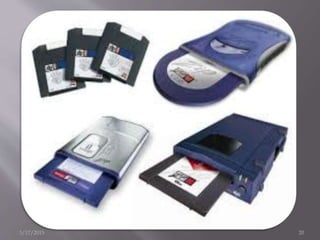
 Consist of single hard disk platter.
 Storage capacity 8GB to 500GB or more
 May be portable or fixed.
 The fixed type is connected permanently.
 Portable type is connected to computer during
use and then after use it can be disconnected.
 It can be loaded/Unloaded into a Zip drive as
we insert/remove a video cassette into video
cassette player.
3/17/2015 19
3/17/2015 20
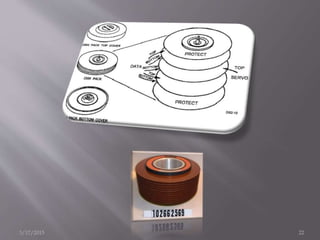
 Consists of multiple hard disk platter.
 All disk revolved together around single
central shaft.
 When not in use user can store a disk pack off-
line in a plastic case.
 This gives virtually unlimited storage capacity
to disk pack.
 Storage capacity of disk pack varies from
hundred GB to several Thousand GB.
 Diameter 14-inch introduced by IBM.
3/17/2015 21
3/17/2015 22
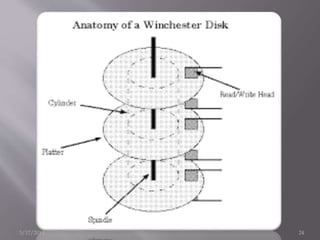
 Consists of multiple Hard disk platters
Mounted on a single central shaft.
 Its hard disk platters and disk drive are sealed
together and can not be separated from each
other.
 Have large storage capacity because all
surfaces of all disk platters are used for data
recording.
 Storage capacity varies from few gigabits to
few terabits.
3/17/2015 23
3/17/2015 24
3/17/2015 25

Presentation 14 che-section-b(1)

  • 1.
    “Computer & Computation” Muhammad Azeem Zahid (10)  Hafiz Burhan Ahmad (06)  Usama Iqbal (12)  Muhammad Muneeb (90)  Farooq Ali (32) 3/17/2015 1
  • 3.
    DATA:  Unorganized collectionof facts which is able to be organized into useful information. Storage: Storage holds data, instructions, and information for future use.  For example, computers can store hundreds or millions of customer names and addresses. Storage holds these items permanently. Storage devices: Hardware components that read data from and write data to storage media called storage devices. 3/17/2015 3
  • 4.
    There are threetypes of storage devices. 1) Magnetic Storage Devices 2) Optical Storage Devices 3) Solid-State Storage Devices: 3/17/2015 4
  • 5.
     Such devices,coated with magnetically sensitive material (i.e. Iron Oxide that react to a magnetic material)  Uses magnet to access data  Use binary relation to store data (1 and 0 form)  The storage capacity is unlimited.  Magnetic disk are less vulnerable to data corruption due to careless handling.  E.g. (Floppy Disk, Hard Disk) 3/17/2015 5
  • 6.
  • 7.
     Use laserto read data and write data to the reflective surface of optical disc  They are better storage medium than magnetic storage devices.  Optical disc storage system consists of a metallic or plastic disk.  Due to there compact size and light weight, optical disks are easy to handle store and port from one place to another.  E.g. (CD, DVD, And Blue Ray Disc) 3/17/2015 7
  • 8.
  • 9.
     Non volatile Less Expensive from blue rays  High Speed  They stored data on memory circuits rather than disk or tapes.  They store data electronically not in a magnetic or optical form.  They don’t need to move a head or sensor to find data.  E.g. ( Flash drive, Memory Cards) 3/17/2015 9
  • 10.
  • 11.
  • 12.
    “Introduced by IBMin 1956 became the dominant secondary storage device for general purpose computers by the early 1960s”  Data storage device for storing and retrieving digital information using platters (rapidly rotating disks).  Non volatile.  Individual blocks of data can be stored or retrieved in any order rather than sequentially.  It consist one or more rigid platters. 3/17/2015 12
  • 13.
    There's just alarge shiny, circular "plate" of magnetic material called a platter, divided into billions of tiny areas. Each one of those areas can be independently magnetized (to store a 1) or demagnetized (to store a 0) Hard disk drive (HDD) records the data by magnetizing ferromagnetic material directionally to represent either 0 or 1 binary digit. They read the data back by magnetization of the material. 3/17/2015 13
  • 14.
     The totalcapacity of HDDs is given by manufacturers in SI-based units such as gigabytes (1 GB = 1,000,000,000 bytes) and terabytes (1 TB = 1,000,000,000,000 bytes.  Capacities of memory (RAM, ROM) and CDs are traditionally quoted using binary prefixes, meaning powers of 1,024. Decimal and binary units prefixes interpretation Capacity advertised by manufacturers Capacity expected by consumers Reported capacity Windows Mac OS X 10.6+With prefix Bytes Bytes Diff. 100 GB 100,000,000,000 107,374,182,400 7.37% 93.1 GB, 95,367 MB 100 GB 1 TB 1,000,000,000,0 00 1,099,511,627,7 76 9.95% 931 GB, 953,674 MB 1,000 GB, 1,000,000 MB 3/17/2015 14
  • 15.
    There are twoways to measure the performance of a hard disk. 1) Data rate: It is the number of bytes per seconds that the drive can delivers to the CPU the rate between 5 and 40 megabytes are common. 3/17/2015 15
  • 16.
    2) Seek Time: Theseek time is the amount of time between when the CPU request the file and when the first byte of the file is sent to the CPU. Times Between 10 and 20 milliseconds are common. 3/17/2015 16
  • 17.
     More than200 companies have manufactured HDDs over time.  Most popular production companies today: Western Digital, Seagate, and Toshiba.  Worldwide revenues for disk storage were $32 billion in 2013, down about 3% from 2012..  The estimated 2013 market shares are about 40–45% each for Seagate and Western Digital and 13–16% for Toshiba. 3/17/2015 17
  • 18.
    There are typesof hard drive. 1) ZIP/ Bernoulli disk. 2) Disk pack. 3) Winchester Disk. 3/17/2015 18
  • 19.
     Consist ofsingle hard disk platter.  Storage capacity 8GB to 500GB or more  May be portable or fixed.  The fixed type is connected permanently.  Portable type is connected to computer during use and then after use it can be disconnected.  It can be loaded/Unloaded into a Zip drive as we insert/remove a video cassette into video cassette player. 3/17/2015 19
  • 20.
  • 21.
     Consists ofmultiple hard disk platter.  All disk revolved together around single central shaft.  When not in use user can store a disk pack off- line in a plastic case.  This gives virtually unlimited storage capacity to disk pack.  Storage capacity of disk pack varies from hundred GB to several Thousand GB.  Diameter 14-inch introduced by IBM. 3/17/2015 21
  • 22.
  • 23.
     Consists ofmultiple Hard disk platters Mounted on a single central shaft.  Its hard disk platters and disk drive are sealed together and can not be separated from each other.  Have large storage capacity because all surfaces of all disk platters are used for data recording.  Storage capacity varies from few gigabits to few terabits. 3/17/2015 23
  • 24.
  • 25.