


3/18/2015
How Can we Define Research…??
Purpose of Research
Types of Research
Research Methods
Advantages & Disadvantages
Application in Transport Planning
3/18/2015
A broad definition of research is given by
Martyn Shuttleworth:
"In the broadest sense of the word, the
definition of research includes any gathering
of data, information and facts for the
advancement of knowledge."
3/18/2015
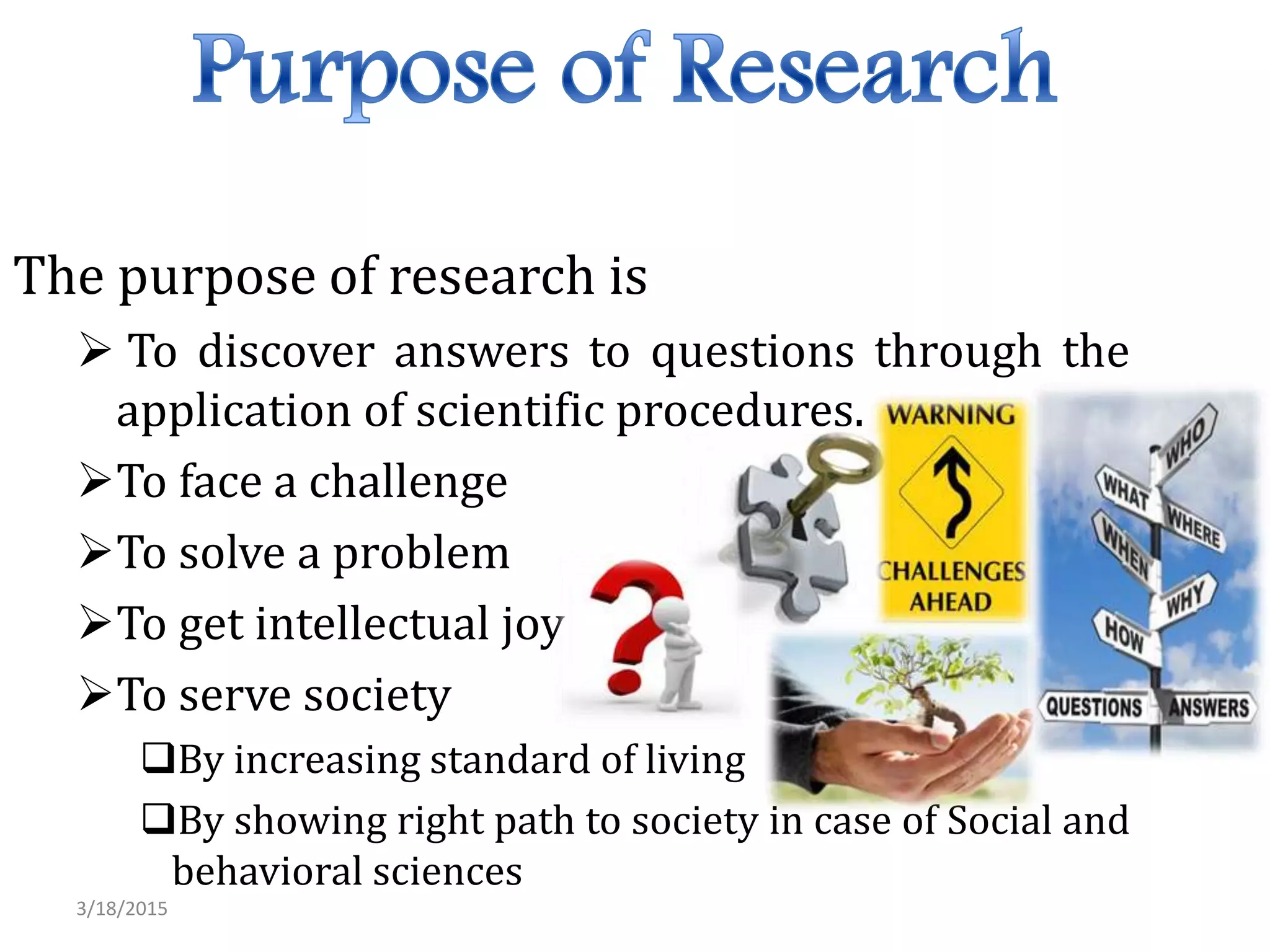
The purpose of research is
 To discover answers to questions through the
application of scientific procedures.
To face a challenge
To solve a problem
To get intellectual joy
To serve society
By increasing standard of living
By showing right path to society in case of Social and
behavioral sciences
3/18/2015
Descriptive Research
Analytical Research
Applied Research
Fundamental Research
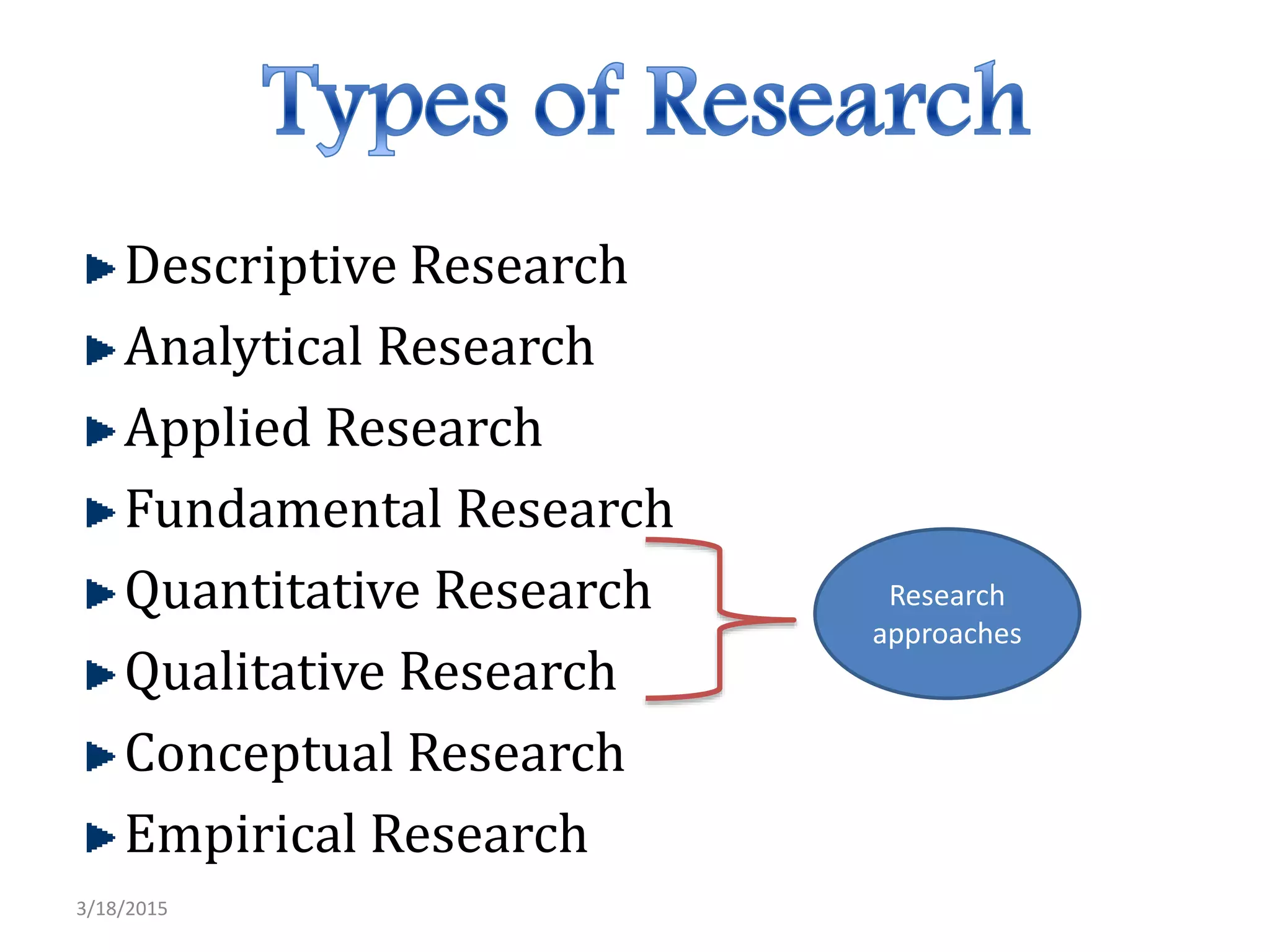
Quantitative Research
Qualitative Research
Conceptual Research
Empirical Research
3/18/2015
Research
approaches
Descriptive Research
It describes data and characteristics about the
population or phenomenon being studied. It does
not answer questions about e.g.: how/when/why the
characteristics occurred
Analytical Research
In analytical research, the researcher has to use
facts or information already available, and analyze
these to make a critical evaluation of the material.
3/18/2015
Fundamental Research
Fundamental research (also called Basic or
Pure Research) is mainly concerned with
generalizations and the formulation of theory. It is
driven by curiosity or interest in a subject. The
main motivation is to expand man’s knowledge, not
to create or invent something.
Applied Research
Applied research (also called Action or
Practitioner Research) is designed to solve practical
problems of the society. It helps to solve the
problems facing the world today such as
overpopulation, pollution, drought, floods and
disease.
3/18/2015
Quantitative Research
Quantitative research includes designs, techniques
and measures that produce discrete numerical or
quantifiable data. E.g
Research that consists of the percentage amounts of all
the elements that make up Earth's atmosphere.
Qualitative Research
Qualitative research deals with designs techniques
and measure that do not produce discrete numerical
data.
The techniques used in research are In depth
Interviews, Sentence Completion Test and Story
Completion Test.
3/18/2015
Conceptual Research
Conceptual research is that related to some
abstract idea(s) or theory. It is generally used by
philosophers and thinkers to develop new
concepts or to reinterpret existing ones.
Empirical Research
Empirical research relies on experience or
observation alone, often without due regard for
system and theory. It is data-based research,
coming up with conclusions which are capable of
being verified by observation or experiment.
3/18/2015
"Research methods are the particular
strategies researchers use to collect the
evidence necessary for building and
testing theories"
(Frey, Botan, Friedman, & Kreps; 1991)
3/18/2015
There are two basic approaches to research,
Quantitative Approach
Qualitative Approach
3/18/2015
Quantitative Approach
It involves the generation of data in
quantitative form which can be subjected to
accurate quantitative analysis in a formal
and rigid fashion.
Quantitative approach can be further
sub-classified into
Inferential Approach
Experimental Approach
Simulation Approach
3/18/2015
Quantitative Approach
 Inferential Approach
The purpose of inferential approach to
research is to form a data base from which to infer
characteristics or relationships of population. This
usually means survey research where a sample of
population is studied (questioned or observed) to
determine its characteristics, and it is then
inferred that the population has the same
characteristics.
3/18/2015
Quantitative Approach
Experimental Approach
Experimental approach is characterized by
much greater control over the research
environment and in this case some variables are
manipulated to observe their effect on other
variables.
3/18/2015
Quantitative Approach
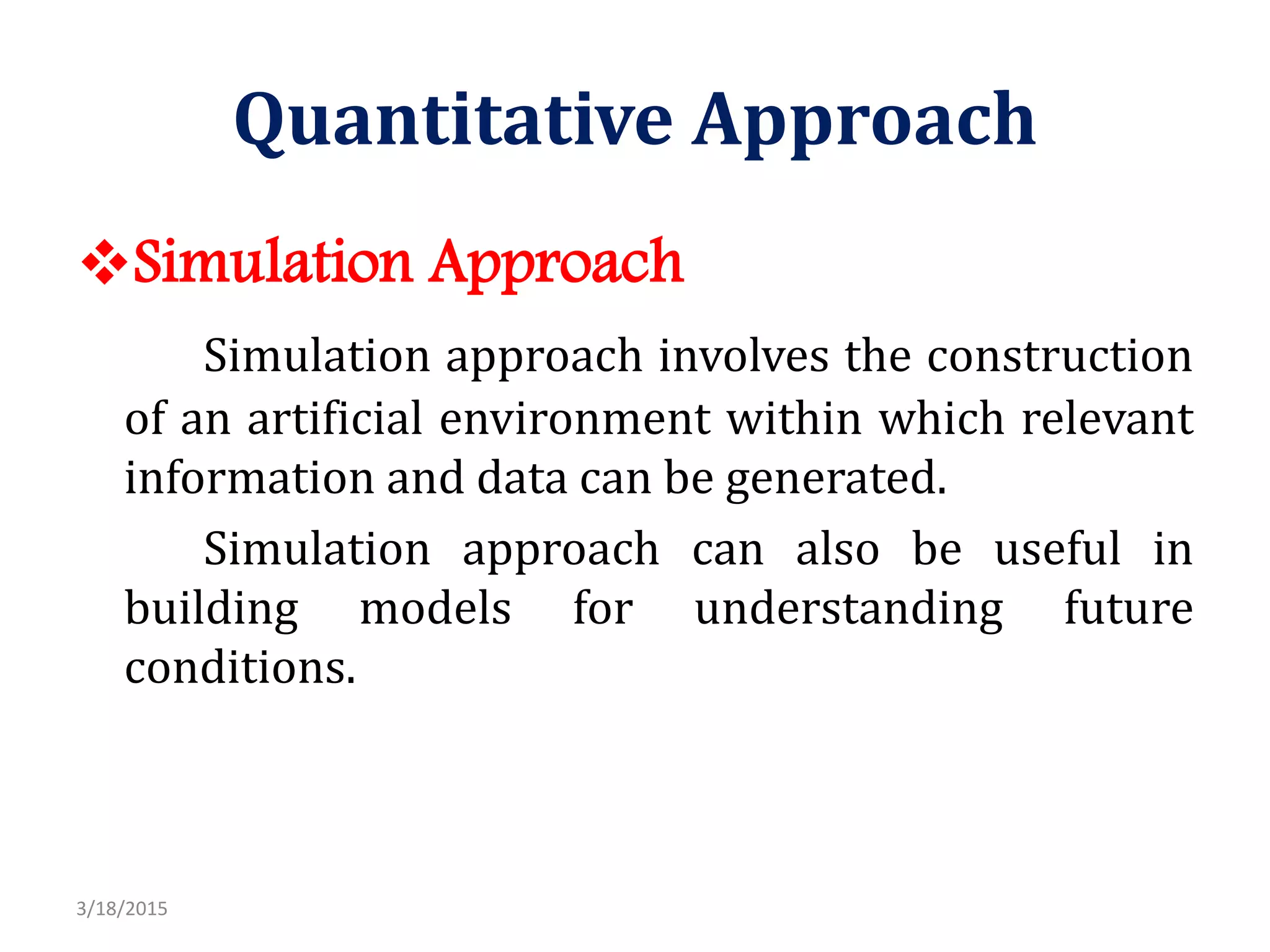
Simulation Approach
Simulation approach involves the construction
of an artificial environment within which relevant
information and data can be generated.
Simulation approach can also be useful in
building models for understanding future
conditions.
3/18/2015
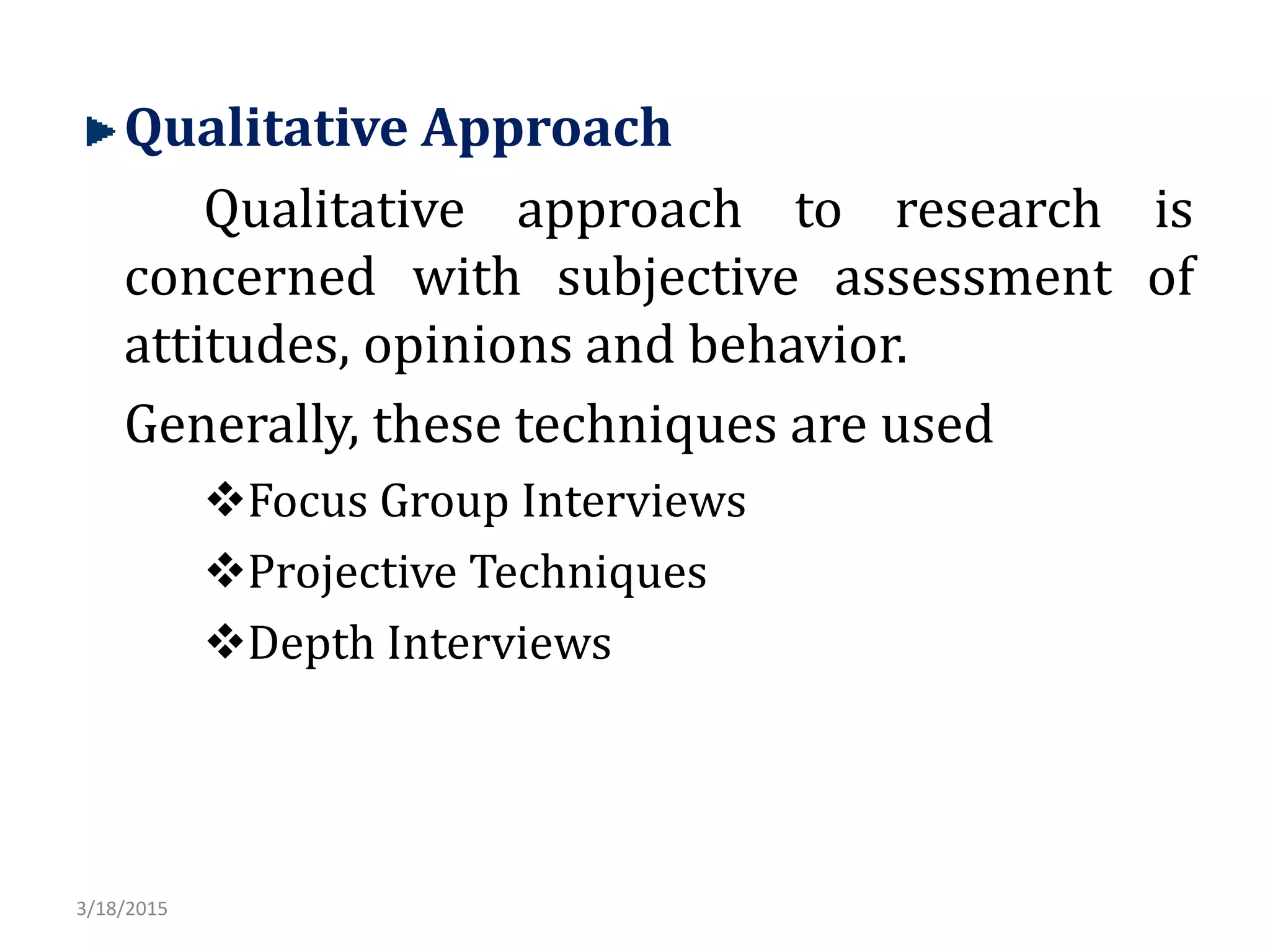
Qualitative Approach
Qualitative approach to research is
concerned with subjective assessment of
attitudes, opinions and behavior.
Generally, these techniques are used
Focus Group Interviews
Projective Techniques
Depth Interviews
3/18/2015
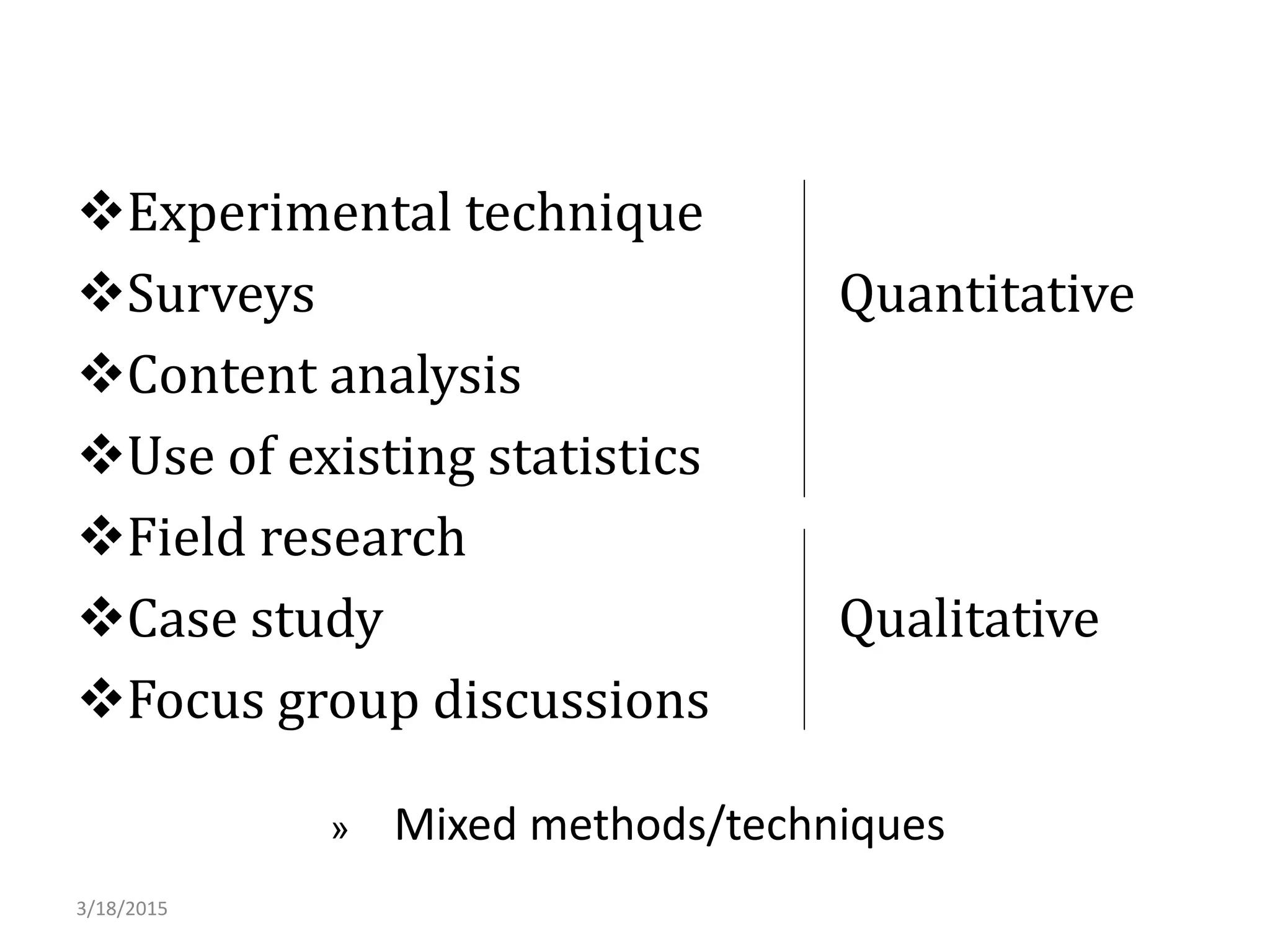
Experimental technique
Surveys Quantitative
Content analysis
Use of existing statistics
Field research
Case study Qualitative
Focus group discussions
» Mixed methods/techniques
3/18/2015
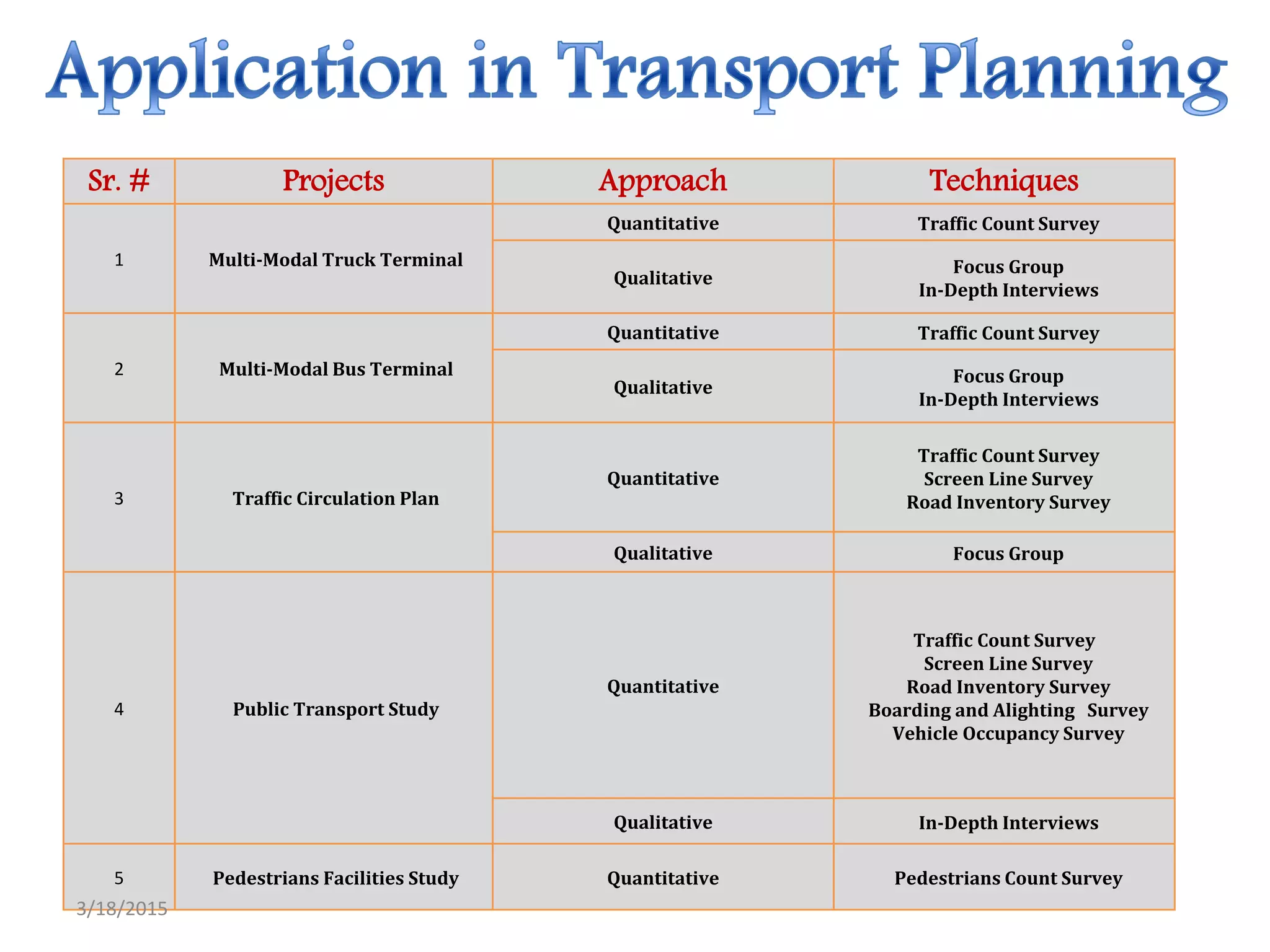
Sr. # Projects Approach Techniques
1 Multi-Modal Truck Terminal
Quantitative Traffic Count Survey
Qualitative
Focus Group
In-Depth Interviews
2 Multi-Modal Bus Terminal
Quantitative Traffic Count Survey
Qualitative
Focus Group
In-Depth Interviews
3 Traffic Circulation Plan
Quantitative
Traffic Count Survey
Screen Line Survey
Road Inventory Survey
Qualitative Focus Group
4 Public Transport Study
Quantitative
Traffic Count Survey
Screen Line Survey
Road Inventory Survey
Boarding and Alighting Survey
Vehicle Occupancy Survey
Qualitative In-Depth Interviews
5 Pedestrians Facilities Study Quantitative Pedestrians Count Survey
3/18/2015
3/18/2015
“Research” available from:
http://wikieducator.org/Research#Descriptive_an
d_analytical_research (14 March 2013)
“Research” available from:
http://en.wikipedia.org/wiki/Research (14 March
2013)
“Research Methodology: An Introduction”
available from:
http://www.limat.org/data/research/Research%
20Methodology.pdf (14 March 2013)
3/18/2015
3/18/2015

Presentation 1; research methods

  • 1.
  • 2.
    How Can weDefine Research…?? Purpose of Research Types of Research Research Methods Advantages & Disadvantages Application in Transport Planning 3/18/2015
  • 3.
    A broad definitionof research is given by Martyn Shuttleworth: "In the broadest sense of the word, the definition of research includes any gathering of data, information and facts for the advancement of knowledge." 3/18/2015
  • 4.
    The purpose ofresearch is  To discover answers to questions through the application of scientific procedures. To face a challenge To solve a problem To get intellectual joy To serve society By increasing standard of living By showing right path to society in case of Social and behavioral sciences 3/18/2015
  • 5.
    Descriptive Research Analytical Research AppliedResearch Fundamental Research Quantitative Research Qualitative Research Conceptual Research Empirical Research 3/18/2015 Research approaches
  • 6.
    Descriptive Research It describesdata and characteristics about the population or phenomenon being studied. It does not answer questions about e.g.: how/when/why the characteristics occurred Analytical Research In analytical research, the researcher has to use facts or information already available, and analyze these to make a critical evaluation of the material. 3/18/2015
  • 7.
    Fundamental Research Fundamental research(also called Basic or Pure Research) is mainly concerned with generalizations and the formulation of theory. It is driven by curiosity or interest in a subject. The main motivation is to expand man’s knowledge, not to create or invent something. Applied Research Applied research (also called Action or Practitioner Research) is designed to solve practical problems of the society. It helps to solve the problems facing the world today such as overpopulation, pollution, drought, floods and disease. 3/18/2015
  • 8.
    Quantitative Research Quantitative researchincludes designs, techniques and measures that produce discrete numerical or quantifiable data. E.g Research that consists of the percentage amounts of all the elements that make up Earth's atmosphere. Qualitative Research Qualitative research deals with designs techniques and measure that do not produce discrete numerical data. The techniques used in research are In depth Interviews, Sentence Completion Test and Story Completion Test. 3/18/2015
  • 9.
    Conceptual Research Conceptual researchis that related to some abstract idea(s) or theory. It is generally used by philosophers and thinkers to develop new concepts or to reinterpret existing ones. Empirical Research Empirical research relies on experience or observation alone, often without due regard for system and theory. It is data-based research, coming up with conclusions which are capable of being verified by observation or experiment. 3/18/2015
  • 10.
    "Research methods arethe particular strategies researchers use to collect the evidence necessary for building and testing theories" (Frey, Botan, Friedman, & Kreps; 1991) 3/18/2015
  • 11.
    There are twobasic approaches to research, Quantitative Approach Qualitative Approach 3/18/2015
  • 12.
    Quantitative Approach It involvesthe generation of data in quantitative form which can be subjected to accurate quantitative analysis in a formal and rigid fashion. Quantitative approach can be further sub-classified into Inferential Approach Experimental Approach Simulation Approach 3/18/2015
  • 13.
    Quantitative Approach  InferentialApproach The purpose of inferential approach to research is to form a data base from which to infer characteristics or relationships of population. This usually means survey research where a sample of population is studied (questioned or observed) to determine its characteristics, and it is then inferred that the population has the same characteristics. 3/18/2015
  • 14.
    Quantitative Approach Experimental Approach Experimentalapproach is characterized by much greater control over the research environment and in this case some variables are manipulated to observe their effect on other variables. 3/18/2015
  • 15.
    Quantitative Approach Simulation Approach Simulationapproach involves the construction of an artificial environment within which relevant information and data can be generated. Simulation approach can also be useful in building models for understanding future conditions. 3/18/2015
  • 16.
    Qualitative Approach Qualitative approachto research is concerned with subjective assessment of attitudes, opinions and behavior. Generally, these techniques are used Focus Group Interviews Projective Techniques Depth Interviews 3/18/2015
  • 17.
    Experimental technique Surveys Quantitative Contentanalysis Use of existing statistics Field research Case study Qualitative Focus group discussions » Mixed methods/techniques 3/18/2015
  • 18.
    Sr. # ProjectsApproach Techniques 1 Multi-Modal Truck Terminal Quantitative Traffic Count Survey Qualitative Focus Group In-Depth Interviews 2 Multi-Modal Bus Terminal Quantitative Traffic Count Survey Qualitative Focus Group In-Depth Interviews 3 Traffic Circulation Plan Quantitative Traffic Count Survey Screen Line Survey Road Inventory Survey Qualitative Focus Group 4 Public Transport Study Quantitative Traffic Count Survey Screen Line Survey Road Inventory Survey Boarding and Alighting Survey Vehicle Occupancy Survey Qualitative In-Depth Interviews 5 Pedestrians Facilities Study Quantitative Pedestrians Count Survey 3/18/2015
  • 19.
  • 20.
    “Research” available from: http://wikieducator.org/Research#Descriptive_an d_analytical_research(14 March 2013) “Research” available from: http://en.wikipedia.org/wiki/Research (14 March 2013) “Research Methodology: An Introduction” available from: http://www.limat.org/data/research/Research% 20Methodology.pdf (14 March 2013) 3/18/2015
  • 21.

Editor's Notes

  • #4 Research is a process of steps used to collect and analyze information to increase our understanding of a topic or issue". It consists of three steps: Pose a question, collect data to answer the question, and present an answer to the question.
  • #5 The purpose of research is to discover answers to questions through the application of scientific procedures. The main aim of research is to find out the truth which is hidden and which has not been discovered as yet. Though each research study has its own specific purpose, we may think of research objectives as falling into a number of following broad groupings: 1. To gain familiarity with a phenomenon or to achieve new insights into it (studies with this object in view are termed as exploratory or formulative research studies); 2. To portray accurately the characteristics of a particular individual, situation or a group (studies with this object in view are known as descriptive research studies); 3. To determine the frequency with which something occurs or with which it is associated with something else (studies with this object in view are known as diagnostic research studies); 4. To test a hypothesis of a causal relationship between variables (such studies are known as hypothesis-testing research studies).
  • #7 Descriptive research attempts to determine, describe, or identify what is. It uses description, classification, measurement and comparison to describe a situation. The main characteristic is that the researcher has no control over the variables. He only reports the situation as it is at the time. The term ex-post facto is usually used for descriptive research studies in social sciences. The survey method is commonly used in descriptive research. Analytical research attempts to explain why and how. It usually concerns itself with cause–effect relationships among variables. The researcher attempts to analyze the situation and make critical evaluation.
  • #8 Basic and applied research Basic research (also called fundamental or pure research) is mainly concerned with generalizations and the formulation of theory. It is driven by curiosity or interest in a subject. The main motivation is to expand man’s knowledge, not to create or invent something. Many scientists believe that basic research lays the foundation for the applied research that follows. Applied research is designed to solve practical problems of the society. It can be argued that the goal of applied research is to improve the human condition. An example of applied research could be a study to find out how the school feeding programme has affected school enrolment rates in drought-prone districts. Applied research is increasingly gaining favour as it is helps to address the problems facing the world today such as overpopulation, pollution, depletion of natural resources, drought, floods, declining moral standards and disease. Action research is a unique form of applied research. It is a reflective process of progressive problem solving. It is also called "practitioner research" because of the involvement of the actual practitioner in real life. Action implies that the practitioner is involved in the collection of data, analysis, and the interpretation of results. He or she is also involved in implementing results of the research and is thus well placed to judge the effectiveness of the interventions.
  • #9 Quantitative vs. Qualitative: Quantitative research is based on the measurement of quantity or amount. It is applicable to phenomena that can be expressed in terms of quantity. Qualitative research, on the other hand, is concerned with qualitative phenomenon, i.e., phenomena relating to or involving quality or kind. For instance, when we are interested in investigating the reasons for human behaviour (i.e., why people think or do certain things), we quite often talk of ‘Motivation Research’, an important type of qualitative research. This type of research aims at discovering the underlying motives and desires, using in depth interviews for the purpose. Other techniques of such research are word association tests, sentence completion tests, story completion tests and similar other projective techniques. Attitude or opinion research i.e., research designed to find out how people feel or what they think about a particular subject or institution is also qualitative research. Qualitative research is specially important in the behavioural sciences where the aim is to discover the underlying motives of human behaviour. Through such research we can analyse the various factors which motivate people to behave in a particular manner or which make people like or dislike a particular thing. It may be stated, however, that to apply qualitative research in practice is relatively a difficult job and therefore, while doing such research, one should seek guidance from experimental psychologists.
  • #10 Conceptual research is that related to some abstract idea(s) or theory. It is generally used by philosophers and thinkers to develop new concepts or to reinterpret existing ones. On the other hand, empirical research relies on experience or observation alone, often without due regard for system and theory. It is data-based research, coming up with conclusions which are capable of being verified by observation or experiment. We can also call it as experimental type of research. In such a research it is necessary to get at facts firsthand, at their source, and actively to go about doing certain things to stimulate the production of desired information. In such a research, the researcher must first provide himself with a working hypothesis or guess as to the probable results. He then works to get enough facts (data) to prove or disprove his hypothesis. He then sets up experimental designs which he thinks will manipulate the persons or the materials concerned so as to bring forth the desired information. Such research is thus characterised by the experimenter’s control over the variables under study and his deliberate manipulation of one of them to study its effects. Empirical research is appropriate when proof is sought that certain variables affect other variables in some way. Evidence gathered through experiments or empirical studies is today considered to be the most powerful support possible for a given hypothesis.