



When do you have
English?
LESSON 1.2
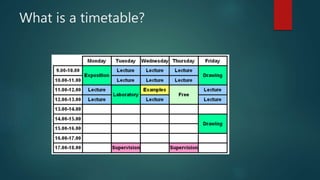
What is a timetable?
School Subjects
VOCABULARY
Geography History Art Science
Design Sports Maths Computer Studies
Days of the week and times
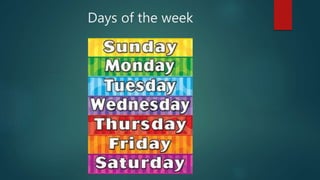
Days of the week
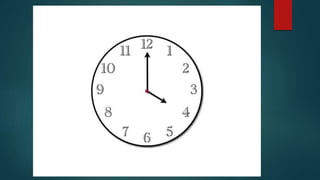
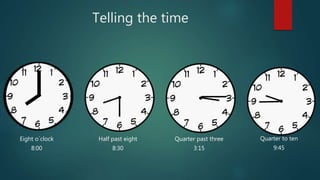
Telling the time
Eight o´clock Half past eight Quarter past three Quarter to ten
8:00 8:30 3:15 9:45
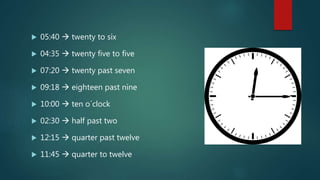
 05:40  twenty to six
 04:35  twenty five to five
 07:20  twenty past seven
 09:18  eighteen past nine
 10:00  ten o´clock
 02:30  half past two
 12:15  quarter past twelve
 11:45  quarter to twelve
Speaking activity
• What time do you usually wake up during the week?
• What time do you usually have lunch?
• What time do you usually go to sleep?
• What time do you usually wake up in weekends?
Simple Present
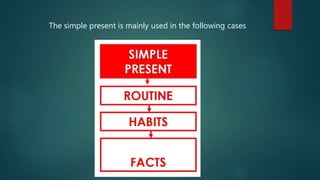
The simple present is mainly used in the following cases
Simple Present
To Do To Be
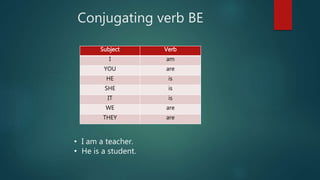
Conjugating verb BE
Subject Verb
I am
YOU are
HE is
SHE is
IT is
WE are
THEY are
• I am a teacher.
• He is a student.
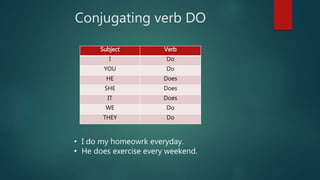
Conjugating verb DO
Subject Verb
I Do
YOU Do
HE Does
SHE Does
IT Does
WE Do
THEY Do
• I do my homeowrk everyday.
• He does exercise every weekend.
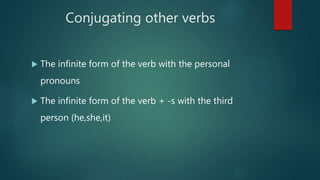
Conjugating other verbs
 The infinite form of the verb with the personal
pronouns
 The infinite form of the verb + -s with the third
person (he,she,it)
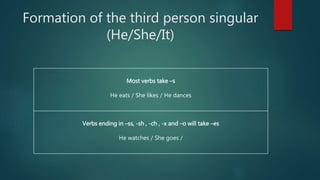
Formation of the third person singular
(He/She/It)
Most verbs take –s
He eats / She likes / He dances
Verbs ending in –ss, -sh , -ch , -x and –o will take –es
He watches / She goes /
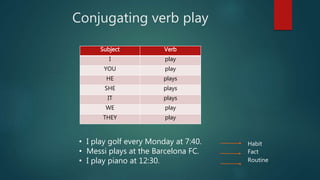
Conjugating verb play
Subject Verb
I play
YOU play
HE plays
SHE plays
IT plays
WE play
THEY play
• I play golf every Monday at 7:40.
• Messi plays at the Barcelona FC.
• I play piano at 12:30.
Habit
Fact
Routine
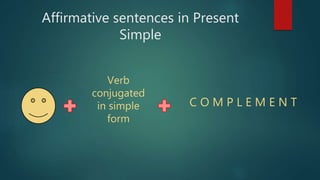
Affirmative sentences in Present
Simple
Verb
conjugated
in simple
form
C O M P L E M E N T
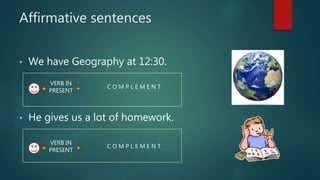
Affirmative sentences
• We have Geography at 12:30.
• He gives us a lot of homework.
VERB IN
PRESENT
C O M P L E M E N T
VERB IN
PRESENT
C O M P L E M E N T
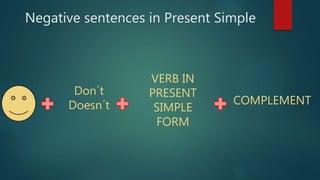
Negative sentences in Present Simple
Don´t
Doesn´t COMPLEMENT
VERB IN
PRESENT
SIMPLE
FORM
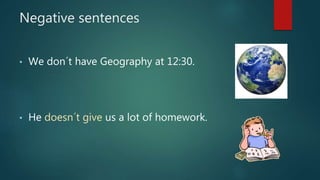
Negative sentences
• We don´t have Geography at 12:30.
• He doesn´t give us a lot of homework.
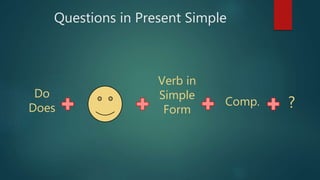
Questions in Present Simple
Do
Does
Comp.
Verb in
Simple
Form ?
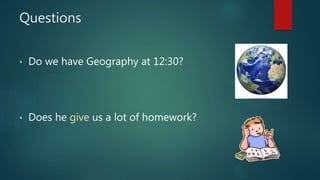
Questions
• Do we have Geography at 12:30?
• Does he give us a lot of homework?
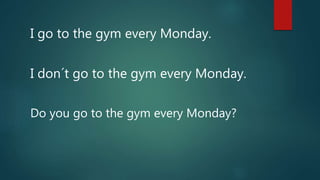
I go to the gym every Monday.
I don´t go to the gym every Monday.
Do you go to the gym every Monday?
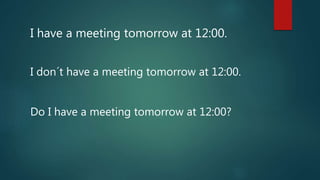
I have a meeting tomorrow at 12:00.
I don´t have a meeting tomorrow at 12:00.
Do I have a meeting tomorrow at 12:00?
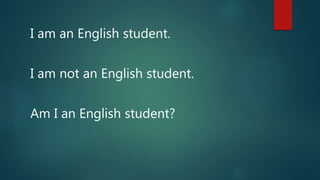
I am an English student.
I am not an English student.
Am I an English student?
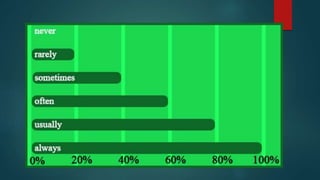
Adverbs of Frequency
• He always gives us a lot of homework.
• He is always late.
The adverb comes before the verb
The adverb comes after the verb to be.
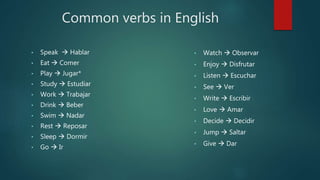
Common verbs in English
• Speak  Hablar
• Eat  Comer
• Play  Jugar*
• Study  Estudiar
• Work  Trabajar
• Drink  Beber
• Swim  Nadar
• Rest  Reposar
• Sleep  Dormir
• Go  Ir
• Watch  Observar
• Enjoy  Disfrutar
• Listen  Escuchar
• See  Ver
• Write  Escribir
• Love  Amar
• Decide  Decidir
• Jump  Saltar
• Give  Dar

Present Simple Tense and Telling the Time

  • 1.
    When do youhave English? LESSON 1.2
  • 2.
    What is atimetable?
  • 3.
  • 4.
    Geography History ArtScience Design Sports Maths Computer Studies
  • 5.
    Days of theweek and times
  • 6.
  • 8.
    Telling the time Eighto´clock Half past eight Quarter past three Quarter to ten 8:00 8:30 3:15 9:45
  • 9.
     05:40 twenty to six  04:35  twenty five to five  07:20  twenty past seven  09:18  eighteen past nine  10:00  ten o´clock  02:30  half past two  12:15  quarter past twelve  11:45  quarter to twelve
  • 10.
    Speaking activity • Whattime do you usually wake up during the week? • What time do you usually have lunch? • What time do you usually go to sleep? • What time do you usually wake up in weekends?
  • 11.
  • 12.
    The simple presentis mainly used in the following cases
  • 13.
  • 14.
    Conjugating verb BE SubjectVerb I am YOU are HE is SHE is IT is WE are THEY are • I am a teacher. • He is a student.
  • 15.
    Conjugating verb DO SubjectVerb I Do YOU Do HE Does SHE Does IT Does WE Do THEY Do • I do my homeowrk everyday. • He does exercise every weekend.
  • 16.
    Conjugating other verbs The infinite form of the verb with the personal pronouns  The infinite form of the verb + -s with the third person (he,she,it)
  • 17.
    Formation of thethird person singular (He/She/It) Most verbs take –s He eats / She likes / He dances Verbs ending in –ss, -sh , -ch , -x and –o will take –es He watches / She goes /
  • 18.
    Conjugating verb play SubjectVerb I play YOU play HE plays SHE plays IT plays WE play THEY play • I play golf every Monday at 7:40. • Messi plays at the Barcelona FC. • I play piano at 12:30. Habit Fact Routine
  • 19.
    Affirmative sentences inPresent Simple Verb conjugated in simple form C O M P L E M E N T
  • 20.
    Affirmative sentences • Wehave Geography at 12:30. • He gives us a lot of homework. VERB IN PRESENT C O M P L E M E N T VERB IN PRESENT C O M P L E M E N T
  • 21.
    Negative sentences inPresent Simple Don´t Doesn´t COMPLEMENT VERB IN PRESENT SIMPLE FORM
  • 22.
    Negative sentences • Wedon´t have Geography at 12:30. • He doesn´t give us a lot of homework.
  • 23.
    Questions in PresentSimple Do Does Comp. Verb in Simple Form ?
  • 24.
    Questions • Do wehave Geography at 12:30? • Does he give us a lot of homework?
  • 25.
    I go tothe gym every Monday. I don´t go to the gym every Monday. Do you go to the gym every Monday?
  • 26.
    I have ameeting tomorrow at 12:00. I don´t have a meeting tomorrow at 12:00. Do I have a meeting tomorrow at 12:00?
  • 27.
    I am anEnglish student. I am not an English student. Am I an English student?
  • 28.
  • 30.
    • He alwaysgives us a lot of homework. • He is always late. The adverb comes before the verb The adverb comes after the verb to be.
  • 31.
    Common verbs inEnglish • Speak  Hablar • Eat  Comer • Play  Jugar* • Study  Estudiar • Work  Trabajar • Drink  Beber • Swim  Nadar • Rest  Reposar • Sleep  Dormir • Go  Ir • Watch  Observar • Enjoy  Disfrutar • Listen  Escuchar • See  Ver • Write  Escribir • Love  Amar • Decide  Decidir • Jump  Saltar • Give  Dar