The Simple Present Tense
7th Grade
What We'll Learn Today
1
Define & Differentiate
You'll learn to identify the Simple Present Tense and understand its core uses: describing routines (e.g., "I *go* to school every day"), facts (e.g., "The sun *rises*
in the East"), and general truths (e.g., "Birds *fly*"). We'll also clearly distinguish it from other tenses you know, like the Present Continuous.
2
Construct Sentences Precisely
Master the specific rules for building sentences in the Simple Present Tense. You'll learn how to form affirmative sentences (e.g., "She *reads* a lot"), negative
sentences (e.g., "He *doesn't play* video games"), and interrogative sentences (e.g., "Do you *like* pizza?"), paying special attention to adding '-s' or '-es' for third-
person singular subjects.
3
Apply in Real Contexts
Practice using the Simple Present Tense in practical situations, such as talking about your daily habits (e.g., "I *wake up* at 6 AM"), describing scheduled events
(e.g., "The class *starts* at 8:00"), and stating universal truths. We'll integrate common time expressions like 'every day,' 'always,' 'often,' and 'on Mondays' to make
your sentences more natural.
4
Engage in Practical Application
Solidify your understanding through hands-on activities. You'll practice constructing your own accurate sentences, participate in interactive drills, and complete
exercises from your learning workbook (LKPD), including fill-in-the-blanks, sentence transformation, and speaking activities to build confidence and fluency.
The Purpose of Simple Present Tense
The Simple Present Tense is an essential tool in English that helps us talk about a variety of actions and facts. We use it to describe things that happen regularly, facts that are always true,
and events that follow a fixed schedule.
Habits & Routines
This tense describes actions that you do regularly,
repeatedly, or as part of your daily routine. Think of your
habits, hobbies, or what you do every day. Example 1: I go
to school every day.Example 2: My brother always plays
video games on Saturdays.
General Truths & Facts
We also use the Simple Present Tense to state facts or
things that are universally true and don't change. This
includes scientific facts or common knowledge.Example 1:
The sun rises in the east.Example 2: Birds sing in the
morning.
Schedules & Timetables
The Simple Present Tense is perfect for talking about
events that are fixed on a schedule, like public
transportation, movie times, or class schedules.Example 1:
The bus leaves at 7 a.m.Example 2: Our English class
begins at 9:00 AM.
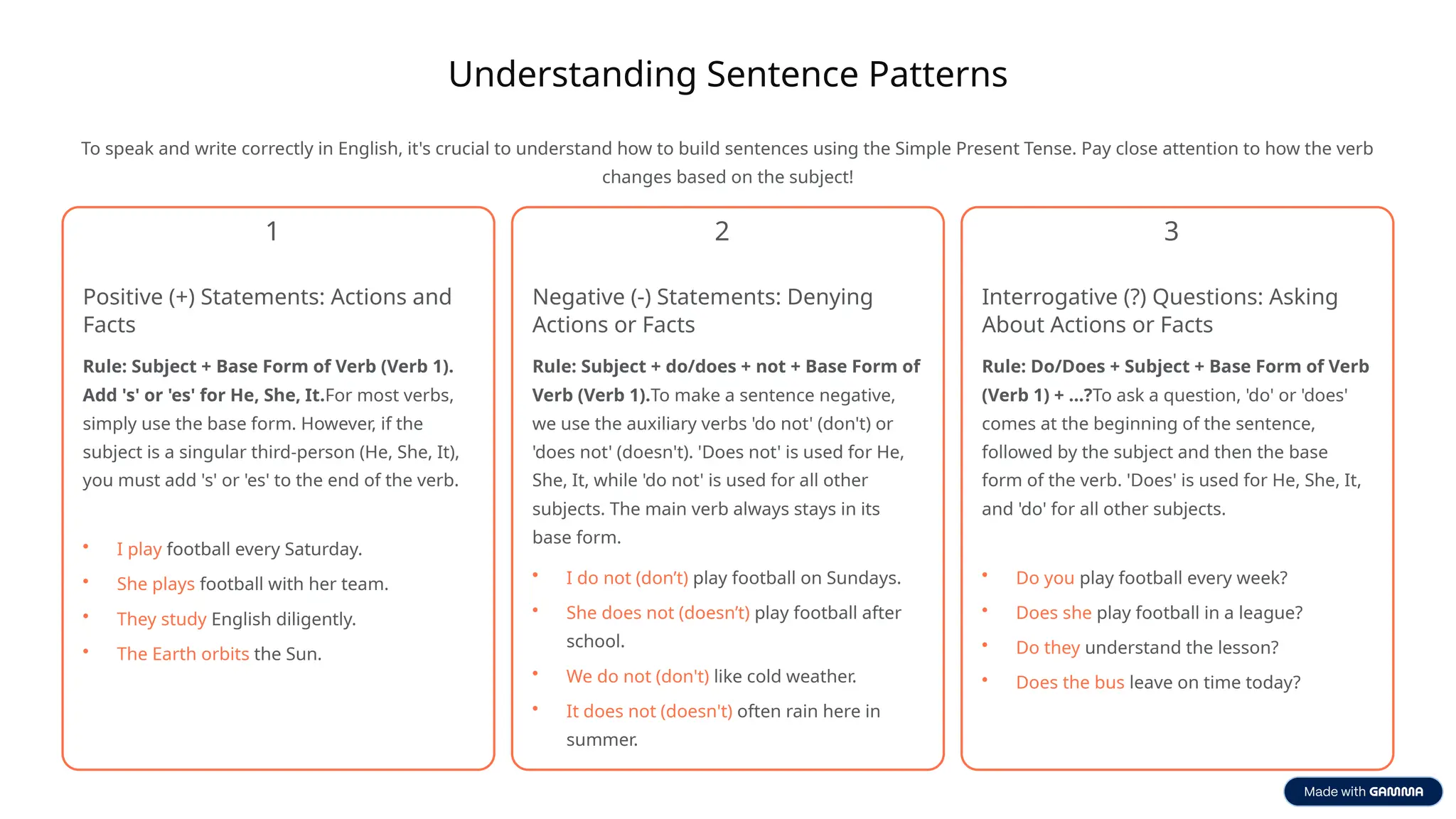
Understanding Sentence Patterns
To speak and write correctly in English, it's crucial to understand how to build sentences using the Simple Present Tense. Pay close attention to how the verb
changes based on the subject!
1
Positive (+) Statements: Actions and
Facts
Rule: Subject + Base Form of Verb (Verb 1).
Add 's' or 'es' for He, She, It.For most verbs,
simply use the base form. However, if the
subject is a singular third-person (He, She, It),
you must add 's' or 'es' to the end of the verb.
• I play football every Saturday.
• She plays football with her team.
• They study English diligently.
• The Earth orbits the Sun.
2
Negative (-) Statements: Denying
Actions or Facts
Rule: Subject + do/does + not + Base Form of
Verb (Verb 1).To make a sentence negative,
we use the auxiliary verbs 'do not' (don't) or
'does not' (doesn't). 'Does not' is used for He,
She, It, while 'do not' is used for all other
subjects. The main verb always stays in its
base form.
• I do not (don’t) play football on Sundays.
• She does not (doesn’t) play football after
school.
• We do not (don't) like cold weather.
• It does not (doesn't) often rain here in
summer.
3
Interrogative (?) Questions: Asking
About Actions or Facts
Rule: Do/Does + Subject + Base Form of Verb
(Verb 1) + …?To ask a question, 'do' or 'does'
comes at the beginning of the sentence,
followed by the subject and then the base
form of the verb. 'Does' is used for He, She, It,
and 'do' for all other subjects.
• Do you play football every week?
• Does she play football in a league?
• Do they understand the lesson?
• Does the bus leave on time today?
Common Time Expressions
These words and phrases are your allies when using the Simple Present Tense, as they frequently appear together to help
you clearly convey habits, routines, and scheduled events.
Frequency Adverbs: How Often?
These adverbs indicate how often an action takes place. They typically come before the main verb, but after the verb
"to be".
• Always (100%): She always drinks milk for breakfast. (Every single day, without fail.)
• Usually (90%): They usually play soccer on Saturdays. (Most Saturdays, but not all.)
• Often (70%): My brother often helps with chores. (He does it frequently.)
• Sometimes (50%): We sometimes go to the library. (We go on some occasions, not all.)
• Rarely/Seldom (10%): She rarely watches TV. (Almost never.)
• Never (0%): He never watches scary movies. (He does not watch them at any time.)
Time Phrases: When Exactly?
These phrases specify the exact time or period when an action occurs repeatedly. They are usually placed at the
beginning or end of a sentence.
• Every day/week/month/year: I wake up early every day. (This happens on all days.)
• On Mondays/weekends/weekdays: We have an English class every week. (e.g., every Tuesday.) / They visit their
grandparents on Sundays. (Specifically on that day.)
• In the morning/afternoon/evening: The birds sing loudly in the morning. (Each day during that part of the day.)
• At night/noon/midnight: Students usually do their homework at night. (During the nighttime hours.)
• Once/twice a week/month: I go to the gym twice a week. (Two times every week.)
• From time to time: He checks his email from time to time. (Occasionally.)
Putting It All Together: Examples
Now, let's see how the rules for sentence patterns and time expressions work together in practical examples. Pay close attention to how the verbs change and where the time
expressions are placed.
Positive Example: Describing a Daily Routine
Sarah studies English literature at the university every evening.
This sentence clearly illustrates a regular, habitual action ("studies")
performed by a third-person singular subject ("Sarah"). As per the rules for
positive statements, the verb 'study' incorporates the '-es' ending because
the subject is 'She'. The time expression "every evening" precisely
indicates the frequency of this routine, aligning with our discussion on
'Habits & Routines' and specific time phrases.
Negative Example: Denying a Regular Action
My brother does not (doesn't) watch TV on weekdays.
Here, we see the application of the negative statement rule: "does not"
(or its contraction "doesn't") is used with the base form of the verb
("watch") to negate a habitual action. Since the subject is 'My brother'
(He), 'does not' is used. The time expression "on weekdays" specifies that
this non-action is consistent from Monday to Friday, reinforcing how
specific time phrases define the period of the action's absence.
Interrogative Example: Inquiring About Habits and Frequency
Does your father always drive to work, or does he sometimes take the train?
This question effectively uses "Does" at the beginning to inquire about a third-person singular subject's ("your father") regular habit ("drive to work"). It
demonstrates the placement of the frequency adverb "always" before the main verb 'drive'. The question further introduces an alternative using "sometimes take
the train", prompting a more detailed answer about his transportation routine. This shows how interrogative structures, combined with time expressions, allow us
to ask specific questions about recurring events.
Learning Activities
We'll engage in a series of dynamic activities designed to reinforce your understanding and practical application of the Simple Present Tense, building on the sentence patterns and
time expressions we've just covered.
Activity 1: Rule Recap & Clarification (10 min)
The teacher will lead a concise review, highlighting the core functions of the Simple
Present Tense (e.g., describing daily habits, universal truths, and scheduled events).
We will revisit the sentence patterns for positive, negative, and interrogative
statements, paying special attention to how verbs conjugate for third-person singular
subjects (He, She, It) and the correct usage of 'do' and 'does' with various pronouns.
This will be reinforced with practical, real-life examples on the board.
Activity 2: "Anna's Daily Routine" Analysis (15 min)
Working in pairs, students will receive a short text detailing "Anna's Daily Routine."
Your task is to identify all actions described and rewrite them as grammatically correct
Simple Present Tense sentences. For instance, if the text says "Anna wakes up early,"
you might analyze the subject-verb agreement. Focus on correctly applying verb
forms, especially for third-person singular subjects, and incorporating common time
expressions like "every morning," "at noon," or "on weekdays" where appropriate to
reflect her schedule.
Activity 3: Targeted Practice Exercises (20 min)
Individually, students will complete a worksheet with two types of exercises. First, a
series of fill-in-the-blank questions requiring correct verb conjugation (e.g., "He (go)
____ to school every day"). Second, a set of scrambled words that must be rearranged
into coherent, grammatically correct sentences, practicing positive, negative, and
interrogative patterns (e.g., "sometimes / I / library / to / go / the" to "I sometimes go
to the library.").
Activity 4: Class Showcase & Constructive Feedback (10 min)
Selected students will present their completed work from Activity 3 to the entire class.
This includes reading aloud their revised "Anna's Daily Routine" sentences or sharing
answers from the practice exercises. This session will provide an opportunity for peer
review and teacher-led constructive feedback, focusing on accuracy in verb forms,
correct use of 'do/does', and appropriate placement of time expressions, ensuring
everyone benefits from shared learning.
Your Learning Workbook (LKPD)
This workbook is designed to help you practice and apply what you've
learned about the Simple Present Tense.
• Goal: Identify patterns, use for daily activities, and construct correct
sentences.
• Instructions: Read carefully, be thorough, use Verb 1, and write
answers in the provided space.
Workbook Activities
1. Choose the Correct
Answer
Select the appropriate verb
form for each sentence.
• She ____ (go/goes) to
school every day.
• He ____ (doesn't/don't)
eat breakfast.
2. Complete with
Correct Verb Form
Fill in the blanks with the
correct Simple Present
Tense verb.
• My mother ____ (cook)
rice every morning.
• Does she ____ (read)
novels?
3. Arrange Words
into Sentences
Put the scrambled words
in the correct order to
form Simple Present Tense
sentences.
• every / drinks / milk /
morning / brother / my
• play / after school /
basketball / do / they ?
4. Write Your Daily
Activities
Describe 5 of your daily
activities using the Simple
Present Tense. (e.g., I wake
up at 5 a.m.)
Simple Present in Conditional Sentences
The Simple Present Tense is fundamental in constructing conditional sentences, which are used to
express cause-and-effect relationships or hypothetical situations.
Type 0 Conditionals: General
Truths
Used for facts, scientific laws, or general truths
where the outcome is always the same. The
structure is If + Simple Present, Simple
Present. For example, "If you heat water to
100°C, it boils."
Type 1 Conditionals: Real
Possibilities
Used for situations that are possible in the
present or future, with a likely outcome. The
structure is If + Simple Present, Simple
Future (will + base verb). For example, "If
it rains tomorrow, we will stay home."
Understanding these structures helps you accurately convey certainty or possibility in your
communication.

The-Simple-Present-Tense (1).pptx english for grade 7

  • 1.
    The Simple PresentTense 7th Grade
  • 2.
    What We'll LearnToday 1 Define & Differentiate You'll learn to identify the Simple Present Tense and understand its core uses: describing routines (e.g., "I *go* to school every day"), facts (e.g., "The sun *rises* in the East"), and general truths (e.g., "Birds *fly*"). We'll also clearly distinguish it from other tenses you know, like the Present Continuous. 2 Construct Sentences Precisely Master the specific rules for building sentences in the Simple Present Tense. You'll learn how to form affirmative sentences (e.g., "She *reads* a lot"), negative sentences (e.g., "He *doesn't play* video games"), and interrogative sentences (e.g., "Do you *like* pizza?"), paying special attention to adding '-s' or '-es' for third- person singular subjects. 3 Apply in Real Contexts Practice using the Simple Present Tense in practical situations, such as talking about your daily habits (e.g., "I *wake up* at 6 AM"), describing scheduled events (e.g., "The class *starts* at 8:00"), and stating universal truths. We'll integrate common time expressions like 'every day,' 'always,' 'often,' and 'on Mondays' to make your sentences more natural. 4 Engage in Practical Application Solidify your understanding through hands-on activities. You'll practice constructing your own accurate sentences, participate in interactive drills, and complete exercises from your learning workbook (LKPD), including fill-in-the-blanks, sentence transformation, and speaking activities to build confidence and fluency.
  • 3.
    The Purpose ofSimple Present Tense The Simple Present Tense is an essential tool in English that helps us talk about a variety of actions and facts. We use it to describe things that happen regularly, facts that are always true, and events that follow a fixed schedule. Habits & Routines This tense describes actions that you do regularly, repeatedly, or as part of your daily routine. Think of your habits, hobbies, or what you do every day. Example 1: I go to school every day.Example 2: My brother always plays video games on Saturdays. General Truths & Facts We also use the Simple Present Tense to state facts or things that are universally true and don't change. This includes scientific facts or common knowledge.Example 1: The sun rises in the east.Example 2: Birds sing in the morning. Schedules & Timetables The Simple Present Tense is perfect for talking about events that are fixed on a schedule, like public transportation, movie times, or class schedules.Example 1: The bus leaves at 7 a.m.Example 2: Our English class begins at 9:00 AM.
  • 4.
    Understanding Sentence Patterns Tospeak and write correctly in English, it's crucial to understand how to build sentences using the Simple Present Tense. Pay close attention to how the verb changes based on the subject! 1 Positive (+) Statements: Actions and Facts Rule: Subject + Base Form of Verb (Verb 1). Add 's' or 'es' for He, She, It.For most verbs, simply use the base form. However, if the subject is a singular third-person (He, She, It), you must add 's' or 'es' to the end of the verb. • I play football every Saturday. • She plays football with her team. • They study English diligently. • The Earth orbits the Sun. 2 Negative (-) Statements: Denying Actions or Facts Rule: Subject + do/does + not + Base Form of Verb (Verb 1).To make a sentence negative, we use the auxiliary verbs 'do not' (don't) or 'does not' (doesn't). 'Does not' is used for He, She, It, while 'do not' is used for all other subjects. The main verb always stays in its base form. • I do not (don’t) play football on Sundays. • She does not (doesn’t) play football after school. • We do not (don't) like cold weather. • It does not (doesn't) often rain here in summer. 3 Interrogative (?) Questions: Asking About Actions or Facts Rule: Do/Does + Subject + Base Form of Verb (Verb 1) + …?To ask a question, 'do' or 'does' comes at the beginning of the sentence, followed by the subject and then the base form of the verb. 'Does' is used for He, She, It, and 'do' for all other subjects. • Do you play football every week? • Does she play football in a league? • Do they understand the lesson? • Does the bus leave on time today?
  • 5.
    Common Time Expressions Thesewords and phrases are your allies when using the Simple Present Tense, as they frequently appear together to help you clearly convey habits, routines, and scheduled events. Frequency Adverbs: How Often? These adverbs indicate how often an action takes place. They typically come before the main verb, but after the verb "to be". • Always (100%): She always drinks milk for breakfast. (Every single day, without fail.) • Usually (90%): They usually play soccer on Saturdays. (Most Saturdays, but not all.) • Often (70%): My brother often helps with chores. (He does it frequently.) • Sometimes (50%): We sometimes go to the library. (We go on some occasions, not all.) • Rarely/Seldom (10%): She rarely watches TV. (Almost never.) • Never (0%): He never watches scary movies. (He does not watch them at any time.) Time Phrases: When Exactly? These phrases specify the exact time or period when an action occurs repeatedly. They are usually placed at the beginning or end of a sentence. • Every day/week/month/year: I wake up early every day. (This happens on all days.) • On Mondays/weekends/weekdays: We have an English class every week. (e.g., every Tuesday.) / They visit their grandparents on Sundays. (Specifically on that day.) • In the morning/afternoon/evening: The birds sing loudly in the morning. (Each day during that part of the day.) • At night/noon/midnight: Students usually do their homework at night. (During the nighttime hours.) • Once/twice a week/month: I go to the gym twice a week. (Two times every week.) • From time to time: He checks his email from time to time. (Occasionally.)
  • 6.
    Putting It AllTogether: Examples Now, let's see how the rules for sentence patterns and time expressions work together in practical examples. Pay close attention to how the verbs change and where the time expressions are placed. Positive Example: Describing a Daily Routine Sarah studies English literature at the university every evening. This sentence clearly illustrates a regular, habitual action ("studies") performed by a third-person singular subject ("Sarah"). As per the rules for positive statements, the verb 'study' incorporates the '-es' ending because the subject is 'She'. The time expression "every evening" precisely indicates the frequency of this routine, aligning with our discussion on 'Habits & Routines' and specific time phrases. Negative Example: Denying a Regular Action My brother does not (doesn't) watch TV on weekdays. Here, we see the application of the negative statement rule: "does not" (or its contraction "doesn't") is used with the base form of the verb ("watch") to negate a habitual action. Since the subject is 'My brother' (He), 'does not' is used. The time expression "on weekdays" specifies that this non-action is consistent from Monday to Friday, reinforcing how specific time phrases define the period of the action's absence. Interrogative Example: Inquiring About Habits and Frequency Does your father always drive to work, or does he sometimes take the train? This question effectively uses "Does" at the beginning to inquire about a third-person singular subject's ("your father") regular habit ("drive to work"). It demonstrates the placement of the frequency adverb "always" before the main verb 'drive'. The question further introduces an alternative using "sometimes take the train", prompting a more detailed answer about his transportation routine. This shows how interrogative structures, combined with time expressions, allow us to ask specific questions about recurring events.
  • 7.
    Learning Activities We'll engagein a series of dynamic activities designed to reinforce your understanding and practical application of the Simple Present Tense, building on the sentence patterns and time expressions we've just covered. Activity 1: Rule Recap & Clarification (10 min) The teacher will lead a concise review, highlighting the core functions of the Simple Present Tense (e.g., describing daily habits, universal truths, and scheduled events). We will revisit the sentence patterns for positive, negative, and interrogative statements, paying special attention to how verbs conjugate for third-person singular subjects (He, She, It) and the correct usage of 'do' and 'does' with various pronouns. This will be reinforced with practical, real-life examples on the board. Activity 2: "Anna's Daily Routine" Analysis (15 min) Working in pairs, students will receive a short text detailing "Anna's Daily Routine." Your task is to identify all actions described and rewrite them as grammatically correct Simple Present Tense sentences. For instance, if the text says "Anna wakes up early," you might analyze the subject-verb agreement. Focus on correctly applying verb forms, especially for third-person singular subjects, and incorporating common time expressions like "every morning," "at noon," or "on weekdays" where appropriate to reflect her schedule. Activity 3: Targeted Practice Exercises (20 min) Individually, students will complete a worksheet with two types of exercises. First, a series of fill-in-the-blank questions requiring correct verb conjugation (e.g., "He (go) ____ to school every day"). Second, a set of scrambled words that must be rearranged into coherent, grammatically correct sentences, practicing positive, negative, and interrogative patterns (e.g., "sometimes / I / library / to / go / the" to "I sometimes go to the library."). Activity 4: Class Showcase & Constructive Feedback (10 min) Selected students will present their completed work from Activity 3 to the entire class. This includes reading aloud their revised "Anna's Daily Routine" sentences or sharing answers from the practice exercises. This session will provide an opportunity for peer review and teacher-led constructive feedback, focusing on accuracy in verb forms, correct use of 'do/does', and appropriate placement of time expressions, ensuring everyone benefits from shared learning.
  • 8.
    Your Learning Workbook(LKPD) This workbook is designed to help you practice and apply what you've learned about the Simple Present Tense. • Goal: Identify patterns, use for daily activities, and construct correct sentences. • Instructions: Read carefully, be thorough, use Verb 1, and write answers in the provided space.
  • 9.
    Workbook Activities 1. Choosethe Correct Answer Select the appropriate verb form for each sentence. • She ____ (go/goes) to school every day. • He ____ (doesn't/don't) eat breakfast. 2. Complete with Correct Verb Form Fill in the blanks with the correct Simple Present Tense verb. • My mother ____ (cook) rice every morning. • Does she ____ (read) novels? 3. Arrange Words into Sentences Put the scrambled words in the correct order to form Simple Present Tense sentences. • every / drinks / milk / morning / brother / my • play / after school / basketball / do / they ? 4. Write Your Daily Activities Describe 5 of your daily activities using the Simple Present Tense. (e.g., I wake up at 5 a.m.)
  • 10.
    Simple Present inConditional Sentences The Simple Present Tense is fundamental in constructing conditional sentences, which are used to express cause-and-effect relationships or hypothetical situations. Type 0 Conditionals: General Truths Used for facts, scientific laws, or general truths where the outcome is always the same. The structure is If + Simple Present, Simple Present. For example, "If you heat water to 100°C, it boils." Type 1 Conditionals: Real Possibilities Used for situations that are possible in the present or future, with a likely outcome. The structure is If + Simple Present, Simple Future (will + base verb). For example, "If it rains tomorrow, we will stay home." Understanding these structures helps you accurately convey certainty or possibility in your communication.