

REG / IRREG VERBS SIMPLE PRESENT
REGULAR / IRREGULAR VERBS: (SIMPLE
PRESENT)
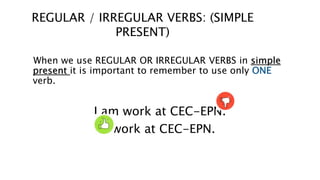
When we use REGULAR OR IRREGULAR VERBS in simple
present it is important to remember to use only ONE
verb.
I am work at CEC-EPN.
I work at CEC-EPN.
USE:
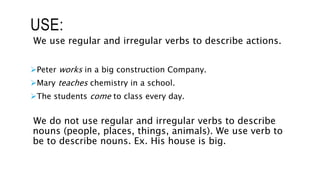
We use regular and irregular verbs to describe actions.
Peter works in a big construction Company.
Mary teaches chemistry in a school.
The students come to class every day.
We do not use regular and irregular verbs to describe
nouns (people, places, things, animals). We use verb to
be to describe nouns. Ex. His house is big.
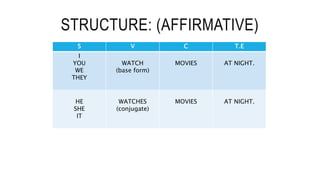
STRUCTURE: (AFFIRMATIVE)
S V C T.E
I
YOU
WE
THEY
WATCH
(base form)
MOVIES AT NIGHT.
HE
SHE
IT
WATCHES
(conjugate)
MOVIES AT NIGHT.
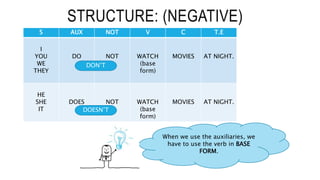
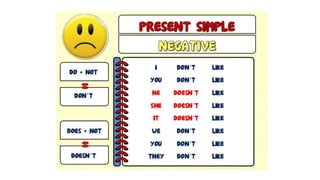
STRUCTURE: (NEGATIVE)
S AUX NOT V C T.E
I
YOU
WE
THEY
DO NOT WATCH
(base
form)
MOVIES AT NIGHT.
HE
SHE
IT
DOES NOT WATCH
(base
form)
MOVIES AT NIGHT.
DON’T
DOESN’T
When we use the auxiliaries, we
have to use the verb in BASE
FORM.
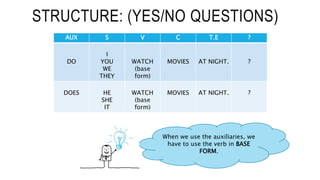
STRUCTURE: (YES/NO QUESTIONS)
AUX S V C T.E ?
DO
I
YOU
WE
THEY
WATCH
(base
form)
MOVIES AT NIGHT. ?
DOES HE
SHE
IT
WATCH
(base
form)
MOVIES AT NIGHT. ?
When we use the auxiliaries, we
have to use the verb in BASE
FORM.
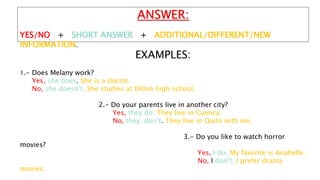
EXAMPLES:
1.- Does Melany work?
Yes, she does. She is a doctor.
No, she doesn’t. She studies at Dillon high school.
2.- Do your parents live in another city?
Yes, they do. They live in Cuenca.
No, they, don’t. They live in Quito with me.
3.- Do you like to watch horror
movies?
Yes, I do. My favorite is Anabelle.
No, I don’t. I prefer drama
movies.
ANSWER:
YES/NO + SHORT ANSWER + ADDITIONAL/DIFFERENT/NEW
INFORMATION.
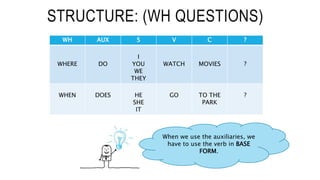
STRUCTURE: (WH QUESTIONS)
WH AUX S V C ?
WHERE DO
I
YOU
WE
THEY
WATCH MOVIES ?
WHEN DOES HE
SHE
IT
GO TO THE
PARK
?
When we use the auxiliaries, we
have to use the verb in BASE
FORM.
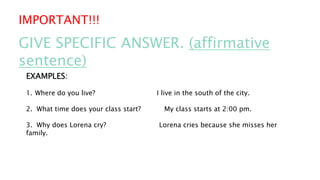
IMPORTANT!!!
GIVE SPECIFIC ANSWER. (affirmative
sentence)
EXAMPLES:
1. Where do you live? I live in the south of the city.
2. What time does your class start? My class starts at 2:00 pm.
3. Why does Lorena cry? Lorena cries because she misses her
family.
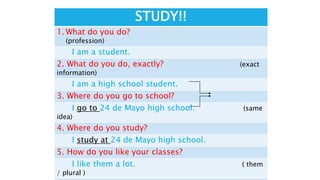
STUDY!!
1. What do you do?
(profession)
I am a student.
2. What do you do, exactly? (exact
information)
I am a high school student.
3. Where do you go to school?
I go to 24 de Mayo high school. (same
idea)
4. Where do you study?
I study at 24 de Mayo high school.
5. How do you like your classes?
I like them a lot. ( them
/ plural )
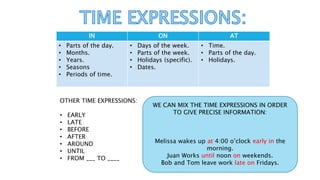
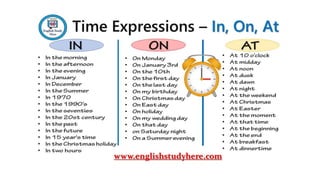
IN ON AT
• Parts of the day.
• Months.
• Years.
• Seasons
• Periods of time.
• Days of the week.
• Parts of the week.
• Holidays (specific).
• Dates.
• Time.
• Parts of the day.
• Holidays.
OTHER TIME EXPRESSIONS:
• EARLY
• LATE
• BEFORE
• AFTER
• AROUND
• UNTIL
• FROM ___ TO ____
WE CAN MIX THE TIME EXPRESSIONS IN ORDER
TO GIVE PRECISE INFORMATION:
Melissa wakes up at 4:00 o’clock early in the
morning.
Juan Works until noon on weekends.
Bob and Tom leave work late on Fridays.
Simple Present: regular and irregular verbs

Simple Present: regular and irregular verbs

  • 1.
    REG / IRREGVERBS SIMPLE PRESENT
  • 2.
    REGULAR / IRREGULARVERBS: (SIMPLE PRESENT) When we use REGULAR OR IRREGULAR VERBS in simple present it is important to remember to use only ONE verb. I am work at CEC-EPN. I work at CEC-EPN.
  • 3.
    USE: We use regularand irregular verbs to describe actions. Peter works in a big construction Company. Mary teaches chemistry in a school. The students come to class every day. We do not use regular and irregular verbs to describe nouns (people, places, things, animals). We use verb to be to describe nouns. Ex. His house is big.
  • 4.
    STRUCTURE: (AFFIRMATIVE) S VC T.E I YOU WE THEY WATCH (base form) MOVIES AT NIGHT. HE SHE IT WATCHES (conjugate) MOVIES AT NIGHT.
  • 6.
    STRUCTURE: (NEGATIVE) S AUXNOT V C T.E I YOU WE THEY DO NOT WATCH (base form) MOVIES AT NIGHT. HE SHE IT DOES NOT WATCH (base form) MOVIES AT NIGHT. DON’T DOESN’T When we use the auxiliaries, we have to use the verb in BASE FORM.
  • 8.
    STRUCTURE: (YES/NO QUESTIONS) AUXS V C T.E ? DO I YOU WE THEY WATCH (base form) MOVIES AT NIGHT. ? DOES HE SHE IT WATCH (base form) MOVIES AT NIGHT. ? When we use the auxiliaries, we have to use the verb in BASE FORM.
  • 9.
    EXAMPLES: 1.- Does Melanywork? Yes, she does. She is a doctor. No, she doesn’t. She studies at Dillon high school. 2.- Do your parents live in another city? Yes, they do. They live in Cuenca. No, they, don’t. They live in Quito with me. 3.- Do you like to watch horror movies? Yes, I do. My favorite is Anabelle. No, I don’t. I prefer drama movies. ANSWER: YES/NO + SHORT ANSWER + ADDITIONAL/DIFFERENT/NEW INFORMATION.
  • 10.
    STRUCTURE: (WH QUESTIONS) WHAUX S V C ? WHERE DO I YOU WE THEY WATCH MOVIES ? WHEN DOES HE SHE IT GO TO THE PARK ? When we use the auxiliaries, we have to use the verb in BASE FORM.
  • 11.
    IMPORTANT!!! GIVE SPECIFIC ANSWER.(affirmative sentence) EXAMPLES: 1. Where do you live? I live in the south of the city. 2. What time does your class start? My class starts at 2:00 pm. 3. Why does Lorena cry? Lorena cries because she misses her family.
  • 12.
    STUDY!! 1. What doyou do? (profession) I am a student. 2. What do you do, exactly? (exact information) I am a high school student. 3. Where do you go to school? I go to 24 de Mayo high school. (same idea) 4. Where do you study? I study at 24 de Mayo high school. 5. How do you like your classes? I like them a lot. ( them / plural )
  • 13.
    IN ON AT •Parts of the day. • Months. • Years. • Seasons • Periods of time. • Days of the week. • Parts of the week. • Holidays (specific). • Dates. • Time. • Parts of the day. • Holidays. OTHER TIME EXPRESSIONS: • EARLY • LATE • BEFORE • AFTER • AROUND • UNTIL • FROM ___ TO ____ WE CAN MIX THE TIME EXPRESSIONS IN ORDER TO GIVE PRECISE INFORMATION: Melissa wakes up at 4:00 o’clock early in the morning. Juan Works until noon on weekends. Bob and Tom leave work late on Fridays.