Autora:
Dilcia Lares
1
UNIVERSIDAD YACAMBÚ
VICERRECTORADO ACADÉMICO
FACULTAD DE HUMANIDADES
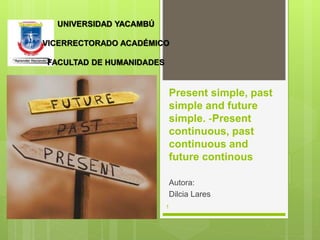
Present simple, past
simple and future
simple. -Present
continuous, past
continuous and
future continous
Present simple
July 21, 20162
USE1RepeatedActions
Use the Simple Present to
express the idea that an
action is repeated or usual.
The action can be a habit, a
hobby, a daily event, a
scheduled event or
something that often
happens. It can also be
something a person often
forgets or usually does not
do.
Examples:
I play tennis.
She does not play tennis.
Does he play tennis?
The train leaves every
morning at 8 AM.
USE2FactsorGeneralizations
The Simple Present can
also indicate the speaker
believes that a fact was
true before, is true now,
and will be true in the
future. It is not
important if the speaker
is correct about the fact.
It is also used to make
generalizations about
people or things.
Examples:
California is in America.
California is not in the
United Kingdom.
Windows are made of
glass.
USE3ScheduledEvents
intheNearFuture
Speakers occasionally
use Simple Present to
talk about scheduled
events in the near future.
This is most commonly
done when talking about
public transportation, but
it can be used with other
scheduled events as well.
Examples:
The train leaves tonight
at 6 PM.
The bus does not arrive
at 11 AM, it arrives at 11
PM.
When do we board the
plane?
USE4Now(Non-
ContinuousVerbs)
Speakers sometimes use
the Simple Present to
express the idea that an
action is happening or is
not happening now. This
can only be done with
Non-Continuous Verbs
and certain Mixed Verbs.
Examples:
I am here now.
She is not here now.
Past simple
3
Positive Negative Question
no differences I spoke. I did not speak. Did I speak?
Exceptions in spelling when adding ed Example
after a final e only add d love – loved
final consonant after a short, stressed vowel
or l as final consonant after a vowel is doubled
admit – admitted
travel – travelled
final y after a consonant becomes i hurry – hurried
The simple past expresses an action in the past taking place once, never, several times. It can also be used for actions taking
place one after another or in the middle of another action.
Form of Simple Past
For irregular verbs, use the past form (see list of irregular verbs, 2nd column). For regular verbs, just add “ed”. Exceptions in
Spelling when Adding ‘ed’
Use of Simple Past
action in the past taking place once, never or several times Example: He visited his
parents every weekend.
actions in the past taking place one after the other Example: He came in, took off his
coat and sat down.
action in the past taking place in the middle of another action Example: When I was
having breakfast, the phone suddenly rang.
July 21, 20164
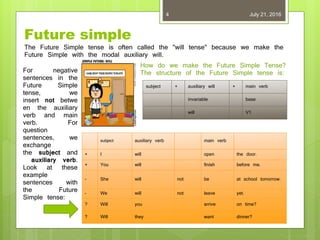
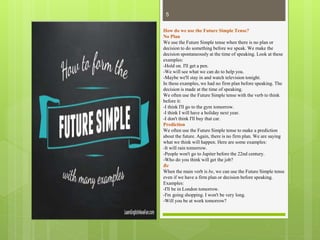
Future simple
The Future Simple tense is often called the "will tense" because we make the
Future Simple with the modal auxiliary will.
subject + auxiliary will + main verb
invariable base
will V1
For negative
sentences in the
Future Simple
tense, we
insert not betwe
en the auxiliary
verb and main
verb. For
question
sentences, we
exchange
the subject and
auxiliary verb.
Look at these
example
sentences with
the Future
Simple tense:
How do we make the Future Simple Tense?
The structure of the Future Simple tense is:
subject auxiliary verb main verb
+ I will open the door.
+ You will finish before me.
- She will not be at school tomorrow.
- We will not leave yet.
? Will you arrive on time?
? Will they want dinner?
5
How do we use the Future Simple Tense?
No Plan
We use the Future Simple tense when there is no plan or
decision to do something before we speak. We make the
decision spontaneously at the time of speaking. Look at these
examples:
-Hold on. I'll get a pen.
-We will see what we can do to help you.
-Maybe we'll stay in and watch television tonight.
In these examples, we had no firm plan before speaking. The
decision is made at the time of speaking.
We often use the Future Simple tense with the verb to think
before it:
-I think I'll go to the gym tomorrow.
-I think I will have a holiday next year.
-I don't think I'll buy that car.
Prediction
We often use the Future Simple tense to make a prediction
about the future. Again, there is no firm plan. We are saying
what we think will happen. Here are some examples:
-It will rain tomorrow.
-People won't go to Jupiter before the 22nd century.
-Who do you think will get the job?
Be
When the main verb is be, we can use the Future Simple tense
even if we have a firm plan or decision before speaking.
Examples:
-I'll be in London tomorrow.
-I'm going shopping. I won't be very long.
-Will you be at work tomorrow?
6
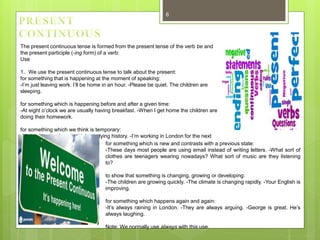
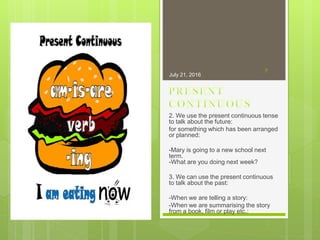
The present continuous tense is formed from the present tense of the verb be and
the present participle (-ing form) of a verb:
Use
1. We use the present continuous tense to talk about the present:
for something that is happening at the moment of speaking:
-I’m just leaving work. I’ll be home in an hour. -Please be quiet. The children are
sleeping.
for something which is happening before and after a given time:
-At eight o’clock we are usually having breakfast. -When I get home the children are
doing their homework.
for something which we think is temporary:
-Michael is at university. He’s studying history. -I’m working in London for the next
two weeks. for something which is new and contrasts with a previous state:
-These days most people are using email instead of writing letters. -What sort of
clothes are teenagers wearing nowadays? What sort of music are they listening
to?
to show that something is changing, growing or developing:
-The children are growing quickly. -The climate is changing rapidly. -Your English is
improving.
for something which happens again and again:
-It’s always raining in London. -They are always arguing. -George is great. He’s
always laughing.
Note: We normally use always with this use.
2. We use the present continuous tense
to talk about the future:
for something which has been arranged
or planned:
-Mary is going to a new school next
term.
-What are you doing next week?
3. We can use the present continuous
to talk about the past:
-When we are telling a story:
-When we are summarising the story
from a book, film or play etc.:
July 21, 2016
7
July 21, 20168
USE 1 Interrupted Action in the
Past: Use
the Past Continuous to indicate
that a longer action in the past was
interrupted. The interruption is
usually a shorter action in the
Simple Past. Remember this can be
a real interruption or just an
interruption in time. Examples:
-I was watching TV when she
called.
-When the phone rang, she was
writing a letter.
-While we were having the picnic,
it started to rain.
USE 2
Specific Time as an Interruption:
In USE 1, described above, the Past
Continuous is interrupted by a shorter
action in the Simple Past. However,
you can also use a specific time as an
interruption. Examples:
-Last night at 6 PM, I was eating
dinner. -
At midnight, we were still driving
through the desert.
IMPORTANT In the Simple Past, a
specific time is used to show when an
action began or finished. In the Past
Continuous, a specific time only
interrupts the action. Examples:
- Last night at 6 PM, I ate dinner. I
started eating at 6 PM. -
Last night at 6 PM, I was eating
dinner. I started earlier; and at 6 PM, I
was in the process of eating dinner.
USE 3 Parallel Actions:
When you use the Past
Continuous with two actions in the
same sentence, it expresses the
idea that both actions were
happening at the same time. The
actions are parallel.
Examples:
-I was studying while he was
making dinner.
-While Ellen was reading, Tim was
watching television.
-Were you listening while he was
talking?
USE 4 Atmosphere:
In English, we often use a
series of parallel actions to
describe the atmosphere at a
particular time in the past.
Example:
-When I walked into the
office, several people were
busily typing, some were
talking on the phones, the
boss was yelling directions,
and customers were waiting to
be helped. One customer was
yelling at a secretary and
waving his hands. Others were
complaining to each other
about the bad service.
FORM
[was/were + present participle] Examples:
-You were studying when she called. -Were you studying when she called? -You were not studying when she called.
July 21, 20169
Form
The future continuous is made up of two elements:
the simple future of the verb 'to be' + the present participle (base+ing)
Subject simple future of the verb 'to be' present participle
You will be watching
I will be staying
Functions
The future continuous refers to an unfinished action or event that
will be in progress at a time later than now. The future continuous
is used for quite a few different purposes.
The future continuous can be used to project ourselves into the
future.
Examples
-This time next week I will be sun-bathing in Bali.
-By Christmas I will be skiing like a pro.
The future continuous can be used for predicting or guessing about
future events.
Examples
-He'll be coming to the meeting, I expect.
-I guess you'll be feeling thirsty after working in the sun.
In the interrogative form, the future continuous
can be used to ask politely for information about
the future.
Examples
-Will you be bringing your friend to the pub
tonight?
-Will Jim be coming with us?
The future continuous can be used to refer to
continuous events that we expect to happen in the
future.
Examples
-I'll be seeing Jim at the conference next week.
-When he is in Australia he will be staying with friends.
When combined with still, the future continuous refers to events that are already
happening now and that we expect to continue some time into the future.
Examples
In an hour I'll still be ironing my clothes.
Tomorrow he'll still be suffering from his cold.

Present simple, past simple and future simple. -Present continuous, past continuous and future continous

  • 1.
    Autora: Dilcia Lares 1 UNIVERSIDAD YACAMBÚ VICERRECTORADOACADÉMICO FACULTAD DE HUMANIDADES Present simple, past simple and future simple. -Present continuous, past continuous and future continous
  • 2.
    Present simple July 21,20162 USE1RepeatedActions Use the Simple Present to express the idea that an action is repeated or usual. The action can be a habit, a hobby, a daily event, a scheduled event or something that often happens. It can also be something a person often forgets or usually does not do. Examples: I play tennis. She does not play tennis. Does he play tennis? The train leaves every morning at 8 AM. USE2FactsorGeneralizations The Simple Present can also indicate the speaker believes that a fact was true before, is true now, and will be true in the future. It is not important if the speaker is correct about the fact. It is also used to make generalizations about people or things. Examples: California is in America. California is not in the United Kingdom. Windows are made of glass. USE3ScheduledEvents intheNearFuture Speakers occasionally use Simple Present to talk about scheduled events in the near future. This is most commonly done when talking about public transportation, but it can be used with other scheduled events as well. Examples: The train leaves tonight at 6 PM. The bus does not arrive at 11 AM, it arrives at 11 PM. When do we board the plane? USE4Now(Non- ContinuousVerbs) Speakers sometimes use the Simple Present to express the idea that an action is happening or is not happening now. This can only be done with Non-Continuous Verbs and certain Mixed Verbs. Examples: I am here now. She is not here now.
  • 3.
    Past simple 3 Positive NegativeQuestion no differences I spoke. I did not speak. Did I speak? Exceptions in spelling when adding ed Example after a final e only add d love – loved final consonant after a short, stressed vowel or l as final consonant after a vowel is doubled admit – admitted travel – travelled final y after a consonant becomes i hurry – hurried The simple past expresses an action in the past taking place once, never, several times. It can also be used for actions taking place one after another or in the middle of another action. Form of Simple Past For irregular verbs, use the past form (see list of irregular verbs, 2nd column). For regular verbs, just add “ed”. Exceptions in Spelling when Adding ‘ed’ Use of Simple Past action in the past taking place once, never or several times Example: He visited his parents every weekend. actions in the past taking place one after the other Example: He came in, took off his coat and sat down. action in the past taking place in the middle of another action Example: When I was having breakfast, the phone suddenly rang.
  • 4.
    July 21, 20164 Futuresimple The Future Simple tense is often called the "will tense" because we make the Future Simple with the modal auxiliary will. subject + auxiliary will + main verb invariable base will V1 For negative sentences in the Future Simple tense, we insert not betwe en the auxiliary verb and main verb. For question sentences, we exchange the subject and auxiliary verb. Look at these example sentences with the Future Simple tense: How do we make the Future Simple Tense? The structure of the Future Simple tense is: subject auxiliary verb main verb + I will open the door. + You will finish before me. - She will not be at school tomorrow. - We will not leave yet. ? Will you arrive on time? ? Will they want dinner?
  • 5.
    5 How do weuse the Future Simple Tense? No Plan We use the Future Simple tense when there is no plan or decision to do something before we speak. We make the decision spontaneously at the time of speaking. Look at these examples: -Hold on. I'll get a pen. -We will see what we can do to help you. -Maybe we'll stay in and watch television tonight. In these examples, we had no firm plan before speaking. The decision is made at the time of speaking. We often use the Future Simple tense with the verb to think before it: -I think I'll go to the gym tomorrow. -I think I will have a holiday next year. -I don't think I'll buy that car. Prediction We often use the Future Simple tense to make a prediction about the future. Again, there is no firm plan. We are saying what we think will happen. Here are some examples: -It will rain tomorrow. -People won't go to Jupiter before the 22nd century. -Who do you think will get the job? Be When the main verb is be, we can use the Future Simple tense even if we have a firm plan or decision before speaking. Examples: -I'll be in London tomorrow. -I'm going shopping. I won't be very long. -Will you be at work tomorrow?
  • 6.
    6 The present continuoustense is formed from the present tense of the verb be and the present participle (-ing form) of a verb: Use 1. We use the present continuous tense to talk about the present: for something that is happening at the moment of speaking: -I’m just leaving work. I’ll be home in an hour. -Please be quiet. The children are sleeping. for something which is happening before and after a given time: -At eight o’clock we are usually having breakfast. -When I get home the children are doing their homework. for something which we think is temporary: -Michael is at university. He’s studying history. -I’m working in London for the next two weeks. for something which is new and contrasts with a previous state: -These days most people are using email instead of writing letters. -What sort of clothes are teenagers wearing nowadays? What sort of music are they listening to? to show that something is changing, growing or developing: -The children are growing quickly. -The climate is changing rapidly. -Your English is improving. for something which happens again and again: -It’s always raining in London. -They are always arguing. -George is great. He’s always laughing. Note: We normally use always with this use.
  • 7.
    2. We usethe present continuous tense to talk about the future: for something which has been arranged or planned: -Mary is going to a new school next term. -What are you doing next week? 3. We can use the present continuous to talk about the past: -When we are telling a story: -When we are summarising the story from a book, film or play etc.: July 21, 2016 7
  • 8.
    July 21, 20168 USE1 Interrupted Action in the Past: Use the Past Continuous to indicate that a longer action in the past was interrupted. The interruption is usually a shorter action in the Simple Past. Remember this can be a real interruption or just an interruption in time. Examples: -I was watching TV when she called. -When the phone rang, she was writing a letter. -While we were having the picnic, it started to rain. USE 2 Specific Time as an Interruption: In USE 1, described above, the Past Continuous is interrupted by a shorter action in the Simple Past. However, you can also use a specific time as an interruption. Examples: -Last night at 6 PM, I was eating dinner. - At midnight, we were still driving through the desert. IMPORTANT In the Simple Past, a specific time is used to show when an action began or finished. In the Past Continuous, a specific time only interrupts the action. Examples: - Last night at 6 PM, I ate dinner. I started eating at 6 PM. - Last night at 6 PM, I was eating dinner. I started earlier; and at 6 PM, I was in the process of eating dinner. USE 3 Parallel Actions: When you use the Past Continuous with two actions in the same sentence, it expresses the idea that both actions were happening at the same time. The actions are parallel. Examples: -I was studying while he was making dinner. -While Ellen was reading, Tim was watching television. -Were you listening while he was talking? USE 4 Atmosphere: In English, we often use a series of parallel actions to describe the atmosphere at a particular time in the past. Example: -When I walked into the office, several people were busily typing, some were talking on the phones, the boss was yelling directions, and customers were waiting to be helped. One customer was yelling at a secretary and waving his hands. Others were complaining to each other about the bad service. FORM [was/were + present participle] Examples: -You were studying when she called. -Were you studying when she called? -You were not studying when she called.
  • 9.
    July 21, 20169 Form Thefuture continuous is made up of two elements: the simple future of the verb 'to be' + the present participle (base+ing) Subject simple future of the verb 'to be' present participle You will be watching I will be staying Functions The future continuous refers to an unfinished action or event that will be in progress at a time later than now. The future continuous is used for quite a few different purposes. The future continuous can be used to project ourselves into the future. Examples -This time next week I will be sun-bathing in Bali. -By Christmas I will be skiing like a pro. The future continuous can be used for predicting or guessing about future events. Examples -He'll be coming to the meeting, I expect. -I guess you'll be feeling thirsty after working in the sun. In the interrogative form, the future continuous can be used to ask politely for information about the future. Examples -Will you be bringing your friend to the pub tonight? -Will Jim be coming with us? The future continuous can be used to refer to continuous events that we expect to happen in the future. Examples -I'll be seeing Jim at the conference next week. -When he is in Australia he will be staying with friends. When combined with still, the future continuous refers to events that are already happening now and that we expect to continue some time into the future. Examples In an hour I'll still be ironing my clothes. Tomorrow he'll still be suffering from his cold.