


Present forms
future meanings
Present Simple
The concert finishes at
midnight.
Term starts on 10 April.
The sun rises at 6.13 tomorrow.
The concert finishes at
midnight.
Term starts on 10 April.
The sun rises at 6.13 tomorrow.
these are
timetables
timetables
are like habits
(remember we use
the Present Simple for habits)
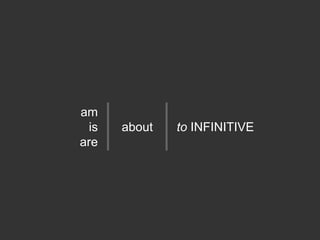
about to
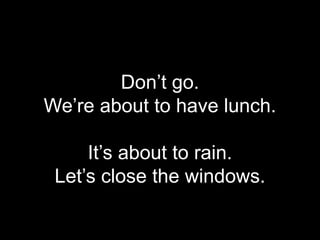
Don’t go.
We’re about to have lunch.
It’s about to rain.
Let’s close the windows.
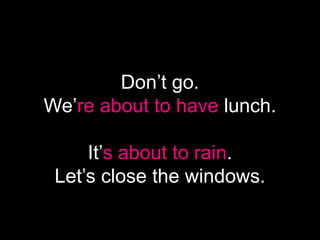
Don’t go.
We’re about to have lunch.
It’s about to rain.
Let’s close the windows.
am
is
are
about to INFINITIVE
am
is
are
about to INFINITIVE
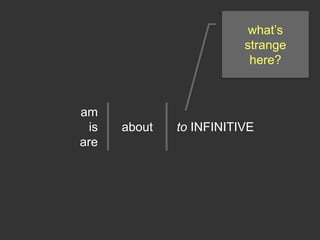
what’s
strange
here?
am
is
are
about to INFINITIVE
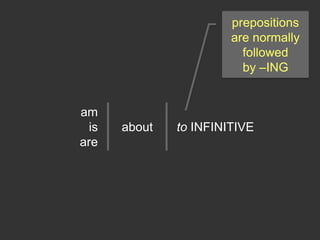
prepositions
are normally
followed
by –ING
Don’t go.
We’re about to have lunch.
It’s about to rain.
Let’s close the windows.
‘about to’ expresses an action
that will happen very soon
‘about to’ is called the
Immediate Future
going to (1)
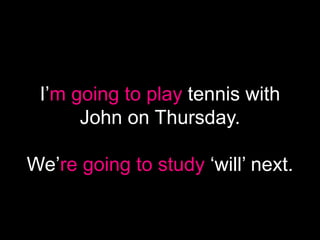
I’m going to play tennis with
John on Thursday.
We’re going to study ‘will’ next.
I’m going to play tennis with
John on Thursday.
We’re going to study ‘will’ next.
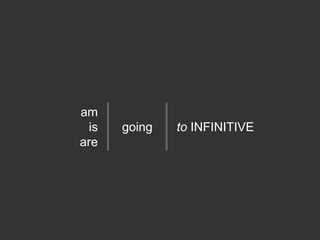
am
is
are
going to INFINITIVE
am
is
are
going to INFINITIVE
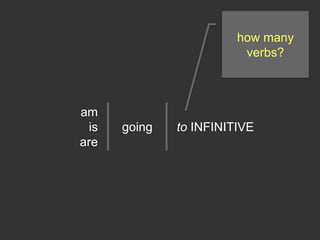
how many
verbs?
am
is
are
going to INFINITIVE
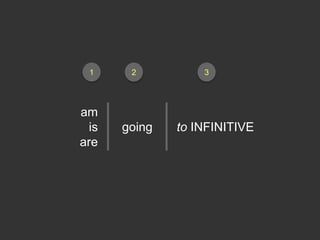
1 3
2
I’m going to play tennis with
John on Thursday.
We’re going to study ‘will’ next.
‘going to’ expresses
intention
‘going to’ is called
the intentional future
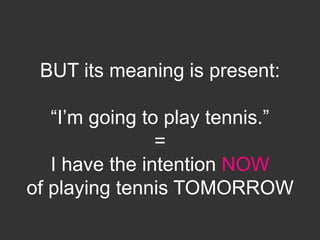
BUT its meaning is present:
“I’m going to play tennis.”
=
I have the intention NOW
of playing tennis TOMORROW
going to (2)
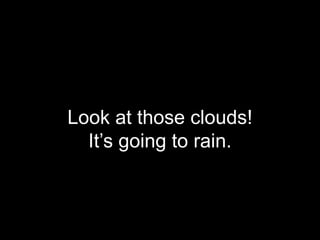
Look at those clouds!
It’s going to rain.
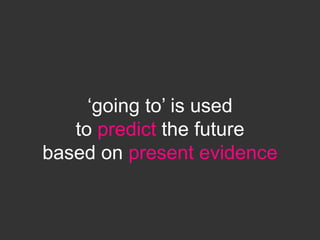
‘going to’ is used
to predict the future
based on present evidence
Present Continuous
I’m flying to Milan on Tuesday.
We’re meeting John in the
centre later.
‘Present Continuous’ for the
Future usually has a time
expression.
‘Present Continuous’
expresses plans
something is a plan if:
- you have a ticket
- you have an appointment
- you’ve written it in your diary
the ‘Present Continuous’
is very common when we talk
about arrangements for travel
and meeting people
We use ‘going to’ and ‘Present
Continuous’ to talk about plans
and arrangements.
We use ‘going to’ and ‘Present
Continuous’ to talk about plans
and arrangements.
NOT ‘will’
‘going to’
vs.
‘Present Continuous’
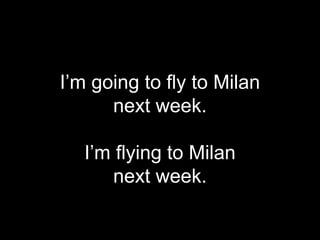
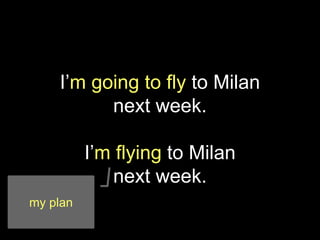
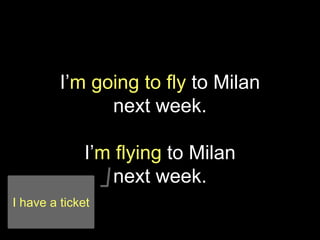
I’m going to fly to Milan
next week.
I’m flying to Milan
next week.
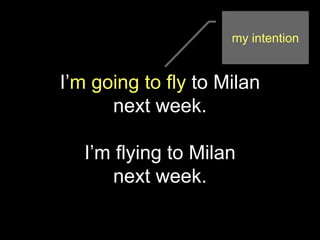
I’m going to fly to Milan
next week.
I’m flying to Milan
next week.
my intention
I’m going to fly to Milan
next week.
I’m flying to Milan
next week.
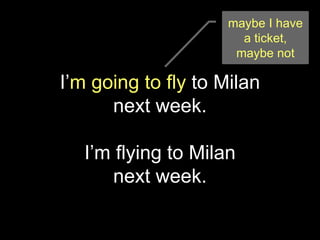
maybe I have
a ticket,
maybe not
I’m going to fly to Milan
next week.
I’m flying to Milan
next week.
my plan
I’m going to fly to Milan
next week.
I’m flying to Milan
next week.
I have a ticket
another example
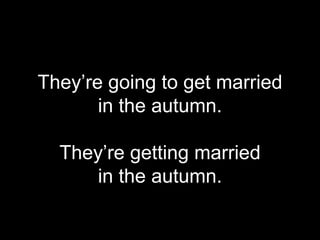
They’re going to get married
in the autumn.
They’re getting married
in the autumn.
the main verb is ‘to go’
I’m going to go to Milan
next week.
I’m going (to go) to Milan
next week.
I’m going to go to Milan
next week.
=
I’m going to Milan
next week.
main verb is ‘to come’
They’re going to come to Rome
the week after.
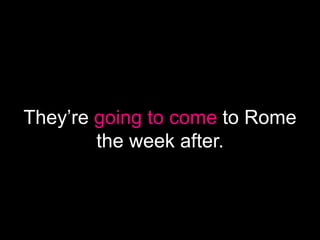
They’re going to come to Rome
the week after.
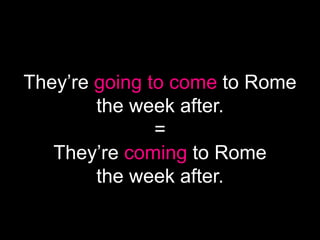
They’re going to come to Rome
the week after.
=
They’re coming to Rome
the week after.
www.davidnicholson.it

Present forms future meanings