FUTURE TIME
1. Will Future Spontaneous Decisions that we make. Oh,   sorry I was busy all day so I forgot to email you the graphics! I’ll email them tomorrow morning. I’ll have a straight coffee and a muffin please. I’ll get the door. Just go on with your work.
Predictions,   facts that we assume to be true. Over the next few years there will be a dramatic increase in internet users in our country. I think she will study law at university. Robots will have an artificial intelligence in a very short time.
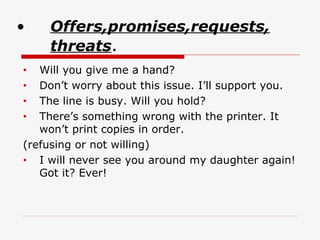
Offers,promises,requests, threats . Will you give me a hand? Don’t worry about this issue. I’ll support you.  The line is busy.   Will you hold? There’s something wrong with the printer. It won’t print copies in order. (refusing or not willing) I will never see you around my daughter again!   Got it? Ever!
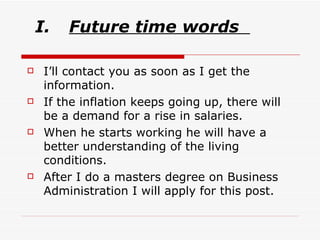
Future time words   I’ll contact you as soon as I get the information. If the inflation keeps going up, there will be a demand for a rise in salaries. When he starts working he will have a better understanding of the living conditions. After I do a masters degree on Business Administration I will apply for this post.
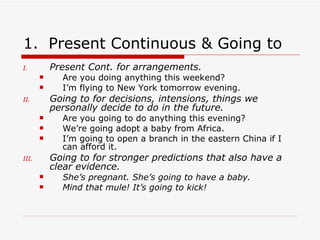
Present  Continuous  & Going to   Present Cont. for arrangements. Are you doing anything this we e kend? I’m flying to New York tomorrow evening. Going to for decisions, intensions,   things we personally decide to do in the future. Are you going to do anything this evening? We’re going adopt a baby from Africa. I’m going to open a branch in the eastern China if I can afford it. Going to for stronger predictions that also have a clear evidence. She’s pregnant. She’s going to have a baby. Mind that mule! It’s going to kick!
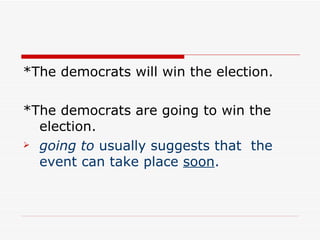
*The democrats will win the election.  * The democrats are going to win the election.  going to  usually suggests that  the event can take place  soon .
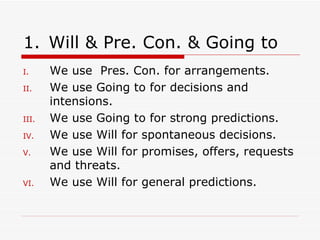
Will & Pre. Con. & Going to We use  Pres. Con. for arrangements. We use Going to for decisions and intensions. We use Going to for strong predictions. We use Will for spontaneous decisions. We use Will for promises, offers,   requests and threats. We use Will for general predictions.
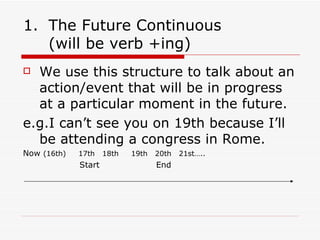
The Future Continuous  (will be verb   +ing) We use this structure to talk about an action/event that will be in progress at a particular moment in the future. e.g.I can’t see you on 19th because I’ll be attending a congress in Rome. Now  (16th)  17th  18th  19th  20th  21st….. Start  End
The Future Perfect  (will have Verb3) We use this structure to talk about an action/event that will be completed at a particular time in the future. e.g.  23rd? Oh, the congress will have finished by then. I’m available that day. e.g. In five years time we will have completed the construction of the whole complex. e.g. By the time you get back he will have left.
The Future Perfect Continuous This structure is used to talk about how long future actions/events will be in progress at a certain time. e.g. By the end of September I will have been working at this organization for two months. (will have been Verb+ing)
Simple Present We use this structure to talk about actions/events that are part of a timetable, schedule, a  programme or calendar references. The fast train to London leaves at 7.30 and gets to Paddington at 8.40. Then you must catch the shuttle to the airport. It goes every ten minutes. Ramadan ends on 29th this year.
Miscellaneous /misılleniyıs/ To be e.g. The accused is guilty and to undergo six months’ imprisonment. e.g. The prime Minister is to visit Russia next month. e.g. The summit is to take place in Çırağan Palace on 12th October. e.g.   The president is to speak on behalf of the committee next week.
be about to e.g.   The second session is about to start. Please take your seats. be on the point of e.g. He can’t carry such a burden on his shoulders. He is on the point of breaking down. be due to e.g. The reports are due on Monday. e.g. The meeting is due to finish at 4pm.
REMEMBER! Some of these structures may refer to similar meanings!

Future Time

  • 1.
  • 2.
    1. Will FutureSpontaneous Decisions that we make. Oh, sorry I was busy all day so I forgot to email you the graphics! I’ll email them tomorrow morning. I’ll have a straight coffee and a muffin please. I’ll get the door. Just go on with your work.
  • 3.
    Predictions, facts that we assume to be true. Over the next few years there will be a dramatic increase in internet users in our country. I think she will study law at university. Robots will have an artificial intelligence in a very short time.
  • 4.
    Offers,promises,requests, threats .Will you give me a hand? Don’t worry about this issue. I’ll support you. The line is busy. Will you hold? There’s something wrong with the printer. It won’t print copies in order. (refusing or not willing) I will never see you around my daughter again! Got it? Ever!
  • 5.
    Future time words I’ll contact you as soon as I get the information. If the inflation keeps going up, there will be a demand for a rise in salaries. When he starts working he will have a better understanding of the living conditions. After I do a masters degree on Business Administration I will apply for this post.
  • 6.
    Present Continuous & Going to Present Cont. for arrangements. Are you doing anything this we e kend? I’m flying to New York tomorrow evening. Going to for decisions, intensions, things we personally decide to do in the future. Are you going to do anything this evening? We’re going adopt a baby from Africa. I’m going to open a branch in the eastern China if I can afford it. Going to for stronger predictions that also have a clear evidence. She’s pregnant. She’s going to have a baby. Mind that mule! It’s going to kick!
  • 7.
    *The democrats willwin the election. * The democrats are going to win the election. going to usually suggests that the event can take place soon .
  • 8.
    Will & Pre.Con. & Going to We use Pres. Con. for arrangements. We use Going to for decisions and intensions. We use Going to for strong predictions. We use Will for spontaneous decisions. We use Will for promises, offers, requests and threats. We use Will for general predictions.
  • 9.
    The Future Continuous (will be verb +ing) We use this structure to talk about an action/event that will be in progress at a particular moment in the future. e.g.I can’t see you on 19th because I’ll be attending a congress in Rome. Now (16th) 17th 18th 19th 20th 21st….. Start End
  • 10.
    The Future Perfect (will have Verb3) We use this structure to talk about an action/event that will be completed at a particular time in the future. e.g. 23rd? Oh, the congress will have finished by then. I’m available that day. e.g. In five years time we will have completed the construction of the whole complex. e.g. By the time you get back he will have left.
  • 11.
    The Future PerfectContinuous This structure is used to talk about how long future actions/events will be in progress at a certain time. e.g. By the end of September I will have been working at this organization for two months. (will have been Verb+ing)
  • 12.
    Simple Present Weuse this structure to talk about actions/events that are part of a timetable, schedule, a programme or calendar references. The fast train to London leaves at 7.30 and gets to Paddington at 8.40. Then you must catch the shuttle to the airport. It goes every ten minutes. Ramadan ends on 29th this year.
  • 13.
    Miscellaneous /misılleniyıs/ Tobe e.g. The accused is guilty and to undergo six months’ imprisonment. e.g. The prime Minister is to visit Russia next month. e.g. The summit is to take place in Çırağan Palace on 12th October. e.g. The president is to speak on behalf of the committee next week.
  • 14.
    be about toe.g. The second session is about to start. Please take your seats. be on the point of e.g. He can’t carry such a burden on his shoulders. He is on the point of breaking down. be due to e.g. The reports are due on Monday. e.g. The meeting is due to finish at 4pm.
  • 15.
    REMEMBER! Some ofthese structures may refer to similar meanings!