Mihai ION ● Basic English Morphology
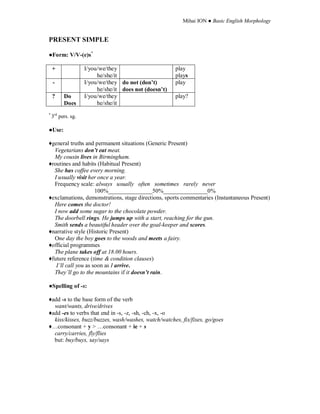
PRESENT SIMPLE
●Form: V/V-(e)s*
+ I/you/we/they
he/she/it
play
plays
- I/you/we/they
he/she/it
do not (don’t)
does not (doesn’t)
play
? Do
Does
I/you/we/they
he/she/it
play?
*
3rd
pers. sg.
●Use:
♦general truths and permanent situations (Generic Present)
Vegetarians don’t eat meat.
My cousin lives in Birmingham.
♦routines and habits (Habitual Present)
She has coffee every morning.
I usually visit her once a year.
Frequency scale: always usually often sometimes rarely never
100%_______________50%_______________0%
♦exclamations, demonstrations, stage directions, sports commentaries (Instantaneous Present)
Here comes the doctor!
I now add some sugar to the chocolate powder.
The doorbell rings. He jumps up with a start, reaching for the gun.
Smith sends a beautiful header over the goal-keeper and scores.
♦narrative style (Historic Present)
One day the boy goes to the woods and meets a fairy.
♦official programmes
The plane takes off at 18.00 hours.
♦future reference (time & condition clauses)
I’ll call you as soon as I arrive.
They’ll go to the mountains if it doesn’t rain.
●Spelling of -s:
♦add -s to the base form of the verb
want/wants, drive/drives
♦add -es to verbs that end in -s, -z, -sh, -ch, -x, -o
kiss/kisses, buzz/buzzes, wash/washes, watch/watches, fix/fixes, go/goes
♦…consonant + y > …consonant + ie + s
carry/carries, fly/flies
but: buy/buys, say/says
Mihai ION ● Basic English Morphology
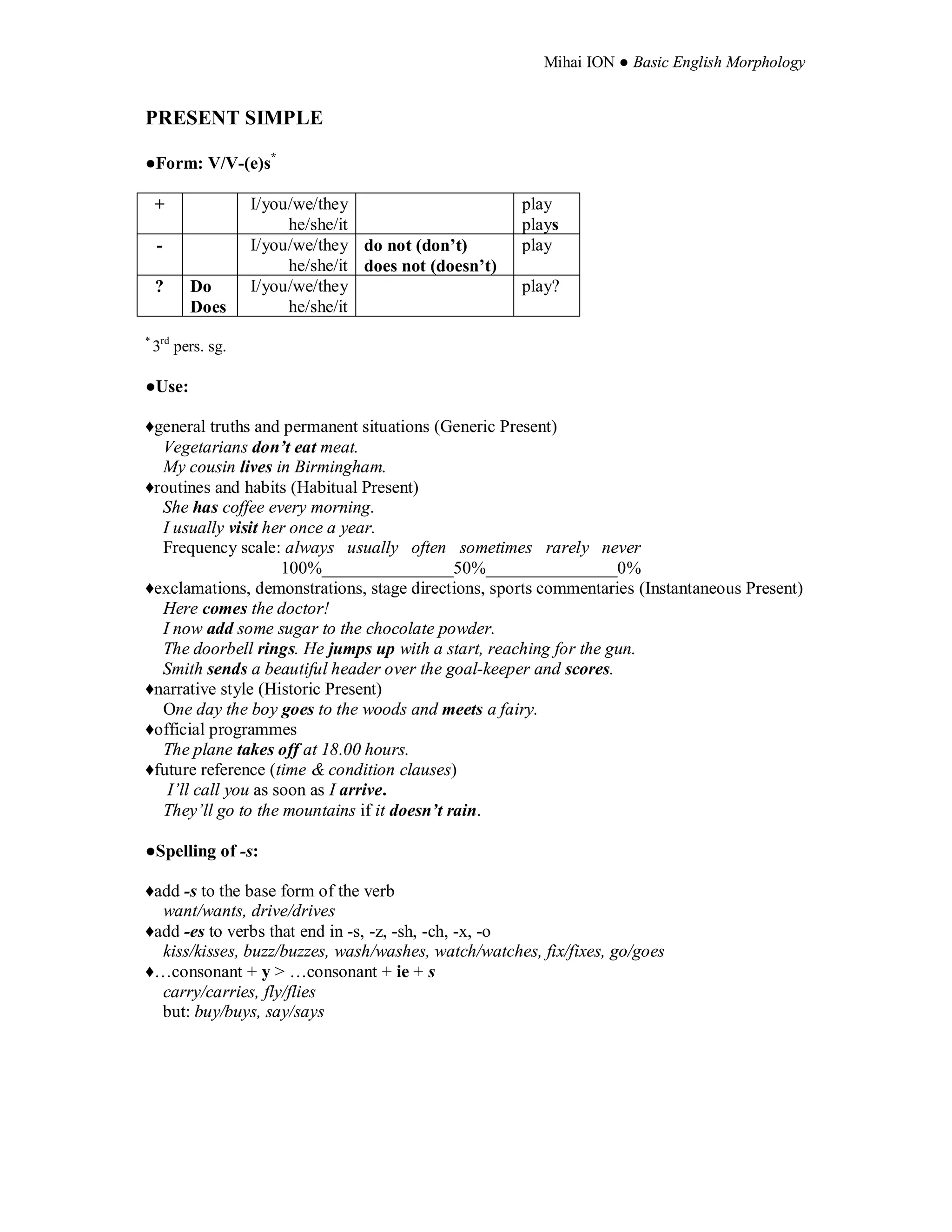
PRESENT CONTINUOUS
●Form: BE (present) + V-ing
+
I
you/we/they
he/she/it
am (’m)
are (’re)
is (’s)
playing
-
I
you/we/they
he/she/it
am not (’m not)
are not (aren’t)
is not (isn’t)
playing
?
Am
Are
Is
I
you/we/they
he/she/it
playing?
●Use:
♦ongoing activities (+ now/at present/at the moment)
I’m driving home now.
♦temporary situations (+ today/this …)
I usually drink coffee, but today I’m drinking some milk.
♦immediate personal plans (+ today/tonight/tomorrow/this …)
He’s coming to see us tomorrow.
What are you doing tonight?
♦annoyance (+ always/continually/all the time)
You are always fixing your car when I go to sleep!
●Spelling of -ing:
♦add -ing to the base form of the verb
go/going, wear/wearing
♦drop final -e
come/coming, make/making
but: agree/agreeing, be/being, dye/dyeing, singe/singeing
♦…-ie > …-y + ing
lie/lying, die/dying
♦…1 stressed vowel + consonant > …2x consonant + ing
stop/stopping, hit/hitting,begin/beginning
but: travel/travelling (BrE), kidnap/kidnapping, picnic/picnicking
●Non-continuous verbs:
♦verbs of the senses: see, hear, smell, taste, notice, feel, touch
♦verbs of the mind: think (=cred), know, understand,believe, remember, forget, mean, doubt,
suppose, expect
♦verbs of emotion & feeling: like, dislike, love, hate, prefer, want, wish, care
♦verbs of possession: have, own, owe, belong, possess
♦verbs of relation: matter, concern, consist, contain, hold, cost, depend, resemble
Mihai ION ● Basic English Morphology
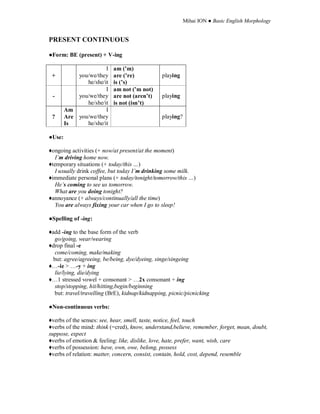
PRESENT PERFECT SIMPLE
●Form: HAVE (present) + V-en*
+
I/you/we/they
he/she/it
have (’ve)
has (’s)
eaten
drunk
played
-
I/you/we/they
he/she/it
have not (haven’t)
has not (hasn’t)
eaten
drunk
played
?
Have
Has
I/you/we/they
he/she/it
eaten?
drunk?
played?
*
V-en = past participle (V3); with regular verbs, V-en = V-ed (past simple)
●Use:
♦present result
He has cleaned his bike. (It is clean now)
♦experience (+ ever, never, already, yet)
Have you ever been in a car crash?
I haven’t read the poem yet.
♦recent past (+ just, lately, recently, till now, so far, of late)
The train has just left.
We haven’t seen Jack lately.
♦incomplete period of time (+ today/this …/all day/all night)
I’ve seen a good film this morning. (It’s 11am)
but: I saw a good film this morning. (It’s 11pm – period completed)
♦persistent situation (for a period of time/since a point in time)
I’ve been a doctor for ten years.
He’s driven a car since last summer.
♦future reference (time & condition clauses)
When I have finished, I’ll let you know.
If you have done your work by seven, I’ll take you to the pool.
●Spelling of -ed: (for regular verbs)
♦add -ed to the base form of the verb
work/worked, clean/cleaned
♦drop final -e
move/moved, dance/danced, recite/recited
♦…consonant + y > …consonant + i + ed
try/tried, cry/cried
♦…1 stressed vowel + consonant > …2x consonant + ed
stop/stopped, drop/dropped, omit/omitted, occur/occurred
but: travel/travelled (BrE), kidnap/kidnapped, picnic/picnicked
Mihai ION ● Basic English Morphology
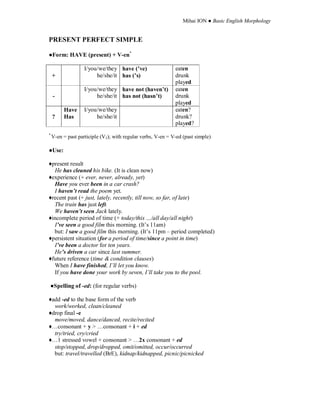
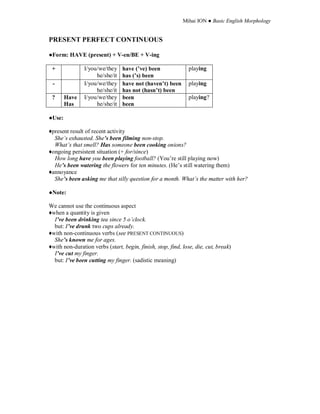
PRESENT PERFECT CONTINUOUS
●Form: HAVE (present) + V-en/BE + V-ing
+ I/you/we/they
he/she/it
have (’ve) been
has (’s) been
playing
- I/you/we/they
he/she/it
have not (haven’t) been
has not (hasn’t) been
playing
? Have
Has
I/you/we/they
he/she/it
been
been
playing?
●Use:
♦present result of recent activity
She’s exhausted. She’s been filming non-stop.
What’s that smell? Has someone been cooking onions?
♦ongoing persistent situation (+ for/since)
How long have you been playing football? (You’re still playing now)
He’s been watering the flowers for ten minutes. (He’s still watering them)
♦annoyance
She’s been asking me that silly question for a month. What’s the matter with her?
●Note:
We cannot use the continuous aspect
♦when a quantity is given
I’ve been drinking tea since 5 o’clock.
but: I’ve drunk two cups already.
♦with non-continuous verbs (see PRESENT CONTINUOUS)
She’s known me for ages.
♦with non-duration verbs (start, begin, finish, stop, find, lose, die, cut, break)
I’ve cut my finger.
but: I’ve been cutting my finger. (sadistic meaning)

English present tense

  • 1.
    Mihai ION ●Basic English Morphology PRESENT SIMPLE ●Form: V/V-(e)s* + I/you/we/they he/she/it play plays - I/you/we/they he/she/it do not (don’t) does not (doesn’t) play ? Do Does I/you/we/they he/she/it play? * 3rd pers. sg. ●Use: ♦general truths and permanent situations (Generic Present) Vegetarians don’t eat meat. My cousin lives in Birmingham. ♦routines and habits (Habitual Present) She has coffee every morning. I usually visit her once a year. Frequency scale: always usually often sometimes rarely never 100%_______________50%_______________0% ♦exclamations, demonstrations, stage directions, sports commentaries (Instantaneous Present) Here comes the doctor! I now add some sugar to the chocolate powder. The doorbell rings. He jumps up with a start, reaching for the gun. Smith sends a beautiful header over the goal-keeper and scores. ♦narrative style (Historic Present) One day the boy goes to the woods and meets a fairy. ♦official programmes The plane takes off at 18.00 hours. ♦future reference (time & condition clauses) I’ll call you as soon as I arrive. They’ll go to the mountains if it doesn’t rain. ●Spelling of -s: ♦add -s to the base form of the verb want/wants, drive/drives ♦add -es to verbs that end in -s, -z, -sh, -ch, -x, -o kiss/kisses, buzz/buzzes, wash/washes, watch/watches, fix/fixes, go/goes ♦…consonant + y > …consonant + ie + s carry/carries, fly/flies but: buy/buys, say/says
  • 2.
    Mihai ION ●Basic English Morphology PRESENT CONTINUOUS ●Form: BE (present) + V-ing + I you/we/they he/she/it am (’m) are (’re) is (’s) playing - I you/we/they he/she/it am not (’m not) are not (aren’t) is not (isn’t) playing ? Am Are Is I you/we/they he/she/it playing? ●Use: ♦ongoing activities (+ now/at present/at the moment) I’m driving home now. ♦temporary situations (+ today/this …) I usually drink coffee, but today I’m drinking some milk. ♦immediate personal plans (+ today/tonight/tomorrow/this …) He’s coming to see us tomorrow. What are you doing tonight? ♦annoyance (+ always/continually/all the time) You are always fixing your car when I go to sleep! ●Spelling of -ing: ♦add -ing to the base form of the verb go/going, wear/wearing ♦drop final -e come/coming, make/making but: agree/agreeing, be/being, dye/dyeing, singe/singeing ♦…-ie > …-y + ing lie/lying, die/dying ♦…1 stressed vowel + consonant > …2x consonant + ing stop/stopping, hit/hitting,begin/beginning but: travel/travelling (BrE), kidnap/kidnapping, picnic/picnicking ●Non-continuous verbs: ♦verbs of the senses: see, hear, smell, taste, notice, feel, touch ♦verbs of the mind: think (=cred), know, understand,believe, remember, forget, mean, doubt, suppose, expect ♦verbs of emotion & feeling: like, dislike, love, hate, prefer, want, wish, care ♦verbs of possession: have, own, owe, belong, possess ♦verbs of relation: matter, concern, consist, contain, hold, cost, depend, resemble
  • 3.
    Mihai ION ●Basic English Morphology PRESENT PERFECT SIMPLE ●Form: HAVE (present) + V-en* + I/you/we/they he/she/it have (’ve) has (’s) eaten drunk played - I/you/we/they he/she/it have not (haven’t) has not (hasn’t) eaten drunk played ? Have Has I/you/we/they he/she/it eaten? drunk? played? * V-en = past participle (V3); with regular verbs, V-en = V-ed (past simple) ●Use: ♦present result He has cleaned his bike. (It is clean now) ♦experience (+ ever, never, already, yet) Have you ever been in a car crash? I haven’t read the poem yet. ♦recent past (+ just, lately, recently, till now, so far, of late) The train has just left. We haven’t seen Jack lately. ♦incomplete period of time (+ today/this …/all day/all night) I’ve seen a good film this morning. (It’s 11am) but: I saw a good film this morning. (It’s 11pm – period completed) ♦persistent situation (for a period of time/since a point in time) I’ve been a doctor for ten years. He’s driven a car since last summer. ♦future reference (time & condition clauses) When I have finished, I’ll let you know. If you have done your work by seven, I’ll take you to the pool. ●Spelling of -ed: (for regular verbs) ♦add -ed to the base form of the verb work/worked, clean/cleaned ♦drop final -e move/moved, dance/danced, recite/recited ♦…consonant + y > …consonant + i + ed try/tried, cry/cried ♦…1 stressed vowel + consonant > …2x consonant + ed stop/stopped, drop/dropped, omit/omitted, occur/occurred but: travel/travelled (BrE), kidnap/kidnapped, picnic/picnicked
  • 4.
    Mihai ION ●Basic English Morphology PRESENT PERFECT CONTINUOUS ●Form: HAVE (present) + V-en/BE + V-ing + I/you/we/they he/she/it have (’ve) been has (’s) been playing - I/you/we/they he/she/it have not (haven’t) been has not (hasn’t) been playing ? Have Has I/you/we/they he/she/it been been playing? ●Use: ♦present result of recent activity She’s exhausted. She’s been filming non-stop. What’s that smell? Has someone been cooking onions? ♦ongoing persistent situation (+ for/since) How long have you been playing football? (You’re still playing now) He’s been watering the flowers for ten minutes. (He’s still watering them) ♦annoyance She’s been asking me that silly question for a month. What’s the matter with her? ●Note: We cannot use the continuous aspect ♦when a quantity is given I’ve been drinking tea since 5 o’clock. but: I’ve drunk two cups already. ♦with non-continuous verbs (see PRESENT CONTINUOUS) She’s known me for ages. ♦with non-duration verbs (start, begin, finish, stop, find, lose, die, cut, break) I’ve cut my finger. but: I’ve been cutting my finger. (sadistic meaning)