
1
PRESCRIPTION
Prepared By
Ms. Shivanee Vyas
M. Pharmacy
Lakshi Narain College of Pharmacy
CONTENTS
• Definition
• Parts of Prescription
• Sources of errors in Prescription
2
3
Prescription is an order written by a
physician, dentist, veterinarian to a pharmacist to
compound and dispense a specific medication for
the patient.
Important feature of prescription is it
contain directions for the patient to follow when
taking the drug and the directions for the
pharmacist about what type of dosage form to be
dispensed.
PRESCRIPTION
Definition
4
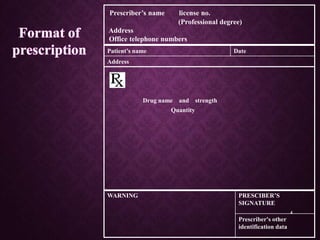
Prescriber’s name license no.
(Professional degree)
Address
Office telephone numbers
Patient’s name Date
Address
Drug name and strength
Quantity
WARNING PRESCIBER’S
SIGNATURE
Prescriber's other
identification data
5
PARTS OF A PRESCRIPTION:
1. Date
2. Name & age of the patient
3. Superscription
4. Inscription
5. Subscription
6. Signatura
7. Renewal instructions
8. Signature, address and registration number of
the prescriber
6
1. Date - Date on the prescription helps the
pharmacist to know when the medicine ware last
dispensed. In the case of habit forming drug the date
prevents the misuses of the drug.
2. Name and age of the patient - By name of
the patient the prescription can be identified. Age of the
patient is especially required for child patients.
3. Superscription - It is represented by a Latin
symbol which means “take thou” or “you take”.
4. Inscription - This is the main part of the
prescription. It contain the name of the prescribed
medicaments.
7
5. Subscription - In this part the prescriber gives
directions to the pharmacist regarding the dosage
form to be dispensed.
6. Signatura – It is usually written as “Sig”. In this
part the prescriber gives direction to the patients.
The instructions may include
• The quantity to be taken
• The route of administration
• The frequency and timing of the administration
• Other special instructions
8
Sources of error in prescriptions
1. Abbreviation
2. Name of the drug
3. Strength of the preparation
4. Dosage form of the drug prescribed
5. Instructions to the patient
6. Incompatibilities
9
1. Abbreviation
It is preferable to avoid this types of misleading
abbreviations .
E.g. ‘SSKI’ is the abbreviated term of ‘Saturated
Solution of Potassium Iodide’.
2. Name of the drugs
Names of some drugs (especially the brand names)
either sounds alike or looks alike (SALA). So any error in
the name of a drug will lead to major danger to the
patient.
E.g. Althrocin – Eltroxin , Acidin – Apidin etc
3. Strength of the preparation
Drugs are available in the market in various strengths.
So a drug must not be dispensed if the strength is not
written in the prescription.
Ex. Paracetamol tablet 500mg should not be dispensed
when no strength is mentioned in the prescription.
Many drugs are available in more than one dosage
forms.
Ex. Liquid, tablets, injections or suppositories. The
dosage form intended for the patient must be mentioned
in the prescription.
11
5. Instructions to the patient
Some times the instruction for a certain
preparation is either omitted or mentioned partially.
The quantity of the drug to be taken, the frequency
and timing of administration and route of
administration should be mentioned clearly.
6. Incompatibilities
It is essential to check that there is no pharmaceutical
or therapeutic incompatibilities in the prescription.
12
If more than two medicines are prescribed then it is
the duty of the pharmacist to see whether their
interactions will produce any harm to the patient or
not.
Ex. Tetracycline should not be taken with milk or
antacid.
13

Prescription : Pharmacy Practice

  • 1.
    1 PRESCRIPTION Prepared By Ms. ShivaneeVyas M. Pharmacy Lakshi Narain College of Pharmacy
  • 2.
    CONTENTS • Definition • Partsof Prescription • Sources of errors in Prescription 2
  • 3.
    3 Prescription is anorder written by a physician, dentist, veterinarian to a pharmacist to compound and dispense a specific medication for the patient. Important feature of prescription is it contain directions for the patient to follow when taking the drug and the directions for the pharmacist about what type of dosage form to be dispensed. PRESCRIPTION Definition
  • 4.
    4 Prescriber’s name licenseno. (Professional degree) Address Office telephone numbers Patient’s name Date Address Drug name and strength Quantity WARNING PRESCIBER’S SIGNATURE Prescriber's other identification data
  • 5.
    5 PARTS OF APRESCRIPTION: 1. Date 2. Name & age of the patient 3. Superscription 4. Inscription 5. Subscription 6. Signatura 7. Renewal instructions 8. Signature, address and registration number of the prescriber
  • 6.
    6 1. Date -Date on the prescription helps the pharmacist to know when the medicine ware last dispensed. In the case of habit forming drug the date prevents the misuses of the drug. 2. Name and age of the patient - By name of the patient the prescription can be identified. Age of the patient is especially required for child patients. 3. Superscription - It is represented by a Latin symbol which means “take thou” or “you take”. 4. Inscription - This is the main part of the prescription. It contain the name of the prescribed medicaments.
  • 7.
    7 5. Subscription -In this part the prescriber gives directions to the pharmacist regarding the dosage form to be dispensed. 6. Signatura – It is usually written as “Sig”. In this part the prescriber gives direction to the patients. The instructions may include • The quantity to be taken • The route of administration • The frequency and timing of the administration • Other special instructions
  • 8.
    8 Sources of errorin prescriptions 1. Abbreviation 2. Name of the drug 3. Strength of the preparation 4. Dosage form of the drug prescribed 5. Instructions to the patient 6. Incompatibilities
  • 9.
    9 1. Abbreviation It ispreferable to avoid this types of misleading abbreviations . E.g. ‘SSKI’ is the abbreviated term of ‘Saturated Solution of Potassium Iodide’. 2. Name of the drugs Names of some drugs (especially the brand names) either sounds alike or looks alike (SALA). So any error in the name of a drug will lead to major danger to the patient. E.g. Althrocin – Eltroxin , Acidin – Apidin etc
  • 10.
    3. Strength ofthe preparation Drugs are available in the market in various strengths. So a drug must not be dispensed if the strength is not written in the prescription. Ex. Paracetamol tablet 500mg should not be dispensed when no strength is mentioned in the prescription. Many drugs are available in more than one dosage forms. Ex. Liquid, tablets, injections or suppositories. The dosage form intended for the patient must be mentioned in the prescription.
  • 11.
    11 5. Instructions tothe patient Some times the instruction for a certain preparation is either omitted or mentioned partially. The quantity of the drug to be taken, the frequency and timing of administration and route of administration should be mentioned clearly. 6. Incompatibilities It is essential to check that there is no pharmaceutical or therapeutic incompatibilities in the prescription.
  • 12.
    12 If more thantwo medicines are prescribed then it is the duty of the pharmacist to see whether their interactions will produce any harm to the patient or not. Ex. Tetracycline should not be taken with milk or antacid.
  • 13.