VIGNAN PHARMACY COLLEGE,
VADLAMUDI 1
 INTRODUCTION
 TYPES OF DRUG DISTRIBUTION
 INDIVIDUAL PRESCRIBTION ORDER
 FLOOR STOCK SYSTEM
 COMBINATION OF INDIVIDUAL AND
FLOOR STOCK METHOD
 UNIT DOSE DISPENSING
 FLOW CHARTS OF OUT PATIENT AND IN
PATIENT.
 Drug distribution is defined as, “Physical transfer of drugs
from storage area in the hospital to the patient’s bedside”.
 This involves two types of drug distribution. They are:
In-patient distribution
Out-patient distribution
INPATIENT DISTRIBUTION
 The drug distribution to the in patient department can be
carried out from the out patient dispensing area.
 The pharmacists involved in dispensing the drugs for out
patient can dispense drugs for in patients too.
 The pharmacist employed for drug distribution to the in
patient wards should be well skilled and qualified staff.
 Out patient refers to the patients not occupying beds in
hospital or in clinics, health centres and other places where out
patients usually go for health care.
 No medicaments should be issued without the prescription.
 After the issue has been made the quantities supplied must be
recorded.
 In short form the out patient department was called as OPD.
TYPES OF DRUG DISTRIBUTION SYSTEMS:
 There are five different systems in use for drug
distribution in hospitals:
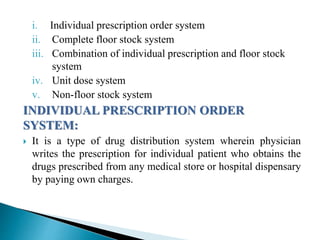
i. Individual prescription order system
ii. Complete floor stock system
iii. Combination of individual prescription and floor stock
system
iv. Unit dose system
v. Non-floor stock system
INDIVIDUAL PRESCRIPTION ORDER
SYSTEM:
 It is a type of drug distribution system wherein physician
writes the prescription for individual patient who obtains the
drugs prescribed from any medical store or hospital dispensary
by paying own charges.
 This system is generally used by the small and/or private
hospitals because of the reduced man power requirements and
desirability for individualised service.
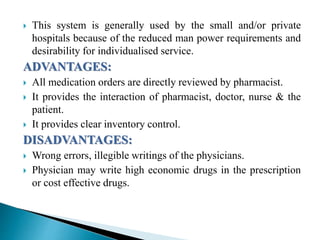
ADVANTAGES:
 All medication orders are directly reviewed by pharmacist.
 It provides the interaction of pharmacist, doctor, nurse & the
patient.
 It provides clear inventory control.
DISADVANTAGES:
 Wrong errors, illegible writings of the physicians.
 Physician may write high economic drugs in the prescription
or cost effective drugs.
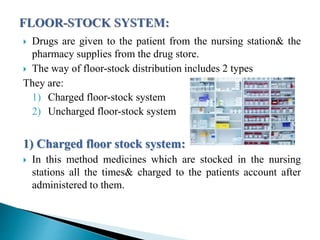
 Drugs are given to the patient from the nursing station& the
pharmacy supplies from the drug store.
 The way of floor-stock distribution includes 2 types
They are:
1) Charged floor-stock system
2) Uncharged floor-stock system
1) Charged floor stock system:
 In this method medicines which are stocked in the nursing
stations all the times& charged to the patients account after
administered to them.
 The patient is charged for every single dose administered to
him.
 Once the floor-stock list is prepared it is the responsibility of
the hospital pharmacist to make the drugs available.
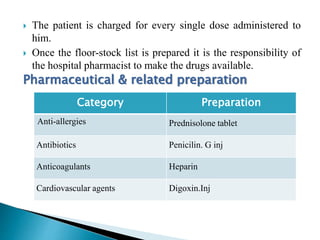
Pharmaceutical & related preparation
Category Preparation
Anti-allergies Prednisolone tablet
Antibiotics Penicilin. G inj
Anticoagulants Heparin
Cardiovascular agents Digoxin.Inj
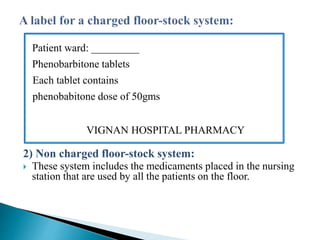
2) Non charged floor-stock system:
 These system includes the medicaments placed in the nursing
station that are used by all the patients on the floor.
Patient ward: _________
Phenobarbitone tablets
Each tablet contains
phenobabitone dose of 50gms
VIGNAN HOSPITAL PHARMACY
 There shall be no direct charge from the patients account.
 This is divided into two methods.
They are:
1) Drug basket method
2) Mobile dispensary unit
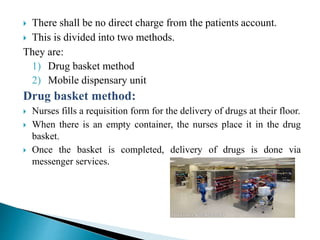
Drug basket method:
 Nurses fills a requisition form for the delivery of drugs at their floor.
 When there is an empty container, the nurses place it in the drug
basket.
 Once the basket is completed, delivery of drugs is done via
messenger services.
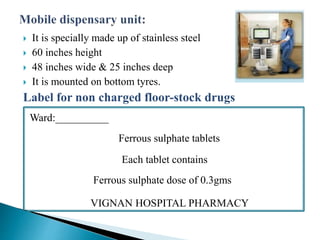
 It is specially made up of stainless steel
 60 inches height
 48 inches wide & 25 inches deep
 It is mounted on bottom tyres.
Label for non charged floor-stock drugs
Ward:__________
Ferrous sulphate tablets
Each tablet contains
Ferrous sulphate dose of 0.3gms
VIGNAN HOSPITAL PHARMACY
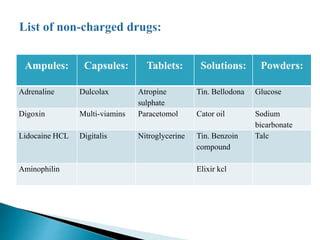
Ampules: Capsules: Tablets: Solutions: Powders:
Adrenaline Dulcolax Atropine
sulphate
Tin. Bellodona Glucose
Digoxin Multi-viamins Paracetomol Cator oil Sodium
bicarbonate
Lidocaine HCL Digitalis Nitroglycerine Tin. Benzoin
compound
Talc
Aminophilin Elixir kcl
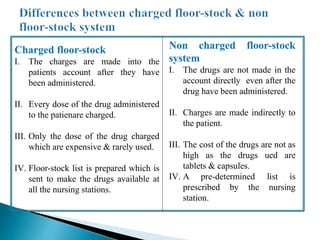
Charged floor-stock
I. The charges are made into the
patients account after they have
been administered.
II. Every dose of the drug administered
to the patienare charged.
III. Only the dose of the drug charged
which are expensive & rarely used.
IV. Floor-stock list is prepared which is
sent to make the drugs available at
all the nursing stations.
Non charged floor-stock
system
I. The drugs are not made in the
account directly even after the
drug have been administered.
II. Charges are made indirectly to
the patient.
III. The cost of the drugs are not as
high as the drugs ued are
tablets & capsules.
IV. A pre-determined list is
prescribed by the nursing
station.
 This system is followed by all government hospitals and also private
hospitals those run on the basis of no -profit and no loss.
 Surgical items are given to the patients, who purchases and deposit
those items in a hospital wards on rooms under the supervision of
registered headness.
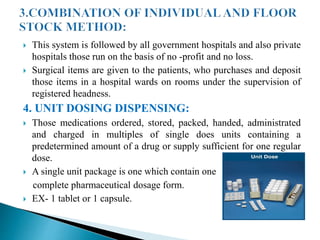
4. UNIT DOSING DISPENSING:
 Those medications ordered, stored, packed, handed, administrated
and charged in multiples of single does units containing a
predetermined amount of a drug or supply sufficient for one regular
dose.
 A single unit package is one which contain one
complete pharmaceutical dosage form.
 EX- 1 tablet or 1 capsule.
 Better financial control
 It prevents loss of partially used medications.
 Does not require storage facilities at nursing stations.
DISADVANTAGES:
 Irregular dosage
 skill physician is required for administration of drug.
 Regular monitoring is required.
TYPES OF UNIT DOSE DRUG DISPENSING
SYSTEMS:
1) TYPE A- CENTRALISED UDDDS
2) TYPE B-DECENTRALISED UDDDS
 All inpatients drugs are dispensed in unit doses and all drugs
are stored in central area of pharmacy and dispensed at a time
of dose that is to be given to the patient.
2) TYPE B-DECENTRALISED UDDDS:
 This is operated through satellite pharmacies located on each
floor of hospital.
PROCEDURE:
 Patient profile card containing full data ,disease,
diagnosis, is prepared.
 Prescriptions are sent directly to the pharmacist which are
then entered in patient profile card.
 Pharmacist check the medication order is filled by pharmacy
technicians.
 The nurse administeres the drug and make entry in their
record.
ADVANTAGES:
 Easy for admission of staff.
 Accounting becomes easier in certain cases.
DISADVANTAGES:
 High cost
 Consumption is more time.
 Will occupy more space for sorting out ledger posting and
inventory control problem.
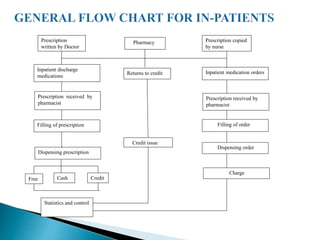
Prescription
written by Doctor
Pharmacy Prescription copied
by nurse
Inpatient discharge
medications
Returns to credit Inpatient medication orders
Prescription received by
pharmacist
Filling of prescription
Dispensing prescription
Prescription received by
pharmacist
Filling of order
Dispensing order
Credit issue
Free Cash Credit
Charge
Statistics and control
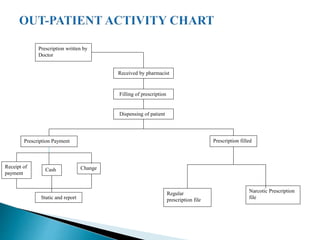
Prescription written by
Doctor
Received by pharmacist
Filling of prescription
Dispensing of patient
Prescription Payment Prescription filled
Receipt of
payment
Cash Change
Static and report
Regular
prescription file
Narcotic Prescription
file
 Dr. Ramesh K. Goyal, Dr. R. K. Parikh, Dr. Mayur M. Patel –
A Text book of Hospital Pharmacy, Pg.no: 101 – 103
 H. P. Tipnis, Amrita Bajaj – Hospital Pharmacy, Pg.no: 89 – 91
 http://www.srmuniv.ac.in
 www.researchgate.net
 Textbook of hospital pharmacy 2nd edition by of page
number:166-168

14ab1t0019 drug distribution

  • 1.
  • 2.
     INTRODUCTION  TYPESOF DRUG DISTRIBUTION  INDIVIDUAL PRESCRIBTION ORDER  FLOOR STOCK SYSTEM  COMBINATION OF INDIVIDUAL AND FLOOR STOCK METHOD  UNIT DOSE DISPENSING  FLOW CHARTS OF OUT PATIENT AND IN PATIENT.
  • 3.
     Drug distributionis defined as, “Physical transfer of drugs from storage area in the hospital to the patient’s bedside”.  This involves two types of drug distribution. They are: In-patient distribution Out-patient distribution INPATIENT DISTRIBUTION  The drug distribution to the in patient department can be carried out from the out patient dispensing area.  The pharmacists involved in dispensing the drugs for out patient can dispense drugs for in patients too.  The pharmacist employed for drug distribution to the in patient wards should be well skilled and qualified staff.
  • 4.
     Out patientrefers to the patients not occupying beds in hospital or in clinics, health centres and other places where out patients usually go for health care.  No medicaments should be issued without the prescription.  After the issue has been made the quantities supplied must be recorded.  In short form the out patient department was called as OPD. TYPES OF DRUG DISTRIBUTION SYSTEMS:  There are five different systems in use for drug distribution in hospitals:
  • 5.
    i. Individual prescriptionorder system ii. Complete floor stock system iii. Combination of individual prescription and floor stock system iv. Unit dose system v. Non-floor stock system INDIVIDUAL PRESCRIPTION ORDER SYSTEM:  It is a type of drug distribution system wherein physician writes the prescription for individual patient who obtains the drugs prescribed from any medical store or hospital dispensary by paying own charges.
  • 6.
     This systemis generally used by the small and/or private hospitals because of the reduced man power requirements and desirability for individualised service. ADVANTAGES:  All medication orders are directly reviewed by pharmacist.  It provides the interaction of pharmacist, doctor, nurse & the patient.  It provides clear inventory control. DISADVANTAGES:  Wrong errors, illegible writings of the physicians.  Physician may write high economic drugs in the prescription or cost effective drugs.
  • 7.
     Drugs aregiven to the patient from the nursing station& the pharmacy supplies from the drug store.  The way of floor-stock distribution includes 2 types They are: 1) Charged floor-stock system 2) Uncharged floor-stock system 1) Charged floor stock system:  In this method medicines which are stocked in the nursing stations all the times& charged to the patients account after administered to them.
  • 8.
     The patientis charged for every single dose administered to him.  Once the floor-stock list is prepared it is the responsibility of the hospital pharmacist to make the drugs available. Pharmaceutical & related preparation Category Preparation Anti-allergies Prednisolone tablet Antibiotics Penicilin. G inj Anticoagulants Heparin Cardiovascular agents Digoxin.Inj
  • 9.
    2) Non chargedfloor-stock system:  These system includes the medicaments placed in the nursing station that are used by all the patients on the floor. Patient ward: _________ Phenobarbitone tablets Each tablet contains phenobabitone dose of 50gms VIGNAN HOSPITAL PHARMACY
  • 10.
     There shallbe no direct charge from the patients account.  This is divided into two methods. They are: 1) Drug basket method 2) Mobile dispensary unit Drug basket method:  Nurses fills a requisition form for the delivery of drugs at their floor.  When there is an empty container, the nurses place it in the drug basket.  Once the basket is completed, delivery of drugs is done via messenger services.
  • 11.
     It isspecially made up of stainless steel  60 inches height  48 inches wide & 25 inches deep  It is mounted on bottom tyres. Label for non charged floor-stock drugs Ward:__________ Ferrous sulphate tablets Each tablet contains Ferrous sulphate dose of 0.3gms VIGNAN HOSPITAL PHARMACY
  • 12.
    Ampules: Capsules: Tablets:Solutions: Powders: Adrenaline Dulcolax Atropine sulphate Tin. Bellodona Glucose Digoxin Multi-viamins Paracetomol Cator oil Sodium bicarbonate Lidocaine HCL Digitalis Nitroglycerine Tin. Benzoin compound Talc Aminophilin Elixir kcl
  • 13.
    Charged floor-stock I. Thecharges are made into the patients account after they have been administered. II. Every dose of the drug administered to the patienare charged. III. Only the dose of the drug charged which are expensive & rarely used. IV. Floor-stock list is prepared which is sent to make the drugs available at all the nursing stations. Non charged floor-stock system I. The drugs are not made in the account directly even after the drug have been administered. II. Charges are made indirectly to the patient. III. The cost of the drugs are not as high as the drugs ued are tablets & capsules. IV. A pre-determined list is prescribed by the nursing station.
  • 14.
     This systemis followed by all government hospitals and also private hospitals those run on the basis of no -profit and no loss.  Surgical items are given to the patients, who purchases and deposit those items in a hospital wards on rooms under the supervision of registered headness. 4. UNIT DOSING DISPENSING:  Those medications ordered, stored, packed, handed, administrated and charged in multiples of single does units containing a predetermined amount of a drug or supply sufficient for one regular dose.  A single unit package is one which contain one complete pharmaceutical dosage form.  EX- 1 tablet or 1 capsule.
  • 15.
     Better financialcontrol  It prevents loss of partially used medications.  Does not require storage facilities at nursing stations. DISADVANTAGES:  Irregular dosage  skill physician is required for administration of drug.  Regular monitoring is required. TYPES OF UNIT DOSE DRUG DISPENSING SYSTEMS: 1) TYPE A- CENTRALISED UDDDS 2) TYPE B-DECENTRALISED UDDDS
  • 16.
     All inpatientsdrugs are dispensed in unit doses and all drugs are stored in central area of pharmacy and dispensed at a time of dose that is to be given to the patient. 2) TYPE B-DECENTRALISED UDDDS:  This is operated through satellite pharmacies located on each floor of hospital. PROCEDURE:  Patient profile card containing full data ,disease, diagnosis, is prepared.  Prescriptions are sent directly to the pharmacist which are then entered in patient profile card.
  • 17.
     Pharmacist checkthe medication order is filled by pharmacy technicians.  The nurse administeres the drug and make entry in their record. ADVANTAGES:  Easy for admission of staff.  Accounting becomes easier in certain cases. DISADVANTAGES:  High cost  Consumption is more time.  Will occupy more space for sorting out ledger posting and inventory control problem.
  • 18.
    Prescription written by Doctor PharmacyPrescription copied by nurse Inpatient discharge medications Returns to credit Inpatient medication orders Prescription received by pharmacist Filling of prescription Dispensing prescription Prescription received by pharmacist Filling of order Dispensing order Credit issue Free Cash Credit Charge Statistics and control
  • 19.
    Prescription written by Doctor Receivedby pharmacist Filling of prescription Dispensing of patient Prescription Payment Prescription filled Receipt of payment Cash Change Static and report Regular prescription file Narcotic Prescription file
  • 20.
     Dr. RameshK. Goyal, Dr. R. K. Parikh, Dr. Mayur M. Patel – A Text book of Hospital Pharmacy, Pg.no: 101 – 103  H. P. Tipnis, Amrita Bajaj – Hospital Pharmacy, Pg.no: 89 – 91  http://www.srmuniv.ac.in  www.researchgate.net  Textbook of hospital pharmacy 2nd edition by of page number:166-168