Gas Reinjection   Presentation at  Workshop on”CDM Methodology Issues related to Gas Flaring” Amsterdam 03.12.08 By Steinar Njå, Project Director,  Norwegian Petroleum Directorate Carbon Limit, Amsterdam, 03.12.08
Content of presentation Gas reinjection in general Purpose of gas reinjection Gas and Reservoir properties Injection facilities   The economics of gas reinjection The Norwegian Case Legal framework Some field cases Gas reinjection related to CDM Reinjection schemes Injection Monitoring Closing remarks Carbon Limit, Amsterdam, 03.12.08
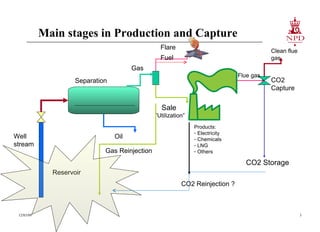
Main stages in Production and Capture 06/07/09 Reservoir Separation Oil Gas Flare Sale  ” Utilization” Flue gas CO2 Capture CO2 Storage Clean flue gas Gas Reinjection Products: Electricity Chemicals LNG Others Fuel CO2 Reinjection ? Well stream
Purpose of gas reinjection High pressure gas reinjection is used for many producing fields: Provides pressure maintenance Improves recovery of oil Provides storage and swing capacity Different form for application: Non-miscible injection Miscible injection Tertier injection after water flooding Injection in gas/condensate fields Carbon Limit, Amsterdam, 03.12.08
Gas Properties and Reservoir Considerations For Improved Recovery Reservoir geology and configuration Compatability with reservoir fluid Miscibility Injectivity Theft  Zones(High permeability layers, Hetrogeniety) For Storage Reservoir geology and configuration Available volume Injectivity Reservoir pressure Leakage Normally not a problem Strict rules for well plugging before abandonment  Carbon Limit, Amsterdam, 03.12.08
Injection facilities   Standard high pressure compressors are applied driven by gas turbines or electrical motors Gas have to be cleaned and conditioned before compressed and reinjected into the reservoir Injection wells normally cheaper than production wells Carbon Limit, Amsterdam, 03.12.08
The economics of gas reinjection Gas reinjection has to compete with other alternatives for utilization.  For IOR purposes there are always great uncertainties regarding efficiency and added recovery of oil For storage purposes better utilization of transportation systems and improved delivery efficency is the main economical driver. Some gas will be used as fuel(2-3%) to reinject and 15-25% of gas reinjected will be left in the reservoir.  Carbon Limit, Amsterdam, 03.12.08
Reservoir Management System for Management and Monitoring is requiered. Most companies have established monitoring program for each field based on geological models, petrophysical properties of the reservoir and reservoir simulations. Reservoir behaviour  evaluated on regular basis by flow measurement and well testing. In some instances tracers are used to understand flow regimes in the reservoir Carbon Limit, Amsterdam, 03.12.08
The Norwegian Case Carbon Limit, Amsterdam, 03.12.08
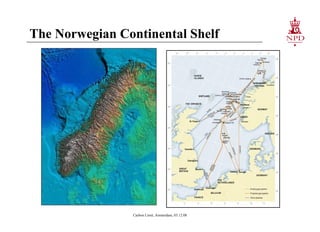
The Norwegian Continental Shelf Carbon Limit, Amsterdam, 03.12.08
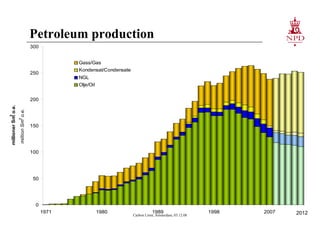
Petroleum production Carbon Limit, Amsterdam, 03.12.08 2012
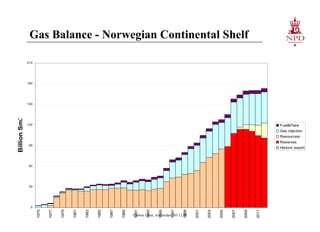
Gas Balance - Norwegian Continental Shelf Carbon Limit, Amsterdam, 03.12.08
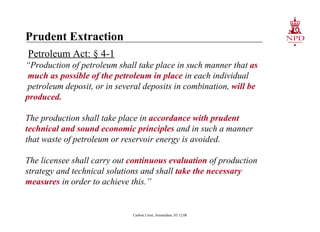
Prudent Extraction Carbon Limit, Amsterdam, 03.12.08 Petroleum Act:  § 4-1   “ Production of petroleum shall take place in such manner that  as  much as possible of the petroleum in place  in each individual  petroleum deposit, or in several deposits in combination,  will be  produced.  The production shall take place in  accordance with prudent technical and sound economic principles  and in such a manner  that waste of petroleum or reservoir energy is avoided.  The licensee shall carry out  continuous evaluation  of production  strategy and technical solutions and shall  take the necessary  measures  in order to achieve this.”
Gas flaring and venting regulations Petroleum Act:  § 4-4 “ Flaring in excess of the quantities needed for normal operational safety shall not be allowed unless approved by the Ministry”: Associated gas utilisation required to get authority approval of Plan for Development and Operation Annual gas flaring permits Avoid waste of petroleum and reservoir energy Cold venting is not in accordance with the principle of environmentally prudent petroleum production CO 2 -tax charged on all fuel and flare consumed and vented gas (~USD 0.1 per Sm 3  gas) Carbon Limit, Amsterdam, 03.12.08
Reservoir Management Production reg. - Section 27 “ The licensee shall continually monitor the deposit during production, including pressure and flow conditions, produced or injected volumes per well, zone and reservoir, the composition of components of petroleum etc. The total monthly production and injection volumes of the field shall be apportioned to each individual well on a monthly basis according to recognized norm.” Carbon Limit, Amsterdam, 03.12.08
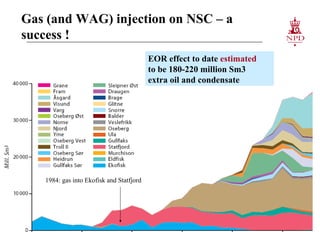
Gas (and WAG)  injection on  NSC – a  success !   Carbon Limit, Amsterdam, 03.12.08 EOR  effect to date  estimated   to be 180-220 million Sm3  extra oil and condensate 1984: gas into Ekofisk and Statfjord
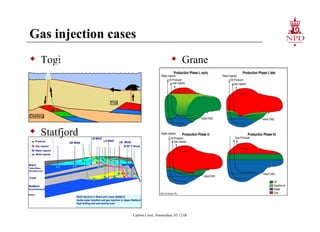
Gas injection cases Togi Statfjord Grane Carbon Limit, Amsterdam, 03.12.08 Oseberg Troll
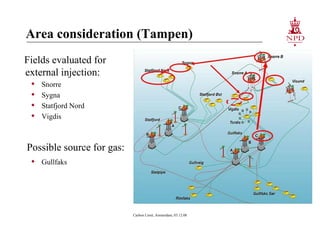
Area consideration (Tampen) Fields evaluated for external injection: Snorre Sygna Statfjord Nord Vigdis Possible source for gas: Gullfaks Carbon Limit, Amsterdam, 03.12.08
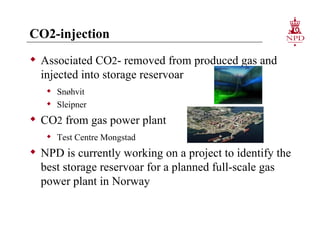
CO2-injection Associated CO 2 - removed from produced gas and injected into storage reservoar Snøhvit Sleipner CO 2  from gas power plant Test Centre Mongstad NPD is currently working on a project to identify the best storage reservoar for a planned full-scale gas power plant in Norway
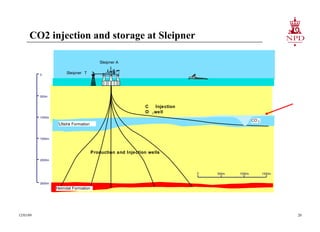
CO2 injection and storage at Sleipner 06/07/09 Sleipner A Sleipner  T Utsira  Formation Heimdal Formation Production and Injection  wells CO 2 CO 2 Injection  well   1000m 2000m 2500m 0 500m 1500m 1000m 0 500m 1500m
Gas reinjection related to CDM Carbon Limit, Amsterdam, 03.12.08
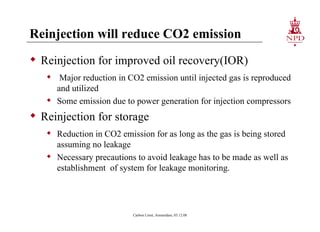
Reinjection schemes Reinjection for IOR Reinjection  for storage Carbon Limit, Amsterdam, 03.12.08
Reinjection will reduce CO2 emission Reinjection for improved oil recovery(IOR) Major reduction in CO2 emission until injected gas is reproduced and utilized  Some emission due to power generation for injection compressors Reinjection for storage Reduction in CO2 emission for as long as the gas is being stored assuming no leakage Necessary precautions to avoid leakage has to be made as well as establishment  of system for leakage monitoring. Carbon Limit, Amsterdam, 03.12.08
Injection Monitoring Program for Reservoir Management  Petroleum producing countries have rules and regulations for proper depletion and requirments for reservoir management In general most companies will have program established for reservoir monitoring Behaviour of gas injected can be traced using well testing and reservoir simulations Gas resirculation will be discovered through GOR measurement Possible to establish monitoring program that controls reproduction of injected gas. Carbon Limit, Amsterdam, 03.12.08
Additionality IOR from gas injection has  in the long run  proved more economical than expected Yet, in a project perspective the IOR-effect may be too risky for investment purposes CDM may be a good solution  for projects to reduce flaring on fields in production. Flaring restriction should however be handled at planning stage as a requirement to the company developing the field. Carbon Limit, Amsterdam, 03.12.08
Closing remarks Gas reinjection is a well known method for storing of gas instead of flaring Gas reinjection will in most cases improve oil recovery if applied in a right way Calculation and accounting of gas injected and stored should be possible through proper reservoir monitoring Considering the huge amount of gas currently being flared, gas reinjection is a fast and valuable alternative to avoid flaring and thereby reduce CO2 emission Carbon Limit, Amsterdam, 03.12.08
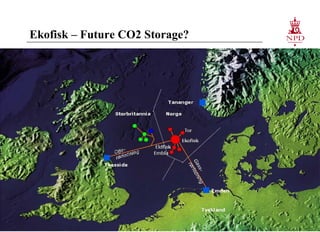
Ekofisk – Future CO2 Storage?
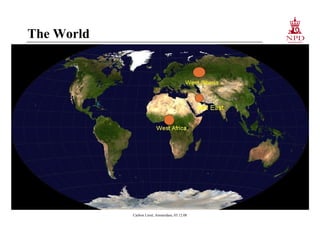
The World Carbon Limit, Amsterdam, 03.12.08
The difference between natural gas(CH4+) and CO2 CH4+ Rich in energy Easy to produce Easy to store High value on storage CO2 Low in energy Difficult to extract Easy to store Low value on storage Carbon Limit, Amsterdam, 03.12.08

Gas reinjection and flaring reduction Norway's experience - Steinar Nja (Norway Petroleum Directorate)

  • 1.
    Gas Reinjection Presentation at Workshop on”CDM Methodology Issues related to Gas Flaring” Amsterdam 03.12.08 By Steinar Njå, Project Director, Norwegian Petroleum Directorate Carbon Limit, Amsterdam, 03.12.08
  • 2.
    Content of presentationGas reinjection in general Purpose of gas reinjection Gas and Reservoir properties Injection facilities The economics of gas reinjection The Norwegian Case Legal framework Some field cases Gas reinjection related to CDM Reinjection schemes Injection Monitoring Closing remarks Carbon Limit, Amsterdam, 03.12.08
  • 3.
    Main stages inProduction and Capture 06/07/09 Reservoir Separation Oil Gas Flare Sale ” Utilization” Flue gas CO2 Capture CO2 Storage Clean flue gas Gas Reinjection Products: Electricity Chemicals LNG Others Fuel CO2 Reinjection ? Well stream
  • 4.
    Purpose of gasreinjection High pressure gas reinjection is used for many producing fields: Provides pressure maintenance Improves recovery of oil Provides storage and swing capacity Different form for application: Non-miscible injection Miscible injection Tertier injection after water flooding Injection in gas/condensate fields Carbon Limit, Amsterdam, 03.12.08
  • 5.
    Gas Properties andReservoir Considerations For Improved Recovery Reservoir geology and configuration Compatability with reservoir fluid Miscibility Injectivity Theft Zones(High permeability layers, Hetrogeniety) For Storage Reservoir geology and configuration Available volume Injectivity Reservoir pressure Leakage Normally not a problem Strict rules for well plugging before abandonment Carbon Limit, Amsterdam, 03.12.08
  • 6.
    Injection facilities Standard high pressure compressors are applied driven by gas turbines or electrical motors Gas have to be cleaned and conditioned before compressed and reinjected into the reservoir Injection wells normally cheaper than production wells Carbon Limit, Amsterdam, 03.12.08
  • 7.
    The economics ofgas reinjection Gas reinjection has to compete with other alternatives for utilization. For IOR purposes there are always great uncertainties regarding efficiency and added recovery of oil For storage purposes better utilization of transportation systems and improved delivery efficency is the main economical driver. Some gas will be used as fuel(2-3%) to reinject and 15-25% of gas reinjected will be left in the reservoir. Carbon Limit, Amsterdam, 03.12.08
  • 8.
    Reservoir Management Systemfor Management and Monitoring is requiered. Most companies have established monitoring program for each field based on geological models, petrophysical properties of the reservoir and reservoir simulations. Reservoir behaviour evaluated on regular basis by flow measurement and well testing. In some instances tracers are used to understand flow regimes in the reservoir Carbon Limit, Amsterdam, 03.12.08
  • 9.
    The Norwegian CaseCarbon Limit, Amsterdam, 03.12.08
  • 10.
    The Norwegian ContinentalShelf Carbon Limit, Amsterdam, 03.12.08
  • 11.
    Petroleum production CarbonLimit, Amsterdam, 03.12.08 2012
  • 12.
    Gas Balance -Norwegian Continental Shelf Carbon Limit, Amsterdam, 03.12.08
  • 13.
    Prudent Extraction CarbonLimit, Amsterdam, 03.12.08 Petroleum Act: § 4-1 “ Production of petroleum shall take place in such manner that as much as possible of the petroleum in place in each individual petroleum deposit, or in several deposits in combination, will be produced. The production shall take place in accordance with prudent technical and sound economic principles and in such a manner that waste of petroleum or reservoir energy is avoided. The licensee shall carry out continuous evaluation of production strategy and technical solutions and shall take the necessary measures in order to achieve this.”
  • 14.
    Gas flaring andventing regulations Petroleum Act: § 4-4 “ Flaring in excess of the quantities needed for normal operational safety shall not be allowed unless approved by the Ministry”: Associated gas utilisation required to get authority approval of Plan for Development and Operation Annual gas flaring permits Avoid waste of petroleum and reservoir energy Cold venting is not in accordance with the principle of environmentally prudent petroleum production CO 2 -tax charged on all fuel and flare consumed and vented gas (~USD 0.1 per Sm 3 gas) Carbon Limit, Amsterdam, 03.12.08
  • 15.
    Reservoir Management Productionreg. - Section 27 “ The licensee shall continually monitor the deposit during production, including pressure and flow conditions, produced or injected volumes per well, zone and reservoir, the composition of components of petroleum etc. The total monthly production and injection volumes of the field shall be apportioned to each individual well on a monthly basis according to recognized norm.” Carbon Limit, Amsterdam, 03.12.08
  • 16.
    Gas (and WAG) injection on NSC – a success ! Carbon Limit, Amsterdam, 03.12.08 EOR effect to date estimated to be 180-220 million Sm3 extra oil and condensate 1984: gas into Ekofisk and Statfjord
  • 17.
    Gas injection casesTogi Statfjord Grane Carbon Limit, Amsterdam, 03.12.08 Oseberg Troll
  • 18.
    Area consideration (Tampen)Fields evaluated for external injection: Snorre Sygna Statfjord Nord Vigdis Possible source for gas: Gullfaks Carbon Limit, Amsterdam, 03.12.08
  • 19.
    CO2-injection Associated CO2 - removed from produced gas and injected into storage reservoar Snøhvit Sleipner CO 2 from gas power plant Test Centre Mongstad NPD is currently working on a project to identify the best storage reservoar for a planned full-scale gas power plant in Norway
  • 20.
    CO2 injection andstorage at Sleipner 06/07/09 Sleipner A Sleipner T Utsira Formation Heimdal Formation Production and Injection wells CO 2 CO 2 Injection well 1000m 2000m 2500m 0 500m 1500m 1000m 0 500m 1500m
  • 21.
    Gas reinjection relatedto CDM Carbon Limit, Amsterdam, 03.12.08
  • 22.
    Reinjection schemes Reinjectionfor IOR Reinjection for storage Carbon Limit, Amsterdam, 03.12.08
  • 23.
    Reinjection will reduceCO2 emission Reinjection for improved oil recovery(IOR) Major reduction in CO2 emission until injected gas is reproduced and utilized Some emission due to power generation for injection compressors Reinjection for storage Reduction in CO2 emission for as long as the gas is being stored assuming no leakage Necessary precautions to avoid leakage has to be made as well as establishment of system for leakage monitoring. Carbon Limit, Amsterdam, 03.12.08
  • 24.
    Injection Monitoring Programfor Reservoir Management Petroleum producing countries have rules and regulations for proper depletion and requirments for reservoir management In general most companies will have program established for reservoir monitoring Behaviour of gas injected can be traced using well testing and reservoir simulations Gas resirculation will be discovered through GOR measurement Possible to establish monitoring program that controls reproduction of injected gas. Carbon Limit, Amsterdam, 03.12.08
  • 25.
    Additionality IOR fromgas injection has in the long run proved more economical than expected Yet, in a project perspective the IOR-effect may be too risky for investment purposes CDM may be a good solution for projects to reduce flaring on fields in production. Flaring restriction should however be handled at planning stage as a requirement to the company developing the field. Carbon Limit, Amsterdam, 03.12.08
  • 26.
    Closing remarks Gasreinjection is a well known method for storing of gas instead of flaring Gas reinjection will in most cases improve oil recovery if applied in a right way Calculation and accounting of gas injected and stored should be possible through proper reservoir monitoring Considering the huge amount of gas currently being flared, gas reinjection is a fast and valuable alternative to avoid flaring and thereby reduce CO2 emission Carbon Limit, Amsterdam, 03.12.08
  • 27.
    Ekofisk – FutureCO2 Storage?
  • 28.
    The World CarbonLimit, Amsterdam, 03.12.08
  • 29.
    The difference betweennatural gas(CH4+) and CO2 CH4+ Rich in energy Easy to produce Easy to store High value on storage CO2 Low in energy Difficult to extract Easy to store Low value on storage Carbon Limit, Amsterdam, 03.12.08