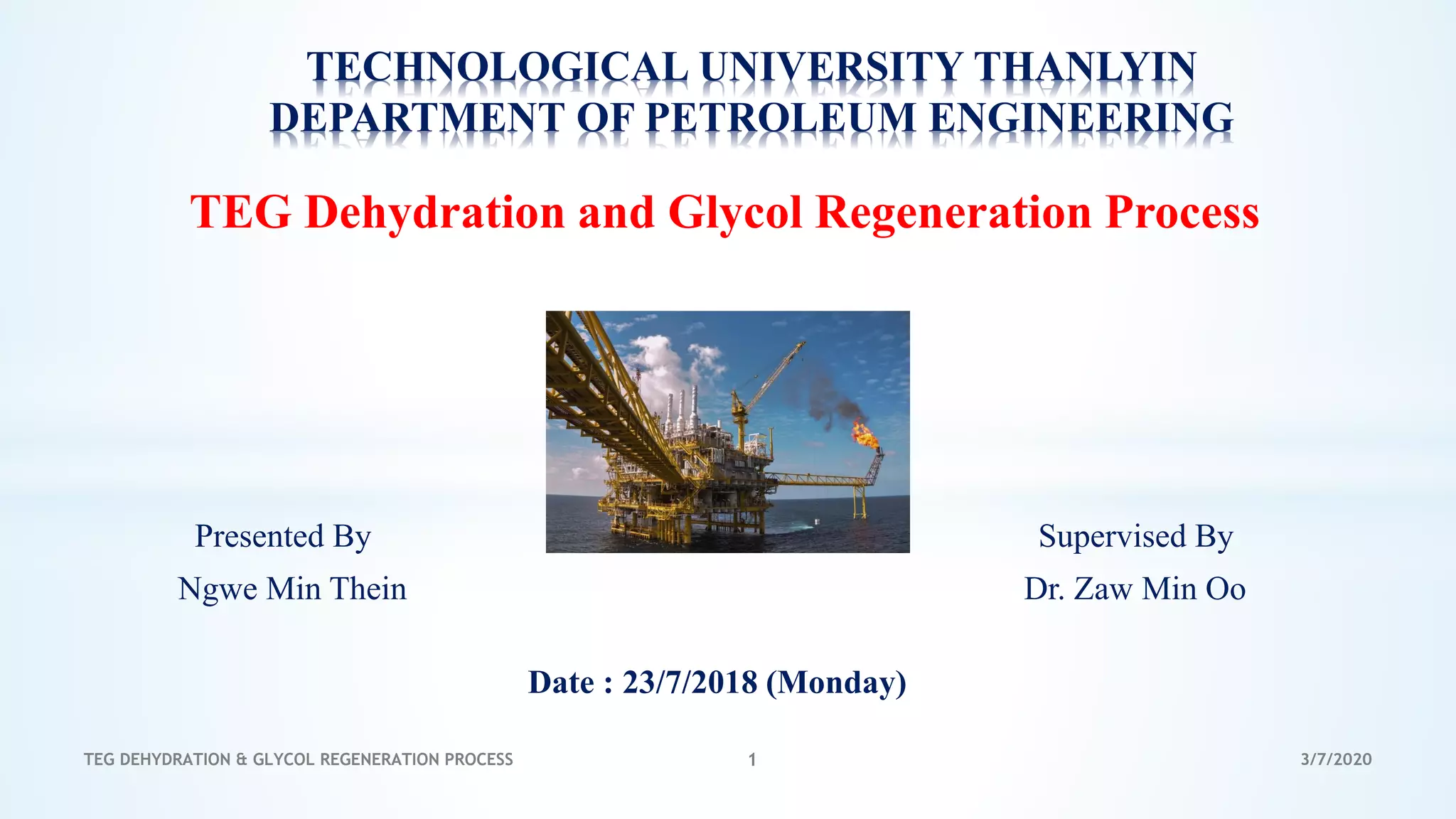
TEG Dehydration and Glycol Regeneration Process
Presented By Supervised By
Ngwe Min Thein Dr. Zaw Min Oo
TECHNOLOGICAL UNIVERSITY THANLYIN
DEPARTMENT OF PETROLEUM ENGINEERING
Date : 23/7/2018 (Monday)
3/7/2020TEG DEHYDRATION & GLYCOL REGENERATION PROCESS 1
Presentation Outline
1. Aim & Objective
2. Solid Adsorption Dehydration
3. Handling Capacity of the Molecular sieve Dehydration unit
4. Tri-Ethylene Glycol Demand For Gas Dehydration Industry
5. The Most Usable Method
6. Roll of Dehydration in the Oil and Gas Production
7. TEG Dehydration & Glycol Regeneration Process Equipment
8. Gas Mole Percent of Total & PTTEP (OGC Result)
9. What is OGC ?
3/7/2020TEG DEHYDRATION & GLYCOL REGENERATION PROCESS 2
Aim and Objective
Aim
➢To known about Tri-Ethylene Glycol Dehydration Equipment.
Objective
➢To known the roll of TEG usage in the natural gas industry
➢ To known about the Process and regeneration equipment.
➢To known about gas Mole percent and GCV relationship.
3/7/2020TEG DEHYDRATION & GLYCOL REGENERATION PROCESS 3
3/7/2020TEG DEHYDRATION & GLYCOL REGENERATION PROCESS 4
Solid Adsorption Method
➢The solid adsorption method is use to dehydrate with solid desiccant .
➢The desiccant material become saturated as moisture is absorbed onto its surface.
➢A good desiccant should therefore have the greatest surface area available for adsorption.
➢The mechanisms of adsorption on a desiccant surface are two types: Physical and chemical.
➢Chemical adsorption processes find very limited application in gas processing.
➢This section considers only physical adsorption, and all reference to adsorption mean physical
adsorption.
➢There are two type of solid adsorption materials, they are
1. Silica gel and
2. Molecular Sieve
3/7/2020TEG DEHYDRATION & GLYCOL REGENERATION PROCESS 5
Solid Adsorption Method
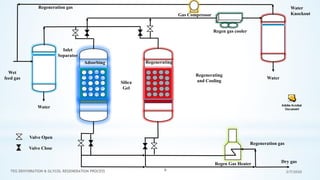
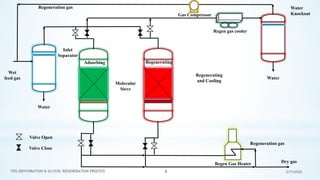
➢The adsorption of water vapor from a gas stream is added a solid to dehydration process.
➢At least two bed type are required for solid adsorption method.
➢Once bed is in adsorption phase and the other is in the regeneration phase.
➢As the bed adsorb water it become saturated, and that portion of the bed can do longer
adsorb water.
➢Once the entire bed is saturated with water, the bed must be regenerated.
6 3/7/2020TEG DEHYDRATION & GLYCOL REGENERATION PROCESS
Gas Compressor
Water
Knockout
Water
Regen gas cooler
Wet
feed gas
Regeneration gas
Dry gas
Regeneration gas
Inlet
Separator
Adsorbing Regenerating
Regenerating
and Cooling
Regen Gas Heater
Valve Open
Valve Close
Water
Silica
Gel
3/7/2020TEG DEHYDRATION & GLYCOL REGENERATION PROCESS 7
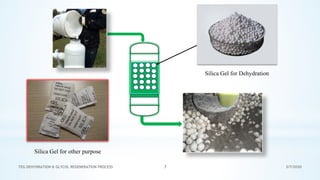
Silica Gel for other purpose
Silica Gel for Dehydration
3/7/2020TEG DEHYDRATION & GLYCOL REGENERATION PROCESS 8
Gas Compressor
Water
Knockout
Water
Regen gas cooler
Wet
feed gas
Regeneration gas
Dry gas
Regeneration gas
Inlet
Separator
Adsorbing Regenerating
Regenerating
and Cooling
Regen Gas Heater
Valve Open
Valve Close
Water
Molecular
Sieve
3/7/2020TEG DEHYDRATION & GLYCOL REGENERATION PROCESS 9
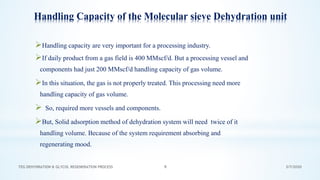
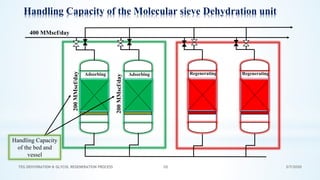
Handling Capacity of the Molecular sieve Dehydration unit
➢Handling capacity are very important for a processing industry.
➢If daily product from a gas field is 400 MMscf/d. But a processing vessel and
components had just 200 MMscf/d handling capacity of gas volume.
➢In this situation, the gas is not properly treated. This processing need more
handling capacity of gas volume.
➢ So, required more vessels and components.
➢But, Solid adsorption method of dehydration system will need twice of it
handling volume. Because of the system requirement absorbing and
regenerating mood.
3/7/2020TEG DEHYDRATION & GLYCOL REGENERATION PROCESS 10
Adsorbing RegeneratingAdsorbing Regenerating
400 MMscf/day
200MMscf/day
200MMscf/day
Handling Capacity
of the bed and
vessel
Handling Capacity of the Molecular sieve Dehydration unit
3/7/2020TEG DEHYDRATION & GLYCOL REGENERATION PROCESS 11
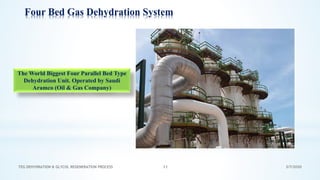
Four Bed Gas Dehydration System
The World Biggest Four Parallel Bed Type
Dehydration Unit. Operated by Saudi
Aramco (Oil & Gas Company)
3/7/2020
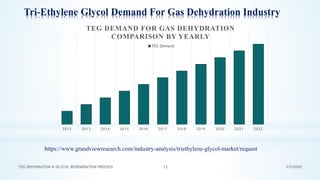
Tri-Ethylene Glycol Demand For Gas Dehydration Industry
2012 2013 2014 2015 2016 2017 2018 2019 2020 2021 2022
TEG DEMAND FOR GAS DEHYDRATION
COMPARISON BY YEARLY
TEG Demand
TEG DEHYDRATION & GLYCOL REGENERATION PROCESS 12
https://www.grandviewresearch.com/industry-analysis/triethylene-glycol-market/request
3/7/2020TEG DEHYDRATION & GLYCOL REGENERATION PROCESS 13
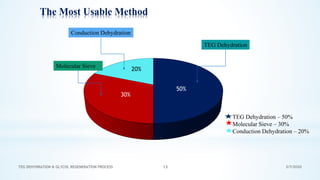
The Most Usable Method
TEG Dehydration
Conduction Dehydration
Molecular Sieve
TEG Dehydration – 50%
Molecular Sieve – 30%
Conduction Dehydration – 20%
50%
30%
20%
3/7/2020TEG DEHYDRATION & GLYCOL REGENERATION PROCESS 14
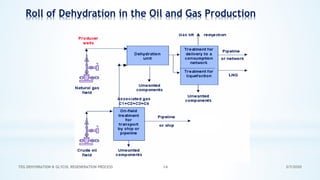
Roll of Dehydration in the Oil and Gas Production
3/7/2020TEG DEHYDRATION & GLYCOL REGENERATION PROCESS 15
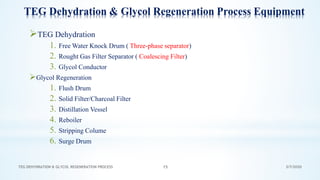
TEG Dehydration & Glycol Regeneration Process Equipment
➢TEG Dehydration
1. Free Water Knock Drum ( Three-phase separator)
2. Rought Gas Filter Separator ( Coalescing Filter)
3. Glycol Conductor
➢Glycol Regeneration
1. Flush Drum
2. Solid Filter/Charcoal Filter
3. Distillation Vessel
4. Reboiler
5. Stripping Colume
6. Surge Drum
3/7/2020TEG DEHYDRATION & GLYCOL REGENERATION PROCESS 16
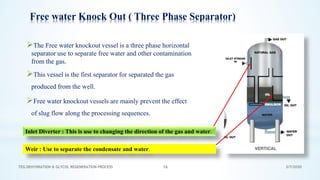
Free water Knock Out ( Three Phase Separator)
➢The Free water knockout vessel is a three phase horizontal
separator use to separate free water and other contamination
from the gas.
➢This vessel is the first separator for separated the gas
produced from the well.
➢Free water knockout vessels are mainly prevent the effect
of slug flow along the processing sequences.
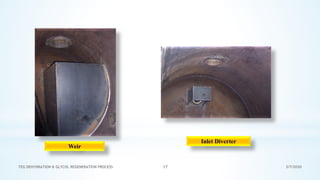
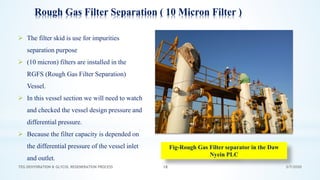
Inlet Diverter : This is use to changing the direction of the gas and water.
Weir : Use to separate the condensate and water.
3/7/2020TEG DEHYDRATION & GLYCOL REGENERATION PROCESS 17
Weir
Inlet Diverter
3/7/2020TEG DEHYDRATION & GLYCOL REGENERATION PROCESS 18
Rough Gas Filter Separation ( 10 Micron Filter )
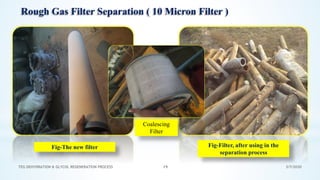
➢ The filter skid is use for impurities
separation purpose
➢ (10 micron) filters are installed in the
RGFS (Rough Gas Filter Separation)
Vessel.
➢ In this vessel section we will need to watch
and checked the vessel design pressure and
differential pressure.
➢ Because the filter capacity is depended on
the differential pressure of the vessel inlet
and outlet.
Fig-Rough Gas Filter separator in the Daw
Nyein PLC
3/7/2020TEG DEHYDRATION & GLYCOL REGENERATION PROCESS 19
Fig-The new filter Fig-Filter, after using in the
separation process
Rough Gas Filter Separation ( 10 Micron Filter )
Coalescing
Filter
3/7/2020TEG DEHYDRATION & GLYCOL REGENERATION PROCESS 20
Glycol Contactor
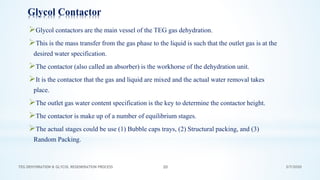
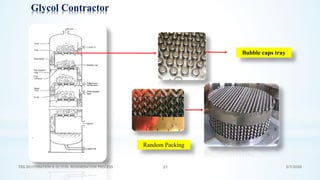
➢Glycol contactors are the main vessel of the TEG gas dehydration.
➢This is the mass transfer from the gas phase to the liquid is such that the outlet gas is at the
desired water specification.
➢The contactor (also called an absorber) is the workhorse of the dehydration unit.
➢It is the contactor that the gas and liquid are mixed and the actual water removal takes
place.
➢The outlet gas water content specification is the key to determine the contactor height.
➢The contactor is make up of a number of equilibrium stages.
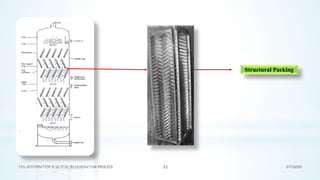
➢The actual stages could be use (1) Bubble caps trays, (2) Structural packing, and (3)
Random Packing.
3/7/2020TEG DEHYDRATION & GLYCOL REGENERATION PROCESS 21
Glycol Contractor
Bubble caps tray
Random Packing
3/7/2020TEG DEHYDRATION & GLYCOL REGENERATION PROCESS 22
Structural Packing
3/7/2020TEG DEHYDRATION & GLYCOL REGENERATION PROCESS 23
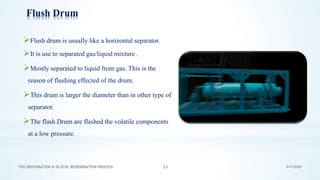
Flush Drum
➢Flush drum is usually like a horizontal separator.
➢It is use to separated gas/liquid mixture .
➢Mostly separated to liquid from gas. This is the
reason of flushing effected of the drum.
➢This drum is larger the diameter than in other type of
separator.
➢The flash Drum are flashed the volatile components
at a low pressure.
3/7/2020TEG DEHYDRATION & GLYCOL REGENERATION PROCESS 24
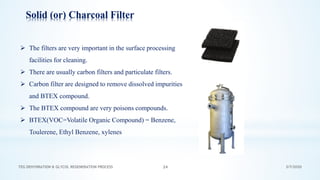
Solid (or) Charcoal Filter
➢ The filters are very important in the surface processing
facilities for cleaning.
➢ There are usually carbon filters and particulate filters.
➢ Carbon filter are designed to remove dissolved impurities
and BTEX compound.
➢ The BTEX compound are very poisons compounds.
➢ BTEX(VOC=Volatile Organic Compound) = Benzene,
Toulerene, Ethyl Benzene, xylenes
3/7/2020TEG DEHYDRATION & GLYCOL REGENERATION PROCESS 25
Distillation Vessel & Reboiler
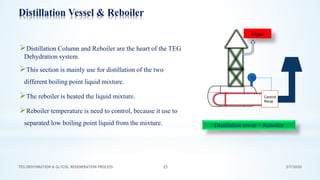
➢Distillation Column and Reboiler are the heart of the TEG
Dehydration system.
➢This section is mainly use for distillation of the two
different boiling point liquid mixture.
➢The reboiler is heated the liquid mixture.
➢Reboiler temperature is need to control, because it use to
separated low boiling point liquid from the mixture.
Control
Penal
TC
Distillation tower + Reboiler
Vapor
3/7/2020TEG DEHYDRATION & GLYCOL REGENERATION PROCESS 26
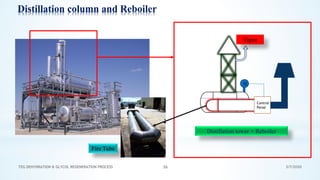
Distillation column and Reboiler
Control
Penal
TC
Distillation tower + Reboiler
Vapor
Fire Tube
3/7/2020TEG DEHYDRATION & GLYCOL REGENERATION PROCESS 27
Stripping Column
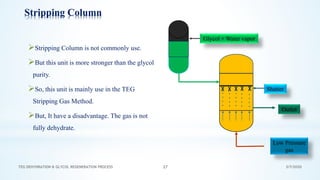
➢Stripping Column is not commonly use.
➢But this unit is more stronger than the glycol
purity.
➢So, this unit is mainly use in the TEG
Stripping Gas Method.
➢But, It have a disadvantage. The gas is not
fully dehydrate.
Low Pressure
gas
Glycol + Water vapor
Shatter
Outlet
3/7/2020TEG DEHYDRATION & GLYCOL REGENERATION PROCESS 28
Surge Drum
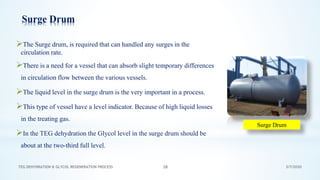
➢The Surge drum, is required that can handled any surges in the
circulation rate.
➢There is a need for a vessel that can absorb slight temporary differences
in circulation flow between the various vessels.
➢The liquid level in the surge drum is the very important in a process.
➢This type of vessel have a level indicator. Because of high liquid losses
in the treating gas.
➢In the TEG dehydration the Glycol level in the surge drum should be
about at the two-third full level.
Surge Drum
3/7/2020TEG DEHYDRATION & GLYCOL REGENERATION PROCESS 29
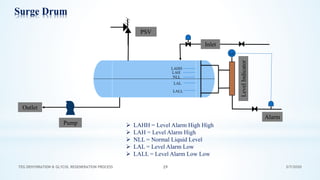
Surge Drum
Inlet
Outlet
LevelIndicator
LI
LAHH
LAH
NLL
LAL
LALL
➢ LAHH = Level Alarm High High
➢ LAH = Level Alarm High
➢ NLL = Normal Liquid Level
➢ LAL = Level Alarm Low
➢ LALL = Level Alarm Low Low
Alarm
PSV
Pump
3/7/2020TEG DEHYDRATION & GLYCOL REGENERATION PROCESS 30
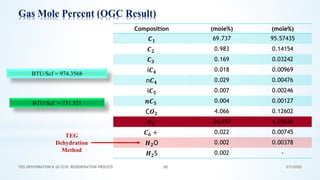
Gas Mole Percent (OGC Result)
Composition (mole%) (mole%)
𝑪 𝟏 69.737 95.57435
𝑪 𝟐 0.983 0.14154
𝑪 𝟑 0.169 0.03242
i𝑪 𝟒 0.018 0.00969
n𝑪 𝟒 0.029 0.00476
i𝑪 𝟓 0.007 0.00246
𝒏𝑪 𝟓 0.004 0.00127
C𝑶 𝟐 4.066 0.12602
𝑵 𝟐 24.957 4.09626
𝑪 𝟔 + 0.022 0.00745
𝑯 𝟐O 0.002 0.00378
𝑯 𝟐S 0.002 -
BTU/Scf = 731.321
BTU/Scf = 974.3568
TEG
Dehydration
Method
3/7/2020TEG DEHYDRATION & GLYCOL REGENERATION PROCESS 31
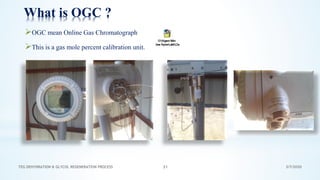
What is OGC ?
➢OGC mean Online Gas Chromatograph
➢This is a gas mole percent calibration unit.
3/7/2020TEG DEHYDRATION & GLYCOL REGENERATION PROCESS 32
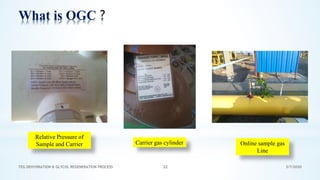
What is OGC
Online sample gas
Line
Carrier gas cylinder
Relative Pressure of
Sample and Carrier
3/7/2020TEG DEHYDRATION & GLYCOL REGENERATION PROCESS 33
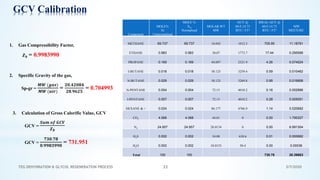
1. Gas Compressibility Factor,
𝒁 𝒃 = 0.9983990
2. Specific Gravity of the gas,
Sp-gr =
𝑴𝑾 (𝒈𝒂𝒔)
𝑴𝑾 (𝒂𝒊𝒓)
=
𝟐𝟎.𝟒𝟐𝟎𝟖𝟒
𝟐𝟖.𝟗𝟔𝟐𝟓
= 0.704993
Component
MOLE%
Xi
Unmormalised
MOLE %
Xin
Normalised
MOLAR-WT
MW
GCV @
60-F,14.73
BTU / FT3
IDEAL GCV @
60-F,14.73
BTU / FT3
MW
MIXTURE
METHANE 69.737 69.737 16.043 1012.3 705.95 11.18791
ETHANE 0.983 0.983 30.07 1773.7 17.44 0.295588
PROPANE 0.169 0.169 44.097 2521.9 4.26 0.074524
I-BUTANE 0.018 0.018 58.123 3259.4 0.59 0.010462
N-BUTANE 0.029 0.029 58.123 3269.8 0.95 0.016856
N-PENTANE 0.004 0.004 72.15 4018.2 0.16 0.002886
I-PENTANE 0.007 0.007 72.15 4010.2 0.28 0.005051
HEXANE & > 0.024 0.024 86.177 4766.9 1.14 0.020682
CO2 4.068 4.068 44.01 0 0.00 1.790327
N2 24.957 24.957 28.0134 0 0.00 6.991304
H2S 0.002 0.002 34.08 638.6 0.01 0.000682
H2O 0.002 0.002 18.0153 50.4 0.00 0.00036
Total 100 100 730.78 20.39663
3. Calculation of Gross Calorific Value, GCV
GCV =
𝑺𝒖𝒎 𝒐𝒇 𝑮𝑪𝑽
𝒁 𝒃
GCV =
𝟕𝟑𝟎.𝟕𝟖
𝟎.𝟗𝟗𝟖𝟑𝟗𝟗𝟎
= 731.951
GCV Calibration
3/7/2020TEG DEHYDRATION & GLYCOL REGENERATION PROCESS 34
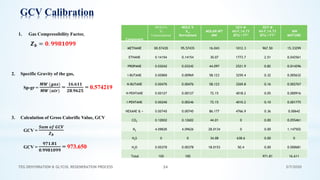
GCV Calibration
1. Gas Compressibility Factor,
𝒁 𝒃 = 𝟎. 𝟗𝟗𝟖𝟏𝟎𝟗𝟗
2. Specific Gravity of the gas,
Sp-gr =
𝑴𝑾 (𝒈𝒂𝒔)
𝑴𝑾 (𝒂𝒊𝒓)
=
𝟏𝟔.𝟔𝟏𝟏
𝟐𝟖.𝟗𝟔𝟐𝟓
= 0.574219
Component
MOLE%
Xi
Unmormalised
MOLE %
Xin
Normalised
MOLAR-WT
MW
GCV @
60-F,14.73
BTU / FT3
GCV @
60-F,14.73
BTU / FT3
MW
MIXTURE
METHANE 95.57435 95.57435 16.043 1012.3 967.50 15.33299
ETHANE 0.14154 0.14154 30.07 1773.7 2.51 0.042561
PROPANE 0.03242 0.03242 44.097 2521.9 0.82 0.014296
I-BUTANE 0.00969 0.00969 58.123 3259.4 0.32 0.005632
N-BUTANE 0.00476 0.00476 58.123 3269.8 0.16 0.002767
N-PENTANE 0.00127 0.00127 72.15 4018.2 0.05 0.000916
I-PENTANE 0.00246 0.00246 72.15 4010.2 0.10 0.001775
HEXANE & > 0.00745 0.00745 86.177 4766.9 0.36 0.00642
CO2 0.12602 0.12602 44.01 0 0.00 0.055461
N2 4.09626 4.09626 28.0134 0 0.00 1.147502
H2S 0 0 34.08 638.6 0.00 0
H2O 0.00378 0.00378 18.0153 50.4 0.00 0.000681
Total 100 100 971.81 16.611
3. Calculation of Gross Calorific Value, GCV
GCV =
𝑺𝒖𝒎 𝒐𝒇 𝑮𝑪𝑽
𝒁 𝒃
GCV =
𝟗𝟕𝟏.𝟖𝟏
𝟎.𝟗𝟗𝟖𝟏𝟎𝟗𝟗
= 973.650
3/7/2020TEG DEHYDRATION & GLYCOL REGENERATION PROCESS 35
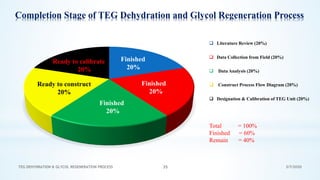
Completion Stage of TEG Dehydration and Glycol Regeneration Process
Ready to construct
20%
Finished
20%
❑ Literature Review (20%)
❑ Data Collection from Field (20%)
❑ Data Analysis (20%)
❑ Construct Process Flow Diagram (20%)
❑ Designation & Calibration of TEG Unit (20%)
Finished
20%
Finished
20%
Ready to calibrate
20%
Total = 100%
Finished = 60%
Remain = 40%
3/7/2020TEG DEHYDRATION & GLYCOL REGENERATION PROCESS 36
Thank You For Your Attention
Q & A

Basic-TEG Dehydration Glycol Regeneration Process

  • 1.
    TEG Dehydration andGlycol Regeneration Process Presented By Supervised By Ngwe Min Thein Dr. Zaw Min Oo TECHNOLOGICAL UNIVERSITY THANLYIN DEPARTMENT OF PETROLEUM ENGINEERING Date : 23/7/2018 (Monday) 3/7/2020TEG DEHYDRATION & GLYCOL REGENERATION PROCESS 1
  • 2.
    Presentation Outline 1. Aim& Objective 2. Solid Adsorption Dehydration 3. Handling Capacity of the Molecular sieve Dehydration unit 4. Tri-Ethylene Glycol Demand For Gas Dehydration Industry 5. The Most Usable Method 6. Roll of Dehydration in the Oil and Gas Production 7. TEG Dehydration & Glycol Regeneration Process Equipment 8. Gas Mole Percent of Total & PTTEP (OGC Result) 9. What is OGC ? 3/7/2020TEG DEHYDRATION & GLYCOL REGENERATION PROCESS 2
  • 3.
    Aim and Objective Aim ➢Toknown about Tri-Ethylene Glycol Dehydration Equipment. Objective ➢To known the roll of TEG usage in the natural gas industry ➢ To known about the Process and regeneration equipment. ➢To known about gas Mole percent and GCV relationship. 3/7/2020TEG DEHYDRATION & GLYCOL REGENERATION PROCESS 3
  • 4.
    3/7/2020TEG DEHYDRATION &GLYCOL REGENERATION PROCESS 4 Solid Adsorption Method ➢The solid adsorption method is use to dehydrate with solid desiccant . ➢The desiccant material become saturated as moisture is absorbed onto its surface. ➢A good desiccant should therefore have the greatest surface area available for adsorption. ➢The mechanisms of adsorption on a desiccant surface are two types: Physical and chemical. ➢Chemical adsorption processes find very limited application in gas processing. ➢This section considers only physical adsorption, and all reference to adsorption mean physical adsorption. ➢There are two type of solid adsorption materials, they are 1. Silica gel and 2. Molecular Sieve
  • 5.
    3/7/2020TEG DEHYDRATION &GLYCOL REGENERATION PROCESS 5 Solid Adsorption Method ➢The adsorption of water vapor from a gas stream is added a solid to dehydration process. ➢At least two bed type are required for solid adsorption method. ➢Once bed is in adsorption phase and the other is in the regeneration phase. ➢As the bed adsorb water it become saturated, and that portion of the bed can do longer adsorb water. ➢Once the entire bed is saturated with water, the bed must be regenerated.
  • 6.
    6 3/7/2020TEG DEHYDRATION& GLYCOL REGENERATION PROCESS Gas Compressor Water Knockout Water Regen gas cooler Wet feed gas Regeneration gas Dry gas Regeneration gas Inlet Separator Adsorbing Regenerating Regenerating and Cooling Regen Gas Heater Valve Open Valve Close Water Silica Gel
  • 7.
    3/7/2020TEG DEHYDRATION &GLYCOL REGENERATION PROCESS 7 Silica Gel for other purpose Silica Gel for Dehydration
  • 8.
    3/7/2020TEG DEHYDRATION &GLYCOL REGENERATION PROCESS 8 Gas Compressor Water Knockout Water Regen gas cooler Wet feed gas Regeneration gas Dry gas Regeneration gas Inlet Separator Adsorbing Regenerating Regenerating and Cooling Regen Gas Heater Valve Open Valve Close Water Molecular Sieve
  • 9.
    3/7/2020TEG DEHYDRATION &GLYCOL REGENERATION PROCESS 9 Handling Capacity of the Molecular sieve Dehydration unit ➢Handling capacity are very important for a processing industry. ➢If daily product from a gas field is 400 MMscf/d. But a processing vessel and components had just 200 MMscf/d handling capacity of gas volume. ➢In this situation, the gas is not properly treated. This processing need more handling capacity of gas volume. ➢ So, required more vessels and components. ➢But, Solid adsorption method of dehydration system will need twice of it handling volume. Because of the system requirement absorbing and regenerating mood.
  • 10.
    3/7/2020TEG DEHYDRATION &GLYCOL REGENERATION PROCESS 10 Adsorbing RegeneratingAdsorbing Regenerating 400 MMscf/day 200MMscf/day 200MMscf/day Handling Capacity of the bed and vessel Handling Capacity of the Molecular sieve Dehydration unit
  • 11.
    3/7/2020TEG DEHYDRATION &GLYCOL REGENERATION PROCESS 11 Four Bed Gas Dehydration System The World Biggest Four Parallel Bed Type Dehydration Unit. Operated by Saudi Aramco (Oil & Gas Company)
  • 12.
    3/7/2020 Tri-Ethylene Glycol DemandFor Gas Dehydration Industry 2012 2013 2014 2015 2016 2017 2018 2019 2020 2021 2022 TEG DEMAND FOR GAS DEHYDRATION COMPARISON BY YEARLY TEG Demand TEG DEHYDRATION & GLYCOL REGENERATION PROCESS 12 https://www.grandviewresearch.com/industry-analysis/triethylene-glycol-market/request
  • 13.
    3/7/2020TEG DEHYDRATION &GLYCOL REGENERATION PROCESS 13 The Most Usable Method TEG Dehydration Conduction Dehydration Molecular Sieve TEG Dehydration – 50% Molecular Sieve – 30% Conduction Dehydration – 20% 50% 30% 20%
  • 14.
    3/7/2020TEG DEHYDRATION &GLYCOL REGENERATION PROCESS 14 Roll of Dehydration in the Oil and Gas Production
  • 15.
    3/7/2020TEG DEHYDRATION &GLYCOL REGENERATION PROCESS 15 TEG Dehydration & Glycol Regeneration Process Equipment ➢TEG Dehydration 1. Free Water Knock Drum ( Three-phase separator) 2. Rought Gas Filter Separator ( Coalescing Filter) 3. Glycol Conductor ➢Glycol Regeneration 1. Flush Drum 2. Solid Filter/Charcoal Filter 3. Distillation Vessel 4. Reboiler 5. Stripping Colume 6. Surge Drum
  • 16.
    3/7/2020TEG DEHYDRATION &GLYCOL REGENERATION PROCESS 16 Free water Knock Out ( Three Phase Separator) ➢The Free water knockout vessel is a three phase horizontal separator use to separate free water and other contamination from the gas. ➢This vessel is the first separator for separated the gas produced from the well. ➢Free water knockout vessels are mainly prevent the effect of slug flow along the processing sequences. Inlet Diverter : This is use to changing the direction of the gas and water. Weir : Use to separate the condensate and water.
  • 17.
    3/7/2020TEG DEHYDRATION &GLYCOL REGENERATION PROCESS 17 Weir Inlet Diverter
  • 18.
    3/7/2020TEG DEHYDRATION &GLYCOL REGENERATION PROCESS 18 Rough Gas Filter Separation ( 10 Micron Filter ) ➢ The filter skid is use for impurities separation purpose ➢ (10 micron) filters are installed in the RGFS (Rough Gas Filter Separation) Vessel. ➢ In this vessel section we will need to watch and checked the vessel design pressure and differential pressure. ➢ Because the filter capacity is depended on the differential pressure of the vessel inlet and outlet. Fig-Rough Gas Filter separator in the Daw Nyein PLC
  • 19.
    3/7/2020TEG DEHYDRATION &GLYCOL REGENERATION PROCESS 19 Fig-The new filter Fig-Filter, after using in the separation process Rough Gas Filter Separation ( 10 Micron Filter ) Coalescing Filter
  • 20.
    3/7/2020TEG DEHYDRATION &GLYCOL REGENERATION PROCESS 20 Glycol Contactor ➢Glycol contactors are the main vessel of the TEG gas dehydration. ➢This is the mass transfer from the gas phase to the liquid is such that the outlet gas is at the desired water specification. ➢The contactor (also called an absorber) is the workhorse of the dehydration unit. ➢It is the contactor that the gas and liquid are mixed and the actual water removal takes place. ➢The outlet gas water content specification is the key to determine the contactor height. ➢The contactor is make up of a number of equilibrium stages. ➢The actual stages could be use (1) Bubble caps trays, (2) Structural packing, and (3) Random Packing.
  • 21.
    3/7/2020TEG DEHYDRATION &GLYCOL REGENERATION PROCESS 21 Glycol Contractor Bubble caps tray Random Packing
  • 22.
    3/7/2020TEG DEHYDRATION &GLYCOL REGENERATION PROCESS 22 Structural Packing
  • 23.
    3/7/2020TEG DEHYDRATION &GLYCOL REGENERATION PROCESS 23 Flush Drum ➢Flush drum is usually like a horizontal separator. ➢It is use to separated gas/liquid mixture . ➢Mostly separated to liquid from gas. This is the reason of flushing effected of the drum. ➢This drum is larger the diameter than in other type of separator. ➢The flash Drum are flashed the volatile components at a low pressure.
  • 24.
    3/7/2020TEG DEHYDRATION &GLYCOL REGENERATION PROCESS 24 Solid (or) Charcoal Filter ➢ The filters are very important in the surface processing facilities for cleaning. ➢ There are usually carbon filters and particulate filters. ➢ Carbon filter are designed to remove dissolved impurities and BTEX compound. ➢ The BTEX compound are very poisons compounds. ➢ BTEX(VOC=Volatile Organic Compound) = Benzene, Toulerene, Ethyl Benzene, xylenes
  • 25.
    3/7/2020TEG DEHYDRATION &GLYCOL REGENERATION PROCESS 25 Distillation Vessel & Reboiler ➢Distillation Column and Reboiler are the heart of the TEG Dehydration system. ➢This section is mainly use for distillation of the two different boiling point liquid mixture. ➢The reboiler is heated the liquid mixture. ➢Reboiler temperature is need to control, because it use to separated low boiling point liquid from the mixture. Control Penal TC Distillation tower + Reboiler Vapor
  • 26.
    3/7/2020TEG DEHYDRATION &GLYCOL REGENERATION PROCESS 26 Distillation column and Reboiler Control Penal TC Distillation tower + Reboiler Vapor Fire Tube
  • 27.
    3/7/2020TEG DEHYDRATION &GLYCOL REGENERATION PROCESS 27 Stripping Column ➢Stripping Column is not commonly use. ➢But this unit is more stronger than the glycol purity. ➢So, this unit is mainly use in the TEG Stripping Gas Method. ➢But, It have a disadvantage. The gas is not fully dehydrate. Low Pressure gas Glycol + Water vapor Shatter Outlet
  • 28.
    3/7/2020TEG DEHYDRATION &GLYCOL REGENERATION PROCESS 28 Surge Drum ➢The Surge drum, is required that can handled any surges in the circulation rate. ➢There is a need for a vessel that can absorb slight temporary differences in circulation flow between the various vessels. ➢The liquid level in the surge drum is the very important in a process. ➢This type of vessel have a level indicator. Because of high liquid losses in the treating gas. ➢In the TEG dehydration the Glycol level in the surge drum should be about at the two-third full level. Surge Drum
  • 29.
    3/7/2020TEG DEHYDRATION &GLYCOL REGENERATION PROCESS 29 Surge Drum Inlet Outlet LevelIndicator LI LAHH LAH NLL LAL LALL ➢ LAHH = Level Alarm High High ➢ LAH = Level Alarm High ➢ NLL = Normal Liquid Level ➢ LAL = Level Alarm Low ➢ LALL = Level Alarm Low Low Alarm PSV Pump
  • 30.
    3/7/2020TEG DEHYDRATION &GLYCOL REGENERATION PROCESS 30 Gas Mole Percent (OGC Result) Composition (mole%) (mole%) 𝑪 𝟏 69.737 95.57435 𝑪 𝟐 0.983 0.14154 𝑪 𝟑 0.169 0.03242 i𝑪 𝟒 0.018 0.00969 n𝑪 𝟒 0.029 0.00476 i𝑪 𝟓 0.007 0.00246 𝒏𝑪 𝟓 0.004 0.00127 C𝑶 𝟐 4.066 0.12602 𝑵 𝟐 24.957 4.09626 𝑪 𝟔 + 0.022 0.00745 𝑯 𝟐O 0.002 0.00378 𝑯 𝟐S 0.002 - BTU/Scf = 731.321 BTU/Scf = 974.3568 TEG Dehydration Method
  • 31.
    3/7/2020TEG DEHYDRATION &GLYCOL REGENERATION PROCESS 31 What is OGC ? ➢OGC mean Online Gas Chromatograph ➢This is a gas mole percent calibration unit.
  • 32.
    3/7/2020TEG DEHYDRATION &GLYCOL REGENERATION PROCESS 32 What is OGC Online sample gas Line Carrier gas cylinder Relative Pressure of Sample and Carrier
  • 33.
    3/7/2020TEG DEHYDRATION &GLYCOL REGENERATION PROCESS 33 1. Gas Compressibility Factor, 𝒁 𝒃 = 0.9983990 2. Specific Gravity of the gas, Sp-gr = 𝑴𝑾 (𝒈𝒂𝒔) 𝑴𝑾 (𝒂𝒊𝒓) = 𝟐𝟎.𝟒𝟐𝟎𝟖𝟒 𝟐𝟖.𝟗𝟔𝟐𝟓 = 0.704993 Component MOLE% Xi Unmormalised MOLE % Xin Normalised MOLAR-WT MW GCV @ 60-F,14.73 BTU / FT3 IDEAL GCV @ 60-F,14.73 BTU / FT3 MW MIXTURE METHANE 69.737 69.737 16.043 1012.3 705.95 11.18791 ETHANE 0.983 0.983 30.07 1773.7 17.44 0.295588 PROPANE 0.169 0.169 44.097 2521.9 4.26 0.074524 I-BUTANE 0.018 0.018 58.123 3259.4 0.59 0.010462 N-BUTANE 0.029 0.029 58.123 3269.8 0.95 0.016856 N-PENTANE 0.004 0.004 72.15 4018.2 0.16 0.002886 I-PENTANE 0.007 0.007 72.15 4010.2 0.28 0.005051 HEXANE & > 0.024 0.024 86.177 4766.9 1.14 0.020682 CO2 4.068 4.068 44.01 0 0.00 1.790327 N2 24.957 24.957 28.0134 0 0.00 6.991304 H2S 0.002 0.002 34.08 638.6 0.01 0.000682 H2O 0.002 0.002 18.0153 50.4 0.00 0.00036 Total 100 100 730.78 20.39663 3. Calculation of Gross Calorific Value, GCV GCV = 𝑺𝒖𝒎 𝒐𝒇 𝑮𝑪𝑽 𝒁 𝒃 GCV = 𝟕𝟑𝟎.𝟕𝟖 𝟎.𝟗𝟗𝟖𝟑𝟗𝟗𝟎 = 731.951 GCV Calibration
  • 34.
    3/7/2020TEG DEHYDRATION &GLYCOL REGENERATION PROCESS 34 GCV Calibration 1. Gas Compressibility Factor, 𝒁 𝒃 = 𝟎. 𝟗𝟗𝟖𝟏𝟎𝟗𝟗 2. Specific Gravity of the gas, Sp-gr = 𝑴𝑾 (𝒈𝒂𝒔) 𝑴𝑾 (𝒂𝒊𝒓) = 𝟏𝟔.𝟔𝟏𝟏 𝟐𝟖.𝟗𝟔𝟐𝟓 = 0.574219 Component MOLE% Xi Unmormalised MOLE % Xin Normalised MOLAR-WT MW GCV @ 60-F,14.73 BTU / FT3 GCV @ 60-F,14.73 BTU / FT3 MW MIXTURE METHANE 95.57435 95.57435 16.043 1012.3 967.50 15.33299 ETHANE 0.14154 0.14154 30.07 1773.7 2.51 0.042561 PROPANE 0.03242 0.03242 44.097 2521.9 0.82 0.014296 I-BUTANE 0.00969 0.00969 58.123 3259.4 0.32 0.005632 N-BUTANE 0.00476 0.00476 58.123 3269.8 0.16 0.002767 N-PENTANE 0.00127 0.00127 72.15 4018.2 0.05 0.000916 I-PENTANE 0.00246 0.00246 72.15 4010.2 0.10 0.001775 HEXANE & > 0.00745 0.00745 86.177 4766.9 0.36 0.00642 CO2 0.12602 0.12602 44.01 0 0.00 0.055461 N2 4.09626 4.09626 28.0134 0 0.00 1.147502 H2S 0 0 34.08 638.6 0.00 0 H2O 0.00378 0.00378 18.0153 50.4 0.00 0.000681 Total 100 100 971.81 16.611 3. Calculation of Gross Calorific Value, GCV GCV = 𝑺𝒖𝒎 𝒐𝒇 𝑮𝑪𝑽 𝒁 𝒃 GCV = 𝟗𝟕𝟏.𝟖𝟏 𝟎.𝟗𝟗𝟖𝟏𝟎𝟗𝟗 = 973.650
  • 35.
    3/7/2020TEG DEHYDRATION &GLYCOL REGENERATION PROCESS 35 Completion Stage of TEG Dehydration and Glycol Regeneration Process Ready to construct 20% Finished 20% ❑ Literature Review (20%) ❑ Data Collection from Field (20%) ❑ Data Analysis (20%) ❑ Construct Process Flow Diagram (20%) ❑ Designation & Calibration of TEG Unit (20%) Finished 20% Finished 20% Ready to calibrate 20% Total = 100% Finished = 60% Remain = 40%
  • 36.
    3/7/2020TEG DEHYDRATION &GLYCOL REGENERATION PROCESS 36 Thank You For Your Attention Q & A