Well Injection
  According to the International Energy
   Agency’s Greenhouse Gas Program
findings, conventional recovery by water
     removal produces about half the
    methane adsorbed onto the coal.
Tiffany Project
•   Amoco Production Co., now part of BP, conducted the Tiffany project in the 1990s on its CBM
    properties in southern Colorado. Company engineers reasoned that nitrogen injection would
    improve recovery from the coal since nitrogen has twice as great an affinity for San Juan Basin
    coals as methane. In addition, the sweep of the nitrogen front through the formation would push
    the released methane to the production wells.
    According to an Advanced Resources International study of EGR, if the nitrogen flushes the
    methane, it can reach a saturation of almost 100% on the coal.
    This is not an inexpensive technique. Even though air is mostly nitrogen, a nitrogen generator
    must create nitrogen with high enough quality for an effective sweep, and nitrogen produced with
    the methane must be separated, treated and reinjected.
    Amoco started the project after the group of wells had produced conventionally for 9 years. It
    drilled 10 new directional wells in January 1998 and in December of that year converted two
    producing wells to injectors. It injected 22 MMcf/d to 28 MMcf/d of nitrogen into the 12 wells.
    Before the injection, the project wells produced 5 MMcf/d of gas from 34 wells. The speed of the
    nitrogen action was immediately evident as well production peaked at 29 MMcf/d of gas, a five-
    fold increase, in March 1999.
    Now, the company is studying the potential of adding CO2 injection to the already-generated
    nitrogen.
Allison Project
• In its Allison project in New Mexico, Burlington Northern, now part of
  ConocoPhillips, injected CO2 and shut in five producing wells for 6
  months to let the CO2 “soak” and give the CO2 and methane a
  chance to change places.
   The company reasoned CO2 has four times the affinity for coal that
   methane has, and it should displace the methane from the coal.
   After 6 months, the company opened the production wells and saw
   an immediate increase in water production. The company also
   found a 0.6% concentration of CO2 after injection compared with
   0.4% before injection.
   The company injected 4.7 Bcf of CO2 into the partially dewatered
   coals and got a 1.5 Bcf incremental increase in methane production.
   About 4.2 Bcf of the CO2 remained adsorbed on the coal.
Economics
•   Advanced Resources International came up with a calculation for base
    methane recovery and recovery with nitrogen and CO2 individually in a
    conceptual five-spot recovery pattern.
    Base recovery with no enhanced mechanisms was 1.171 Bcf of gas.
    Recovery with nitrogen rose to 2.933 Bcf, and recovery with CO2 was in
    between at 2.147 Bcf. In other words, incremental recovery with nitrogen
    more than doubled recovery from the pattern, and the CO2 injection nearly
    doubled the production.
    The US Environmental Protection Agency (EPA) offered a look at the
    economics of a 100-well CO2 injection project, assuming a wellhead price of
    US $2/Mcf for the CBM and assuming the cost of drilling the production
    wells and the infrastructure already had been sunk in the conventional
    production phase. It estimated an undiscounted cash flow of $1.l6 to
    $1.36/Mcf of gas at a 40% recovery. A new project with new production
    wells and infrastructure would lower cash flow by $0.13 to $0.20/Mcf,
    leaving the operator a profit between $0.96 and $1.23/Mcf, undiscounted.
Combining CO2 & Nitrogen
•   Given the qualities of both CO2 and nitrogen in improving CSG production
    and given the potential of coal to adsorb four times as much CO2 as
    methane in a world looking for ways to get rid of greenhouse gases, a
    combination of the two technologies was a natural extension.

    Advanced Resources International, and later the Alberta Research Council
    in Canada, speculated on the value of combining the technologies using flue
    gas from coal-fired power plants, which contains both gases.
    The CO2 remains adsorbed to the coal, and most of the nitrogen returns to
    the surface in the methane stream.
    Utility companies also try to build power plants near the power source, in
    this case coal. That opens another attractive alternative. An operator could
    collect flue gas from a coal-fired power plant, use the gas to enhance
    recovery from the coal beds and use the produced methane for cleaner
    industrial utility power.
Real World Tests
• A one-well test in the south Qinshui Basin in
  Shanxi Province in northern China showed the
  coal was stable and permeable enough to
  adsorb CO2 and increase methane production.
  In related activity, the Asia Canada Energy Inc.
  subsidiary of Pacific Asia China Energy Inc. and
  the Alberta Research Council started a
  cooperative research study to evaluate EGR
  potential in the company’s coalbed methane
  concession in Guizhou Province in China.
Why Docklands Science Park?
• Question remaining

 A CBM enhanced recovery conference in
 Boulder, Colo., revealed that operators had no
 problem with the mechanics of injecting CO2,
 nitrogen or flue gas into coal seams.
 The big question centred on the economics of
 gathering, processing and treating the gases to
 get them ready for injection.
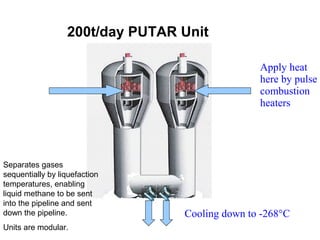
200t/day PUTAR Unit

                                                Apply heat
                                                here by pulse
                                                combustion
                                                heaters


Separates gases
sequentially by liquefaction
temperatures, enabling
liquid methane to be sent
into the pipeline and sent
down the pipeline.               Cooling down to -268°C
Units are modular.

Well injection

  • 1.
    Well Injection According to the International Energy Agency’s Greenhouse Gas Program findings, conventional recovery by water removal produces about half the methane adsorbed onto the coal.
  • 2.
    Tiffany Project • Amoco Production Co., now part of BP, conducted the Tiffany project in the 1990s on its CBM properties in southern Colorado. Company engineers reasoned that nitrogen injection would improve recovery from the coal since nitrogen has twice as great an affinity for San Juan Basin coals as methane. In addition, the sweep of the nitrogen front through the formation would push the released methane to the production wells. According to an Advanced Resources International study of EGR, if the nitrogen flushes the methane, it can reach a saturation of almost 100% on the coal. This is not an inexpensive technique. Even though air is mostly nitrogen, a nitrogen generator must create nitrogen with high enough quality for an effective sweep, and nitrogen produced with the methane must be separated, treated and reinjected. Amoco started the project after the group of wells had produced conventionally for 9 years. It drilled 10 new directional wells in January 1998 and in December of that year converted two producing wells to injectors. It injected 22 MMcf/d to 28 MMcf/d of nitrogen into the 12 wells. Before the injection, the project wells produced 5 MMcf/d of gas from 34 wells. The speed of the nitrogen action was immediately evident as well production peaked at 29 MMcf/d of gas, a five- fold increase, in March 1999. Now, the company is studying the potential of adding CO2 injection to the already-generated nitrogen.
  • 3.
    Allison Project • Inits Allison project in New Mexico, Burlington Northern, now part of ConocoPhillips, injected CO2 and shut in five producing wells for 6 months to let the CO2 “soak” and give the CO2 and methane a chance to change places. The company reasoned CO2 has four times the affinity for coal that methane has, and it should displace the methane from the coal. After 6 months, the company opened the production wells and saw an immediate increase in water production. The company also found a 0.6% concentration of CO2 after injection compared with 0.4% before injection. The company injected 4.7 Bcf of CO2 into the partially dewatered coals and got a 1.5 Bcf incremental increase in methane production. About 4.2 Bcf of the CO2 remained adsorbed on the coal.
  • 4.
    Economics • Advanced Resources International came up with a calculation for base methane recovery and recovery with nitrogen and CO2 individually in a conceptual five-spot recovery pattern. Base recovery with no enhanced mechanisms was 1.171 Bcf of gas. Recovery with nitrogen rose to 2.933 Bcf, and recovery with CO2 was in between at 2.147 Bcf. In other words, incremental recovery with nitrogen more than doubled recovery from the pattern, and the CO2 injection nearly doubled the production. The US Environmental Protection Agency (EPA) offered a look at the economics of a 100-well CO2 injection project, assuming a wellhead price of US $2/Mcf for the CBM and assuming the cost of drilling the production wells and the infrastructure already had been sunk in the conventional production phase. It estimated an undiscounted cash flow of $1.l6 to $1.36/Mcf of gas at a 40% recovery. A new project with new production wells and infrastructure would lower cash flow by $0.13 to $0.20/Mcf, leaving the operator a profit between $0.96 and $1.23/Mcf, undiscounted.
  • 5.
    Combining CO2 &Nitrogen • Given the qualities of both CO2 and nitrogen in improving CSG production and given the potential of coal to adsorb four times as much CO2 as methane in a world looking for ways to get rid of greenhouse gases, a combination of the two technologies was a natural extension. Advanced Resources International, and later the Alberta Research Council in Canada, speculated on the value of combining the technologies using flue gas from coal-fired power plants, which contains both gases. The CO2 remains adsorbed to the coal, and most of the nitrogen returns to the surface in the methane stream. Utility companies also try to build power plants near the power source, in this case coal. That opens another attractive alternative. An operator could collect flue gas from a coal-fired power plant, use the gas to enhance recovery from the coal beds and use the produced methane for cleaner industrial utility power.
  • 6.
    Real World Tests •A one-well test in the south Qinshui Basin in Shanxi Province in northern China showed the coal was stable and permeable enough to adsorb CO2 and increase methane production. In related activity, the Asia Canada Energy Inc. subsidiary of Pacific Asia China Energy Inc. and the Alberta Research Council started a cooperative research study to evaluate EGR potential in the company’s coalbed methane concession in Guizhou Province in China.
  • 7.
    Why Docklands SciencePark? • Question remaining A CBM enhanced recovery conference in Boulder, Colo., revealed that operators had no problem with the mechanics of injecting CO2, nitrogen or flue gas into coal seams. The big question centred on the economics of gathering, processing and treating the gases to get them ready for injection.
  • 8.
    200t/day PUTAR Unit Apply heat here by pulse combustion heaters Separates gases sequentially by liquefaction temperatures, enabling liquid methane to be sent into the pipeline and sent down the pipeline. Cooling down to -268°C Units are modular.