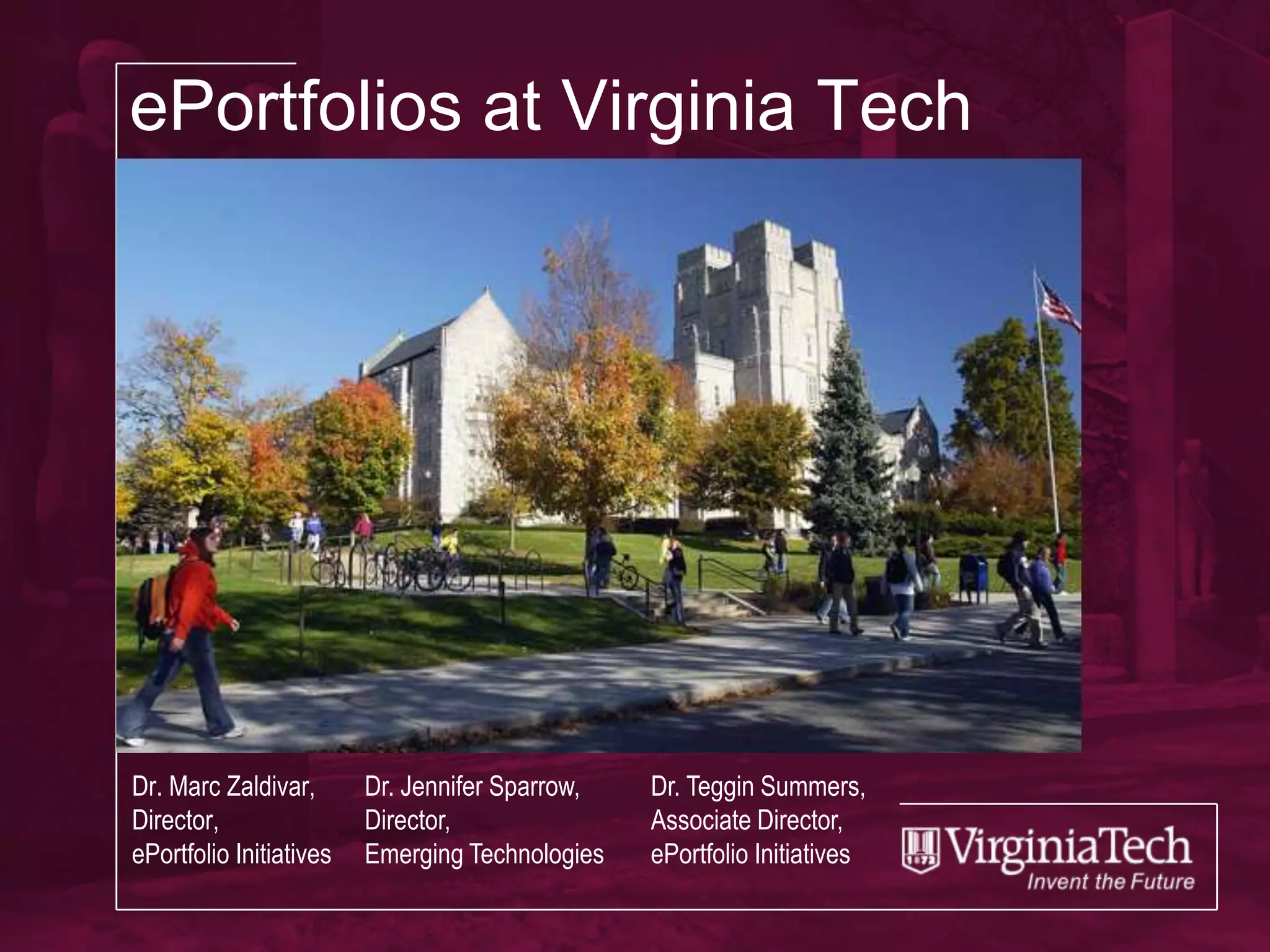
ePortfolios at Virginia Tech


Dr. Marc Zaldivar,       Dr. Jennifer Sparrow,   Dr. Teggin Summers,
Director,                Director,               Associate Director,
ePortfolio Initiatives   Emerging Technologies   ePortfolio Initiatives
A definition…
• A portfolio is a purposeful collection of
  student work that exhibits the student's
  efforts, progress and achievements in one or
  more areas. The collection must include
  student participation in selecting contents, the
  criteria for selection; the criteria for judging
  merit, and evidence of student self-reflection.
         – Northwest Evaluation Association (1990). Portfolios and
           Assessment. Paper presented at the Annual Conference
           for the Northwest Evaluation Association.
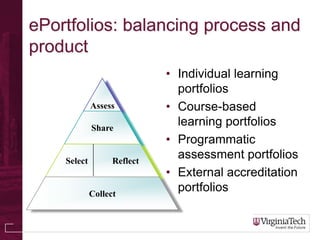
ePortfolios: balancing process and
product
                             • Individual learning
                               portfolios
             Assess          • Course-based
             Share
                               learning portfolios
                             • Programmatic
    Select         Reflect
                               assessment portfolios
                             • External accreditation
             Collect
                               portfolios
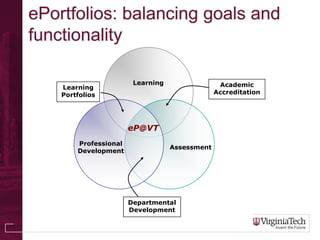
ePortfolios: balancing goals and
functionality

                        Learning                 Academic
    Learning
    Portfolios                                  Accreditation


                       eP@VT
        Professional
                                   Assessment
        Development


                       Departmental
                       Development
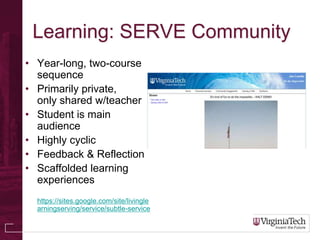
Learning: SERVE Community
• Year-long, two-course
  sequence
• Primarily private,
  only shared w/teacher
• Student is main
  audience
• Highly cyclic
• Feedback & Reflection
• Scaffolded learning
  experiences
  https://sites.google.com/site/livingle
  arningserving/service/subtle-service
Advantages of “Folio Thinking”
• Aids students’ self-assessment
• Enables the tracking of student development
  over time
• Emphasizes process over product
• Highlights connections between assignments
  (and courses)
• Facilitates academic richness - personal
  contact with instructors, advisors, and
  mentors
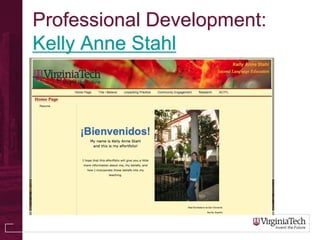
Professional Development:
Kelly Anne Stahl
Professional Development:
They are watching…
• CareerBuilder.com (2009) survey of ~3000
  HR managers
  • Primary finding: 45% used social networking sites
    to research job candidates.
Professional Development:
They are watching…
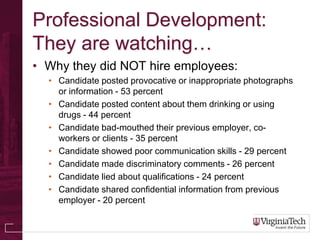
• Why they did NOT hire employees:
  • Candidate posted provocative or inappropriate photographs
    or information - 53 percent
  • Candidate posted content about them drinking or using
    drugs - 44 percent
  • Candidate bad-mouthed their previous employer, co-
    workers or clients - 35 percent
  • Candidate showed poor communication skills - 29 percent
  • Candidate made discriminatory comments - 26 percent
  • Candidate lied about qualifications - 24 percent
  • Candidate shared confidential information from previous
    employer - 20 percent
Professional Development:
They are watching…
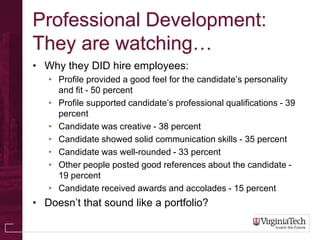
• Why they DID hire employees:
   • Profile provided a good feel for the candidate’s personality
     and fit - 50 percent
   • Profile supported candidate’s professional qualifications - 39
     percent
   • Candidate was creative - 38 percent
   • Candidate showed solid communication skills - 35 percent
   • Candidate was well-rounded - 33 percent
   • Other people posted good references about the candidate -
     19 percent
   • Candidate received awards and accolades - 15 percent
• Doesn’t that sound like a portfolio?
Professional Development:
ePortfolios offer…
• Focus on Growth and Continuity of Learning
• Networked and Symphonic Selves
  (Cambridge, 2009)
• Controlled and Presented by the Student
• Direct (multimedia) examples of abilities and
  skills
• Easily coordinated to professional standards
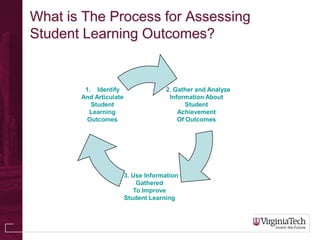
What is The Process for Assessing
Student Learning Outcomes?


        1. Identify                  2. Gather and Analyze
       And Articulate                 Information About
          Student                           Student
         Learning                        Achievement
         Outcomes                        Of Outcomes


                        3. Use Information
                            Gathered
                           To Improve
                        Student Learning
ePs for Assessment
• Help us to provide evidence of our students’ achievement
  of learning outcomes.
• Provide students and faculty a tool for organizing their
  assessment work.
• Provide opportunities for students and faculty to reflect on
  teaching and learning.

“We are being pummeled by a deluge of data and unless we create
  time and spaces in which to reflect, we will be left with only our
  reactions.”
                       – Rebecca Blood
Learning and Assessment
• “For me, my ePortfolio was a personal learning
   space that I could tailor to reflect the teacher I had
   become at this point in my teaching career. By
   taking the time to intricately tie together all I had
   learned, I found that I had a better understanding of
   pedagogy and application within the English
   classroom as well. Thus, the connections that link
   together each page within my ePortfolio truly create a
   rich realm of learning, reflecting, and applying.”
-- Crystal Beach, ’09, Secondary English Education,
   M.Ed.
How do we do ePortfolio?
• We have two tools:
  • Portfolio templates (for self/programmatic
    reflection and showcase portfolios)
  • Matrix/Forms (for scaffolded learning and high-
    level assessment)
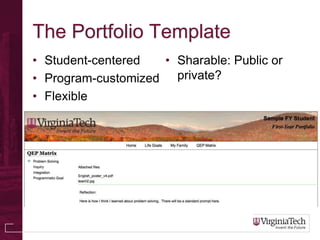
The Portfolio Template
• Student-centered  • Sharable: Public or
• Program-customized private?
• Flexible
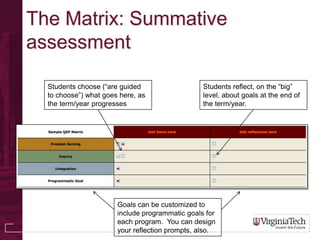
The Matrix: Summative
assessment

  Students choose (“are guided                   Students reflect, on the “big”
  to choose”) what goes here, as                 level, about goals at the end of
  the term/year progresses                       the term/year.


                       Goals can be customized to
                       include programmatic goals for
                       each program. You can design
                       your reflection prompts, also.
Some other examples…
• Examples can be found at
  https://eportfolio.vt.edu/gallery.html
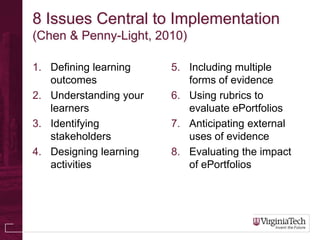
8 Issues Central to Implementation
(Chen & Penny-Light, 2010)

1. Defining learning    5. Including multiple
   outcomes                forms of evidence
2. Understanding your   6. Using rubrics to
   learners                evaluate ePortfolios
3. Identifying          7. Anticipating external
   stakeholders            uses of evidence
4. Designing learning   8. Evaluating the impact
   activities              of ePortfolios
Conditions for Success
(Knight, Hakel, & Gromko, 2008)

•   eP-based curriculum
•   Feedback
•   Include engagement and personalization
•   Examples
•   Time for development
•   Faculty promote value of eP
•   Technical assistance
Faculty Visioning Process
• When and from where will student work be
  collected?
• Are there specific assignments that
  correspond to specific goals?
• Who will evaluate student work?
• Who has access to student work?
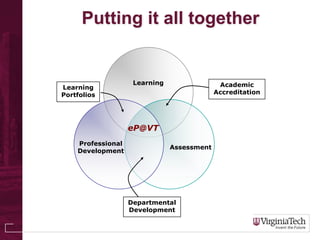
Putting it all together


                    Learning                 Academic
Learning
Portfolios                                  Accreditation


                   eP@VT
    Professional
                               Assessment
    Development


                   Departmental
                   Development

ePortfolioOverview

  • 1.
    ePortfolios at VirginiaTech Dr. Marc Zaldivar, Dr. Jennifer Sparrow, Dr. Teggin Summers, Director, Director, Associate Director, ePortfolio Initiatives Emerging Technologies ePortfolio Initiatives
  • 2.
    A definition… • Aportfolio is a purposeful collection of student work that exhibits the student's efforts, progress and achievements in one or more areas. The collection must include student participation in selecting contents, the criteria for selection; the criteria for judging merit, and evidence of student self-reflection. – Northwest Evaluation Association (1990). Portfolios and Assessment. Paper presented at the Annual Conference for the Northwest Evaluation Association.
  • 3.
    ePortfolios: balancing processand product • Individual learning portfolios Assess • Course-based Share learning portfolios • Programmatic Select Reflect assessment portfolios • External accreditation Collect portfolios
  • 4.
    ePortfolios: balancing goalsand functionality Learning Academic Learning Portfolios Accreditation eP@VT Professional Assessment Development Departmental Development
  • 5.
    Learning: SERVE Community •Year-long, two-course sequence • Primarily private, only shared w/teacher • Student is main audience • Highly cyclic • Feedback & Reflection • Scaffolded learning experiences https://sites.google.com/site/livingle arningserving/service/subtle-service
  • 6.
    Advantages of “FolioThinking” • Aids students’ self-assessment • Enables the tracking of student development over time • Emphasizes process over product • Highlights connections between assignments (and courses) • Facilitates academic richness - personal contact with instructors, advisors, and mentors
  • 7.
  • 8.
    Professional Development: They arewatching… • CareerBuilder.com (2009) survey of ~3000 HR managers • Primary finding: 45% used social networking sites to research job candidates.
  • 9.
    Professional Development: They arewatching… • Why they did NOT hire employees: • Candidate posted provocative or inappropriate photographs or information - 53 percent • Candidate posted content about them drinking or using drugs - 44 percent • Candidate bad-mouthed their previous employer, co- workers or clients - 35 percent • Candidate showed poor communication skills - 29 percent • Candidate made discriminatory comments - 26 percent • Candidate lied about qualifications - 24 percent • Candidate shared confidential information from previous employer - 20 percent
  • 10.
    Professional Development: They arewatching… • Why they DID hire employees: • Profile provided a good feel for the candidate’s personality and fit - 50 percent • Profile supported candidate’s professional qualifications - 39 percent • Candidate was creative - 38 percent • Candidate showed solid communication skills - 35 percent • Candidate was well-rounded - 33 percent • Other people posted good references about the candidate - 19 percent • Candidate received awards and accolades - 15 percent • Doesn’t that sound like a portfolio?
  • 11.
    Professional Development: ePortfolios offer… •Focus on Growth and Continuity of Learning • Networked and Symphonic Selves (Cambridge, 2009) • Controlled and Presented by the Student • Direct (multimedia) examples of abilities and skills • Easily coordinated to professional standards
  • 12.
    What is TheProcess for Assessing Student Learning Outcomes? 1. Identify 2. Gather and Analyze And Articulate Information About Student Student Learning Achievement Outcomes Of Outcomes 3. Use Information Gathered To Improve Student Learning
  • 13.
    ePs for Assessment •Help us to provide evidence of our students’ achievement of learning outcomes. • Provide students and faculty a tool for organizing their assessment work. • Provide opportunities for students and faculty to reflect on teaching and learning. “We are being pummeled by a deluge of data and unless we create time and spaces in which to reflect, we will be left with only our reactions.” – Rebecca Blood
  • 14.
    Learning and Assessment •“For me, my ePortfolio was a personal learning space that I could tailor to reflect the teacher I had become at this point in my teaching career. By taking the time to intricately tie together all I had learned, I found that I had a better understanding of pedagogy and application within the English classroom as well. Thus, the connections that link together each page within my ePortfolio truly create a rich realm of learning, reflecting, and applying.” -- Crystal Beach, ’09, Secondary English Education, M.Ed.
  • 15.
    How do wedo ePortfolio? • We have two tools: • Portfolio templates (for self/programmatic reflection and showcase portfolios) • Matrix/Forms (for scaffolded learning and high- level assessment)
  • 16.
    The Portfolio Template •Student-centered • Sharable: Public or • Program-customized private? • Flexible
  • 17.
    The Matrix: Summative assessment Students choose (“are guided Students reflect, on the “big” to choose”) what goes here, as level, about goals at the end of the term/year progresses the term/year. Goals can be customized to include programmatic goals for each program. You can design your reflection prompts, also.
  • 18.
    Some other examples… •Examples can be found at https://eportfolio.vt.edu/gallery.html
  • 19.
    8 Issues Centralto Implementation (Chen & Penny-Light, 2010) 1. Defining learning 5. Including multiple outcomes forms of evidence 2. Understanding your 6. Using rubrics to learners evaluate ePortfolios 3. Identifying 7. Anticipating external stakeholders uses of evidence 4. Designing learning 8. Evaluating the impact activities of ePortfolios
  • 20.
    Conditions for Success (Knight,Hakel, & Gromko, 2008) • eP-based curriculum • Feedback • Include engagement and personalization • Examples • Time for development • Faculty promote value of eP • Technical assistance
  • 21.
    Faculty Visioning Process •When and from where will student work be collected? • Are there specific assignments that correspond to specific goals? • Who will evaluate student work? • Who has access to student work?
  • 22.
    Putting it alltogether Learning Academic Learning Portfolios Accreditation eP@VT Professional Assessment Development Departmental Development