Preparing Future Digital Curators:
  An Overview of Digital Curation
Curriculum Development at Carolina


              Carolyn Hank
              School of Information and Library Science
              University of North Carolina at Chapel Hill

              CeRch Research Seminar
              King’s College London
              November 30, 2009
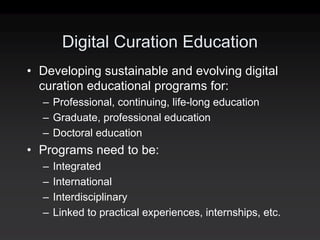
Digital Curation Education
• Developing sustainable and evolving digital
  curation educational programs for:
  – Professional, continuing, life-long education
  – Graduate, professional education
  – Doctoral education
• Programs need to be:
  –   Integrated
  –   International
  –   Interdisciplinary
  –   Linked to practical experiences, internships, etc.
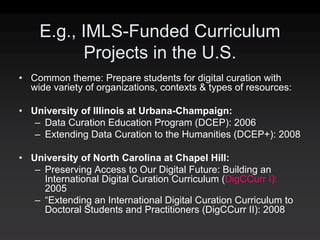
E.g., IMLS-Funded Curriculum
           Projects in the U.S.
• Common theme: Prepare students for digital curation with
  wide variety of organizations, contexts & types of resources:

• University of Illinois at Urbana-Champaign:
   – Data Curation Education Program (DCEP): 2006
   – Extending Data Curation to the Humanities (DCEP+): 2008

• University of North Carolina at Chapel Hill:
   – Preserving Access to Our Digital Future: Building an
     International Digital Curation Curriculum (DigCCurr I):
     2005
   – “Extending an International Digital Curation Curriculum to
     Doctoral Students and Practitioners (DigCCurr II): 2008
DigCCurr Project
                  say: dij-seeker
• Preserving Access to Our Digital Future: Building an
  International Digital Curation Curriculum.
  http://www.ils.unc.edu/digccurr.

• IMLS Grant # RE-05-06-0044

• Collaboration of School of Information & Library
  Science (SILS), University of North Carolina at
  Chapel Hill (UNC-CH) & U.S. National Archives &
  Records Administration (NARA)

• Runs July 1, 2006 – December 31, 2009
DigCCurr Goal
• Build a growing and evolving network of international
  experts;
• Develop an evolving curricular framework and
  content, field experience exemplars, and enriching
  activities;
• Raise public awareness of the need for and nature of
  digital curation;
• Explore the creation, cost, and sustainability of a
  certificate in digital/data curation;
• Attract the best possible students to this emerging
  area of study using the IMLS‐funded Carolina Digital
  Curation Fellowships.
DigCCurr Components
Curriculum: To prepare students for digital curation with wide
  variety of organizations, contexts & types of resources:
   – Graduate-level curricular framework
   – Course modules
   – Course development
   – Experiential components
   – International guest speakers

Two International Symposia:
   – DigCCurr2007: April 18-20, 2007 in Chapel Hill -
     http://ils.unc.edu/digccurr2007/
   – DigCCurr2009: Practice, Promise and Prospects: April 1-3,
     2009 in Chapel Hill - http://ils.unc.edu/digccurr2009

Carolina Digital Curation Fellowship program
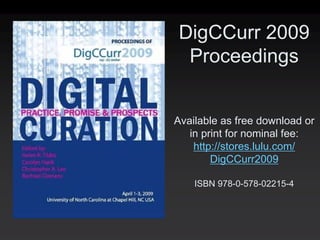
DigCCurr 2009
 Proceedings


Available as free download or
   in print for nominal fee:
    http://stores.lulu.com/
        DigCCurr2009

    ISBN 978-0-578-02215-4
DigCCurr Partners
NARA, UNC Libraries, UNC ITS, Odum Institute, ibiblio,
and 17 international expert Advisory Board members from:

•   Cornell University              •   SDSC, now SILS
•   Harvard University              •   SUNY‐Albany
•   IBM (The Netherlands)           •   University of
•   NASA                                California‐Santa Cruz
•   Nationaal Archief of the        •   UCLA
    Netherlands                     •   Universita Degli Studi di
•   National Archives & Records         Urbino
    Administration                  •   University of Glasgow
•   National Library of Australia   •   University of Michigan
•   National Library of New         •   University of Toronto
    Zealand
Guiding Questions
• What knowledge and competencies do
  professional need in order to do digital
  curation work?
• What should students learn in the
  classroom?
• What should students learn through
  field experiences?
Guiding Principles
• Build on work of others
• Digital curation activities span entire life
  of digital resources
• Build from and for modules rather than
  entire courses
• Emphasize core, generalizable modules
• Avoid tying curriculum to specific
  institution types
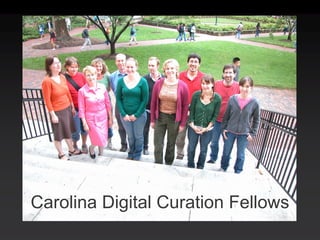
Carolina Digital Curation Fellows
• 5 Digital Curation Fellows pursuing degrees at
  SILS - began fall 2007; funded through 2009

• UNC partners providing practical experience
  opportunities: ibiblio, ITS, Odum Institute, and
  University Library

• 4 additional Fellows supported by UNC partners
  for 2008-09
Carolina Digital Curation Fellows
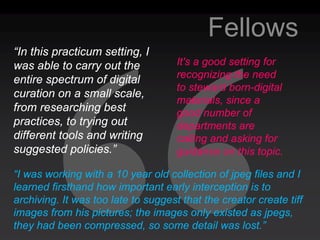
Fellows
“In this practicum setting, I
was able to carry out the            It's a good setting for
entire spectrum of digital           recognizing the need
                                     to steward born-digital
curation on a small scale,
                                     materials, since a
from researching best                good number of
practices, to trying out             departments are
different tools and writing          calling and asking for
suggested policies.”                 guidance on this topic.

“I was working with a 10 year old collection of jpeg files and I
learned firsthand how important early interception is to
archiving. It was too late to suggest that the creator create tiff
images from his pictures; the images only existed as jpegs,
they had been compressed, so some detail was lost.”
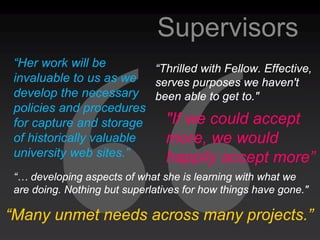
Supervisors
 “Her work will be        “Thrilled with Fellow. Effective,
 invaluable to us as we   serves purposes we haven't
 develop the necessary been able to get to."
 policies and procedures
 for capture and storage    "If we could accept
 of historically valuable   more, we would
 university web sites.”     happily accept more”
 “… developing aspects of what she is learning with what we
 are doing. Nothing but superlatives for how things have gone."

“Many unmet needs across many projects.”
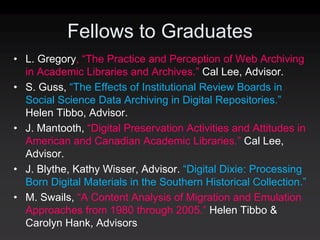
Fellows to Graduates
• L. Gregory, “The Practice and Perception of Web Archiving
  in Academic Libraries and Archives.” Cal Lee, Advisor.
• S. Guss, “The Effects of Institutional Review Boards in
  Social Science Data Archiving in Digital Repositories.”
  Helen Tibbo, Advisor.
• J. Mantooth, “Digital Preservation Activities and Attitudes in
  American and Canadian Academic Libraries.” Cal Lee,
  Advisor.
• J. Blythe, Kathy Wisser, Advisor. “Digital Dixie: Processing
  Born Digital Materials in the Southern Historical Collection.”
• M. Swails, “A Content Analysis of Migration and Emulation
  Approaches from 1980 through 2005.” Helen Tibbo &
  Carolyn Hank, Advisors
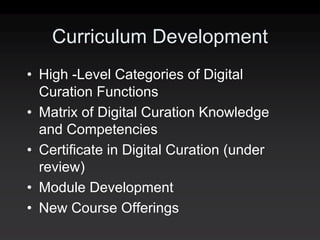
Curriculum Development
• High ‐Level Categories of Digital
  Curation Functions
• Matrix of Digital Curation Knowledge
  and Competencies
• Certificate in Digital Curation (under
  review)
• Module Development
• New Course Offerings
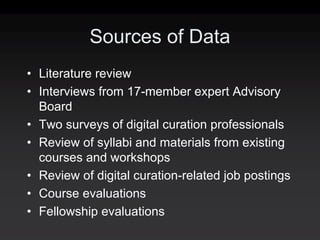
Sources of Data
• Literature review
• Interviews from 17-member expert Advisory
  Board
• Two surveys of digital curation professionals
• Review of syllabi and materials from existing
  courses and workshops
• Review of digital curation-related job postings
• Course evaluations
• Fellowship evaluations
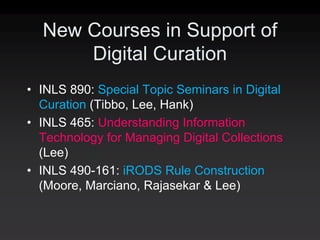
New Courses in Support of
      Digital Curation
• INLS 890: Special Topic Seminars in Digital
  Curation (Tibbo, Lee, Hank)
• INLS 465: Understanding Information
  Technology for Managing Digital Collections
  (Lee)
• INLS 490-161: iRODS Rule Construction
  (Moore, Marciano, Rajasekar & Lee)
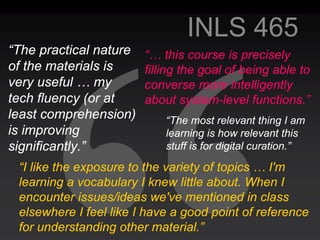
INLS 465
“The practical nature   “… this course is precisely
of the materials is     filling the goal of being able to
very useful … my        converse more intelligently
tech fluency (or at     about system-level functions.”
least comprehension)        “The most relevant thing I am
is improving                learning is how relevant this
significantly.”             stuff is for digital curation.”

 “I like the exposure to the variety of topics … I'm
 learning a vocabulary I knew little about. When I
 encounter issues/ideas we've mentioned in class
 elsewhere I feel like I have a good point of reference
 for understanding other material.”
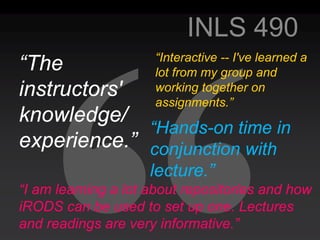
INLS 490
                     “Interactive -- I've learned a
“The                 lot from my group and
instructors'         working together on
                     assignments.”
knowledge/
             “Hands-on time in
experience.” conjunction with
                     lecture.”
“I am learning a lot about repositories and how
iRODS can be used to set up one. Lectures
and readings are very informative.”
Matrix of Digital Curation
    Knowledge & Competencies
• Tool for thinking about, planning for, identifying &
  organizing curriculum

• Each unit of curriculum content can address one or more
  dimensions

• Helping to address fundamental issue: core vs.
  specialized (optional) education elements
1) Mandates, Values and
              Principles
•   Professional ethics
•   Legal requirements
•   Standards
•   Interoperability and sustainability
    requirements
2) Professional, Disciplinary or
    Institutional/Organizational
               Context
• Professional context:
  – History of professional activities
  – Professional development
• Disciplinary and
  Institutional/Organizational Contexts
  – Characteristics of information and record
    keeping environments
3) Transition Point in Life of
           Digital Object
• Pre-creation design and planning
• Creation
• Primary use environment (active use)
• Transfer to archives
• Archives (preservation environment)
• Transfer copies or surrogates to
  secondary use environment
• Secondary use environment
4) Type of Resource
• Types of storage media
• Types of digital objects
  – Format, genre
• Level of aggregation
  – Component, object, collection
• Level of abstraction
  – Work, expression, manifestation, item
5) Prerequisite Knowledge
• Terminology
• Characteristics of information
  communication technologies (ICTs)
6) Functions and Skills
• 24 High-level functional categories
  across six activity areas:
  – Technical infrastructure
  – Information resource treatment
  – Metadata treatment
  – Human interaction
  – Strategies, prioritization, and judgments
  – Administration
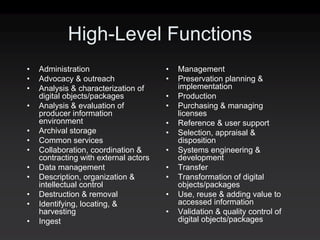
High-Level Functions
•   Administration                     •   Management
•   Advocacy & outreach                •   Preservation planning &
•   Analysis & characterization of         implementation
    digital objects/packages           •   Production
•   Analysis & evaluation of           •   Purchasing & managing
    producer information                   licenses
    environment                        •   Reference & user support
•   Archival storage                   •   Selection, appraisal &
•   Common services                        disposition
•   Collaboration, coordination &      •   Systems engineering &
    contracting with external actors       development
•   Data management                    •   Transfer
•   Description, organization &        •   Transformation of digital
    intellectual control                   objects/packages
•   Destruction & removal              •   Use, reuse & adding value to
•   Identifying, locating, &               accessed information
    harvesting                         •   Validation & quality control of
•   Ingest                                 digital objects/packages
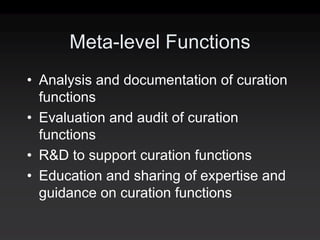
Meta-level Functions
• Analysis and documentation of curation
  functions
• Evaluation and audit of curation
  functions
• R&D to support curation functions
• Education and sharing of expertise and
  guidance on curation functions
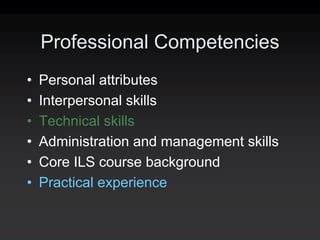
Professional Competencies
•   Personal attributes
•   Interpersonal skills
•   Technical skills
•   Administration and management skills
•   Core ILS course background
•   Practical experience
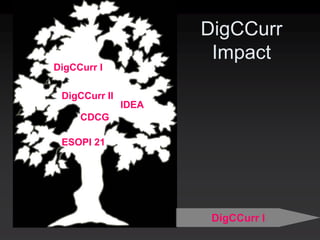
DigCCurr
                       Impact
DigCCurr I

 DigCCurr II
               IDEA
     CDCG

 ESOPI 21


                       DigCCurr I
DigCCurr II
• “Extending an International Digital Curation
  Curriculum to Doctoral Students and Practitioners.”
  http://www.ils.unc.edu/digccurr.
• This project is funded through IMLS Laura Bush
  funds.
• A collaboration of the School of Information and
  Library Science (SILS) at the University of North
  Carolina at Chapel Hill (UNC-CH) and the U.S.
  National Archives and Records Administration
  (NARA).
• Project to run August 1, 2008 – July 31, 2012.
DigCCurr II Key Activities
• PhD Fellowships
• Digital Curation Exchange (DCE)
  – http://digitalcurationexchange.org/
• Summer Institutes
  –   Week-long summer workshop for practitioners.
  –   Follow-up session held approximately six months later.
  –   http://www.ils.unc.edu/digccurr/institute.html
  –   First held June 21-26, 2009 (31 participants)
• Public Symposia with Advisory Board
  – First to be held January 8, 2010
  – Engaging Communities for the Curation of Digital Products
    of Scholarly Endeavors
IDEA
• Has built an international network of Digital Curation
  educators, the IDEA Working Group.
• IDEA (International Digital curation Education and
  Action) WG is a collaboration of SILS, HATII at the
  University of Glasgow, and the UK Digital Curation
  Center.
• Fourth meeting to be held December 1st, in
  conjunction with 5th International Digital Curation
  Conference
• See D-Lib report (March/April 2009) for more info:
   – http://www.dlib.org/dlib/march09/hank/03hank.html
Closing the Digital Curation Gap
            (CDCG)
• Years: 2009‐2011
• Partners: IMLS, JISC, DCC
• Goals:
  – Establish and support a network of digital curation
    practitioners, researchers, and educators through
    face‐to‐face meetings, web‐based communication, and
    various other information and communication
    technology (ICT) tools;
  – Establish a baseline of digital curation
    practice/knowledge, especially in small to
    medium‐sized cultural heritage institutions in the US
    and UK, through surveys, interviews and case studies;
ESOPI 21
• Years: 2009‐2012
• Partners: UNC School of Government,
  National Archives, NC State Archives, UNC
• Goals:
  – Dual Degree Program
  – Fund 8 master’s students for 2 years leading to
    both a Masters of Science in Library Science
    (MSLS)/Masters of Public Administration (MPA) or
    a Masters of Science in Information Science
    (MSIS)/MPA.
ESOPI 21 Goals, Continued
• Integrate
   – Policy development;
   – Issues of legal compliance;
   – extensive knowledge of government structures and
     information …
   – With archival principles, digital curation fundamentals, and
     electronic records management workflows and information
     technologies.
• SILS and the SOG are uniquely positioned for this
  educational challenge as these are the only
  MSIS/MSLS/MPA dual degree programs in the
  United States.
THANK YOU

  Questions?

  Resources…
  http://www.ils.unc.edu/digccurr/

  Feedback…
  hcarolyn@email.unc.edu
DigCCurr Professional Institute:
Curation Practices for the Digital Object Lifecycle

         May 16-21, 2010 & January 6-7, 2011
                 Chapel Hill, NC, USA
    http://www.ils.unc.edu/digccurr/institute.html
         ASIST 2008, Columbus, OH                     39

(Nov 2009) Preparing Future Digital Curators

  • 1.
    Preparing Future DigitalCurators: An Overview of Digital Curation Curriculum Development at Carolina Carolyn Hank School of Information and Library Science University of North Carolina at Chapel Hill CeRch Research Seminar King’s College London November 30, 2009
  • 2.
    Digital Curation Education •Developing sustainable and evolving digital curation educational programs for: – Professional, continuing, life-long education – Graduate, professional education – Doctoral education • Programs need to be: – Integrated – International – Interdisciplinary – Linked to practical experiences, internships, etc.
  • 3.
    E.g., IMLS-Funded Curriculum Projects in the U.S. • Common theme: Prepare students for digital curation with wide variety of organizations, contexts & types of resources: • University of Illinois at Urbana-Champaign: – Data Curation Education Program (DCEP): 2006 – Extending Data Curation to the Humanities (DCEP+): 2008 • University of North Carolina at Chapel Hill: – Preserving Access to Our Digital Future: Building an International Digital Curation Curriculum (DigCCurr I): 2005 – “Extending an International Digital Curation Curriculum to Doctoral Students and Practitioners (DigCCurr II): 2008
  • 4.
    DigCCurr Project say: dij-seeker • Preserving Access to Our Digital Future: Building an International Digital Curation Curriculum. http://www.ils.unc.edu/digccurr. • IMLS Grant # RE-05-06-0044 • Collaboration of School of Information & Library Science (SILS), University of North Carolina at Chapel Hill (UNC-CH) & U.S. National Archives & Records Administration (NARA) • Runs July 1, 2006 – December 31, 2009
  • 5.
    DigCCurr Goal • Builda growing and evolving network of international experts; • Develop an evolving curricular framework and content, field experience exemplars, and enriching activities; • Raise public awareness of the need for and nature of digital curation; • Explore the creation, cost, and sustainability of a certificate in digital/data curation; • Attract the best possible students to this emerging area of study using the IMLS‐funded Carolina Digital Curation Fellowships.
  • 6.
    DigCCurr Components Curriculum: Toprepare students for digital curation with wide variety of organizations, contexts & types of resources: – Graduate-level curricular framework – Course modules – Course development – Experiential components – International guest speakers Two International Symposia: – DigCCurr2007: April 18-20, 2007 in Chapel Hill - http://ils.unc.edu/digccurr2007/ – DigCCurr2009: Practice, Promise and Prospects: April 1-3, 2009 in Chapel Hill - http://ils.unc.edu/digccurr2009 Carolina Digital Curation Fellowship program
  • 7.
    DigCCurr 2009 Proceedings Availableas free download or in print for nominal fee: http://stores.lulu.com/ DigCCurr2009 ISBN 978-0-578-02215-4
  • 8.
    DigCCurr Partners NARA, UNCLibraries, UNC ITS, Odum Institute, ibiblio, and 17 international expert Advisory Board members from: • Cornell University • SDSC, now SILS • Harvard University • SUNY‐Albany • IBM (The Netherlands) • University of • NASA California‐Santa Cruz • Nationaal Archief of the • UCLA Netherlands • Universita Degli Studi di • National Archives & Records Urbino Administration • University of Glasgow • National Library of Australia • University of Michigan • National Library of New • University of Toronto Zealand
  • 9.
    Guiding Questions • Whatknowledge and competencies do professional need in order to do digital curation work? • What should students learn in the classroom? • What should students learn through field experiences?
  • 10.
    Guiding Principles • Buildon work of others • Digital curation activities span entire life of digital resources • Build from and for modules rather than entire courses • Emphasize core, generalizable modules • Avoid tying curriculum to specific institution types
  • 11.
    Carolina Digital CurationFellows • 5 Digital Curation Fellows pursuing degrees at SILS - began fall 2007; funded through 2009 • UNC partners providing practical experience opportunities: ibiblio, ITS, Odum Institute, and University Library • 4 additional Fellows supported by UNC partners for 2008-09
  • 12.
  • 13.
    Fellows “In this practicumsetting, I was able to carry out the It's a good setting for entire spectrum of digital recognizing the need to steward born-digital curation on a small scale, materials, since a from researching best good number of practices, to trying out departments are different tools and writing calling and asking for suggested policies.” guidance on this topic. “I was working with a 10 year old collection of jpeg files and I learned firsthand how important early interception is to archiving. It was too late to suggest that the creator create tiff images from his pictures; the images only existed as jpegs, they had been compressed, so some detail was lost.”
  • 14.
    Supervisors “Her workwill be “Thrilled with Fellow. Effective, invaluable to us as we serves purposes we haven't develop the necessary been able to get to." policies and procedures for capture and storage "If we could accept of historically valuable more, we would university web sites.” happily accept more” “… developing aspects of what she is learning with what we are doing. Nothing but superlatives for how things have gone." “Many unmet needs across many projects.”
  • 15.
    Fellows to Graduates •L. Gregory, “The Practice and Perception of Web Archiving in Academic Libraries and Archives.” Cal Lee, Advisor. • S. Guss, “The Effects of Institutional Review Boards in Social Science Data Archiving in Digital Repositories.” Helen Tibbo, Advisor. • J. Mantooth, “Digital Preservation Activities and Attitudes in American and Canadian Academic Libraries.” Cal Lee, Advisor. • J. Blythe, Kathy Wisser, Advisor. “Digital Dixie: Processing Born Digital Materials in the Southern Historical Collection.” • M. Swails, “A Content Analysis of Migration and Emulation Approaches from 1980 through 2005.” Helen Tibbo & Carolyn Hank, Advisors
  • 16.
    Curriculum Development • High‐Level Categories of Digital Curation Functions • Matrix of Digital Curation Knowledge and Competencies • Certificate in Digital Curation (under review) • Module Development • New Course Offerings
  • 17.
    Sources of Data •Literature review • Interviews from 17-member expert Advisory Board • Two surveys of digital curation professionals • Review of syllabi and materials from existing courses and workshops • Review of digital curation-related job postings • Course evaluations • Fellowship evaluations
  • 18.
    New Courses inSupport of Digital Curation • INLS 890: Special Topic Seminars in Digital Curation (Tibbo, Lee, Hank) • INLS 465: Understanding Information Technology for Managing Digital Collections (Lee) • INLS 490-161: iRODS Rule Construction (Moore, Marciano, Rajasekar & Lee)
  • 19.
    INLS 465 “The practicalnature “… this course is precisely of the materials is filling the goal of being able to very useful … my converse more intelligently tech fluency (or at about system-level functions.” least comprehension) “The most relevant thing I am is improving learning is how relevant this significantly.” stuff is for digital curation.” “I like the exposure to the variety of topics … I'm learning a vocabulary I knew little about. When I encounter issues/ideas we've mentioned in class elsewhere I feel like I have a good point of reference for understanding other material.”
  • 20.
    INLS 490 “Interactive -- I've learned a “The lot from my group and instructors' working together on assignments.” knowledge/ “Hands-on time in experience.” conjunction with lecture.” “I am learning a lot about repositories and how iRODS can be used to set up one. Lectures and readings are very informative.”
  • 21.
    Matrix of DigitalCuration Knowledge & Competencies • Tool for thinking about, planning for, identifying & organizing curriculum • Each unit of curriculum content can address one or more dimensions • Helping to address fundamental issue: core vs. specialized (optional) education elements
  • 22.
    1) Mandates, Valuesand Principles • Professional ethics • Legal requirements • Standards • Interoperability and sustainability requirements
  • 23.
    2) Professional, Disciplinaryor Institutional/Organizational Context • Professional context: – History of professional activities – Professional development • Disciplinary and Institutional/Organizational Contexts – Characteristics of information and record keeping environments
  • 24.
    3) Transition Pointin Life of Digital Object • Pre-creation design and planning • Creation • Primary use environment (active use) • Transfer to archives • Archives (preservation environment) • Transfer copies or surrogates to secondary use environment • Secondary use environment
  • 25.
    4) Type ofResource • Types of storage media • Types of digital objects – Format, genre • Level of aggregation – Component, object, collection • Level of abstraction – Work, expression, manifestation, item
  • 26.
    5) Prerequisite Knowledge •Terminology • Characteristics of information communication technologies (ICTs)
  • 27.
    6) Functions andSkills • 24 High-level functional categories across six activity areas: – Technical infrastructure – Information resource treatment – Metadata treatment – Human interaction – Strategies, prioritization, and judgments – Administration
  • 28.
    High-Level Functions • Administration • Management • Advocacy & outreach • Preservation planning & • Analysis & characterization of implementation digital objects/packages • Production • Analysis & evaluation of • Purchasing & managing producer information licenses environment • Reference & user support • Archival storage • Selection, appraisal & • Common services disposition • Collaboration, coordination & • Systems engineering & contracting with external actors development • Data management • Transfer • Description, organization & • Transformation of digital intellectual control objects/packages • Destruction & removal • Use, reuse & adding value to • Identifying, locating, & accessed information harvesting • Validation & quality control of • Ingest digital objects/packages
  • 29.
    Meta-level Functions • Analysisand documentation of curation functions • Evaluation and audit of curation functions • R&D to support curation functions • Education and sharing of expertise and guidance on curation functions
  • 30.
    Professional Competencies • Personal attributes • Interpersonal skills • Technical skills • Administration and management skills • Core ILS course background • Practical experience
  • 31.
    DigCCurr Impact DigCCurr I DigCCurr II IDEA CDCG ESOPI 21 DigCCurr I
  • 32.
    DigCCurr II • “Extendingan International Digital Curation Curriculum to Doctoral Students and Practitioners.” http://www.ils.unc.edu/digccurr. • This project is funded through IMLS Laura Bush funds. • A collaboration of the School of Information and Library Science (SILS) at the University of North Carolina at Chapel Hill (UNC-CH) and the U.S. National Archives and Records Administration (NARA). • Project to run August 1, 2008 – July 31, 2012.
  • 33.
    DigCCurr II KeyActivities • PhD Fellowships • Digital Curation Exchange (DCE) – http://digitalcurationexchange.org/ • Summer Institutes – Week-long summer workshop for practitioners. – Follow-up session held approximately six months later. – http://www.ils.unc.edu/digccurr/institute.html – First held June 21-26, 2009 (31 participants) • Public Symposia with Advisory Board – First to be held January 8, 2010 – Engaging Communities for the Curation of Digital Products of Scholarly Endeavors
  • 34.
    IDEA • Has builtan international network of Digital Curation educators, the IDEA Working Group. • IDEA (International Digital curation Education and Action) WG is a collaboration of SILS, HATII at the University of Glasgow, and the UK Digital Curation Center. • Fourth meeting to be held December 1st, in conjunction with 5th International Digital Curation Conference • See D-Lib report (March/April 2009) for more info: – http://www.dlib.org/dlib/march09/hank/03hank.html
  • 35.
    Closing the DigitalCuration Gap (CDCG) • Years: 2009‐2011 • Partners: IMLS, JISC, DCC • Goals: – Establish and support a network of digital curation practitioners, researchers, and educators through face‐to‐face meetings, web‐based communication, and various other information and communication technology (ICT) tools; – Establish a baseline of digital curation practice/knowledge, especially in small to medium‐sized cultural heritage institutions in the US and UK, through surveys, interviews and case studies;
  • 36.
    ESOPI 21 • Years:2009‐2012 • Partners: UNC School of Government, National Archives, NC State Archives, UNC • Goals: – Dual Degree Program – Fund 8 master’s students for 2 years leading to both a Masters of Science in Library Science (MSLS)/Masters of Public Administration (MPA) or a Masters of Science in Information Science (MSIS)/MPA.
  • 37.
    ESOPI 21 Goals,Continued • Integrate – Policy development; – Issues of legal compliance; – extensive knowledge of government structures and information … – With archival principles, digital curation fundamentals, and electronic records management workflows and information technologies. • SILS and the SOG are uniquely positioned for this educational challenge as these are the only MSIS/MSLS/MPA dual degree programs in the United States.
  • 38.
    THANK YOU Questions? Resources… http://www.ils.unc.edu/digccurr/ Feedback… hcarolyn@email.unc.edu
  • 39.
    DigCCurr Professional Institute: CurationPractices for the Digital Object Lifecycle May 16-21, 2010 & January 6-7, 2011 Chapel Hill, NC, USA http://www.ils.unc.edu/digccurr/institute.html ASIST 2008, Columbus, OH 39